A Study on Waste Management in a Construction
Industry: A Value Engineering Perspective
Prajwal G Gudigar
1, Devanand R
2& Harsha H N
3 1PG Student, Dept. of Civil Engineering, GEC, HASSAN, IndiaVTU, Belgaum. Karnataka, India, 1E-mail:[email protected] 2Assistant Professor. Dept. of Civil Engineering, GEC, HASSAN, India 3Assistant professor, Department of Civil Engineering, G.E.C, Hassan
Abstract:
Construction industry is an important indicator of the development as it creates investment opportunities across various related sectors. However, construction industry generates significant amounts of wastes. A major share of these wastes can be reused or recycled. Construction industry produces more wastes, both by volume and weight, than all industries put together. It is also true that the use of input materials is significantly higher in construction industry, more so, the use of natural materials. These wastes need to be managed, since they are not degradable. A strategic approach to manage these wastes can be termed as Waste Management Technique. One such technique that is adopted in this dissertation work is Value Engineering.
Value Engineering is a methodology using which the cost can be reduced by improving functionality through lesser consumption of energy. This work aims at reducing the cost of construction by reducing the amount of wastes generated in various elements of construction, using Value Engineering perspective. The waste management strategy has been divided in to three phases, viz.
Pre-Construction, Construction and Post-Construction, based on the hierarchy of the waste management the study was carried out. Construction Elements like Earth work for foundation, PCC for footing, Shuttering for footing, Column plastering, partition walls, doors and reinforcing steel have been considered in the work. A cost comparison has been made between the elements, pre and post implementation of Value Engineering Perspective.
A considerable reduction in the cost of each construction element has been achieved after the implementation of Value Engineering Technique. It is value engineering effort coupled with technical insights, sound planning, and envisioning which can yield a successful waste management system.
Keywords:
Introduction
Construction process is known to generate waste due to its very nature of evolution of building inputs to its transformation to final form for use. At various stages of construction, the inputs gets deformed, discarded, is owned, discarded, discouraged, discounted, disgraced, diseased, disfigured, disintegrated and hence categorized and termed as waste. While it known that “energy can neither be created nor destroyed”. The embodied energy in such ‘waste’ materials needs to be used for creativity, creatively.
A project has plenty of inputs; optimum use of these inputs to achieve project objectives needs effective management system and utilization of all resources. It is known that resources when utilized to its optimum would results in high in efficiency and performance. Construction projects in its execution phase are disorderly. The project teams are so absorbed in meeting project deadlines that optimum usage of resources is of reduced priority.
Waste management
Construction waste has caused serious environmental problems in many large cities. Enormous amounts of infrastructure and building work have been built, so numbers of demolished structures are also increasing in construction work. As increasing demands of dumping areas for never-ended demolished waste are thrown away, there is a shortage of landfills.
Therefore, reducing waste generation becomes a pressing issue around the world.
Value engineering
Originally called Value Analysis by its inventor, Larry Miles, an engineer in GE's purchasing operation in 1947, VA/VE uses a value equation that says value is equal to function divided by cost. If, for example, the buyer wants to get more item value, he/she needs to either increase the item's functionality at the same time he/she is containing cost; or he/she needs to reduce cost while holding or improving its functionality. Either way, the result is more value for the customer.
Value engineering is a methodology which tries to reduce cost by improving functionality through lesser consumption of energy. The information technology can integrate the compartmentalized nature of the construction industry and play the role of 'incredible facilitator or enabler' in both knowledge management and value engineering.
Value engineering is a methodology used to analyze the function of the goods and services and to obtain the required functions of the user at the lowest total cost without reducing the necessary quality of performance.
Methodology
value engineering. A detailed comparative study should be done to identify the possible wastages during construction and efforts should made to eliminate or minimize the wastage by using the value engineering perspective through reuse, reduce or recycle
Phases in Waste Management
In planning a construction project, it is important to understand what excess materials are likely to be generated and then focus on how the generation of those excess materials can either be avoided or the material can be diverted from landfill. One approach is to develop a construction waste management plan. The construction waste management plan should be divided into phases.
Figure 1.0 Waste management phases
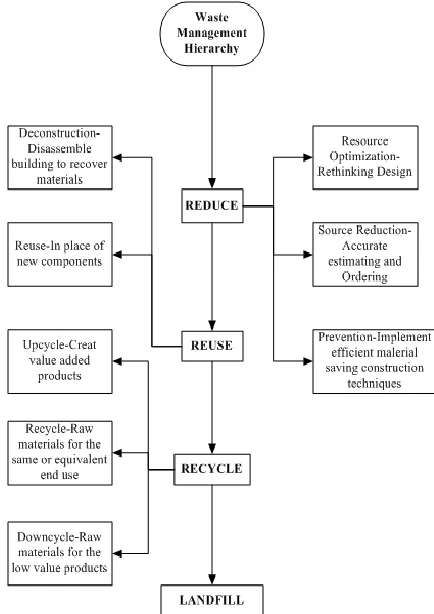
Waste Management Hierarchy
Figure 2.0 Waste management hierarchy
Value Engineering
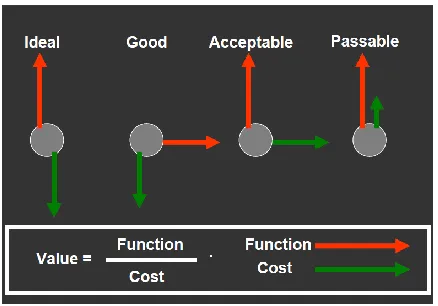
Value engineering (VE) is a systematic method to improve the "value" of goods or products and services by using an examination of function. Value, as defined, is the ratio of function to cost. Value can therefore be increased by either improving the function or reducing the cost. It is a primary tenet of value engineering that basic functions be preserved and not be reduced
Waste Management
Phases
Pre-Construction
Phase
Construction Phase
Post-Construction
as a consequence of pursuing value improvements.
Value = Function/Cost
Value Methodology
The systematic applications of recognized techniques which identify the functions of the product or service, establish the worth of those functions, and provide the necessary functions to meet the required performance at the lowest overall cost.
Figure 3.0 showing Concept of Value Desirable
Figure 4.0 showing Concept of Value Undesirable
Study approach
1. Data Collection
2. Identification of Waste
3. Eliminate / Reduce Waste using Value Engineering
4. Compare & Analysis
Case Study
The study of waste management base on value engineering was carried out at the construction site of M/s Aptex Research Private Limited. The construction project was for a Large Volume Manufacturing Pharmaceutical Plant (LVMP).
RESULTS AND DISCUSSION
Introduction
Construction industry is one of the largest waste generators in the country. It is also one of the largest consumers of raw materials and manufactured products. If the construction industry demands and (re)uses products with recycled content – particularly products with content that comes direct from other job sites, then project economics and affordability can improve for better. Additionally, if demand for recycled products increases, the demand for the recycled raw materials at sites would raise. That will drive demand for reuse and recycling costs even lower, and further enhance the economic benefits to be gained from reuse and recycling.
Costs are competitive to reduce, reuse and recycle than the costs of the material itself. Preparation of a waste management plan, successful implementation and passing over the lesson learnt to many other projects would need several trials and attempts.
Comparative Study of Pre &
Post Value engineering
1 Foundation Pit excavation
The practice for foundation design of the structure is initially designed based on the site characteristics such as soil color, soil
coarseness, etc... During the study, the soil bearing capacity (SBC) was established and the result prompted us to redesign the foundation the structure.
Generally 4ft-5.5ft depth or until we get the hard strata excavation depth will be provided. When we found the hard strata at the lower depth which intern reduced the depth of the foundation, thus saving lot of time and money?
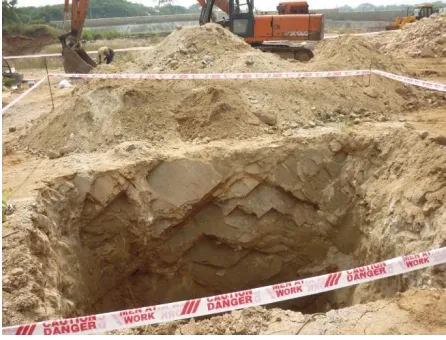
Figure 5.0 showing the Foundation pit
showing soft rock at Site
Table 1.0 Comparative value between Pre &
Figure 6.0 Chart showing comparison
between Pre & Post Value Engineering of
Foundation pits
2 Footing – PCC
The general practice, PCC is provided to give an even surface for footing and to prevent water percolation to the footing, in our case study hard strata was found at shallow depth and it can be levelled even without PCC. This prompted us to eliminate the use of PCC in some of the pits where the hard strata were found.
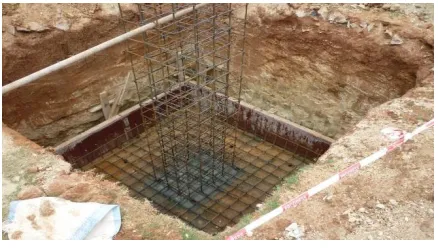
Figure 7.0 showing the Foundation without
PCC
Table 2.0 Comparative value between Pre &
Post Value Engineering of PCC 0
500 1000 1500 2000 2500 3000 3500
Pre Value Engineering
Post Value Engineering 3231.91
2122.34
V
o
lu
me
in
C
u
b
ic
M
e
te
r Basis of
Calculation
Volume
/ Pit
(m3)
No
of
Pits
Total
Pre Value
Engineering 26.71 121 3231.91m
3
Post Value
Engineering 17.54 121 2122.34m
3
Saving 1109.57 m3
Rate per m3 Rs150.00/ m3
Total Saving Rs1,66,435.50
Basis of
Calculation
Volume
/ Pit
(m3)
No
of
Pits
Total
Pre Value
Engineering 1.12 121 135.52m
3
Post Value
Engineering 0.42 121 50.82m
3
Saving 84.70 m3
Rate per m3 Rs3006.24/ m3
Figure 8.0 Chart showing comparison
between Pre and Post Value Engineering of
PCC
3 Shuttering for Footing
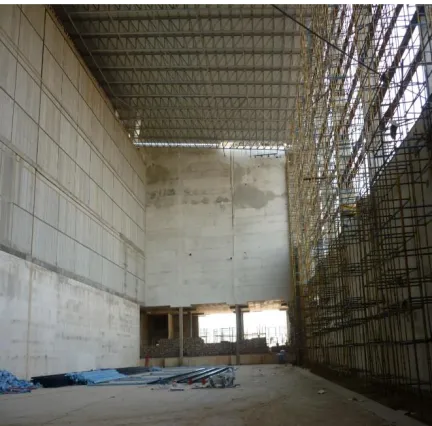
Usually in footing foundation once the pit are excavated the soil on the side walls tend to collapse, to prevent this condition shuttering is provided. In this project the soil condition of the side walls of the excavated pit was found to be stable which helped to eliminate the shuttering in many place where the soil was hard.
Figure 9.0 Showing the Foundation with
partial Shuttering
Figure 10.0 Comparison between Pre and
Post Value Engineering of Shuttering
Table 3.0 Comparative value between Pre &
Post Value Engineering of Shuttering 0
20 40 60 80 100 120 140
Pre Value Engineering
Post Value Engineering 135.52
50.82
V
o
lu
mr
in
C
u
b
ic
M
e
te
r
0 200 400 600 800 1000 1200 1400 1600 1800
Pre Value Engineering
Post Value Engineering 1620.19
77.44
A
re
a i
n
S
q
M
e
te
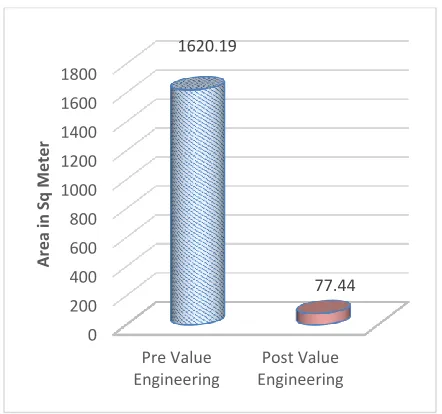
4 Partition Wall
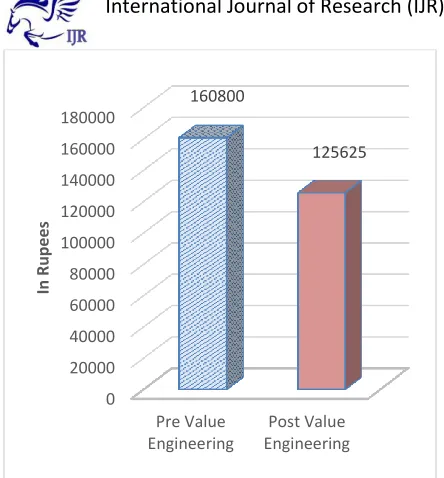
Partition wall are usually built using concrete blocks. The latest construction trends were recommended and it was suggested to use the partition wall for all internal walls and waterproof partition walls for all rest rooms. This type of partition walls are now being used in many commercial and office building which helped them by reduce the overall cost of the building. This practice helped us to reduce time, labor and material, thus reducing the construction waste.
Figure 11.0 Showing the Partition Wall
Table 4.0 Comparative value between Pre &
Post Value Engineering of Partitions Basis of
Calculation
Area/
Pit (m2) No
of
Pits
Total
Pre Value
Engineering 13.39 121 1620.19m
2
Post Value
Engineering 0.64 121 77.44m
2
Saving 1542.75 m2
Rate per m3 Rs244.00/ m3
Total Saving Rs3,76,431.00
Basis of
Calculation
Area
(m2)
Rate/
m2 Total
Pre Value
Engineering 1005 Rs160 Rs1,60,800
Post Value
Engineering 1005 Rs125 Rs1,25,625
Total
Figure 12.0 Chart showing comparison
between Pre and Post Value Engineering of
Partitions
Table 5.0 Comparative value between Pre &
Post Value Engineering of Waterproof
Partitions
Figure 13.0 Chart showing comparison
between Pre and Post Value Engineering of
Waterproof Partitions
5 Doors
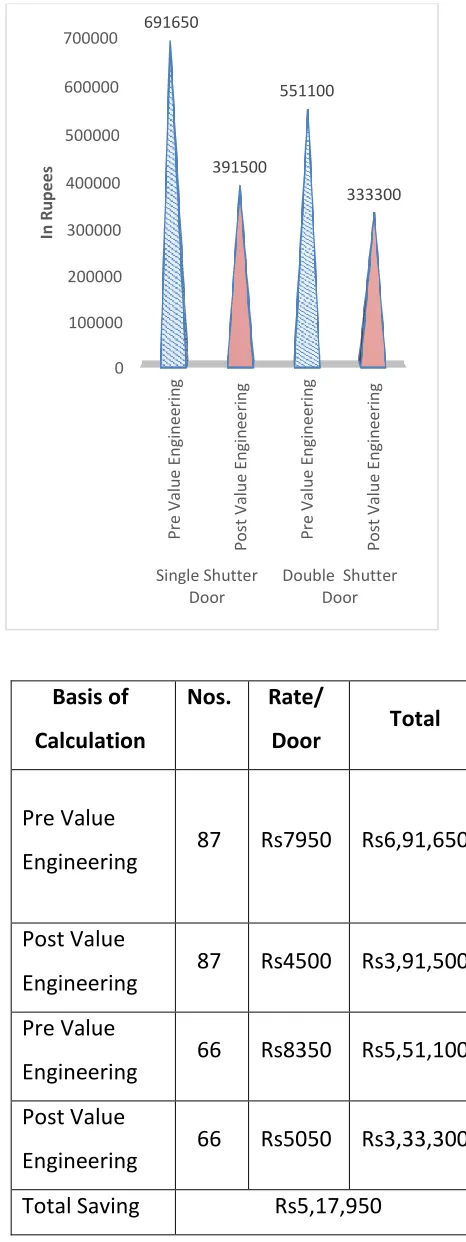
A Door is a moving structure used to block off, and allow access to, an entrance to or within an enclosed space, such as a building or vehicle. Usually all the door have frame and panels, in the new era of construction the doors come without frames which will reduce the cost of the door and helps in easy installation which makes fast and easy work. This was used for both single and double shutters doors. This practice helped us to reduce time, labor and material.
0 20000 40000 60000 80000 100000 120000 140000 160000 180000
Pre Value Engineering
Post Value Engineering 160800
125625
In
Ru
p
e
e
s
64000 66000 68000 70000 72000 74000 76000 78000 80000 82000 84000 86000
Pre Value Engineering
Post Value Engineering 84576
71361
In
R
u
p
ee
s
Basis of
Calculation
Area(
m2)
Rate/
m2 Total
Pre Value
Engineering 528.6 Rs160 Rs84,576
Post Value
Engineering 528.6 Rs135 Rs71,361
Total
Figure 14.0 showing the frameless doors
(single & Double Shutter)
Table 6.0 Comparative value between Pre &
Post Value Engineering of Doors
0 100000 200000 300000 400000 500000 600000 700000
Pre
V
alu
e
E
n
gi
n
ee
ri
n
g
Po
st V
alu
e E
n
gi
n
ee
ri
n
g
Pre
V
alu
e
E
n
gi
n
ee
ri
n
g
Po
st V
alu
e E
n
gi
n
ee
ri
n
g
Single Shutter Door
Double Shutter Door 691650
391500 551100
333300
In
R
u
p
ee
s
Basis of
Calculation
Nos. Rate/
Door Total
Pre Value
Engineering 87 Rs7950 Rs6,91,650
Post Value
Engineering 87 Rs4500 Rs3,91,500 Pre Value
Engineering 66 Rs8350 Rs5,51,100 Post Value
Figure 15.0: Chart showing comparison
between Pre and Post Value Engineering of
Doors
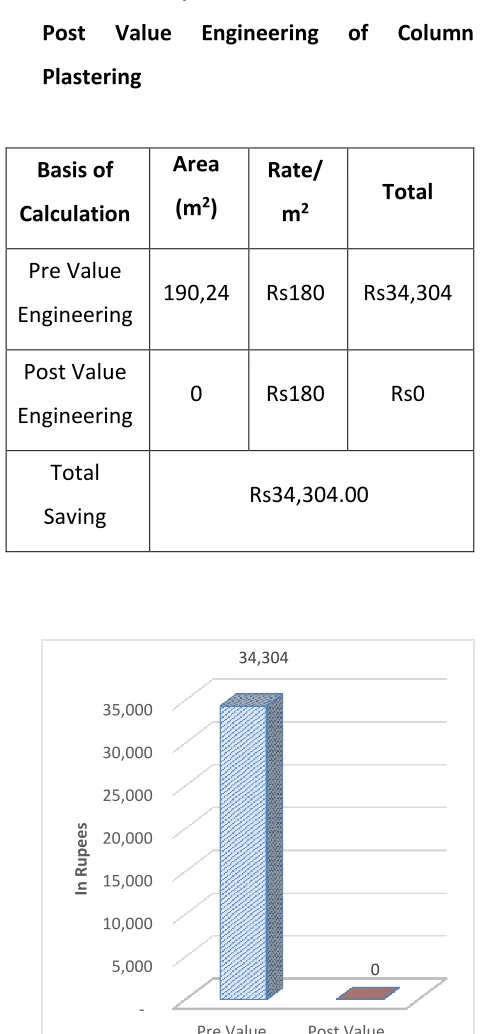
6 Column Plastering
Plastering is a carried out on the structure to protect the structural surface from harsh weather conditions and to conceal the unevenness of masonry and other structural members. However, plastering is also carried out to give an aesthetic look to the structure. During this study, we recommended good shuttering system, which prompted us to eliminate plastering in some identified structure elements. Initially, it was planned to exclude plastering for column, beam and slab, but due to some practical difficulties, we limited our scope to the columns only.
Figure 16.0: Showing the column without
Plastering
Table 7.0 Comparative value between Pre &
Post Value Engineering of Column
Plastering
Figure 17.0: Chart showing comparison
between Pre and Post Value Engineering of
Column Plastering
5,000 10,000 15,000 20,000 25,000 30,000 35,000
Pre Value Engineering
Post Value Engineering 34,304
0
In
Ru
p
e
e
s
Basis of
Calculation
Area
(m2)
Rate/
m2 Total
Pre Value
Engineering 190,24 Rs180 Rs34,304
Post Value
Engineering 0 Rs180 Rs0
Total
7 Fe 415 vs Fe 500
Steel is the main material of construction or we can call it as backbone of the structure which helps to give strength to the structure. In normal terms steel are recognized by grade for example Fe415 grade steel.
The trend has started of moving towards the use of TMT 500 steel bars or a bar conforming to IS 1786-2008 Fe 500. We can save about 16.67 % of steel over Fe415 by proper design.
Figure 18.0: Showing the use of Fe500
Table 8.0 Comparative value between Pre &
Post Value Engineering of Reinforcement
steel
Figure 19.0: Chart showing comparison
between Pre and Post Value Engineering of
Reinforcement steel
CONCLUSION
Waste management is very important in any construction industry, which helps in reducing unnecessary waste which is generated in site.
0 500 1,000 1,500 2,000 2,500
Pre Value Engineering
Post Value Engineering 2,450
2,042
In
To
n
n
e
s
Grade
of
steel
Quantity
(tonnes) Rate/ MT Total
Fe415 2450 Rs45,000 Rs11,02, 50,000
Fe500 2041.58 Rs46,500 Rs9,49,3 3,470
Total
Value engineering is a technique, through which we can reduce waste and cost by improving the functionality of the material or product.
By proper soil bearing capacity (SBC) report the design can be changed and unnecessary excavation of soil can be avoided.
By the proper study of the soil, the shuttering and PCC of the footing can be avoided in some areas.
Studying the functions of the material or product which are used in the project and improving the functionality for example using frameless doors or using low cost partition wall.
Knowing the exact properties of the material we are using can cut down the waste and construction cost for example steel (fe415, fe500), concrete grade and blocks etc...
The following percentages of cost reduction have been achieved in the construction elements after the implementation of Value Engineering Technique.
1. Foundation Pit Excavation – 34.4% 2. Footing - PCC – 62.5%
3. Shuttering - Footing – 95.22% 4. Partition Wall – 22.8%
5. Partition wall – Toilets – 15.63% 6. Doors – Single Shutter – 43.4% 7. Doors – Double Shutter – 39.52% 8. Plastering – Column – 100% 9. Steel – 16.67%
Waste Management needs its due importance in projects. This managements area needs to be developed as any other management knowledge area and the benefits of this area towards environment, sustainability, cost-benefits, speed of construction, needs distribution.
It is value engineering efforts coupled with technical insights, sound planning, and envisioning which can yield a successful waste management system.
REFERENCES
[1] V.Bharathi and Dr.R.Paranthaman “Application of Value Engineering in Construction
Building” Indian journal of applied research (2013).
[2] Apurva J Chavan “VALUE ENGINEERING IN CONSTRUCTION INDUSTRY”
International Journal of Application or Innovation in Engineering & Management (IJAIEM) (2013)
[3] Jillian K Seidel and W. Mac Ware “Value Engineering Trends in the Construction Industry” Construction Systems Management Program of the Ohio State University
(2012).
“CONSTRUCTABILITY RELATED TO TQM, VALUEENGINEERING, AND
COST/BENEFITS” Journal of Performance of Constructed Facilities, Vol. 8, (1994).
[5] Babatunde and Solomon Olusola “Quantitative Assessment of Construction Materials
Wastage in the Nigerian Construction Sites” Journal of Emerging Trends in Economics and Management Sciences (JETEMS) 3(3): 238-241 (2012).
[6] Ayarkwa, J, K. Agyekum and E. Adinyira “EXPLORING WASTE MINIMIZATION
MEASURES IN THE GHANAIAN CONSTRUCTION INDUSTRY” Built
Environmental Journal Vol. 8, No. 2, 22-30, (2011).
[7] Vivian W.Y. Tam “On the effectiveness in implementing a waste-management-plan method in construction” Griffith university (2008).
[8] Carlos T. Formoso, Lucio Soibelman M.ASCE, Claudia De Cesare, and Eduardo L. Isatto “Material Waste in Building Industry: Main Causesand Prevention” journal of construction engineering and management 316/ 325 (2002).
[9] B.A.G.Bosssink and H.J.H.Brouwers “Construction Waste: Quantification and Source
Evaluation” Journal of Construction Engineering and Management (1996).
[10] A Masood, T Ahmad, M Arif and F Mahadi, “Waste Management Startagies for concrete”, Environ Engg Policy 3, 2002.
[11] Bruce McDonald and Mark Smithers, “Implementing wastage management plan during construction phase of a project”, Construction Management and Economics, 2008.
[12] C. S. Poon, Ann T. W. Yu and L. Jaillon, “Reducing building waste at construction sites in Hong Kong” Construction Management and Economics, 2004
[13] Carlos Torres Formoso, Eduardo Luís Isatto, and Ercilia Hitomi Hirota, “Method for waste control in building Industry”, University of California, Berkeley, CA, USA 1999.
[14] Chun-Li Peng, Domenice E. Scorpio and Charles J. Kibert, “Strategies for successful construction and demolition waste refscycling operations” Construction Management and
Economics, 1997
[15] George Ofori, “Construction Material waste source evalusation” Proceedings: Strategies for a Sustainable Built Environment, Pretoria, 23-25 August 2000.
and Contractor”, Institution of recycling Network, 2005.
[17] Mohamed M. Matar, Maged E. Georgy and Moheeb Elsaid Ibrahim, "Sustainable