Composable Security in the Tamper Proof Hardware Model
under Minimal Complexity
Carmit Hazay∗ Antigoni Polychroniadou† Muthuramakrishnan Venkitasubramaniam‡
Abstract
We put forth a new formulation of tamper-proof hardware in the Global Universal Composable (GUC) framework introduced by Canetti et al. in TCC 2007. Almost all of the previous works rely on the formulation by Katz in Eurocrypt 2007 and this formulation does not fully capture tokens in a concurrent setting. We address these shortcomings by relying on the GUC framework where we make the following contributions:
1. We construct secure Two-Party Computation (2PC) protocols for general functionalities with opti-mal round complexity and computational assumptions using stateless tokens. More precisely, we show how to realize arbitrary functionalities with GUC security in two rounds under the minimal assumption of One-Way Functions (OWFs). Moreover, our construction relies on the underlying function in a black-box way. As a corollary, we obtain feasibility of Multi-Party Computation (MPC) with GUC-security under the minimal assumption of OWFs. As an independent contri-bution, we identify an issue with a claim in a previous work by Goyal, Ishai, Sahai, Venkatesan and Wadia in TCC 2010 regarding the feasibility of UC-secure computation with stateless tokens assuming collision-resistant hash-functions (and the extension based only on one-way functions). 2. We then construct a 3-round MPC protocol to securely realize arbitrary functionalities with
GUC-security starting from any semi-honest secure MPC protocol. For this construction, we require the so-called one-many commit-and-prove primitive introduced in the original work of Canetti, Lindell, Ostrovsky and Sahai in STOC 2002 that is round-efficient and black-box in the underlying commitment. Using specially designed “input-delayed” protocols we realize this primitive (with a 3-round protocol in our framework) using stateless tokens and one-way functions (where the underlying one-way function is used in a black-box way).
Keywords:Secure Computation, Tamper-Proof Hardware, Round Complexity, Minimal Assumptions
∗Bar-Ilan University, Israel. Email:[email protected]. †Aarhus University, Denmark. Email:[email protected].
Contents
1 Introduction 2
1.1 Our Results . . . 4
1.2 Our Techniques . . . 5
1.3 Related Work . . . 7
2 Modeling Tamper-Proof Hardware in the GUC Framework 7 2.1 The Global Tamper-Proof Model . . . 10
3 Preliminaries 13 3.1 Pseudorandom Functions . . . 13
3.2 Commitment Schemes . . . 13
3.3 Randomness Extractors . . . 14
3.4 Hardcore Predicates . . . 15
3.5 Secret-Sharing. . . 15
4 Two-Round Oblivious Transfer in the Stand-Alone Model 16 4.1 Building Blocks: Commitment Schemes . . . 16
4.2 Our Protocol. . . 18
4.2.1 Relaxing to One-Way Functions . . . 29
4.3 Reusability of Tokens . . . 30
5 Two-Round Token-Based GUC Oblivious Transfer 35 5.1 Two-Round 2PC Using Stateless Tokens . . . 45
5.2 GUC-Secure MPC using Stateless Tokens from One-Way Functions . . . 46
5.3 On Reusability . . . 46
6 Three-Round Token-Based GUC Secure Multi-Party Computation 47 6.1 One-Many Commit-and-Prove Functionality . . . 47
6.1.1 RealizingFCP1:Min theFgWRAP-Hybrid . . . 48
6.2 Warmup: Simple MPC Protocol in theFCP1:M-Hybrid. . . 52
6.3 Three-Round MPC Protocol in theFgWRAP-Hybrid . . . 53
7 Acknowledgements 57
1
Introduction
Secure Multi-Party Computation (MPC) enables a set of parties to mutually run a protocol that computes some functionf on their private inputs, while preserving two important properties: privacy and correct-ness. The former implies data confidentiality, namely, nothing leaks by the protocol execution but the computed output, while, the later requirement implies that no corrupted party or parties can cause the out-put to deviate from the specified function. It is by now well known how to securely comout-pute any efficient functionality [Yao86,GMW87,MR91,Bea91] under the stringent simulation-based definitions (following the ideal/real paradigm). These traditional results prove security in the stand-alone model, where asingle set of parties run asingle execution of the protocol. However, the security of most cryptographic proto-cols proven in the stand-alone setting does not remain intact if many instances of the protocol are executed concurrently [Can01, CF01, Lin03]. The strongest (but also the most realistic) setting for concurrent se-curity, known asUniversally Composable(UC) security [Can01] considers the execution of an unbounded number of concurrent protocols in an arbitrary and adversarially controlled network environment. Unfor-tunately, stand-alone secure protocols typically fail to remain secure in the UC setting. In fact, without assuming sometrusted help, UC-security is impossible to achieve for most tasks [CF01,CKL06,Lin03]. Consequently, UC-secure protocols have been constructed under varioustrusted setupassumptions in a long series of works; see [BCNP04,CDPW07,Kat07,KLP07,CPS07,LPV09,DMRV13] for few examples.
One such setup assumption and the focus of this work is the use of tamper-proof hardware tokens. The first work to model tokens in the UC framework was by Katz in [Kat07] who introduced theFWRAP
-functionality to capture such tokens and demonstrated feasibility of realizing general functionalities with UC-security. Most of the previous works in the tamper proof hardware [Kat07,CGS08,LPV09,GIS+10,
DMRV13,CKS+14,DKMN15b] rely on this formulation. As we explain next, this formulation does not provide adequate composability guarantees. We begin by mentioning that any notion of composable security in an interactive setting should allow for multiple protocols to co-exist in the same system and interact with each other. We revisit the following desiderata put forth by Canetti, Lin and Pass [CLP10] for any notion of composable security:
Concurrent multi-instance security: The security properties relating to local objects (including data and tokens) of the analyzed protocol itself should remain valid even when multiple instances of the pro-tocol are executed concurrently and are susceptible to coordinated attacks against multiple instances. Almost all prior works in the tamper proof model do not specifically analyze their security in a con-current setting. In other words, they only discuss UC-security of a single instance of the protocol. In particular, when executing protocols in the concurrent setting with tokens, an adversary could in fact transfer a token received from one execution to another and none of the previous works that are based on theFWRAP-functionality accommodate transfers.
Modular analysis: Security of the larger overall protocols must be deducible from the security properties of its components. In other words, composing protocols should preserve security in a modular way. One of the main motivations and features in the UC-framework is the ability to analyze a protocol locally in isolation while guaranteeing global security. This does not only enable easier design but identifies the required security properties. The current framework proposed by Katz [Kat07] does not allow for such a mechanism.
The state-of-affairs regarding tamper-proof tokens leads us to ask the following question.
Since the work of [Kat07], the power of hardware tokens has been explored extensively in a long series of works, especially in the context of achieving UC-security (for example, [CGS08,MS08,GIS+10,DKM11,
DMMN13,DKMN15b,CKS+14]). While the work of Katz [Kat07] assumed the stronger stateful tokens, the work of Chandran, Goyal and Sahai [CGS08] was the first to achieve UC-security using only stateless tokens. In this work we will focus only on the weaker stateless token model. In the tamper-proof model with stateless tokens, as we argue below, the issue of minimal assumptions and round-complexity have been largely unaddressed. The work of Chandran et al. [CGS08] gives an O(κ)-round protocol (where κ is the security parameter) based on enhanced trapdoor permutations. Following that, Goyal et al. [GIS+10] provided an (incorrect) O(1)-round construction based on Collision-Resistant Hash Functions (CRHFs). The work of Choi et al. [CKS+14], extending the techniques of [GIS+10] and [DKM11], establishes the same result and provide a five-round construction based on CRHFs.
All previous constructions require assumptions stronger than one-way functions (OWFs), namely ei-ther trapdoor permutations or CRHFs. Thus as a first question, we investigate the minimal assumptions required for token-based secure computation protocols. The works of [GIS+10] and [CKS+14] rely on CRHFs for realizing statistically-hiding commitment schemes. Towards minimizing assumptions, both these works, originally considered a variant of their respective protocols where they replace the construction of the statistically-hiding commitment scheme based on CRHFs to the one based on one-way functions [HHRS15] to obtain UC-secure protocols under minimal assumptions (See Theorem 3 in [GIS+10] and Footnote 7 in [CKS+14]). While analyzing the proof of this variant in the work of [GIS+10], we found an issue in the original construction based on CRHFs.1 More recently, the authors of [CKS+14] have removed this obser-vation in their updated version of the original work (see [CKS+13]).2 Given the state of affairs, our starting point is to address the following fundamental question regarding tokens that remains open.
Can we construct tamper-proof UC-secure protocols using stateless tokens assuming only one-way functions?
A second important question that we address here is:
What is the round complexity of UC-secure two-party protocols using stateless tokens assuming only one-way functions?
We remark here that relying on black-box techniques, it would be impossible to achieve non-interactive secure computation even in the tamper proof model as any such approach would be vulnerable to a residual function attack.3This holds even if we allow an initial token exchange phase, where the two parties exchange tokens (that are independent of their inputs). Hence, the best we could hope for is two rounds.
(G)UC-secure protocols in the multi-party setting. In the UC framework, it is possible to obtain UC-secure protocols in the MPC setting by first realizing the UC-UC-secure oblivious transfer functionality (UC OT) in the two-party setting and then combining it with general compilation techniques (e.g., [Kil88,CLOS02,
IPS08,LPV12] to obtain UC-secure multi-party computation protocols. First, we remark that specifically in the stateless tamper-proof tokens model, prior works fail to consider multi-versions of the OT-functionality
1
In fact, we present a concrete attack that breaks the security of their construction in AppendixA. We remark that our observation
onlyaffects one particular result in [GIS+10], namely, realizing the UC-secure oblivious transfer functionality based on CRHFs and stateless tokens.
2In private communication, the authors of [CKS+13] explained that the variant that naively replaces the commitment with one
based on one-way functions might be vulnerable to covert attacks. 3
while allowing transferrability of tokens which is important in an MPC setting.4 As such, none of the previous works explicitly study the round complexity of multi-party protocols in the tamper proof model (with stateless tokens), we thus initiate this study in this work and address the following question.
Can we obtain round-optimal multi-party computation protocols with GUC-security in the tam-per proof model?
Unidirectional token exchange. Consider the scenario where companies such as Amazon or Google wish to provide anemail spam-detectionservice and users of this service want to keep their emails private (so as to not have unwanted advertisements posted based on the content of their emails). In such a scenario, it is quite reasonable to assume that Amazon or Google have the infrastructure to create tamper-proof hardware tokens in large scale while the clients cannot be expected to create tokens on their own. Most of the prior works assume (require) that both parties have the capability of constructing tokens. When relying on non-black-box techniques, the work of [CKS+14] shows how to construct UC-OT using a single stateless token and consequently requires only one of the parties to create the token. The work of Moran and Segev in [MS08] on the other hand shows how to construct UC-secure two-party computation via a black-box construction where tokens are required to be passed only in one direction, however, they require the stronger model of stateful tokens. It is desirable to obtain a black-box construction when relying on stateless tokens. Unfortunately, the work of [CKS+14] shows that this is impossible in the fully concurrent setting. More precisely, they show that UC-security is impossible to achieve for general functionalities via a black-box construction using stateless tokens if only one of the parties is expected to create tokens. In this work, we therefore wish to address the following question:
Is there a meaningful security notion that can be realized in a client-server setting relying on black-box techniques using stateless tokens where tokens are created only by the server?
1.1 Our Results
As our first contribution, we put forth a formulation of the tamper-proof hardware as a “global” function-ality that provides strong composability guarantees. Towards addressing the various shortcomings of the composability guarantees of the UC-framework, Canetti et al. [CDPW07] introduced the Global Universal Composability (GUC) framework which among other things allows to consider global setup functionalities such as the common reference string model, and more recently the global random oracle model [CJS14]. In this work, we put forth a new formulation of tokens in the GUC-framework that will satisfy all our desiderata for composition. Furthermore, in our formulation, we will be able to invoke the GUC composition theorem of [CDPW07] in a modular way. A formal description of theFgWRAP-functionality can be found in Figure2
and more detailed discussion is presented in the next section.
In the two-party setting we resolve both the round complexity and computational complexity required to realize GUC-secure protocols in the strongerFgWRAP-hybrid stated in the following theorem:
Theorem 1.1 (Informal) Assuming the existence of OWFs, there exists a two-round protocol that GUC re-alizes any (well-formed) two-party functionality in the global tamper proof model assuming stateless tokens. Moreover it only makes black-box use of the underlying OWF.
4
As mentioned earlier, any (black-box) non-interactive secure computation protocol is vulnerable to a residual function attack assuming stateless tokens. Therefore, the best round complexity we can hope for assuming (stateless) tamper-proof tokens is two which our results shows is optimal. In concurrent work [DKMN15a], Dottling et al. show how to obtain UC-secure two-party computation protocol relying on one-way functions via non-black-box techniques.
In the multi-party setting, our first theorem follows as a corollary of our results from the two-party setting.
Theorem 1.2 Assuming the existence of OWFs, there exists aO(df)-round protocol that GUC realizes any multi-party (well formed) functionalityf in the global tamper proof model assuming stateless tokens, where
df is the depth of any circuit implementingf.
Furthermore, this construction relies on the underlying one-way function in a black-box manner. Next, we improve the round-complexity of our construction to obtain the following theorem:
Theorem 1.3 Assuming the existence of OWFs and stand-alone semi-honest MPC, there exists a three-round protocol that GUC realizes any multi-party (well formed) functionality in the global tamper proof model assuming stateless tokens.
We remark that our construction is black-box in the underlying one-way function but unlike our previous theorem it relies on the code of the MPC protocol in a non-black-box way. In particular, underlying MPC protocols typically rely on semi-honest oblivious-transfer and our construction is non-black-box in this assumptions.
Finally, in the client-server setting, we prove the following theorem in the full version [?]:
Theorem 1.4 (Informal) Assuming the existence of one-way functions, there exists a two-round protocol that securely realizes any two-party functionality assuming stateless tokens in a client-server setting, where the tokens are created only by the server. We also provide an extension where we achieve UC-security against malicious clients and sequential and parallel composition security against malicious servers.
In more detail, we provide straight-line (UC) simulation of malicious clients and standard rewinding-based simulation against malicious servers. Our protocols guarantee security of the servers against arbitrary mali-cious coordinating clients and protects every individual client executing sequentially or in parallel against a corrupted server. We believe that this is a reasonable model in comparison to the Common Reference String (CRS) model where both parties require a trusted entity to sample the CRS. Furthermore, it guarantees meaningful concurrent security that is otherwise not achievable in the plain model in two rounds.
1.2 Our Techniques
Our starting point for our round optimal secure two-party computation is the following technique from [GIS+10] for an extractable commitment scheme.
observe the queries made by the sender to the token and observe that queries that yieldsvto retrieveu. This commitment scheme is based on one-way functions but is only extractable. To obtain a full-fledged UC-commitment from an extractable UC-commitment we can rely on standard techniques (See [PW09,HV15] for a few examples). Instead, in order to obtain round-optimal constructions for secure two-party computation, we extend this protocol directly to realize the UC oblivious transfer functionality. A first incorrect approach is the following protocol. The parties exchange two sets of PRF tokens. Next, the receiver commits to its bit
comb using the approach described above, followed by the sender committing to its input(coms0,coms1)
along with an OT token that implements the one-out-of-two string OT functionality. More specifically, it stores two stringss0 ands1, and given a single bitboutputssb. Specifically, the code of that token behaves
as follows:
• On inputb∗, u∗, the token outputs(sb,decomsb)only ifcomb= (Ext(u∗;r)⊕b∗, r, v)andPRF(u∗) =
v. Otherwise, the token aborts.
The receiver then runs the token to obtainsband verifies ifdecomsb correctly decommitscomsb tosb. This
simple idea is vulnerable to an input-dependent abort attack, where the token aborts depending on the value
b∗. The work of [GIS+10] provides a combiner to handle this particular attack which we demonstrate is flawed. We describe the attack in Section A. We instead will rely on a combiner from the recent work of Ostrovsky, Richelson and Scafuro [ORS15] to obtain a two-round GUC-OT protocol.
GUC-secure multi-party computation protocols. In order to demonstrate feasibility, we simply rely on the work of [IPS08] who show how to achieve GUC-secure MPC protocols in the OT-hybrid. By instantiat-ing the OT with our GUC-OT protocol, we obtain MPC protocols in the tamper proof model assuminstantiat-ing only one-way functions. While this protocol minimizes the complexity assumptions, the round complexity would be high. In this work, we show how to construct a 3-round MPC protocol. Our starting point is to take any semi-honest MPC protocol in the stand-alone model and compile it into a malicious one using tokens fol-lowing the paradigm in the original work of Canetti et al. [CLOS02] and subsequent works [Pas03,Lin03]. Roughly, the approach is to define a commit-and-prove GUC-functionalityFCPand compile the semi-honest
protocol using this functionality following a GMW-style compilation.
We will follow an analogous approach where we directly construct a full-fledgedFCP1:M-functionality that
allows a single prover to commit to a string and then prove multiple statements on the commitment simul-taneously to several parties. In the token model, realizing this primitive turns out to be non-trivial. This is because we need the commitment in this protocol to be straight-line extractable and the proof to be about the value committed. Recall that, the extractable commitment is based on a PRF token supplied by the receiver of the commitment (and the verifier in the zero-knowledge proof). The prover cannot attest the validity of its commitment (via anNP-statement) since it does not know the code (i.e. key) of the PRF. Therefore, any commit and prove scheme in the token model necessarily must rely on a zero-knowledge proof that is black-box in the underlying commitment scheme. In fact, in the seminal work of Ishai et al. [IKOS09] they showed how to construct such protocols that have been extensively used in several works where the goal is to obtain constructions that are black-box in the underlying primitives. Following this approach and solving its difficulties that appear in the tamper-proof hardwire model, we can compile aT-round semi-honest secure MPC protocol to aO(T)-round protocol. Next, to reduce the rounds of the computation we consider the approach of Garg et al. [GGHR14] who show how to compress the round complexity of any MPC protocol to a two-round GUC-secure MPC protocol in the CRS model using obfuscation primitives.
underlying MPC protocol, and has each party obfuscate their “next-message” function in that protocol, providing one obfuscation for each round. To ensure correctness, zero-knowledge proofs are used to validate the actions of each party w.r.t the commitments made in the first step. Such a mechanism is also referred to as a commit-and-prove strategy. This enables each party to independently evaluate the obfuscation one by one, generating messages of the underlying MPC protocol and finally obtain the output. The observation here is that party Pi’s next-message circuit for round j in the underlying MPC protocol depends on its private inputxiand randomnessri (which are hard-coded in the obfuscation) and on input the transcript of the communication in the firstj−1rounds outputs its message for the next round.
To incorporate this approach in the token model, we can simply replace the obfuscation primitives with tokens. Next, to employ zero-knowledge proofs via a black-box construction, we require a zero-knowledge protocol that allows commitment of a witness via tokens at the beginning of the protocol and then in a later step prove a statement about this witness where the commitment scheme is used in a “black-box” way. A first idea here would be to compile using the zero-knowledge protocol of [IKOS09] that facilitate such a commit-and-prove paradigm. However, as we explain later this would cost us in round-complexity. Instead we will rely on so-called input-delayed proofs [LS90] that have recently received much attention [CPS+16a,CPS+16b,HV16]. In particular, we will rely on the recent work of [HV16] who shows how to construct the so-called “input-delay” commit-and-prove protocols which allow a prover to commit a string in an initial commit phase and then prove a statement regarding this string at a later stage where the input statement is determined later. However, their construction only allows for proving one statement regarding the commitment. One of our technical contributions is to extend this idea to allow multiple theorems and further extend it so that a single prover can prove several theorems to multiple parties simultaneously. This protocol will be 4-round and we show how to use this protocol in conjunction with the Garg et al.’s round collapsing technique.
1.3 Related Work
In recent and independent work, using the approach of [CJS14], Nilges [Nil15,MMN16] consider a GUC-like formulation of the tokens for the two-party setting where the parties have fixed roles. The focus in [Nil15,MMN16] was to obtain a formulation that accommodates reusability of a single token for several independent protocols in the UC-setting for the specific two-party case. In contrast to our work, they do not explicitly model or discuss adversarial transferability of the tokens. In particular they do not discuss in the multi-party case, which is the main motivation behind our work.
Another recent work by Boureanu, Ohkubo and Vaudenay [BOV15] studies the limit of composition when relying on tokens. In this work, they prove that EUC (or GUC)-security is impossible to achieve for most functionalities if tokens can be transferred in a restricted framework. More precisely, their impossibility holds, if the tokens themselves do not “encode” the session identifier in any way. Our work, circumvents this impossibility result by precisely allowing the tokens generated (by honest parties) to encode the session identifier in which they have to be used.
2
Modeling Tamper-Proof Hardware in the GUC Framework
Basic UC. Introduced by Canetti in [Can01], the Universal Composability (UC) framework provides a framework to analyse security of protocols in complex network environments in a modular way. One of the fundamental contributions of this work was to give a definition that will allow to design protocols and demonstrate security by “locally” analyzing a protocol but guaranteeing security in a concurrent setting where security of the protocol needs to be intact even when it is run concurrently with many instances of arbitrary protocols. Slightly more technically, in the UC-framework, to demonstrate that a protocol Π
securely realizes an ideal functionality F, we need to show that for any adversary A in the real world interacting with protocolΠ in the presence of arbitrary environmentsZ, there exists an ideal adversaryS such that for any environmentZthe view of an interaction withAis indistinguishable from the view of an interaction with the ideal functionalityFandS.
Unfortunately, soon after its inception, a series of impossibility results [CF01,CKL06,Lin03] demon-strated that most non-trivial functionalities cannot be realized in the UC-framework. Most feasibility results in the UC-framework relied on some sort of trusted setup such as the common reference string (CRS) model [CF01], tamper-proof model [Kat07] or relaxed security requirements such as super-polynomial simulation [Pas03, PS04, BS05]. When modeling trusted setup such as the CRS model, an extension of the UC-framework considers theG-hybrid model where “all” real-world parties are given access to an ideal setup functionalityG. In order for the basic composition theorem to hold in such aG-hybrid model, two restric-tions have to be made. First, the environmentZcannot access the ideal setup functionalitydirectly; it can only do so indirectly via the adversary. In some sense, the setupGis treated as “local” to a protocol instance. Second, two protocol instances of the same or different protocol cannot share “state” for the UC-composition theorem to hold. Therefore, a setup model such as the CRS in the UC-framework necessitates that each pro-tocol uses its own local setup. In other words, an independently sampled reference string for every propro-tocol instance. An alternative approach that was pursued in a later work was to realize a multi-version of a func-tionality and proved security of the multi-version using a single setup. For example, the original feasibility result of Canetti, Lindell, Ostrovsky and Sahai [CLOS02] realized the FMCOM-functionality which is the
multi-version of the basic commitment functionalityFCOMin the CRS model.
JUC. Towards accommodating a global setup such as the CRS for multiple protocol instances, Canetti and Rabin [CR03] introduced the Universal Composition with Joint State (JUC) framework. Suppose we want to analyze several instances of protocolΠwith an instanceGas common setup, then at the least, each instance of the protocol must share some state information regardingG(e.g., the reference string in the CRS model). The JUC-framework precisely accommodates such a scenario, where a new composition theorem is proven, that allows for composition of protocols that share some state. However, the JUC-model for the CRS setup would only allow the CRS to be accessible to a pre-determined set of protocols and in particular still does not allow the environment to directly access the CRS.
programmability of the CRS. In fact, it was shown in [CDPW07] that the CRS setup is insufficient to se-curely realize the ideal commitment functionality in the GUC-framework. More generally, they show that any setup that simply provides only “public” information is not sufficient to realize GUC-security for most non-trivial functionalities. They further demonstrated a feasibility in the Augmented CRS model, where the CRS contains signature keys, one for each party and a secret signing key that is not revealed to the parties, except if it is corrupt, in which case the secret signing key for that party is revealed.
As mentioned before, the popular framework to capture the tamper-proof hardware is the one due to [Kat07] who defined the FWRAP-functionality in the UC-framework. In general, in the token model, the
two basic advantages that the simulator has over the adversary is “observability” and “programmability”. Observability refers to the ability of the simulator to monitor all queries made by an adversary to the token and programmability refers to the ability to program responses to the queries in an online manner. In the context of tokens, both these assumptions are realistic as tamper-proof tokens do provide both these abilities in a real-world. However, when modeling tamper proof hardware tokens in the UC-setting, both these properties can raise issues as we discuss next.
Apriori, it is not clear why one should model the tamper proof hardware as a global functionality. In fact, the tokens are local to the parties and it makes the case for itnot to be globally accessible. Let us begin with the formulation by Katz [Kat07] who introduced theFWRAP-functionality (see Figure1for the
stateless variant). In the real world the creator or sender of a token specifies the code to be incorporated in a token by sending the description of a Turing machineM to the ideal functionality. The ideal functionality then emulates the code ofM to the receiver of the token, only allowing black-box access to the input and output tapes of M. In the case of stateful tokens, M is modeled as an interactive Turing machine while for stateless tokens, standard Turing machines would suffice. Slightly more technically, in the UC-model, parties are assigned unique identifiersPID and sessions are assigned identifierssid. In the tamper proof model, to distinguish tokens, the functionality accepts an identifier mid when a token is created. More formally, when one party PIDi creates a token with programM with token identifier midand sends it to another partyPIDj in sessionsid, then theFWRAP records the tuple(PIDi,PIDj,mid, M). Then whenever a party with identifierPIDj sends a query(Run,sid,PIDi,mid, x)to theFWRAP-functionality, it first checks
whether there is a tuple of the form(·,PIDj,mid,·)and then runs the machineM in this tuple if one exists.
FunctionalityFStateless WRAP
FunctionalityFStateless
WRAP is parameterized by a polynomialp(·)and an implicit security parameterκ.
Create. Upon receiving(Create,sid,PIDi,PIDj,mid, M)fromS, whereM is a Turing machine, do:
1. Send(Create,PIDi,PIDj,mid)toR. 2. Store(PIDi,PIDj,mid, M).
Execute. Upon receiving (Run,sid,PIDi,mid, x) from R, find the unique stored tuple (PIDi,PIDj,mid, M). If no such tuple exists, do nothing. RunM(x)for at mostp(κ)steps, and let outbe the response (out=⊥ifM does not halt inp(k)steps). Send(PIDi,PIDj,mid,out)toR.
Figure 1: The ideal functionality for stateless tokens [Kat07].
token from one honest party in a left interaction can forward the token to another party in a right interaction. Unfortunately, theFWRAP-functionality does not facilitate such a transfer.
Let us modify FWRAP to accommodate transfer of tokens by adding a special “transfer” query that
allows a token in the possession of one party to be transferred to another party. Since protocols designed in most works do not explicitly prove security in a concurrent man-in-the-middle setting, such a modification renders the previous protocols designed inFWRAPinsecure. For instance, consider the commitment scheme
discussed in the introduction based on PRF tokens. Such a scheme would be insecure as an adversary can simply forward the token from the receiver in a right interaction to the sender in a left interaction leading to a malleable commitment.
In order to achieve security while allowing transferability we need to modify the tokens themselves in such a way to be not useful in an execution different from where it is supposed to be used. If every honestly generated token admits only queries that are prefixed with the correct session identifier then transferring the tokens created by one honest party to another honest party will be useless as honest parties will prefix their queries with the right session and the honestly generated tokens will fail to answer on incorrect session prefixes. This is inspired by an idea in [CJS14], where they design GUC-secure protocols in the Global Random Oracle model [CJS14]. As such, introducing transferrability naturally requires protocols to address the issue of non-malleability.
While this modification allows us to model transferrability, it still requires us to analyze protocols in a concurrent man-in-the-middle setting. In order to obtain a more modular definition, where each protocol instance can be analyzed in isolation we need to allow the token to be transferred from the adversary to the environment. In essence, we require the token to be somewhat “globally” accessible and this is the approach we take.
2.1 The Global Tamper-Proof Model
A natural first approach would be to consider the same functionality in the GUC-framework and let the environment to access theFWRAP-functionality. This is reasonable as an environment can have access to
the tokens via auxiliary parties to whom the tokens were transferred to. However, naively incorporating this idea would deny “observability” and “programmability” to the simulator as all adversaries can simply transfer away their tokens the moment they receive them and let other parties make queries on their behalf. Indeed, one can show that the impossibility result of [CKS+14] extends to this formulation of the tokens (at least if the code of the token is treated in a black-box manner).5 A second approach would be to reveal to the simulator all queries made to the token received by the adversary even if transferred out to any party. However, such a formulation would be vulnerable to the following transferring attack. If an adversary received a token from one session, it can send it as its token to an honest party in another session and now observe all queries made by the honest party to the token. Therefore such a formulation of tokens is incorrect.
Our formulation will accommodate transferrability while still guaranteeing observability to the simu-lator. In more detail, we will modify the definition of FWRAP so that it will reveal to the simulator all
“illegitimate” queries made to the token by any other party. This approach is analogous to the one taken by Canetti, Jain and Scafuro [CJS14] where they model the Global Random Oracle Model and are confronted by a similar issue; here queries made to a globally accessible random oracle via auxiliary parties by the environment must be made available to the simulator while protecting the queries made by the honest party.
5
In order to define “legitimate” queries we will require that all tokens created by an honest party, by default, will accept an input of the form(sid, x) and will respond with the evaluation of the embedded program
M on inputx, only ifsid = sid, wheresidcorresponds to the session where the token is supposed to be used, i.e. the session where the honest party created the token. Furthermore, whenever an honest party in sessionsidqueries a token it received on inputx, it will prefix the query with the correct session identifier, namely issue the query(sid, x). Anillegitimate queryis one where thesidprefix in a query differs from the session identifier from which the party is querying from. Every illegitimate query will be recorded by our functionality and will be disclosed to the party whose session identifier is actuallysid.
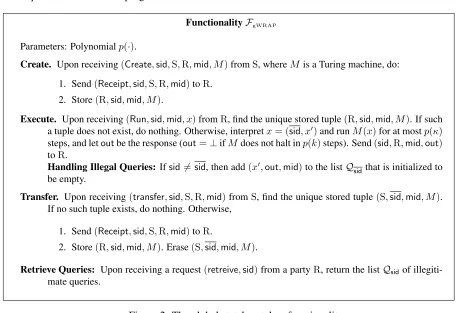
More formally, theFgWRAP-functionality is parameterized by a polynomialp(·)which is the time bound
that the functionality will exercise whenever it runs any program. The functionality admits the following queries:
Creation Query: This query allows one partySto create and send a token to another partyRby sending the query(Create,sid,S,R,mid, M)whereM is the description of the machine to be embedded in the token,mid is a unique identifier for the token andsidis the session identifier. The functionality records(R,sid,mid, M).6
Transfer Query: We explicitly provide the ability for parties to transfer tokens to other parties that were not created by them (eg, received from another session). Such a query will only be used by the adversary in our protocols as honest parties will always create their own tokens. When a transfer query of the form(transfer,sid,S,R,mid)is issued, the tuple (S,sid,mid, M)is erased and a new tuple (R,sid,mid, M) is created where sidis the identifier of the session where it was previously used.
Execute Query: To run a token the party needs to provide an input in a particular format. All honest parties will provide the input asx= (sid, x′)and the functionality will runM on inputxand supply the answer. In order to achieve non-malleability, we will make sure in all our constructions that tokens generated by honest parties will respond to a query only if it contains the correctsid.
Retrieve Query: This is the important addition to our functionality following the approach taken by [CJS14]. FgWRAP-functionality will record all illegitimate queries made to a token. Namely for a token recorded
as the tuple(R,sid,mid, M)an illegitimate query is of the form(sid, x)wheresid ̸=sidand such a query will be recorded in a setQsid that will be made accessible to the receiving party corresponding tosid.
A formal description of the ideal functionalityFgWRAPis presented in Figure2. We emphasize that our
formulation of the tamper-proof model will now have the following benefits:
1. It overcomes the shortcomings of the FWRAP-functionality as defined in [Kat07] and used in
subse-quent works. In particular, it allows for transferring tokens from one session to another while retaining “observability”.
2. Our model allows for designing protocols in the UC-framework and enjoys the composition theorem as it allows the environment to access the token either directly or via other parties.
3. Our model explicitly rules out “programmability” of tokens. We remark that it is (potentially) possible to explicitly provide a mechanism for programmability in theFgWRAP-functionality. We chose to not
provide such a mechanism so as to provide stronger composability guarantees.
4. In our framework, we can analyze the security of a protocol in isolation and guarantee concurrent multi-instance security directly using the GUC-composition theorem. Moreover, it suffices to consider a “dummy” adversary that simply forwards the environment everything (including the token).
An immediate consequence of our formulation is that it renders prior works such as [Kat07, CGS08,
DKM11,DKMN15a] that rely on the programmability of the token insecure in our model. The works of [GIS+10,CKS+14] on the other hand can be modified and proven secure in theFgWRAP-hybrid as they do
not require the tokens to be programmed.
FunctionalityFgWRAP
Parameters: Polynomialp(·).
Create. Upon receiving(Create,sid,S,R,mid, M)fromS, whereM is a Turing machine, do: 1. Send(Receipt,sid,S,R,mid)toR.
2. Store(R,sid,mid, M).
Execute. Upon receiving(Run,sid,mid, x)fromR, find the unique stored tuple(R,sid,mid, M). If such a tuple does not exist, do nothing. Otherwise, interpretx= (sid, x′)and runM(x)for at mostp(κ)
steps, and letoutbe the response (out=⊥ifMdoes not halt inp(k)steps). Send(sid,R,mid,out)
toR.
Handling Illegal Queries:Ifsid̸=sid, then add(x′,out,mid)to the listQsidthat is initialized to be empty.
Transfer. Upon receiving(transfer,sid,S,R,mid)fromS, find the unique stored tuple(S,sid,mid, M). If no such tuple exists, do nothing. Otherwise,
1. Send(Receipt,sid,S,R,mid)toR.
2. Store(R,sid,mid, M). Erase(S,sid,mid, M).
Retrieve Queries: Upon receiving a request(retreive,sid)from a partyR, return the listQsidof illegiti-mate queries.
Figure 2: The global stateless token functionality.
We now provide the formal definition of UC-security in the Global Tamper-Proof model.
Definition 2.1 (GUC security in the global tamper-proof model)LetFbe an ideal functionality and let
πbe a multi-party protocol. Then protocolπGUC realizesFinFgWRAP-hybrid model, if for every uniform
P P T hybrid-model adversaryA, there exists a uniformP P T simulatorS, such that for every non-uniform
P P T environmentZ, the following two ensembles are computationally indistinguishable,
{
3
Preliminaries
Basic notations. We denote the security parameter byκ. We say that a functionµ:N→ Nisnegligible if for every positive polynomial p(·) and all sufficiently large κ’s it holds thatµ(κ) < p(1κ). We use the abbreviation PPT to denote probabilistic polynomial-time. We specify next the definition of computationally indistinguishable and statistical distance.
Definition 3.1 LetX = {X(a, κ)}a∈{0,1}∗,κ∈N andY = {Y(a, κ)}a∈{0,1}∗,κ∈N be two distribution en-sembles. We say thatX andY arecomputationally indistinguishable, denoted X ≈c Y, if for every PPT machineD, everya∈ {0,1}∗, every positive polynomialp(·)and all sufficiently largeκ’s,
Pr [D(X(a, κ),1κ) = 1]−Pr [D(Y(a, κ),1κ) = 1]< 1 p(κ).
Definition 3.2 Let Xκ and Yκ be random variables accepting values taken from a finite domain Ω ⊆ {0,1}κ. Thestatistical distancebetweenXκandYκis
SD(Xκ, Yκ) =
1 2
∑
ω∈Ω
Pr[Xκ=ω]−Pr[Yκ =ω].
We say thatXκandYκareε-closeif their statistical distance is at mostSD(Xκ, Yκ) ≤ε(κ). We say that
XκandYκarestatistically close, denotedXκ ≈sYκ, ifε(κ)is negligible inκ.
3.1 Pseudorandom Functions
Informally speaking, a pseudorandom function (PRF) is an efficiently computable function that looks like a truly random function to any PPT observer. Namely,
Definition 3.3 (Pseudorandom function ensemble) Let F = {PRFκ}κ∈N where for every κ, PRFκ : {0,1}κ × {0,1}m → {0,1}l is an efficiently computable ensemble of keyed functions. We say that F =
{PRFκ}κ∈Nis a pseudorandom function ensembleif for every PPT machine D, there exists a negligible functionnegl(·)such that for all sufficiently largeκ’s,
|Pr[DPRFκ(k,·)(1κ)] = 1−Pr[Dfκ(1κ) = 1]| ≤negl(κ),
where kis picked uniformly from{0,1}κ andf
κ is chosen uniformly at random from the set of functions mappingm-bit strings into l-bit strings. We sometimes omitκ from our notation when it is clear from the context.
3.2 Commitment Schemes
Definition 3.4 (Commitment schemes) A PPT machine Com = ⟨S, R⟩ is said to be a non-interactive commitment scheme if the following two properties hold.
Computational hiding: For every (expected)PPTmachineR∗, it holds that the following ensembles are computationally indistinguishable.
• {ViewRCom∗ (m1, z)}κ∈N,m1,m2∈{0,1}κ,z∈{0,1}∗
• {ViewRCom∗ (m2, z)}κ∈N,m1,m2∈{0,1}κ,z∈{0,1}∗
where ViewRCom∗ (m, z) denotes the random variable describing the output of R∗ after receiving a commitment tomusingCom.
Statistical binding: For any (computationally unbounded) malicious sender S∗ and auxiliary inputz, it holds that the probability that there exist valid decommitments to two different values for a viewv, generated with an honest receiver while interacting withS∗(z)usingCom, is negligible.
We refer the reader to [Gol01] for more details. We recall that non-interactive perfectly binding commit-ment schemes can be constructed based on one-way permutation, whereas two-round statistically binding commitment schemes can be constructed based on one-way functions [Nao91]. To set up some notations, we letcomm ← Com(m;rm) denote a commitment to a messagem, where the sender uses uniform ran-dom coins rm. The decommitment phase consists of the sender sending the decommitment information
decomm = (m, rm) which contains the message m together with the randomnessrm. This enables the receiver to verify whetherdecomm is consistent with the transcriptcomm. If so, it outputsm; otherwise it outputs⊥. For simplicity of exposition, in the sequel, we will assume that random coins are an implicit input to the commitment functions, unless specified explicitly.
Definition 3.5 (Trapdoor commitment schemes) LetCom= (S,R)be a statistically binding commitment scheme. We say thatComis a trapdoor commitment scheme is there exists an expectedPPToracle machine S = (S1,S2)such that for anyPPTR∗ and allm∈ {0,1}κ, the output(τ, w)of the following experiments
is computationally indistinguishable:
- an honest senderSinteracts withR∗to commit tom, and then opens the commitment:τ is the view ofR∗
in the commit phase, andwis the messageSsends in the open phase.
- the simulatorSgenerates a simulated viewτ for the commit phase, and then opens the commitment tom
in the open phase: formally(τ, state)← S1R∗(1κ),w← S2(state, m).
3.3 Randomness Extractors
The min-entropy of a random variableXisH∞(X) =−log(maxxPr[X =x]).
Definition 3.6 (Extractors) A functionExt:{0,1}n× {0,1}t→ {0,1}mis a(k, ε)-strong extractor if for all pairs of random variables(X, I)such thatX ∈ {0,1}nandH∞(X|I)≥kit holds that
The Leftover Hash Lemma shows how to explicitly construct an extractor from a family of pairwise independent functionsH. The extractor uses a random hash functionh← Has its seed and keeps this seed in the output of the extractor.
Theorem 3.7 (Leftover Hash Lemma) IfH={h:{0,1}n→ {0,1}m}is a pairwise independent family wherem=n−2 log1ε, thenExt(x, h) = (h, h(x))is a strong(n, ε)-extractor.
In this work we will consider the case wherem= 1andn≥2κ+ 1whereκis the security parameter. This yieldsε= 2−2κ+12−1 = 2−κ.
3.4 Hardcore Predicates
Definition 3.8 (Hardcore predicate) Letf :{0,1}κ → {0,1}∗andH:{0,1}κ → {0,1}be a polynomial-time computable functions. We sayHis a hardcore predicate off, if for everyPPTmachineA, there exists a negligible functionnegl(·)such that
Pr[x← {0,1}κ;y=f(x) :A(1κ, y) =H(x)]≤ 1
2 +negl(κ).
An important theorem by Goldreich and Levin [GL89] states that iff is a one-way function over{0,1}κ
then the one-way functionf′over{0,1}2κ, defined byf′(x, r) = (f(x), r), admits the following hardcore predicateb(x, r) = ⟨x, r⟩ = Σxirimod 2, wherexi, riis theith bit ofx, rrespectively. In the following, we refer to this predicate as the GL bit off. We will use the following theorem that establishes the list-decoding property of the GL bit.
Theorem 3.9 ([GL89]) There exists aPPT oracle machine Invthat on input (κ, ε) and oracle access to a predictor PPTB, runs in time poly(κ,1ε), makes at mostO(κε22) queries toB and outputs a listLwith
|L| ≤ 4εκ2 such that if
Pr[r ← {0,1}κ :B(r) =⟨x, r⟩]≥ 1 2 +
ε 2
then
Pr[L←InvB(κ, ε) :x∈L]≥ 1 2.
3.5 Secret-Sharing
A secret-sharing scheme allows distribution of a secret among a group of nplayers, each of whom in a sharing phasereceive a share (or piece) of the secret. In its simplest form, the goal of secret-sharing is to allow only subsets of players of size at leastt+ 1to reconstruct the secret. More formally at+ 1-out-of-n
secret sharing scheme comes with a sharing algorithm that on input a secretsoutputsnsharess1, . . . , sn and a reconstruction algorithm that takes as input((si)i∈S, S)where|S|> tand outputs either a secrets′ or⊥. In this work, we will use the Shamir’s secret sharing scheme [Sha79] with secrets in F =GF(2κ). We present the sharing and reconstruction algorithms below:
Sharing algorithm: For any inputs∈F, pick a random polynomialf(·)of degreetin the polynomial-field
Reconstruction algorithm: For any input (s′i)i∈S where none of the s′i are ⊥ and |S| > t, compute a polynomialg(x) such thatg(i) = s′ifor everyi∈ S. This is possible using Lagrange interpolation wheregis given by
g(x) =∑
i∈S
s′i ∏
j∈S/{i}
x−j i−j .
Finally the reconstruction algorithm outputsg(0).
We will additionally rely on the following property of secret-sharing schemes. To this end, we view the Shamir secret-sharing scheme as a linear code generated by the followingn×(t+ 1)Vandermonde matrix
A=
1 12 · · · 1t 1 22 · · · 2t
..
. ... ... ...
1 n2 · · · nt
More formally, the shares of a secretsthat are obtained via a polynomialf in the Shamir scheme, can be obtained by computingAcwherecis the vector containing the coefficients off. Next, we recall that for any linear codeA, there exists a parity check matrixHof dimension(n−t−1)×nwhich satisfies the equation
HA=0(n−t−1)×(t+1), i.e. the all0’s matrix. We thus define the linear operatorϕ(v) =Hvfor any vector
v. Then it holds that any set of sharessis valid if and only if it satisfies the equationϕ(s) =0n−t−1.
The authors in [DZ13] were the first to propose an algorithm for verifying membership in (binary) codes, i.e., verifying the product of Boolean matrices in quadratic time with exponentially small error probability, while previous methods only achieved constant error.
4
Two-Round Oblivious Transfer in the Stand-Alone Model
4.1 Building Blocks: Commitment Schemes
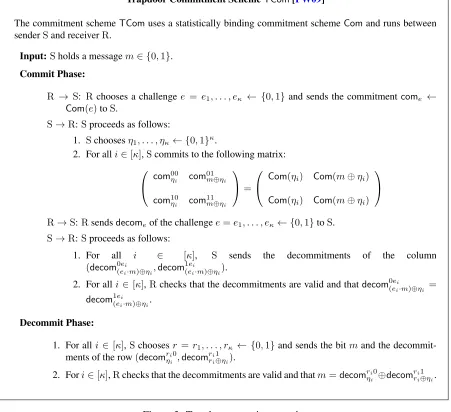
Trapdoor commitment schemes. A core building block of our protocol is a trapdoor commitment scheme
TCom(cf. Definition3.5) introduced by Pass and Wee in [PW09]. In Figure3we describe their4-round trapdoor commitment scheme that is based on one-way permutations. In particular, the protocol comprises a 4-round challenge-response protocol where the receiver commits to its challenge in the first message (using a non-interactive perfectly binding commitment scheme). The knowledge of the receiver’s challenge enables the simulator to cheat in the commit phase and equivocate the committed message into any bit (this notion of “look ahead” trapdoor commitment is borrowed from the area of zero-knowledge proofs).
Non-interactive commitment schemes. Our construction further relies on a non-interactive perfectly binding commitment scheme that is incorporated inside the sender’s tokenTKcomS . Such commitments can be build based on the existence of one-way permutations. Importantly, it is possible to relax our assumptions to one-way functions by relying on a two-round statistically binding commitment scheme [Nao91], and al-lowing the tokenTKcomS to take an additional input that will serve as the first message of the commitment scheme. Overall, that implies that we only need to assume one-way functions. For clarity of presentation, we use a non-interactive commitment scheme that is based on one-way permutations; see Section4.2.1for more details.
Trapdoor Commitment SchemeTCom[PW09]
The commitment schemeTComuses a statistically binding commitment schemeComand runs between senderSand receiverR.
Input:Sholds a messagem∈ {0,1}. Commit Phase:
R → S: Rchooses a challengee = e1, . . . , eκ ← {0,1}and sends the commitment come ← Com(e)toS.
S→R:Sproceeds as follows:
1. Schoosesη1, . . . , ηκ← {0,1}κ.
2. For alli∈[κ],Scommits to the following matrix:
com
00
ηi com
01
m⊕ηi
com10ηi com
11
m⊕ηi
=
Com(ηi) Com(m⊕ηi)
Com(ηi) Com(m⊕ηi)
R→S:Rsendsdecomeof the challengee=e1, . . . , eκ← {0,1}toS. S→R:Sproceeds as follows:
1. For all i ∈ [κ], S sends the decommitments of the column
(decom0(eei
i·m)⊕ηi,decom
1ei
(ei·m)⊕ηi).
2. For alli∈[κ],Rchecks that the decommitments are valid and thatdecom0ei
(ei·m)⊕ηi = decom1(eei
i·m)⊕ηi.
Decommit Phase:
1. For alli ∈[κ],Schoosesr =r1, . . . , rκ ← {0,1}and sends the bitmand the
decommit-ments of the row(decomri0 ηi ,decom
ri1 ri⊕ηi).
2. Fori∈[κ],Rchecks that the decommitments are valid and thatm=decomri0
ηi ⊕decom ri1 ri⊕ηi.
4.2 Our Protocol
We are now ready to introduce our first protocol that securely computes the functionalityFOT: ((s0, s1), b)
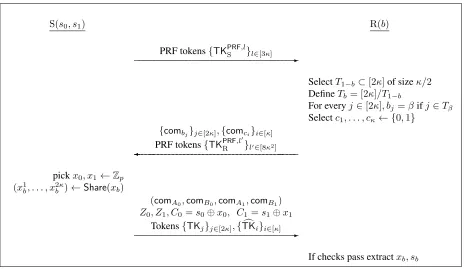
7→ (⊥, sb) in the plain model, using only two rounds and a one-way tokens transfer phase that involves sending a set of tokens from the sender to the receiver in one direction. We begin with a protocol that comprises of three rounds where the first round only transfers tokens from one party and then later modify it to obtain a two-round protocol where the tokens are reusable and need to be transferred once at the beginning of the protocol. For simplicity of exposition, in the sequel we will assume that the random coins are an implicit input to the commitments and the extractor, unless specified explicitly. Informally, in the one-way tokens transfer phase the sender sends two types of tokens. The PRF tokens{TKPRFS ,l}l∈[4κ2]are used by the
receiver to commit to its inputbusing the shares{bi}i∈[κ]. Namely, the number of tokens equals4κ(which
denote the number of tokens per Pass-Wee commitment), times κ which is the number of the receiver’s input shares. Whereas, the commitment tokenTKComS is used by the receiver to obtain the commitments of the sender in order to mask the values{(si0, si1)}i∈[κ]which are later used to conceal the sender’s real
inputs to the oblivious transfer. Next, the receiver shares its bitb into b1, . . . , bκ such thatb =
⊕κ i=1bi and commits to these shares using the Pass-Wee trapdoor commitment scheme. Importantly, we consider a slightly variant of the Pass-Wee commitment scheme where we combine the last two steps of the commit phase with the decommit phase. In particular, the final verification in the commit phase is included as part of the decommitment phase and incorporated into the sender’s tokens{TKi}that are forwarded in the second round. The sender further sends the commitments to its inputss0, s1computed based on hardcore predicates
for the(s0i, s1i)values and a combiner specified as follows. The sender choosesz1, . . . , zκand∆at random, where⊕κi=1zi maskss0 and
⊕κ
i=1zi ⊕∆maskss1. Finally, the sender respectively commits to eachzi andzi⊕∆using the hardcore bits computed on the(s0i, s1i)values. More precisely, it sends
s′0 =w⊕s0ands′1 =w⊕∆⊕s1
∀i∈[κ]w0i =zi⊕H(s0i)andw1i =zi⊕∆⊕H(s1i)
where w = ⊕κi=1zi. If none of the tokens abort, the receiver obtains sbi
i for all i ∈ [κ]and computes
sb=s′b⊕(w b1
1 ⊕H(s
b1
1 ))· · · ⊕(wκbκ⊕H(sbκκ)). If any of the OT tokens, i.e.TKi, aborts then the receiver assumes a default value forsb.
Remark 4.1 In [GIS+10], it is pointed out by Goyal et al. in Footnote 12 that assuming a default value in case the token aborts might cause an input-dependent abort. However, this problem arises only in their protocol as a result of the faulty simulation. In particular, our protocol is not vulnerable to this since the simulator for a corrupted sender follows the honest receiver’s strategy to extract both the inputs via (statistical) equivocation. In contrast, the simulation in [GIS+10] runs the honest receiver’s strategy for a randomly chosen input in a main execution to obtain the (adversarially corrupted) sender’s view and uses a “receiver-independent” strategy to extract the sender’s inputs. For more details, see AppendixA.
here that our protocol is not vulnerable to such an attack. We ensure that there is only one input on which the receiver can query the OTM token and this invalidates the attack presented in [GIS+10].
Next, we describe our OT protocolΠOTin theFgWRAP-hybrid with senderSand receiverR. Let (1)Com
be a non-interactive perfectly binding commitment scheme, (2) TCom = {TCmsg1,TCmsg2,TCmsg3}
denote the three messages exchanged in the commit phase of the trapdoor commitment scheme, (3)F, F′
be two PRF families that map {0,1}5κ → {0,1}κ and {0,1}κ → {0,1}p(κ), respectively (4) Hdenote a hardcore bit function and (5) Ext : {0,1}5κ × {0,1}d → {0,1}denote a randomness extractor where the source has length5κ and the seed has lengthd(for simpler exposition we drop the randomness in the description below).
Protocol 1 ProtocolΠOT- OT with stateless tokens in the plain model.
• Input:Sholds two stringss0, s1∈ {0,1}κandRholds a bitb. The common input issid.
• The Protocol:
S→R: The sender creates two sets of tokens as follows and sends them to the receiver.
1. {TKPRFS ,l}l∈[4κ2]:Schooses4κ2randomPRFkeys{γl}l∈[4κ2]for familyF. LetPRFγ
l:{0,1}
5κ→
{0,1}κdenote the pseudorandom function. For alll∈[4κ2],Screates a tokenTKPRFS ,lby sending
(Create,sid,S,R,midl, M1)toFgWRAP, that on input(sid, x)outputsPRFγl(x), whereM1is the
functionality; ifsid̸=sidthe token aborts.
2. TKComS : Schooses a randomPRF′ keyγ′for familyF′. LetPRFγ′′ :{0,1}κ→ {0,1}p(κ)denote
the pseudorandom function. Screates tokenTKComS by sending(Create,sid,S,R,midl+1, M2)to
FgWRAPwhereM2is the functionality that on input(sid,tcombi, i)proceeds as follows:
– For the case wheresid̸=sidthe token aborts;
– Ifi= 0: computeV =PRF′γ′(0κ), parseV ase∥rand outputcome←Com(e;r).
– Otherwise: compute V = PRF′γ′(tcombi∥i), parse V as s
i
0∥si1∥r0∥r1, computecomsi b ← Com(si
b;rb)forb={0,1}, and outputcomsi
0,comsi1.
We remark that if V is longer than what is required in either case, we simply truncate it to the
appropriate length.
R→S:
1. Rsends(Run,sid,midl+1,(0κ,0))and receivescomeand interprets it asTCmsg1.
2. For all i ∈ [κ]and j ∈ [4κ], Rsends (Run,sid,mid1l, u
j
i)where u
j
i ← {0,1}
5κ and receives
vji =TKPRFS ,l(uji)(wherel∈[4κ2]is an encoding of the pair(i, j)). If the token aborts the receiver
aborts.
3. Rchoosesκ−1random bitsb1, . . . , bκ−1and setsbκ such thatb =
⊕κ
i=1bi. For all i ∈ [κ],
it commits tobi be setting tcombi = (M1i, . . . , Mκi). In particular, ∀j ∈ [κ] the receiver picks
ηi,j← {0,1}κas per Figure3and computes:
Mji=
(Ext(u
4j−3
i )⊕ηi,j, v
4j−3
i ) (Ext(u
4j−1
i )⊕bi⊕ηi,j, v
4j−1
i )
(Ext(u4ij−2)⊕ηi,j, v4ij−2) (Ext(u
4j
i )⊕bi⊕ηi,j, v4ij)
.
4. For alli∈[κ],Rsendstcombi.
S→R:
1. Schoosesz1, . . . , zκ,∆← {0,1}, computesw=
⊕κ
i=1ziand sendss′0=w⊕s0, s′1=w⊕∆⊕s1
and{w0
i = zi⊕H(s0i), wi1 = zi⊕∆⊕H(s1i)}i∈[κ] where(s0i, s1i)are computed by running the
2. SsendsTCmsg3= (e,decome).
3. For alli∈[κ],Screates a tokenTKiby sending(Create,sid,S,R,midl+1+i, M3)toFgWRAPwhere
M3implements the following functionality:
On input(sid, bi,TCdecombi):
– For the case wheresid̸=sidthe token aborts;
IfTCdecombiis verified correctly then output(sib,decomsi
b), else output(⊥,⊥)
• Output Phase:
1. For alli∈[κ],Rsends(Run,sid,midl+1,(tcombi, i))and receivescomsi
0,comsi0.
2. For alli∈[κ],Rsends(Run,sid,midl+1+i,(bi,TCdecombi))and receives(sib,decomsi
b). If the
decom-mitmentsdecomsi
banddecomeare valid,Rcomputesz˜i=H(s i b)⊕w
bi
i andsb =
⊕κ
i=1z˜i⊕s′b. If any
of the tokens abort, the receiver setssb=⊥, where⊥is a default value.
Next, we prove the following theorem,
Theorem 4.1 Assume the existence of one-way permutations, then Protocol1securely realizesFOT in the
FgWRAP-hybrid.
Proof overview. On a high-level, when the sender is corrupted the simulator rewinds the adversary in order to extract bothS’s inputs to the OT. Namely, in the first execution simulatorS plays the role of the honest receiver with input0and learns the challengee. It then rewinds the adversary and changes the receiver’s commitmentsbi’s in a way that allows equivocating these commitments into bothb= 0andb= 1. Finally, Squeries the tokens{TKi}i∈[κ]twice by communicating withFgWRAPand decommiting into two different
sets of bit-vectors, which allowsSto extract both inputss0ands1. The security proof follows by exploiting
the trapdoor commitment property, which allows in the simulation to open the commitments of the receiver’s input shares{bi}i∈[κ]into two distinct bit-vectors that correspond to distinct bits. The indistinguishability
argument asserts that the simulated and real views are statistically close, due to the statistical hiding property of the commitment scheme that we use within the Pass-Wee trapdoor commitment scheme.
On the other hand, when the receiver is corrupted the simulator extracts its input b based on the first message and the queries to the tokens. We note that extraction must be carried out carefully, as the receiver commits to each bitbiusingκmatrices and may commit to different bits within each set of matrices (specif-ically, there may be commitment for which the committed bit is not even well defined). Upon extractingb, the proof continues by considering a sequence of hybrids where we replace the hardcore bits for the posi-tions{bi⊕1}i∈[κ]. Specifically, these are the positions in which the receiver cannot ask for decommitments
and hence does not learn{si
bi⊕1}i∈[κ]. Our proof of indistinguishability relies on the list-decoding ability
of the Goldreich-Levin hardcore predicate (cf. Theorem3.9), that allows extraction of the input from an adversary that can guess the hardcore predicate on the input with probability significantly better than a half.
Proof: We consider each corruption case separately. In case the adversary A issues a transfer query
(transfer,·),Stransfers the query to theFgWRAP.
Note that in this protocol there is no need to allow transfer queries to theFgWRAPfunctionality.
Simulating the corruptedS. LetAbe a PPT adversary that corruptsSthen we construct a simulatorS as follows,