Kayawood, a Key Agreement Protocol
Iris Anshel, Derek Atkins, Dorian Goldfeld, and Paul E. Gunnells
SecureRF Corporation
100 Beard Sawmill Rd #350, Shelton, CT 06484
[email protected], [email protected], [email protected], [email protected]
Abstract. Public-key solutions based on number theory, including RSA, ECC, and Diffie-Hellman, are subject to various quantum attacks, which makes such solutions less attractive long term. Certain group theoretic constructs, however, show promise in providing quantum-resistant cryptographic primitives be-cause of the infinite, non-cyclic, non-abelian nature of the underlying mathematics. This paper introduces Kayawood Key Agreement protocol (Kayawood, or Kayawood KAP), a new group-theoretic key agree-ment protocol, that leverages the known NP-Hard shortest word problem (among others) to provide an Elgamal-style, Diffie-Hellman-like method. This paper also (i) discusses the implementation of and behav-ioral aspects of Kayawood, (ii) introduces new methods to obfuscate braids using Stochastic Rewriting, and (iii) analyzes and demonstrates Kayawood’s security and resistance to known quantum attacks.
Keywords: Group Theoretic Cryptography, Diffie–Hellman, Key Agreement, E-Multiplication, Braids
1
Introduction
Methods to apply group theory to cryptography have been studied for decades. In the last two decades, a number of group theoretic key agreement protocols were introduced, including [1] and [28]. Attacks on the conjugacy search problem such as those appearing in [17], [19], [25] suggested that these types of schemes may not be practical in low-resource environments. More recently, there is a renewed interest in Group Theoretic Cryptography (GTC) as reflected in two recent monographs [24], [33]. Instead of focusing on the conjugacy search problem, other problems in the Braid group have been explored for purposes of creating a quantum-resistant key agreement protocol.
Previous Work
The Artin Braid group BN, which has generators
b1, b2, . . . , bN−1,
and defining relations
bibi+1bi = bi+1bibi+1 (1≤i≤n−2), bibj = bjbi (|i−j| ≥2),
the underlying group is infinite, non-cyclic, and non-abelian. Moreover, methods based on E-Multiplication also scale linearly and, therefore, scale better against Grover’s quantum search algorithm [21] versus methods that scale quadratically (or worse).
In 2006, [2] introduced a key agreement protocol based on GTC (specifically the Braid group) that withstood several attacks over the past decade. First, [32] determined that if braids are too short then it is possible to find the conjugating factor and use that to break the system. It was pointed out, however, in [23] that, in practice, the braids are long enough to thwart this attack. Such an attack can never actually succeed. It is akin to using Fermat to factor short RSA keys, which becomes impractical at “secure” sizes. Second, [26] showed a linear algebra attack (KTT) that would allow an attacker to determine part of the private key data. Similarly, in practice, [22] showed that this is just a class of weak keys, that would not be used. That is, by choosing the private key data in a specific way, this attack is defeated.
More recently, [11] built upon the defeated KTT attack; [11] reconstructed the shared secret by using all of the public information and leveraging a large precomputation before spending several hours to reconstruct it. In other words, this attack not only required access to the public parameters but also both public keys (including their permutations). It was shown in [7] that the attack work grows as the size of the permutation order grows as well as the size of the Braid group.
Still, none of these attacks targeted the underlying hard problems in the Braid group, or attempted to attack the one-way E-Multiplication function introduced in [2].
A meta key agreement protocol was designed to defeat all these attacks; this protocol, however, requires secure provisioning of both sides [6]. A true public key method based on hard problems in the Braid group obviates this need.
Our Contribution
This paper introduces an asymmetric key agreement protocol, Kayawood, which is structured as an Elgamal-type. The security of Kayawood relies on the difficulty in solving a specific set of equations over BN. If the shortest representation of a braid word could be found, it would make solving equations inBN tenable. However, the shortest word problem is known to be NP-hard [34]. Inherently, Kayawood possesses some features that suit cryptographic applications and environments where not all devices can be preloaded with data in advance of being utilized in the field. In addition, Kayawood possesses the features that other E-Multiplication-based protocols do: quantum resistance; rapidly computable output; and the security level of the system scales linearly with the size of the user ephemeral private keys.
The paper proceeds as follows. First, it reviews E-Multiplication and Cloaking Elements. Next, it introduces the Kayawood protocol. Following the protocol is a security discussion and then a security reduction. Next, the paper introduces Stochastic Rewriting and then a new braid collecting method. Finally, the papers finishes with some notes on implementation experience and conclusions.
2
E-Multiplication and Cloaking Elements
colored Burau matrix CB(β) (whose entries are Laurent polynomials inN variables) and the natural permutationσβ of the braid which is an element inSN. Since permutations themselves act on the colored Burau matrices, the ordered pairs (CB(β), σβ) form a group under the semi-direct product operation. By fixing a field Fq, and a collection of N invertible elements in Fq, {τ1, . . . , τN}, termed t-values, we can define the right action of (CB(β), σβ) on the ordered pair (M, σ)∈GLN(Fq)×SN:
(M, σ)⋆(CB(β), σβ) = M · σ CB(β
)↓t-values, σ◦σβ
,
where the ↓t-values indicates the polynomials are evaluated at the t-values. While the
Lau-rent polynomials which would naturally occur as entries of the colored Burau matrices would become computationally unmanageable, the generators bi of BN have sparse colored Burau matrices, and, hence, E-Multiplication can be evaluated very efficiently and rapidly.
The above discussion of an infinite group acting on a finite group necessitates the existence of stabilizing elements in the group BN. With this in mind, we have the following:
Definition 2.1 (Cloaking element) Let m∈ GL(N,Fq) and σ ∈SN. An element v in the
pure braid subgroup of BN (i.e., the permutation associated to v is the identity) is termed a
cloaking element of (m, σ) if (m, σ)⋆ v= (m, σ).
Thus a cloaking element will essentially disappear when E-Multiplication is evaluated. It is not immediately obvious how to construct cloaking elements. The following proposition addresses this issue when certain assumptions about t-values are made.
Proposition 2.2 Fix integers N ≥2, and 1≤a < b ≤N,and assume that the t-values τa, τb
are both equal to 1. Let m ∈GL(N,Fq)and let σ ∈SN.Then a cloaking element v of (m, σ) is
given by v =wb2
iw −1
where bi is any Artin generator (1≤i < N) and w∈BN has associated permutation which move i→σ−1(a), i+ 1→σ−1(b).
Since stabilizing elements of a group action form a subgroup, the following proposition is immediate:
Proposition 2.3 The set of braids that cloak a specific ordered pair (m, σ) forms a subgroup of BN.
It should be remarked that when cloaking elements are constructed in the manner above, such elements only depend on the permutation σ. Thus, with a small abuse of language, we can say the element v cloaks for the permutation σ without any ambiguity.
3
The Kayawood Protocol
The Kayawood protocol allows a user, Alice, to generate sets of data for both herself and for a second user, Bob. Alice will use her data to choose an ephemeral private key, and Bob, upon receiving his data from Alice, will likewise generate an ephemeral private key. A novel feature of the Kayawood protocol is that each user’s ephemeral public key is based not only on their respective private keys, but also on some received public data from the other user.
Public Information:
• The Braid group BN, where N ≥16 is an even integer.
• One or more rewriting algorithms, R: BN →BN, such as [13] or [15], or the Stochastic rewriting method of Section 7.
• A finite fieldFq of q ≥32 elements. • Two integers 1≤a < b≤N.
•T-values ={τ1, τ2, . . . , τN}, where eachτi is an invertible element inFq, and τa =τb = 1.
With these choices in place, Alice generates the following private data.
Private Data Generated by Alice:
• Braid elements β1, . . . , βr from the subgroup hbN
2+1, . . . , bN−1i ≤BN whose associated
per-mutations have high order. Such elements can be obtained via a search algorithm.
• A braid element z ∈ BN whose associated permutation has the following mixing property: if ΛA={1,2, . . . ,N2}and ΛB ={N2 + 1, . . . , N}, then half of ΛA moves to ΛB and half of ΛB moves to ΛA. The elementz may be obtained constructively or via a search algorithm. •Alice’s Private key, Priv(A) =zαz−1, whereαis an element in the subgroup ofB
N generated
b1, . . . , bN
2−1.
With the above data in place, we can proceed as follows.
3.1 The Protocol
1. Alice sends Bob the rewritten conjugates = {R(zβ1z−1), . . . ,R(zβ
rz−1)}, together with permutationσA associated to her private key Priv(A) .
2. Bob chooses for his private key Priv(B) a word in the conjugates
R(zβ1z−1), . . . ,R(zβ
rz−1)
and their inverses:
Priv(B) = R(zβi1z−1)ǫi1 R(zβ
i2z
−1)ǫi2 · · ·R(zβ
iℓz
−1)ǫiℓ.
LettingσB denote the permutation associated to Priv(B), Bob constructs two cloaking ele-mentsvB1, vB2 which cloak for the permutationsσAandσA·σB, respectively, and evaluates
his public key:
Pub(B) = R(vB1 ·Priv(B)·vB2)∈BN. (1)
Bob sends his public key to Alice.
3. Alice evaluates the permutation associated to Pub(B), σB, and constructs two cloaking elements vA1, vA2 which cloak for the permutationsσB and σB·σA, respectively. She then
evaluates her public key:
Pub(A) = R(vA1 ·Priv(A)·vA2)∈BN. (2)
4. Alice evaluates
(Id,1)⋆Priv(A)⋆Pub(B) = (Id,1)⋆Priv(A)⋆Priv(B),
and, likewise, Bob evaluates
(Id,1)⋆Priv(B)⋆Pub(A) = (Id,1)⋆Priv(B)⋆Priv(A).
These equations hold because Pub(A) evaluates the same as Priv(A) underE-Multiplication due to the way cloaking elements are built, and the outputs of these evaluations are the same because, by construction, Priv(A) and Priv(B) commute in the Braid group.
3.2 Protocol Analysis
An astute reader will notice that the Kayawood protocol requires one extra message beyond a pure Diffie-Hellman / Elgamal protocol. Specifically, Alice cannot generate her public key until Bob has sent enough information for Alice to obtain his key permutation. This has several implications:
– Both Alice’s and Bob’s public keys are dependent on both Alice’s and Bob’s private data (specifically, the permutation thereof)
– Alice’s public key will necessarily be different when communicating with different “Bob” entities (or the same “Bob” entity with different ephemeral private keys)
– Alice’s public key cannot be a priori generated and put into a certificate, however
– Alice’s permutation, conjugate material, and even t-values can be signed by a CA; only the real Alice would know the z and be able to present a zαz−1
that would create a valid shared secret with the conjugates
4
Security Discussion
The security of Kayawood rests upon the following assertions:
(i) The search space for each users private key is sufficiently large;
(ii) The simultaneous conjugacy search problem cannot yield a solution;
(iii) The methods of Ben-Zvi–Blackburn–Tsaban [11] do not apply;
(iv) Users private keys are obscured by the cloaking elements and the rewriting operation.
Assessing each of the points above in turn, we begin with the search space for Alice’s private key zαz−1, which is tantamount to estimating how many braids α Alice could choose from.
Assumingαis a product ofLAArtin generatorsb1, . . . , bN
2−1, it is shown in [5] that the security
level is bounded below by
log2
2LA
LA ·
N
2 −2
LA−3 + N2 N
2 −2
The search space for Bob’s private key is somewhat simpler to analyze and again amounts to estimating the number of private keys Bob could create. Assuming Bob’s private key is a word of length LB in the subgroup generated by the conjugates,
hR(zβ1z−1), . . . ,R(zβrz−1)i,
the security level will be
log2 (2r)LB
=LB(1 + log2(r)),
because nontrivial relations for the subgroup will generally not be short.
Next, the simultaneous conjugacy search problem (SCSP) is the following generalization of the conjugacy problem. Let z ∈BN, fix an integer ℓ, ℓ′, and let {α1, . . . , αℓ′} ⊂ hb1, . . . , bN
2−1i
and {β1, . . . , βℓ} ⊂ hbN
2+1, . . . , bN−1i. Then SCSP is the following: Given the lists
{R(zαiz−1)},{R(zβiz−1)}
of rewritten/disguised conjugates, find z and the original words {αi},{βi}. An attack on the SCSP was described by Myasnikov–Ushakov [32] and was analyzed in [23], where it was shown to be ineffective once the conjugating elementz is chosen to be even moderately long. However, regardless of the efficacy of this attack, it cannot be used to attack Kayawood, since the attack needs both sets of conjugates to proceed. In Kayawood, only the set {R(zβiz−1
)} is known; Alice’s private key zαz−1 is not made public.
In contrast to Myasnikov–Ushakov, the Ben-Zvi–Blackburn–Tsaban approach makes no attempt to solve SCSP. Instead it proceeds by using the public data exchanged by Alice and Bob and one set of conjugates from the SCSP to build surrogate private keys that can be used to recover the shared secret. The presence of the nontrivial cloaking elements in Kayawood, which can involve any generator ofBN, prevents this linear algebraic method from succeeding. The process of obscuring of the private keys by surrounding them by cloaking elements is a novel feature of the Kayawood protocol. The Walnut digital signature algorithm uses cloaking elements to obscure an encoded message which has been conjugated by the users private key. In Kayawood, the users private and public keys are ephemeral and different cloaking elements are generated each time. An observer cannot, a priori, tease the ephemeral private key out of the public key, because a rewriting method has been applied to the ephemeral private key. Further, the shared secret is obtained by the E-Multiplications
(Id,1)⋆Priv(A)⋆Pub(B),
respectively
(Id,1)⋆Priv(B)⋆Pub(A).
The set of all possible matrices which appear in the first component of the E-Multiplications
(Id,1)⋆Priv(A)
and
(Id,1)⋆Priv(B)
has order
and, thus, any attempt at a brute force attack1 on the possible users matrix will be ineffective.
In the Kayawood protocol, increasing the security level does require a proportional increase in key size and linear increase in computation. This stands in contrast to the situation that arises in other protocols that are standard in the art, where the increase is quadratic. Given the emergence of quantum attacks on cryptographic protocols, this is a significant and noteworthy feature.
5
A Security Reduction for the Kayawood Protocol
Following the model presented in Kudla and Paterson [29], and earlier work of Bellare, Pointcheval, and Rogaway [9], we posit the following algorithmically hard problem. Assume we are given a braid word β which is known to the output of a rewriting operation R,
β = R(v1·β0 ·v2)∈BN,
where v1, v2 are cloaking elements for known permutations, and the braid β0 may be in an unknown subgroup of BN. The cloaking problem, which is the underlying hard problem on which the Kayawood protocol is based, asks for the ordered pair
(Id,1)⋆ β0.
To date, there is no known approach to solving the cloaking problem: even a brute-force enumeration of all possible braids b0 and cloaking elements v1, v2 will at best result in a collection of possible (Id,1)⋆ β0.There is no a priori way to decide which β0 is correct.
In order to demonstrate that the Kayawood protocol is as robust as the cloaking problem, let us assume that there is a random oracle Othat outputs the shared secret of the Kayawood protocol, i.e., given the inputs
Pub(A) =R(vA1 ·Priv(A)·vA2),
and
Pub(B) =R(vB1 ·Priv(B)·vB2),
O produces the shared secret
(M, σ) = (Id,1)⋆Priv(B)⋆Priv(A) = (Id,1)⋆Priv(A)⋆Priv(B).
Consider the braid Pub(B). By definition, we know that
Pub(B) =R(vB1 ·Priv(B)·vB2) = vB1 ·Priv(B)·vB2.
Thus, taking the inverse of Pub(B), we have
Pub(B)−1 =vB−12 ·Priv(B)−1·vB−11.
1 We shall note later there is a more conservative estimate due to the fact that a t-value of 1 generally results in a row
Recalling that vB2 is a cloaking element for the permutation σB ·σA, we have that v
−1
B2 is
likewise a cloaking element for the permutation σB ·σA. Similarly, vB−11 is a cloaking element
for σA. Observe further that the permutation in output of the Kayawood protocol (M, σ) is preciselyσ =σB·σA. By E-multiplying the output of the random oracle with the in Pub(B)
−1
and using the properties of the above cloaking elements we obtain
(M, σ)⋆Pub(B)−1 = (Id,1)⋆Priv(A)⋆Priv(B)⋆Pub(B)−1 = (Id,1)⋆Priv(A)⋆Priv(B)⋆ v−1
B2 ·Priv(B)
−1 ·v−1
B1
= (Id,1)⋆Priv(A)⋆Priv(B)⋆Priv(B)−1·v−1
B1
= (Id,1)⋆Priv(A).
Thus, we obtain a solution to the cloaking problem and the argument is complete.
6
Resistance to Quantum Attacks
A cryptographic protocol is said to be quantum resistant if it remains secure even when an attacker has access to a quantum computer and can perform polynomial time quantum computations. In this section and the next, we present evidence that Kayawood resists two major quantum attack methods, Grover’s quantum search algorithm and Shor’s quantum factoring algorithm.
6.1 Resistance to Grover’s Quantum Search Algorithm
Grover’s quantum search algorithm [21] allows a quantum computer of sufficient size to search for a particular item in an unordered n-element search space inO(√n) steps. By comparison, searching on a classical computer takes O(n) steps. It follows that if the security level of a cryptosystem is based on a brute force search of a keyspace, then Grover’s quantum search algorithm will reduce a security level of 2k to 2k/2. In order to yield a net desired security
level of 2k, if the crypto system running time is quadratic in the security level, then Grover’s algorithm generally requires a fourfold increase in running time.
Given that Kayawood’s runtime is linear in its security level, to double the security strength, one must double the complexity. Thus, in order to thwart an attacker’s use of a quantum computer, the running time will only have to double to maintain the same security level because doubling the security level to counteract Grover’s algorithm only requires double the runtime.
6.2 Resistance to Shor’s Factoring Algorithm
Shor’s quantum method [35] enables a sufficiently large quantum computer to break RSA, ECC, and Diffie-Hellman by factoring or solving the discrete log problem. Kitaev [27] noted that Shor’s method can be vastly generalized to solve the Hidden Subgroup Problem (HSP):
Hidden Subgroup Problem: Let G be a finite group and let H be a subgroup of G. For a finite set X, let f: G → X be a function that is constant and distinct on left cosets of H. In other words, f(gh) =f(gh′
) for any fixed g ∈ G and all h, h′
∈H and f(gh)6= f(g′
g 6=g′ (g, g′
∈G) and any h∈H.We say f hides the subgroup H ⊂G. TheHidden Subgroup Problem is then the following:given an f as above, find the subgroup H that it hides.
Shor’s algorithm [35] reduces the hard problem of factoring to finding the order of an element in a cyclic group (discrete logarithm problem). Shor then solves the order-finding problem with a quantum period-finding subroutine that reduces to the HSP for cyclic groups. It is known that the HSP can be solved on a quantum computer when the hidden subgroup
H is abelian [30].
By contrast, at present there is no known polynomial-time solution to the HSP when the hidden subgroup is non-abelian, although some special cases have been solved [8,12,16,18,20]. The Kayawood protocol takes place on the Braid group BN, which is an infinite, non-cyclic, non-abelian group. The security of Kayawood is based on the hardness of reversing E-Multiplication and CCSP. There seems to be no way to connect these hard problems with HSP.
The core operation in Kayawood is E-Multiplication, as described in Section 2. Given an element
β =bǫ1
i1 b
ǫ2
i2 · · · b
ǫk
ik ∈BN, (3)
whereij ∈ {1, . . . , N−1}, andǫj ∈ {±1}, we can define a functionf :BN →GL(N, Fq) where
f(β) is given by the E-Multiplication (1,1)∗(β, σβ) andσβ is the permutation associated toβ. Now, E-Multiplication is a highly nonlinear operation. As the lengthk of the wordβ increases, the complexity of the Laurent polynomials occurring in the E-Multiplication defining f(β) increases exponentially. It does not seem to be possible that the function f exhibits any type of simple periodicity, so it is very unlikely that inverting f can be achieved with a polynomial quantum algorithm. Note that this does reduce the Kayawood into a finite, yet still highly non-cyclic, non-abelian group; however, this does not affect the analysis.
The class NP (nondeterministic polynomial time) is the set of all decision problems with the property that if someone reveals the answer to the decision problem, then it is possible to vary the answer in polynomial time. In [10] it is shown that relative to an oracle chosen uniformly at random with probability 1, the class NP cannot be solved on a quantum Turing machine in time o(2n/2). In this sense, the quantum search algorithms, which are purely based
on the blackbox property of the formulae, cannot solve the search problem in time o(2n/2).
This implies that the search problem remains resistant in the quantum computational model. Given a group presentation G and a word w in G, consider the class of all words in G
7
A New Braid Obfuscation Method: Stochastic Rewriting
There are three standard methods that can be used to rewrite braids: the Artin generator based Garside normal form (see [14]); the band generator Birman, Ko, Lee normal form (see [13]); and the Artin generator based Dehornoy handle reduction method (see [15]). While combining handle reduction with a normal form provides effective means of braid obfuscation, in certain applications the running time of these options becomes too great. Here we introduce a new set of generators for BN and a randomized rewriting method that takes advantage of the shorter relations between the new generators.
LetP ={p1, p2, . . . , pℓ} denote a partition of N −1, where 3≤pi,
N −1 = p1+p2+· · ·+pℓ.
Defining the sequence of values
r1 = 1
r2 = r1+p1 = 1 +p1
...
ri = ri+pi = 1 +p1+p2+· · ·+pi−1
...
rℓ+1 = rℓ+pℓ = 1 +p1+p2+· · ·+pℓ =N,
we then form the new set of generators, the y-generators yGen(P), for the Braid group as follows:
y1 =b1b2 · · · br2−1 y2 =b2 · · · br2−1
...
yr2−1 =br2−1
yr2 =br2br2+1 · · · br3−1 yr2+1 =br2+1 · · · br3−1
...
yr3−1 =br3−1
yr3 =br3br3+1 · · · br4−1 ...
Observe that the Artin generators can be expressed as words in the y-generators yGen(P) as follows:
b1 =y1y−1 2 b2 =y2y3−1
...
br2−1 =yr2−1 br2 =yr2y−r2+11
...
yN−1 =yrℓ+1−1.
Hence the braid relations, expressed as words in the Artin generators, can likewise be expressed as words in yGen(P): for example, the relation
b1b2b1 =b2b1b2
becomes
y1y2−1y2y3−1 y1y2−1 = y2y3−1y1y2−1y2y3−1,
=⇒ y1y3−1y1y−21 =y2y3−1y1y3−1.
The relation b1b3 = b3b1 is handled similarly. The collection of Artin relations, expressed as
words in the y-generators, is termed the y-Relations, and is denoted by yRel(P). That any cyclic permutation of a y-relation is itself a relation is clear, but there are other less obvious relations: for example, if rµ≤i < j ≤rµ−1, then
yjyi = yiyj−1y−rµ1−1.
Amassing these additional relations, together with the y-Relations and cyclic permutations of all of the above, yields the full set of relations that will enable the Stochastic rewriting. This complete set is denoted SRel(P).
Given a word w in the Artin generators, and a fixed partition P of N −1, the Stochastic rewriting will obfuscate a braid and proceeds as follows:
(i) Expressw as a word in the y-generators, denoted wyGen(P).
(ii) Choose a specified interval [a, b], and breakwyGen(P)into a string of blocks Block1,Block2, . . .
where each block has a length, length(Blockj), in the specified interval. In most cases 5 ≤ length(Blockj)≤10.
(iii) Choose a subword, u, of length 2 in each block.
(iv) For each of the above subwords u, search for a relation r in the list SRel(P) which contains the subwordu:r=L u R= 1. If no such relation exists, the block remains untouched. If r can be found, replace the u within the block by L−1R−1.
(vi) Repeat (ii)-(v) as needed. The final word in the y-generators should be expressed as a word in the Artin generators.
We tested Stochastic Rewriting to determine how many rounds were needed to successfully obfuscate a braid. Testing consisted of taking a braid and running it through several iterations of rewriting and using the Smith-Waterman algorithm [36] to find the maximal run-length of similarity between both outputs.
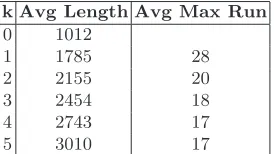
When we look at Stochastically Rewritten braids, we can clearly see the average of the maximum run length between two rewrites of the same signature goes down as one increases the number of iterations of the rewriting method. For instance, we take 100 braids of appoximate length of 1012 generators, and then take each input and run Stochastic Rewriting twice with k
iterations to produce two rewritten outputs. Obviously, the length increases, but surprisingly, the largest jump in length is from k = 0 to k = 1. After that, the length seems to increase linearly. As k increases, the maximal run size decreases (See Table 1).
k Avg Length Avg Max Run
0 1012
1 1785 28
2 2155 20
3 2454 18
4 2743 17
5 3010 17
Table 1.Comparing the average output length and average run length with number of rounds of Stochastic Rewriting
Testing shows that k = 3 represents a “sweet spot”, at least as far as this quantity is concerned. Increasingkbeyond this point does not need to reduce the average maximal length.
8
A New Braid Collecting Method
In the case of the trivial partition of N−1,P = {0, N−1}, the y–generators take the form
y1 =b1b2 · · · bN−1
y2 =b2 · · · bN−1 ...
yN−1 =bN−1.
Observe that the following relations hold: for i = 2, . . . , N −1,
yiy1 = y1yi−1y
−1 N−1.
Some simple manipulations with the above yields a second set of relations:
y−i 1y1 = y1yN−1y −1 i−1,
and we see that given an arbitrary word in the y-generators, w, it is possible to express w in the form
wherew1 is a word in the generators{y2, . . . , yN−1}. This method of moving all the occurrences
of y1 in wto the left is a collecting method akin to commutator collection methods (see [31]).
This process can be continued because occurrences of yi can be collected on the left once occurrences of yi−1 have been collected via the relations:
yjyi = yiyj−1yN−1−1 if i < j,
and
y−1
j yi = (
yiyN−1y −1
j−1, ifj > i
yi−1y −1 N−1y
−1
i , ifj < i.
The above formulae can be extended to moving powers of yi past powers ofy±j1. For example, when i < j, we have
yj yki =
yik yj−k yN−1−k, k < j−i,
yik+1 yN−1−k, k =j −i,
yik+1 yN−(k−j+i)) y−N1−k, j−i < k < N −i,
yik+1 yj yi−1, k =N −i,
yiN−i+1 yj, k =N −i+ 1.
The output of this collection method is a sequence of decompositions of the original word
w:
w = =ya1 1 w1 w = ya1
1 y
a2 2 w2
...
w = ya1
1 y2a2 · · ·yaN
−1 N−1 wN−1
where wi is an expression in the generators
{y−11, y−21, . . . , yN−1−1, yi+1, . . . , yN−1}.
Note that in the final output of the collection method, ya1
1 y2a2 · · · yaN
−1
N−1 wN−1 the wordwN−1 only involves inverses of y-generators, i.e.,
w = ya1
1 y2a2 · · · y
aN−1
N−1 ·negative word.
Thus, the output is an expression of significantly different form when compared to the original expression forw. While it is beyond the scope of this paper, this collecting method has potential to be another means of obscuring a braid.
9
Implementation Experience
Bob’s public key is the second-largest operation. Third largest is generating Alice’s public key. Generating the shared secret, because it uses E-Multiplication, is extremely fast.
For testing purposes, we chose two configurations, B16, F32, r = 32, L= 22 for a 128-bit
security level, and B16, F256, r= 32, L= 43 for a 256-bit security level. Then, we generated 250 keysets for Alice which include z, T-values, and Bob’s conjugates. For each keyset, we then created 20 Alice keys and 20 Bob keys and ran the key exchange.
At the 128-bit security level, the lengths of z varied from 141 to 332 generators with an average length of 212.76 and standard deviation of 35.21. Using these private braids, the conjugates (after using BKL Normal Form to obfuscate them and Dehornoy Reduction to reduce them) ranged in length from 422 to 1,868 generators with an average length of 884.45 and a standard deviation of 196.7.
Alice’s private key, generated directly from z, ranged in length from 328 to 752 with an average length of 489.15 and standard deviation of 70.78. Bob’s private key, however, is generated from the conjugates and is expected to be much longer. Specifically, because it is generated by 22 words in the conjugates (and inverses), they ranged from 6,876 to 22,554 generators with an average length of 12,378.83 and a standard deviation of 2,554.93.
Alice and Bob’s public keys are generated by creating cloaking elements around their private keys and then running the result through Stochastic Rewriting. This results in a public key for Alice ranging from 2,018 to 4,218 generators with an average length of 3,025.33 and a standard deviation of 288.57. Bob’s public key ranged from 12,900 to 57,972 with an average of 30,141.29 and a standard deviation of 5,974.7. This is an average increase of 2.4x to 6.2x over the private key. Alice’s public key increased more over the private key because the cloaking elements were a larger percentage of the raw public key before processing with Stochastic Rewriting.
For 256-bit security, the lengths of z varied from 241 to 496 generators with an average length of 359.05 and standard deviation of 48.11. The conjugates created by these braids (after BKL and Dehornoy) resulted in a length from 740 to 2,698 generators with an average length of 1,463.84 and a standard deviation of 269.
Using these parameters, Alice’s private key ranged in length from 568 to 1,114 generators with an average length of 825.05 and a standard deviation of 97.33. Generating Bob’s private key in 43 words in the conjugates results in a length ranging from 17,530 to 54,030 with an average length of 32,205.33 and a standard deviation of 5,208.67.
An astute reader will notice that Alice’s private key is on average twice as long when doubling the security level, whereas Bob’s private key is, on average, 2.6 times longer (just a bit over double in length). This implies, due to the linear nature of E-Multiplication, that the operation will take twice as long to process.
The private keys at 256-bit are also approximately double in size from their 128-bit siblings. After Stochastic Rewriting, Alice’s public keys ranged from 3,086 to 5,694 generators with an average of 4,329.93 and standard deviation of 366.35. Bob’s public keys ranged from 37,356 to 132,200 generators with an average length of 76,458.29 and a standard deviation of 11,919.39. Note that it is possible to run Dehornoy Reduction on Bob’s public key prior to Stochastic Rewriting. This will condense the private-key portion (removing the intermediary, adjacent z
and z−1
Specifically, if we run Dehornoy first, then this reduces Bob’s public key to the range of 6,500 to 12,856 generators, with an average of 9,737.46 and a standard deviation of 1,446.99. Running Stochastic rewriting on these reduced public keys results in an output ranging from 15,768 to 32,170 generators, with an average of 24,512.09 and a standard deviation of 3,621.32. This is a reduction of 3x from the original non-reduced keys.
It should be noted that Dehornoy could also be run after Stochastic Rewriting, but the resulting shortening of the public key may not offset the time required to run Dehornoy at that point in the process. Moreover, whether or not to run Dehornoy prior to Stochastic Rewriting is more affected by the length of Bob’s raw private key. Specifically, as the security level is increased or r is decreased, increasing the resulting L, the length of the raw private key increases.
If we run Dehornoy on the SL256 public keys once more, this reduces them to a range of 6,478 to 12,988 generators, with an average of 9,753.63 and a standard deviation of 1,430.71. These lengths are similar to the lengths obtained by the first Dehornoy operation, however, these versions are better-mixed than the original.
Studying the exact points of when it is beneficial to apply Dehornoy is left as an exercise for the reader. For example, we did not test running Dehornoy after Stochastic Rewriting on the raw public key. Most likely the end length would again result in similar output, but this would be future work.
10
Conclusions
This paper introduced the Kayawood Key Agreement Protocol, a quantum-resistant, Diffie-Hellman-like, Elgamal-style method based on infinite group theory. It analyzed its security and provided a security reduction. The paper also introduced Stochastic Rewriting and a new braid collecting method as alternative methods to obscure braids. Due to the non-cyclic, non-abelian nature of the underlying group, Kayawood is not subject to Shor’s quantum algorithm, and because the data grows linearly, defeating Grover’s quantum search algorithm only requires doubling the computation time. Consequently, Kayawood is an interesting, quantum-resistant method.
References
1. I. Anshel; M. Anshel; D. Goldfeld, An algebraic method for public-key cryptography, Math. Res. Lett. 6 (1999), 287-291.
2. I. Anshel; M. Anshel; D. Goldfeld; S. Lemieux,Key agreement, the Algebraic EraserT M, and Lightweight Cryptog-raphy,Algebraic methods in cryptography, Contemp. Math., vol. 418, Amer. Math. Soc., Providence, RI, 2006, pp. 1–34.
3. I. Anshel; D. Atkins; D. Goldfeld; P. E. Gunnells,A Class of Hash Functions Based on the Algebraic Eraser,2015.
4. I. Anshel; D. Atkins; D. Goldfeld; P. E. Gunnells, Hickory HashTM: Implementing an Instance of an Algebraic EraserTM Hash Function on an MSP430 Microcontroller,2016, https://eprint.iacr.org/2016/1052.
5. I. Anshel; D. Atkins; D. Goldfeld; P. E. Gunnells,WalnutDSATM: A Quantum-Resistant Digital Signature Algorithm, to appear.
7. I. Anshel; D. Atkins; D. Goldfeld; P. E. Gunnells, Defeating the Ben-Zvi, Blackburn, and Tsaban Attack on the Algebraic Eraser, arXiv:1601.04780v1 [cs.CR].
8. D. Bacon; A. Childs; W. van Dam, From optimal measurements to efficient quantum algorithms for the hidden subgroup problem over semidirect product groups, 46th Annual IEEE Symposium on Foundations of Computer Science, pages 469–478, 2005.
9. M. Bellare; D. Pointcheval; P. Rogaway,Authenticated Key Exchange Secure Against Dictionary Attacks, Advances in Cryptology – Eurocrypt 2000, Lecture Notes in Computer Science.
10. C. H. Bennett; E. Bernstein; G. Brassard; U. Vazirani,Strengths and weaknesses of quantum computing,SIAM J. Comput., 26(5):1510–1523, October 1997.
11. A. Ben-Zvi; S. R. Blackburn; B. Tsaban,A practical cryptanalysis of the Algebraic Eraser, CRYPTO 2016, Lecture Notes in Computer Science 9814 (2016), 179–189.
12. T. Beth; M. R¨otteler,Polynomial-time solution to the hidden subgroup problem for a class of non-abelian groups,
1998, arXiv:9812070.
13. J. Birman; K. H. Ko; S. J. Lee, A new approach to the word and conjugacy problems in the braid groups,Adv. Math. 139 (1998), no. 2, 322–353.
14. J. Birman,Braids, Links and Mapping Class Groups, Annals of Mathematics Studies, Princeton University Press, 1974.
15. P. Dehornoy,A fast method for comparing braids,Adv. Math. 125 (1997), no. 2, 200–235.
16. K. Friedl; G. Ivanyos; F. Magniez; M. Santha; P. Sen, Hidden translation and orbit coset in quantum computing.
In Proc. 35th Annual ACM Symposium on Theory of Computing, pages 1–9, 2001.
17. D. Garber; S. Kaplan; M. Teicher; B. Tsaban; U. Vishne,Length-based conjugacy search in the braid group,Algebraic methods in cryptography, 75-87, Contemp. Math., 418, Amer. Math. Soc., Providence, RI, 2006.
18. D. Gavinsky,Quantum solution to the hidden subgroup problem for poly-near- hamiltonian groups,Quantum Infor-mation and Computing, 4:229–235, 2004.
19. V. Gebhardt,A new approach to the conjugacy problem in Garside groups, J. Algebra 292(1) (2005), 282–302.
20. M. Grigni; L. Schulman; M. Vazirani; U. Vazirani, Quantum mechanical algorithms for the nonabelian hidden subgroup problem,in Proc. 33rd Annual ACM Symposium on Theory of Computing, page 6874, 2001.
21. L. K. Grover,A fast quantum mechanical algorithm for database search,Proceedings, 28th Annual ACM Symposium on the Theory of Computing, (May 1996) p. 212.
22. D. Goldfeld and P. Gunnells, Defeating the Kalka-Teicher-Tsaban linear algebra attack on the Algebraic Eraser, Arxiv eprint 1202.0598, February 2012.
23. P. Gunnells,On the cryptanalysis of the generalized simultaneous conjugacy search problem and the security of the Algebraic Eraser,arXiv:1105.1141v1 [cs.CR].
24. M. I. G. Vasco; S. Magliveras and R. Steinwandt, Group-theoretic cryptography, Chapman & Hall / CRC Press, (2015).
25. D. Hofheinz; R. Steinwandt, A practical attack on some braid group based cryptographic primitives, Public Key Cryptography, Proceedings of PKC 2003 (Yvo Desmedt, ed.), Lecture Notes in Computer Science, no. 2567, Springer-Verlag, 2002, pp. 187-198.
26. A. Kalka, M. Teicher and B. Tsaban, Short expressions of permutations as products and cryptanalysis of the Algebraic Eraser, Advances in Applied Mathematics 49 (2012), 57-76.
27. A. Y. Kitaev,Quantum measurements and the Abelian stabilizer problem,1995, quant-ph/9511026.
28. K. H. Ko, S. J. Lee, J. H. Cheon, J. W. Han, J. Kang, and C. Park,New public-key cryptosystem using braid group,
in Advances in Cryptology–CRYPTO 2000 (M. Bellare, ed.), Lecture Notes in Computer Science 1880 (Springer, Berlin, 2000), 166–183.
29. C. Kudla and K. Paterson, Modular Security Proofs for Key Agreement Protocols, in Advances in Cryptology– ASIACRYPT 2005, Lecture Notes in Computer Science 3788.
30. C. Lomont,The hidden subgroup problem - review and open problems,2004, arXiv:0411037.
32. A. D. Myasnikov and A. Ushakov,Cryptanalysis of the Anshel-Anshel-Goldfeld-Lemieux key agreement protocol, Groups Complex. Cryptol. 1 (2009), no. 1, 63-75.
33. A. G. Myasnikov, V. Shpilrain, and A. Ushakov, Group-based Cryptography, Advanced Courses in Mathematics CRM Barcelona (Birkh¨auser, Basel, 2008).
34. M. S. Paterson; A. A. Razborov,The Set of Minimal Braids is co-NP-Complete,J. Algorithms,12, (1991), 393–408.
35. P. Shor,Polynomial-time algorithms for prime factorization and discrete logarithms on a quantum computer,SIAM J. on Computing, (1997) 1484–1509.
36. T. F. Smith; M. S. Waterman (1981), Identification of Common Molecular Subsequences, Journal of Molecular Biology, 147: 195–197. doi:10.1016/0022-2836(81)90087-5. PMID 7265238.