A Hybrid Approach for Proving Noninterference of Java Programs
Ralf Küsters∗, Tomasz Truderung∗, Bernhard Beckert†, Daniel Bruns†, Michael Kirsten† and Martin Mohr† ∗University of Trier, Germany
Email: {kuesters,truderung}@uni-trier.de †Karlsruhe Institute of Technology, Germany
Email: {bernhard.beckert,daniel.bruns,michael.kirsten,martin.mohr}@kit.edu
Abstract—Several tools and approaches for proving nonin-terference properties for Java and other languages exist. Some of them have a high degree of automation or are even fully automatic, but overapproximate the actual information flow, and hence, may produce false positives. Other tools, such as those based on theorem proving, are precise, but may need interaction, and hence, analysis is time-consuming.
In this paper, we propose a hybrid approach that aims at obtaining the best of both approaches: We want to use fully automatic analysis as much as possible and only at places in a program where, due to overapproximation, the automatic approaches fail, we resort to more precise, but interactive analysis, where the latter involves the verification only of specific functional properties in certain parts of the program, rather than checking more intricate noninterference properties for the whole program.
To illustrate the hybrid approach, in a case study we use this approach—along with the fully automatic tool Joana for checking noninterference properties for Java programs and the theorem prover KeY for the verification of Java programs—as well as the CVJ framework proposed by Küsters, Truderung, and Graf to establish cryptographic privacy properties for a non-trivial Java program, namely an e-voting system. The CVJ framework allows one to establish cryptographic in-distinguishability properties for Java programs by checking (standard) noninterference properties for such programs.
Keywords-language-based security; noninterference; pro-gram analysis; code-level cryptographic analysis
I. INTRODUCTION
The problem of checking noninterference properties of programs has a long tradition in the field of computer security and, in particular, in language-based security [1]. A program is called noninterferent (w.r.t. confidentiality) if no information from high variables, which contain confidential information, flows to low variables, which can be observed by the attacker or an unauthorized user. Several tools and approaches exist in the literature for checking noninterfer-ence. Some approaches, such as type checking [2], [3], [4], [5], [6], [7], abstract interpretations [8], and program dependency graphs (PDGs) [9], with tools including JIF [10], TAJ [11], Joana [9], as well as tools described in [8] and [12], have a high degree of automation, but they overapproximate the actual information flow, and hence, may produce false positives. Other approaches—such as those based on theorem proving—allow for precise analysis, but
need human interaction, and hence, the analysis is often time-consuming (see, e.g., [13], [14], [15], [16], [17], [18], [19], [20], [21], [22], [23], [24]).
Fully automated tools are often preferable over interactive approaches since with such tools program analysis is typi-cally less time-consuming and might require less expertise. However, if automated tools fail due to false positives and the analysis cannot further be refined by these tools, because, for example, the tools do not allow this or run into scalability problems, the only option for proving noninterference so far is to drop the automated tools altogether and instead turn to fine-grained but interactive, and hence, more time-consuming approaches, such as theorem proving. This “all or nothing” approach is unsatisfying and problematic in practice.
Contributions. In this paper, we therefore propose a tool-independent hybrid approach, which allows one to use (fully) automated verification tools for checking noninterference properties as much as possible and only resort to more fine-grained, but possibly interactive verification tools (typically theorem provers) at places in a program where necessary. The latter verification requires checking specific functional properties in (parts of) the program only, rather than check-ing the more involved noninterference properties.
typically be carried out by an (interactive) theorem prover. The key property that we show for the hybrid approach to work is that if the extended program is noninterferent and is a conservative extension of the original program, then the original program is noninterferent as well. We note that in this work we are concerned with termination-insensitive noninterference since this suffices to prove cryptographic properties for Java programs (see below). However, the basic idea should also be applicable to termination-sensitive noninterference.
While our hybrid approach should be widely applicable— it is not tailored to specific tools or specific applications, and the basic idea is quite independent of a specific programming language—, our main motivation stems from the problem of checking, on the code level, cryptographic properties of programs (that use cryptography), where here we consider Java programs. This has become an active field of research in the last few years (see, e.g., [25], [27], [28], [29], [30], [31] for some of the recent works). More specifically, we use the CVJ framework (cryptographic verification of Java programs) proposed by Küsters, Truderung, and Graf [25] for this purpose. This framework enables tools that can check (standard) noninterference properties for Java programs, but a priori cannot deal with cryptography, to establish cryp-tographic indistinguishability properties for Java programs. The CVJ framework combines techniques from program analysis and universal composability [32], [33], [34]. Given a Java program (that uses cryptography), the idea is to first check noninterference for this program where cryptographic operations (such as encryption) are performed within so-called ideal functionalities, in the sense of universal com-posability. The cryptographic framework then guarantees that the actual Java program, where the ideal functionalities are replaced by the actual cryptographic operations, enjoys cryptographic indistinguishability properties.
In order to illustrate our hybrid approach, in a case study we use this approach and the CVJ framework to establish cryptographic privacy properties for a non-trivial Java program, namely an e-voting system. In addition to human actors (voters, auditors, clerks), the system involves a voting machine, which gathers all votes and calculates the election result, and a bulletin board on which the result and other information of the election is published. Now, in order to establish cryptographic privacy properties for this Java system it suffices, according to the CVJ framework, to verify that this system (when run using ideal function-alities for public-key encryption and digital signatures) is noninterferent. To establish noninterference, we use the fully automated tool Joana [9]. However, this tool produces a false positive. (Since establishing noninterference for our case study requires quite intricate reasoning, it seems that all fully automated tools would fail.) We therefore extend the system to avoid the false positive following our hybrid approach, have Joana prove that this extension indeed is noninterferent,
and finally prove that the extension is conservative, using the software verification system KeY [35], which is based on theorem proving for dynamic logics. By our hybrid approach, this implies that the system (running with ideal functionalities) is noninterferent. The CVJ framework then immediately yields cryptographic privacy of the Java system when the ideal functionalities are replaced by the actual cryptographic implementations.
Structure of the paper. We first briefly recall some prelim-inary definitions in SectionII, before we present the hybrid approach in SectionIII. For our case study, we also briefly recall the CVJ framework in SectionIVand, in SectionV, provide some more background on the tools Joana and KeY that we use. The case study, including the description of the e-voting system and the verification process, is then presented in SectionVI. We conclude in SectionVIII. Some more details and proofs are provided in the appendix. The source code of the e-voting system, all proofs scripts, and machine generated proofs are available online [36].
II. PRELIMINARIES
We briefly recall the notion of noninterference and also present the Java-like language Jinja+, for which the hybrid approach as well as the CVJ framework [25] are stated and proven.
Jinja+.The Java-like languageJinja+[25] is based onJinja [26] and extends this language with some additional features that are relevant in practical applications.
Jinja+ covers a rich subset of Java, including classes, inheritance, (static and non-static) fields and methods, the primitive types int,boolean, andbyte(with the usual op-erators for these types), arrays, exceptions, and field/method access modifiers, such aspublic,private, andprotected. It also includes a primitive randomBit() that returns a random bit each time it is called.
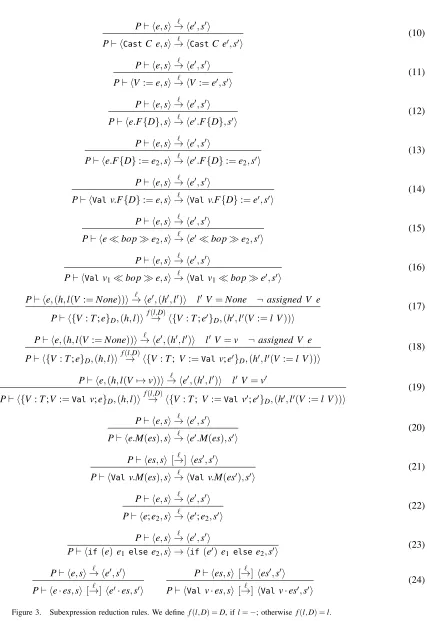
A (Jinja+) program/system is a set of class declarations. A class declaration consists of the name of the class, the name of its direct superclass, a list of field declarations, and a list of method declarations. A program/system isclosedif it uses only classes/methods/fields declared in the program itself. A program is deterministic if it does not use the randomBit() primitive. Note that in fact ifrandomBit() is not used in a program, then up to reference renaming the run of a program is deterministic. (Names of references do not have any effect on the behavior of the program.) For the reader’s convenience, we recall the syntax and semantics of Jinja+ programs in Appendix B.
All Java programs considered in this paper, including the systems considered in our case study as well as the ideal functionalities and their realizations, fall into the Jinja+ fragment.
from high to low variables within a program. Here, we define noninterference for closed deterministic (Jinja+) programs where some static variables of primitive types are labeled as high and some other static variables of primitive types are labeled as low. We denote such programs byP[~x] where~x is a vector of the variables that are labeled as high inP. For simplicity of notation, the variables in P[~x] that are labeled as low are omitted in the notation. By P[~a] we denote the programPwhere the high variables~xare initialized with the values~aand the low variables are initialized as specified in P.
Now, noninterference for a closed deterministic program is defined as follows: LetP[~x]be a program as above. Then, P[~x]is noninterferent/has the noninterference propertyif the following holds true: for all~a1and~a2(of appropriate type), ifP[~a1]andP[~a2]terminate, then at the end of their runs, the values of the low variables are the same. Recall that variables marked low or high are assumed to be static variables of primitive types and note that the above defines termination-insensitive noninterference.1 This is sufficient for applica-tions concerned with cryptographic security properties (see Theorem 3). More general definitions of non-interference can for example be found in [38].
III. A HYBRIDAPPROACH FORPROVING NONINTERFERENCE
In this section, we present our hybrid approach. As al-ready mentioned in the introduction, this approach provides a method to leverage the precision of certain tools, such as theorem provers (e.g., KeY), in order to allow less precise, but automated tools, such as Joana, to prove noninterference of programs which otherwise they would not be able to deal with.
A. Outline of the Approach
The hybrid approach can be used when an automated tool is employed to prove noninterference of a given programP but the tool reports (as we believe) a false positive, i.e., illegal information flow in a point of a program where (again, as we believe) there is no such illegal flow. Clearly, at this point, one option could be to try to use a more precise, but interactive tool, and drop the automated tool altogether. This would, however, typically involve a substantial, potentially unacceptable amount of work. Our hybrid approach opens up another possibility which combines the advantages of i) automated, but imprecise, and ii) precise, but interac-tive tools. When applying our approach, one still uses the automated tool as much as possible and resorts to other, more interactive tools only at places in the program where necessary, namely where the automated tool failed.
1Also note that in this definition we do not consider low input. However,
such low input will be captured in the stronger notion ofI-noninterference, where we consider and universally quantify over arbitrary environments (adversaries). These environments provide arbitrary low input.
Our hybrid approach works as follows. Given a program Pas above, for which an illegal information flow is reported by the automated tool, we first provide an extensionP0ofP. We do this following the rules (explained below) of our approach in such a way that (a) it is made (more) explicit for the automated tool that there is no illegal information flow inP0 and (b) P0 extends P in what we call a conservative way. Now, one uses the automated tool to verify thatP0 is noninterferent. If the automated tool should still fail to prove noninterference for P0, because of another (as we believe) false positive, one can further extend P0 in a conservative way, and so on. Once, noninterference ofP0 is established, it remains to verify thatP0is in fact a conservative extension ofP0. As we will see below, being a conservative extension is a specific functional property. To prove this property, we typically need support of a more precise, but possibly interactive tool, e.g., a theorem prover. However, this should typically involve analyzing only a smaller fragment of the overall program. Being a functional property, this approach is more practical than to prove noninterference properties (of the complete program). If now noninterference and conservatism of P0 is established, our hybrid approach (see Theorem1) implies noninterference of the original program P.
In a nutshell, to construct a (conservative) extension of a program P, one adds an additional component M to the program P. This component is constructed in such a way that its state is isolated from the state of P. The component M is then used to collect some low data and explicitly “kill” potential illegal information flow paths, as explained below.
B. Formalizing the Hybrid Approach
In the following definition, we consider a deterministic and closed program P[~x], with the variables~x labeled as high, as in the definition of noninterference. In what follows, we first define the notion of an extension of such a program and then the notion of a conservative extension. We then state the main theorem, which says that if the conservative extension of a program enjoys noninterference, then so does the original program.
Definition 1 (Extension). Let P=P[~x] be a deterministic and closed (Jinja+) program. Anextension of Pis a program P0=P0[~x]obtained fromPin the following way. First, a new component M is added to P consisting of some number of classes with the following properties:
(i) the methods and fields of the classes inM are static, (ii) the arguments and the results of the methods ofM are
of primitive types,
(iii) the methods ofM do not refer to classes defined inP (in particular, no methods and fields ofP are used in M),
Second,Pis extended by adding statements of the following form in arbitrary places within methods ofP:
(a) (output to M)
C.f(e1, . . . ,en) (1)
whereC is a class in M with a (static) method f and e1, . . . ,enare expressions without side effects.
(b) (input from M)
r=C.f(e1, . . . ,en), (2)
whereC is a class inM,C.f is a (static) method with some (primitive) return type τ, e1, . . . ,en are expres-sions as above, and r is an expression that evaluates without side effects to a reference of type τ. (Such an expression can, for example, be a variable or an expression of the form o.x, where o is an object with fieldx.)
The property of being an extension of a program typically is easy to verify. Conditions (i) to (iii) can easily be checked syntactically. As for Condition (iv), typicallyM should be a quite simple class, and hence, it should be easy to see that methods cannot throw exceptions. If there are potentially problematic operations, one can explicitly catch them inside M. Whether this is done can, again, be checked syntactically. Similarly, for Condition (v) there are simple syntactical criteria such as a lack of loops and recursion. These criteria seem to suffice for the typical ways in which conservative extensions are constructed, as we expect them to be simple. Note that an extension is defined in such a way that the state of the added component M is separated from the state of P (these components do not share references; see Appendix A for a formal definition of state separation). Moreover, additional statements of the form (1) do not change the state of P. Only statements of the form (2) could potentially change the state ofP. We call an extension conservative if this, however, is not the case:
Definition 2 (Conservative extension). An extension P0[~x] of P[~x] is called aconservative extension of P[~x], if for all initial values~a of high variables~xthe following is true in the run of P0[~a]: Whenever a statement of the form (2) is executed, it does not change the value ofr. That is, the value of r rightbefore the execution of the assignment coincides with the value returned by the method callC.f(e1, . . . ,en). As such, statement (2) is redundant.
The intuition behind the above definitions is the following. In a conservative extension P0 of P, not only the state of M is disjoint from the state of the original programP, but additionally all the added statements preserve the state ofP (and hence are redundant). Altogether,Pand its conservative extension P0 are equivalent in that they produce the same runs up to calls toM and up to the state ofM.
Being a conservative extension obviously is a functional property. Proving this property requires a (possibly
non-trivial) proof. For such a proof one would typically use an (interactive) theorem prover. However, for the hybrid approach it clearly does not matter by what means conser-vatism is established. If this property can be established by some automated tool (probably a different tool than the one used for proving noninterference of P0), then one can of course use such a tool.
As illustrated by our example below and our case study in SectionVI, proving conservatism will typically be some-thing that one implicitly would have to prove even if one tried to prove noninterference directly for the original pro-gramP: In the conservative extensionP0 certain information flows are canceled out explicitly. This will typically be one of the “puzzle pieces” for the noninterference of P anyway. So, the hybrid approach typically will not add proof obligations.
Now, following the intuition that the runs of a program Pand a conservative extension ofPproduce the same runs up to calls toM and the state ofM, we prove the following theorem (see AppendixAfor the full proof). The theorem says that if a conservative extension of a program with high and low variables is noninterferent, then so is the program itself. Note that part of the proof of the theorem is that the conditions for M in Definition 2 in fact guarantee that M does not change the state of a program.
Theorem 1. Let P[~x] be a program with the variables~x labeled as high and variables~y labeled as low. Let P0[~x]be a conservative extension of P[~x]such that in P0[~x]again the variables in~x are labeled as high and those in~y are labeled as low. Then, if P0[~x]is noninterferent, then so is P[~x].
Proof sketch: Let P0[~x] be a conservative extension of P[~x]. Recall that the high variables ~x, as well as the low variables~y, are assumed to be static and of primitive types. Notice also that these variables do not occur in M (the additional class of P0).
Now, suppose that the program P0[~x] is noninterferent, whereas the original program P[~x] is not. This means that there exist values ~a1 and ~a2 such that P[~a1] and P[~a2] terminate and for the final values~b1 and~b2, respectively, of the low variables~ywe have that~b16=~b2.
Clearly, the variables ~y are part of the state of the original program P. Therefore, one can show that, due to the separation of states of the original program P and the state ofM and because the additional statements added toP do not change the state ofP, the programsP0[~a1] andP0[~a2] (1) terminate as well and, moreover, (2) terminate with the same final values of the low variables ~y, namely with~b1 and~b2, respectively. Since~b16=~b2, this, however, means— contrary to what we have assumed—that the program P0[~x] is not noninterferent. Hence we have reached a contradiction and proven that P[~x] is noninterferent. We refer the reader to Appendix Afor the full proof.
proof.
The definitions and results stated above do not say how one can come up with a conservative extension of a program. This process is not automatic and requires some understand-ing of the analyzed program and the automated tool that is used.2 We now explain this process.
C. Constructing a Conservative Extension
As sketched above, the approach to come up with a conservative extension of a program is as follows: For the sake of the discussion, say that some potentially high information flows into some variable vand from this point this information flows to some low variables. If the value assigned tovdoes not actually depend on high variables, the conservative extension should make this more explicit. For this purpose, the componentM should be provided with low data that is sufficient to compute the value forv. This is done by adding statements of the form (1) in Definition1(output to M) in such a way that it is apparent for the automated tool that the data given toM is low. Then, at the problematic point in the program (typically after the point in the original program wherevis assigned a value) an assignment to vof the form (2) in Definition 1(input fromM) is added to the program to make it more explicit for the automated tool that vdepends on low data only. In other words, the assignment explicitly “kills” potential dependencies from high data.
We illustrate this general idea by a toy example, with a more interesting and complex case study presented in Section VI. More specifically, by the example presented below we illustrate the process of running into a false positive with an automated tool, extending the code, proving that this extension has the desired noninterference property (using some automated tool), and proving that the extension is conservative (by some interactive theorem prover). The example also demonstrates that the hybrid approach can be very beneficial, compared to giving up on automated analysis altogether and switching to an interactive theorem prover for checking noninterference for (the whole) program.
Example. We consider the following Java program, where secretis declared to be a high variable andresultis low.
1 class Example {
2 static public int result;
3 static private int a;
4 public static void main(int secret) { 5 a = 42;
6 bar(secret);
7 int b = foo(secret); 8 result = b;
2Note that proving noninterference properties for the whole program,
rather than functional properties for parts of the program, with an interactive tool would typically require much more understanding of the program and human interaction. Also, and importantly, as explained, typically proving conservatism would implicitly be part of the proof of noninterference of the original program anyway.
9 }
10 static int foo(int secret) { 11 int b = a;
12 // M.set(a);
13 if (secret==0) b+=secret;
14 // b = M.get();
15 return b;
16 }
17 static void bar(int secret) {
18 ...
19 }
20 } 21
22 /*
23 class M {
24 static int x;
25 public static void set(int n) { x=n; }
26 public static int get() { return x; }
27 } 28 */
We applied the fully automated tool Joana for checking noninterference for Java programs to this example (see SectionV-Afor more information about Joana), wherebar was some piece of code on which Joana did not report an illegal information flow. Joana reported in method foo, line13a potential information flow from the variablesecret to the variable b, the value of which is then returned and assigned to the low variableresult. This flow is, however, not real, as can easily be seen: the value ofbis in fact not altered in line13and it only depends on the low variablea. We can easily make this nondependency explicit by adding (uncommenting) the classMand uncommenting lines12and 14. Now, Joana establishes noninterference for this extended program without problems.3 Note that, in particular, Joana tells us that the method bar does not cause a, and hence, result to depend on high information.
It remains to prove that the extension is conservative, i.e., that before executing line14the variablebcarries the value returned by M.get() (= a). This is merely a functional property which can easily be verified using the theorem prover KeY (see SectionV-Bfor more background on KeY). Note that in order to prove this property, KeY has to analyze only the code of the methodfooand the classM. In particular, it does not have to touch the potentially large methodbar or other methods or classes that might be contained in the program. So the analysis one has to perform with the theorem prover, KeY in this case, is relatively simple in that for checking the functional property only part of the program has to be touched (rather than the whole program) and checking the functional property would be part of a full-fledged noninterference proof anyway.
Now, by the results of Joana and KeY, Theorem1implies that our original example program (with the class M and
3We note that for this the fact that Joana is flow sensitive is important.
lines12and14commented out) enjoys the noninterference property, a fact that with Joana alone could not have been established.
We note that even in complex applications, M will often be very simple. Therefore, to ease the notation, one can often safely inline the code of methods of M. In the above example, one could replace lines12and14byM.x = aand b = M.x, respectively. In some cases, one can even move static fields of M to the original program and get rid of M completely. In our example, we could obtain an equivalent variant by declaringxto be a static field of classExampleand replace lines12and14byx = aandb = x, respectively.
IV. FRAMEWORK FORCRYPTOGRAPHICVERIFICATION OFJAVAPROGRAMS
As already mentioned in the introduction, while the hybrid approach should be widely applicable (it is not tailored to specific tools or applications), our main motivation for devising methods for proving noninterference properties comes from the problem of establishing cryptographic guar-antees, in particular, cryptographic indistinguishability, for Java programs.
In [25], a framework, which is referred to as the CVJ framework, for cryptographic verification of Java programs, has been proposed which enables tools that can check (standard) noninterference properties for Java programs, but a priori cannot deal with cryptography (probabilities, poly-nomially bounded adversaries), to establish cryptographic indistinguishability properties of Java programs. For this purpose, the framework combines techniques from program analysis and universal composability. Given a Java program that uses cryptographic operations, the framework shows that in order to verify that the program enjoys a cryptographic indistinguishability property it suffices to prove, using the tools, that the program enjoys a (standard) noninterference property when the cryptographic operations are replaced by so-called ideal functionalities. The reason for using ideal functionalities is that they often do not involve probabilistic operations and are secure even for unbounded adversaries, which are the kind of adversaries considered for standard noninterference properties. The framework has been stated and proven in [25] for the language Jinja+ (see SectionII). In this section, we briefly recall the CVJ framework. The definitions and theorems stated here are somewhat simplified and informal, but should suffice to follow the rest of the paper. We refer the reader to [25] for full details.
Indistinguishability. Aninterface Iis defined like a (Jinja+) system but where (i) all private fields and private methods are dropped and (ii) method bodies as well as static field initializers are dropped. A systemS implementsan interface I, writtenS:I, ifIis a subinterface of the public interface of S. We say thata system S uses an interface I, writtenI`S, if, besides its own classes,Suses at most classes/methods/fields declared in I. We write I0`S:I1for I0`SandS:I1.
For two systemsSandT, we denote byS·T the composi-tionofSandT which, formally, is the union of (declarations in)SandT. Clearly, for the composition to make sense, we require that there are no name clashes in the declarations of S and T. Of course, S may use classes/methods/fields provided in the public interface ofT, and vice versa.
A system E is called an environment (or adversary) if it declares a distinct private static variable result of type boolean with initial valuefalse. Given a system S:I, we call E an I-environment for S if there exists an interface IE disjoint from I such that IE `S:I and I`E:IE. Note that E·S is a closed program. The value written by E to resultat the end of a run ofE·Sis called theoutputof the programE·S; the output is false for infinite runs. IfE·S is a deterministic program, we writeE·S trueif the output ofE·S istrue. IfE·S is a randomized program, we write Prob{E·S true}to denote the probability that the output ofE·S istrue.
We assume that all systems have access to a security parameter (modeled as a public static variable of a class SP). We denote byP(η)a programPrunning with security
parameterη.
To define computational equivalence and computational indistinguishability between (probabilistic) systems, we con-sider systems that run in (probabilistic) polynomial time in the security parameter, referred to asprobabilistic polyno-mially bounded systems. We omit the details of the runtime notions used in the CVJ framework, but note that the runtimes of systems and environments are defined in such a way that their composition results in polynomially bounded programs.
LetP1andP2be (closed, possibly probabilistic) programs. We say thatP1andP2arecomputationally equivalent, writ-tenP1 ≡comp P2, if|Prob{P1(η) true} −Prob{P2(η)
true}|is a negligible function in the security parameterη.4 Let S1 and S2 be probabilistic polynomially bounded systems. ThenS1andS2are computationally indistinguish-able w.r.t. I, written S1 ≈Icomp S2, if S1:I, S2:I, both systems use the same interface, and for every polynomially bounded I-environment E for S1 (and hence, S2) we have thatE·S1 ≡comp E·S2.
Simulatability and Universal Composition. We now de-fine what it means for a system to realize another system, in the spirit of universal composability. Security is defined by an ideal systemF (also called an ideal functionality), which, for instance, models ideal encryption, signatures, MACs, key exchange, or secure message transmission. A real system R (also called a real protocol) realizes F if there exists a simulatorSsuch that no polynomially bounded environment can distinguish between R and S·F. So, intuitively, the
4As usual, a function f from the natural numbers to the real numbers is
negligible, if for everyc>0 there existsη0 such that f(η)≤ 1
ηc for all
simulator tries to makeS·F look likeRfor the environment. To provide some intuition, consider, for example, public-key encryption. When instructed to encrypt a message m, the ideal functionalityF would instead encrypt the message 0|m| and it would store the pair (m,c), where c is the ciphertext resulting from encrypting 0|m|. So, by definition of F, the ciphertext c does not contain any information about the plaintext m, except for its length. If later F is asked to decrypt c, it would look up the corresponding plaintext in its table and return this plaintext,min this case. Conversely, in R the actual message would be encrypted and for decryption one would simply apply the decryption algorithm to the given ciphertext. One can show that if the cryptographic algorithms used in R are IND-CCA2-secure (a standard security assumption for public-key encryption schemes), then Rin fact realizes F. Such a result has been proven in [30] for Java implementations of R and F, both for key encryption and digital signatures (with public-key infrastructures). We use these results in our case study in SectionVI.
To define the notion of realization more formally, let F and R be probabilistic polynomially bounded systems which implement the same interface Iout and use the same interface, except that in additionF may use some interface provided by a simulator. Then, we say that R realizes F w.r.t. Iout, writtenR≤IoutF or simplyR≤F, if there exists a probabilistic polynomially bounded systemS(the simulator) such thatR ≈Iout
comp S·F. As shown in [25],≤is reflexive and
transitive. It also enjoys composability, i.e., one can analyze a system using ideal functionalities (such as F) and later replace these functionalities by their realizations (such as R); see also Theorem3.
I-noninterference. The standard notion of (termination-insensitive) noninterference (see Section II) deals with closed programs/systems. For the CVJ framework, this notion is generalized to open systems as follows: Let I be an interface and let S[~x] be a (not necessarily closed) deterministic system with high variables~x such that S:I. Then, S[~x] is I-noninterferent if for every deterministic I-environment E for S[~x] and every security parameter η,
noninterference holds for the system E·S[~x](η), where the
variableresult declared in E is considered to be the only low variable in the systemE·S[~x](η). Note that here neither
E nor Sare required to be polynomially bounded.
Tools for checking noninterference consider only a single closed program. However, I-noninterference is a property of a potentially open system S[~x], which is composed with an arbitrary I-environment. Therefore in [25] a technique was developed which reduces the problem of checking I-noninterference to checking I-noninterference for a single (almost) closed system. More specifically, it was shown that to proveI-noninterference for a systemS[~x]withIE`S:Iit suffices to consider a single environment ˜EI,IE
~u only (simply
denoted by ˜E~u), which is parameterized by a sequence~u of values.5The output produced by ˜E~utoS[~x]is determined by ~uand is independent of the input it gets fromS[~x]. To keep
˜
E~usimple, the analysis technique assumes some restrictions on the interfaces between S[~x] and E. For example, S[~x] and E should interact only through primitive types, arrays, exceptions, and simple objects.
Theorem 2 (simplified, [25]). I-noninterference, for I=/0, holds true for S[~x] if and only if for all sequences ~u noninterference holds true forE˜~u·S[~x].
Analysis tools often ignore or can ignore specific values encoded in a program, such as an input sequence ~u. So, if such an analysis establishes noninterference for E~u·S[~x], with some vector~u, the theorem implies I-noninterference for S[~x].
From I-Noninterference to Computational Indistin-guishability. In [25], it was shown that the problem of verifying cryptographic privacy of the secret (high) input given to a systemS[~x]can be reduced to the simpler problem of verifying I-noninterference for S[~x] where the crypto-graphic operations performed by S[~x]are replaced by ideal functionalities.6This enables tools that can check (standard) noninterference properties but cannot deal with cryptography (probabilities, polynomially bounded adversaries) to estab-lish strong cryptographic privacy properties. Note that such tools assume unbounded adversaries, which can easily break basically all cryptographic operations, such as encryption. The result in [25] avoids this problem by replacing the cryptographic operations by ideal functionalities, which are secure even w.r.t. unbounded adversaries. More specifically, the following theorem immediately follows from results proven in [25].
Theorem 3 (simplified, [25]). Let I and J be disjoint inter-faces. Let F, R, P[~x]be systems such that R≤JF, P[~x]·F is deterministic, and P[~x]·F:I (and hence, P[~x]·R:I). Now, if P[~x]·F is I-noninterferent, then, for all ~a1 and ~a2 (of appropriate type), we have that P[~a1]·R ≈Icomp P[~a2]·R.
The intuition is that the cryptographic operations that P needs to perform are carried out using the systemR(a cryp-tographic library). The theorem says that to prove privacy of the secret inputs (∀ ~a1, ~a2: P[~a1]·R ≈Jcomp P[~a2]·R) it suffices to prove I-noninterference for P[~x]·F, i.e., the system where R is replaced by the ideal counterpart F. To prove I-noninterference for P[~x]·F, one can in turn use Theorem 2 to reduce the problem further to checking standard noninterference, which in turn can be done using the hybrid approach if an automated tool alone would fail.
5The sequence~ucan be seen as low input to ˜E.
6The result in [25] is actually more general and considers general
P
R
E
untrusted libraries (networking,. . . )
∀
P
F
E
untrusted libraries (networking, cryptographic operations, . . . )
∀
P
F
˜
E
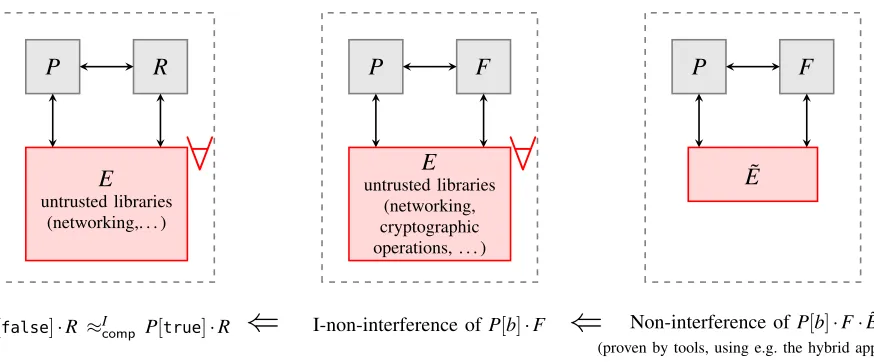
Non-interference ofP[b]·F·E˜~ u (proven by tools, using e.g. the hybrid approach) I-non-interference ofP[b]·F
P[false]·R ≈I
comp P[true]·R
⇐
⇐
Figure 1. By Theorems2and3, tools for proving noninterference can be used to prove cryptographic privacy of a programPthat uses some cryptographic operations (real cryptographic functionalities)Rand is connected to untrusted libraries subsumed by the environmentE(see the left-most system above). For simplicity of presentation, in this figure we assumePto have only one high boolean variable. By these theorems, to prove cryptographic privacy of this system (that isP[false]·R ≈I
comp P[true]·R), it is enough to show (classical) noninterference of the systemP[b]·F·E˜, whereF are the ideal
functionalities corresponding toRand ˜E~u is the specific environment given in Theorem2. Note thatF often uses cryptographic libraries. However, the
cryptographic guarantees are established byFitself (e.g.,Fmight call an encryption function, but with 0|m|instead of the actual messagem, and hence, by
the definition ofFand independently of the encryption function, the ciphertext will not reveal information aboutm, except for the length ofm). Therefore, the cryptographic libraries thatF uses can be untrusted, and hence, provided by the environment. Conversely, the cryptographic library implemented inR is supposed to realizeF. So, this library cannot be subsumed by the environment.
The overall approach is illustrated in Figure1.
Jumping ahead, in our case study (see Section VI), the Java system P[~x]·R (and P[~x]·F) describes an indistin-guishability or privacy game for an e-voting system, where the adversary has to guess a bit b∈ {true,false}. Hence, the high input~x is simply b, and we want to prove that P[false]·R ≈I
comp P[true]·R. This means that the
environ-ment/adversary cannot distinguish whether the secret bit is falseor true.
V. TOOLS
While our hybrid approach does not depend on any specific tools, for the analysis of concrete systems one has to choose tools to perform the analysis (based on the hybrid approach). In our case study and in the toy example from SectionIIIwe use the tools Joana and KeY. In this section, we provide some background about these tools.
A. Joana
Joana7[9], [39] is a tool for the fully automatic analysis
of noninterference properties of Java programs. A user needs to only specify the high and low variables of a program. Joana is based on the program analysis framework WALA.8 It computes a conservative approximation of the information flow inside the program in form of a program dependence graph (PDG). Then, the PDG is checked for
7The sourcecode of Joana and additional information is available at
http://joana.ipd.kit.edu/.
8http://wala.sf.net/
illegal information flows using advanced dataflow analysis based onslicing. If no illegal flow is found in the PDG, the program is guaranteed to be noninterferent. The correctness of this implication has been verified with a machine-checked proof [40] which includes formal specifications of PDGs and the slicing algorithm [41], [42].
The fully automatic analysis performed by Joana comes at the cost of potential false alarms due to overapproxi-mation. Joana leverages sophisticated flow-, context-, field-and object-sensitive analysis techniques that help to reduce such false alarms, but it does not consider actual values of variables. For example, whenever a high variable is used in an expression, the value of the expression is considered to contain high information—even if the value of the high vari-able does not actually influence the result (this phenomenon is also illustrated by the example in SectionIIIand our case study in SectionVI).
B. The KeY Verification System
KeY9 [43], [35], [44] is an integrated program
verifi-cation system, which targets sequential Java. At its core lies an interactive theorem prover for first-order dynamic logic (JavaDL) [45]. Program specifications can be given in the Java Modeling Language (JML) [46], [47]. KeY provides both a stand-alone graphical user interface, intended for in-teractive proofs, and an integration into the Eclipse platform,
9KeY is free software and can be downloaded (in source or binary) from
intended for push-button proofs hiding the underlying prover architecture [48].
In dynamic logic [49], [50], programs π give rise to modal operators [π] and hπi. For instance, the formula
φ→hπiψ intuitively means “if started in a state in which
formulaφholds, programπterminates, and in the final state,
formula ψ holds.” This means that the right-hand side of
this implication is equivalent to the weakest precondition ofπ w.r.t.ψ. Replacingh·iby[·]yields the weakest liberal
precondition. Dynamic logic can be seen as a super-set of Hoare logic [51]. In contrast to Hoare triples, however, programs are an integral part of formulae. This allows one to write down more elaborate formulae, e.g., formulae with multiple programs or existential quantification ranging over program states.
The sequent calculus for JavaDL that is built into KeY precisely reflects the semantics of sequential Java, i.e., it does not use approximations. Thus, analysis techniques built on KeY are precise. They do not report any false positives. Proofs can be automated to a certain degree, while the user can interact with the prover at any time. KeY can generate counter examples and unit tests from failed proof attempts.
VI. THECASESTUDY
To illustrate that our hybrid approach can successfully be used to verify non-trivial programs, we applied our approach to prove that a Java implementation of an electronic voting system provides cryptographic vote privacy.10 This system, even if relatively simple for an e-voting protocol, is chal-lenging from the point of view of code-level cryptographic verification in that it appears impossible to completely verify this system using just fully automated tools (i.e., tools that hardly need any human input or interaction) for checking noninterference. Also, we do not see a feasible way to verify noninterference for this Java program directly with a theorem proving approach given the currently available tools. At the very least, the hybrid approach, tremendously reduces the necessary effort.
In what follows, we first provide a brief description of the analyzed program. We then state the cryptographic privacy property that we verify and describe the verification process, which is based on our hybrid approach, using the tools Joana and KeY, and the CVJ framework. The code of the analyzed system, as well as the proof scripts, are available under [36].
A. Description of the Analyzed System
We consider an electronic voting system where voters cast their ballots in a polling station. The system involves a voting machine and a bulletin board as well as human actors, namely voters, auditors, and clerks. The voting machine and the bulletin board are implemented in Java, including the real/ideal cryptographic operations that they use. Since, in
10While privacy is not the only property one would require from an
e-voting system, it is a central one.
the end, we analyze Java code, the human actors will be modeled as Java programs as well. More specifically, they will be modeled in the privacy game which is formulated as Java code and expresses the privacy property we are interested in. This game is described in SectionVI-B.
In what follows, we describe the expected behavior of all components (the bulletin board, the voting machine, and the human actors) and their interaction. Before going into more detail, we first provide a brief overview of the actions of the bulletin board and the voting machine, which use public-key encryption and digital signatures.
The bulletin board allows the voting machine to publish messages in a write-only manner (no messages can be altered or deleted after they have been posted). The bulletin board accepts messages only if they are signed by the voting machine. The messages published on the bulletin board are made public to any party. More specifically, parties can ask the bulletin board to deliver its content to them.
The voting machine collects voters’ choices and publishes the result and some additional data on the bulletin board. The voting machine communicates with the bulletin board over an untrusted network, which is controlled by the adversary. In its internal state, the voting machine stores the current par-tial result, i.e., for each possible election choice (candidate) an integer representing the number of votes cast so far for this choice. In addition, the machine maintains an operation counter. That is, an integer which is incremented every time the machine performs one of its critical operations, such as a vote is collected or canceled (see below). Moreover, the voting machine keeps an encrypted log of all critical steps. For this purpose, the voting machine uses the public-key of the auditors so that the log can be decrypted by them only. Setup phase. The auditors, among whom at least one should be honest, publish a public encryption key and share the corresponding private decryption key in such a way that cooperation of all the auditors is necessary to decrypt a message. Hence, auditors can only decrypt messages col-lectively. In our modeling, for simplicity we will assume one auditor and this auditor should be honest.
Voting. We assume that clerks, among whom one should be honest, check the identity of each voter and make sure that only authorized voters can vote and that each voter votes only once. Voters indicate their choices directly to the voting machine.
counter and the ciphertext just created is then logged by the machine in its internal log. In addition, the machine signs this entry (using the machine’s signing key) and sends it to the bulletin board. Finally, the voting machine returns an operation counter to the voter.
Vote canceling. Auditors (together) can decide to vote just like a voter. In particular, this action is logged, internally and on the bulletin board, as described above. The auditors check that an entry that carries the same operation counter as the one given to the auditors when they voted is indeed added to the bulletin board. By asking the machine to output the internal log (as described below), the auditors can also make sure that the voting machine logged this entry internally.
Right after voting, the auditors are supposed to indicate to the voting machine to cancel their vote. We assume that the canceling operation is available to auditors only (canceling might require some physical key or password). Upon such a canceling request, the voting machine first decrements the counter corresponding to the election choice made by the auditors (i.e., the last choice indicated to the machine). Also, the machine increments the operation counter. Finally, this action is logged internally and on the bulletin board similarly to the action of voting.
Log publishing. At any time, the machine may be triggered by the auditors to publish the complete internal (encrypted) log. This may be useful, when, for instance, some of the messages sent by the voting machine in the voting step got lost because of network problems.
Result publishing. Finally, when the voting phase is over, the voting machine can be triggered by the auditors (or clerks) to publish the election result. The machine signs the result and sends it to the bulletin board.
We note that certain entries or even the complete logs (internal and on the bulletin board) could be decrypted by the auditors to verify actions of the voting machine. Typically, auditors would open entries corresponding to their voting and cancellation actions. However, they could also decide to open a (small) sample of other entries in the logs in order to statistically compare this sample with the published result. Of course this would weaken privacy. While in our analysis, we take vote canceling operation into account, for simplicity of the analysis we do not model the orthogonal issue of opening of entries by auditors.
B. The Privacy Game
We want to verify that the (Java implementation of the) above e-voting system ensures cryptographic privacy of the votes of honest voters. For this purpose, we define a cryp-tographic privacy game, similar to games in cryptography, except that this game is formulated in Java. It is this game we have to analyze, using the hybrid approach, the CVJ framework, and the tools Joana and KeY.
To define this game, letρ be a result function which takes a multiset (or a vector) of choices/candidates and returns a result vector~v, i.e., for every choice,~v contains an entry with the number of occurrences of this choice in the given multiset.
In a nutshell, in the privacy game the environment (the adversary) can provide two vectors~c0 and~c1 of choices of (honest and dishonest) voters such that the two vectors yield the same result according to ρ, i.e., ρ(~c0) =ρ(~c1); otherwise the game is stopped immediately. Now, the voters vote according to~cb, wherebis a secret bit. The environment tries to distinguish whether the voters voted according to~c0 or to~c1. In other words, the environment tries to determine b. We denote the Java program describing this game by EVReal[b], withbbeing the only secret/high input. Note that for the considered e-voting system there is no difference between an honest and a dishonest voter. Just like for honest voters, for dishonest voters the clerks check eligibility and make sure that these voters vote at most once, then they can only cast one vote which they have to indicate to the machine. Hence, our analysis takes dishonest voters into account.
More specifically, the Java program EVReal[b] contains a setup class with the methodmain, which works as follows. First, as mentioned, the environment (the adversary) is asked bymainto provide two vectors~c0and~c1ofn(valid) choices, one for each voter. Then,mainchecks thatρ(~c0) =ρ(~c1). If this is not the case,mainaborts, and hence, the privacy game halts. Otherwise, the voting protocol is performed where the voters vote according to~cb. More specifically,main creates one object for the voting machine and one object for the bulletin board. Now, in a loop, the environment decides which actions are executed and it also determines how long the loop is executed. Determining the actions corresponds to oracle queries in cryptographic security games. The actions the environment can trigger include the following:
– triggering the next voter to vote,
– triggering the auditors to cast a vote (determined by the environment) and then cancel it,
– triggering the voting machine to output the content of the internal log (with encrypted entries).
– posting a message determined by the environment on the bulletin board, and
– reading the content of the bulletin board.
If all voters have voted, main triggers the voting machine to publish the election result on the bulletin board. As usual (see also SectionIV), the environment is supposed to output its decision, i.e., its guess of b, in a distinct private static (low) variableresult.
message is directly given to the environment. Also, if a party wants to read a message from the network, this message is provided by the environment. In particular, all data that the voting machine sends to the bulletin board, since it is sent via the network, is given to the environment.
For public-key encryption and digital signatures, the bul-letin board and the voting machine use Java classes proposed in [30], which support a public-key infrastructure. As shown in [30], under standard cryptographic assumptions (IND-CCA2 security of the public-key encryption scheme and UF-CMA security of the digital signatures scheme) these classes realize suitable ideal functionalities. This is used later in our analysis (see below).
C. The Security Property
As mentioned before, the security property we want to verify for the e-voting system is the cryptographic privacy of the votes of honest voters. Formally, this is expressed by the computational indistinguishability property (see SectionIV) as follows:
EVReal[false] ≈comp/0 EVReal[true]. (3)
This property says that a polynomially bounded environment (adversary) is not able to distinguish whether the privacy game EVReal for the e-voting system it interacts with uses trueor falseas the initial value of the variable b. By the definition of EVReal, this in turn means that even though the environment dictates the two possible ways in which the voters may vote (as long as they yield the same result), the environment is not able to tell which one of them has actually been used (except with negligible probability).
The computational indistinguishability relation in (3) uses the empty interfaceI=/0. This means that the environment cannot directly call methods defined in the e-voting system. However, the environment controls the network and by definition of EVReal (in particular, main) it can determine which actions are taken and when.
We also note that EVReal is an open system, which uses some classes not defined within EVReal, in particular for the network library. These classes are provided by the environment,11 and hence, are untrusted and controlled by the environment. Thus, property (3) implies privacy of honest votes no matter how such untrusted libraries are implemented. In particular, as mentioned before, this also means that the environment controls the network.
As already explained in Section IV and illustrated in Figure 1, in order to prove (3), by Theorem 3 it suffices to show that
EVIdeal[b]isI-noninterferent, (4)
11Recall from SectionIVthat anI-environmentEfor a systemSprovides
all classes thatSneeds but are not defined inSin order for the composed systemE·Sto be a closed (and hence, runnable) system.
whereI=/0 andEVIdealdenotes the system which coincides withEVReal except that the real cryptographic operations are replaced by their ideal counterparts. More specifically, the real cryptographic operations for public-key encryption and digital signatures are replaced by ideal functionalities for these primitives, as provided in [30]. The realization result in [30] shows that the real cryptographic operations realize the ideal functionalities. Hence, these operations can indeed be replaced by their ideal counterparts.
Since, as can easily be seen, EVIdeal[b] satisfies the conditions of Theorem 2, we can further reduce checking (4) to checking the following property:
˜
E~u·EVIdeal[b] is noninterferent for all~u, (5)
where the family of systems ˜E~u, parameterized by a finite sequence of integers ~u, is as described in Section IV. This system can be automatically generated fromEVIdeal[b]. Also note that by “noninterference” we mean standard termination-insensitive noninterference (see SectionII).
Altogether, it suffices to prove (5) in order to obtain (3). In the following, we will refer to the system ˜E~u·EVIdeal[b] byEV~u[b].
D. Verification Approach
In principle, the automated tool Joana is able to check properties such as (5) (see, e.g., [25], [30]). However, when applied to check (5) for our particular program, Joana reports an information flow from the high valuebto the result of the election, and from this result to the low output.12The reason for this alert is the overapproximation that Joana employs. The election result actually does not depend onb, because mainin EV~u[b] ensures that the vectors~c0 and~c1 produce the same election result. If the voting machine computes the result of the election correctly, then this result is independent of whether the voters voted according to~c0or to~c1. Hence, to avoid this false positive, an analysis tool has to establish that the voting machine correctly computes the result of the election and that this result corresponds to ~c0 (and hence,~c1). This is a non-trivial functional property, which — not surprisingly — is beyond what Joana and, it seems, all other fully automated tools for checking noninterference can achieve.
We therefore use our hybrid approach. It is straightforward to provide an extension EV~∗u[b] of EV~u[b] which makes it more explicit for Joana that there is no information flow. If the voting machine indeed works as expected, the election outcome corresponds to~c0 (and hence,~c1). So in the extension EV~∗u[b] we explicitly state that the election outcome actuallyisthe result corresponding to~c0.
More specifically, we obtain EV~∗u[b]from EV~u[b] as fol-lows: The result of the election as determined by the vector
12We note that the output produced by Joana allows one to conveniently
~c0 is stored in an additional static array correctResult in EV~∗u[b] which contains the number of votes for each candidate as determined by~c0. (This field is the only field of extension M, as introduced in Definition 2). Moreover, after the point in the code of the voting machine where the number of votes for the i-th candidate is computed by the voting machine and stored in a local variablex, we add the assignmentx = correctResult[i].
If the system is implemented correctly, then the result computed by the voting machine (the number of votes for each candidate) indeed is the same as the result stored in correctResult and, therefore, the additional assignment does not change the state of the program. In fact, we successfully used the KeY tool to verify that in the state just before the additional assignment, the variablex already has the value ofcorrectResult[i], a statement we will refer to by (*). This means that EV~∗u[b] is a conservative extension of EV~u[b]. (It is trivial to see that our extensionM satisfies all the conditions required by Definition1.)
We emphasize that proving (*) would be part of every proof of noninterference: if, for example, due to program-ming errors the voting machine would drop or miscalculate some of the votes, an adversary might be able to distinguish whether the voters voted according to~c0 or~c1. Also (*) is a functional property of (part of) the program rather than a noninterference property (of the whole program). In order to prove (*), many things, which would be important for noninterference, do not need to be taken into account. For example, one can prove (*) even if the voting machine revealed votes, provided that the final result is computed correctly.
E. Proving Noninterference with Joana
For the extension EV~∗u[b] of EV~u[b], Joana easily estab-lished the noninterference property:
EV~∗u[b] is noninterferent for all~u. (6)
Joana took about 18 seconds on a standard PC (Core i5 2.5GHz, 8GB RAM) to finish the analysis of the program (with a size of 934 LoC). To conduct the analysis, we wrote a small driver program (about 60 LoC) which sets various configuration options of Joana, initiates the PDG construction, identifies and annotates the appropriate nodes in the PDG, and triggers the slicing-based information flow analysis.
We emphasize that whileEV~∗u[b]contains the ideal func-tionalities for public-key encryption and digital signatures that we use, and which hence, are part of the code analyzed by Joana, and also KeY (see below), these tools donothave to analyze the code of the untrusted libraries, namely net-work and cryptographic libraries (see also Figure1). These libraries are subsumed by the (malicious) environment.
F. Proving the Conservatism Property with KeY
We have successfully used KeY to prove that
EV~∗u[b]is a conservative extension ofEV~u[b]for all~u. (7) Therefore, together with (6), by our hybrid approach (Theo-rem 1), this implies (5), and hence, by the CVJ framework, we obtain the desired cryptographic privacy property (3).
At its core, as already mentioned in SectionVI-D, verify-ing (7) involved proving that the voting machine calculates the result correctly. However, with Java being an imperative and object-oriented language one also has to make sure that if one component calls another one, then this other component does not have unexpected side effects on the calling component. Hence, often one has to prove that components are sufficiently separated. While KeY can prove this, in some places it was more efficient to make use of the PDG that Joana computed, from which the separation of certain components can easily be read off. This information directly implied that in order to verify (7) certain parts of the program were provably not relevant and could be ignored by KeY. So, interestingly, even in the “theorem proving part” of our analysis, we could make use of the information provided by the automated tool. However, clearly there is a limit to what Joana can do: in our case study, Joana certainly cannot prove (7) on its own; this, as mentioned, requires a theorem prover, such as KeY.
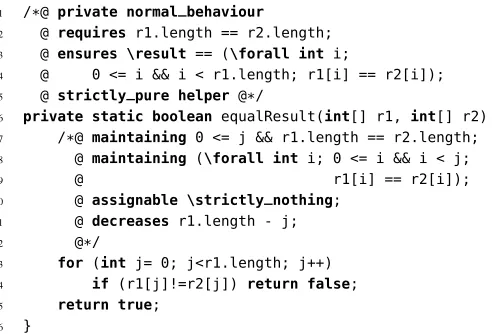
To give a feel for the kind of analysis performed in KeY, Fig. 2 displays one of the Java methods that had to be analyzed, which checks whether two arrays of equal length have equal integer arguments. The code to be analyzed needs to be annotated with specifications, i.e., pre- and post-conditions as well as loop invariants, which then need to be proven by KeY. The latter, in general, might again require some human interaction if the prover cannot verify the conditions automatically.
The part of the program that needs to be analyzed in order to prove (7) comprises 9 Java classes with 40 relevant methods in about 359 LoC. The methods were specified in 498 LoS (lines of specification), resulting in an overall LoS-to-LoC ratio of 1.39. The comprehensive specification process enabled an automated verification process (i.e., no user interaction was necessary) in KeY 2.4.0. It comprises 39 proofs, which take 17 minutes of computation time in total, with the longest proof taking 260 s, and 25 s on average (on an Intel Core 2 Duo at 2.66 GHz with 4 GB RAM). This resulted in a total of 200,843 rule applications, the longest proof requiring 72,109 rule applications. The entire specification and verification process took between two and three person weeks.
1 /*@ private normal_behaviour
2 @ requires r1.length == r2.length; 3 @ ensures \result == (\forall int i;
4 @ 0 <= i && i < r1.length; r1[i] == r2[i]); 5 @ strictly_pure helper @*/
6 private static boolean equalResult(int[] r1, int[] r2) { 7 /*@ maintaining 0 <= j && r1.length == r2.length; 8 @ maintaining (\forall int i; 0 <= i && i < j;
9 @ r1[i] == r2[i]);
10 @ assignable \strictly_nothing;
11 @ decreases r1.length - j;
12 @*/
13 for (int j= 0; j<r1.length; j++) 14 if (r1[j]!=r2[j]) return false;
15 return true;
16 }
Figure 2. JML annotated method to compare result vectors. JML annotations appear as comments with the special delimiter pair/*@ @*/. Lines1ff. (before the method signature) state the contract. Line2imposes a precondition, while Line3defines a postcondition. Termination and absence of exceptions is included by default as stated bynormal_behavior. The modifiers in Line5additionally require the method to not change the value of any location. Since the method contains an unbounded loop, we need to annotate that as well in order to prove the contract. A loop invariant is given in Lines7ff. To prove termination, we also have a variant clause in Line11.
in principle, we could have used KeY to verify property (6) directly without Joana (and the hybrid approach). However, given our experience with KeY and other theorem proving approaches, this would have been practically infeasible, both because of scalability problems and the overwhelming amount of human interaction that would have been neces-sary. At the very least, our hybrid approach tremendously simplified the analysis effort as it opened the way to use an automated tool.
VII. RELATEDWORK
Analysis based on type systems have been the predom-inant information flow analysis technique until recently. These approaches are usually sound, i.e., they are guaranteed to find any security violations. But they are incomplete w.r.t. sophisticated policies such as noninterference. This means that they tend to reportfalse positiveresults. There exists a plethora of type systems for different programing languages using different extensions to narrow (but not close) the incompleteness gap. A widely used implementation of type-based analysis for sequential Java programs is the Jif com-piler [52]. Other type systems for sequential Java include [5], [6], [7]. A related technique is explicitdependency tracking of variables. For example, [53], [22] present approaches— built on symbolic execution—in which for each variable a set of variables is stored on which its value at most depends. Amtoft and Banerjee [13] were among the first to encode noninterference in a program logic and with that laid the
foundation for sound and complete reasoning about infor-mation flows. Since classical Hoare logic cannot express noninterference, they employed a dedicated extension of it [54]. In [17], this line of research is continued, but using dynamic logic instead which can express such properties readily. In [21], [20], several practical improvements to this approach were presented and implemented in KeY. To the best of our knowledge, this is the only logic-based nonin-terference analysis for Java. However, previous experiments show that conducting a proof on a large system, such as the e-voting system in our case study, is not feasible with this approach alone.
None of the existing approaches for checking noninterfer-ence properties (for Java programs) appear to be applicable on their own to our e-voting case study. The hybrid approach proposed in this paper, and hence, the combination of automated and interactive tools, was key in tackling this already quite complex system.
An approach for code-level cryptographic verification similar to the CVJ framework approach has been presented in [27], but for the language F# and using refinement types (see [25] for a more detailed discussion).
VIII. CONCLUSION
In this paper, we have proposed what we call a hybrid approach for checking noninterference properties of Java program. This approach allows one to combine (fast) au-tomated, but possibly imprecise analysis, with precise, but typically interactive tools, and hence, more time consuming analysis. By our approach, automated tools can be used as much as possible and only in places of a program where the automated tools fail, one resorts to more precise analysis.
Acknowledgment. This work was partially supported by Deutsche Forschungsgemeinschaft (DFG) under Grant KU 1434/6-3 and project DeduSec within the priority pro-gramme 1496 “Reliably Secure Software Systems – RS3”.
REFERENCES
[1] A. Sabelfeld and A. C. Myers, “Language-Based Information-Flow Security,”IEEE Journal on Selected Areas in Communi-cations, special issue on Formal Methods for Security, vol. 21, no. 1, pp. 5–19, 2003.
[2] D. E. Denning and P. J. Denning, “Certification of programs for secure information flow,” Communications of the ACM, vol. 20, no. 7, pp. 504–513, 1977.
[3] D. Volpano, G. Smith, and C. Irvine, “A sound type system for secure flow analysis,”Journal of Computer Security, vol. 4, no. 3, pp. 167–187, Dec. 1996. [Online]. Available: http:// www.cs.nps.navy.mil/research/languages/papers/atsc/jcs.ps.Z
[4] D. M. Volpano and G. Smith, “Eliminating covert flows with minimum typings,” in10th Computer Security Foundations Workshop (CSFW ’97), June 10-12, 1997, Rockport, Mas-sachusetts, USA, 1997, pp. 156–169.
[5] M. Strecker, “Formal analysis of an information flow type sys-tem for MicroJava,” Technische Universität München, Tech. Rep., Jul. 2003.
[6] A. Banerjee and D. A. Naumann, “Stack-based access control and secure information flow,” J. Funct. Program., vol. 15, no. 2, pp. 131–177, 2005.
[7] G. Barthe, D. Pichardie, and T. Rezk, “A certified lightweight non-interference Java bytecode verifier,”Mathematical Struc-tures in Computer Science, vol. 23, no. 5, pp. 1032–1081, 2013.
[8] M. Alba-Castro, M. Alpuente, and S. Escobar, “Abstract Certification of Global Non-interference in Rewriting Logic,” inFormal Methods for Components and Objects - 8th Inter-national Symposium (FMCO 2009). Revised Selected Papers, ser. Lecture Notes in Computer Science, F. S. de Boer, M. M. Bonsangue, S. Hallerstede, and M. Leuschel, Eds., vol. 6286. Springer, 2009, pp. 105–124.
[9] C. Hammer and G. Snelting, “Flow-sensitive, context-sensitive, and object-sensitive information flow control based on program dependence graphs,”Int. J. Inf. Sec., vol. 8, no. 6, pp. 399–422, 2009.
[10] A. C. Myers, S. Chong, N. Nystrom, L. Zheng, and S. Zdancewic,Jif: Java Information Flow (software release), July 2001,http://www.cs.cornell.edu/jif/.
[11] O. Tripp, M. Pistoia, S. J. Fink, M. Sridharan, and O. Weis-man, “Taj: effective taint analysis of web applications,” SIG-PLAN Not., vol. 44, no. 6, pp. 87–97, 2009.
[12] S. Guarnieri, M. Pistoia, O. Tripp, J. Dolby, S. Teilhet, and R. Berg, “Saving the world wide web from vulnerable javascript,” ser. ISSTA ’11. New York, NY, USA: ACM, 2011. [Online]. Available:http://doi.acm.org/10.1145/ 2001420.2001442
[13] T. Amtoft and A. Banerjee, “Information flow analysis in logical form,” inSAS, 2004, pp. 100–115.
[14] A. Banerjee, D. A. Naumann, and S. Rosenberg, “Expressive declassification policies and modular static enforcement,” IEEE Symp. on Security and Privacy, pp. 339–353, 2008.
[15] G. Barthe, P. R. D’Argenio, and T. Rezk, “Secure Information Flow by Self-Composition,” in17th IEEE Computer Security Foundations Workshop, (CSFW-17 2004). IEEE Computer Society, 2004, pp. 100–114.
[16] L. Beringer and M. Hofmann, “Secure information flow and program logics,” in 20th IEEE Computer Security Founda-tions Symposium, CSF 2007, 6-8 July 2007, Venice, Italy, 2007, pp. 233–248.
[17] Á. Darvas, R. Hähnle, and D. Sands, “A theorem proving approach to analysis of secure information flow,” in Pro-ceedings, Security in Pervasive Computing, ser. LNCS 3450, D. Hutter and M. Ullmann, Eds. Springer, 2005.
[18] K. R. M. Leino and R. Joshi, “A semantic approach to secure information flow,” inMathematics of Program Construction, MPC’98, Marstrand, Sweden, June 15-17, 1998, Proceedings, J. Jeuring, Ed., 1998, pp. 254–271.
[19] A. Nanevski, A. Banerjee, and D. Garg, “Verification of information flow and access control policies with dependent types,” in Security and Privacy (SP), 2011, may 2011, pp. 165–179.
[20] C. Scheben, “Program-level specification and deductive veri-fication of security properties,” Ph.D. dissertation, Karlsruhe Institute of Technology, 2014, submitted.
[21] C. Scheben and P. H. Schmitt, “Verification of information flow properties of Java programs without approximations,” in Formal Verification of Object-Oriented Software, ser. LNCS 7421. Springer, 2012, pp. 232–249.
[22] B. van Delft, “Abstraction, objects and information flow analysis,” Master’s thesis, Institute for Computing and Infor-mation Science, Radboud University Nijmegen, 2011.
[23] D. von Oheimb, “Formal methods in the security business: exotic flowers thriving in an expanding niche,” in14th Inter-national Symposium on Formal Methods, FM2006, J. Misra, T. Nipkow, and E. Sekerinski, Eds., 2006, pp. 592–597.
[24] A. Nanevski, A. Banerjee, and D. Garg, “Dependent type theory for verification of information flow and access control policies,” ACM Trans. Program. Lang. Syst, vol. 35, no. 2, p. 6, 2013.
[25] R. Küsters, T. Truderung, and J. Graf, “A Framework for the Cryptographic Verification of Java-like Programs,” in 25th IEEE Computer Security Foundations Symposium (CSF 2012). IEEE Computer Society, 2012, pp. 198–212.
[26] G. Klein and T. Nipkow, “A Machine-Checked Model for a Java-Like Language, Virtual Machine, and Compiler,” ACM Trans. Program. Lang. Syst., vol. 28, no. 4, pp. 619–695, 2006.
![Figure 4.Expression reduction rules. In the rule for method invocation, the required nested block structure is built with the help of the auxiliary functionblocks defined as follows: blocksC([],[],[],e) = e and blocksC(V ·Vs,T ·Ts,v·vs,e) = {V : T; V :=v; blocks(Vs,Ts,vs,e)}C, (where · is the list constructorand [] denotes the empty list).](https://thumb-us.123doks.com/thumbv2/123dok_us/7936430.1317642/21.612.143.559.95.607/expression-reduction-invocation-structure-auxiliary-functionblocks-dened-constructorand.webp)