Application for High-Speed RSA
Implementation
Hwajeong Seo1, Zhe Liu2, Johann Großsch¨adl2, and Howon Kim1⋆ 1
Pusan National University, School of Computer Science and Engineering,
San-30, Jangjeon-Dong, Geumjeong-Gu, Busan 609–735, Republic of Korea {hwajeong,howonkim}@pusan.ac.kr
2
University of Luxembourg,
Laboratory of Algorithmics, Cryptology and Security (LACS), 6, rue R. Coudenhove-Kalergi, L–1359 Luxembourg-Kirchberg, Luxembourg
{zhe.liu,johann.groszschaedl}@uni.lu
Abstract. Advanced modern processors support Single Instruction Mul-tiple Data (SIMD) instructions (e.g. Intel-AVX, ARM-NEON) and a massive body of research on vector-parallel implementations of modular arithmetic, which are crucial components for modern public-key cryp-tography ranging from RSA, ElGamal, DSA and ECC, have been con-ducted. In this paper, we introduce a novel Double Operand Scanning (DOS) method to speed-up multi-precision squaring with non-redundant representations on SIMD architecture. The DOS technique partly dou-bles the operands and computes the squaring operation without Read-After-Write (RAW) dependencies between source and destination vari-ables. Furthermore, we presented Karatsuba Cascade Operand Scan-ning (KCOS) multiplication and Karatsuba Double Operand ScanScan-ning (KDOS) squaring by adopting additive and subtractive Karatsuba’s meth-ods, respectively. The proposed multiplication and squaring methods are compatible with separated Montgomery algorithms and these are highly efficient for RSA crypto system. Finally, our proposed multiplica-tion/squaring, separated Montgomery multiplication/squaring and RSA encryption outperform the best-known results by 22/41%, 25/33% and 30% on the Cortex-A15 platform.
Keywords: Public-key cryptography, Modular arithmetic, SIMD-level parallelism, Vector instructions, ARM-NEON, RSA
1
Introduction
Multi-precision modular multiplication and squaring are performance-critical building blocks of public-key algorithms (e.g. RSA, ElGamal, DSA and ECC).
⋆
One of the most famous modular reduction techniques is Montgomery’s algo-rithm which avoids division in modular multiplication and squaring [22]. How-ever, the algorithm is still a computation-intensive operation for embedded pro-cessors so it demands careful optimizations to achieve acceptable performance. Recently, an increasing number of embedded processors started to employ Sin-gle Instruction Multiple Data (SIMD) instructions to perform massive body of multimedia workloads.
(CICOS) method, which essentially consists of two COS computations, whereby one contributes to the multiplication and the second to the Montgomery reduc-tion.
However, there are still two open interesting topics for Montgomery algo-rithm on ARM-NEON processors [5, 19, 20, 29]. First, the previous work mainly focused on multiplication not squaring. The overheads of squaring occupies roughly 70 ∼ 80% of that of multiplication and for RSA approximately 5/6 of all operations are spent on squaring. Second, previous methods do not con-sider Karatsuba multiplication. The GMP multi-precision library switches to one Karatsuba level when it comes to 832-bit inputs but recent SIMD implementa-tions even over 1024- and 2048-bit avoided all use of Karatsuba’s method [5, 19, 20, 29]. Since Karatsuba multiplication has nice property that it ensures asymp-totic complexity θ(nlog23), current implementations can be enhanced by using
Karatsuba algorithm. In this paper, we work on these two interesting topics by suggesting a non-redundant Double Operand Scanning (DOS) squaring method and constant-time Karatsuba algorithms for multiplication and squaring. Firstly, the DOS technique partly doubles the operands and computes the squaring op-eration without Read-After-Write (RAW) dependencies between source and des-tination variables. Secondly, we present constant-time Karatsuba multiplication and squaring over SIMD architectures. We choose different Karatsuba algorithms for multiplication and squaring to ensure better performance in each operation. Furthermore, SISD and SIMD instructions are properly mix used to reduce laten-cies. Finally, we present separated KCOS and KDOS Montgomery multiplication and squaring for traditional public key cryptography. Our experimental results show that a Cortex-A15 processor is able to execute SKCOS and SKDOS Mont-gomery multiplication/squaring with 2048-bit operands in only 19680 and 17584 clock cycles, which are almost 25% and 33% faster than the NEON implemen-tation of Seo et al. (26232 cycles according to [29, Table 2]).
Summary of Research Contributions
The main contributions of our work are summarized as the following four points. 1. Novel Double Operand Scanning approach for efficient implementation of multi-precision squaring on ARM-NEON processors.When implementing on the Cortex-A15 processor, only 6288 clock cycles are required for squaring at the length of 2048-bit. The result is the fastest implementations published for the identical platform and non-redundant representations. The details of novel approaches can be found in Section 4.1 and performance comparison with related works can be found in Table 1 and 2.
3. Separated Montgomery algorithm for ARM-NEON processors. In terms of modular multiplication and squaring, we presented separated Montgomery multiplication and squaring. These are compatible with asymptotically faster integer multiplication and squaring algorithms like Karatsuba methods to boost performance significantly. The details of novel approaches can be found in Section 4.3.
4. Efficiently implemented cryptographic library for RSA.As RSA-based schemes are the most widely used asymmetric primitives, enhancements of Mont-gomery algorithms should be concerned. Thanks to highly optimized modu-lar multiplication and squaring operations, our work only needs 367408 and 14250720 clock cycles for 2048-bit RSA encryption and decryption over A15 processor, respectively. Performance comparison with related works can be found in Table 1 and 2.
The remainder of this paper is organized as follows. In Section 2, we recap the previous best results for squaring on SISD and SIMD architectures. In Section 3, we explore the asymptotically faster integer multiplication algorithm, namely Karatsuba’s method. In Section 4, we present novel methods for multi-precision multiplication/squaring and Montgomery algorithms for ARM-NEON engine. Thereafter, we will summarize our experimental results in Section 5. Finally, in Section 6, we conclude the paper.
2
Multi-precision Squaring Methods
Multi-precision squaring can be utilized with ordinary multiplication methods. However, squaring dedicated method has two advantages over the multiplication methods for squaring computations. First, only one operand (A) is required for squaring computations because both operands share same variables. For this reason, we can reduce the number of registers to retain the operands and memory accesses to load operands by about half times. Second, the some part of partial products output the identical partial product results. For example, both partial productsA[i]×A[j] andA[j]×A[i] output the same results. By taking accounts of the feature, the parts are multiplied once and added twice (i.e. 2×A[i]×
A[j]) to intermediate results to get identical results of naive approaches (i.e.
A[i]×A[j] +A[j]×A[i]). This squaring approach can reduce the number of partial products from n2 to n2−n
2 +n whereby n = ⌈m/w⌉, and w and m is the word size and operand length. In the following sub-sections, we explore the cutting-edge squaring methods over both SISD and SIMD architectures.
computation per each inner structure of partial products. In INDOCRYPT’13, Sliding-Block-Doubling (SBD) method was introduced [28]. SBD method com-putes doubling using “1-bit left shifting” operation at the end of duplicated par-tial product computation. Recently, Karatsuba squaring was introduced [27]. It divides the traditional squaring architecture into two squaring and one sub-multiplication parts. It computes the sub-multiplication part with the subtractive-Karatsuba multiplication and then remaining two squaring parts are conducted with the SBD technique.
However, the advanced SISD based squaring is not compatible with SIMD architecture. The SISD instruction set can readily handle carry bits with status registers but carry-handing over SIMD architecture incurs a number of pipeline stalls in the non-redundant representations. Furthermore SISD approach does not concern about grouping the multiple operands for parallel computations but SIMD approach should concern the alignments of operands and intermediate re-sults. Let’s take an example of 512-bit LD squaring over (A0∼511×A0∼511) using the 256-bit COS method as an inner loop. The structure consists of three 256-bit wise multiplications (A0∼255×A0∼255,A0∼255×A256∼511,A256∼511×A256∼511). For starter, a computation over A0∼255×A0∼255 is conducted. After then, the duplicated part (A0∼255×A256∼511) is computed subsequently. While comput-ing the second part, intermediate results of first part should not be mixed with second part because the intermediate results of second part should be doubled but first part does not need doubling process. After doubling the second part, a number of carry propagations from 257th to 768th bit occur to sum both first (0 ∼511) and second (256∼767) parts, The alternative approaches including SBD and Karatsuba squaring methods also suffer from same problems. Firstly, they compute the middle part (A0∼255×A256∼511) with doubling and then con-duct other remaining parts (A0∼255×A0∼255,A256∼511×A256∼511). As like LD method, the methods generate chains of carry propagations from 257th to 768th bit to sum both intermediate results.
ECC curve’s operands and intermediate results. Furthermore, redundant repre-sentations should conduct carry propagations to fit the results into smaller radix if the next operation is multiplication or squaring. This was not big problem in case of scalar multiplication because the scalar multiplication consists of not only multiplication/squaring but also addition/subtraction operations so we can avoid direct radix-fitting and take advantages of lazy radix-fitting. However, in case of RSA, the main exponentiation operation conducts consecutive multipli-cation or squaring operation so results always conduct radix-fitting to maintain smaller radix for following multiplication and squaring operations. Furthermore as author explained in [2, Section 1.2.], the standard NIST elliptic curves al-low easy computation of modular operation in radix 232 so suitable radix for
p= 2384−2128−296+ 232−1 in the redundant representation is radix 216which would cause considerably higher overheads than benefits. In this stance, we need a squaring specialized operation in non-redundant representations for RSA and specific ECC implementations, but still there are no feasible results available in the non-redundant representation over ARM-NEON.
3
Karatsuba’s Multiplication
One of the multiplication techniques with sub-quadratic complexity is called Karatsuba’s multiplication [14]. Karatsuba’s method reduces a multiplication of two n-word operands to three multiplications, which have a length of n
2 words. These three half-size multiplications can be performed with any multiplication techniques (e.g. operand-scanning method, product-scanning method, hybrid-scanning method, operand-caching method [21, 6, 10, 12, 25, 26]). The Karatsuba method can also be scheduled in a recursive way and its asymptotic complexity is
θ(nlog23). There are two typical ways to describe Karatsuba’s multiplication such
as additive Karatsuba and subtractive Karatsuba. Taking the multiplication of
n-word operand A and B as an example, we represent the operands as A =
AH·2
n
2 +AL and B =BH·2n2 +BL. The multiplication (P =A·B) can be
computed according to the following equation when using additive Karatsuba’s method:
AH·BH·2n+ [(AH+AL)(BH+BL)−AH·BH−AL·BL]·2
n
2 +AL·BL (1)
and subtractive Karatsuba’s method:
AH·BH·2n+ [AH·BH+AL·BL− |AH−AL| · |BH−BL|]·2
n
2 +AL·BL (2)
Karatsuba’s method turns one multiplication of size n into three multipli-cations and eight additions of size n
A[15]A[0]
A[0]A[0] A[15]A[15]
C[0] C[15]
C[30]
1
2
3
2
3 1
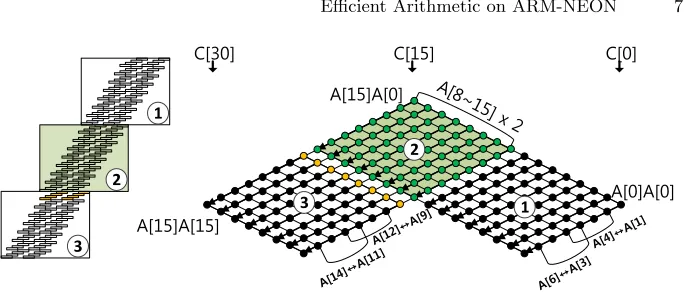
Fig. 1: Double Operand Scanning squaring for SIMD architecture
non-interleaved Montgomery multiplication. In [8], a single level of Karatsuba on top of Comba’s method is introduced. The Karatsuba approach for 1024-bit modular multiplication can reduce the number of multiplication and addition instructions by a factor 1.14 and 1.18 respectively, than that of sequential inter-leaved Montgomery approach. Obviously the Karatsuba approach can enhance Montgomery algorithm with SIMD instructions. However, there are no feasible Montgomery results in non-redundant representations on ARM-NEON engine [5, 19, 20, 29]. In this paper, we present clever approaches to improve Montgomery algorithms with Karatsuba’s multiplication in a mixed approach of SISD and SIMD instruction sets.
4
Proposed Methods
4.1 Double Operand Scanning Squaring
Efficient implementation of squaring method is highly relied on computations of duplicated partial products (A[i]×A[j] and A[j]×A[i]). There are two ways to calculate the duplicated parts of squaring. First approach is doubling the intermediate results [15, 28, 27]. Generally, the method needs to conduct the du-plicated part and the other parts separately in order to ensure doubling the duplicated parts except non-duplicated parts. After then, both intermediate re-sults are summed up. However, the addition of both intermediate rere-sults causes huge overheads in non-redundant representations by incurring a chain of carry propagations. In order to resolve this issue, we selected a method which doubles operands in advance rather then intermediate results. Proposed Double Operand Scanning (DOS) method uses both doubled and original operands and the du-plicated part and non-dudu-plicated parts are computed with different operands (doubled, original) in integrated way and non-redundant representations. This can avoid inefficient carry propagations and a number of pipeline stalls by n
In Figure 1, we describe DOS squaring for SIMD architecture. The DOS consists of three inner loops (one for duplicated (⃝2) and the other two for non-duplicated parts (⃝1, ⃝3)) and each inner loop follows COS multiplication [29]3. Taking the 32-bit word with 512-bit squaring as an example, our method works as follows4. Firstly, we re-organized operands by conducting transpose operation, which can efficiently shuffle inner vector by 32-bit wise. Instead of a normal order ((A[0], A[1]), (A[2], A[3]), (A[4], A[5]), (A[6], A[7])), we classify the operand as groups ((A[0], A[4]), (A[2], A[6]), (A[1], A[5]), (A[3], A[7])), for computing two 32-bit wise multiplications where each operand ranges from 0 to 232−1 (i.e.0xffff ffffin hexadecimal form). Secondly, multiplicationA[0] with re-organized operands ((A[0], A[4]),(A[2], A[6]),(A[1], A[5]),(A[3], A[7])) is com-puted, generating the partial product pairs including (C[0], C[4]), (C[2], C[6]),
(C[1], C[5]), (C[3], C[7]) where the results are located from 0 to 264−233+ 1, namely0xffff fffe 0000 0001. Third, partial products are divided into higher bits (64 ∼ 33) and lower bits (32 ∼1) by using transpose operation with 64-bit initialized registers having zero value (i.e. 0x0000 0000 0000 0000), which outputs a pair of 32-bit results ranging from 0 to 232−1 (i.e. 0xffff ffff). After then the higher bits are added to lower bits of upper intermediate re-sults. For example, higher bits of (C[0], C[4]), (C[1], C[5]), (C[2], C[6]), (C[3]) are added to lower bits of (C[1], C[5]), (C[2], C[6]), (C[3], C[7]), (C[4]). After the addition operation, the least significant word (C[0], lower bits of partial product (A[0]×A[0])) is placed within 32-bit in range of [0, 0xffff ffff] and this can be stored into 32-bit wise temporal registers or memory stor-ages. On the other hand, the remaining intermediate results fromC[1] toC[7] are placed within [0, 0x1 ffff fffe]5, which exceed range of 32-bit in certain
3
LetAbe an operand with a length of m-bit that are represented by multiple-word arrays. Each operand is written as follows:A= (A[n−1], ..., A[2], A[1], A[0]), whereby n=⌈m/w⌉, andwis the word size. The result of multiplication C=A·Ais twice length of A, and represented by C = (C[2n−1], ..., C[2], C[1], C[0]). For clarity, we describe the method using a multiplication structure and rhombus form. The multiplication structure describes order of partial products from top to bottom and each point in rhombus form represents a multiplication A[i]×A[j]. The rightmost corner of the rhombus represents the lowest indices (i,j= 0), whereas the leftmost represents corner the highest indices (i,j =n−1). A black arrow over the point indicates the processing of the partial products. The lowermost side represents result indicesC[k], which ranges from the rightmost corner (k= 0) to the leftmost corner (k = 2n−1). Since NEON architecture computes two 32-bit partial products with single instruction, we use two multiplication structures to describe NEON’s SIMD operations. These block structures placed in the same level of row represent two partial products with single instruction. In Part 2, the green block and dot represent the partial products with doubled operands; In Part 3, yellow block and dot represent the masked addition with carry bit of doubled operands.
4 OperandsA[0∼15] are stored in 32-bit registers. Intermediate resultsC[0∼31] are stored in 64-bit registers. We use two packed 32-bit registers in the 64-bit register. 5 In the first round, the range of result is within [0,0x1 ffff fffd], because higher
Algorithm 1Double Operand Scanning Squaring Require: An evenm-bit operandA
Ensure: 2m-bit resultC=A·A 1: C=A[0,m2−1]·A[0,m2−1] 2: {ACARRY, ADBL[m
2,m−1]}=A[m2,m−1]≪1
3: C=C+A[0,m
2−1]·ADBL[m2,m−1]·2
m
2
4: C=C+ACARRY ·A[0,m2−1]·2m 5: C=C+A[m
2,m−1]·A[m2,m−1]·2 m
6: returnC
cases. However, the addition of intermediate results (C[1 ∼ 7]) and 32-bit by 32-bit multiplication in next step are placed into 64-bit registers without over-flowing, because addition of maximum multiplication result 264−233+ 1 (i.e.
0xffff fffe 0000 0001) and intermediate result 233−2 (i.e. 0x1 ffff fffe) outputs the final results within 64-bit 264−1 (i.e. 0xffff ffff ffff ffff)6. This process is iterated by 7 times more to complete the first inner loop for partial products (A[0∼ 7]×A[0 ∼7]). The intermediate results are retained in temporal registers ((C[8], C[12]),(C[9], C[13]),(C[10], C[14]), (C[11], C[15])) placed within 233−2 (i.e.0x1 ffff fffe).
In second inner loop, we firstly doubled the half of 512-bit operands (256-bit,
A[8∼15]) by conducting left-shift operation by 1-bit. Since the operation may output 1-bit carry (257th bit), we stored doubled operands into 9 32-bit registers (ACARRY, ADBL[8 ∼ 15]). Secondly, multiplication ADBL[8] with (A[0], A[4]), (A[2], A[6]),(A[1], A[5]),(A[3], A[7]) is computed, generating the partial product pairs including (C[8], C[12]),(C[9], C[13]),(C[10], C[14]), (C[11], C[15]). Third, partial products are separated into higher bits (64∼33) and lower bits (32∼1) by using transpose operation with 64-bit initialized registers having zero value (i.e. 0x0000 0000 0000 0000). After then the higher bits are added to lower bits of upper intermediate results. After the addition operation, the least sig-nificant word is saved into temporal registers or memory storages. This pro-cess is iterated by 7 times more to complete the second inner loop for partial products (A[0∼7]×ADBL[8∼15]). The intermediate results are retained in (C[16], C[20]),(C[17], C[21]),(C[18], C[22]),(C[19], C[23]) placed within 233−2 (i.e.0x1 ffff fffe).
In third inner loop, we firstly conduct the carry handling by masking the operands with the carry bit (ACARRY) to ensure secure against side channel at-tacks. By using multiplication and accumulation operation (VMLAL), we can mul-tiply the operand with the carry bit (ACARRY) and then the results are added to of higher and lower bits are located within [0,0x1 ffff fffe], because both higher and lower bits are located in range of [0,0xffff ffff].
6 In the first round, intermediate results (C[0 ∼ 7]) are in range of [0,
intermediate results simultaneously. If the carry bit is set, operandsA[0∼7] are added to the intermediate results ((C[16], C[20]), (C[17], C[21]),(C[18], C[22]),
(C[19], C[23])) and otherwise zero values are added to the intermediate results. After then the intermediate results are separated into higher and lower 32-bit wise and added to (C[17], C[21]), (C[18], C[22]), (C[19], C[23]), (C[20], C[24]). Secondly, we re-organized operands (A[8∼15]) by conducting transpose opera-tion into (A[8], A[12]),(A[10], A[14]), (A[9], A[13]), (A[11], A[15]). Thirdly, mul-tiplication A[8] with re-organized operands ((A[8], A[12]), (A[10], A[14]), (A[9], A[13]),(A[11], A[15])) is computed, generating the partial product pairs includ-ing (C[16], C[20]), (C[17], C[21]), (C[18], C[22]), (C[19], C[23]). After then the intermediate results are separated into each higher and lower 32-bit wise and added to (C[17], C[21]), (C[18], C[22]), (C[19], C[23]), (C[20], C[24]). After the addition operation, the least significant word is saved into temporal registers or memory storages. This process is iterated by 7 times more to complete the third inner loop for partial products (A[8∼15]×A[8∼15]).
After three inner loops, the results from C[0] to C[23] are perfectly fitted into 32-bit wise word, because the least significant word is outputted in 32-bit way in every round. However, remaining intermediate results (C[24] ∼ C[31]) are not placed within 32-bit so we should process a chain of carry propaga-tions to satisfy the radix 232, namely final alignment. The final alignment ex-ecutes carry propagations on results from C[24] to C[31] to fit into radix 232 with sequential addition and transpose instructions. This process causes pipeline stalls by 8 times, because higher bits of former results are directly added to next intermediate results. In order to reduce these latencies of final alignments, we used SISD rather than SIMD instruction because SISD has lower latencies than SIMD in terms of sequential operations. Finally, 512-bit DOS squaring requires SIMD instructions including 103 VTRN, 100 VMULL/VMLAL, 100 VEOR,
104 VADD, 24 VEXT, 4 VSHR/VSHLand 9 VMOV and several SISD ADDS/ADCS
in-structions. The algorithm of DOS squaring is drawn in Algorithm 1. In Step 1, multiplications on A[0,m
2−1] ×A[0,m2−1] are conducted and stored into
re-sults (C). In Step 2, operandsA[0,m
2−1] are doubled to output doubled operands
(ACARRY, ADBL[m
2,m−1]). The part of doubled operands (ADBL[
m
2,m−1]) is
mul-tiplied by A[0,m
2−1] and added to results in Step 3. In Step 4, the carry bit
(ACARRY) is multiplied byA[0,m
2−1] and added to results. In Step 5,
multipli-cations onA[m
2,m−1]×A[
m
2,m−1] are conducted and then added to intermediate
results. Finally, the results are returned in Step 6.
4.2 Constant-Time Karatsuba Multiplication/Squaring
“carry-Algorithm 2Additive Karatsuba Multiplication on SIMD Require: An evenm-bit operandsA(ALOW+AHIGH·2
m
2),B(BLOW+BHIGH·2m2)
Ensure: 2m-bit resultC=A·B
1: L=ALOW·BLOW (SIMD)
2: H=AHIGH·BHIGH (SIMD)
3: {ACARRY, ASU M}=ALOW+AHIGH (SISD)
4: {BCARRY, BSU M}=BLOW+BHIGH (SISD)
5: M=ASU M·BSU M (SIMD)
6: M=M+ (AN D(COM(ACARRY), BSU M))·2
m
2 (SISD)
7: M=M+ (AN D(COM(BCARRY), ASU M))·2
m
2 (SISD)
8: M=M+ (AN D(ACARRY, BCARRY))·2
m
2 (SISD)
9: C=L+ (M−L−H)·2m2 +H·2m (SISD)
10: returnC
propagated” addition proposed by [17]. The method conducts masking the inter-mediate results with carry bit. However, under non-redundant representations, addition operation causes a chain of carry propagations. In order to avoid these latencies, we used SISD instructions for the sequential addition and subtraction operations. The detailed constant-time additive Karatsuba’s multiplication is described in Algorithm 2. The partial products onALOW·BLOW andAHIGH·
BHIGH are conducted by following COS multiplication for SIMD architecture. After then, “carry-propagated” addition is conducted onALOW +AHIGH and
BLOW+BHIGH with SISD instructions. And then, the middle partial products on ASU M·BSU M are conducted with COS multiplication with SIMD instruc-tions. After then, carry bits includingACARRY andBCARRY are two’s comple-mented (COM) and logical-and operation (AN D) is conducted on partial prod-uctsBSU MandASU Mwith the results ofCOM(ACARRY) andCOM(BCARRY), respectively. The outputs and the result ofAN D(ACARRY, BCARRY) are added to middle block of intermediate results. Finally, whole partial products including
L, M and H are summed up by following equation (C = L+ (M −L−H)· 2m2 +H·2m). From Step 6 to 9, all addition and subtraction operations are
con-ducted sequentially by using SISD operations. The combinations of SISD and SIMD instruction sets reduce the pipeline stalls and latencies. For large integer multiplication, we used multiple level of additive Karatsuba multiplications. For scalability, our Karatsuba multiplications are performed in recursive way. We used 256-bit COS multiplication as a basic multiplication operation and con-duct 1-, 2- and 3-level of additive Karatsuba multiplication for 512-, 1024- and 2048-bit multiplications.
Algorithm 3Subtractive Karatsuba Squaring on SIMD Require: An evenm-bit operandA(ALOW+AHIGH·2
m
2)
Ensure: 2m-bit resultC=A·A
1: L=ALOW·ALOW (SIMD)
2: H=AHIGH·AHIGH (SIMD)
3: {ABORROW, ADIF F}=ALOW−AHIGH (SISD)
4: ADIF F =XOR(ABORROW, ADIF F) (SISD)
5: ADIF F =ADIF F +COM(ABORROW) (SISD)
6: M=ADIF F ·ADIF F (SIMD)
7: C=L+ (L+H−M)·2m2 +H·2m (SISD)
8: returnC
Algorithm 4Calculation of the Montgomery reduction
Require: An oddm-bit modulusM, Montgomery radixR= 2m, an operandT where
T = A·B or T = A·A in the range [0,2M −1], and pre-computed constant M′=−M−1modR
Ensure: Montgomery productZ= MonRed(T, R) =T·R−1modM 1: Q←T·M′modR
2: Z←(T+Q·M)/R
3: if Z≥M thenZ←Z−M end if 4: returnZ
conducted main squaring computations with parallel DOS squaring by using SIMD instructions and the other operations with SISD operations in sequential way. The detailed constant-time subtractive Karatsuba’s squaring is described in Algorithm 3. The partial products onALOW·ALOW andAHIGH·AHIGHare con-ducted by following DOS squaring. After then,ALOW is subtracted byAHIGH to output the {ABORROW, ADIF F}. If borrow occurs, theABORROW is set to 232−1 (i.e. 0xffff ffff) andA
DIF F is negative value. Otherwise,ABORROW is set to zero (i.e.0x0000 0000) andADIF F is positive value. In order to ensure the differences in positive form, we conduct masking operation withABORROW variables. Firstly, bit-wise exclusive-or operation (XOR) is conducted on differ-ences (ADIF F) withABORROW. Secondly, two’s complement operation (COM) is conducted onABORROW and the output is added to the difference (ADIF F). If
ABORROW is set to 232−1 (i.e.0xffff ffff),ADIF F is two’s complemented and otherwiseADIF F maintains its own value. This masking technique is conducted sequentially by using SISD instructions. After then, the middle partial product (M) onADIF F ·BDIF F is conducted with DOS squaring for SIMD instruction sets. Finally, whole partial products includingL, M andH are summed up by following equation (C=L+ (L+H−M)·2m2 +H·2m) with SISD instruction
4.3 Separated Karatsuba Cascade/Double Operand Scanning for Montgomery Multiplication and Squaring
In [29, 5], the integrated Montgomery multiplication methods are proposed. How-ever, the interleaved version is not compatible with Karatsuba’s methods because Karatsuba multiplication recursively conducts the part of partial products but Montgomery reduction is normally performed in sequential way from the least to most significant bits. In order to exploit nice properties of Karatsuba ap-proaches, we selected the separated (non-interleaved) Montgomery algorithm. In the Algorithm 4, we firstly compute multi-precision multiplication (A×B) or squaring (A×A) with KCOS multiplication or KDOS squaring, respectively. After then the intermediate results (T) are multiplied by inverse of modulus (M′) and the results are reduced byR and stored intoQ. After then, following equation ((T+Q×M)/R) is conducted.
Finally, the calculation of the Montgomery multiplication may require a fi-nal subtraction of the modulus (M) to get a fully reduced result in range of [0, M). In order to get the reduced results, the final subtraction is conducted. The operation is computable with conditional branch by checking the carry bit. However, this method has two drawbacks. First two operands should be com-pared byte by byte via the compare function and the attacker can catch the leakage information because conditional statements consumes different clock cy-cles [30]. In order to resolve this problem, in [16], author suggested without conditional branch method for Montgomery multiplication. Based on the con-cept of incomplete modular arithmetic, we don’t compare exact value between
Z and M, but we use most significant bit (zm) of Z. If zm is set, modulus re-mains, and otherwise modulus (M) is set to zero by using bit-masking. After then, the intermediate results (Z) is subtracted by modulus (M)7. Final result may not be the at least non-negative residue but this is always in the range of [0,2m). This incomplete reduction does not introduce any problems in practice because incomplete representation can still be used as operand in a subsequent Montgomery multiplication [31].
5
Results
5.1 Target Platform
The ARM Cortex-A9 and A15 series are full implementations of the ARMv7 architecture including NEON engine. Register sizes are 64-bit and 128-bit for double(D) and quadruple(Q) word registers, respectively. Each register provides short bit size computations such as 8-bit, 16-bit, 32-bit and 64-bit. This feature provides more precise operation and benefits to various word size computations. The Cortex-A9 processor is adopted in several devices including iPad 2, iPhone 7 In order to reduce the latencies, we conducted final subtraction with SISD instruction
Table 1: Results of multiplication/squaring and Montgomery multiplication/squaring and RSA operations in clock cycles on ARM Cortex-A9 platform,∗: estimated results
Bit Cortex-A9
Our [29] NEON[5] ARM[5] GMP[7] OpenSSL[23]
Multiplication
512 1048 1050 - - 2176
-1024 3791 4298 - - 6256
-2048 13736 17080 - - 19618
-Squaring
512 850 - - - 1343
-1024 3315 - - - 4063
-2048 9180 - - - 14399
-Montgomery Multiplication
512 2210 2254 5236 3175 -
-1024 8245 8358 17464 10167 -
-2048 30940 32732 63900 36746 -
-Montgomery Squaring
512 1938 - - - -
-1024 7837 - - - -
-2048 26860 - - - -
-RSA encryption
1024 156502 167160∗ 379736 245167 214064 294831 2048 535020 654640∗ 1358955 872468 791911 1029724
RSA decryption
1024 2965820 - 7166897 4233862 - 4896000
2048 20977660 - 47205919 27547434 - 33134700
4S, Galaxy S2, Galaxy S3, Galaxy Note 2, PandaBoard and Kindle Fire. The Cortex-A15 is used in Chromebook, NEXUS 10, Tegra 4, Odroid-XU, Galaxy S4 and Galaxy S5.
5.2 Evaluation
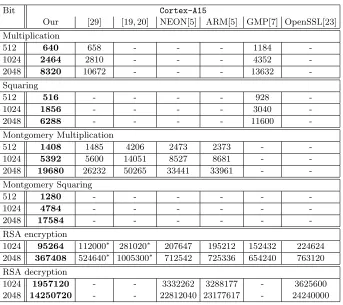
We prototyped our methods for ARM Cortex-A9 and A15 processors, which are equivalent to the target processors used in previous works [29, 5, 19, 20]. We compared our results with best previous results from proceeding version of Seo et al.’s paper presented at ICISC 2014 [29]. In Table 1 and 2, we categorize the timings with respect to the architecture that served as experimental platform8. In the case of 2048-bit multiplication, we achieve an execution time of 13736 and 8320 clock cycles on the Cortex-A9 and A15 series, while Seo et al.’s SIMD implementation requires 17080 and 10672 clock cycles. Previous works did not
8
Table 2: Results of multiplication/squaring and Montgomery multiplication/squaring and RSA operations in clock cycles on ARM Cortex-A15 platform,∗: estimated results
Bit Cortex-A15
Our [29] [19, 20] NEON[5] ARM[5] GMP[7] OpenSSL[23]
Multiplication
512 640 658 - - - 1184
-1024 2464 2810 - - - 4352
-2048 8320 10672 - - - 13632
-Squaring
512 516 - - - - 928
-1024 1856 - - - - 3040
-2048 6288 - - - - 11600
-Montgomery Multiplication
512 1408 1485 4206 2473 2373 -
-1024 5392 5600 14051 8527 8681 -
-2048 19680 26232 50265 33441 33961 -
-Montgomery Squaring
512 1280 - - -
-1024 4784 - - -
-2048 17584 - - -
-RSA encryption
1024 95264 112000∗ 281020∗ 207647 195212 152432 224624 2048 367408 524640∗ 1005300∗ 712542 725336 654240 763120
RSA decryption
1024 1957120 - - 3332262 3288177 - 3625600
2048 14250720 - - 22812040 23177617 - 24240000
provide a squaring specialized method with non-redundant representations on ARM-NEON [29, 5, 19, 20]. We compared our squaring to the latest GNU multi-ple precision arithmetic library (GMP) ver 6.0.0a [7]. We compute the 2048-bit squaring in an execution time of 9180 and 6288 clock cycles for A9 and A15, while GMP implementation requires 14399 and 11600 clock cycles. In the case of 2048-bit Montgomery multiplication, we achieve an execution time of 30940 clock cycles on the Cortex-A9 series, while Seo et al.’s SIMD implementation re-quires 32732 clock cycles. Furthermore, on a Cortex-A15, we compute a 2048-bit Montgomery multiplication within 19680 clock cycles rather than 26232 clock cycles as specified in [29, Table 2]. The Montgomery squaring shows much more optimized results than Montgomery multiplication. The strength of Montgomery squaring is vividly seen in RSA encryption and decryption, because exponen-tiation operation requires a number of modular squaring9. For this reason, our 9 RSA benchmark setting: (1) decryption with Chinese Remainder Theorem
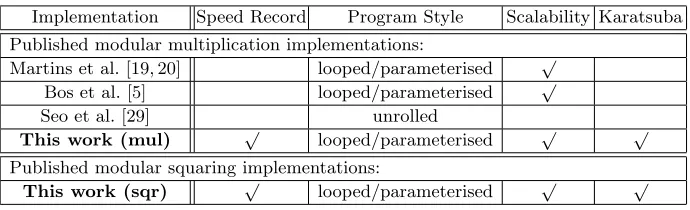
Table 3: Comparison of proposed implementations with related works
Implementation Speed Record Program Style Scalability Karatsuba
Published modular multiplication implementations:
Martins et al. [19, 20] looped/parameterised √ Bos et al. [5] looped/parameterised √
Seo et al. [29] unrolled
This work (mul) √ looped/parameterised √ √
Published modular squaring implementations:
This work (sqr) √ looped/parameterised √ √
2048-bit RSA encryption only requires 535020 and 367408 clock cycles, while Seo et al.’s work needs 654640 and 524640 clock cycles. Thus, our work out-performs Seo et al.’s work by approximately 18% and 30% on a Cortex-A9 and Cortex-A15, respectively. For comparison with 2048-bit RSA encryption and decryption of OpenSSL 1.0.2 [23], our implementations are roughly two times faster than that of OpenSSL. Proposed methods satisfy the operand scalability and Karatsuba algorithm under non-redundant representations (see Table 3). In terms of scalability, we can conduct various length of modular multiplication or squaring in a single code by altering loop counter. This would be beneficial for practical usages such as modular operations for random prime numbers. The interesting point is our work even defeats the unrolled work by [29]. In case of Karatsuba algorithm, this is a novel approach to improve SIMD based multipli-cation and squaring under non-redundant representations. Following are reasons for the significant speed-up compared to Seo et al.’s NEON implementations.
First, we used squaring dedicated method which can compute squaring more efficiently than ordinary multiplication approach. Second, constant-time Karat-suba algorithm is adopted to multiplication and squaring, which provides asymp-totically fast methods than traditional approaches. Finally, we properly mix-used SISD and SIMD instruction sets in order to reduce latencies from a number of pipeline stalls.
5.3 Comparison to GMP
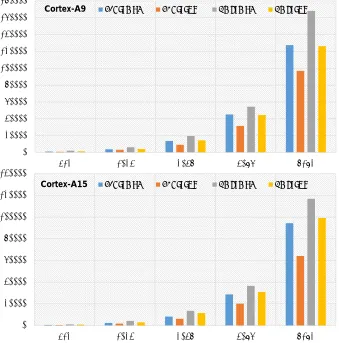
0 20000 40000 60000 80000 100000 120000 140000 160000 180000
512 1024 2048 4096 8192
Cortex-A9 KCOS_MUL KDOS_SQR GMP_MUL GMP_SQR
0 20000 40000 60000 80000 100000 120000 140000
512 1024 2048 4096 8192
Cortex-A15 KCOS_MUL KDOS_SQR GMP_MUL GMP_SQR
Fig. 2: Results of multiplication/squaring in clock cycles on ARM Cortex-A9/A15
6
Conclusion
We presented optimization techniques to improve the performance of modular arithmetic operations (in particular multiplication, squaring and Montgomery algorithm) on 2-way SIMD platforms. On an ARM Cortex-A15 processor, our separated KCOS and KDOS methods perform 2048-bit Montgomery multiplica-tion and squaring only 19680 and 17584 clock cycles, which are roughly 25% and 41% faster than the NEON implementation of Seo et al. (26232 cycles). For full implementations of 2048-bit RSA encryption and decryption on A15 processor, our implementations only need 367408 and 14250720 clock cycles.
It is also worth to note that our methods are perfectly suitable for processors that support SIMD multiplication (PMULUDQ, VPMULUDQ) and shuffle (VPSHUFD,
on these observations, the most obvious future work is to apply the proposed modular multiplication and squaring routines to Intel-SSE and Intel-AVX pro-cessors. This will be straight-forward to push the boundaries even further by replacing traditional approaches by our modular arithmetic routines.
References
1. D. J. Bernstein. Batch binary edwards. InAdvances in Cryptology-CRYPTO 2009, pages 317–336. Springer, 2009.
2. D. J. Bernstein, C. Chuengsatiansup, and T. Lange. Curve41417: Karatsuba re-visited. In Cryptographic Hardware and Embedded Systems–CHES 2014, pages 316–334. Springer, 2014.
3. D. J. Bernstein and P. Schwabe. Neon crypto. In Cryptographic Hardware and Embedded Systems–CHES 2012, pages 320–339. Springer, 2012.
4. J. W. Bos and M. E. Kaihara. Montgomery multiplication on the cell. InParallel Processing and Applied Mathematics, pages 477–485. Springer, 2010.
5. J. W. Bos, P. L. Montgomery, D. Shumow, and G. M. Zaverucha. Montgomery multiplication using vector instructions. In T. Lange, K. Lauter, and P. Lisonek, editors,Selected Areas in Cryptography — SAC 2013, volume 8282 ofLecture Notes in Computer Science, pages 471–489. Springer Verlag, 2014.
6. P. G. Comba. Exponentiation cryptosystems on the IBM PC. IBM Systems Jour-nal, 29(4):526–538, Dec. 1990.
7. Free Software Foundation, Inc. GMP: The GNU Multiple Precision Arithmetic Library. Available for download athttp://www.gmplib.org/, Feb. 2015.
8. J. Großsch¨adl, R. M. Avanzi, E. Sava¸s, and S. Tillich. Energy-efficient software implementation of long integer modular arithmetic. In Cryptographic Hardware and Embedded Systems–CHES 2005, pages 75–90. Springer, 2005.
9. S. Gueron and V. Krasnov. Software implementation of modular exponentiation, using advanced vector instructions architectures. In Arithmetic of Finite Fields, pages 119–135. Springer, 2012.
10. N. Gura, A. Patel, A. S. Wander, H. Eberle, and S. Chang Shantz. Comparing ellip-tic curve cryptography and RSA on 8-bit CPUs. In M. Joye and J.-J. Quisquater, editors, Cryptographic Hardware and Embedded Systems — CHES 2004, volume 3156 ofLecture Notes in Computer Science, pages 119–132. Springer Verlag, 2004. 11. M. Hutter and P. Schwabe. Multiprecision multiplication on avr revisited. 2014. 12. M. Hutter and E. Wenger. Fast multi-precision multiplication for public-key
cryp-tography on embedded microprocessors. In B. Preneel and T. Takagi, editors, Cryptographic Hardware and Embedded Systems — CHES 2011, volume 6917 of Lecture Notes in Computer Science, pages 459–474. Springer Verlag, 2011. 13. Intel Corporation. Using streaming SIMD extensions (SSE2) to perform big
multi-plications. Application note AP-941, available for download athttp://software. intel.com/sites/default/files/14/4f/24960, July 2000.
14. A. Karatsuba and Y. Ofman. Multiplication of multidigit numbers on automata. InSoviet physics doklady, volume 7, page 595, 1963.
15. Y. Lee, I.-H. Kim, and Y. Park. Improved multi-precision squaring for low-end RISC microcontrollers. Journal of Systems and Software, 86(1):60–71, 2013. 16. Z. Liu and J. Großsch¨adl. New speed records for montgomery modular
17. Z. Liu, H. Seo, J. Großsch¨adl, and H. Kim. Reverse product-scanning multiplication and squaring on 8-bit AVR processors. In L. C.-K. Hui, S. Qing, E. Shi, and S.-M. Yiu, editors, Information and Communications Security — ICICS 2014,Lecture Notes in Computer Science, Springer Verlag, 2015.
18. S. Mangard, E. Oswald, and T. Popp.Power analysis attacks: Revealing the secrets of smart cards, volume 31. Springer Science & Business Media, 2008.
19. P. Martins and L. Sousa. On the evaluation of multi-core systems with simd engines for public-key cryptography. In Computer Architecture and High Performance Computing Workshop (SBAC-PADW), 2014 International Symposium on, pages 48–53. IEEE, 2014.
20. P. Martins and L. Sousa. Stretching the limits of programmable embedded devices for public-key cryptography. In Proceedings of the Second Workshop on Cryptog-raphy and Security in Computing Systems, page 19. ACM, 2015.
21. A. J. Menezes, P. C. van Oorschot, and S. A. Vanstone. Handbook of Applied Cryptography. CRC Press Series on Discrete Mathematics and Its Applications. CRC Press, 1996.
22. P. L. Montgomery. Modular multiplication without trial division. Mathematics of Computation, 44(170):519–521, Apr. 1985.
23. OpenSSL. The open source toolkit for SSL/TLS. Available for download athttps: //www.openssl.org/, Mar. 2015.
24. K. C. Pabbuleti, D. H. Mane, A. Desai, C. Albert, and P. Schaumont. Simd accel-eration of modular arithmetic on contemporary embedded platforms. InHigh Per-formance Extreme Computing Conference (HPEC), 2013 IEEE, pages 1–6. IEEE, 2013.
25. H. Seo and H. Kim. Multi-precision multiplication for public-key cryptography on embedded microprocessors. InInformation Security Applications, pages 55–67. Springer, 2012.
26. H. Seo and H. Kim. Optimized multi-precision multiplication for public-key cryp-tography on embedded microprocessors. International Journal of Computer and Communication Engineering, 2(3):255–259, 2013.
27. H. Seo, Z. Liu, J. Choi, and H. Kim. Optimized karatsuba squaring on 8-bit avr processors.
28. H. Seo, Z. Liu, J. Choi, and H. Kim. Multi-precision squaring for public-key cryptography on embedded microprocessors. In INDOCRYPT 2013, pages 227– 243. Springer, 2013.
29. H. Seo, Z. Liu, J. Großsch¨adl, J. Choi, and H. Kim. Montgomery modular multi-plication on arm-neon revisited.
30. C. D. Walter and S. Thompson. Distinguishing exponent digits by observing mod-ular subtractions. InTopics in CryptologyCT-RSA 2001, pages 192–207. Springer, 2001.