More Rounds, Less Security?
Jian Guo1, J´er´emy Jean1, Nicky Mouha2,3, and Ivica Nikoli´c1
1
Nanyang Technological University, Singapore
2 Dept. Electrical Engineering-ESAT/COSIC, KU Leuven, Leuven and iMinds, Ghent, Belgium
3 Project-team SECRET, Inria, France
[email protected],[email protected],[email protected],[email protected]
Abstract. This paper focuses on a surprising class of cryptanalysis re-sults for symmetric-key primitives: when the number of rounds of the primitive is increased, the complexity of the cryptanalysis result de-creases. Our primary target will be primitives that consist of identical round functions, such as PBKDF1, the Unix password hashing algorithm, and the Chaskey MAC function. However, some of our results also ap-ply to constructions with non-identical rounds, such as the PRIDE block cipher. First, we construct distinguishers for which thedata complexity decreases when the number of rounds is increased. They are based on two well-known observations: iterating a random permutation increases the expected number of fixed points, and iterating a random function decreases the expected number of image points. We explain that these effects also apply to components of cryptographic primitives, such as a round of a block cipher. Second, we introduce a class of key-recovery and preimage-finding techniques that correspond to exhaustive search, however on a smaller part (e.g. one round) of the primitive. As thetime complexityof a cryptanalysis result is usually measured by the number of full-round evaluations of the primitive, increasing the number of rounds will lower the time complexity. None of the observations in this paper result in more than a small speed-up over exhaustive search. Therefore, for lightweight applications, implementation advantages may outweigh the presence of these observations.
Keywords:Iterated cipher, fixed points, slide attack, PRIDE, Chaskey, PKCS, PBKDF1, Unix password hashing algorithm, Even-Mansour, FX-construction.
1
Introduction
How to determine the number of rounds of a symmetric-key primitive, for exam-ple of an iterated block cipher? O’Connor noted that “Most ciphers are secure after sufficiently many rounds,” to which Massey replied that “Most ciphers are too slow after sufficiently many rounds.” From this point of view, the challenge is to design a cipher that is both fast and secure.
counterexample are primitives that are vulnerable to slide attacks [8,9]. As stated by Biryukov in [7], slide attacks “realize the dream of cryptanalysts: if the cipher is vulnerable to such an attack, the complexity of the attack is independent of the number of rounds of the cipher.” In that context, this paper describes what certainly must be the nightmare of any cryptographer. We will discuss cryptanalysis results where the complexity decreases when the number of rounds is increased.
Before we continue, let us clarify how we measure complexity in terms of data complexity and time complexity. In symmetric-key cryptanalysis, thedata complexity commonly refers to the number of input-output pairs of a certain keyed function, for example the number of plaintext-ciphertext pairs for a block cipher. The time complexity is usually defined as an equivalent number of full-round evaluations of a cryptographic primitive. This is a very simplified model, but nevertheless useful for designers and cryptanalysts as the cost in practice of an attack is usually very difficult to estimate.
Our basic observations hold for primitives that have identical round func-tions, such as Unix’s crypt(3) and PKCS #5’s PBKDF1 password hashing algorithms, or the Chaskey MAC function [31]. But as we will show, our results also apply to primitives with non-identical round functions, such as the recently proposed PRIDE block cipher [1].
The very nature of the results in this paper seems to defy logic, however designers do not need to worry too much: their practical impact is very low, as all of them are very close to exhaustive search. Nevertheless, this paper should be interesting from an academic point of view, given the interest in recent years into “brute-force-like” cryptanalysis. These include, for example, the recently proposed biclique results for many ciphers, including the full AES [10]. However, it can be shown that the biclique attacks on AES are thwarted when the number of rounds is increased. This is an essential difference with the results that we will introduce in this paper, as they will have an even lower complexity when the number of rounds is increased.
In this light, this paper is particularly interesting for the domain of lightweight cryptography. Designers may want to explicitly allow small speed-ups of exhaus-tive search, if such design choices lead to a more efficient implementation. As such, we hope that this paper will eventually lead to a better theoretical under-standing of the design of symmetric-key primitives. It is typically conjectured that a cipher becomes more secure when the number of rounds is increased. While a proof of this conjecture remains an open problem for many construc-tions, this paper will show that there exist constructions for which the conjecture does not hold.
Therefore, we do not claim that any of the observations in this paper are “at-tacks,” and definitely not that any designs are “broken” when they are applica-ble. Note that there is a large amount of literature on cryptographic observations that do not affect the security of a design, such as for example reduced-round attacks. They should nevertheless be interesting and relevant to understand the security properties of the design.
In fact, the observations in this paper should be seen in a positive light, to open the way for more efficient designs. A lightweight design with ann-bit block size that is susceptible to the observations in this paper, may suggest that it is secure up to 2n round function evaluations, instead of 2n evaluations of the entire primitive.
For many of the observations in this paper, we can not give exact calculations of their complexities. One reason is that they have some computational overhead, which is platform-dependent and therefore difficult to evaluate. But regardless of this overhead, they will always outperform generic attacks when the number of rounds is high enough. Another reason that the complexities are difficult to evaluate, is that we will assume that non-ideal primitives behave as ideal primitives in order to make an analysis possible. Nevertheless, we should see an effect if the number of rounds is high enough, otherwise the non-ideal primitives would have other cryptographic weaknesses.
Our Contributions. In the domain of provable security, it is well-known that
iterating an ideal primitive will result in a loss of security. This is already evident from the very first results in provable security, so we certainly do not claim a new result in that area. However, after performing a thorough literature study on the cryptanalysis of non-ideal primitives, it appears to be a little-known fact that for certain constructions, the complexity of a cryptanalysis result can decrease when the number of rounds of the primitive isincreased. The goal of this paper is to perform the first comprehensive study on this subject. We give an overview of the existing literature, which typically involves ideal primitives. Then, we apply these insights to non-ideal components (e.g. one round of a block cipher) that arise in the field of cryptanalysis. We obtain new cryptanalysis results on ciphers built on the Even-Mansour block cipher and the FX-construction, which we then apply respectively to Chaskey and PRIDE.
2
Related Work
Wagner and Goldberg [35] performed an analysis of the Unix password hashing algorithm, which consists of 25 applications of a variant of DES on an all-zero plaintext. The password of the user is used as the key of the DES variant. Note that this description omits the salt value, an important feature of the password hashing algorithm. However, Wagner and Goldberg do not analyze the effect of the salt in their paper. As the salt value is used to create different variants of the DES algorithm, their analysis therefore effectively considers the Unix password hashing algorithm when only one salt value is used.
They analyzed this construction by observing its close relation to the security of the CBC-MAC algorithm [3, 4]. Their security bound shows that Unix pass-word hashes may not be uniformly random. However, as their analysis assumes that the adversary obtains only one password hash, this effect becomes negligi-ble. The implications of changing the number of iterations is not considered in their paper.
The same effect was analyzed by Bard et al. [2], when they calculated the expected number of fixed points of a random permutation that is iteratedk≤2n times. They found that it is equal to τ(k), where τ is the number-of-divisors function. For example, when this result is applied to Unix password hashing wherek= 25, they calculated that the expected number of fixed points isτ(25) = 3, as 25 has three divisors: 1, 5 and 25. Thus, by counting the number of fixed points, we can distinguish this construction from random. Note that for the particular case of Unix password hashing, this distinguisher will have a low, but nevertheless non-negligible success probability. The reason for the low success probability is that the length of the password (56 bits) is smaller than the length of the hash value (64 bits).
Bard et al. did not state that their cryptanalysis result becomes better when the number of rounds is increased. In fact, strictly speaking, such a statement would not be correct. There are infinitely many prime numbers, and if the num-ber of rounds is a prime numnum-ber, the expected numnum-ber of fixed points is always two. However, the limit superior of τ(k) goes to infinity, and τ(k) is strictly increasing for commonly used subsets ofk, such as powers of two:τ(2ℓ) =ℓ+ 1, or powers of ten:τ(10ℓ) = (ℓ+ 1)2. Under this more narrow interpretation, we argue that this can be seen as a distinguisher for which the complexity decreases when the number of rounds is increased.
In subsequent work, Yao and Yin [37, 38] analyzed the two standardized password-based key derivation functions of PKCS #5: PBKDF1 and PBKDF2. PBKDF1 concatenates the password and salt, and then iteratively applies a hash functionktimes to the result. Note thatkis not a fixed parameter, but depends on the implementation. They argue that PBKDF1 becomes more secure whenk is increased, which they refer to as the effect of “key-stretching.”
iteration count k is increased. We should note that in practice, passwords of-ten have a very low entropy, in which case adversaries only need to make a small amount of queries. Nevertheless, it should be interesting to understand the generic security of iterated constructions for any number of queries.
Gligoroski and Klima [20] showed how this weaker security bound also corre-sponds to an observation on iterated random functions such as PBKDF1. They recalled a theorem by Flajolet and Odlyzko [19]: if ann-bit random function is iteratedktimes, the expected number of image points is (1−tk)·2n (for large n), where tk satisfies the recurrence relationt0 = 0 and tk+1 = exp(−1 +tk). From this, it can be shown that the expected number of image points is 2n−i+1 when a random function is iteratedk= 2itimes. This approximation is valid for i≥5, and becomes more accurate wheniincreases. Note that the observations of Gligoroski and Kilma also hold if kindependent random functions are used, instead of one random function that is iterated ktimes.
Using this theorem, Gligoroski and Klima constructed distinguishers for sev-eral iterated constructions, including PBKDF1 and sevsev-eral narrow-pipe hash functions. From their observations, they argued for wide-pipe instead of narrow-pipe hash functions. They did not, however, point out that increasing the number of rounds of a primitive makes their distinguishers more successful. This is of course evident from the formulas, but it was not part of their story line.
The same “entropy loss” was evaluated in the context of stream ciphers, for example by Hong and Kim [21] and by R¨ock [34] for the MICKEY stream cipher. However, the context is not the same as the one that we consider in this paper. Their analysis concludes that security decreases when more output bits are known, whereas we do not increase the number of output bits, but only the number of rounds of the primitive.
The security of iterated random permutations was studied very recently by Minaud and Seurin [29] at CRYPTO 2015. When the number of iterations kis constant, they provide a security bound as well as a simple attack that matches their bound up to a constant factor. An alternative simple proof was later pro-vided by Nandi [33]. We will recall their result in this paper, and analyze the security of an iterated random function in the same setting. We argue that re-sulting distinguishers also apply when a non-ideal permutation is iterated, and support this claim by experiments.
At the rump session of the ECRYPT II Hash Function Retreat in 2009 [15], Dunkelman showed how to speed up preimage search for the ESSENCE hash function [28] by the number of rounds. Unfortunately, this result was never published, and appears to be unknown to most of the research community. In the context of the 3D Cipher, the technique of Dunkelman was independently rediscovered by Wang et al. [36], who point out that the complexity decreases when the number of rounds is increased. In Sect. 5, we will recall this observation and extend it to other constructions.
Sasaki found that the 6.5 rounds are weaker against a preimage attack than 6 rounds. Similarly, Ma et al. [26] constructed preimage attacks on 5 rounds and 6.5 rounds of the GOST-256 hash function, but could not attack 6 rounds. In this paper, we will not consider these attacks, as we will only focus on results where the complexity decreases (monotonically or non-monotonically) as the number of rounds is increased.
The indifferentiability setting will not be studied in this paper. Of particular interest in this area, however, is a result by Dodis et al. [14] that show that the second iterate H2(M) = H(H(M)) of a random oracle H has poor concrete security in the sense of indifferentiability from a random oracle.
3
Distinguishers on Ideal Iterated Primitives
In this section, we will study the security of iterated primitives. Firstly, we will look at constructions where an ideal primitive is iterated, which can be a ran-dom function or a ranran-dom permutation. Then, we state security bounds for the resulting constructions. For a fixed number of iterations k, we will explain that these security bounds are tight. We do this by recalling the cycle distinguisher of Minaud and Seurin [29] for an iterated random permutation, and by introducing a collision distinguisher for an iterated random function.
We then recall two other distinguishers on these constructions: entropy-loss distinguishers and fixed-point distinguishers. As mentioned in Sect. 2, these dis-tinguishers have been described in existing literature when a random function or a random permutation is used. We will explain how they also apply to con-structions with non-ideal primitives, by presenting a fixed-point distinguisher for the Chaskey MAC function. Interestingly, doubling the number of rounds will decrease the complexity of this fixed-point distinguisher.
3.1 Security Bounds on Iterated Primitives
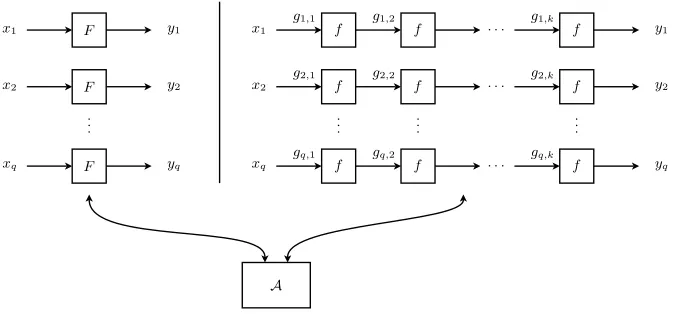
Let us assume that adversaries are computationally unbounded, and are only limited by the number of queries that they make. Without loss of generality, we assume that all queries made by an adversary are distinct. Letperm(n) denote the set of all permutations on n bits, and let func(n) be the set of all func-tions from n to n bits. We then define the advantage of an iterated primitive distinguisher as follows (see also Fig. 1).
Definition 1 (Iterated Primitive Distinguisher). Let F and f be random
variables over perm(n)(resp. overfunc(n)). For an adversary A, the advantage of distinguishing a random function (resp. random permutation) from the k-th iterate of a random function (resp. random permutation) using at mostqqueries is
AdvF,fk(A) =
PrhAF(q)→1i−PrhAfk
(q)→1i
A
..
. ...
x1 f y1
f f
g1,2
· · ·
g1,1
f
g1,k
x1 F y1
x2 F y2 x2 f f y2
g2,2
· · ·
g2,1
f
g2,k
xq F yq xq f gq, f yq
2
· · ·
gq,1 gq,k
..
. ...
Fig. 1.Distinguishing between a random function (resp. permutation)Fand a random function (resp. permutation)fthat is iteratedktimes. The adversaryAmakes at most qqueries. All queries are assumed to be distinct. In caseF andf are permutations,A
can make both forward and inverse queries.
where the adversary can make both forward and inverse queries in caseF andf are permutations. Note that the adversary is only given access toF andfk, and not tof directly.
For an iterated random function, the maximum adversarial advantage can be derived from the security bounds of CBC-MAC [3–5, 32], as was done by Wagner and Goldberg [35]. We will provide a simpler proof and a tighter bound for this construction. For the security bound for a iterated random permutation, we recall a recent result of Minaud and Seurin [29]. Theorem 2 considers the case where both F and f are random functions. In Theorem 1, both F and f are random permutations.
Theorem 1 (Iterated Random Permutation Security). Let F be a
ran-dom permutation, andfk be a random permutation that is iteratedktimes. Then for allA making at mostqqueries,
AdvF,fk(A)≤
(2k+ 1)q
2n . (2)
We refer to Minaud and Seurin [29] for a proof of this bound.
Theorem 2 (Iterated Random Function Security).LetFbe random
func-tion, andfk be a random function that is iteratedktimes. Then for allAmaking at mostq queries,
AdvF,fk(A)≤
kq(kq−1) 2n+1 −
q(q−1)
Proof. LetE1be the event that there existgi,j=gi′,j′ such that¬(i=i′∧j=j′) (see Fig. 1). Given thatE1 does not happen, no input of f will be reused. Note that trivial reuse occurs when there exist ℓ, ℓ′ : ℓ 6= ℓ′ such that x
ℓ = xℓ′, but we do not have to consider this as we assumed w.l.o.g. that the adversary makes distinct queries. Under the negation of E1, all queries are independent of each other, and the reply to every query follows a uniformly random distribution, so that F and fk are indistinguishable. By the fundamental lemma of game playing, AdvF,fk ≤Pr
h E1
i
. From the union bound, the probability thatgi,j = gi′,j′ where ¬(i = i′ ∧j = j′), is at most 0/2n+ 1/2n+ · · ·+ (kq−1)/2n = kq(kq −1)/2n+1. In fact, we can construct a tighter upper bound, by noting that since we assumed that all queries are distinct, we know thatgi,16=gi′,1 for i 6=i′. Let us therefore consider the event E
2 that there existgi,j =gi′,j′ such that ¬(i=i′∧j =j′) and¬(j =j′ = 1). Using a similar reasoning as before,
F and fk are indistinguishable under the negation of E
2. Again by the union
bound, the probability thatgi,j=gi′,j′ where¬(i=i′∧j=j′)and¬(j=j′= 1), is at most q/2n+ (q+ 1)/2n+ · · ·+ (kq−1)/2n. This bound is similar toE
1,
but it does not contain the first q terms of E1 as they correspond to the cases
where¬(i=i′∧j =j′)but j=j′ = 1. This sum is equal to kq(kq−1)/2n+1
-q(q−1)/2n+1, from which the theorem follows. ⊓⊔
3.2 Matching Attacks for Iterated Primitives
Iterated Random Permutation. In [29], Minaud and Seurin proved that the
bound of Theorem 1 is tight. When the number of iterations k is fixed, they provide a distinguisher that matches this bound up to a constant factor. We recall their distinguisher in Algorithm 1.
Algorithm 1:Cycle DistinguisherDQcycle(q)
s0←− {$ 0,1}n
fori←0toq−1do
si+1←Q(si)
end
if allsi distinct then
return0
else
return1
end
Iterated Random Function. In their analysis of CBC-MAC, Mandal and
We recall their distinguisher in Algorithm 2. Mandal and Nandi [27] proved that this distinguisher has an advantage ofΩ(kq2/2n). The distinguisher makes q queries to the interface Q, which can be eitherF or fk, where F and f are random functions.
Algorithm 2:Collision DistinguisherDcollQ (q)
fori←0toq−1do
si←Q(i)
end
if allsi distinct then
return0
else
return1
end
4
Distinguishers on Non-Ideal Iterated Primitives
In Sect. 3, we stated security bounds for iterated permutations and iterated random functions. Both bounds were shown to be tight. For a fixed value of the iteration countk, respectively the cycle distinguisher (Algorithm 1) and the collision distinguisher (Algorithm 2) can be shown to match the bounds up to a constant factor.
In Sect. 2, we recalled two other distinguishers for iterated primitives, which we will refer to as the entropy-loss distinguisher for the case of random func-tions, and as the fixed-point distinguisher when random permutations are con-sidered. As we explained, these distinguishers have already been applied to sev-eral iterated constructions, including the Unix password hashing algorithm and PBKDF1. For each of these constructions, the underlying building blocks were assumed to be ideal.
4.1 Application to Chaskey
≪5
v1 v0 v2 v3
v1 v0 v2 v3
≪16
≪8
≪13
≪7
≪16
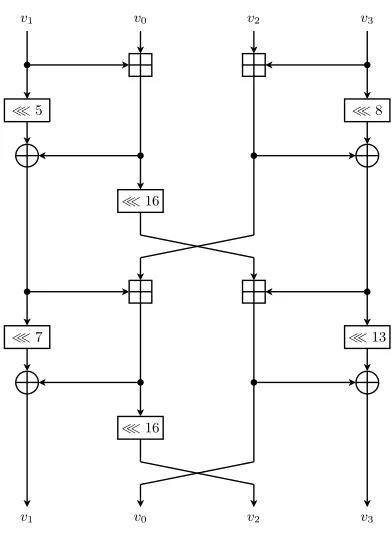
Fig. 2. One round of the Chaskey permutation π, defined as: v0kv1kv2kv3 ←
π(v0kv1kv2kv3). The values v0 and v1 are intentionally swapped, as this reduces the number of crossing lines in the figure.
Chaskey [31] is a Message Authentication Code (MAC) algorithm designed by Mouha et al. as a collaboration between KU Leuven-COSIC and Hitachi YRL. Soon after its publication, Chaskey entered a study period for standardization by ISO/IEC JTC 1/SC 27/WG 2. In October 2015, the committee decided to circulate a first working draft on the new 29192-6 lightweight MAC standard [30]. ITU-T SG17 has recently added new work items related to IoT [39] and ITS [39] security, for which Chaskey seems to be well-suited.
number of rounds k
0 4 8 12 16 20 24 28 32
number of fixed points
0 4 8 12 16 20 24
experimental theoretical
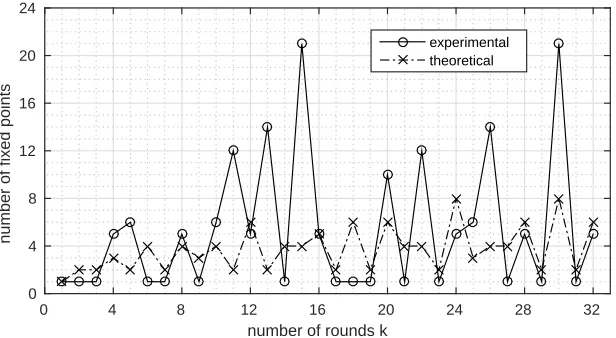
Fig. 3.Number of fixed points for 1≤k≤32 rounds of the SmallChaskey permuta-tion, compared to the expected number of fixed points if every round were a random permutation.
linear function.4Here, the plaintextP is equal to the one-block message, and the ciphertextCcorresponds to the (untruncated) tagT. The Chaskey permutation πconsists of eight identical rounds, one of which is shown in Fig. 2.
The derivation of the subkeyK1 fromK goes as follows. Let us interchange-ably consider an elementaofGF(2128) as the integer 2127a[127] + 2126a[126] + . . .20a[0] in decimal notation, and as the polynomial a(x) = a[n−1]xn−1+ a[n−2]xn−2+. . .+a[0] with binary coefficients. To multiply two elements a and b, we represent them as two polynomials a(x) and b(x), and calculate a(x)b(x) modf(x) wheref(x) =x128+x7+x2+x+ 1. Using this notation, the subkeyK1 of Chaskey can be defined asK1= 2K.
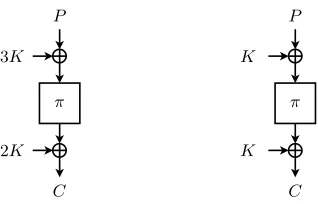
Related the Chaskey MAC function, we also define the Chaskey block cipher. This block cipher is used in Chaskey’s 3PRP security proof [31], and is bench-marked in the FELICS project [13]. It is defined asC=EK(P) =K⊕π(P⊕K). A graphic representation of both constructions is given in Fig. 4.
For both the Chaskey MAC function on one-block messages and the Chaskey block cipher, the claimed security is aboutT= 2128/Dpermutation evaluations when D plaintext-ciphertexts are available. We will refer to T and D as the time and the data complexity, respectively. The currently best known attack on Chaskey is by Leurent [25] on 7 rounds out of 8 rounds, with 248chosen plaintexts and 267 time. The attack applies to the Chaskey MAC function as well as the Chaskey block cipher. As a result of this attack, it was decided to introduce
4 Chaskey also uses a subkey
3K P
π
2K
C
K P
π
K
C
Fig. 4. The Chaskey MAC function for a one-block message (left) and the Chaskey block cipher (right).
the twelve-round variant Chaskey-12 to be considered for the upcoming 29192-6 lightweight MAC standard [30].
In the fixed-point distinguishers that we will now consider, we will have T = 0. This means that we will not perform a single permutation evaluation: the distinguisher does not depend on the permutationπ, and even works if the algorithmic description of π is unknown to the adversary. Going back to the setting of Even-Mansour [17, 18], this means that the entire codebook (all 2128 plaintexts and ciphertexts) should appear as if it was generated by a random permutation.
Any number of rounds of the Chaskey permutation always has at least one fixed point: the all-zero input. The search for additional fixed points seems to be a computationally difficult problem, even for only one round of the Chaskey permutation. For this reason, we performed some experiments on the Small-Chaskey permutation, a variant of the Small-Chaskey permutation that we introduce in this paper. In SmallChaskey, all 32-bit words are replaced by 8-bit words, and the rotation constants 16, 8, 13, and 7 are replaced by 4, 2, 6, and 3, respectively. The results are plotted in Fig. 3. As we can see from this figure, the number of fixed points is significantly higher than one, which is the number of fixed points expected for a random permutation. It also seems to be sometimes much higher than expected for an iterated random permutation. We conjecture that this behavior also holds for the full-size Chaskey block cipher and for other cryptographic round functions.
If this is the case, an adversary can distinguish the Chaskey block cipher from a random permutation by collecting close toD= 2128plaintext-ciphertext pairs and counting the number of fixed points. This distinguisher has no impact on the security of the Chaskey MAC function, which restricts the data complexity available to the adversary to at most 264 plaintext-ciphertexts, because then a collision in the internal state of the mode of operation has a non-negligible probability. However, we do not look into the mode of operation, but instead distinguish the Chaskey block cipher from a random permutation. This problem may be of independent academic interest.
function, a fixed point for the permutation will not correspond to a fixed point for the MAC function. However, it is possible to collect all pairs of distinct plaintexts (Pi, Pj), and count how often Pi⊕Ci = Pj⊕Cj. If Chaskey’s permutation π has more fixed points than a random permutation, the aforementioned equation will also be satisfied more often.
In Sect. 5.2, we will present results on the Chaskey MAC function that also apply when a low number of plaintext-ciphertexts are available.
5
Speeding Up Exhaustive Search
The distinguishers that we presented in Sect. 3 and 4 have the property that thedata complexity decreases when the number of rounds is increased. The time complexity was not a parameter, in fact the distinguishers even work if the underlying algorithm is not known to the adversary.
We now look at cryptanalysis results where the time complexity decreases when the number of rounds is increased. These results hold in the conventional model that is used in cryptanalysis: the time complexity is calculated in terms of the equivalent number of full-round computations.
However, we assume that the time complexity is only determined by the number of round evaluations. Any other computations that are performed by the adversary, are not taken into account. As a result of this, the speed-up over exhaustive search may be less than our simplified model shows. If the overhead of these other computations is significant, it may even be that there is only a speed-up over exhaustive search if the cipher uses a sufficiently large number of rounds.
Note that our analysis uses a computational model that is common for meet-in-the-middle and biclique-style cryptanalysis. However, those types of crypt-analysis can be prevented by increasing the number of rounds. This is not the case for our observations. In fact, our observations have a lower complexity when the number of rounds is increased.
After recalling an observation by Dunkelman on the ESSENCE hash function, we will introduce new speed-ups over exhaustive search for the Chaskey MAC function, for the PRIDE block cipher, and for a variant of PBKDF1 without a salt.
5.1 ESSENCE
Let us recall the speed-up over exhaustive preimage search by Dunkelman [15] on the ESSENCE hash function. The ESSENCE compression function consists of 32 identical rounds, shown in Fig. 5. A preimage for the compression function (a “pseudo-preimage” for the hash function) can be found as follows. LetX be the target compression function value, so that we are looking for a message M and a chaining valueCV for whichC(CV, M) =X, whereC is the ESSENCE compression function.
F
r7 r6 r5 r4 r3 r2 r1 r0
L F
k7 k6 k5 k4 k3 k2 k1 k0
L
Fig. 5.One round of the ESSENCE hash function. The chaining valueCV is loaded into the ri registers, whereas the message M is loaded into the ki registers. Every
register is either 32 or 64 bits, resulting in a hash value of either 256 or 512 bits. FunctionF is a bitwise non-linear function, andLis a linear function operating on an entire word. ESSENCE consists of 32 rounds, after which a feed-forward is applied.
2. Iterate the ESSENCE round function 32 times, storing all intermediate val-ues ofM and CV.
3. Apply the feed-forward function, and check if the resulting compression out-put corresponds to the target valueX.
4. If not, apply only one additional round of ESSENCE, and return to the previous step.
For the sake of completeness, we should note that a pseudo-preimage may not exist for the target value X, in which case this algorithm (and any other algorithm) will fail. The algorithm will also fail if it cycles back to the initial (M, CV) without encountering the target valueX. This problem can be solved by selecting a new value of (M, CV) and restarting the algorithm.
If we assume that the ESSENCE round function evaluations dominate any of the other calculations, then Dunkelman’s observation effectively speeds up the search for a pseudo-preimage by the number of rounds. In the conventional secu-rity model where the attack complexity is determined by the equivalent number of compression function evaluations, this means that the time complexity goes down when the number of rounds is increased. This observation was indepen-dently rediscovered by Wang et al. [36] when they analyzed the 3D Cipher.
5.2 Chaskey
We now describe a speed-up of exhaustive search using known plaintexts on the Chaskey MAC algorithm. In the observation, all messages consist of one block, and the tags are not truncated. As explained in Sect. 4.1, the Chaskey MAC function is then equivalent to an Even-Mansour block cipher C = EK(P) = K1⊕π(P⊕K⊕K1), whereK1= 2K. From this, it follows thatC=EK(P) = 2K⊕π(P⊕3K).
The observation goes as follows. First,D known plaintexts (Pi, Ci) are ob-tained, which are encrypted under the secret key K. Each known plaintext can be transformed into another known plaintext (P′
i, Ci′), encrypted under an un-known key K′
i, where Pi′ = 0, Ci′ =Ci⊕2·3−1Pi and Ki′ =K⊕3−1Pi. It is easy to check from the key schedule that both (Pi, Ci) and (Pi′, Ci′) are valid plaintext-ciphertext pairs (under keysKandK′respectively), as input and
out-put to the underlying permutationπremain the same. Then, store (C′
i, Pi) into a hash table, indexed by the first coordinate.
We then obtainT input-output pairs (xj, yj) of the permutation π. This is done using the same trick as for ESSENCE (Sect. 5.1): once one input-output pair of the permutation is calculated, any additional input-output pairs can be obtained from only one additional round evaluation. If an all-zero plaintext were encrypted, (xj, yj) would correspond to a plaintext (Pj, Cj) under a known key Kj, where Pj = 0, Cj =y⊕2·3−1xand Kj = 3−1x. We therefore check for each (xj, yj) if Cj appears as the first element in the hash table. If this is the case for elementi, we can check the guessK= 3−1(P
i⊕xj).
The probability that Ci = Cj for any i, j is 2−128. As our data contains T D= 2128pairs (C
i, Cj), we will find a match with a non-negligible probability of success. As each of the T permutation evaluations can be generated with an equivalent time complexity of T /k, wherek is the number of rounds of the cipher, exhaustive search is effectively sped up with a factor ofk. Of course, this analysis assumes that any other calculations besides the Chaskey round function evaluations are negligible. If this is not the case, the speed-up over exhaustive search will be smaller thank. Regardless of this assumption, the time complexity of our observation will decrease when the number of rounds is increased.
All results in this section were experimentally verified on a Chaskey variant using the SmallChaskey permutation defined in Sect. 4.1.
5.3 PRIDE
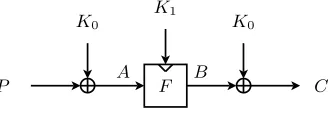
PRIDE is a lightweight block cipher proposed by Albrecht et al. [1]. It pro-cesses a 64-bit plaintextP using a 128-bit keyK, which is split into two 64-bit keys K0 and K1. Similar to PRINCE [11], PRIDE is also based on the FX-construction [23, 24] and also claims a security of T D = 2128, where T and D are again, respectively, the time and data complexity of any cryptanalysis re-sult. The PRIDE construction is illustrated in Fig. 6. Our description of PRIDE omits a bit permutation that is applied to the plaintext and ciphertext, and adds a diffusion layer to the last round, so that every round becomes identical. The adversary can easily revert the bit permutation, as it does not require knowledge of the key. The omission of the diffusion layer in the last round is a bit trickier to deal with, and will be done after explaining the basic attack.
P
K0
F
K0
C K1
A B
Fig. 6.The PRIDE block cipher, which processes 64-bit plaintextPusing a 128-bit key K, which is split into two 64-bit keysK0andK1. KeyK0is used for prewhitening and postwhitening. The block cipher F is a 20-round Substitution-Permutation Network (SPN) that usesK1.
cryptanalysis model used in this paper. But first, we describe the round function and key schedule of PRIDE.
The block cipherFused inside PRIDE is a 20-round Substitution-Permutation Network (SPN). It consists of a subkey addition (the XOR offi(K1) for round i), followed by a substitution layer S and a permutation layer P, as shown in Fig. 7. The subkeysfi(K1) are derived fromK1as follows. Letkdenote the con-catenation of binary strings. First, we splitK1into eight bytes:K1=u1k. . .ku8. Then,
fi(K1) =u1ku2+ 193iku3ku4+ 165iku5ku6+ 81iku7ku8+ 197i , (4)
where all operations are performed modulo 28.
K1
S P
fi
Fig. 7.One round of the PRIDE Substitution-Permutation Network (SPN), whereS denotes the substitution layer andP refers to the permutation layer.
This results in the following pair of slid keysK1, K1′:
K1=a1ka2 ka3ka4 ka5ka6 ka7ka8 , (5) K′
1=a1ka2+ 193ka3ka4+ 165ka5ka6+ 81ka7ka8+ 197 , (6)
where again all calculations are performed modulo 28.
At the core of the attack, we will speed up the generation of (A, B)-values for the block cipherF, shown in Fig. 6. A full-round encryption is required to obtain one (A, B)-value under an adversary-chosen keyK1, after which each additional round will result in another (A′, B′), where the relation betweenK1 andK′
1 is given by (5)-(6).
For the FX-construction used in PRIDE, the existing attacks proceed as follows: iterate over all keysK1, and then apply an attack of the Even-Mansour block cipher. This strategy is used in the chosen-plaintext attack by Kilian and Rogaway [23, 24], and in the known plaintext attack for D= 2n/2 by Biryukov and Wagner [9], wheren denotes the block size. In a straightforward way, the attack by Dunkelman et al. [16] on Even-Mansour also can be turned into a known plaintext attack on the FX-construction for any value ofD.
However, none of these attacks seem to be applicable to speed up exhaustive search for PRIDE. This is because all of them require a loop overK1, whereas our speed-up will generate (A, B)-values under random keysK1. For this reason, we now introduce a new cryptanalysis result on the FX-construction. First, D known plaintexts (Pi, Ci) are collected, each encrypted under the secret key K = (K0, K1). The values (Pi⊕Ci, Pi) are stored in a hash table, using the first coordinate as the index. Then, for the inner cipher, we take T different values of (Aj, K1,j) and produce the correspondingBj =FK1,j(Aj), j= 1, . . . , T.
Obviously, if for some particulariandj, we got a matchPi⊕Ci=Aj⊕Bj and the inner key K1 was correctly guessed (i.e. K1,j = K1), then we can recover the outer keyK0 as K0 =Pi⊕Aj. Thus, we can have a full key recovery5 as long as we can get the required match on 128 bits (64-bits for K1 and 64-bits forPi⊕K0=Aj), thus as long asT D≥2128.
The aforementioned related key slid pairs allow the speed-up the complex-ity of the key recovery. In the above analysis, we have assumed that the time complexity for producing Bj = FK1,j(Aj) is equivalent to one full
encryp-tion. However, the complexity can be reduced. Assume, for the inner cipher, the adversary takes a random key K1,j and a random plaintext Aj and pro-duces the ciphertextBj by executing 20 rounds of the cipher. In order to pro-duce another tuple (Aj+1, K1,j+1, Bj+1) the adversary does not have to execute again 20 rounds, but only one. To achieve this, the adversary takes K1,j+1 = K1,j+ 0||193||0||165||0||81||0||197 (i.e. (K1,j, K1,j+1) are a slid pair of keys), and a plaintext Aj+1 =P(S(Aj⊕f1(K1,j). Note, the plaintextAj+1 is in fact the state after one round of encryption of the previous state and under the previous key (which can be saved). It is clear that (Aj, K1,j) and (Aj+1, K1,j+1) for a perfect slid pair, thus the ciphertext Bj correspond to the exact value of the state in the encryption of (Aj+1, K1,j+1) after 19 rounds. Hence, to produce the ciphertext Bj+1 the adversary only has to apply one round (out of 20) of encryption to Bj. Therefore, the generation ofT tuples (Aj, K1,j, Bj) roughly requires onlyT /20 full encryptions of the inner cipher.
So far, we have assumed that all the rounds in PRIDE are equal (except for the subkeys). However, the last round differs from the remaining rounds as the
diffusion layer in this round is omitted. Nevertheless, the analysis can still be applied. The trick is to use two rounds of encryption for checking against entries in the hash table and for generation of an additional tuple (Aj+1, K1,j+1, Bj+1) from (Aj, K1,j, Bj). The adversary applies the last (different) round to Bj to check against the D matches of the hash table. This way, the adversary can be sure that the encryption it obtains is the original encryption. However, to produce Bj+1 the adversary applies a normal encryption round. This assures that the chain of ciphertext is aligned for sliding. As a result, the adversary obtains T candidates in time equivalent toT /20 +T /20 =T /10 encryptions.
We have experimentally verified all parts of this observation on a small-scale variant of PRIDE with a 32-bit block size and a 64-bit key size.
5.4 Password Hashing: PKCS #5’s PBKDF1 Without a Salt
We now show how exhaustive search for password hashing algorithms can be sped up, in particular for a variant of PKCS #5’s PBKDF1. Recall the PBKDF1 construction from Sect. 2: the password and salt are concatenated, after which a hash function is iteratively appliedktimes to obtain the password hash. The PKCS #5 standard recommends to use at leastk= 1000, however in recent real-world applications,kis often ten or a hundred times higher. More specifically, in this section we will consider a variant of PBKDF1 that does not use a salt value. Our findings therefore do not apply to PBKDF1 directly, but may nevertheless lead to theoretical insights into its construction.
Let n be the output size of the hash function. Given one password hash, a classical preimage search requires about T = 2n evaluations of PBKDF1 to obtain a non-negligible success probability. If D password hashes are given, a straightforward calculation shows that recovering any of these requires about T = 2n/D PBKDF1 evaluations.
Now observe that the time complexity can be reduced by a factor ofk. This is because evaluating one password guess requires k evaluations of the hash function used inside PBKDF1, but every additional guess has an additional cost of only one hash function evaluation. This effectively speeds up exhaustive search by a factor of k: given D password hashes, recovering any of them has a time complexity of 2n/(D·k). Yet again, this cryptanalysis result has a time complexity that decreases when the number of rounds is increased.
We constructed a small-scale variant of this password hashing function with a 64-bit digest size to verify our results experimentally.
6
Conclusion and Future Work
iterated symmetric-key constructions: distinguishers and speed-ups of exhaustive search.
The distinguishers exploited the fact that iterating identical round functions always leads to security erosion. The expected number of fixed points increases when a random permutation is iterated, whereas iterating a random function reduces the expected number of image points. We explained how these effects also appear for non-ideal primitives, and used this to construct a new observation for the Chaskey MAC function.
When the underlying primitives are ideal, we recalled the security bounds of iterated primitives. When the number of iterations k is fixed, there exist attacks that match the bounds up to a constant factor. The bound for an iterated permutation is linear in k, whereas the bound for an iterated random function is quadratic ink. An interesting open problem to prove a linear bound in kfor this case, or to find a better attack.
For ciphers that consist of identical rounds, we recalled an unpublished obser-vation by Dunkelman, which was later rediscovered by Wang et al. They noted that one output has been evaluated, any subsequent input-output pairs can be obtained at the cost of only one additional round evaluation. We showed how to use this observation to speed up exhaustive search for several algorithms, in-cluding Chaskey, PRIDE, and an unsalted variant of the PKCS #5’s PBKDF1 password hashing algorithm.
As we explained, the actual complexity of our observations is difficult to evaluate, but nevertheless decreases when the number of rounds is increased. Our speed-ups over exhaustive search required the development of two new variants of existing attacks: one on the Even-Mansour construction, and another on the FX-construction.
As our analysis of the PRIDE block cipher showed, our results also apply to a block cipher with non-identical round functions. An interesting direction for future work is to see if our speed-ups of exhaustive search can be applied to other ciphers with non-identical rounds. We hope that this will eventually lead to a better understanding of the security of various symmetric-key primitives, when small speed-ups over exhaustive search are taken into account.
Acknowledgments. Thanks to the anonymous reviewers and to Ritam
References
1. Albrecht, M.R., Driessen, B., Kavun, E.B., Leander, G., Paar, C., Yal¸cin, T.: Block Ciphers - Focus on the Linear Layer (feat. PRIDE). In Garay, J.A., Gennaro, R., eds.: Advances in Cryptology - CRYPTO 2014 - 34th Annual Cryptology Confer-ence, Santa Barbara, CA, USA, August 17-21, 2014, Proceedings, Part I. Volume 8616 of LNCS., Springer (2014) 57–76
2. Bard, G.V., Ault, S.V., Courtois, N.T.: Statistics of Random Permutations and the Cryptanalysis of Periodic Block Ciphers. Cryptologia36(3) (2012) 240–262 3. Bellare, M., Kilian, J., Rogaway, P.: The Security of Cipher Block Chaining. In
Desmedt, Y., ed.: Advances in Cryptology - CRYPTO ’94, 14th Annual Inter-national Cryptology Conference, Santa Barbara, California, USA, August 21-25, 1994, Proceedings. Volume 839 of LNCS., Springer (1994) 341–358
4. Bellare, M., Kilian, J., Rogaway, P.: The Security of the Cipher Block Chaining Message Authentication Code. J. Comput. Syst. Sci.61(3) (2000) 362–399 5. Bernstein, D.J.: A short proof of the unpredictability of cipher block chaining
(January 2005)http://cr.yp.to/antiforgery/easycbc-20050109.pdf.
6. Biham, E., Chen, R.: Near-Collisions of SHA-0. In Franklin, M.K., ed.: Advances in Cryptology - CRYPTO 2004, 24th Annual International CryptologyConference, Santa Barbara, California, USA, August 15-19, 2004, Proceedings. Volume 3152 of LNCS., Springer (2004) 290–305
7. Biryukov, A.: Slide Attack. In van Tilborg, H.C.A., Jajodia, S., eds.: Encyclopedia of Cryptography and Security, 2nd Ed. Springer (2011) 1221–1222
8. Biryukov, A., Wagner, D.: Slide Attacks. In Knudsen, L.R., ed.: Fast Software Encryption, 6th International Workshop, FSE ’99, Rome, Italy, March 24-26, 1999, Proceedings. Volume 1636 of LNCS., Springer (1999) 245–259
9. Biryukov, A., Wagner, D.: Advanced Slide Attacks. In Preneel, B., ed.: Advances in Cryptology - EUROCRYPT 2000, International Conference on the Theory and Application of Cryptographic Techniques, Bruges, Belgium, May 14-18, 2000, Pro-ceeding. Volume 1807 of LNCS., Springer (2000) 589–606
10. Bogdanov, A., Khovratovich, D., Rechberger, C.: Biclique Cryptanalysis of the Full AES. In Lee, D.H., Wang, X., eds.: ASIACRYPT. Volume 7073 of LNCS., Springer (2011) 344–371
11. Borghoff, J., Canteaut, A., G¨uneysu, T., Kavun, E.B., Knezevic, M., Knudsen, L.R., Leander, G., Nikov, V., Paar, C., Rechberger, C., Rombouts, P., Thomsen, S.S., Yal¸cin, T.: PRINCE - A Low-Latency Block Cipher for Pervasive Computing Applications - Extended Abstract. In Wang, X., Sako, K., eds.: Advances in Cryp-tology - ASIACRYPT 2012 - 18th International Conference on the Theory and Application of Cryptology and Information Security, Beijing, China, December 2-6, 2012. Proceedings. Volume 7658 of LNCS., Springer (2012) 208–225
12. Daemen, J.: Limitations of the Even-Mansour Construction. [22] 495–498 13. Dinu, D., Biryukov, A., Großsch¨adl, J., Khovratovich, D., Corre, Y.L., Perrin,
15. Dunkelman, O.: Preimages for the ESSENCE Compression Function. Presented at the Rump Session of the ECRYPT II Hash Function Retreat (2009)
16. Dunkelman, O., Keller, N., Shamir, A.: Minimalism in Cryptography: The Even-Mansour Scheme Revisited. In Pointcheval, D., Johansson, T., eds.: EUROCRYPT. Volume 7237 of LNCS., Springer (2012) 336–354
17. Even, S., Mansour, Y.: A Construction of a Cipher From a Single Pseudorandom Permutation. [22] 210–224
18. Even, S., Mansour, Y.: A Construction of a Cipher from a Single Pseudorandom Permutation. J. Cryptology 10(3) (1997) 151–162
19. Flajolet, P., Odlyzko, A.M.: Random Mapping Statistics. In Quisquater, J., Vande-walle, J., eds.: Advances in Cryptology - EUROCRYPT ’89, Workshop on the The-ory and Application of of Cryptographic Techniques, Houthalen, Belgium, April 10-13, 1989, Proceedings. Volume 434 of LNCS., Springer (1989) 329–354 20. Gligoroski, D., Klima, V.: Practical Consequences of the Aberration of
Narrow-Pipe Hash Designs from Ideal Random Functions. In Gusev, M., Mitrevski, P., eds.: ICT Innovations 2010. Volume 83 of Communications in Computer and In-formation Science., Springer (2011) 81–93
21. Hong, J., Kim, W.: TMD-Tradeoff and State Entropy Loss Considerations of Streamcipher MICKEY. In Maitra, S., Madhavan, C.E.V., Venkatesan, R., eds.: Progress in Cryptology - INDOCRYPT 2005, 6th International Conference on Cryptology in India, Bangalore, India, December 10-12, 2005, Proceedings. Vol-ume 3797 of LNCS., Springer (2005) 169–182
22. Imai, H., Rivest, R.L., Matsumoto, T., eds.: Advances in Cryptology - ASI-ACRYPT ’91, International Conference on the Theory and Applications of Cryp-tology, Fujiyoshida, Japan, November 11-14, 1991, Proceedings. In Imai, H., Rivest, R.L., Matsumoto, T., eds.: ASIACRYPT. Volume 739 of LNCS., Springer (1993) 23. Kilian, J., Rogaway, P.: How to Protect DES Against Exhaustive Key Search.
In Koblitz, N., ed.: Advances in Cryptology - CRYPTO ’96, 16th Annual Inter-national Cryptology Conference, Santa Barbara, California, USA, August 18-22, 1996, Proceedings. Volume 1109 of LNCS., Springer (1996) 252–267
24. Kilian, J., Rogaway, P.: How to Protect DES Against Exhaustive Key Search (an Analysis of DESX). J. Cryptology 14(1) (2001) 17–35
25. Leurent, G.: Differential and Linear Cryptanalysis of ARX with Partitioning – Application to FEAL and Chaskey. Cryptology ePrint Archive, Report 2015/968 (2015)http://eprint.iacr.org/.
26. Ma, B., Li, B., Hao, R., Li, X.: Improved (Pseudo) Preimage Attacks on Reduced-Round GOST and Grøstl-256 and Studies on Several Truncation Patterns for AES-like Compression Functions. In Tanaka, K., Suga, Y., eds.: Advances in Information and Computer Security - 10th International Workshop on Security, IWSEC 2015, Nara, Japan, August 26-28, 2015, Proceedings. Volume 9241 of LNCS., Springer (2015) 79–96
27. Mandal, A., Nandi, M.: An improved collision probability for CBC-MAC and PMAC. Cryptology ePrint Archive, Report 2007/032 (2007)http://eprint.iacr. org/.
28. Martin, J.W.: ESSENCE: A Family of Cryptographic Hashing Algorithms. Sub-mission to the NIST SHA-3 Competition (Round 1) (2008) http://csrc.nist. gov/groups/ST/hash/sha-3/Round1/submissions_rnd1.html.
Cryptology - CRYPTO 2015 - 35th Annual Cryptology Conference, Santa Bar-bara, CA, USA, August 16-20, 2015, Proceedings, Part I. Volume 9215 of LNCS., Springer (2015) 351–367
30. Mouha, N.: Chaskey: a MAC Algorithm for Microcontrollers – Status Update and Proposal of Chaskey-12 –. Cryptology ePrint Archive, Report 2015/1182 (2015)
http://eprint.iacr.org/.
31. Mouha, N., Mennink, B., Herrewege, A.V., Watanabe, D., Preneel, B., Ver-bauwhede, I.: Chaskey: An Efficient MAC Algorithm for 32-bit Microcontrollers. In Joux, A., Youssef, A.M., eds.: Selected Areas in Cryptography - SAC 2014 - 21st International Conference, Montreal, QC, Canada, August 14-15, 2014, Revised Se-lected Papers. Volume 8781 of LNCS., Springer (2014) 306–323
32. Nandi, M.: A Simple and Unified Method of Proving Indistinguishability. In Barua, R., Lange, T., eds.: Progress in Cryptology - INDOCRYPT 2006, 7th In-ternational Conference on Cryptology in India, Kolkata, India, December 11-13, 2006, Proceedings. Volume 4329 of LNCS., Springer (2006) 317–334
33. Nandi, M.: A Simple Proof of a Distinguishing Bound of Iterated Uniform Random Permutation. Cryptology ePrint Archive, Report 2015/579 (2015)http://eprint. iacr.org/.
34. R¨ock, A.: Stream Ciphers Using a Random Update Function: Study of the Entropy of the Inner State. In Vaudenay, S., ed.: Progress in Cryptology - AFRICACRYPT 2008, First International Conference on Cryptology in Africa, Casablanca, Mo-rocco, June 11-14, 2008. Proceedings. Volume 5023 of LNCS., Springer (2008) 258–275
35. Wagner, D., Goldberg, I.: Proofs of Security for the Unix Password Hashing Al-gorithm. In Okamoto, T., ed.: Advances in Cryptology - ASIACRYPT 2000, 6th International Conference on the Theory and Application of Cryptology and Infor-mation Security, Kyoto, Japan, December 3-7, 2000, Proceedings. Volume 1976 of LNCS., Springer (2000) 560–572
36. Wang, L., Sasaki, Y., Sakiyama, K., Ohta, K.: Polynomial-Advantage Cryptanaly-sis of 3D Cipher and 3D-Based Hash Function. In Hanaoka, G., Yamauchi, T., eds.: Advances in Information and Computer Security - 7th International Workshop on Security, IWSEC 2012, Fukuoka, Japan, November 7-9, 2012. Proceedings. Volume 7631 of LNCS., Springer (2012) 170–181
37. Yao, F.F., Yin, Y.L.: Design and Analysis of Password-Based Key Derivation Functions. In Menezes, A., ed.: Topics in Cryptology - CT-RSA 2005, The Cryp-tographers’ Track at the RSA Conference 2005, San Francisco, CA, USA, February 14-18, 2005, Proceedings. Volume 3376 of LNCS., Springer (2005) 245–261 38. Yao, F.F., Yin, Y.L.: Design and Analysis of Password-Based Key Derivation
Functions. IEEE Transactions on Information Theory51(9) (2005) 3292–3297 39. Yoshida, H.: ITU-T work programme,X.iotsec-1. ITU-T (2016)https://www.itu.