Vol. 2, Issue 10, October 2013
Copyright to IJIRSET www.ijirset.com 5585
Effect of Mineral Admixture on Fresh
and Hardened Properties of Self
Compacting Concrete
Prof. Shriram H. Mahure
1, Dr. V. M. Mohitkar
2Head of Civil Engineering Department, Babasaheb Naik College of Engineering Pusad, District-avatmal,
(Maharashtra), India1
Secretary, Maharashtra State Board of Technical Education, Mumbai (Maharashtra), India2
Abstract: Self-compacting concrete (SCC) is one of the High Performance Concrète with excellent strength and durability
properties. However, its mix proportioning and testing methods for flow characteristics are different from those of the ordinary concrete. SCC has high powder content and a super plasticizer for enabling flow while keeping coarse aggregate in a viscous suspension. The powder is usually cement and a filler material.
In this paper an attempt has been made to study fresh and hardened properties of self compacting concrete using cement klin dust (CKD) as partial replacement of cement in different percentages in addition to filler.Modified Nan-su method has been used for design mix as the study was carried out for medium strength of concrete.
Keywords – Cement Kiln Dust (CKD), Self Compacting Concrete, Strength, Durability, Modified Nan-su Method.
I. INTRODUCTION
Self-compacting concrete (SCC) is an innovative concrete that does not requires vibration for placing and compaction. It is able to flow under its own weight, completely filling formwork and achieving full compaction, even in the presence of congested reinforcement. The hardened concrete is dense, homogeneous and has the same mechanical properties and durability as traditional vibrated concrete. Popularity of using self-compacting concrete (SCC) in concrete construction is increased in many countries, since SCC is effectively applied for improving durability of structures while reducing the need of skilled workers at the construction site.
Self-compacting concrete (SCC) offers various advantages in the construction process due to its improved quality, and productivity. SCC has higher powder content and a lower coarse aggregate volume ratio as compared to normally vibrated concrete (NVC) in order to ensure SCC’s filling ability, passing ability and segregation resistance. If Only cement is used in SCC, then it become costly, susceptible to be attacked and produces much thermal crack. It is therefore necessary to replace some of the cement by addition of filler to achieve an economical and durable concrete.
Nowadays, the ecological trend aims at limiting the use of natural raw materials in the Field of building materials and hence there is an increased interest in the use of alternative materials (waste) from various industrial activities, which presents significant advantages in economic, energetic and environmental terms. In this paper cement kiln dust is used as a mineral
admixture which is byproduct of the manufacturing of OPC produced by the dry process.Cement kiln dust (CKD) is a fine
Vol. 2, Issue 10, October 2013
Copyright to IJIRSET www.ijirset.com 5586 Fig.1 Cement kiln dust
II. LITERATURE REVIEW
Ali S. Al-Harthy, Ramzi Taha, et.al.[1] Investigated the use of CKD in concrete mixtures and to study the effect on strength
and durability aspect. They also studied that addition of 5% CKD has no negative effects on strength properties.
Iliana Rodríguez Viacava, et.al.[2] Presented theoretically and practically, the feasibility of developing SCC in the range of
medium strength using CKD as a filler and investigated six mixtures with different percentages of cement replacement by CKD. Properties at fresh and hardened state were studied.
Naveen Kr. C.kiran, et.al.[3] Presented a result of experimental studies on different mineral admixtures used in SCC as filler.
The results showed that SCC can be produced with cement content, as low as 200kg/m3 of concrete together with rest of the
powder coming from fly ash.
Vilas V. Kirjinni & Shrishail B. Anadinn.[4] They emphasized on the mixture proportion which is one of the important
parameter in the self compacting concrete. They have used modified Nan-su method and obtained mix design in normal grades with different mineral admixtures & the compressive strength and flow properties of SCC were also studied.
Vilas V. Karjinni, Shrishail B.Anadinni, Dada S. Patil et al.[5] Presented a comparative evaluations of fresh and hardened
properties of SCC using different mineral admixture with Nan-su and Modified Nan-su mix design method.
On the basis of above studies, the objective of this investigation was to study the behavior of SCC with different percentages of CKD in addition to filler, to understand effect of mineral admixture on fresh and hardened properties of SCC. The modified Nan-su method was used for mix design of SCC and also investigated the compatibility of CKD in SCC along with chemical admixture such as superplasticizer and to study the durability aspect of SCC.
III. RESEARCH SIGNIFICANCE
Self-compacting concrete (SCC) has recently been one of the most important developments in the concrete technology. For a newly developing material like Self compacting concrete, studies on durability is of paramount importance for instilling confidence among the engineers and builders.
The literature indicates that some studies are available on the SCC with different mineral admixture as powder content (filler) but comprehensive studies are not available on fresh and hardened properties of self compacting concrete with different percentages of mineral admixture in addition to filler which involves compressive strength, flexural strength, split tensile strength and water absorption test.
Vol. 2, Issue 10, October 2013
Copyright to IJIRSET www.ijirset.com 5587
IV. MATERIALS
A. Cement
In this experimental study, Ordinary Portland Cement conforming to IS: 8112-1989 [6] was used. The physical and mechanical properties of the cement used are shown in Table1.
Table 1: Properties of cement
Physical property Results
Fineness (retained on 90-µm) sieve) 8%
Normal Consistency 28%
Vicat initial setting time(minutes) 75
Vicat final setting time (minutes) 215
Specific gravity 3.15
Compressive strength at 7-days 20.6 MPa
Compressive strength at 28-days 51.2 MPa
B. Aggregates
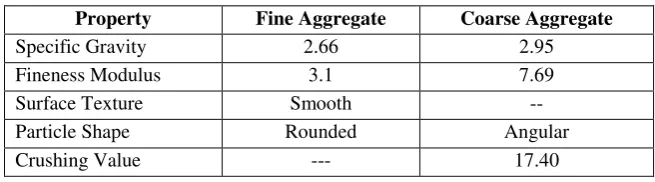
Locally available natural sand with 4.75 mm maximum size was used as fine aggregate, having specific gravity, fineness modulus and unit weight as given in Table 3 and crushed stone with 16mm maximum size having specific gravity, fineness modulus and unit weight as given in Table 2 was used as coarse aggregate.
Table 2. Physical properties of coarse and fine aggregates
Property Fine Aggregate Coarse Aggregate
Specific Gravity 2.66 2.95
Fineness Modulus 3.1 7.69
Surface Texture Smooth --
Particle Shape Rounded Angular
Vol. 2, Issue 10, October 2013
Copyright to IJIRSET www.ijirset.com 5588
C. Cement kiln Dust (CKD)
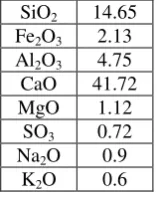
Cement kiln dust (CKD) is a waste product generated by the cement industry; it is a powder mainly composed of micron-sized particles collected from electrostatic precipitators during the manufacture of cement clinker. For this work CKD was obtained from Cement factory at Chandrapur.
Table 3: Chemical composition of CKD
Table 4: Physical properties of CKD.
D. Super plasticizer (SP)
The admixture CONPLAST SP 430 G8was used a superplasticizer with a density of 1.2 kg/l.It was used to provide necessary
workability.
Table 5: Physical Properties of Super plasticizer
SiO2 14.65
Fe2O3 2.13
Al2O3 4.75
CaO 41.72
MgO 1.12
SO3 0.72
Na2O 0.9
K2O 0.6
Physical Properties Results
Fineness (retained on 90-µm) 1%
Specific Gravity 2.24
Colour Greenish
Physical Properties Results Results
Colour Black
Vol. 2, Issue 10, October 2013
Copyright to IJIRSET www.ijirset.com 5589
V. MIX PROPORTIONING
The mix proportion was done based on the Modified Nan-Su method. The mix design was carried out for M30 normal grade of self compacting concrete with CKD as partial replacement of cement with a fraction of 0%, 10%, 20% & 30%.
Table 6: Quantities of Materials for 1m3of SCC mixes.
Mix Cement
(kg/m3)
CKD (Filler)
(kg/m3)
CKD as Cement Replacement
(kg/m3)
Total Powder Content
(kg/m3)
Fine Aggregate
(kg/m3)
Coarse Aggregate
(kg/m3)
W/P (0.38)
(kg/m3)
SP (1.2 %)
(kg/m3)
Mix-0 382 295 0.00 677 710 612 258 8.124
Mix-1 343.8 295 38.2 677 710 612 258 8.124
Mix-2 305.6 295 76.4 677 710 612 258 8.124
Mix-3 267.2 295 114.8 677 710 612 258 8.124
Mix-0:- 0% Replacement of Cement with CKD. Mix-1:- 10% Replacement of Cement with CKD. Mix-2:- 20% Replacement of Cement with CKD. Mix-3:- 30% Replacement of Cement with CKD.
A. Self Compactability Tests on SCC mixes
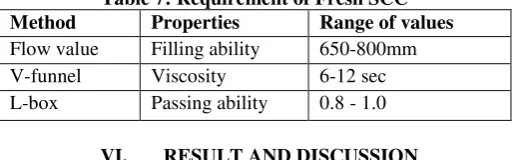
Various tests were conducted on the trial mixes to check the quality control test for SCC are performed to ensure that the requirement of Filling ability, Passing ability and flow ability are as required.
Table 7: Requirement of Fresh SCC
Method Properties Range of values
Flow value Filling ability 650-800mm
V-funnel Viscosity 6-12 sec
L-box Passing ability 0.8 - 1.0
VI. RESULT AND DISCUSSION
A. Fresh properties SCC
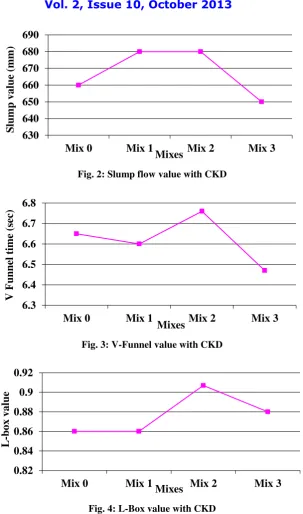
CKD was used to replace the cement content by three various percentages (10, 20 and 30%). The partial replacement with CKD was carried out for M30 grades of concrete. To fulfill the requirement of SCC in fresh state and evaluate flow characteristic using slump cone, V-funnel, & L-box tests and to fix dosage of superplasticizer (HRWRA) as per EFNARC guidelines and fix the dosage of water /powder ratio was needed. The test results are presented in the table 7.
Table 8: Fresh properties of SCC.
Mixes Mix-0 Mix-1 Mix-2 Mix-3
Slump Flow Test 660 mm 680 mm 680 mm 650 mm
V-Funnel Test 6.65 Sec 6.60 Sec 6.76 Sec 6.47 Sec
Vol. 2, Issue 10, October 2013
Copyright to IJIRSET www.ijirset.com 5590 Fig. 2: Slump flow value with CKD
Fig. 3: V-Funnel value with CKD
Fig. 4: L-Box value with CKD
630
640
650
660
670
680
690
Mix 0
Mix 1
Mix 2
Mix 3
Slum
p
val
ue
(m
m
)
Mixes
6.3
6.4
6.5
6.6
6.7
6.8
Mix 0
Mix 1
Mix 2
Mix 3
V
F
un
nel
t
im
e
(se
c)
Mixes
0.82
0.84
0.86
0.88
0.9
0.92
Mix 0
Mix 1
Mix 2
Mix 3
L
-box
val
ue
Vol. 2, Issue 10, October 2013
Copyright to IJIRSET www.ijirset.com 5591
B. Hardened Properties of SCC
All the mixes were tested for various hardened properties like compressive strength, flexural strength & Split Tensile Strength and water absorption test as per Indian Standards.
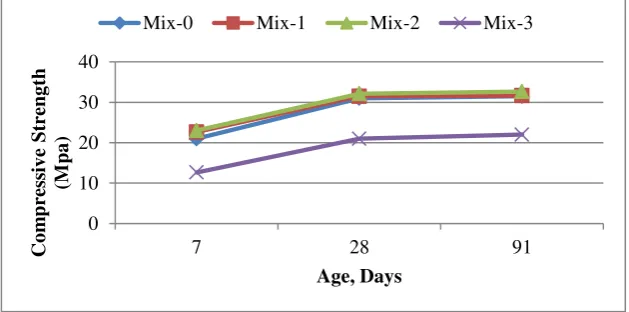
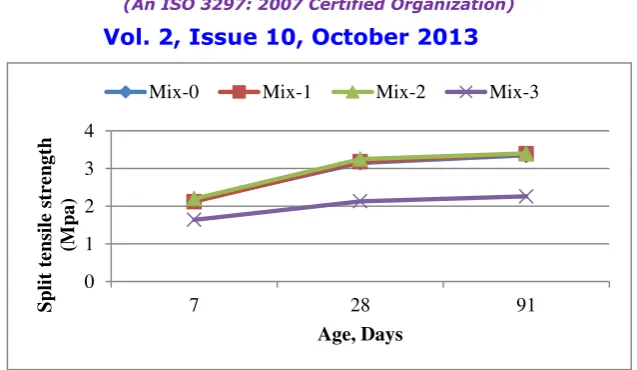
Up to 20% addition of CKD (Mix-2), the compressive strength, flexural strength & Split Tensile Strength were obtained nearly
same. After addition of 20% CKD the above results were found in decreasing order.
Fig 4 to Fig 6 shows the variation in compressive strength, flexural strength & Split Tensile Strength obtained for SCC.
Fig. 4: Variation of compressive strength with age
Fig. 5: Variation of flexural strength with age 0
10 20 30 40
7 28 91
Co
m
press
iv
e
Str
eng
th
(M
pa
)
Age, Days
Mix-0 Mix-1 Mix-2 Mix-3
0 2 4 6 8
7 28 91
F
lex
ura
l
Str
eng
th (
M
pa
)
Age, Days
Vol. 2, Issue 10, October 2013
Copyright to IJIRSET www.ijirset.com 5592 Fig. 6: Variation of split tensile strength with age
VII. CONCLUSIONS
On the basis of experimental investigations carried out, it is concluded that,
i. The brief literature review of SCC mixes made with CKD as a filler and addition of CKD as a partial replacement of
cement used in SCC whenever economic, environmental and easy availability considerations predominate, without much apprehension.
ii. The slump flow value was same up to 20% CKD and decreased after 20% CKD.
iii. The V-funnel & L-box Test showed acceptable value on 20% CKD compared to other mixes.
iv. It is observed that CKD can be used in large quantity in SCC and cement content can be reduced to as low 305.6 kg/m3
without losing the requisite characteristic of SCC. However this result in obtaining lower grades of concrete in terms of 28-days compressive strength. This may be acceptable for many applications where high 28-28-days compressive strengths are not necessary.
v. The SCC mixes with the addition of 20% CKD gave an optimum strength for M30 grade.
vi. The compressive strength of M30 grade of concrete monitored up to 91 days and showed an increased 1 to 2% over its 28
day strength. Similarly the split tensile strength and flexural strength increased by 2 to 3% compared to the 28 day strength.
REFERENCES
[1] Ali S. Al-Harthy, Ramzi Taha, Faisal Al-Maamary. “Effect of Cement Kiln Dust (CKD) On Mortar and Concrete Mixtures” Construction and Building Materials Vol.17, 2003-pp, 353–360.
[2] Iliana Rodríguez Viacava, Antonio Aguado de Cea, Gemma Rodríguez de Sensale, “Self-compacting Concrete of Medium Characteristic Strength” Construction and Building Materials Vol.30, 2012-pp, 776–782.
[3] Naveen Kr. C. Kiran, et.al. “Self Compacting Concrete with Fly Ash and Metakaoline” Indian concrete journal April. 2006 pp, 33-39. [4] Vilas V. Karjinni, Shrishail B. Anadinni, “Mixture Proportion Procedure for SCC” Indian Concrete Journal June 2009 pp 35-41.
[5] Vilas V. Karjinni, Shrishail B. Anadinni, Dada S. Patil “An Investigation On the Characteristic Properties of High Performance SCC With Mineral Admixture” Indian concrete journal Sept. 2009-pp, 15-19.
[6] IS 8112:1989 Ordinary Portland cement, 43 Grade, may 2005
[7] Nan Su, Kung-Chung Hsu, His-Wen Chai. “A Simple Mix Design Method for Self-compacting Concrete”, Cement and Concrete Research Vol.31, 2001-pp, 799–1807.
[8] EFNARC. “Specification and Guidelines for Self-compacting Concrete. European Federation of Producers and Applicators of Specialist Products for Structures”, 2002.www.efnarc.org
[9] Portland cement association (PCA). http://www.cement.org. 0
1 2 3 4
7 28 91
Sp
lit
tens
ile
st
re
ng
th
(M
pa
)
Age, Days