A Practical Key Exchange for the Internet using Lattice
Cryptography
Vikram Singh∗
Abstract
In [21], Peikert presents an efficient and provably secure set of lower level primitives for practical post-quantum cryptography. These primitives also give the first lattice-based scheme to provide perfect forward secrecy, and thus represent a major advancement in providing the same sort of security guarantees that are now expected for modern internet traffic protection. However, the presentation in [21] might prove a bit daunting for the slightly less mathematical reader. Here we provide what we hope will be a clear and self-contained exposition of how the algorithm can be implemented, along with sample code and some initial analysis for potential parameter sizes.
We focus on the simpler case, as chosen by Bos et al in [1], of cyclotomic rings whose degree is a power of two. We describe the necessary arithmetic setup and choices regard-ing error samplregard-ing, and give a possibly cleaner mechanism for reconciliation of the shared secrets. Then we present Peikert’s Diffie-Hellman-like key exchange algorithms along with security, correctness and implementation analysis. We demonstrate parameter choices that outperform [1] by a factor of up to 13 for equivalent security.
Keywords: Cryptography, Lattice, Ring-LWE, Ring Learning With Errors, Key Ex-change, IKE, TLS
1
Introduction
Lattice-based cryptographic protocols, particularly those presented by Peikert in [21], have great promise as components of Internet standards and other open protocols such as Internet Key Exchange (IKE) and Transport Layer Security (TLS). This is due both to their efficiency and practicality, and that they provide security guarantees against classical and quantum adver-saries. Indeed, Peikert expressly defines his protocols as drop-in replacements for the classical key exchange and key transport primitives of Diffie-Hellman and RSA as used in real-world networks, andadhering as closely as possibleto the abstract protocols underlying existing and proposed standards, e.g. IETF RFCs like [11, 26, 10, 12, 13]. Adapting lattice-based mecha-nisms to have the desired properties of these primitives had been a challenge, but Peikert was
∗
able to demonstrate concrete ways in which existing protocols could be generalised so as to yield secure lattice-based instantiations, without substantially affecting their overall form or security analysis. Unlike earlier lattice-based constructions such as NTRUEncrypt, the Peikert scheme fits neatly into the TLS protocols with proofs of security in each case ([21, 1]).
Each of the schemes proposed by Peikert is based on thelearning with errors over rings (ring-LWE) problem [19, 20]. In overview, the ring-LWE problem in a ringRmay be defined by fixing a certain error distribution χ over R that is concentrated on “small” elements, and randomly picking a secret ring element s ∈ R from which to generate “random noisy ring equations”. Each such equation is generated by letting ai ∈ R be a random ring element, and ei ∈ R be
drawn from χ as a random small perturbation, then publishing pairs (ai, bi =ai·s+ei). The
decisionversion of ring-LWE is to distinguish independent “random noisy ring equations” from truly uniform pairs. That is, given pairs (ai, bi)∈R×Reither of the form (ai, bi =ai·s+ei) or
uniform random in R×R, distinguish from which of the two distributions the pairs have been drawn. There is also a searchversion of ring-LWE: given pairs of the form (ai, bi)∈R×R as
above, recover the secret s.
Ring-LWE enjoys strong provable hardness guarantees: it is hard on average so long as the Short Vector Problem (SVP) is hard to approximate on so-called ideal lattices in the corresponding ringin the worst case. These results provide good theoretical evidence that ring-LWE is a solid foundation on which to design cryptosystems, and this evidence has been reinforced by concrete cryptanalytic efforts.
In [21], Peikert presents a ring-LWE based Diffie-Hellman-like key exchange algorithm in which two users each exchange a single ring-LWE “sample” or public key to arrive atapproximate or “noisy” agreement on a ring element. Let b = a·s0+e0 be the public key of the first party,
and c = a·s1 +e1 be the public key of the second. Then the two parties can arrive at an
approximate shared secret s0·c = s0 ·a·s1+s0 ·e1 ≈ s0 ·a·s1+s1·e0 = s1·b, assuming
thats0, e0, s1, e1 are all “small” for a suitable definition of small. In order to (non-interactively)
reachexactagreement, the second party will derive the binary key stream from its version of the shared secret value and also derive and send an additional bit-string referred to as the “masking bits.” These masking bits provide the extra hint which can be then fed into the “reconciliation” technique for the first party to arrive at exact agreement with the key stream derived by the second.
Throughout this paper we aim to give a readable and self-contained description of the Peikert algorithms and our implementation. We restrict to the case of cyclotomic rings whose degree is a power of two, as do Bos et al in [1]. This case hides complexities of ring arithmetic which it is clearer to do without at this stage, yet also provides a reasonable diversity of practical security levels.
for efficient arithmetic. We define the error distribution we shall use to randomly draw small ring elements. In Section 3 we sketch the key exchange, and describe how masking bits and the reconciliation mechanism are used to generate key from the approximate shared secrets. The reconciliation mechanism is a slight variation on Peikert’s, which is cleaner but has the same effect.
In Section 4 we present Peikert’s basic key exchange algorithm in detail in the context of our implementation choices. We then present Peikert’s development of provably actively secure key exchanges in order to protect against an adversary that can choose ciphertexts, and his development of provably secure authenticated key exchanges in order to assure each party that the key is agreed only with the holder of the desired certified identity.
In Section 5 we describe our parameter choices along with a consideration of their security, an analysis of correctness, and performance timings for the basic key exchange. We provide examplesage code in Appendix A, and higher performance Ccode at
https://github.com/vscrypto/ringlwe power.
We suggest that our parameters are both more efficient and more secure than any previous work.
2
Preliminaries and definitions
For any integerq, letZq denote the quotient ringZ/qZ,i.e. the ring of integers modulo q. The
elements of this ring can be considered in terms of a distinguished set of representatives, e.g. the set {0,1, . . . q−1}.
For any two subsets X, Y of an additive group, we define−X :={−x:x∈X} and X+Y :=
{x+y:x∈X, y ∈Y}. Similarly, we definex+Y :={x+y:y∈Y}for a fixed element x.
We define the infinity norm on a ring R with basis Y = {yj} to be ||r||∞ := maxj(rj) for
r = P
jrj ·yj ∈ R. We will be interested in the growth of individual basis coefficients of
elements ofR and will perform our analysis on this infinity norm || · ||∞ rather the Euclidean
norm || · ||2.
2.1 Gaussian and subgaussian distributions
Early exposition of ring-LWE ([19]) relied on Gaussian distributions for all error sampling. For r >0, the Gaussian distribution Dr over Rwith parameter r has probability distribution
its distribution) over R is δ-subgaussian with parameter r > 0 if for all t ∈ R, the (scaled)
moment-generating function satisfies
E[exp(2πtX)]≤exp(δ)·exp(πr2t2).
Subgaussians are useful to simplify the analysis and have many nice features, such as the sum of independent subgaussians is another subgaussian whose parameters can be calculated. Most importantly, as noted in [21], any B-bounded centered random variable X (i.e.,E[X] = 0 and
|X| ≤ B always) is 0-subgaussian with parameter B√2π. Thus simple bounded distributions, such as uniform random from an interval, are subgaussian. We will utilise this fact to provide significant efficiency gains and simplification to our key establishment.
2.2 Ring-LWE
We now recall the ring-LWE probability distribution and (decisional) problem as presented in [21]; see [19] for a more general form.
Definition 1 (Ring-LWE Distribution). For an s∈ R and a distribution χ over R, a sample from the Ring-LWE DistributionAs,χ overRq×Rqis generated by choosing a←Rq uniformly
at random, choosinge←χ, and outputting (a, b=a·s+e).
Definition 2 (Ring-LWE Decision). The decision version of the ring-LWE problem, denoted R-DLWEq,χ,is to distinguish with non-negligible advantage between independent samples from
As,χ, where s←χ is chosen once and for all, and the same number of uniformly random and
independent samples from Rq×Rq.
The main theorem of [19] can be stated informally as follows:
Theorem 1. Suppose that it is hard for polynomial-time quantum algorithms to approximate (the search version of) the shortest vector problem (SVP) in the worst case on ideal lattices in R to within a fixed poly(n) factor. Then any poly(n) number of samples drawn from the R-LWE distribution are pseudorandom to any polynomial-time (possibly quantum) attacker.
This tells us that distinguishing the Ring-LWE Distribution from random or recovering its secret is hard, provided SVP is hard.
A main benefit of ring-LWE over traditional LWE and other lattice-based techniques is in efficiency. Whereas LWE requires the use of Ω(n) samples (ai, bi) ∈ Znq ×Zq, for ring-LWE,
typically only a very small number of samples (a, b) ∈ R ×R are used.1 Essentially, ring-LWE offers a compact representation for the lattice in question. The reason for this is that each polynomial v ∈ R represents n vectors in the lattice, one for each multiple v ·xi for
1
i ∈ {0, . . . , n−1}.2 If a is fixed for all users, then the public key is just the element b ∈ R. We see that this results in smaller public keys for ring-LWE because LWE would have Ω(n2) modular values whereas ring-LWE can have only n.
2.3 Cyclotomic rings
Let R := Z[ζm]∼=Z[x]/hΦm(x)i be the mth cyclotomic ring, where Φ is defined by xm−1 =
Q
d|mΦd(x) andζm is a primitive mth root of unity. The degree of R is the degree of Φ, which
is given by the Euler totient functionn:=φ(m). We shall mainly be interested in the quotient ring Rq :=R/qR∼=Zq[ζm] where all of our operations can be defined.
There are a variety of simplifications and efficiencies that arise when considering the special case of m = 2` a power of two. In this paper, we will focus on this special case in order to invoke those results. In this case,n=φ(m) =m/2 and Φm(x) = 1 +xn. We shall utilise prime
q such that q≡1 (mod m), as is required by the Security Proof stated in Theorem 2.7 of [19]. This also allows arithmetic speed-ups using the Chinese Remainder basis: the ideal< q >:=qR factors asm/2 prime ideals which provide the orthogonal components required by the Chinese Remainder Theorem. For the remainder of this paper, we considerm and q of this form unless explicitly stated. We also drop the subscriptm on ζm.
2.3.1 Bases for cyclotomic rings
In [20], multiple bases for the cyclotomic ringRare defined. As we choose to work withm= 2`, the power, powerful, and decoding bases will all coincide, a nice simplification that stems from choosing mof this form.3
The power basis for R orRq is the natural basis of powers of ζ:
~
p:= (ζi)i=0,...,n−1
If we write a∈ R in the power basis as a =p~·a, then the canonical embedding4 defines the Chinese Remainder Theorem matrix CRT as the square matrix
σ(a) = CRT·a=
1 ω ω2 · · · ωn−1
1 ω3 ω6 · · · ω3(n−1)
..
. ... ... . .. ... 1 ωm−1 ω(m−1)2 · · · ω(m−1)(n−1)
·a
2In ring-LWE, each ring element actually represents a so-calledideal lattice- a latticeLis an ideal lattice if for allv∈L,x·vis also inL. Thus one polynomial inRdefines a space ofnvectors inL.
3
Simplifying equation 6.2 of [20] to them= 2`case, we find thatd~= (2/m)~pford~the decoding basis ofR∨. Thus, performing the scaling described in Section 2.3.2 of [21] to move to the decoding basis ofRsimply recovers the power basis ofR.
4The canonical embeddingσ:R→H⊂
where the rows are indexed byZ∗m and the columns by{0,1, . . . , n−1}forn=m/2. Note that
multiplication by CRT can be done by fast Fourier transform methods inO(nlogn) complexity.
In [20], the CRT matrix is defined as a general object over any commutative ring containing a primitivemth root of unity ω. By fixing a specific primitivemth root of unityζ inZq, we can
turn the CRT matrix into an important and powerful tool for working in Rq. Asq was chosen
withq ≡1 (mod m), the cyclotomic polynomial xn+ 1 will factor completely modulo q:
xn+ 1 = (x−ζ)(x−ζ3)(x−ζ5)· · ·(x−ζm−1)
forζ a primitive mth root of unity inZq. Thus, multiplication by CRT gives evaluation of the
polynomial at each of the mth roots of unity, that is, at the primitive root ζ and each of its odd powers. Each polynomial inRq has a unique representation from evaluating at the roots of
unity, so this form can be used as a basis, the Chinese Remainder basis. While addition can be performed component-wise in all bases, the unique thing about the Chinese Remainder basis is that multiplication is also component-wise: for any two polynomials z, z0∈Rq and any c∈Zq,
z(c)·z0(c) = (z·z0)(c). Naively multiplication would require summing O(n2) cross-products of all pairs of coefficients but use of the Chinese Remainder basis brings that toO(n)-complexity.
The Chinese Remainder basis~cis defined for Rq by
~cT :=~pT ·CRTq−1 , where CRTq := CRT (modq)
and thus admits O(nlogn) fast Fourier transform method conversion between itself and the power basis. We have shown we can convert between any of these bases and the Chinese Remainder basis inO(nlogn), hence can perform multiplication in O(nlogn).
2.4 Error distributions
In order that each party has some secret information that can be combined in Diffie-Hellman fashion to obtain a shared secret value accessible only to the two parties, it is necessary to produce the short error elements that act as private keys. The aim is to produce errors that are subgaussian with parameters as tight as possible, so that the security parameters of these errors can be nicely controlled once they have been combined to form shared secret values.
As in [1], since this paper restricts to the case of m= 2` being a power of 2, sampling from a discrete Gaussian can be performed by sampling each coefficient from a 1-dimensional discrete Gaussian DZ,σwith parameter σ.5 The discrete Gaussian assigns to each x ∈ Z a
probabil-ity proportional to e−x2/(2σ2), normalized by the factor S = 1 + 2P∞k=1e−k2/(2σ2), given by 5
In [20], the short secret and error vectors are produced by sampling the conjugate symmetry spaceH⊂Cn
and then mapping into R by left-multiplying by the matrix CRT∗m. Ifm = 2`, the matrix CRT ∗
m·CRTm is
diagonal. Let us consider the covariance matrix Σ =E[(CRT∗m·v)(CRT∗m·v)∗] =E[CRT∗m·v·v∗·CRTm] =
CRT∗m·E[vv ∗
]·CRTm since CRT∗m is a constant and so can be removed from the expectation. Since the
DZ,σ(x) = S1e−x
2/(2σ2)
. To sample fromRq according to a discretised Gaussian distribution, we
use the method in [1]: precompute a lookup table T of size 52 where T[0] :=b2192/Scand
T[i] :=2192· 1
S + 2
i
X
x=1
DZ,σ(x)
fori= 1, . . . ,50, and whereT[51] := 2192. We sample each coefficient by generating a 192-bit integertat random, finding the indexind∈[0,50] such thatT[ind]≤t < T[ind+ 1], and then generating an additional random bit for the sign sign∈ {−1,1}:
GaussSample
Input: standard deviationσ Output: error vector e fori= 1, . . . , n
t←$ (0,2192) indi= 0
repeat indi += 1 until
T[indi]≤t < T[indi+ 1]
signi ← {−$ 1,1}
ei=signi·indi
e←~p·(e1, . . . , en)
To accord with [24, 18, 17, 1], we will set σ = 8/√2π ≈ 3.192 so that the discrete Gaussian DZn,σ approximates the continuous GaussianDσ extremely well.
In instantiations of ring-LWE, sampling the error terms from Gaussian distributions is typically by far the most expensive operation. As noted in Section 2.2 of [21], uniform sampling from a B-bounded interval is subgaussian with parameter B√2π, and uniform sampling of each coefficient is both simpler and significantly more efficient:
UniformSample
Input: bound B Output: error vector e fori= 1, . . . , n
ei
$
← {−B, . . . , B}
e←~p·(e1, . . . , en)
3
Key generation and reconciliation mechanism
In [21], Peikert presents a ring-LWE based Diffie-Hellman-type key exchange algorithm in which two users exchange ring-LWE public keys to arrive at approximate or “noisy” agreement on a ring element. In order to (non-interactively) reach exact agreement, the second party sends along an additional bit-string which can be fed into the “reconciliation” technique from [21] which we will develop in this section.
3.1 Description of the exchange
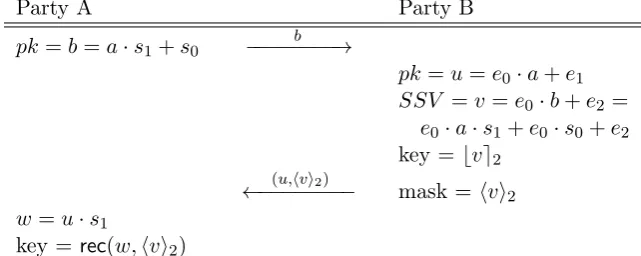
We begin with an informal sketch of how the key exchange works. In the basic key exchange, the first party creates a public key b = a·s1 +s0 and transmits that to the second party.
Upon receipt of the public key b, the second party creates his public key u = e0·a+e1 and
his version of the approximate shared secret v = e0 ·b+e2 = e0 ·a·s1 +e0 ·s0 +e2. Upon
receipt of the public keyuand masking bitshvi2, the first party forms her version of the shared secret w=u·s1 =e0·a·s1+e1·s1, and feeds w and the received masking bits hvi2 into the
reconciliation function to recover the key stream. Sinces0, s1, e0, e1, e2 are all small,w≈v and
the masking bitshvi2provide sufficient information for the two parties to exactly agree; however, for adversaries, the masking bits do not give any help in determining what the underlying key bit will be.
Party A Party B
pk=b=a·s1+s0
b
−−−−−−−−→
pk=u=e0·a+e1
SSV =v=e0·b+e2 =
e0·a·s1+e0·s0+e2
key =bve2 (u,hvi2)
←−−−−−−−− mask =hvi2
w=u·s1
key = rec(w,hvi2)
Figure 1: Basic key exchange algorithm.
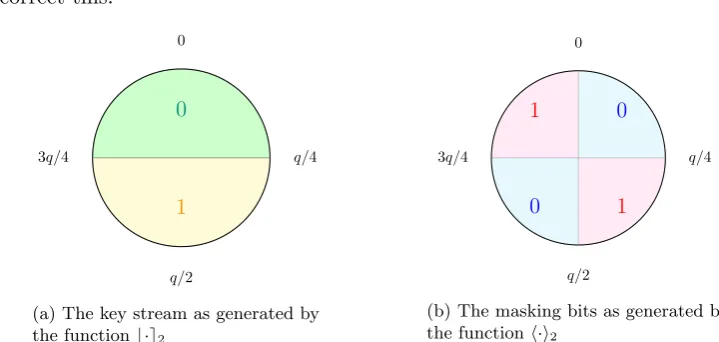
The key stream that the two users will agree upon will be generated by applying the modular rounding function b·e2 to each coefficient of the shared secret to round to the closer of 0 or q2. In order for the two parties to achieve exact agreement, the second party also sends over the “masking bits” for his version of the approximate shared secret as generated by the functionh·i2
which labels which “quadrant” moduloq a coefficient falls into. If an equal number of elements of Zq were in each quadrant, then key would be unbiased and the masking bits would give no
to correct this.
q/4
q/2 3q/4
0
0
1
(a) The key stream as generated by the functionb·e2
q/4
q/2 3q/4
0
0
0
1
1
(b) The masking bits as generated by the functionh·i2
Figure 2: The key stream and mask bits generating functions.
3.2 Randomized Rounding
We will now explain in detail each of the functions required to generate the key stream and masking bits, as well as the reconciliation function.
In order to create the new reconciliation technique in [21], Peikert works with even q, and generalises to the more common setting of odd q by introducing a step wherein all elements of
Zqare mapped intoZ2qin a randomized way. However, there are two basic criteria that need to
be achieved, namely that the key stream be unbiased and that the masking bits achieve perfect hiding, each of which can be realised without resorting to mapping up into an even modulus by utilising a simple randomized rounding procedure common in engineering. By utilising the randomized rounding procedure, no larger internal states need be generated and in fact nothing at all needs to be done except in a pair of edge cases where the flip of a coin decides how to modify the value. This randomized rounding is thus more efficient.
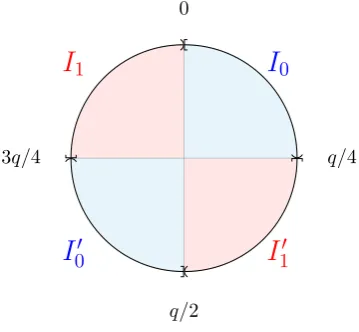
We begin by defining the intervalsI0, I10, I00, I1 to partition the elements ofv∈Zq according to
the four respective quadrants as in Figure 3 as:
I0 :=Zq∩[0,q4)
I10 :=Zq∩[q4,q2)
I00 :=Zq∩[q2,34q)
For odd q the number of elements in each set is:
#I1 #I0
#I00 #I10
=
q−1 4
q+3 4
q−1 4
q−1 4
!
forq ≡1 (mod 4)
q−3 4 q+1 4 q+1 4 q+1 4 !
forq ≡3 (mod 4).
We will define key to be 0 if an element is in the top rowI0∪I1 and 1 for the bottom rowI00∪I10.
We will define the masking bit as 0 for the anti-diagonal I0 ∪I00 and 1 for the lead-diagonal
I1∪I10. We want the key to be unbiased, which will require that the top and bottom rows have
equal counts. Furthermore, the masking bit tells us the diagonal; conditional on this, we shall require that no information is given about the key, i.e. both cells of the diagonal have equal counts. In order to meet these two criteria on the count array, we can perform a preprocessing stage which randomizes the value of elements in some edge cases. To minimise the amount of randomization and the distance an element moves, a natural choice is to probabilistically nudge the two edge elements out of the unique large cell forq ≡1 (mod 4), or into the unique small cell forq ≡3 (mod 4).
q/4
q/2 3q/4
0
I
0I
00I
1I
10Figure 3: The values modulo q and their partition into I0, I10, I00, I1.
Thus we can define ourrandomized roundingprocedure to affect this, for the two separate cases:
• q≡1 (mod 4). We map out ofI0. Ifv= 0, we will flip a coin or draw a uniform random
bit and map 0 to either itself or q−1 depending on the random bit. This has the effect of, with 50% probability, moving an element fromI0 toI1. Independently, ifv= q−41, we
each set becomes
q+1 4
q−1 4
q−1 4
q+1 4
forq ≡1 (mod 4)
which satisfies the two criteria of equal row sums for unbiased key, and equal cells on the lead-diagonal and anti-diagonal for perfect hiding of key by the mask. Note that the mask bit is biased, but this does not impact security.
• q≡3 (mod4). We map intoI1. If v = 0, we will flip a coin or draw a uniform random
bit and map 0 to either itself or q−1 depending on the random bit. This has the effect of, with 50% probability, moving an element from I0 to I1. Independently, if v = 3q4−1,
we map 3q4−1 to either itself or 3q4+3 depending on a random bit, thus moving an element fromI00 toI1 with 50% probability. The count array representing the relative probability
of each set becomes
q+1 4
q−1 4
q−1 4
q+1 4
forq ≡3 (mod 4)
which satisfies the two criteria of equal row sums for unbiased key, and equal cells on the lead-diagonal and anti-diagonal for perfect hiding of key by the mask. Note that the mask bit is biased, but this does not impact security.
This randomized rounding procedure produces a similar effect to the dbl(·) procedure from [21], without the additional computational burden of mapping all elements of Zq intoZ2q. We will
denote the randomized rounding of v by ¯v and apply it before deriving mask and key bits.
3.3 Reconciliation mechanism
Given the above exposition, we can now define themodular roundingfunctionb·e2 :Zq→Z2 as bxe2 :=b2q·xe (mod 2). We will useb¯ve2 to generate the key stream, which will not be biased
due to the use of randomized rounding.
As in [21], we define thecross rounding functionh·i2 :Zq→Z2 as
hvi2 :=4
q ·v
(mod 2).
Equivalently, h¯vi2 is the b∈ {0,1}such that ¯v ∈Ib∪Ib0. We use hv¯i2 to generate the masking
bit-string. If v is uniform random inZq, thenh¯vi2 will be biased inZ2 despite the randomized
rounding. Regardless of this bias, however,hv¯i2 hides bv¯e2 perfectly:
Claim 1. If v ∈Zq is uniform random and randomized rounded as outlined above, then bve2
is uniform random given hvi2.
Proof: For any b ∈ {0,1}, if we condition on hvi2 =b, then v is uniform over Ib∪Ib0. By the
definition of Ib, if v ∈ Ib then bve2 = 0, whereas if v ∈ Ib0 then bve2 = 1, so bve2 is uniform
We can now see how reconciliation of the recipient’s derived shared secretwusing the mask bit
hv¯i2 must work. The mask bit tells the recipient which diagonal quadrant ¯vis in. Provided the
difference between shared secrets|w−v¯|is no more than one-eighth q then the shared secrets are sufficiently close that the recipient can infer which quadrant ¯v was in, hence infer the key bit b¯ve2.
LetE := [−q/8, q/8)∩Z, and define the reconciliationfunction rec :Zq×Z2→Z2 as
rec(w, b) :=
(
0 ifw∈Ib+E (mod q)
1 otherwise.
Claim 2. If w=v+e (modq) for some v∈Zq and e∈E, then rec(w,hvi2) =bve2.
To see that the claim is true, we will consider what the reconciliation function does in greater detail.
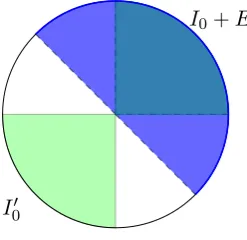
The variable w is a coefficient of the receiving party’s version of the shared secret and hvi2 is the received hint based on which quadrant that coefficient of the sending party’s version of the shared secret fell into. Suppose thatb=hvi2 = 0. Thenv∈I0∪I00, and the region of interest,
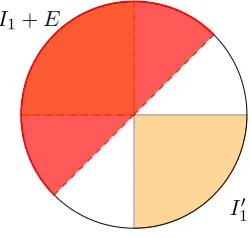
I0+E, can be pictorially represented as the shaded area in Figure 4.
I0+E
I00
Figure 4: The regionI0+E.
Now suppose that we have a guaranteed bound on how far apartw and v can be, namely that w=v+e (mod q) for somev∈Zq and e∈E, that is |w−v|< q8. Then ifw∈I0+E,v must
be inI0 (recallv∈I0∪I00) or else be farther than
q
8 away fromw. Then by the definition ofI0,
we have thatbve2 = 0 and rec(w,0) = 0.Otherwise, ifw /∈I0+E,v must be inI00 since those
are the only possiblev values within q8 of aw value that is not inI0+E, and this would mean
that bve2= 1.
Similarly, suppose thatb=hvi2= 1. Then v∈I1∪I10 and the region of interest I1+E modulo
I1+E
I10
Figure 5: The regionI1+E.
If w∈ I1+E, then v must be in I1 to have|w−v|< q8, and so bve2 = 0 by the definition of
I1. If w /∈I1+E, thenv must be in I10 and so bve2 = 1.
We can extend the rounding and reconciliation functions to any basis for the cyclotomic ring R by simply applying the functions coordinate-wise to theZq-coefficients of the inputs in the
chosen basis. Formally, if Y ={yi} ⊂R is a basis forR and v=Pjvjyj ∈Rq for coefficients
vj ∈ Zq, then bve2 := Pjbvje2 ·yj ∈ R2 and similarly for hvi2. The reconciliation function
can be extended to rec : Rq× {0,1}n → R2 by setting rec(w, b) := Pjrec(wj, bj)·yj where
w=P
jwjyj and b=b0b1. . . bn∈ {0,1}n.
4
Main algorithm and variants
In [21], Peikert presents a ring-LWE based Diffie-Hellman-type key exchange algorithm that is provably passively secure, and then shows how to use this basic primitive to construct provably actively secure key exchanges and provably secure authenticated key exchanges. We will present each of these variants in detail for completeness.
4.1 Ring-LWE ephemeral Diffie-Hellman
In this section we present an efficient key encapsulation mechanism (KEM1) or key exchange that is provably secure against passive attacks. The system is constructed using the reconcil-iation technique from Section 3 to allow the two parties to derive an ephemeral key from a pseudorandom value in Rq on which they approximately agree. Previous ring-LWE
cryptosys-tems needed to have a ciphertext consisting of a pair of ring elements, but the reconciliation mechanism reduces this to a single ring element and a bit string of length n.
• m= 2`, and so n=φ(m) =m/2;
• q is an odd prime integer such that q≡1 (mod m);
• ais a fixed element of the ring Rq :=Z/qZ[ζm]=∼Zq[x]/hΦm(x)i; and
• χ is an error distribution overRq.
We will denote by Sample(χ) the function used to sample error terms from χ. For exam-ple, this could be GaussSample(σ) for the discrete Gaussian with standard deviation σ, or
UniformSample(B) for the uniform distribution on the interval {−B, . . . , B}.
Key generation samples error terms from χ to produce a private key (s0, s1), and combines it
with the generator a to form the public key. Note that decapsulation only needss1 so we can
discard s0.
KEM1.Generate
Input: Domain parameters (m, q, a, χ) Output: Private keys1 and public keyb
s0 ←Sample(χ)
s1 ←Sample(χ)
b←s1·a+s0 ∈Rq
Encapsulation6 generates a public key for the second party and takes the received public keyb to produce a shared key µand a ciphertext c. The shared keys will belong toK ={0,1}n and
their corresponding encapsulations will belong to C =Rq× {0,1}n. Here we identify R2 with
bit strings in {0,1}nin the obvious way.
KEM1.Encapsulate
Input: Recipient’s public keyb
Output: Shared keyµ and encapsulationc e0 ←Sample(χ)
e1 ←Sample(χ)
e2 ←Sample(χ)
u←e0·a+e1 ∈Rq
v←e0·b+e2∈Rq
¯
v←RandomizedRound(v)
µ← bv¯e2 ∈ {0,1}n
c←(u,hv¯i2)∈Rq× {0,1}n
6
The reader may notice that the encapsulation and decapsulation functions in [21] include a term gwhich ours omit. In [20], gis defined asg:=Q
Decapsulation forms the approximate shared secret
w=u·s1=e0·a·s1+e1·s1 ≈e0·a·s1+e0·s0+e2 =e0·b+e2 =v
and uses the reconciliation mechanism from Section 3 to derive the shared secret key µ.
KEM1.Decapsulate
Input: Recipient’s private keys1 and encapsulation c
Output: Shared keyµ (u, v0)←c
w←u·s1 ∈Rq
µ←Rec(w, v0)
Lemma 1 (Lemma 4.1 from [21]). The KEM1 is IND-CPA secure, assuming the hardness of
R-DLWEq,χ given two samples.
4.2 Actively secure Ring-LWE key exchange
In this section we present the transformation of KEM1 into an secure encryption scheme (PKC2) which is secure under chosen-ciphertext attack (i.e.,IND-CCA secure). In order to do so, we will utilise the second Fujisaki-Okamoto transformation [7] which converts any passively secure encryption scheme into one which is actively secure in the random-oracle model.7
To apply the Fujisaki-Okamoto transformation to KEM1 there are two main changes that we need to make. Firstly, the transformation uses an encryption scheme where the key is an explicit input while KEM1 derives the key as part of the encapsulation. However, as we shall see it is straightforward to convert a key encapsulation mechanism into an encryption scheme, by using the derived key to mask the plaintext. Secondly, we need the derived encryption scheme to be deterministic. This means that the error terms must be reproducable and so the sampling function needs to be modified to use the output of a deterministic pseudorandom number generatorPRG.
The domain parameters for PKC2 will be (m, q, a, χ, N, `) where
• m= 2`, and so n=φ(m) =m/2;
• q is an odd prime integer such that q≡1 (mod m);
• ais a fixed element of the ring Rq :=Z/qZ[ζm]=∼Zq[x]/hΦm(x)i;
• χ is an error distribution overRq;
• N ≥0 is the bit length of the plaintext; and
• `is the length of the seed for the pseudorandom generator PRG.
We will denote bySample(χ;PRG) the sampling function modified to use output fromPRG
and by PRG.Seed(seed) the seeding function for PRG.
Key generation for the actively secure protocol PKC2 does not require deterministic sampling so is identical to key generation for KEM1.
PKC2.Generate
Input: Domain parameters (m, q, a, χ) Output: Private keys1 and public keyb
s0 ←Sample(χ)
s1 ←Sample(χ)
b←s1·a+s0 ∈Rq
The encryption function PKC2 chooses a random value σ, and uses this to both mask the message and seed the pseudorandom generator. The seedσ is then masked by the key derived from the deterministic KEM1. This requires a pair of hash functionsG:{0,1}n→ {0,1}N and
H:{0,1}n+N → {0,1}`.
PKC2.Encrypt
Input: Recipient’s public keyb and plaintextm Output: Ciphertext (c1, c2)
σ← {$ 0,1}n
c1←KEM1.Encrypt(b, σ,H(σ||m))
c2←G(σ)⊕m∈ {0,1}N
KEM1.Encrypt
Input: Recipient’s public key b, plaintext σ ∈ {0,1}n, and
seedr∈ {0,1}`
Output: Ciphertextc1
PRG.Seed(r)
e0 ←Sample(χ;PRG)
e1 ←Sample(χ;PRG)
e2 ←Sample(χ;PRG)
u←e0·a+e1 ∈Rq
v←e0·b+e2∈Rq
¯
v←RandomizedRound(v)
c1←(u,h¯vi2,bv¯e2⊕σ)∈Rq× {0,1}n× {0,1}n
Decryption uses the reconciliation mechanism from Section 3 to recover the seed and unmask the message. However, to provide protection against chosen ciphertext attacks it is necessary to check that c1 was validly generated from the seed value σ.
PKC2.Decrypt
Input: Recipient’s private keys1, and ciphertext (c1, c2)
Output: Plaintextm or⊥
(u, v0, σ0)←c1
w←u·s1 ∈Rq
ˆ
σ←σ0⊕Rec(w, v0)∈ {0,1}n
m←G(ˆσ)⊕c2
ˆ
c1←KEM1.Encrypt(b,σ,ˆ H(ˆσ||m))
if ˆc1=c1
returnm else
return⊥
Theorem 2 (Theorem 5.1 from [21]). PKC2 is IND-CCA secure, assuming that PKC is
pas-sivelyone-waysecure, PRG is a secure pseudorandom generator, andGand H are modelled as random oracles.
4.3 Ring-LWE authenticated key exchange
KEM1 together with a signature; we will use the signature construction from [23] as it seems to fit best with KEM1.
4.3.1 Signature
We begin by briefly presenting the signature from [23]. The signature scheme is parametrized by (m, q, a, χ, χ0, κ) where
• m= 2` so thatn=φ(m) =m/2;
• q is an odd prime integer such that q≡1 (mod m);
• ais a fixed element of the ring Rq :=Z/qZ[ζm]=∼Zq[x]/hΦm(x)i;
• χ and χ0 are error distributions over Rq; and
• κ is a bound on the size of the ring elements in the signature.
Key generation uses the first distributionχ to produce the static signing key in essentially the same way as for KEM1 and PKC2, except that boths0 ands1 will be needed to sign a message.
SIG.Generate
Input: Domain parameters (m, q, a, χ) Output: Private key (s0, s1) and public keyt
s0 ←Sample(χ)
s1 ←Sample(χ)
t←s1·a+s0∈Rq
Signing generates an ephemeral key from the second distribution χ0 and uses this to construct two “small” elements of the ring that are related by the signing key and the hash of the message. This means that we will need a hash functionH:{0,1}∗ →Rqthat maps onto “small” elements
ofRq, say as drawn from a third distribution χ00 overRq. Further, to avoid leaking information
via the signatures we will need arejection samplingalgorithmReject:R4
q→(0,1) which gives
SIG.Sign
Input: Private key (s0, s1) and messageµ
Output: Signatureσ y0←Sample(χ0)
y1←Sample(χ0)
c←H(a·y1+y0||µ)
z0 ←s0·c+y0
z1 ←s1·c+y1
ifReject(z0, z1, s0·c, s1·c)
start again else
returnσ ←(z0, z1, c)
Verification consists of checking that the elements z0 and z1 are small enough and satisfy the
relation
a·z1+z0−t·c=a·y1+y0.
Note that sincea·y1+y0 is not part of the signature we instead need to use c to check that
H(a·y1+y0||µ) =H(a·z1+z0−t·c||µ).
SIG.Verify
Input: Public keyt, signatureσ and message µ Output: True or false
(z0, z1, c)←σ
if||z0|| ≤κ,||z1|| ≤κ and c=H(a·z1+z0−t·c||µ)
return true else
return false
4.3.2 Sign-and-MAC protocol
The signature-based authentication mode in Internet Key Exchange (IKE) is designed around the “SIGn-and-MAc” (SIGMA) family of protocols specified by Krawczyk in [16]. The Krawczyk paper gives an excellent in-depth, yet still quite readable, explanation of the design considera-tions for AKE protocols and other associated issues.
In [21], Peikert presents a protocol Σ00 which is a slight generalisation of the Σ0 protocol from
structural changes. Thus, an implementation of the new protocol can work alongside alternative existing protocols facilitating backwards compatibility and user choice.
The parameters of the Σ00 protocol are
• A digital signature scheme SIG;
• A key exchange or key encapsulation KEM with key space K;
• A pseudorandom functionF :K × {0,1} → K0; and
• A message authentication code MAC with key space K0 and message space{0,1}∗.
A successful execution of the protocol outputs a secret key inK0.
Initiator Responder
(pkI, skI)←KEM.Gen()
(sid,pkI) −−−−−−−−−−−−→
(c, k)←KEM.Encaps(pkI)
k0←Fk(0), k1←Fk(1)
σR←SIG.SignR(1||sid||pkI||c)
τR←MAC.Tagk1(1||sid||IDR)
(sid,c,IDR,σR,τR) ←−−−−−−−−−−−−−−−
k←KEM.Decaps(c, skI)
k0←Fk(0), k1←Fk(1)
σI←SIG.SignI(0||sid||pkI||c)
τI ←MAC.Tagk1(0||sid||IDI)
(sid,IDI,σI,τI) −−−−−−−−−−−−−−→
SIG.VerifyI(σI,0||sid||pkI||c)
MAC.Verifyk1(τI,0||sid||IDI)
Figure 6: Sign-and-MAC protocol.
We assume that the initiator and responder have static signing keys whose corresponding public verifications are bound to their identitiesIDI andIDR in, for example, certificates issued by a
trusted certificate authority. The protocol Σ00 proceeds as follows:
1. Start message(I →R) : (sid, pkI).
The initiator generates an ephemeral keypair and sends the public key pkI and session
2. Response message(R→I) : (sid, c, IDR,SIG.SignR(1, sid, pkI, c),MAC.Tagk1(1, sid, IDR)). The recipient uses the KEM to generate a master keyk, and derives a session keyk0 and
a MAC key k1 from it. The recipient then signs the initiator’s public key along with the
encapsulated master key, and authenticates their own identity using the MAC.
3. Finish message(I →R) : (sid, IDI,SIG.SignI(0, sid, pkI, c),MAC.Tagk1(0, sid, IDI)). The initiator decapsulates to recover the session key k0 and MAC key k1, and verifies the
signature and authenticated identity. If either verification fails, the session is aborted. Otherwise, the initiator signs their own public key and the encapsulated master key, and authenticates their identity.
4. Responder completion:
The recipient verifies the signature and authenticated identity. If either verification fails, the session is aborted.
Theorem 3. The Σ00 protocol is SK-secure in the post-specified peer model of [2], assuming that SIG and MAC are existentially unforgeable under chosen-message attack, that KEM is IND-CPA secure, and that F is a secure pseudorandom function.
Proof: See Theorem 6.1 from [21], which in turn references the proof from [2].
5
Analysis
5.1 Instantiating the parameters
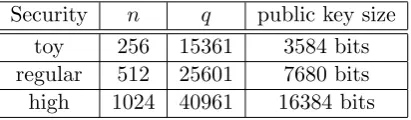
We wish to choose concrete parameters for testing as practical candidates. Our aim shall be to reduce the public key length while maintaining security and correctness. In order to do so, we refer to the guidance in Section 4.4 of [21]. To begin we consider how to set the lattice dimension n=φ(m) and the modulusq. For the special case of m = 2`, the only practical choices for n
are 512 and 1024, and so we will consider each along with a toy of dimension 256. The security analysis in [21] gives a practical bound on the size of q of q ≈n(3/2) (see Section 4.4 of [21]). Thus in order to satisfy both this practical bound and the proof of security for ring-LWE, we begin with q≥n(3/2) and search for q a prime which is congruent to 1 modulom and as close ton(3/2) as failure rates will allow in order to provide the best practical security.
Security n q public key size toy 256 15361 3584 bits regular 512 25601 7680 bits high 1024 40961 16384 bits
The authors of [1] mention that their choice ofq is conservative in that it provides a very large margin for correctness and can be reduced. If we compare our parameters from Table 7 to those of [1], we can see that by decreasingq, our parameter choices offer increased security with smaller bandwidth, a feature that is unthinkable in traditional public key systems but can be enjoyed in lattice-based schemes.8
We have chosen to keep q prime of the form q ≡1 (mod m) to maintain consistency with the proof of security for ring-LWE. By following the analysis in [4, 17] we feel confident in saying that our regular security parameters will provide at least 128-bits of security and our high security parameters will provide over 256-bits of security.9 We also note that the maximum length of the data field of a packet sent over Ethernet is 1500 bytes. If public keys are too large, they will not fit into a single packet, increasing the possibility of key establishment failures based on transmission problems. Our 128-bit secure parameters will fit into a single Ethernet packet, unlike the 128-bit secure parameters proposed by [1] which would require three maximum sized Ethernet packets. Moreover, even our 256-bit secure parameters fit in two Ethernet packets, thus providing greater security with less data overhead than the choice in [1]. Many important applications, including Domain Name Server (DNS) and much voice and video traffic, use User Datagram Protocol (UDP) instead of Transmission Control Protocol (TCP). Unlike TCP, UDP has no concept of acknowledgement, retransmission, or timeout, and thus the more Ethernet packets required to transmit a public key, the greater the potential for key exchange difficulties.
In the next section, we show that this choice of parameters still offers an extremely low failure rate, leading to what we believe is an extremely attractive and practical parameter option.
5.2 Correctness of the scheme
For each of the three systems described in Section 4, we need each coefficient of the error term to be bounded by q8, that is, we must have that ||s0e0 +e2 −s1e1||∞ < bq8c in order to be
guaranteed correctness of the algorithms. This comes from Claim 2 of Section 3, being the maximum difference between shared secret values such that the reconciliation function still produces the correct key. To conduct a direct analysis of the growth of the coefficients of the error term, we will begin by considering what multiplication of elements looks like.
For m = 2`, multiplication is achieved by negacyclic convolution. We recall that R := Z[ζ] = Z[x]/hΦm(x)i=Z[x]/hxn+ 1i forζ a primitive mth root of unity andn=φ(m) =m/2. If we
8As the modulus of reduction q is reduced, errors become larger relative to the size of the problem, thus making the lattice problem harder.
9
multiplyζi·ζj then we just need to reduce modulo the equation Φm(x) = 1 +xn, soxn=−1.
Leta∈Rq be written asPni=0−1aiζi, and similarly let b=Pnj=0−1bjζj ∈Rq. The product of any
two elements a, b∈Rq is given by
n−1 X
i=0
aiζi· n−1 X
j=0
bjζj =
2n−2 X
k=0 X
i+j=k
aibj
ζk
=
n−1 X
k=0 X
i+j=k
aibj
ζk− 2n−2
X
k=n
X
i+j=k
aibj
ζ(k−n)
=
n−1 X
k=0
k
X
i=0
aibk−i− n−1 X
i=k+1
aibn+k−i
ζk
Thus we see that each coefficient of a product of two elements consists of a sum of n terms, each term being the product of two independent random variables.
If error terms are generated by sampling a Gaussian distribution, then each of the independent random variables ai, bj comes from a discretised Gaussian distribution centered at 0 and with
variance σ2. By invoking (a generalisation of) the Central Limit Theorem10, we can say that each of these coefficients is well approximated by a Gaussian distribution centered at 0 with variancenσ4, and to approximate the coefficients ofs0e0+e2−s1e1 we can consider a Gaussian
distribution centered at 0 with variance 2nσ4 +σ2. As the reconciliation function will only fail if the absolute value of one or more of these coefficients exceeds q/8, we will estimate the probability of that occurring for each of our parameter sets. Fixingσ= 8/p(2π), if we use the parametersn= 512, q= 25601, we find a probability of a coefficient of the error term exceeding theq/8 bound is less than 2−71. Forn= 1024 andq= 40961, the probability is less than 2−91.
If we create the private keys and error vectors by drawing coefficients of the power basis uni-formly at random from {−B, . . . ,0, . . . , B}, then it is fairly simple to directly analyse the correctness of the system and compute specific probabilities of failure. In this case, each of the ai and bj are independent random variables following a uniform distribution over the
set {−B, . . . ,0, . . . , B}. The product of two such random variables is itself a random vari-able over {−B2, . . . ,0, . . . , B2} and the sum of sum variables yields a convolution of their distributions.10 Thus the coefficients of a product a·b are random variables with support
{−nB2, . . . ,0, . . . , nB2}. We can calculate the probability that ||s0e0 +e2 −s1e1||∞ < bq8c
by considering the correct convolution of probability distributions. For the parameter set n = 512, q = 25601, we find a probability of a coefficient of the error term exceeding the q/8 bound is 2−75.72. For n = 1024 and q = 40961, the probability is 2−96.11. If we wish to consider the probability of failure of the key exchange, we must recognise that there are n coefficients, each of which could exceed the q/8 bound. However, the q/8 bound is only tight
10
for coefficients falling at the boundary of a quadrant: {0,±bq/4e,bq/2e}. Most coefficients will not lie on or near these boundaries, which will lead to a higher permissible bound. We calculate the probability that a failure of the key exchange will occur to be less than 2−74.37 forn= 512 and to be less than 2−94.11 forn= 1024. Thus we can see that these parameters provide more than sufficient soundness for practical applications.
5.3 Timings
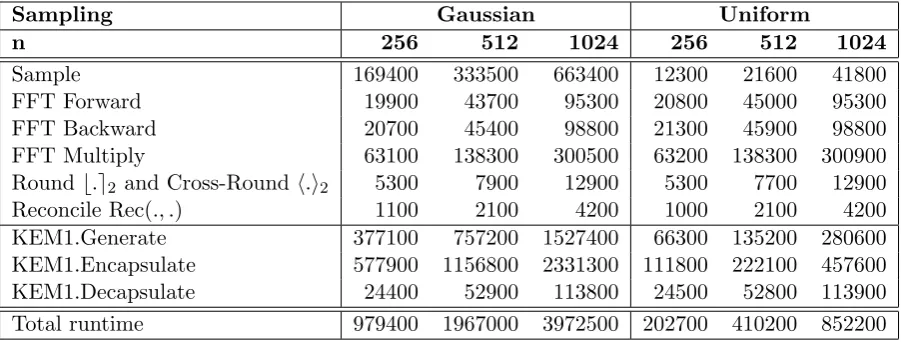
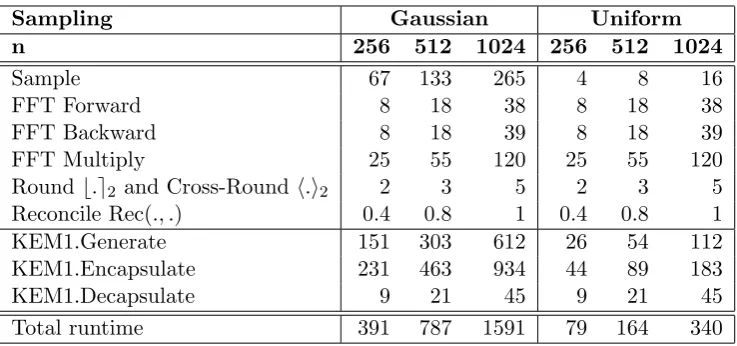
We have implemented the Ring-LWE ephemeral Diffie-Hellman key encapsulation mechanism of Section 4.1 in the lower level language C in order to assess its performance. This code is available on the GitHub repository at https://github.com/vscrypto/ringlwe power along with its benchmarking routines. We are grateful to the authors of [1] for the code accompanying their paper, from which we borrow the overall structure as well as the functions for performance timing, random number generation, and Gaussian sampling. Timings of each operation are presented in Tables 8 and 9, made using a 1.9GHz Intel Core i5 4300U11 with code compiled using gccversion 4.9.2 with the-O3optimisation flag.
Sampling Gaussian Uniform
n 256 512 1024 256 512 1024
Sample 169400 333500 663400 12300 21600 41800
FFT Forward 19900 43700 95300 20800 45000 95300
FFT Backward 20700 45400 98800 21300 45900 98800
FFT Multiply 63100 138300 300500 63200 138300 300900 Roundb.e2 and Cross-Round h.i2 5300 7900 12900 5300 7700 12900 Reconcile Rec(., .) 1100 2100 4200 1000 2100 4200 KEM1.Generate 377100 757200 1527400 66300 135200 280600 KEM1.Encapsulate 577900 1156800 2331300 111800 222100 457600 KEM1.Decapsulate 24400 52900 113800 24500 52800 113900 Total runtime 979400 1967000 3972500 202700 410200 852200
Figure 8: Average cycle count of operations
Sampling Gaussian Uniform
n 256 512 1024 256 512 1024
Sample 67 133 265 4 8 16
FFT Forward 8 18 38 8 18 38
FFT Backward 8 18 39 8 18 39
FFT Multiply 25 55 120 25 55 120
Roundb.e2 and Cross-Roundh.i2 2 3 5 2 3 5
Reconcile Rec(., .) 0.4 0.8 1 0.4 0.8 1
KEM1.Generate 151 303 612 26 54 112
KEM1.Encapsulate 231 463 934 44 89 183
KEM1.Decapsulate 9 21 45 9 21 45
Total runtime 391 787 1591 79 164 340
Figure 9: Average operation time in micro seconds (1µs= 10−6 s)
In comparison, the code of [1], which uses Gaussian sampling with n = 1024, q = 232−1 to achieve the 128-bit security level, has an equivalent total runtime of 2180 µs (5444000 clock cycles) on our machine under the same compilation conditions. Our 256-bit secure n = 1024 parameter set with Gaussian sampling outperforms this with a total runtime of 1591µs. If we compare to our 128-bit secure n= 512 parameter set, with Gaussian sampling we outperform [1] by a factor of nearly three with a total runtime of 787µswhile with uniform sampling, this outperforms [1] by a factor of 13 with a total runtime of 164µs. Given that [1] integrates their key exchange into OpenSSL and finds that the performance is acceptable for TLS, we are also able to make this claim for any of our parameter sets.
The dominant operations of the key exchange are sampling and multiplication of ring elements. We found that the Gaussian sampling function took over 16 times longer than the uniform sampling. Since a total of 5 samples are required for the key exchange, this makes Gaussian sampling responsible for about 83% of the total runtime compared to about 24% for uniform sampling. While we readily acknowledge that significant work has been done to speed up the computation of discrete Gaussian distributions, we think it unlikely that any amount of optimi-sation will ever make Gaussian sampling in line with the speed of uniform sampling. Moreover, many of the fastest Gaussian sampling routines require a significant amount of memory and utilise a large number of random bits as input. Thus we believe that uniform sampling will provide the best combination of practical security and efficiency in real world settings.
We optimise arithmetic on ring elements using the fast fourier transform as described in Sec-tion 2.3.1, and keeping elements in the Fourier domain where possible, because both multiplica-tion and addimultiplica-tion are pointwise. Thus we transmit the recipient’s public keyband the sender’s public key u in the Fourier domain, and store the sender’s private key s1 and recipient’s
pri-vate key e0 in the Fourier domain. This way we never perform the FFT Multiply operation
and an FFT Backward operation. For our implementation of the fast fourier transform we perform a Discrete Weighted Fourier Transform using the decimation-in-frequency algorithm of Gentleman-Sande [8] in the forward direction, and the decimation-in-time algorithm of Cooley-Tukey [5] in the reverse.
6
Conclusions
The ring learning with errors problem is a promising cryptographic primitive that is believed to be resistant to attacks by quantum computers. The decision ring-LWE problem naturally leads to a passively secure Diffie-Hellman-like unauthenticated key exchange protocol, which can readily be extended to an actively secure version and an authenticated version. We have examined these key exchange mechanisms, and provided both practical analysis and more prac-tical parameter choices than were previously available. We provided example implementations in sage in Appendix A and in C at https://github.com/vscrypto/ringlwe power. Using the Cimplementation, we have demonstrated that our parameter choices outperform [1] by as much as a factor of 13 for equivalent security and can thus claim, like [1], that this is acceptable runtime for TLS. Furthermore, our 128-bit secure public keys fit into a single Ethernet packet, and our 256-bit secure public keys require two, thus providing greater reliability of transmission over the Internet and less data overhead.
We plan to continue and expand upon this work. In [20] and [21], the authors develop the theory in the most general setting for the form ofm. We would like to make a careful examination of other specialised forms ofm, starting with the prime form, to see if any practical benefit can be derived from selecting anmthat is not a power of two. We also plan to explore ring-LWE-based signature schemes.
7
Acknowledgments
We are grateful to our associate Arjun Chopra for support and advice on the paper and imple-mentation.
References
[1] J. W. Bos, C. Costello, M. Naehrig, and D. Stebila. Post-quantum key exchange for the TLS protocol from the ring learning with errors problem.http://eprint.iacr.org/2014/599.
[3] Y. Chen and P. Q. Nguyen. BKZ 2.0: Better lattice security estimates. In Dong Hoon Lee and Xiaoyun Wang, editors, ASIACRYPT, volume 7073 of LNCS, pages 1-20. Springer, 2011.
[4] Y. Chen and P. Q. Nguyen. BKZ 2.0: Better lattice security estimates. 2013. Full version. Available at http://www.di.ens.fr/ ychen/research/Full BKZ.pdf.
[5] J. Cooley and J. Tukey. An algorithm for the machine calculation of complex Fourier series. Math. Comp., 19:297-301, 1965.
[6] W. Diffie and M. E. Hellman. New directions in cryptography. IEEE Transactions on Information Theory, IT-22(6):644-654, 1976.
[7] E. Fujisaki and T. Okamoto. Secure integration of asymmetric and symmetric encryption schemes. InCRYPTO’99, pages 537-554. 1999.
[8] W. Gentleman and G. Sande. Fast Fourier transforms - for fun and profit. In Proceedings of the AFIPS, volume 29, pages 563-578, 1966.
[9] T. G¨uneysu, V. Lyubashevsky, and T. P¨oppelmann. Practical Lattice-Based Cryptography: A Signature Scheme for Embedded Systems. In E.Prouff and P. Schaumont, editors,CHES 2012, LNCS 7428, pages 530-547. Springer, 2012.
[10] D. Harkins and D. Carrel. The Internet Key Exchange (IKE). RFC 2409 (Proposed stan-dard), November 1998. Obsoleted by RFC 4306, updated by RFC 4109.
[11] R. Housley. Use of the RSAES-OAEP Key Transport Algorithm in Cryptographic Message Syntax (CMS). RFC 3560 (Proposed Stadard), July 2003.
[12] C. Kaufman. Internet Key Exchange (IKEv2) Protocol. RFC 4306 (Proposed Standard), December 2005. Obsoleted by RFC 5996, updated by RFC 5282.
[13] C. Kaufman, P. Hoffman, Y. Nir, and P. Eronen. Internet Key Exchange Protocol Version 2 (IKEv2). RFC 5996 (proposed Standard), September 2010. Updated by RFCs 5998, 6989.
[14] S. Kent and R. Atkinson. Security Architecture for the Internet Protocol. RFC 2401 (Pro-posed Standard), November 1998. Obsoleted by RFC 4301, updated by RFC 3168.
[15] S. Kent and K. Seo. Security Architecture for the Internet Protocol. RFC 4301 (Proposed Standard), December 2005. Updated by RFC 6040.
[16] H. Krawczyk. SIGMA: The ’SIGn-and-MAc’ approach to authenticated Diffie-Hellman and its use in the IKE-protocols. In CRYPTO’03, pages 400-425. 2003. Full version at http://webee.technion.ac.il/ hugo/sigma.html.
[18] R. Linder and C. Peikert. Better key sizes (and attacks) for LWE-based encryption. In CT-RSA’11, pages 319-339, 2011.
[19] V. Lyubashevsky, C. Peikert, and O. Regev. On ideal lattices and learning with errors over rings.Journal of the AMC, 60(6):43:1-43:35, November, 2013. Preliminary version in EUROCRYPT, pages 1-23, 2010.
[20] V. Lyubashevsky, C. Peikert, and O. Regev. A Toolkit for Ring-LWE Cryptography. In EUROCRYPT’13, pages 35-54. 2013.
[21] C. Peikert. Lattice Cryptography for the Internet. In Michele Mosca, editor,Proc. 6th Inter-national Conference on Post-Quantum Cryptography (PQCrypto) 2014, LNCS 8772, pages 197-219. Springer, 2014. Full version available athttp://eprint.iacr.org/2014/070
[22] V. Lyubashevsky. Fiat-Shamir With Aborts: Applications to Lattice and Factoring-Based Signatures. In M. Matsui, editor, Asiacrypt 2009, volume 5912 of LNCS,pages 598-616. Springer, Dec. 2009.
[23] V. Lyubashevsky. Lattice Signatures Without Trapdoors. In EUROCRYPT’12, pages 738-755, 2012.http://eprint.iacr.org/2011/537
[24] D. Micciancio and O. Regev. Lattice-based cryptography. In Daniel J. Bernstein, Jo-hannes Buchmann, and Erik Dahmaen, editors, Post-Quantum Cryptography, pages 147-191. Springer Berlin Heidelberg, 2009.
[25] R. L. Rivest, A. Shamir, and L. M. Adleman. A method for obtaining digital signatures and public-key cryptosystems.Commun. ACM, 21(2):120-126, 1978.
[26] J. Randall, B. Kaliski, J. Brainard, and S. Turner. Use of the RSA-KEM Key Transport Algorithm in the Cryptographic Message Syntax (CMS). RFC 5990 (Proposed Standard), September 2010.
A
Code
"""
An i m p l e m e n t a t i o n of the P e i k e r t s c h e m e in s a g e .
"""
m = 2 0 4 8 ; q = 4 0 9 6 1 ; n = 1 0 2 4 ; m = 1 0 2 4 ; q = 2 5 6 0 1 ; n = 5 1 2 ;
Phi = c y c l o t o m i c _ p o l y n o m i a l ( m ) # Phi is the mth c y c l o t o m i c p o l y n o m i a l Pq = P o l y n o m i a l R i n g ( I n t e g e r s ( q ) ,’ xx ’); xx = Pq . gen ()
Rq = - Pq . q u o t i e n t ( Phi ,’ zz ’); zz = Rq . gen () # The r i n g R_q u s e d in R - LWE B = 5 # p a r a m e t e r u s e d for the w i d t h of u n i f o r m s a m p l i n g s i g m a = 8/ s q r t (2* pi ) # p a r a m e t e r for the w i d t h of the G a u s s i a n s a m p l i n g
# # # # # # # # # # # # # # # # # # # # # # # # # # # # # # # # # # S a m p l i n g F u n c t i o n s
# # # # # # # # # # # # # # # # # # # # # # # # # # # # # # # # #
T = [] # P r e c o m p u t e t a b l e for G a u s s i a n w i d t h s i g m a T . a p p e n d ( 2 ^ 1 8 9 )
for i in r a n g e (1 ,52): sum = 0
for j in r a n g e (1 , i + 1 ) :
sum += 1 / 8 * exp ( - j ^ 2 / ( 2 * s i g m a ^ 2 ) ) T . a p p e n d ( f l o o r ( 2 ^ 1 9 2 * ( 1 / 8 + 2 * sum ))) T . a p p e n d ( 2 ^ 1 9 2 )
def G a u s s _ s a m p l e _ R q ( s i g m a ): # d i s c r e t i s e d G a u s s i a n s a m p l i n g on Rq tmp = []
for i in r a n g e ( n ):
t = r a n d r a n g e ( 2 ^ 1 8 9 , 2 ^ 1 9 2 ) j = 0
w h i l e t < T [ j ]: j +=1
j -= 1
s i g n = r a n d r a n g e (2)
if s i g n == 0: s i g n = -1 tmp . a p p e n d ( s i g n * j )
r e t u r n tmp
def u n i f o r m _ s a m p l e _ R q ( B ): # c r e a t e e l e m e n t of Rq s a m p l e d u n i f o r m l y f r o m { - B .. B } tmp = []
for i in r a n g e ( n + 1 ) :
tmp . a p p e n d ( r a n d r a n g e ( - B , B + 1 ) )
r e t u r n tmp
# # # # # # # # # # # # # # # # # # # # # # # # # # # # # # # # # # R o u n d i n g f u n c t i o n s
def r a n d o m i z e d _ r o u n d ( a ): # i n p u t an e l e m e n t of Rq
""" R a n d o m i z e d r o u n d i n g for c r e a t i n g the b i t s t r i n g to s e n d i n s i d e the p r o t o c o l ( s i m p l i f i c a t i o n e l i m i n a t i n g the n e e d to map i n t o 2 q ) """
c o e f f = Rq ( a ). l i s t (); r o u n d _ c o e f f = [];
for i in r a n g e ( n ):
if c o e f f [ i ] == 0 : tmp = r a n d r a n g e (0 ,2)
if tmp == 0 :
r o u n d _ c o e f f . a p p e n d (1)
e l s e:
r o u n d _ c o e f f . a p p e n d ( q -1)
e l i f c o e f f [ i ] == ( q - 1 ) / 4 : tmp = r a n d r a n g e (0 ,2)
if tmp == 0 :
r o u n d _ c o e f f . a p p e n d ( c o e f f [ i ])
e l s e:
r o u n d _ c o e f f . a p p e n d ( c o e f f [ i ] + 1 )
e l s e:
r o u n d _ c o e f f . a p p e n d ( c o e f f [ i ])
r e t u r n r o u n d _ c o e f f
def m o d u l a r _ r o u n d ( a ):
""" I n p u t r a n d o m i z e d r o u n d e d a in Rq as a v e c t o r of c o e f f i c i e n t s . """ r o u n d _ c o e f f = []
for i in r a n g e ( n ):
r o u n d _ c o e f f . a p p e n d ( r o u n d ( 2 * ( a [ i ]. l i f t () - r o u n d ( q / 4 ) ) / q ) % 2);
r e t u r n r o u n d _ c o e f f
def c r o s s _ r o u n d ( a ):
""" I n p u t r a n d o m i z e d r o u n d e d a in Rq as a v e c t o r of c o e f f i c i e n t s . """ r o u n d _ c o e f f = []
for i in r a n g e ( n ):
r o u n d _ c o e f f . a p p e n d ( f l o o r (4* a [ i ]. l i f t ()/ q ) % 2)
r e t u r n r o u n d _ c o e f f
def rec ( a , b ): # I n p u t an e l e m e n t of Rq and a b i t s t r i n g c o e f f = Rq ( a ). l i s t (); key = [];
for i in r a n g e ( n ):
if b [ i ] == 0 :
if c o e f f [ i ] in r a n g e (0 , f l o o r ( q /4+ q / 8 ) + 1 ) or c o e f f [ i ] in r a n g e ( q -1 - f l o o r ( q /8) , q ): key . a p p e n d (0)
e l s e: key . a p p e n d (1)
if b [ i ] == 1 :
if c o e f f [ i ] in r a n g e ( f l o o r ( q /4 - q /8) ,( q - 1 ) / 2 + f l o o r ( q / 8 ) + 1 ) : key . a p p e n d (0)
e l s e: key . a p p e n d (1)
r e t u r n key
# # # # # # # # # # # # # # # # # # # # # # # # # # # # # # # # # # Key a g r e e m e n t w i t h U n i f o r m s a m p l i n g # # # # # # # # # # # # # # # # # # # # # # # # # # # # # # # # #
# Gen :
s0 = u n i f o r m _ s a m p l e _ R q ( B ) s1 = u n i f o r m _ s a m p l e _ R q ( B )
# E n c a p s
e0 = u n i f o r m _ s a m p l e _ R q ( B ) e1 = u n i f o r m _ s a m p l e _ R q ( B ) e2 = u n i f o r m _ s a m p l e _ R q ( B )
u = Rq ( a )* Rq ( e0 ) + Rq ( e1 ) v = Rq ( b )* Rq ( e0 ) + Rq ( e2 )
vr = r a n d o m i z e d _ r o u n d ( v ) vp = c r o s s _ r o u n d ( vr ) mu = m o d u l a r _ r o u n d ( vr )
# D e c a p s w = u * Rq ( s1 ) mup = rec ( w , vp )
a s s e r t mu == mup
# # # # # # # # # # # # # # # # # # # # # # # # # # # # # # # # # # Key a g r e e m e n t w i t h G a u s s i a n s a m p l i n g # # # # # # # # # # # # # # # # # # # # # # # # # # # # # # # # #
# Gen :
s0 = G a u s s _ s a m p l e _ R q ( s i g m a ) s1 = G a u s s _ s a m p l e _ R q ( s i g m a )
b = Rq ( a )* Rq ( s1 ) + Rq ( s0 )
# E n c a p s
e0 = G a u s s _ s a m p l e _ R q ( s i g m a ) e1 = G a u s s _ s a m p l e _ R q ( s i g m a ) e2 = G a u s s _ s a m p l e _ R q ( s i g m a )
u = Rq ( a )* Rq ( e0 ) + Rq ( e1 ) v = Rq ( b )* Rq ( e0 ) + Rq ( e2 )
vr = r a n d o m i z e d _ r o u n d ( v ) vp = c r o s s _ r o u n d ( vr ) mu = m o d u l a r _ r o u n d ( vr )
# D e c a p s w = u * Rq ( s1 ) mup = rec ( w , vp )