University of South Carolina
Scholar Commons
Theses and Dissertations
1-1-2013
Race, Class, Gender, and Linked Fate: A
Cross-Sectional Analysis of African American Political
Partisanship, 1996 and 2004
Sherral Yolanda Brown-Guinyard
University of South Carolina
Follow this and additional works at:https://scholarcommons.sc.edu/etd Part of thePolitical Science Commons
This Open Access Dissertation is brought to you by Scholar Commons. It has been accepted for inclusion in Theses and Dissertations by an authorized administrator of Scholar Commons. For more information, please [email protected].
Recommended Citation
R
ACE,C
LASS,G
ENDER, ANDL
INKEDF
ATE:A
C
ROSS-S
ECTIONALA
NALYSIS OFA
FRICANA
MERICANP
OLITICALP
ARTISANSHIP,1996
AND2004
by
Sherral Y. Brown-Guinyard
Bachelor of Arts College of Charleston, 1973
Master of Public Administration University of South Carolina, 1976
Submitted in Partial Fulfillment of the Requirements
For the Degree of Doctor of Philosophy in
Political Science
College of Arts and Sciences
University of South Carolina
2013
Accepted by:
Laura R. Woliver, Major Professor
Todd C. Shaw, Committee Member
C. Blease Graham, Committee Member
Barbara A. Woods, Committee Member
© Copyright by Sherral Y. Brown-Guinyard, 2013
D
EDICATIONAt times our own light goes out and is rekindled by a spark from another person. Each of us has cause to think with deep gratitude of those who have lighted the flame within us.
Albert Schweitzer
It is with sincere gratitude that I dedicate this dissertation in loving memory to my father,
Richard Brown, Jr. who taught me how to triumph in any given situation, and to my
mother, Inell Evergene Brothers Brown from whom I learned to persevere and to prevail.
They dared to dream during a moment in time when reality seemed to obscure the vision
they held for each of their children. Nonetheless, my parents’ steadfastness, hope, and
confidence in Christ kept their flame alive within us. The completion of this research is a
tribute to their determination.
Throughout this effort, and especially after the passing of my parents, my
husband, Furman Guinyard, was my constant source of support and rekindling. I am ever
grateful to him for his great sacrifice on my behalf. It is with incredible joy, love, and
A
CKNOWLEDGEMENTSA number of individuals, in one way or another, contributed and extended their valuable
assistance in the preparation and completion of this study, and for that I am truly grateful.
Nonetheless, it would be remiss of me not to mention the following persons without
whom this dissertation would not have been possible.
I am particularly honored to have the direction, dedication, attention, advice,
feedback, and critiques of my committee, which have served me well. My utmost
gratitude is extended first to Dr. Laura R. Woliver, my committee chair, for her presence,
patience, encouragement, inspiration, and unwavering support; to Dr. Todd C. Shaw, a
strong advocate and constant motivating force, for his unequivocal guidance and
demonstrated quiet confidence in my research; to Dr. C. Blease Graham, whom I
consider one of my most cherished mentors, for his encouragement and advice
throughout the course of my graduate studies; and to my friend and colleague, Dr.
Barbara A. Woods, the lone historian, for her expertise in African-American civil rights
and invaluable assistance on both a professional and a personal level.
My deepest appreciation is further extended to colleagues, family, and friends, Dr.
Michael Boatwright, Yumin Zhao, Dr. El Raya A. Osman, Dr. Teshome Tadesse,
Deborah Gramling, Stephanie Brown-Guion, and Keala “Regina” Inciong-Ako, my
beloved friend (kona hoaloha). Above all, I acknowledge with humble devotion the
Almighty God who has been my perpetual light, constant comfort, and enduring strength
A
BSTRACTOBJECTIVE: To determine the predominance of linked fate and socio-demographic
predictors race, class, and gender in the political partisanship of African Americans, and
in the political partisanship of comparison racial and ethnic group populations.
METHODS: Data obtained from the 1996 National Black Election Study panel series
were used to examine the political attitudes, perceptions, and beliefs of 824 adult African
Americans. In addition, data collected for the 2004 National Politics Study examined
3,087 American adults from comparison racial and ethnic population groups. These
groups included 706 African Americans, 868 White Non-Hispanics, 676 Hispanics, 466
Asians, and 371 Black Caribbeans. Multinomial logistic regression models were used to
analyze linked fate and socio-demographic predictors of African American political
partisanship.
RESULTS: In the 1996 sample about 69% of African Americans were Democrats, 20%
Independent, and 4% Republicans. Similarly, in the 2004 sample Democratic preferences
were held by 70% African Americans followed by about 66% Black Caribbeans, 44%
Hispanics, 37% Asians, and 36% White Non-Hispanics. In the multinomial logistic
regression models linked fate was less likely to influence African American political
partisanship in 1996. Still, when considering the unique contribution of linked fate and
social demography—race, class, and gender—used to predict political partisanship
likely among respondents with perceptions that linked fate has some affect on them; and among
all racial and ethnic population groups when compared to Non-Hispanic Whites. On the other
hand, as class increased the likelihood of Democratic partisanship decreased, whereas gender
was not significantly associated with predicting political partisanship (p>0.05).
CONCLUSIONS: Race continues to be the predominant predictor of significant and distinctive
partisan preference attitudes in the African American racial group. The relationship of race,
class, gender, linked fate, and partisanship shows some reliance on a (black) racial or ethnic
group heuristic for political decision-making. Still, further investigation is needed to assess
whether such group cues in partisan decisions actually reflect perceptions of a (black) linked
T
ABLE OFC
ONTENTSDEDICATION ... iii
ACKNOWLEDGEMENTS ... iv
ABSTRACT ...v
LIST OF TABLES ... xi
LIST OF FIGURES ... xiv
CHAPTER 1:INTRODUCTION ...1
CHAPTER 2TOWARD A THEORETICAL FRAMEWORK FOR PARTISANSHIP ...13
2.1FROM CLASSIC CONCEPTUALIZATION TO REVISIONIST CRITIQUES ...14
2.2BACK TO THE BASICS?THE DEBATE CONTINUES...16
2.3SOURCES OF CHANGE IN POLITICAL PARTY IDENTIFICATION ...18
2.4ABROADER ACCOUNT OF PARTY CHANGE: ISSUE EVOLUTION ...19
2.5AFRICAN AMERICAN PARTISANSHIP:ATHEORETICAL PERSPECTIVE ...21
CHAPTER 3HISTORICAL OVERVIEW AND BACKGROUND:1863-1964 ...31
3.1OVERVIEW ...32
3.2BACKGROUND:AFRICAN AMERICAN ANTI-SLAVERY STRATEGIES ...33
3.3THE DEMOCRATIC-REPUBLICAN PARTY SCHEME AND SLAVERY ...41
3.5PERIOD OF POST-RECONSTRUCTION,1877-1936 ...56
3.6PERIOD OF THE NEW DEAL COALITION,1936-1964 ...62
3.7CONCLUSION ...83
CHAPTER 4FROM PROTEST TO PARTICIPATION:1964-2008 ...86
4.1BACKGROUND ...87
4.2PERIOD OF CIVIL RIGHTS,1964-1980 ...89
4.3FROM CIVIL RIGHTS LEADERS TO CONGRESSIONAL LEGISLATORS ...101
4.4POST-1970:TRANSITION FROM PROTEST TO POLITICS ...103
4.5PERIOD OF POST-CIVIL RIGHTS,1981-2008 ...108
4.6CONCLUSION ...128
CHAPTER 5METHODOLOGICAL APPROACH ...131
5.1DATA AND METHODS:STUDY PROCEDURES ...132
5.2SAMPLE POPULATIONS ...134
5.3INSTRUMENTATION ...134
5.4DEPENDENT VARIABLE SPECIFICATION ...135
5.5INDEPENDENT VARIABLES:SPECIFICATIONS AND DEFINITIONS ...139
5.6RESEARCH QUESTIONS AND HYPOTHESES ...141
5.7ANALYSIS OF THE DATA ...143
5.7.1STATISTICAL TECHNIQUE ...145
5.8MODEL SPECIFICATIONS ...146
5.8.2MODEL 2:THE IMPACT OF RACE ON PARTISAN
ASSESSMENTS ...149
5.8.3MODEL 3:TEST OF GENDER DISTINCTIONS BY RACE ...149
5.8.4MODEL 4:FACTORS THAT DETERMINE PARTISANSHIP ...150
CHAPTER 6FINDINGS ...153
6.1DESCRIPTIVE FINDINGS ...154
6.1.1DISTRIBUTION OF PARTY IDENTIFICATIONS ...156
6.1.2DISTRIBUTION OF LINKED FATE BY GENDER, RACE, AND PARTY ...160
6.1.3DISTRIBUTION OF INCOME BY RACE AND GENDER ...165
6.2INFERENTIAL FINDINGS ...169
6.2.1INFERENTIAL FINDINGS:MODEL 1 ...171
6.2.2INFERENTIAL FINDINGS:MODEL 2 ...177
6.2.3INFERENTIAL FINDINGS:MODEL 3 ...183
6.2.4INFERENTIAL FINDINGS:MODEL 4 ...189
6.3STUDY FINDINGS ...199
CHAPTER 7SUMMARY,CONCLUSIONS, AND RECOMMENDATIONS ...201
7.1SUMMARY OF THE STUDY PROBLEM AND METHODOLOGY ...201
7.2MAIN CONCLUSIONS OF THE STUDY ...204
7.2.1LINKED FATE AND AFRICAN AMERICAN PARTISANSHIP ...205
7.2.2GENDERED PERSPECTIVES OF POLITICAL PARTISANSHIP ...206
7.2.3EVALUATION OF DEMOCRATS’WORK ON BLACK ISSUES ...207
7.3RECOMMENDATIONS FOR FURTHER RESEARCH ...209
BIBLIOGRAPHY ...213
APPENDIX A–TABLES OF SURVEY QUESTION WORDING ...228
A.1DEPENDENT VARIABLE:PARTY IDENTIFICATION ...228
L
IST OFT
ABLESTable 3.1 Symbolic Generation: African Americans in
Congress, 1870-1887 ...54
Table 4.1 Founding Members: The Congressional Black Caucus ...103
Table 5.1 Determinants of African American Partisanship ...141
Table 6.1 Percentages of Political Party Identifications by Race ...155
Table 6.2 Percentages of Party Identifications by Race and Gender 2004 ...158
Table 6.3 Percentages of Linked Fate by Gender for African Americans, 1996 ...161
Table 6.4 Percentages of Linked Fate Perceptions by Race and Gender, 2004 ...163
Table 6.5 Distribution of Household Income for African Americans by Gender ...167
Table 6.6 Percentages of Annual Family Income by Race, 2004 ...168
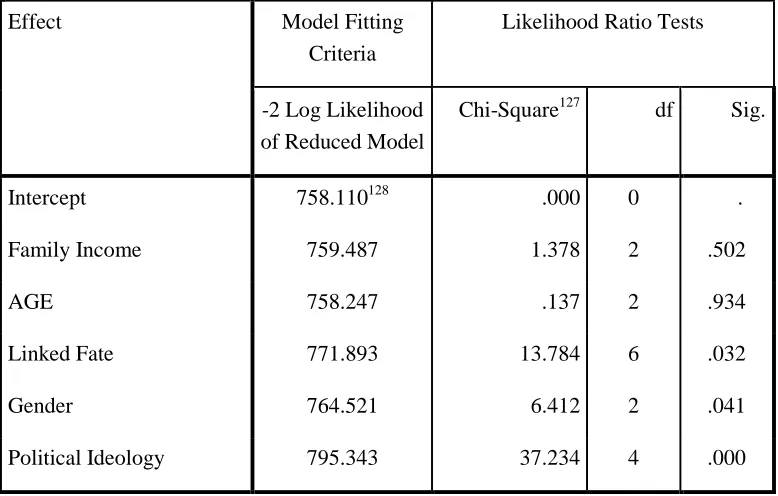
Table 6.7 Model 1: Significance Test of the Model Log Likelihood...172
Table 6.8 Model 1: Output of Statistical Significance of Each Predictor Variable ...173
Table 6.9 Logistic Regression Analysis of the Determinants of Republican Partisanship for 824 Adult African Americans in 1996 by IBM SPSS 20 ...174
Table 6.10 Model 1: Logistic Regression Analysis of the Determinants of Political Independence for 824 Adult African Americans in 1996 by IBM SPSS 20 ...175
Table 6.12 Model 2: Output of Statistical Significance of Each
Predictor Variable ...179
Table 6.13 Model 2: Logistic Regression Analysis of the
Determinants of Republican Partisanship for 548 Adult African
Americans in 1996 by IBM SPSS 20 ...181
Table 6.14 Model 2: Logistic Regression Analysis of the Determinants of Independent Identifications for 548 Adult
African Americans in 1996 by IBM SPSS 20 ...182
Table 6.15 Model 3: Significance Test of the Model
Log Likelihood...184
Table 6.16 Model 3: Output of Statistical Significance of Each
Predictor Variable ...185
Table 6.17 Model 3: Logistic Regression Analysis of Democratic Partisan Decisions for 2553 Respondents in 2004 by
IBM SPSS 20 ...188
Table 6.18 Model 3: Logistic Regression Analysis of Political Independence Decisions for 2553 Respondents in 2004 by
IBM SPSS 20 ...192
Table 6.19 Model 4: Significance Test of the Model
Log Likelihood...190
Table 6.20 Model 4: Output of Statistical Significance of Each
Predictor Variable ...191
Table 6.21 Model 4: Logistic Regression Analysis of Democratic Partisan Decisions for 854 Respondents in 2004 by
IBM SPSS 20 ...193
Table 6.22 Model 4: Logistic Regression Analysis of Political Independence Decisions for 854 Respondents in 2004 by
IBM SPSS 20 ...196
Table A.1 Self-Identification With a Political Party:
Dependent Variable Survey Questions ...229
Table A.2 Linked Racial Fate: Independent Variable
Survey Questions ...230
Table A.4 Class-Family Income Measured in Dollars:
Independent Variable Survey Questions ...231
Table A.5 Gender: Independent Variable Survey Questions ...231
Table A.6 Age: Independent Variable Survey Questions ...232
Table A.7 Ideology: Independent Variable Survey Questions ...232
Table A.8 Presidential Job Approval: Independent Variable Survey Questions ...232
Table A.9 The Nation’s Economy: Independent Variable Survey Questions ...233
L
IST OFF
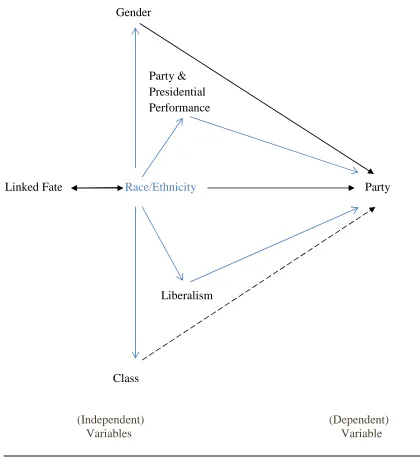
IGURESFigure 2.1 Determinants of African American Partisanship:
1996 and 2004 ...28
Figure 5.1 A Sequential Party Decision-Making Process Based on Party Identification Survey Questions for
1996 and 2004 ...137
Figure 5.2 A Sequential Party Decision-Making Process for
African Americans ...138
Figure 5.3 Arrow Diagram: Determinants of African American
Partisanship: 1996, 2004 ...144
Figure 6.1 Percentages of Political Party Identifications,
1996 and 2004 ...156
Figure 6.2 Percentages of Party Identifications for Women by
Race, 1996 and 2004 ...158
Figure 6.3 Percentages of Party Identifications for Men by
Race, 1996 and 2004 ...159
Figure 6.4 Summary Percentages of African American
Partisanship by Gender ...159
Figure 6.5 Percentages of Linked Fate by Gender Among
Samples of Adult African Americans, 1996 ...161
Figure 6.6 Percentages of Linked Fate by Race Among
Samples of Women, 2004 ...164
Figure 6.7 Percentages of Linked Fate by Race Among
Samples of Men, 2004 ...164
Figure 6.8 Distribution of Annual Family Income for African
Americans, 1996 ...166
CHAPTER
1
I
NTRODUCTIONEver since the Civil Rights Act was passed in 1964, there has been considerable
speculation and debate among scholars that as improved social, economic and political
opportunities expanded for African Americans they would assimilate into the mainstream
United States population like white ethnics that preceded them.1 Most importantly, they
were expected to hold more diverse political party preferences. The subsequent
emergence of a larger black middle class accompanied by the appearance of greater
economic diversity (Gurin, Hatchett, and Jackson 1989) during the post-civil rights era
furthered suppositions that African Americans would become more conservative in their
ideological orientations and partisan predispositions. Despite noticeable improvements in
black economic class standing, African Americans emerged as a politically distinctive
and cohesive group with a strong Democratic bias (Black and Black 2002; Stanley and
Niemi 1991). Consequently, scholars raised questions about the extent to which
improved economic standings could compete meaningfully with racial group identities,
and thereby prompt changes in African American decisions about the two main political
parties.
To investigate this long-term relationship between the African American
electorate and the Democratic Party, the present study draws from Michael C. Dawson’s
general theory of African American racial group interests as advanced in Behind the Mule
(1994). Specifically, this dissertation focuses on his study of “African American
Partisanship and the American Party System,”2 and the supposed lack of political
diversity within the black community. Dawson’s empirical research on the importance of
race and class develops a systematic framework—the Black Utility Heuristic—that
assumes race has a profound impact on African American political decisions. This
includes decisions about which political party better addresses issues of most importance
to African Americans. Thus far, no other study has applied Dawson’s theory of African
American racial group interests and his Black Utility Heuristic paradigm to measure the
relative degree of racial group solidarity and political cohesion beyond his own research
using the 1984 and 1988 National Black Election Studies (Jackson 1984; 1988). I test a
modification of Dawson’s Black Utility Heuristic using the 1996 National Black Election
Study (Tate 1997), and extend his model to test the extent to which such heuristics apply
to both racial and ethnic groups surveyed in the 2004 National Politics Study (Jackson et
al. 2009).
In keeping with Dawson’s theory, I agree that the Black Utility Heuristic is
applicable and reliable as long as race continues to determine prospects of life in the
United States. This is true as long as historical as well as contemporary social and
demographic structures shape perceptions of circumstances within the African American
community, particularly with regard to black life chances.3 While race is considered the
prime factor explaining African Americans’ overwhelming and consistent political
choices, their Democratic partisanship reflects a rational decision calculus that only one
political party of the limited U.S. two-party system meets median racial group policy
preferences. Besides, decisions about which political party is more responsive to African
American racial group interests denotes a rational assessment of how each governing
party fares in promoting the well-being of the racial group (Fiorina 1981). In this regard
race, rather than class and/or other social demography typically shown to influence
partisanship, is central to judgments about policy congruence, or the lack thereof,
between each political party and the African American racial group. Hence, the group
rationale for making political choices is easily transmittable to individual members. This
is primarily because of the continuing significance of race in American society, and
because of the political parties either ignoring or overlooking race-based issues.
Both theoretical and practical political reasons reinforce the basis for this
on-going relationship. For instance, African Americans perceive the Democrats as having
the best over-time record of addressing wrongs against the race; of having a better
approach to dealing with issues of most importance to them; and, of elevating their status
in the economic, social, and political order (Bositis 2002; Tate 1994). So, their long-term
assessments of the policies and performance of the two governing parties (Fiorina 1989)
should point them to the Democratic, not the Republican, Party. Moreover, affiliation
with the Democratic Party is important for practical political reasons as well. Through
this association African Americans have access to the party organization, to institutions
of government, and to both appointive and elective offices. In short, the meaningful
long-term political clout realized by African Americans derives from association with the
Democrats. Hence, this association is efficient in that voting for Democrats allows
African Americans to maintain a sense of group position while engaging the political
system. Correspondingly, Democratic control or “capture” of the black vote is a crucial
factor in securing electoral success (Frymer 1999).
This study contributes to the larger body of literature investigating how social
group identifications shape individual political orientations toward the two main political
parties, as well as to studies of African American politics. Explicitly, the primary focus
of this dissertation is African American political partisanship, and the extent to which
race versus class or other social demography explain their seemingly stable Democratic
Party preferences. In other words: why do African Americans think the way they do
politically, and what induces them to change? To investigate this question I test
Dawson’s Black Utility Heuristic (1994) using data collected for analysis of African
American politics.4 Secondarily, the research aim is to assess the extent to which the
African American form of group-based identity politics influences politically emerging
racial and pan-ethnic minority groups. Important to this examination are individual
perceptions about which party better serves racial group interests, but is this merely a
“black” phenomenon or does Dawson’s heuristic provide a viable (and similar)
explanation for party choice among other racial and ethnic minority groups as well? To
investigate this question I include comparison populations of African Americans, White
Non-Hispanics, Hispanics, Asians, and Caribbean Blacks. Typically, mainstream
research of American party identifications include only a cursory statement about African
American partisanship5 or apply the traditional black-white dichotomy in explanations of
party identifications (Hajnal and Lee 2011). Although this standard relationship is
important, understanding how race and ethnicity matters overall is just as important. This
dissertation fills this gap.
In the 1970s tension between race and class as factors determining black life
chances erupted into intense debate primarily among sociologists from two competing
theoretical perspectives. The “class” perspective, proposed by William J. Wilson in The
Declining Significance of Race (1978; 1980), claims that since the mid-1960s economic
class6 has become the most important factor determining the personal life styles and
external living conditions of African Americans. On the other hand, the “race”
perspective, articulated by Charles V. Willie (1978) holds that integration and affirmative
action programs, implemented after passage of the 1964 Civil Rights Act, place
5. African Americans are the most loyal supporters of the Democratic Party, i.e. in relation to other socio-demographic constituent groups. They are, therefore, often dismissed as highly predictable and virtually resistant to partisan change.
class blacks in direct contact with whites where extensive interactions make the
resurgence of race quite evident. However, Wilson’s (1980) thesis fueled speculations
about the increasing importance of class interests versus racial group interests in African
American politics, and raised expectations that improved economic class situations would
create greater political diversity within the racial group.
Michael C. Dawson (1994) responded explicitly to these two competing
theoretical arguments and to social scholars’ persistent query about the single most
important determinant of African-American politics. Furthermore, in response to
Wilson’s declining significance of race hypothesis, Dawson contends that race interests
supersede class interests primarily because of the continuing significance of race in the
United States. Moreover, the historical circumstances of race shape perceptions of
common interests and racial group solidarity among African Americans producing a
sense of common/linked fate. From Dawson’s perspective, African-American politics as
subsumed within cognitive processes, presupposes that the structure of group perceptions
is on a psychological level where the degree of distinctive actions by individuals depends
on the presence of certain group characteristics. The most notable variables are racial
group identification, a black consciousness, group cohesiveness, and the salience of one’s
racial identity. A relatively high degree of salience means that there is sufficient
information about one’s identity and about “the fit of that identity with social reality”
(Dawson 1994, 11). Finally, and perhaps most importantly, the reality is that race
remains a major force in African American lives.
First, with regard to those prominent racial group characteristics noted above, the
(McClain et al. 2009), and to the idea that there is an intimate association between
individual and group life chances (Simien 2005). This common or linked fate results
when members of a racial grouping face common experiences such as economic
exploitation, social subordination, and psychological oppression (Dawson 1994). It is for
this reason that ascriptive characteristics of race, like the identity of “blackness” and the
African phenotype, have a significant influence on life chance opportunities or the
opportunity to attain meaningful goals in life rather than one’s knowledge, skills and/or
abilities. Being “black” is a visible stereotypical differentiation from those who
determine accessibility to social, political, and economic power in the United States.
Dawson attributes linked fate primarily to perceptions when “economic domination of
blacks by whites became inter-twined with a sense of political domination as well”
(Dawson, 55).
Second, a resulting group political cohesion becomes rational as individual
members follow race-group cues to evaluate and interpret the political world of objects
like parties, issues, candidates, and events. According to Dawson, group political
cohesion is also efficient because individual members can rely on their perceptions of
racial group interests to make the appropriate political choices. Dawson’s theory of
African-American racial group interests employs the economic theory of administrative
decision-making as advanced by Herbert Simon in Administrative Behavior (1947).
Simon argues that multiple factors, including psychological influences, can explain
rational human choice or bounded rationality whereby an individual opts for a satisfying
or “satisficing” solution (Simon 1955). In this regard, the African-American outlook, or
self with the racial group, and with the relative position of the race—predominantly
within the bottom tiers of a stratified social hierarchy. As individuals become more
politically aware of their group’s social class position, they develop a racial group or
“black” consciousness and commit to collective action (Miller, Gurin, Gurin and
Malanchuk 1981).
Here Dawson agrees with seminal studies of political participation (Verba and
Nie 1972; Miller, Gurin, Gurin, and Malanchuk 1981; Shingles 1981) that what
distinguishes African Americans from their White counterparts are “the development of
self-conscious awareness of group membership” (Verba and Nie 1972, 150). There is,
therefore, a sense of “belongingness” or identification with the racial grouping revealed
in such self-identifications, as “I am an African American,” “I am a Liberal,” or “I am a
Democrat” (Sherif and Sherif 1961; Verba and Nie 1972). Herein lies the difference
between blacks and whites, a racial group or black consciousness and a perception of
linked racial fate—us versus them—that serves as a mechanism for political cohesion and
mobilization, and guarantees solidarity in attitudes about appropriate decisions and
behavior. Linked fate insulates individual members against the changing effects of other
structures of attitudes, such as economic class. Most importantly, Dawson (1994) finds
that race continues to be the most powerful explanatory variable for predicting African
American politics because of its continued, profound influence on black life chances,
particularly within the social and economic arenas of life.
According to Miller, Gurin, Gurin, and Malanchuk (1981) politicization of the
racial group produces a sense of black consciousness that occurs when an individual
of group identification and race consciousness based on perceptions of linked fate
confirm the highly distinctive attitudes and behaviors produced by race (Miller, Gurin,
Gurin, and Malanchuk 1981) as previously reported in The American Voter7 (Campbell et
al. 1960). In this regard, identification is a causal factor that, once politicized, determines
individual decisions that adhere to the group political standard. For African Americans
that position tends to be disproportionately at the lower end of the socio-economic scale
(Gurin, Hatchett, and Jackson 1989). This, coupled with the reality of their struggle for
basic civic inclusion, serves as a catalyst for consensus and solidarity among individuals
who perceive their similarly situated class status. Such individuals respond politically by
forming a stable and cohesive bloc to advance African American racial group interests in
partisan politics and within the electoral arena.
Finally, Dawson’s empirically grounded political research demonstrates how
linked racial fate and/or the Black Utility Heuristic influence contemporary African
American orientations toward the two main political parties. He employs his theoretical
framework to analyze African American group political cohesion on this wise: a (black)
racial group consciousness shapes individual perceptions of self-interests and links them
to perceptions of race group interests, both economic and political. Henceforth,
individual perceptions of linked fate stimulate solidarity and direct political orientations.
This is important because there are considerable differences in individual perceptions of
the political world; however, it is imperative for the member to develop a sense of
“community” with the racial group. In so doing, there is a greater likelihood that one will
deem significant the attitudes and behaviors expected by the race, and assume the group
partisan standard. This is what Dawson refers to as the Black Utility Heuristic, a
mechanism employed to determine which political decisions to make in advancing racial
group goals. It is a reliable shortcut for accurate political preference attitudes, voting
decisions, and public opinions.
Race is most significant in determining party identifications. If the Black Utility
Heuristic serves as the primary factor used to decipher political messages, and as a
strategic causal factor within the African American decision calculus, as Dawson
contends, then individuals should correctly identify the political party that is most
responsive to [black] racial group interests in accordance with the current racial group
political standard, the Democratic Party. Such a finding for this research study would
support the “race” perspective as articulated by Willie (1979), and further demonstrate
the significance of linked racial fate and Dawson’s (1994) model, the Black Utility
Heuristic.
This dissertation addresses an important and timely topic in contemporary
American politics. The current chapter introduces the basis for my theoretical framework,
the Black Utility Heuristic as formulated by Michael C. Dawson (1994) in his theory of
African American racial group interests. Additionally, this chapter establishes the focus
of the present research study, and introduces briefly scholarly debates about the single
most important factor that best explains African American life chances: race or class.
Dawson’s response to the race versus class sociological debates is essential to
understanding key variables employed in explaining his theory of African American
racial group interests: racial group identification, a black consciousness, group
African American politics, and the rational and efficient African American decision
calculus.
Chapter 2 provides the principle theoretical goal for this dissertation. I begin with
a discussion of the traditional conceptualization of party identification using classic
literature formulated in the Michigan School. I also present literature regarding
alternative explanations of partisanship from rational theorists and the revisionists. In
addition, later approaches returning to the “Michigan” tradition are included in the
discussion, as well as explanations of partisan change based primarily on Carmines and
Stimson’s (1989) issue evolution. It is, therefore, within the context of this general body
of literature on American party identifications that I review explanations of African
American partisan identifications. The value of the Black Utility Heuristic model, for
comparison among racial and pan-ethnic minority groups, is also considered within the
frame of the theoretical goal.
A core theme of this dissertation is the reality or perception of policy congruence
between African Americans and the two main political parties, and how the parties
responded to secure the black vote. This idea is considered in the historical perspective
discussed in Chapter 3, which covers historical periods from the Reconstruction era to the
Post-New Deal era. Additionally, Chapter 3 sets a background discussion leading up to
the 1860 presidential election of Abraham Lincoln. This historical perspective continues
with a discussion of strategies employed by African Americans to demand that the
political parties provide attention and action to issues that address racial group interests.
African American strategies, the emergence of race to the national political agenda, and
periods representing the Civil Rights and Post-Civil Rights eras. The methodological
approach and model construction used to test research hypotheses explored in this study
are covered in Chapter 5, while reports of statistical analyses and study findings are
presented in Chapter 6. Finally, Chapter 7 discusses both study results and conclusions,
CHAPTER 2
T
OWARDA
T
HEORETICALF
RAMEWORK FORA
FRICANA
MERICANP
ARTISANSHIPOf extreme importance to this investigation of African Americans’ partisanship is the
conceptualization of party identification. Hence, reviews of some major orientations that
have most influenced explanations of citizens’ attitudes toward the two main political
parties, and changes thereto, are enumerated in this chapter. In addition, I attempt to
identify particularly important theoretical issues that underlie different orientations that
contribute to our understanding of African Americans’ decisions about the Democratic
and Republican parties. Lastly, the theoretical framework guiding this dissertation is
formulated.
The relationship between American citizens’ social identifications and their
orientations toward the two main political parties has received considerable attention
from political scientists. Key questions guiding this extensive body of research are: What
is party identification, and what causes partisan change? Some scholars contend that
party identification is a deeply rooted psychological attachment (Campbell, Converse,
Miller, and Stokes 1960; Miller and Shanks 1996) or social identity (Green, Palmquist,
and Schickler 2002) that shapes political preferences. Others suggest that partisanship is
largely an informational short cut (Downs 1957) comprised of a “running tally” of other
political attitudes and evaluations (Achen 1992; Fiorina 1981). This on-going debate,
social-psychological prototype and critical challenges from rational choice theorists and
the revisionists, has spanned half a century and includes a number of pivotal research
studies.
2.1 FROM CLASSIC CONCEPTUALIZATION TO REVISIONIST CRITIQUES
The predominant view of party identification in classic voting behavior research
is advanced in the “Michigan” model of electoral decision-making. Formulated by
Angus Campbell, Philip Converse, Warren Miller, and Donald Stokes in their seminal
study of The American Voter, this social-psychological paradigm emphasizes “the role of
enduring partisan commitments in shaping attitudes toward political objects” (Campbell
et al. 1960, 135). According to Campbell, et al. and subsequent scholarship that has
adopted this perspective (Goldberg 1966; Kelley and Mirer 1974; Miller and Shanks
1996), party identification is as an “unmoved mover” (Johnston 2006); a deeply held
long-term psychological and/or group attachment that is largely unchanging even as
events and other political objects change. This is primarily because candidates and issues
are election specific whereas citizens’ orientations toward the two main political parties
endure since the parties themselves remain relatively stable. Furthermore, party
identification is framed as a conceptual screen through which citizens view and interpret
new political information. While shaping policy preferences and other political attitudes,
party identification remains largely unchanged by them.
On the other hand, revisionist scholars contest strongly the concept of Party
identification as formulated in the social-psychological perspective. Instead, revisionists
contend that party identification is not unmoved; it is shaped by political attitudes and
Elections (1981), in which Morris Fiorina frames party identification as a “running tally”
of citizen evaluations of other political objects and events. Christopher Achen (1992)
further articulates the revisionist conceptualization of partisanship as a Bayesian
updating, or learning process model.
Revisionists build their theoretical perspective on the rational approach employed
by Anthony Downs in An Economic Theory of Democracy (1957), and V.O. Key‘s
treatment of partisan preference, in The Responsible Electorate (1966), as an information
shortcut based on which political party’s ideological and policy positions are relatively
closer to those held by the citizen. Thus, in the revisionists’ perception party
identification is not considered a psychological or group attachment independent of
citizens’ evaluations of contemporary politics. Rather, partisanship represents a summary
of the political evaluations individuals have formed over time. So, while party
identification might be quite stable from one election to the next, it also may change over
time in response to policy preferences, candidate evaluations, evaluations of party
performance, and vote decisions (Jackson 1975; Page and Jones 1979; Markus and
Converse 1979; Fiorina 1981; Franklin and Jackson 1983; Franklin 1984).
The revisionist view clearly supports the idea that individuals might change their
party loyalties in response to their attitudes on policy issues, particularly those salient,
emotional, and polarizing issues commonly associated with periods of partisan change.
Yet, similar to the social-psychological argument, revisionist scholarship acknowledges
the possibility of a long-term component to party identification stemming from childhood
socialization (Fiorina 1981; Achen 2002). Revisionists further purport that partisanship
identification may cause policy preferences as well as be caused by them (Franklin 1984;
Jackson 1975); Page and Jones 1979; Markus and Converse 1979). Most importantly, the
general position of revisionists is that partisanship is more a summary of other political
attitudes than a shaper of them. Fiorina characterizes the revisionist view of party
identification as “an evolving indicator of an individual’s relationship to the parties”
(Fiorina 2002, 98).
2.2 BACK TO THE BASICS? THE DEBATE CONTINUES
Responding to the revisionist case, Warren Miller (1991) initiates defense of the
social-psychological paradigm that he and J. Merrill Shanks further articulate in The New
American Voter (1996). Suggesting that party identification may not be far from the
theoretical framework constructed in The American Voter (1960), Miller and Shanks
indicate that party identification is primarily an attitude of preference that provides a
meaningful explanation for candidate and policy preferences, especially when uncertainty
is present. In addition, Donald Green and his colleagues fully develop a critique of the
revisionist perspective on party identification. They show that when random
measurement error is corrected party identification is almost entirely exogenous in the
short-run to issues, candidates, and performance evaluations (Green and Palmquist 1990;
1994; Green, Palmquist, and Schickler 2002). Furthermore, Alan Gerber and Donald
Green (1998) reject Christopher Achen’s (1992) conceptualization of party identification
as a Bayesian updating process suggesting instead that it is incompatible with the reality
of partisan stability. Green, et al. argues that party ties represent an attachment to a group
similar to religious identification (Green, Palmquist, and Schickler 2002). “People
intact. But when secular realignment is afoot, the public image of the partisan groups
shifts, which in turn produces a shift in party identifications and perhaps further alters
perceptions of partisan groups” (Green et al. 2002, 816). In short, the works of Green
and his colleagues reaffirms the view of partisanship as a deeply rooted social identity
independent of other political evaluations that is firmly held by most citizens.
In spite of this reaffirmation, Green et al. depart from one very important
component of the traditional American Voter model. They argue against the idea of
selective perception, and hold instead that Democratic and Republican identifiers update
their political evaluations in similar ways. In doing so Green and his colleagues reject the
idea that party identification serves as a perceptual screen that shapes the evaluation of
new political information (Gerber and Green 1999; Green, Palmquist and Schickler
2002). Additional scholars contend that partisanship causes change in other political
evaluations. For example, Zaller (1992) suggests that partisan predispositions regulate
the flow of information from political elites to the mass public; thusly, individuals tend to
bring their own policy attitudes into line with those of their party’s leaders. Bartels
(2002) provides even stronger support for the American Voter model with his evidence of
the effect of party identification in shaping political evaluations. He argues that Gerber
and Green’s (1999) unbiased updating actually confirms that there is a partisan bias.
Both Bartels (2000) and Hetherington (2001) provide further support for the role of party
identification as a causal force based on evidence of the strengthening of party
identification and its impact on vote choice.
Finally, while the American Voter model emphasizes the idea that party
personalities” (Campbell et al. 1960, 151), it does not rule out the possibility of some
issue-based change in party loyalties. Here Campbell et al. acknowledge the possibility
of party realignment, suggesting that when individuals hold particularly strong feelings
about issues on which they differ with their party, “this pressure is intense enough, [that]
a stable partisan identification may actually be changed” (Campbell et al. 1960, 135).
The political attitudes most likely to create enough pressure that individuals may shift
their party loyalties are deeply held attitudes on the emotional and polarizing issues
associated with partisan change, such as racial and economic issues (Carmines and
Stimson 1989). Therefore, while party identification may be the causal force in its
relationship with most policy preferences, attitudes toward certain issues that structure
party conflict may lead to shifts in party ties for some citizens. In short, this body of
research revalidates party identification as a principle mover of other political attitudes;
however, it is not an unmoved mover in every situation.
2.3 SOURCES OF CHANGE IN POLITICAL PARTY IDENTIFICATION
In order for individuals to change either their party identifications or their issue
preferences they must first recognize that there are differences in the policy positions of
the two main political parties. Research has established the relationship between issues
and party change (Carmines and Stimson 1989; MacDonald and Rabinowitz 1987;
Sundquist 1983) when parties and candidates assume distinct positions on important
issues, and when citizens are aware of the parties’ differences. Citizens that do not
recognize partisan conflict based on divergent policy stands should have no cause for
change. On the other hand, for individuals that are aware of party differences on
Therefore, when considering the centrality and stability of party identification, the only
individuals that should change their political party preferences on the basis of their issue
attitudes are those that find the issues to be particularly salient. Conversely, citizens that
are not aware of polarizing partisan policy stands on particularly powerful easily
understood, emotional, or symbolic issues have no reason to change their partisanship.
2.4 A BROADER ACCOUNT OF PARTY CHANGE: ISSUE EVOLUTION
A prominent position relegated to issues, especially between the 1964 and 1972
presidential elections, is attributed to the polarizing policy positions of the two main
political parties and their candidates (Carmines and Stimson 1989; Black and Black
1987). Carmines and Stimson’s predominant explanation of partisan change during this
decisive election period is articulated in Issue Evolution: Race and the Transformation of
American Politics (1989). They argue that major changes in the policy stands of the two
main political parties occur in response to the type of issues that command center stage in
American politics. Certain economic, foreign, racial, and social policies that dominate
electoral campaigns evoke powerful emotional responses from the parties and candidates,
and cut across traditional party cleavages such as the New Deal coalition, causing
conflict. According to their theory of issue evolution race is the prime factor explaining
post-New Deal transformations in the partisan balance of identification in the American
electorate (Pomper 1989); and, changes in the doctrinal stances of the political parties
where the Democratic Party emerges as racially liberal and actively pro-civil rights
(Feinstein and Schickler 2008).
Subsequently, defections among white southerners from the New Deal coalition
ideological transformations of Democratic, and Republican, Party policies with regard to
racial issues (Feinstein and Schickler 2008). Apart from white southerners, the most
noticeable shifts to the Republican Party among other social groupings within the
electorate include whites, self-designated conservatives, and both younger and older
cohorts (Norpoth 1987, Petrocik 1987, Black and Black 1989; Gurin, Hatchett, and
Jackson 1989). Social status group factors, especially differences in educational
background, are also prominent forces explaining increased preferences for the
Republican Party among white citizens during the period spanning the 1960s and
extending into the late 1980s (Miller 1992). Carmines and Stimson (1989) further
contend that party-based changes reflect attitudes toward race-related policies regarding
integration, black civil rights, and voting rights for the disenfranchised.
By the mid-1960s African Americans, seemingly impervious to change, culminate
their realignment that began with the 1936 presidential election of Franklin D. Roosevelt
(Weiss 1989). This attachment to the Democratic Party continues to intensify into the late
1980s. Thereafter, most African Americans perceive the Democrats as having the best
over-time record of giving attention to, and taking action to address issues of most
importance to the African American racial group. Moreover, African Americans’
distinctive and enduring Democratic partisanship appears to confirm the significance of
race, or of particular issues that focus on racial group interests, when making decisions
between the two main political parties. Even though important demographic
differentiations are also present within the African American community, variables
commonly associated with predicting political partisanship do not typically provide
Because of persistent racial group solidarity Democratic, not Republican
partisanship appears rational, at least from the perspective of procedural rationality
(Simon 1955). While the Democrats may not be the best choice, they may be the “lesser
of two evils.” Still, the extent to which political distinctiveness and durable partisan
predispositions persist at any point in time depends upon continued perceptions of the
Democratic Party as best capable of addressing racial group interests. Nevertheless,
Bositis (2002) shows evidence of increased conservative ideological preferences among
African Americans in the 1980s Reagan era that furthered speculation of increased
preferences for the Republican Party. Luks and Elms (2005) contend that Democratic
attachments have declined since passage of the 1964 Civil Rights Act, particularly among
younger cohorts. Correspondingly, Lee and Hajnal (2007) reveal a discernible pattern of
fluctuations in African American party affiliation. In spite of such empirical evidence
African Americans continue to prefer the Democrats.
2.5 AFRICAN-AMERICAN PARTISANSHIP: A THEORETICAL PERSPECTIVE
Therefore, in formulation of a theoretical perspective for studying partisanship
among African Americans the theory of African-American racial group interests provides
a more useful paradigm than the traditional prototypes. This is mainly because “to
understand black politics one needs to draw on many methodologies, and one clearly
needs to pay more attention to the boundaries between society and the individual, with
the group as the intermediary phenomenon” (Dawson 1994, 13). Of particular value to
the development of this theoretical framework is the Black Utility Heuristic that provides
a parsimonious explanation for the group-based decision calculus of individual African
framework based on Michael C. Dawson’s synthesis of “psychological theories of the
social group” with “Simonesque approaches to rational decision-making” (Dawson, 12).
In so doing, Dawson “provides a rational choice foundation for the formation of group
identity [where] rationality is procedural, based on assessments of what works as opposed
to what is best [which is useful] to gain insight into the decision-making processes of
African Americans both as individuals and as part of a politically active group within the
American polity” (Dawson, 12).
The theoretical background of African American racial group interests is a group
process perspective of the relationship between the individual and the group, where the
racial grouping is construed as a psychological group. According to John C. Turner
(1987) such groups, descriptively speaking, are psychologically relevant to individual
members subjectively for social comparison. Psychological groups influence individual
members since it is from the group that the individual acquires norms, values, and beliefs.
Herein lies the utility of group membership for such persons. Individuals can accept
membership in, and identification with the group (privately) based on a view of
themselves in relation to those persons that constitute the group (Turner 1987, 1-2). This
makes the group relevant to the establishment of their own socio-political reality.
Henceforth, the psychological group becomes an important frame of reference that shapes
the individuals’ own attitudes, orientations and ideas. In this way, a deference to group
interests as opposed to individual interests is located within the individual. Therefore, the
individual decision is consistent with the notion of procedural rationality, an important
individual by others as a group member reinforces the perception of us versus them and
enhances the importance of identification with the group.
Instrumental to this theoretical approach, and consistent with the theory of
African-American racial group interests, is the idea that individuals are social beings
Fundamentally, the influence of individuals on one another, particularly in relation to
change is inherent in the political motives of African Americans. Any change among a
substantial proportion of individual members or within subgroups is potentially
detrimental to the group as a whole. Movement in opposition to the political standard
could threaten the African American racial group position within the polity. As a
psychological group this collectivity of individuals exerts powerful influence on
individual attitudes toward the two main political parties in the United States. This is
denoted in the seemingly habitual, stable, and enduring relationship between the
Democratic Party and the African Americans. Perceptions of interconnectedness explain
the presence of an “interdependence of fate,” a perceptual realization that one’s fate
depends on the fate of the group as a whole, and “task interdependence” or the
dependence of individual group members on each other for goal achievement (Lewin
1946).
Kurt Lewin (1946, 165-166) explains his principle of interdependence of fate in
relation to the position of Jews in 1939 thusly:
The historical case of African Americans is most applicable to this concept. As a
psychological construct, linked fate measures the degree to which an individual’s own
self interests are tied to the interests of the entire group. Nonetheless, the perception of
relationship with the group waxes or wanes depending upon the extent to which self
becomes less, and group becomes more important. Hence,
Hypothesis 1: African Americans with stronger (black) linked fates are likely to support a political party whose policy preferences are perceived as consistent with (black) racial group interests.
The case of African American women suggests distinct historical and
contemporary life situations that make even more significant the role of interdependence
of fate (Gay and Tate 1998; Simien 2005). This is coupled with making decisions in the
face of multiple identities, such as race and gender. So, to further investigate this
underlying dimension of African American racial group partisanship, the following
proposition is formulated.
Hypothesis 2: African American women are more likely to support the Democratic Party than African American men or women of other ethnicities.
Of further significance to this theoretical perspective is the concept of task
interdependence that sheds light on the inducing influence of certain group attributes.
Understandably, individuals choose membership with the group based on their
perceptions of a common purpose, and on their interest in achieving a common goal.
Bound by perceptions of interconnectedness, individuals often view group goals as more
important than their own. This is because they consider that their goals are interrelated
with the goals of the individuals that compose the group and with whom they share
ascriptive characteristics, an important component of the black utility heuristic. Even
solution for the individual, the decision to align oneself with a collectivity of individuals
similarly situated is both procedurally rational and efficient. In so doing individuals
satisfactorily assess the pursuit, and accomplishment, of racial group goals as fulfilling
their own aspirations.
Hypothesis 3: African Americans are more likely to identify with the political party that they perceive best helps their racial group.
Interdependence plays a significant role in understanding the dynamic processes
of the African American racial group. Using the framework of the black utility heuristic,
Dawson demonstrates how linked racial fate affects political attitudes and decisions of
group cohesion. Additionally, the concept of linked fate guides Dawson’s later work on
the root of contemporary African American politics in Black Visions (2002). In this
regard, his interpretations and systematic findings confirm the race perspective (Willie
1979). Nonetheless, Dawson also finds “limited evidence” confirming the declining
significance of race hypothesis or class perspective (Wilson 1979; 1980) in determining
life chance opportunities (Dawson, 38). Recent relevant research studies that also
employ the concept of linked fate and the black politics model demonstrate its profound
effect on explanations of the political attitudes and behavior of ethnic minority population
groups representing Latinos (Sanchez & Masuoka 2008; Sanchez 2008; Nicholson,
Pantoja & Segura 2005), Asian Americans (Junn & Masuoka 2008), Afro-Caribbeans
(Watt 2009), and West Indians (Rogers, 2001). Correspondingly, the concept of linked
fate also provides a meaningful explanation for predictors of pan-ethnic group
consciousness and the use of group identity cues among Asian Americans and Latinos
Hypothesis 4: The more a person views that the fate of their racial/ethnic group affects their own fate, the greater the likelihood of support for the political party perceived as addressing racial/ethnic group interests.
Explaining the theory of African-American racial group interests, Dawson
considers the following variables: Individual perceptions of racial group interests,
Individual socioeconomic status, Evaluations of the economy, Liberalism, Local black
economic conditions, Approval of Reagan’s presidential performance, and Demographic
characteristics—age, gender, and region (Dawson, 113 – 115). Using data from the 1984
and 1988 National Black Election Studies (NBES) panel series (Jackson 1984; 1988),
Dawson tests his model to assess the strength of interrelationships. He shows that “a key
to African-American partisanship is the economic status of the race.” Moreover, “any
party that wants to attract and hold African-American political support must be seen as
more effective than its rivals in improving the economic health of the black community”
(Dawson, 116-117).
This research study is a modification of Dawson’s (1994) empirical test,
employing data feasible for such analysis: the 1996 National Black Election Stud and the
2004 National Politics Study.8 The focus is African American partisanship. In the
theoretical framework, an influence on decisions about which political party is most
responsive to racial group interests is largely a factor of race, class, and gender (Figure
2.1 below). In addition, race structures individual orientations and determines the extent
8. Katherine Tate, National Black Election Study, 1996 [Computer file]. ICPSR Version. Columbus, Ohio: Ohio State University [producer] 1997. Ann Arbor, MI: Inter-university Consortium for Political and Social Research [distributor], 2004).
to which ideological predispositions influence partisanship, and frames perceptions of
how the parties perform when in control of government. Moreover, race has a profound
effect on individual perceptions about historical experiences, and on contemporary
encounters with White, and other Americans that have resulted in confinement of the
racial group along the perimeter of the social, economic, and political order. In short,
race matters.
What then is race? It is a vast family of human beings, generally of common blood and language, always of common history, traditions and impulses, who are both voluntarily and involuntarily striving together for the accomplishment of certain more or less vividly conceived ideals of life.
W.E.B. DuBois9
According to DuBois racial classifications tend to follow physical traits, but
ascriptive characteristics do not, and cannot, explain such group features as cohesiveness
and continuity. In this he sees that differences transcend race and represent more fully
“spiritual, psychical,” distinctions that bind people together. The group is therefore
composed of individuals that share “first, their race identity and common blood;
secondly, and more important, a common striving together for certain ideals of life”
(DuBois 2003, 159). For this purpose African Americans work for race solidarity in that
they acknowledge their interconnectedness and interdependency. Then perceptions and
real-life experiences most often lead to the development of a sense of interdependence or
linked fate, identification with one’s social group, as well as a black consciousness that
results in solidarity and collective action to advance racial group goals.
9. W.E.B. DuBois. “The Conservation of Races.”(1897) In Social Theory: Roots and Branches, 157-161. Edited by Peter Kivisto. (Los Angeles, California: Roxbury
Publishing Company (2003).
Gender
Party & Presidential Performance
Linked Fate Race/Ethnicity Party
Liberalism
Class
(Independent) (Dependent)
Variables Variable
Figure 2.1 Determinants of African-American Partisanship: 1996, 2004
In the diagram above, perceptions of linked fate influence African American (race)
evaluations and affective attitudes, as well as individual decisions about which of the two
main political parties works harder to promote racial group interests. Most importantly,
seen, race has a direct influence on partisanship; race also influences class and gender
effects on partisanship, where class denotes a strong relationship that influences party
choice in different ways for the racial group.
Race matters for African Americans as a group. Nonetheless, what may be a
valid account of the centrality of race to partisanship within the African American racial
group may not necessarily depict the relationship between race/ethnicity and political
partisanship for other groups of minority status. Therefore, an important element of this
extension of Dawson’s (1994) study is looking across other groups to see how the effects
specified above apply particularly to African Americans and broadly to other
racial/ethnic groups included in this examination. A comparative population of African
Americans, White Non-Hispanics, Hispanics, Asians, and Black Caribbeans are also
included in the analysis. Even though perceptions of linked racial fate tend to be more
explicit among individuals constituting the African American racial group, such
perceptions may also be inferred from the political attitudes and actions of other
population groups. My position is that a “sense” of linked fate is important to individuals
in all groups represented, but in different ways. To this degree the investigation will
further explore that phenomenon.
Additionally, the present research study takes into account the integral role of
race, class, and gender in structuring political partisanship. Race, economic class
position, and gender are sociopolitical constructs that determine individual life chances,
or the opportunity to attain meaningful goals in life. They form the basis for imposing
inequalities resulting from structures of superior-subordinate relationships, that include