University of South Carolina
Scholar Commons
Theses and Dissertations
2013
Charlie: A New Robot Prototype for Improving
Communication and social Skills in Children with
Autism and a New Single-point Infrared Sensor
Technique for Detecting bBeathing and Heart Rate
Remotely
Laura Boccanfuso
University of South Carolina - Columbia
Follow this and additional works at:https://scholarcommons.sc.edu/etd Part of theComputer Sciences Commons
This Open Access Dissertation is brought to you by Scholar Commons. It has been accepted for inclusion in Theses and Dissertations by an authorized administrator of Scholar Commons. For more information, please [email protected].
Recommended Citation
Boccanfuso, L.(2013).Charlie: A New Robot Prototype for Improving Communication and social Skills in Children with Autism and a New Single-point Infrared Sensor Technique for Detecting bBeathing and Heart Rate Remotely.(Doctoral dissertation). Retrieved from
CHARLIE: A NEWROBOT PROTOTYPE FORIMPROVING COMMUNICATION AND
SOCIAL SKILLS INCHILDREN WITH AUTISM AND
A NEWSINGLE-POINTINFRARED SENSORTECHNIQUE FORDETECTING
BREATHING AND HEARTRATE REMOTELY
By
Laura Boccanfuso
Bachelor of Arts
George Mason University, 1990
Master of Science
Bowling Green State University, 2001
Submitted in Partial Fulfillment of the Requirements for the Degree of Doctor of Philosophy in
Computer Science
College of Engineering and Computing University of South Carolina
2014 Accepted by:
Jason M. O’Kane, Major Professor Manton Matthews, Committee Member
John Rose, Committee Member Yan Tong, Committee Member Ruth K. Abramson, Committee Member
A
CKNOWLEDGMENTS
Thanks to my family. My amazingly supportive and bright husband Tony who never blinked when I told him that I wanted to go back to graduate school to complete a Ph.D. Thank you for being an incredible source of support, springboard and resource for me. I could not have completed this work without you. Carolina, Michael, Ana: thank you for understanding when I had to carve out a “little" time here and there to work during family time. You are each so remarkable in your own way and I am exceedingly proud to be your mom. You inspire me!
Many thanks to Jason M. O’Kane. Thank you for your valuable input and insightful guidance along the way. The countless electrical, mechanical and strategic implementation efforts you provided were key to building and making CHARLIE and the remote stress detection system work effectively. I’ve learned so much from you and I am grateful for the opportunity to step into the HRI research domain. It has made all the difference.
I also want to extend my heartfelt gratitude to Ruth K. Abramson, Harry H. Wright and Alicia V. Hall. Thank you for your unwaivering support in refining and field testing CHARLIE and for generously sharing your valuable time to make the CHARLIE study successful. Your insight and expertise was crucial to completing this research.
Thanks to Manton Matthews, John Rose and Yan Tong. I am honored to have each of you on my committee. Thank you for the many ways in which you helped me get through the program to the finish!
A
BSTRACT
This research delivers a new, interactive game-playing robot named CHARLIE and a novel technique for remotely detecting breathing and heart rate using a single-point, thermal in-frared sensor (IR). The robot is equipped with a head and two arms, each with two degrees of freedom, and a camera. We trained a human hands classifier and used this classifier along with a standard face classifier to create two autonomous interactive games: single-player (“Imitate Me, Imitate You”) and two-player (“Pass the Pose”). Further, we developed and implemented a suite of new interactive games in which the robot is teleoperated by remote control. Each of these features has been tested and validated through a field study including eight children diagnosed with autism and speech delays. Results from that study show that significant improvements in speech and social skills can be obtained when using CHAR-LIE with the methodology described herein. Moreover, gains in communication and social interaction are observed to generalize from child-to-robot to co-present others through the scaffolding of communication skills with the systematic approach developed for the study. Additionally, we present a new IR system that continuously targets the sub-nasal region of the face and measures subtle temperature changes corresponding to breathing and cardiac pulse. This research makes four novel contributions: (1) A low-cost, field-tested robot for use in autism therapy, (2) a suite of interactive robot games, (3) a hand classifier created for performing hand detection during the interactive games, and (4) an IR sensor system which remotely collects temperatures and computes breathing and heart rate.
cov-ered with a bright green, fuzzy material and additional padding so that it appears toylike and soft. Additionally, several structural features were included to ensure safety during interactive play and to enhance the robustness of the robot. Because children with autism spectrum disorder (ASD) often enjoy exploring new or interesting objects with their hands, the robot must be able to withstand a moderate amount of physical manipulation without causing injury to the child or damaging the robot or its components. CHARLIE plays five distinct interactive games that are designed to be entertaining to young children, appeal to children of varying developmental ability and promote increased speech and social skill through imitation and turn-taking.
T
ABLE OF
C
ONTENTS
ACKNOWLEDGMENTS . . . iii
ABSTRACT . . . iv
LIST OFTABLES . . . viii
LIST OFFIGURES . . . x
CHAPTER 1 INTRODUCTION . . . 1
CHAPTER 2 RELATEDRESEARCH . . . 8
2.1
Autism, Impact and Computer-Assisted Therapies
. . . 82.2
Robot-Assisted Therapies for Autistic Children
. . . 112.3
Designs for Robot-Assisted Autism Therapy
. . . 152.4
Remote Stress Detection
. . . 24CHAPTER 3 INTERACTIVE ROBOT . . . 35
3.1
Methodology and Approach
. . . 363.2
Physical design
. . . 373.3
Interactive software design
. . . 393.4
Data collection
. . . 483.5
Initial robot experiments
. . . 483.6
Field Study with CHARLIE and Eight Children with Autism
. . 513.7
Field Study Results
. . . 64CHAPTER 4 REMOTE STRESSDETECTION . . . 84
4.1
Methodology and Approach
. . . 854.2
Remote Breathing and Heart Rate Testing
. . . 954.3
Remote Breathing and Heart Rate Detection Conclusions
. . . . 102CHAPTER 5 RESEARCH PLAN . . . 105
BIBLIOGRAPHY . . . 106
APPENDIXA STUDYPROTOCOL . . . 115
APPENDIXB PRESCREENINGQUESTIONNAIRE . . . 117
APPENDIXC RECRUITMENT: FUN WITHCHARLIETHEROBOTFLYER(IN -DIVIDUAL) . . . 119
APPENDIXD AUTISMSTUDYCONSENTFORM . . . 121
L
IST OF
T
ABLES
Table 3.1 Data collected from an interactive session with CHARLIE. . . 50 Table 3.2 Parent/Caregiver Reported Vineland Adaptive Behavior Scale
Re-sults. Participant identifier and beginning age are followed by (from left to right): (a) Composite communication pre-test score, (b) Com-posite communication post-test score, (c) Change in comCom-posite com-munication scores, (d) Composite social interaction pre-test score, (e) Composite social interaction post-test score, (f) Change in composite
socialization scores. . . 67 Table 3.3 Parent/Caregiver Reported VABS-II Combined Receptive and
Expressive Communication V-Scale Results. Participant identifier and beginning age are followed by (from left to right): (a) Total re-ceptive and expressive communication v-scale pre-test score, (b) To-tal receptive and expressive communication v-scale post-test score, (c) Change in receptive and expressive communication
pre-test/post-test v-scale scores and (d) Change in composite communication scores . . 69 Table 3.4 Mean Length of Spontaneous Utterance Determination (MLSUD)
Results. Participant identifier and beginning age are followed by (from left to right): (a) Preliminary evaluation MLSUD, (b) Session 4 MLSUD, (c) Session 8 MLSUD, (d) Final evaluation MLSUD, (e)
Table 3.5 Unstructured Imitation Assessment Results. Participant identifier followed by the percentage of successful imitations for: (1) Prelimi-nary UIA-social, (2) Final UIA-social and, (3) Change between pre-liminary and final social scores; (4) Prepre-liminary UIA-requesting, (5) Final UIA-requesting and, (6) Change between preliminary and fi-nal requesting scores; (7) Preliminary UIA-joint attention, (8) Fifi-nal UIA-joint attention and, (9) Change between preliminary and final
joint attention scores. . . 70 Table 3.6 Expressive Vocabulary Test (EVT) and Motor Imitation Scale
(MIS) Results. Participant identifier followed by: (a) Preliminary EVT(A), (b) Final EVT(B), (c) Percent change in EVT score, (d)
Preliminary MIS(A), (e) Final MIS(B), (f) Percent change in MIS score. . 71 Table 3.7 Comparing average reported points for the VABS communication
composite scores increases obtained from the CHARLIE, Eikeseth,
LeGoff studies. . . 75 Table 3.8 Comparing average reported points for the VABS socialization
com-posite scores increases obtained from the CHARLIE, Eikeseth, LeGoff
studies. . . 76 Table 3.9 Comparing average reported points for the Unstructured Imitation
Assessment from the CHARLIE and Ingersoll studies. . . 78
L
IST OF
F
IGURES
Figure 1.1 Complete robot (top left). Snap-off arm (top right). Snap-off head
(bottom) . . . 3 Figure 1.2 Single-point FAR infrared sensor. . . 6
Figure 2.1 Remote breathing monitoring system. Front view (left) and profile
view (right). . . 31
Figure 3.1 CHARLIE. [left] Completed robot. [right] Internal structure. . . 36 Figure 3.2 [top] Snap off arm. [bottom] Snap off head. . . 38 Figure 3.3 CHARLIE poses. From top to bottom, left to right : Left hand high.
Both hands high. Right hand high. Peek-a-boo. Neutral. . . 40 Figure 3.4 Face and hand detection. . . 41 Figure 3.5 Sample images used to train the hand detector. [top] Positive
exam-ples. [bottom] Negative examexam-ples. . . 42 Figure 3.6 State diagram for CHARLIE’s “Imitate Me, Imitate You” autonomous
interactive game. . . 45 Figure 3.7 State diagram for CHARLIE’s “Pass the Pose” autonomous
interac-tive game. . . 46 Figure 3.8 Children Interacting with CHARLIE. . . 49 Figure 3.9 Therapy room at the USC Speech and Hearing Research Center. . . 58 Figure 3.10 Reported communication composite scores for the Vineland
Adap-tive Behavior Scale obtained through three studies; Red line:
Figure 3.11 Reported socialization composite scores for the Vineland Adaptive Behavior Scale obtained through three studies; Red line:
CHAR-LIE, Green line: Eikeseth and Blue line: LeGoff. . . 75
Figure 3.12 Unstructured Imitation Assessment scores for two studies; Red line: CHARLIE, Green line: Ingersoll. . . 78
Figure 3.13 Mean Length Spontaneous Utterance Determination scores for two studies; Red line: CHARLIE, Green line: Hancock. . . 81
Figure 4.1 Single-point FAR infrared sensor. . . 87
Figure 4.2 Nose and infrared sensor regions of interest. . . 88
Figure 4.3 Successive sliding windows of IR sensor readings. Solid line corre-sponds to infrared temperature data. Dashed line correcorre-sponds to the curve-fit results. . . 91
Figure 4.4 30-second window of unprocessed infrared data (top). Detailed 8-second view of raw data (bottom). . . 92
Figure 4.5 Level 3 DWT coefficients. . . 94
Figure 4.6 Response rate across data sets. . . 97
Figure 4.7 Successful response results in breaths per minute. . . 98
Figure 4.8 IR heart rate (dashed line) and ECG heart rate window (solid line). . . . 99
Figure 4.9 All test set results by root-mean-square error. . . 100
Figure 4.10 Typical test set results by root-mean-square error. . . 100
C
HAPTER
1
I
NTRODUCTION
The use of robots for cooperative work with humans is becoming increasingly pervasive across an ever widening range of disciplines. Medical procedures using robots are reported to be less invasive, result in faster recovery times and are estimated to have nearly tripled from 2007 to 2010 [1]. Robots have been employed for use in post-stroke rehabilitation [2], as assistive feeding systems for the physically handicapped [3] and in therapeutic roles such as robotic pets for the elderly in nursing homes [4]. Engineers across multiple disciplines have capitalized on the unique qualities of robots to perform autonomously and predictably and repeat mechanical tasks consistently. These characteristics also make robots well suited as part of an early intervention strategy for many autistic children who tend to perceive them as nonthreatening and intrinsically interesting.
Robots have been used to effectively engage autistic children in interactive game play-ing and research has demonstrated that robot-assisted autism therapy promotes increased speech and increased child-initiated interactions in children with Autism Spectrum Disor-der (ASD) [5, 6]. However, more research is needed to develop definitive paradigms that describe which types of autonomous robot designs and interactive modalities will most benefit children with autism.
with autism are under greater strain. Further, because of the added expense of therapy and specialized medical care, the cost of raising an autistic child in the United States is estimated to be between 8.5 to 9.5 times greater than raising a typically developing child. This additional financial burden may mean that some families have to choose whether to incur significant debt to get the proper care for their child or limit the amount of therapy their child receives. Even though robots have been proven to be effective for promoting communication with some autistic children, there are few existing robots currently in use for autism therapy and those that do exist are cost prohibitive for widespread use.
Our research focuses on achieving two primary objectives. The first objective is to design and develop an interactive robot that can be used to promote speech and social in-teraction among children with autism, is suitable and sufficiently robust to be handled by children and is financially accessible to those who would most benefit from its use. Our second research focus is inspired by the desire to make human-robot interactions more nat-ural and productive by providing a technique for remotely detecting subtle physiological changes that correspond to stress. The two most important questions this research seeks to answer are: (1) Can a simple, low-cost robot design be effective for promoting human-to-human interaction with autistic children? and (2) Can minimal temperature data collected with a single-point, non-contact infrared sensor be sufficient to accurately calculate breath-ing and heart rate?
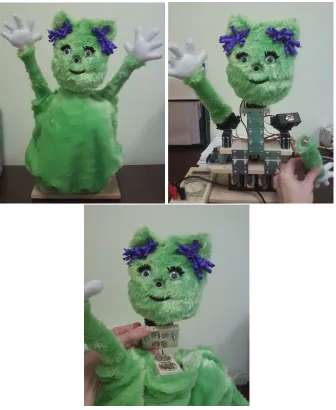
Figure 1.1: Complete robot (top left). Snap-off arm (top right). Snap-off head (bottom)
arms, each with two degrees of freedom, and a camera. For robustness and safety during play, the robot’s arms and head are fully detachable (Figure 1.1). Additionally, a human hands detector was trained and subsequently, this detector was used along with a standard OpenCV face detector [11] to create two autonomous interactive games: single-player (“Imitate Me, Imitate You”) and two-player (“Pass the Pose”.)
and detecting when the child imitates. The “Pass the Pose” game engages two children in cooperative play by enlisting the robot as a mediator between two children who alternately initiate and imitate poses. These games were expressly designed to increase joint attention and encourage child-led interactions through games that are based on turn-taking and im-itation. Because the frequency and duration of each child’s participation is continuously measured, the robot is able to adapt its game mode(s) based on the perceived interest of the child. Three additional teleoperated, human-in-the-loop games were also developed where CHARLIE is employed as a catalyst for improved social interactions. During gameplay in one of the teleoperated modes, children learn and practice verbal requests with the robot (and receive positive reinforcement for each attempt) before generalizing the game to co-present others. The three new contributions co-presented in this part of our research are: (1) a new low-cost robot design which measures and adapts its behavior according to a child’s actions, (2) five new interactive games (two are autonomous and three are teleoperated) and, (3) a new hand classifier used for hand detection, which is now freely available for use in various kinds of human-robot interactions.
Remote collection of breathing and heart rate
Detecting and tracking the physiological state of humans is an important focus for research in human-robot interaction (HRI) because it promises to make robots better-suited to work in close proximity and more cooperatively with humans. Collecting and using physiological indicators can enable robots to adjust their behavior based on the emotional, psychological or physical state of their user. In addition, the overall utility of robots can be further increased when they are able to learn typical physiological patterns and use these patterns as a baseline for identifying anomalies or possible warning signs of various problems in their human users. For example, if an autistic child becomes distraught during the course of therapy, he or she may not be able to appropriately communicate this fact to the therapist or teacher. A robot that can detect and monitor a child’s breathing and heart rate may track subtle shifts in his or her emotional state and change its behavior before the child’s frustration escalates.
Additionally, a robot that continuously collects heart rate and breathing data from a patient undergoing post-stroke therapy can adjust the amount of exertion in a given exercise or the duration and number of repetitions so as to challenge the patient without pushing them beyond their physical limits. Finding an efficient way to accurately detect stress remotely for real-time applications is the necessary next step towards fully realizing this potential.
Figure 1.2: Single-point FAR infrared sensor.
high processing cost.
In a submission to the International Conference on Biomedical Robotics and Biomecha-tronics (BioRob) [12], we present a new technique for capturing changes in the sub-nasal skin surface temperature to monitor breathing events remotely. Temperatures are recorded in real-time using a high precision, single-point infrared (IR) sensor and the breathing rate is automatically extracted using a sinusoidal curve-fitting function which provides an estimated rate in breaths per minute. Results from preliminary tests show this system ef-fectively captures breathing rates within an error rate of under 2 breaths per minute in approximately 70% of typical test cases.
C
HAPTER
2
R
ELATED
R
ESEARCH
2.1
A
UTISM, I
MPACT ANDC
OMPUTER-A
SSISTEDT
HERAPIESSocial psychology literature emphasizes three basic developmental milestones in human social interaction during the first year of life between a child and the caregiver [14,15]:
One to two months of age- Initiates and reciprocates eye contact with a caregiver; exchanges vocal and facial expressions, establishing a pattern of interaction based on prompt and response between child and caregiver.
Three to nine months of age- The child expresses his/her desires, displea-sure and pleadisplea-sure and the caregiver interprets and responds. Gradually the child begins to develop the ability to predict the caregiver’s response, mak-ing their interactions more symmetric.
These critical social milestones provide the framework for identifying cognitive im-pairments relating to communication disorders. Since it was first described in 1943 by Leo Kanner, autism has been classified as a pervasive development disorder or cognitive im-pairment characterized by deficiencies in communication, social interaction, and creative or imaginative play [16]. The American Psychiatric Association’s Diagnostic and Statisti-cal Manual-IV (DSM-IV) provides standardized criteria describing the major impairments characterisitic of children diagnosed with autism which include :
Social (non-verbal) impairments- Marked impairment in the use of non-verbal behaviors such as eye-to-eye gaze, facial expressions, body postures, and gestures used for social interactions. Also characterized by a failure to develop peer relationships appropriate to developmental level, a lack of spontaneous seeking to share enjoyment, interests, or achievements with other people and/or a lack of social or emotional reciprocity.
Linguistic (verbal) impairments- Delay in, or total lack of, the develop-ment of spoken language (not accompanied by an attempt to compensate through gesture or mime.) For individuals with adequate speech, a marked impairment in the ability to initiate or sustain a conversation with others. Additionally, stereotyped and repetitive use of language or idiosyncratic language and a lack of varied, spontaneous make-believe play or social im-itative play appropriate to developmental level.
preoccupation with parts of objects.
The Autism Society of America (ASA) [17] estimates that the annual cost for services for autistic persons is $90 billion, with 90% of these costs dedicated to adult services. In addition, the ASA projects 10-17% annual growth in the occurrence of autistic diagnoses and the annual cost to be approximately $200-$400 billion in 10 years. To add to the sizeable financial strain and the emotional toll it takes, raising an autistic child can be taxing on relationships between family members.
The substantial impact of autism on familial relationships, steep medical costs and the debilitating challenges faced by those diagnosed with the disorder, has driven research over the last few decades to study the possible causes and to design reliable diagnostics and effective therapies for autism. It has been estimated that lifelong costs of care can be reduced by as much as 2/3 when autism is diagnosed and treated at an early age [17].
Since autistic children tend to show a partiality for interacting with computers, pro-grams for the treatment of young autistic children have included various computer-aided therapies aimed at improving vocabulary and grammar acquisition [18]. While the imme-diate goal of teaching autistic children some of the basic tools use for language and expres-sion using computer-assisted methods is often achieved, the ultimate measure of success in autism therapy encompasses more than acquiring the semantics of language. Success-ful therapies should promote long-term social integration and effective human-to-human communication. An example of computer-assisted autism therapy designed to mediate and promote social communication is a program designed at Stanford called SIDES.
challenge in social interaction. Over a six-month period they conducted interviews with school mental health therapists and attended discussions to learn how to identify potential solutions for teaching group work skills. They learned that games had been frequently used in therapy sessions and that highly visual games were most effective for teaching children with Asperger’s. The resulting game design was SIDES (Shared Interfaces to Develop Ef-fective Social Skills) which encourages face-to-face interaction and promotes “listening, negotiation, and group work skills.”
The tabletop computer game showed promise with the group of high-functioning stu-dents with Asperger’s while raising additional questions about the best way to teach ef-fective communication among the participants. The premise of the game, which features frogs and insects and an electronic game panel for each participant, challenges the players to play cooperatively to find the best path for the frog to eat the insect. One very positive outcome from the experiment was that the students were so engrossed in playing the game that they did not realize they were actively working in a group and building confidence in their own social abilities. The SIDES game proved to be engaging for the students and promoted positive social interaction among the participants.
2.2
R
OBOT-A
SSISTEDT
HERAPIES FORA
UTISTICC
HILDRENnatural communication between humans and robots. As this type of research progresses, the utility of robots and the benefits we receive from them increases. Autism treatment is a prime example of the direct benefits possible with natural and effective human-robot interaction.
It is widely accepted that autistic children tend to prefer computers and mimic robots. Recent research conducted by a team of psychologists from the University of Padua, Uni-versity of Melbourne and Royal-Hollaway UniUni-versity of London, provides empirical evi-dence that “interaction with robots can trigger imitative behavior in children with autism” [20]. The study featured a group of twelve high-functioning autistic children, twelve nor-mally developing children, a human model and a robot with a remotely controlled robotic arm. The experiment consisted of two basic conditions and one basic action. In the first condition, a participant was seated at a small table across from a human model. The human model reached for a small ball in the center of the table. Once this action was completed, a sound would signal for the study participant to perform the same reach-to-grasp object. The second condition, featured the same action, this time with a robot arm performing the reach-to-grasp action.
The observations documented in the robotic arm study show great promise for success-ful robot-assisted therapy. Still, to be completely effective in this capacity, robots must be used for more than just visual priming and prompting action in the autistic child. Robots must be implemented as mediators whose role is more dominant at the start of therapy and becomes less so as the autistic child progresses. While empirical validation of visuomotor priming with robots is a fairly new course of research, the introduction of robots to autism therapy is not new.
The first experiment using a robot as a therapeutic tool for autistic children was con-ducted in 1976 by Weir and Emanuel [21]. Using the LOGO programming language (de-veloped by MIT in the 1960s and widely used for teaching children), Weir and Emanuel designed a remote-controlled turtle robot to act as a catalyst for communication with an autistic child. Although the robot did not act autonomously and did not interact physically with the children in the study, the results from their research demonstrated the therapeutic potential that exists when pairing robots with autistic children and provided the foundation for the research that has since followed.
Another more recent example of robot-assisted autism therapy was conducted by artifi-cial intelligence researchers at the University of Hertfordshire who initiated the AURORA (AUtonomous RObotic platform as a Remedial tool for children with Autism) Project in 1998. AURORA consists of a multidisciplinary research team dedicated to the explo-ration of the role of robots in autism therapy. According to their website (www.aurora-project.com), AURORA researchers are using the “robotic platform to attempt to bridge the gulf between the stable, predictable and safe environment of a simple toy (robot), and the potentially unpredictable world of human contact and learning.” By introducing a sim-plified, predictable, interactive world with the robot, and gradually integrating more com-plicated interactions, it is believed that an autistic child can acclimate to the world at their own pace.
mediators to provide a stable environment which would disarm the autistic child’s fears and reduce the stress and pressure inherent to social interaction. During a symposium on Intelligent Robotics Systems in 1999 [22], Werry and Dautenhahn proposed that the robot‘s ability to provide structure and repetition as a friendly agent, makes it an ideal candidate for therapeutic use. Although robots have traditionally been designed to perform a task or to carry out a specific set of actions, researchers involved in the AURORA project make the distinction that the emphasis for robots in autism therapy will be on the interactions and expression of actions, not necessarily the completion of a given task. This is a fundamental departure from the standard design of robots and means that even simple tasks or actions can have significant impact if they are successful in producing the intended response. For example, if the sole objective of a robot is to establish and build trust in a user, the set of actions implemented can be effectively small so long as the actions are predictable, repetitive and non-threatening.
Of course, building trust is just one of the objectives for robots used in autism ther-apy. The robots must also be fun, intriguing and engaging in a non-threatening way for the children to remain actively interested. The original robot used by the AURORA team was a relatively small, flat-topped mobile robot with eight infrared sensors used for avoiding obstacles and a single positional heat sensor. A behavior-based architecture was imple-mented featuring a central decision module which would select appropriate actions from a menu of available choices. The architecture was further broken down into two levels. The first (lower) level actively monitored data read from the sensors, maintained the timer and was in charge of avoiding obstacles. The second level managed the selection of behaviors, deciding when to activate each new behavior and for how long.
interaction sessions observed. First, the study participants showed no fear of the robot and engaged in a positive manner for a relatively extended period of play. Second, the chil-dren enjoyed the robot interaction so much that they responded with laughter, vocalization and substantial eye focusing and attention focusing which is typically uncharacteristic of children with autism. The children were so engaged by the robot that stereotypical autistic “empty gazing” and repetitive behaviors were also reduced.
At the conclusion of this study, Werry and Dautenhahn reported that robots have an im-portant role in rehabilitation partly because they are able to produce consistent, repeatable and reliable behaviors. Consistency is the key in establishing a level of trust between the robot and each participant, and serves as the basis for introducing gradual changes without provoking fear. Finally, but equally importantly, robots have proven that they can capture a child’s attention and engage a child in activities that promote long-term learning.
2.3
D
ESIGNS FORR
OBOT-A
SSISTEDA
UTISMT
HERAPYworld and gradually incorporates increasingly complex behaviors as the child develops. Another interesting viewpoint of hardware design is based on the exploration of how autistic children interact with specific kinds of robots. In 2007, a study was conducted to examine the extent to which proprioceptive perception can be used to identify various positions and movements which indicate whether a child is carrying, rolling or throwing a robot named Roball [23]. The study featured a spherical robot (Roball) equipped with three accelerometers and three tilt sensors which were used to collect information about the robot’s position and orientation. The data collected was then used to make inferences about its own state. Sensory information from the accelerometers was analyzed to deter-mine three physical states including: (1) Alone, (2) Interaction and (3) Carrying (being carried.) Tilt sensor information was used to determine two additional states: (4) Spinning and (5) No Condition. The results of the study were mixed. The robot was highly likely to determine its correct state (greater than 90% accurate) when its sensors were consistent with Alone and Carrying. It was fairly likely to determine its state when the sensory data mapped to Spinning (77%) but highly unlikely to determine Interaction (10%).
Ultimately, this experiment confirmed that general environmental conditions can be de-tected through the collection of relatively crude sensory information. Information about how the user interacts with the robot is important information that may be insightful for both inferring the emotional state of the user and as a determinant for robot behavior. The authors expect that this type of proprioceptive information be used to adapt the robot’s behavior to “create and sustain more meaningful and a broader range of interactions.” Al-though there is still much research to be done in the area, this implementation of proprio-ceptive perception is one approach that seeks to integrate emotional or stress detection into the overall architecture of the robot.
so-cial development and is one of the most basic forms of communication. For many autistic children, it is the primary vehicle for exploring the world around them. The authors of this paper incorporate force sensors on the KASPAR robot in order to capture and classify characteristic touch patterns by autistic children engaged in interactive play with the robot. Three sensors are placed on each of KASPAR’s hands, three on each arm, two on each shoulder and two on the head.
While preliminary, the study concluded that there is strong indication for high fre-quency of touch occurring in the hands, arms and head, autistic children tend to focus on one part of the robot’s body during interaction (with the exception of the hands) and that it is possible to detect the length, location and extent of touch using the simple sensors included in this study. The total cost of the system is approximately 2500 USD.
is a corresponding increase in overall cost, complexity and, especially if deliberate atten-tion is not given to protecting the structural integrity of the robot, a decrease in the robot’s utility. In summary, complex and expensive robots are inaccessible to the majority of the large population of users for which they are intended and have limited translational and research value. As described earlier, physical manipulation and tactile exploration is an essential part of learning for children with and without ASD. Therefore, robots that are designed without careful regard for the human-robot interactions that will necessarily be part of their use, further limits the robot’s overall practical usefulness.
Minimalistic Robot Designs
Over the past decade, the use of robots as social mediators has been explored as a tool for supplementing traditional autism therapies in order to teach and improve social skills. Robots are uniquely suited for engaging children with ASD since they tend to be perceived as predictable, non-threatening, and are able to perform repetitive tasks consistently and reliably [20, 30]. Most importantly, an increase in basic social and interaction skills has been observed when using robots for turn-taking and imitation games [31]. Some of the most promising results from robot-assisted autism therapy include an increased attention span, eye contact, child-led speech, improved turn-taking and imitative game playing skills and overall use of language [32]. Since social behavior is known to be very complex and subtle in nature, social interaction can appear to be unpredictable and extremely difficult to comprehend for a child with ASD and impaired social skills.
communication with co-present others.
Experiments included a child with ASD, the investigator and the child’s caregiver (i.e., teacher or parent), and were videotaped for subsequent analysis by a social psychologist. Trials were designed to allow the child(ren) to interact freely with the robot, in order to al-low the child to explore the robot under their own terms and establish a level of trust. If the child indicated interest in interacting physically with the robot, they were allowed to touch, handle or teleoperate the robot using a remote control. In some scenarios, the investigator or caregiver would manipulate the robot. Preliminary observations of the interactions be-tween KASPAR and children with ASD indicated that the combination of subtle changes in facial expression along with simple gestures was sufficient to convey various emotions to the child.
Field studies with KASPAR revealed that relatively low functioning children with ASD, who would not normally seek physical or eye contact, directly engaged with the robot and, in some cases, proactively touched and gazed at co-present others during sessions with KASPAR. Three successful cases were highlighted. In the first case, a six year-old girl with severe autism was introduced to KASPAR. At the time of the study, the child did not talk and refused all eye contact, even with her own family members. The girl was brought into the room by her mother and after a short acclimation period, she indicated her interest in KASPAR by reaching out to the robot. After she was moved closer to the robot, the girl used her hands to explore the robot’s face, paying particular attention to its eyes. When KASPAR played the tamborine, the child attempted to imitate the motion. At one point, the girl even focused her attention on the investigator and reached out her hand to him, demonstrating the same kind of interactional practice she had shown with the robot.
to his teacher to touch her eyes and then his own. After several sessions with KASPAR, the child began to share his excitement with his teacher by turning to her, reaching out to her and non-verbally encouraging her to engage her in the game with KASPAR.
Research with a robot named Keepon [34] has shown that it is also possible to pro-mote social and communication skills in children with ASD using a non-humanoid robot. Keepon is a small, toylike robot with four degrees of freedom, with a simple physical design and is used for nonverbal interaction with children. Keepon’s predecessor, Infanoid [35], is an upper-torso robot with 29 actuators, capable of expressing its attention and emotions (using eyebrows and lips.) Due to its many moving parts and the large amount of informa-tion that is conveyed when gestures and facial expressions are used, researchers found that the robot was perceived by some children with ASD to be overwhelming.
As a result, the research team developed Keepon which is capable of conveying emotion in a simplistic manner. The robot can convey excitement by bobbing up and down, pleasure by rocking from side to side, and fear by vibrating. The cameras in each of the robot’s eyes and the robot’s ability to orient its head provide the capability for establishing and measuring eye contact, directing gaze and identifying objects of joint or shared attention. By combining these simple actions, the robot can convey not justwhatthe object of interest is, but alsohowit perceives the target.
Addition-ally, several children in this age group mimicked the robot’s positive emotive expressions by bobbing and rocking their own bodies. The oldest age group (2+ year olds) showed a progressive understanding of the robot. Upon first being introduced to it they would watch it carefully and watch how the caregivers interacted with it. Then, upon recognizing that its actions were predicated not only on an object of interest but also by an appraisal of the object of its attention, would begin to treat it as a social agent - showing it toys, stroking its head and verbally interacting with it.
The second tests were conducted in a preschool playroom with approximately 30 typ-ically developing children between 3 and 4 years of age, where the robot was present but no instructions for when or how to interact with Keepon were given to the children. Obser-vations regarding how the robot’s various actions were interpreted, expressed and shared among the children were documented. Four basic styles of play among the children were observed: (1) Violent/Protective, (2) Caregiving, (3) Demonstrative and (4) Self-conscious. Each of these expressions during play are indicative of the children’s perception of the robot as more than a mobile “thing.” Instead, the children attributed communicative meaning to the robot’s simple gestures and sounds. Further, during free-play time dyadic interactions between one child and the robot were observed in addition to several cases of n-adic in-teractions. In the n-adic interactions, the robot became an object of shared interest which spawned interpersonal play with other children and the school teacher.
The last set of experiments were conducted in a day-care center for children with some form of autism between 2 and 4 years of age, over a period of 3 years. Of the approx-imtely 30 children observed during the course of this study, three representative cases were detailed in the research.
that she wanted the therapist to imitate the boy’s actions. During her last few observed sessions with the robot (sessions 11-15), the girl would clothe the robot, look into its eyes, kiss it and vocalize non-words to it. Of specific value are the dyadic interactions between the girl and the robot that emerged from the first and the last sessions.
The second case featured another non-verbal 3-year-old girl with autism and moderate mental retardation. Her participation in the study lasted approximately 17 months, and about 40 sessions. For the first 9 sessions the girl would not interact or pay attention to the robot at all, even though she would glance at it occasionally when it made a noise. After her 10th session, the girl began to touch and interact with the robot. During the 16th session she poked the robot in the nose, causing the robot to bob up and down. The girl showed her surprise and smiled while the others in the playroom burst into laughter. In subsequent sessions, the girl would interact with the robot, smile and look referentially at her therapist and mother. For the last 10 sessions or so, the girl would regularly participate in a game of imitation and turn-taking with the robot, while repeatedly and referentially looking at her therapist and mother. The marked change from non-interaction to triadic interaction, especially given her reluctance to engage in this kind of play prior to the test, is an important observation.
The last case describes a boy (of an undisclosed age) diagnosed with Asperger’s syn-drome and mild mental retardation. In his first encounter with the robot, the boy acted aggressively towards it and knocked it over but in later sessions began to act protectively and interacted with the robot as if it were capable of perceiving the emotional valence of its environment and understood spoken language.
Adaptive Robot Design
Research conducted at the University of Southern California explored the use of a robot whose actions are contingent on user actions to determine the effect on social interaction in children with ASD [36]. Results obtained from the Bubblebot research show that human-robot and human-human social interaction is increased with a human-robot that responds in a predictable way to user commands. Bubble-blowing games are a common technique for diagnosing children with autism since they tend to provoke social behavior including joint attention and pointing. The interesting aspect of the Bubblebot research is that two distinct robot modes are tested to evaluate whether the actions of the robot effect the behavior of the children participating in the study. In the first mode, the robot would blow bubbles randomly and in the second mode, the robot would only blow bubbles when a large button on the robot’s body is pushed.
Five participants (4 with ASD and 1 typically developing) were included in the prelim-inary pilot study and ranged from approximately 1.5-12 years of age. Quantitative mea-surements such as the number of social behaviors exhibited by the children in the study and qualitative observations such as the type of behavior (human-human, human-robot) were collected during each of the play modes. During the trial, video recordings were annotated to identify speech, gestures, movement and physical contact in addition to the target(s) of the behavior (the robot or a co-present parent) and whether the event was proactive or in response to the parent or robot.
Interactive Game Design
More recently, research in the area of robotics for children with special needs has yielded a comprehensive study by the IROMEC project [37] which describes the types of robot technologies and play scenarios most effective for children with various disabilities, how robots can be best used in therapeutic or educational settings, as well as detailed accounts involving the use of robots used for play activities and possible play-based methodologies. The IROMEC project [38] identifies three play scenarios and five distinct developmental areas most beneficial for collaborative, interactive play with children with ASD [39]. The testing protocol developed for the introduction and use of CHARLIE as a play tool for children with autism is based on the guidelines detailed in the IROMEC study.
CHARLIE incorporates key characteristics from each of the above studies. The toylike, non-humanoid appearance of the Keepon and the user-directed modality of the Bubblebot were used as the basis for the development of the robot architecture and the three types of play scenarios identified in the IROMEC study, (1) turn-taking, (2) sensory reward and (3) imitation were used to design the games detailed in this paper. One of the unique contributions made by this research is the low-cost robot design and additional functionality provided by the hand classifier. With hand detection, the robot is not only able to participate in qualitatively different interactive games but it also allows the robot to collect pertinent information regarding a child’s specific progress that may be difficult or impossible to obtain otherwise.
2.4
R
EMOTES
TRESSD
ETECTIONsci-ence [44] and robotics [45].
Traditional approaches rely on devices which capture changes in air temperature, the circumference of the chest or abdomen, or the sound created by breathing events. Ther-mistors measure the air temperature near the nasal region during inhalation and exhalation to detect breathing events [46] while respiratory belt transducers rely on changes in the circumference of the chest or abdomen to capture the breathing cycle [47]. A third ap-proach uses battery-powered wearable sensors to detect the sound created by turbulence occurring in the human respiratory system [48]. In addition to being impractical for use in many real-world scenarios, these devices are generally uncomfortable or impractical to wear. Respiratory belt transducers can sometimes even interfere with the breathing process. None of these options are suitable for mobile applications or for people who are sensitive or disinclined to wearing sensors of any kind.
that stress-sensing robots will be a pervasive, cross-culture technology useful in many areas of life.
Stress Detection Techniques
One of the earliest examples of stress detection is the polygraph. In 1908, an English doc-tor named James McKenzie designed a device called the “ink polygraph” that measured fluctuations in pulse and blood pressure. It was not until several years later that this par-ticular technology was used to determine whether a subject was being deceptive. Over the years, the device has remained essentially the same, adding the measurement of breathing and perspiration to pulse and blood pressure. In terms of detecting deceptiveness, the relia-bility of the polygraph has long been a source of controversy, however, its arelia-bility to detect physiological changes that are known indicators of stress is undisputed.
One major limitation of the polygraph is the requirement that a subject be “hooked up” to a number of measurement devices. In controlled environments, collecting physiological information from a stationary subject may be effective and useful, but in the majority of real-world applications, subjects are mobile and this mode of data collection is not prac-tical. Since the advent of the polygraph, a variety of sensor/receptor designs have been developed which employ the use of specialized sensors placed on a subject and physiolog-ical information is wirelessly transmitted back to a central computer. The application of wireless technology has yielded many new possibilities in general, and specifically, in the field of robotics.
iRobot’s movements.
The OCZ NIA is basically a headband that “reads bioelectric signals that are amplified, digitized and further de-convoluted into computer commands.” The “de-convolution” is used in video game applications where sensor readings are mapped to specific keystrokes used in various computer games. For the purposes of their experiment, the Calgary team customized this convolution to control the iRobot Roomba through its API (application programming interface). Since the most reliable information collected by the OCZ NIA was muscle tension, the team focused solely on interpreting muscle tension readings which it used to infer a person’s emotional state. Instead of directly controlling the robot’s actions using the level of muscle tension, the emotional state is estimated from muscle tension readings and that state is used to influence the robot’s behavior.
Every five seconds, muscle tension readings were averaged and mapped onto one of four stress levels. The higher the muscle tension, the higher the stress level inferred. When the user is experiencing high levels of stress (levels 3-4), the robot’s corresponding action is to enter cleaning mode and avoid the user. When the stress level is low (level 1), the robot will approach the user and stop, behaving as a pet would. Saulnier and his colleagues concluded that crude stress-level readings can be a useful tool for influencing a robot’s behavior. In addition, although trying to directly control robot actions produces unreliable results, using inferred emotional states based on stress levels to influence corresponding robotic behavior can be implemented in a fairly simple, straightforward way.
In another experiment, with the support of a grant from the National Science Foun-dation and the NASA Institute for Advanced Concepts, a team of researchers at Vander-bilt University applied the fundamental concept of human-stress detection to the study of autism therapy [50]. The basic objective of the Vanderbilt team was to “teach” a robot to recognize physiological indicators of stress and determine when to respond with help.
The tests included playing video games, anagram word puzzles and solving mathematical equations. The team fitted subjects with several (wearable), biofeedback sensors which measured heart rate variability, skin conductivity, eyebrow movement, jaw clenching, and body temperature. The sensors then relayed the information from the subject to a computer through a cell phone-sized data acquisition box which is also worn by the subject. To complete the circuit, the computer was used to communicate wirelessly with the robot.
While biofeedback sensors continuously collected physiological data, the robot mon-itored the anxiety level of the subject using wavelet signal processing to analyze the sen-sory data. Results from the data analysis were then used to develop indices correlating to a person’s anxiety level. These indices form the basis for building the robot’s control archi-tecture, defining for the robot some threshold anxiety level which initiates a state change (i.e, respond and help.)
The key to this approach includes designing an affective control architecture and cre-ating rules by which the robot decides how to respond when the threshold anxiety level is reached. In preliminary studies, Sarkar and his colleagues created rules that directed the robot to simply offer assistance when a specific level of stress registered. Later, however, the robot learned to make choices between response options such as protecting itself, mov-ing toward a human to offer assistance, or soundmov-ing an alarm. Accordmov-ing to Sarkar, the action plan executed by the robot may require the robot to change its level of autonomy or simply adjust the priority of tasks within the same autonomy level.
effective without some way to conduct stress-sensing remotely. Another major limitation is with persons (namely children and children with autism, in particular) who are averse to wearing sensors of any kind.
According to a study conducted in 1994 persons with autism may be particularly prone to stress [51]. From an insightful book by Olga Bogdashina [52] “Many a time autistic individuals have been ’pushed’ beyond their limits of sensory endurance. Often this is due to those relating to them not having understood how ’painful’ it is to be overloaded by too much sound; visual stimulation; emotional and/or physical demand and environmental expectation.” For these individuals, effective treatment requires the reliable detection of stress and the minimization (or elimination) of stressors like potentially invasive therapies that require wearing sensors of any kind.
Another study conducted at the Washington University in St. Louis set out to explore the remote detection of stress through the use of Laser Doppler Vibrometry (LDV) [53]. The research team included a professor of psychiatry, university experts in the fields of computer vision and psychology, and researchers in the photonics group at the Boeing Company. The project goal seeks to use LDV to obtain useful physiological information by directing a laser beam at exposed skin.
Experiments were carried out at Washington University, where an LDV device was aimed at the general area on the neck which overlies the carotid artery. Skin vibrations resulting from the pulsating artery were measured for approximately five-minute intervals, three times over a period of several months. Each time, the LDV signal was downsampled to 1kHz and the raw data was extracted. The raw signal easily identified the cardiovascular spike which corresponds to the same R wave in an electrocardiogram (ECG.)
Some of the drawbacks posed by using LDV for physiological data collection are vari-ances in physiology and tracking. It is still unclear how much natural human movement can be tolerated before adversely affecting the accuracy of measurements taken by the LDV. Additionally, it is not known if these variances in tracking can be overcome and whether the differences in physiology can be normalized to a specific population. More research is required to determine the limitations of this type of technology in order to ascertain its po-tential role in remote human stress-sensing in general, and more specifically, its usefulness in autism therapy.
Stress-Detecting Robots
While the collection of physiological data for diagnosing disorders and stress in humans is not new, remotely recovering this information for use in robotics is an emerging field. Recently, a remote-controlled robot was developed that is capable of detecting motion and breathing though building walls using millimeter-wave miniaturized radars [54]. Although such systems have high utility for search and rescue, military and law enforcement appli-cations, they are not suitable for most HRI scenarios because of their size, cost and the fact that they are non-autonomous. Other important research contributions in robotics using contact sensors have shown that physiological responses alone can be used to successfully recognize anxiety in humans [55].
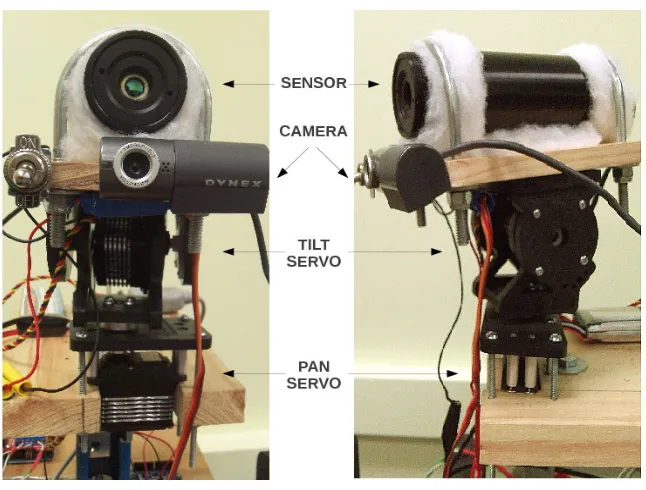
(typ-Figure 2.1: Remote breathing monitoring system. Front view (left) and profile view (right).
Another study applies the fundamental concept of human stress detection to the study of autism therapy [50]. The basic objective was to “teach” a robot to recognize physio-logical indicators of stress and determine when to respond with help. Stress tests were designed to produce physiological symptoms of stress and included activities such as play-ing video games, solvplay-ing anagram word puzzles and mathematical equations. Participants of the study were fitted with biofeedback sensors which measured heart rate variability, skin conductivity, eyebrow movement, jaw clenching, and body temperature. The sensors then relayed the information from the subject to a computer which communicated wirelessly with the robot.
While biofeedback sensors continuously collected physiological data, the robot moni-tored the anxiety level of the subject using wavelet signal processing to analyze the sensory data and indices correlating to a subject’s anxiety level were developed. These indices form the basis for building the robot’s control architecture, defining for the robot some threshold anxiety level which initiates a state change. The key to this approach includes designing an affective control architecture and creating rules by which the robot decides how to re-spond when the threshold anxiety level is reached. Ultimately, the robot learned to make choices between response options such as protecting itself, moving toward a human to offer assistance, or sounding an alarm.
Remote Stress Detection
Remote breathing detection can be used in many applications when it is important to mea-sure changes in breathing rate but it is not practical to attach sensors or receive frequent feedback from the user. One of the first published works which measures breathing rate re-motely uses an active radar detector to measure movements of the chest caused by cardiac and breathing events [56]. Since then, other non-contact modalities have been explored in-cluding laser doppler vibrometry (LDV) and mid-wave infrared video cameras. The LDV study remotely collected physiological information to deduce the stress state of an individ-ual based on vibrations of the skin directly covering the carotid artery [53]. The objective of the study was to obtain useful physiological information such as that provided in an elec-trocardiogram (ECG) by directing a laser beam at exposed skin. However, two significant limitations posed by this approach include the challenge of tracking accurately caused by variances in physiology and the prohibitive cost of the equipment used.
The biomedical engineering field has published a great deal of research dedicated to the acquisition of a wide variety of physiological information. One recent study uses a mid-wave infrared camera to capture breathing rate based on air temperature changes near the nasal region [57]. This particular implementation was initially designed for polysomnog-raphy, or sleep studies, and relies initially on the manual identification of a primary region of interest, tracking the location of the nostrils and, more specifically, the outer extent of the nostril region. Because of the large amount of image and data processing required and the small size of the nostril location to be tracked, segmentation becomes challenging and computationally expensive.
C
HAPTER
3
I
NTERACTIVE ROBOT
It is widely known that the incidence of autism has been increasing over the last decade, with some reports citing a 57% increase in autism prevalence between 2002 and 2006 [7]. Two of the most significant problems stemming from the increased prevalence of autism are the additional strain placed on existing resources for treating children with ASD and the additional financial strain placed on families who care and seek treatment for their chil-dren. The costs associated with additional therapy, specialized and medical care for a child with ASD are estimated to be approximately 8.5 to 9.5 times more than raising a typically developing child [58]. For some families, this additional financial burden may mean hav-ing to choose between incurrhav-ing significant debt in order to get the proper care for their child(ren) or limiting the amount of therapy their child receives. Although several existing robots have been used with children with ASD, they are still generally cost prohibitive for widespread use by special education instructors and therapists.
Figure 3.1: CHARLIE. [left] Completed robot. [right] Internal structure.
to developing an appropriate testing protocol.
3.1
M
ETHODOLOGY ANDA
PPROACHThe physical design of CHARLIE addresses three major objectives. First, the outward ap-pearance of the robot was designed to be toylike and pleasant so as to invite the attention of young children with ASD and avoid being intimidating to the greatest extent possible. Second, we carefully designed the robot structure so as not to allow the robot, nor its con-stituent parts, to harm the child interacting with it. Third, we made the robot more robust by adding features to protect its mechanical components and allow children to explore and interact more freely with the robot without excessive concern for the physical integrity of the robot.
social skill. For children who are reluctant to play with a completely autonomous robot or for those who would benefit from a period of exploration before they begin playing the interactive games, the robot can be teleoperated using a simple remote control. For those who are ready to play directly with the robot, but who are not necessarily ready to play a co-operative game with another child, the single-player interactive game is available. Finally, a two-player interactive game was created to appeal to those children who have established some level of simple imitation and turn-taking but could use more practice with these skills using the robot as a social mediator.
3.2
P
HYSICAL DESIGNWe deliberately designed the outward appearance of CHARLIE with the end-user in mind. Recent research has shown that robots with a simple interface are generally better received initially by children with autism, than robots with a more realistic, human-like appearance [59]. The implication is that low-tech robots, when designed appropriately for the particular needs of the child(ren) with ASD they will serve and the context in which they will be used, can be used effectively to teach and promote social skills. In addition to the low-cost design, CHARLIE’S physical appearance is intended to be toylike to create a friendly and approachable outward appearance and to more easily attract the attention of a child.
Basic hardware components
Figure 3.2: [top] Snap off arm. [bottom] Snap off head.
in order to provide optional auditory instructions for playing interactive games and positive feedback. Exclusive of the computing hardware, the retail cost of the robot’s components is approximately $200 USD. In a production version of this robot, a computer could be integrated into the robot’s body, or users could connect via USB to a standard laptop or desktop PC.
Features for robustness and safety
off. Furthermore, allowing the arms and head of the robot to detach, affords the child more continuous free play since there will be less concern over the child’s safety and the integrity of the robot’s hardware. As described in the IROMEC study [37], while the adult must fulfill a more active role for promoting play skills with children with ASD, “much of the literature on childhood play emphasizes the importance of free play and the need to interfere as little as possible in the child’s actions, thus underscoring the creative aspects that in essence cannot be controlled or oriented.” We expect that longer, uninterrupted interactions will maximize the opportunity for each child to benefit from each session.
3.3
I
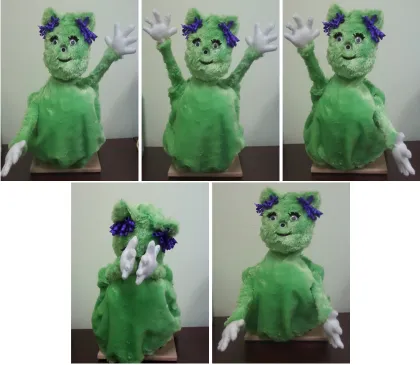
NTERACTIVE SOFTWARE DESIGNFigure 3.3: CHARLIE poses. From top to bottom, left to right : Left hand high. Both hands high. Right hand high. Peek-a-boo. Neutral.
Face detection and tracking
Figure 3.4: Face and hand detection.
face or hand by summing the pixels contained within the rectangle and determining whether it matches the characteristics of the target object as defined by the classifier.
Figure 3.5: Sample images used to train the hand detector. [top] Positive examples. [bot-tom] Negative examples.
Whereas face detection is a well-studied problem [63, 64], and effective face classi-fiers are freely available through OpenCV, robust and real-time hand detection in diverse environments is a topic of continuing research.
Hand classifier and hand detection
To create additional positive training samples representing variations in lighting, rotation and scale, ten distortions were applied to 100 of those samples, yielding a total of approx-imately 1750 positive hand samples. The resulting vector files were then merged and the AdaBoost training procedure was initiated using the combined vector file representing all positive hand samples and the complete set of negative samples.
Interactive game design
Research in robot-assisted autism therapy typically emphasizes specific objectives for ideal human-robot interaction including an increased attention span, eye contact, proactive in-teraction with the robot initiated by the child, verbal and non-verbal cues, turn-taking, imitative game playing and overall use of language.
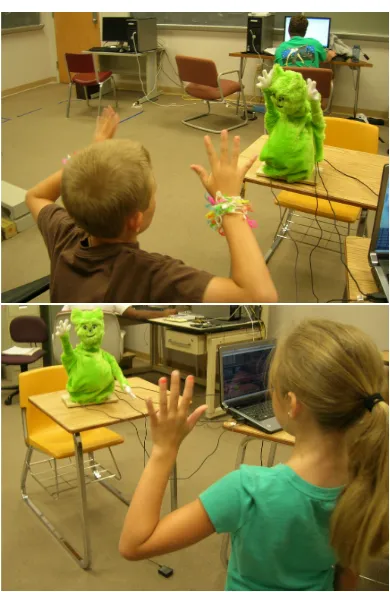
First, we defined the play scenario in terms of: (1) a main target group, (2) a play type, (3) actors involved, (4) a setting, and (5) the duration of the play activity. The main target group consists of a small group of children ages 4 to 11 who have been diagnosed with autism and have documented communication deficiencies. The play type consists of a very simple game of imitation with a basic set of rules and is designed to engage one teacher or one child at a time. The tests take place in a closed classroom, where both the child and teacher are seated across from the robot and the robot will be seated atop and securely attached to a nearby desk so that the robot’s head is at approximately the same height as the child’s. The duration of the play activity is variable. The length of a typical session with the robot is based on the normal amount of session time allotted for that particular child, the perceived benefit of the robot to the child’s development and the child’s interest in the robot.
teacher introduces CHARLIE and explains and/or demonstrates how to play the imitation game. The teacher then invites the child to play with robot and provide guidance, when necessary. For children who prefer to examine the robot and learn about its capabilities independently, the teacher assumes a more passive role, as an observer and guide.
Third, we identified measures of success using the baseline communication skills iden-tified prior to the child’s first session. Initially, the child’s level of interest in CHARLIE is noted in addition to any specific robot characteristics that are especially interesting to the child. During each session, communication between the child and robot, and the child and teacher is documented by the teacher or researcher (the author). Because the robot measures successful imitations between the robot and child it is not necessary to document these interactions, but other nonverbal and verbal communication occurring during the ses-sion is noted for subsequent analysis. Measures of success and user information collected during an interactive game can be used to assess the child’s readiness for more advanced, child-initiated games such as collaborative group play and story-telling.
Ultimately, we designed and implemented two additional interactive games to appeal to children with ASD of a wider range of ability and skill. The original game developed is a single-player game which engages a child in a game called “Imitate Me, Imitate You”. In this game, the child may either initiate a pose for the robot to imitate (“Imitate Me”) or the child may follow the robot’s pose (“Imitate You”). The single-player game is intended for the child with ASD who is comfortable interacting with an autonomous robot but who may not be ready for turn-taking with another child.
Single-player “Imitate Me, Imitate You”
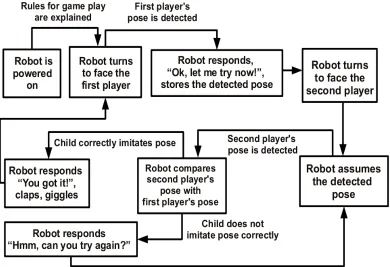
Figure 3.6: State diagram for CHARLIE’s “Imitate Me, Imitate You” autonomous interac-tive game.
default robot state is the passive game mode. Once the robot detects and begins tracking the child’s face and hands, the robot indicates that it is ready to interact by moving to the neutral pose and blinking the LEDs in its hands three times. The robot then immediately enters the passive game mode and waits for the child to initiate a game by raising one or both hands. As the child’s hand movements are detected, the robot responds by imitating the child’s hand positions and lighting the LED in the corresponding hand while simultane-ously detecting any additional hand movements. If ten seconds elapse without any detected hand movement, the robot will transition to the active game mode.
Figure 3.7: State diagram for CHARLIE’s “Pass the Pose” autonomous interactive game.
raised hand or hands of the imitated pose. As with the passive game mode, the robot will wait ten seconds for the child’s response. If ten seconds elapse and a positive response has not been detected, the robot will transition back to the passive game mode, waiting again for the child to initiate a new game.
Two-player “Pass the Pose”
me try”, turns to the second player (seated to the left of the robot), asks the child to follow her and then assumes the same pose learned from the first player. If the second player successfully imitates the pose assumed by CHARLIE, she responds by saying “You got it!”, claps her hands and giggles. If the player does not immediately imitate the correct pose, CHARLIE will ask the child to try again. If the child does not correctly assume the pose after three tries, the robot asks the current player to initiate a new pose and the game continues, this time with the second player initially “passing” the pose to the robot.
If the sound is disabled, we expect that the teacher, therapist or parent will describe how to play the “Pass the Pose” game. When the players are ready the teacher will start the game and CHARLIE will turn to the first player and wait for the child to assume a pose. Once CHARLIE has detected the pose, she turns to the second player and assumes the same pose. If the child correctly imitates the pose, CHARLIE claps her hands and waits for the second player to initiate the next pose. If the second player does not correctly imitate the pose, CHARLIE lowers her head and shakes it slowly from side to side. Should the child fail to imitate the pose correctly after three tries, CHARLIE resumes a neutral position and waits for the second player to start a new game. This two player game is ultimately designed to promote shared attention and cooperative play. We anticipate that the “Pass the Pose” game will be most useful for children who have already demonstrated some level of proficiency with turn-taking and imitation and who are able to play a game with a simple set of rules.
Teleoperation

![Figure 3.2: [top] Snap off arm. [bottom] Snap off head.](https://thumb-us.123doks.com/thumbv2/123dok_us/8479548.1390676/50.612.154.461.68.257/figure-top-snap-off-arm-bottom-snap-head.webp)
![Figure 3.5: Sample images used to train the hand detector. [top] Positive examples. [bot-tom] Negative examples.](https://thumb-us.123doks.com/thumbv2/123dok_us/8479548.1390676/54.612.96.518.68.277/figure-sample-images-detector-positive-examples-negative-examples.webp)