ISSN(Online): 2319-8753 ISSN (Print): 2347-6710
I
nternational
J
ournal of
I
nnovative
R
esearch in
S
cience,
E
ngineering and
T
echnology
(A High Impact Factor, Monthly, Peer Reviewed Journal)
Visit: www.ijirset.com
Vol. 7, Issue 4, April 2018
Production of Biodiesel from Algae for
Alternative Fuel as Diesel
Muragesh Bellad
1, Raghavendra Tevari
2, Rakesh B V
3, Swamith K B
4, Avinash Patel K L
5U.G. Student, Department of Civil Engineering, STJIT Engineering College, Ranebennur, Karnataka, India 1,2,3,4
Asst. Professor, Department of Civil Engineering, STJIT Engineering College, Ranebennur, Karnataka, India5
ABSTRACT:Naturally occurring algal samples were collected from the Baathilake in Davangere. Algae were tested in the microbes testing lab as green algae Pithophora, oil was extracted from dried algal samples and their physicochemical properties such as FFA, density, flash point, fire point, viscosity test were analysed. It concluded that algae can be used as source for the alternative fuel as diesel for the production of biodiesel.
KEYWORDS: Biodiesel; Alternative fuel; Algae fuel; Pithophora fuel.
I. INTRODUCTION
India is growing demand for petroleum based fuel has created challenges for the country’s energy security, as almost
90% of its crude oil requirement is imported from oil producing countries. Increasing demand in transport fuel will eventually lead to the complete depletion of fossil fuel which has led to the discovery of many alternative energy sources. Presently, biodiesel is produced from different crops such as Soybean, sunflower, palm, coconut, etc., there will be certain limitations in the use of these oils as alternative fuels because of its food demand, life span, lower yield/ha, higher land usage.
ASTM International (originally known as the American Society for Testing and Materials) defines biodiesel as a mixture of long-chain mono-alkaylic esters from fatty acids obtained from renewable resources, to be used in diesel engines.Blends with diesel fuel are indicated as ‘‘Bx’’, where ‘‘x’’ is the percentage of biodiesel in the blend.Biofuels are a wide range of fuels which are derived from biomass. The term covers solid biomass, liquid fuels and various biogases. Biofuels are gaining increased public and scientific attention, driven by factors such as oil price hikes and the need for increased energy security.
Affordable energy contributes to rise in productivity, reduction in poverty and improving betterment of life. Reduction in the availability of fossil fuel with a raising fuel demand causing global worry. Biodiesel has gained much attention in recent years due to its eco-friendly nature, non-toxic characteristics, biodegradability and lower net carbon cycle compared to conventional diesel fuels. Algae possess self-contained oxygen and hence complete combustion of derived fuel in the engine cylinder is possible.
The lake or saline water which contain more amount of impurities like carbon, phosphorus, sulphur etc. with efficient 8
to 10 hours of sunlight and average atmospheric temperature of 20oC to 28oC cause favourable condition for the algae
to mature faster. Like plants, algae require primarily three components to grow such as sunlight, carbon-dioxide and water, some bacteria present in algae convert sunlight energy to chemical energy.
ISSN(Online): 2319-8753 ISSN (Print): 2347-6710
I
nternational
J
ournal of
I
nnovative
R
esearch in
S
cience,
E
ngineering and
T
echnology
(A High Impact Factor, Monthly, Peer Reviewed Journal)
Visit: www.ijirset.com
Vol. 7, Issue 4, April 2018
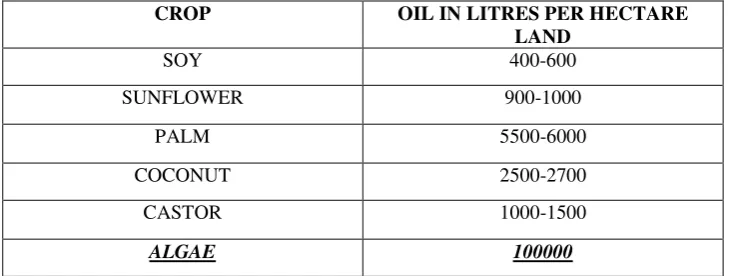
Table 1: Comparison of different crops with oil yielding and land required. CROP OIL IN LITRES PER HECTARE
LAND
SOY 400-600
SUNFLOWER 900-1000
PALM 5500-6000
COCONUT 2500-2700
CASTOR 1000-1500
ALGAE 100000
The table 1 shows oil yielding capacity of different crops per hectare of land will be less than the oil obtained from the algae species which grows under good optimal environmental conditions on the same hectare of land.
Pithophora
Pithophora is a genus of filamentous single-cell green algae belonging to the division Chlorophyta. Pithophora is a common mat forming species grows on under or surface of water, commonly referred to as horsehair algae. It is long visible threads in shape and is without flagella. Pithophora contains the green photosynthetic pigments chlorophyll-a and chlorophyll-b in its chloroplast. It may range colour from dark green or greenish-yellow. Through photosynthesis, it multiplies rapidly, requiring only carbon dioxide, water, sunlight, and a small amount of minerals to reproduce. The taxonomy of Pithophorais show in Table 2. Pithophora is greenish-yellow microalgae.
Table 2: Taxonomy of Pithophora
Taxonomy Pithophora
Family Pithophoraceae
Kingdom Plantae
Division Chlorophyta
Class Ulvophyceae
Order Cladophorales
Genus Pithophora
Species Pithophora
The Pithophora is a genus of green algae in the family Pithophoraceae. This Pithophora species comes under a kingdom Plantae having division Chlorophyta of class Ulvophyceae and order Cladophorales.
II. LITERATURE REVIEW
Alpesh Mehta, Dr. Nirvesh Mehta et al., (Aug. 2015): They conducted an experimental investigation on the topic
“ALGAE BIOFUEL: FUTURISTIC TRENDS IN FUEL INDUSTRY”. This research paper talks about energy from
ISSN(Online): 2319-8753 ISSN (Print): 2347-6710
I
nternational
J
ournal of
I
nnovative
R
esearch in
S
cience,
E
ngineering and
T
echnology
(A High Impact Factor, Monthly, Peer Reviewed Journal)
Visit: www.ijirset.com
Vol. 7, Issue 4, April 2018
Mukesh Kumar et al., (June 2014): They conducted an experimental investigation on the topic “STATUS OF BIO
FUEL PRODUCTION FROM MICROALGAE IN INDIA”. The availability of micro algal species, their advantages,
oil productivity, land requirement of bio diesel production.
Shalini Rajvanshi, Mahendra Pal Sharma et al., (Sept 2012): They conducted an experimental investigation on the
topic “MICROALGAE: a POTENTIAL SOURCE OF BIODIESEL”. The micro algae are considered as one of the
most promising feed stocks for future biodiesel production in India. The advantages of microalgae are their widespread availability, higher oil yields and reduced pressure on cultivable land.
Vandana Pathak et al., (February 2015): They conducted an experimental investigation on the topic “ALGAL OIL
PRODUCTION: RESEARCH PAPER”. Algae were identified in the botany lab as green algae Pithophora, spirogyra,
oil was extracted from the all the three dried algal samples.paper it is concluded that the algal oil can be used as a potential source of biofuel for the production of biodiesel.
III. METHODOLOGY
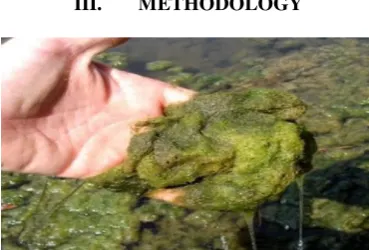
Fig 1: Algae sample collected from Baathilake and surroundings.
The algae sample was formed thick film on or under the surface of the water which have been collected by using net. Since it was grown on the shallow water surface of lake. This kind of filamentous algae has a coarse texture to it hence often referred to as horse hair.The algae samples (Fig 1) were collected from Davangere district of Baathilake and surrounding places, Karnataka state, India. The algae bloom was formed as thick mat on the surface of water.
Step 1:Extraction of parent oil from algae:
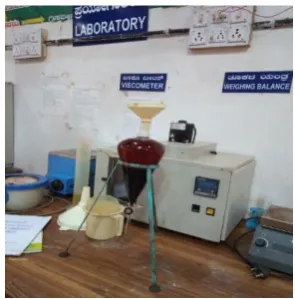
Fig 2: Extraction of algae oil from mini oil expeller.
ISSN(Online): 2319-8753 ISSN (Print): 2347-6710
I
nternational
J
ournal of
I
nnovative
R
esearch in
S
cience,
E
ngineering and
T
echnology
(A High Impact Factor, Monthly, Peer Reviewed Journal)
Visit: www.ijirset.com
Vol. 7, Issue 4, April 2018
Step 2:Calculation of Free Fatty Acid present in oil. a) Preparation of 0.1N NaOH Solution.
Open the NaOH container and weigh about 4 grams of NaOH using weighing machine.
Measure 1 litre of distilled water into one litre standard flask.
Using a glass rod to break the NaOH flakes and dissolve it by constant and uniform stirring.
b) Titration and calculation of Free Fatty Acid content in parent oil.
Take 25ml of 0.1N NaOH solution prepared (in step 2a)transfer into a clean and dry burette.
Take 50ml of Isopropyl alcohol in a clean and dry 250ml conical flask and then add 10gm of parent
oil to flask.
Add few drops of NaOH solution to the above flask and shake well.
Heat the above mixture to about 60oC.
Titrate against 0.1N NaOH from the burette.
Titrate and shake the conical flask mixing the mixture vigorously but uniformly until a faint pink
colour is obtained. Take burette reading.
FFA content= . r a a H T ra a
=
. 𝑥 . 𝑥 . = 3.63%
Step 3: Production of Biodiesel
a) Measure 500ml of oil.
Fig 3: Oil heating in 3-neck flask.
b) Transfer the oil into a 3- neck flask (as shown in fig 3).
c) Place the 3-Necked flask on Magnetic stirrer.
d) Fix the reflux condenser to the central neck of 3- neck flask.
e) Connect the water pipe line to condenser for water circulation from tap to condenser to outlet.
f) Switch on the Magnetic Stirrer switch.
g) Setup the heating control to 60o.
h) Adjust the speed between 600-800rpm to get homogenous heating of the oil.
i) Take 150ml methanol per 500ml of oil.
j) Weigh the required NaOH based on the FFA% determined earlier for the raw oil and add methanol.
Stir well and this mixture is called Methoxide mixture or Fatty Acids Methyl Esters (FAME).
k) When the temperature reaches 63oC(Boiling point of Methanol is 64.07oC), add the Methoxide
mixture slowly to the hot oil into the 3-neck flask and maintain 600rpm.
l) Transesterification process (as shown in Fig 6) takes place after adding methanol and NaOH to the
parent oil.
m) Run the process for 30 minutes and observe the colour of the mixture turns from turbid orange to transparent chilly red.
n) After the first 30 minutes drain a sample and allow it to settle.Two distinct layer will be obtained.
ISSN(Online): 2319-8753 ISSN (Print): 2347-6710
I
nternational
J
ournal of
I
nnovative
R
esearch in
S
cience,
E
ngineering and
T
echnology
(A High Impact Factor, Monthly, Peer Reviewed Journal)
Visit: www.ijirset.com
Vol. 7, Issue 4, April 2018
p) After 1.5 hours, observe for glycerine separation.
q) Transfer the mixture into a separating funnel and allow to settle for 2 hours.
Fig 4: Separation of biodiesel and glycerine.
r) After 2 hours, Glycerine will settle at the bottom and Biodiesel separates as top layer (Fig 4).
s) Transfer biodiesel into the reaction vessel which is set at temperature 70oC to evaporate the methanol.
t) Then cool the biodiesel and collect methanol condensate.
Fig 5: Washing of Biodiesel with water.
u) Wash the biodiesel using warm water(40oC) slowly for 15 minutes. Repeat this procedure until the pure water drains (Fig 5).
v) Heat the biodiesel to a temperature of 100oC to evaporate the moisture present in it.
w) Allow the biodiesel to cool gradually to get pure Biodiesel.
ISSN(Online): 2319-8753 ISSN (Print): 2347-6710
I
nternational
J
ournal of
I
nnovative
R
esearch in
S
cience,
E
ngineering and
T
echnology
(A High Impact Factor, Monthly, Peer Reviewed Journal)
Visit: www.ijirset.com
Vol. 7, Issue 4, April 2018
The algae oil extracted sometimes called parent oil or triglyceride. Parent oil used in making biodiesel consists of triglycerides in which three fatty acid molecules are connected with carbon-carbon chain. In making biodiesel, triglycerides are reacted with methanol in a reaction known as transesterification or alcholysis. The reaction occurs stepwise: Triglycerides are converted to Methyl-esters (Biodiesel) and Glycerol.
Where R1, R2, R3 are
Long chain hydrocarbons as shown in Fig.7
Fig 7: Long chain hydrocarbons.
The long chain hydrocarbons consist of bond between carbon-carbon or carbon-hydrogen in the form of a long chain with carboxylic group and ester group present in the reaction.
IV. TEST RESULTS AND DISCUSSION
Table 3: Comparison of properties of microalgae biodiesel with diesel Properties Biodiesel from
microalgae oil
Diesel fuel
Density (kg. L-1) 0.862 0.838
Flash point (oC) 140 60
Fire point(oC) 160 68
Viscosity at 40oC (mm2/s)
4.8 1.3-4.1
The table 3 shows the properties of the biodiesel from microalgae oil is higher than the Diesel fuel. It means Biodiesel can be used as a fuel for diesel engines with or without modification.
V. CONCLUSION
The microalgae are considered as one of the most promising feedstocks for future biodiesel production in India. Algae specie (Pithophora) was successfully used as a raw material for biodiesel production. The process involved two steps:
Oil extraction and transesterification. After the treatment of the raw materials, the transesterification reaction (usually
with methanol and a basic catalyst) produces a mixture of fatty acids methyl esters (FAME) with glycerine as a co-product. As algae is renewable source of energy. Under optimal conditions, algae mature within 18 to 20 hours (daily production is possible for oil).The production process has the same stages, irrespective of the production scale,
although the differences in equipment may be significant.As compared to the food products algae is available
worldwide. Microalgae make use sunlight and CO2 for their growth and give higher oil productivity more than
ISSN(Online): 2319-8753 ISSN (Print): 2347-6710
I
nternational
J
ournal of
I
nnovative
R
esearch in
S
cience,
E
ngineering and
T
echnology
(A High Impact Factor, Monthly, Peer Reviewed Journal)
Visit: www.ijirset.com
Vol. 7, Issue 4, April 2018
REFERENCES
1. Antonio Jose de Jesus de San, Juan Bosco Echevarria Parres, “Process and Apparatus for Extracting Biodiesel from Algae”, United states Patent Application Publication, US2011/0189741 A1, Aug 4, 2011.
2. Bhaskar Singh, Abhishek Guldhe, Ismail Rawat, Faizal Bux, “Toward sustainable approach for development of biodiesel from plant and microalgae”, published in journal of Renewable and Sustainable Energy Reviews29, 2010, pp216.
3. B. Wang, Y. Li, N. Wu and C. Lan, “CO2 Bio-Mitigation Using Microalgae,” Applied Microbiology and Biotechnology, Vol. 79, No. 5, 2008, pp. 707-718. Canakci M and Van Gerpen J. 2001. “Biodiesel production from oils and fats with high free fatty acids”. Transactions of the ASAE. 44: 1429-1436.
4. D. C. Nielsen, “Oilseed Productivity under Varying Water Availability,” Proceedings of 20th Annual Central Plains Irrigation Conference and Exposition, Akron, 1 January 2008, pp. 30-33.
5. Hanna MA. 1999. “Biodiesel production: a review. Bio resource Technology”. 70: 1-15. National Biodiesel Board.
6. K. Cenciani, M. C. B. Oliveira, B. J. Feigl and C. C. Cerri, “Sustainable Production of Biodiesel by Microalgae and Its Application in Agriculture,” African Journal of Micro- Biology Research, Vol. 5, No. 26, 2011, pp. 4638-4645.
7. Kumar Mukesh, Sharma M.P., Dwivedi Gaurav, “Algae Oil as Future Energy Source in Indian Perspective”, International Journal of Renewable Energy, Vol.3, No.4, 2013, pp13-921.
8. L. C. Meher, V. S. S. Dharmagadda and S. N. Naik, “Optimisation of Alkali-Catalysed Transesterification of Pongamia pinnata Oil for Production of Biodiesel,” Bio resource Technology, Vol. 97, No. 12, 2006, pp. 1392- 1397.
9. Mahesh Kumar, M P Sharma, Gaurav Dwivedi,’ Algae Oil as a Future Energy Source in Indian Perspective’, published in international journal of renewable energy research, voulme3, no.4, 2013,pp 913-921.
10. Rajvanshi Shalini, Mahendra Pal, “Microalgae: A Potential Source of Biodiesel”, http://dx.doi.org/10.4236/jsbs.2012.23008, Journal of Sustainable Bioenergy Systems, 2012, 2, 49-59.
11. Sayadi M.H., Ghatnekar S.D., Kavian M.F., Article on “Algae a promising alternative for biofuel”, Proceedings of the International Academy of Ecology and Environmental Sciences, 2011, 1(2): pp-112-124.