ISSN(Online): 2319-8753 ISSN (Print): 2347-6710
I
nternational
J
ournal of
I
nnovative
R
esearch in
S
cience,
E
ngineering and
T
echnology
(An ISO 3297: 2007 Certified Organization)
Website: www.ijirset.com
Vol. 6, Issue 7, July 2017
Estimation of Defocus Blur from a Single
Image for High Quality Image Processing
Pallav Parmar, Afreen Hussain and Pallavi Sharma
M. Tech. Scholar, Department of Electronics and Communication, SIRT, Bhopal, India
ABSTRACT: Defocusestimation is an important part in high quality image processing, which includesedge detection, image deblurring,and measuring imagequality.Wrong lens setting or shallow depth of fieldwhich would produce defocus blur. Defocus blur is most of the times present in natural images.In this paper we have discussed some of the methods likelocal contrast prior, defocus magnification and spectrum contrast forestimating the defocus blur map.
KEYWORDS: defocus, deblurring, depth of field, defocus magnification
I. INTRODUCTION
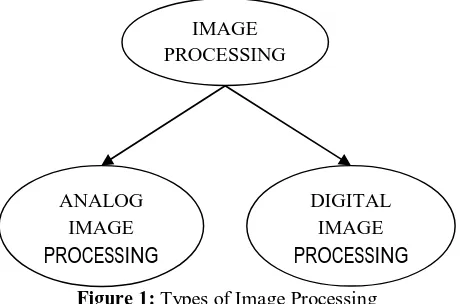
Defocus is the phenomenon in which image is out of focus and it reduces the sharpness and contrast of image. Signal processing is a field in electrical engineering and in mathematics that deals with examine and processing of signals that is analog and digital signal and also deals with storing,filtering, and some other operations on signals. These signals involves transmission, sound or voice , image signals .From these the field that deals with the type of signals in which the input is taken as image and the output is also an image is done is image processing. As itsuggests, it works with the processing on images.Image processing in which images are to be analyzed and acted upon by peoples. It can be further divided into analog image processing and digital imageprocessing.
Figure 1: Types of Image Processing
Analog processing is basically done on analog signals. This includes processing on two dimensional analog signals. In this type of processing in which the images are changes by electrical means by varying the electrical signal.Example include is the TV image. Digital image processing has different impact over analog image processing with the passing of time due its wide range of applications. The digital image processing works with developing a digital system that performs operations on a digital image. Within the field of image processing it includes image restoration, image magnification and image compression. Most of the image processing technique involves the image as a two-dimensional signal. These are the method to convert an image into digital form and perform some process on it, so that we can get an intensified image or to obtainsome useful information. This is a type of signal dispensation in which input is image, like
IMAGE PROCESSING
DIGITAL IMAGE
PROCESSING
ANALOG IMAGE
ISSN(Online): 2319-8753 ISSN (Print): 2347-6710
I
nternational
J
ournal of
I
nnovative
R
esearch in
S
cience,
E
ngineering and
T
echnology
(An ISO 3297: 2007 Certified Organization)
Website: www.ijirset.com
Vol. 6, Issue 7, July 2017
video frame or photo and output may be image or characteristics related with that image.The process in which by applying degradation models and restoration of image is done to its original form. Image restoration is the field in image processing used in the field of photography or where the image by some means is degraded but needs to be improved before it can be printed. Image enhancement is the field in image processing in which by taking the benefits of human visual systems response we take animage and improving it’s visually. One of the simplestenhancement techniques is to simply change the contrast of an image.Enhancement techniques lead to be problem specific. Moreover enhancement and restoration are similar in achieving goal, to make an imagelook much better. They differ in manner that how they reaches the problem. Restoration method try to model the distortion to the image and apply reverse thedegradation, where enhancement technique use knowledge of the human visual systems responses to intensify an image visually. Image compression is the field in image processing which involves reducingthe typically large amount of data or information needed torepresent an image. This done by eliminating data that are notrelevant and by taking benefit of the redundancy that is inherent in images. Image processingbasically includes three stepsimporting the image with optical scanner or by digital photography.Examine and manipulating the image which involves data compression and image enhancement. Output is the last stage in which result can be altered image or report that is based on image analysis. The motives of image processing areVisualization that is Observe the objects that are not visible, Image sharpening and restoration means to create a better image.Image retrieval means Seek for the image of interest.Measurement of pattern that measures various objects in animage.Image recognition which distinguish the objects in an image. An image gives visual representation of a physical object. In an ideal case, each small point within the object will denoted by a small, well-defined point within the image. The "image" of each object point is spread, or blurred, within the image in reality.
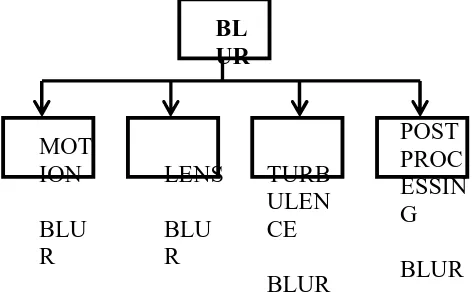
Figure 2: Blur Classification
Image blur can be generally categorized into fourgroups: motion blur, lens blur, turbulence blur andpost processing blur.Camera or object movement during the exposure period causes motion blur. This phenomenon is common especially for digital cameras.Wrong lens setting or shallow depth of field would produce defocus blur, which is an important kind of lens blur. Besides, even if thescene is perfectly in focus and no matter how well the lens is corrected, in most opticalimaging systems there always exists a fundamental resolution limit .commonly used camerasadd an anti-aliasing filter into the lens system to remove high-frequency componentsbeyond the Nyquist limit of the digital camera sensor. Such kind of blur can actually improve the visual quality of captured images. For long-distance imaging systems (such as ground-based astronomical imagingsystems) atmospheric instability, causes change in refractive index in theoptical transmission path and which damages light wave front, can badly affect the image quality. Disturbance of other media also have similar kind of effectsand which degrade the performance of related imaging systems. Generallydisturbance in the transmission medium produces twomajor distortions: geometrical deformation and blur, where both are temporally andspatially changing.Removing such effects is significant for manyapplications and hence it is quite challenging.Post processing methods are denoising, deblurring, super-resolution canalso introduce blur mostly are used to intensify the
ISSN(Online): 2319-8753 ISSN (Print): 2347-6710
I
nternational
J
ournal of
I
nnovative
R
esearch in
S
cience,
E
ngineering and
T
echnology
(An ISO 3297: 2007 Certified Organization)
Website: www.ijirset.com
Vol. 6, Issue 7, July 2017
image quality. Denoisingfilter is used to reduce noise level but it also produces blur as side effect while smoothing the input image.Andif the filter is spatiallyinvariant, like a Gaussian filter, then the blur is uniform.
II. LITERATURE REVIEW
In [1] proposed that Camera shakes during exposure May causes to objectionable image blur and damage photographs. Conventional blind deconvolution techniques rarely assume frequency-domain parameters on images for the motion path while camera shake. Real camera motions can follow up the convoluted way and spatial domain prior can better retains visually image characteristics. They introduce a method to remove the effects of camera shake from blurred images. This method assumes that a uniform camera blur over the image and also negligible in-plane camera rotation. In order to calculatethe blur from the camera shake, the person must specify an image region without saturation effects. They showed results for a wide variety of digital photographs which are taken from personal photo collections.
In [2] presented the image processing technique in which defocus magnification is used to perform blur estimation. To maximize defocus blur caused by lens aperture by taking a single image then estimate the size of blur kernel at edges and further they spread this technique to the whole image. In this approach multi scale edge detector is used and model fitting that obtain the size of bur propagate the blur measure by assuming that blurriness is smooth where intensity and color are approximately similar. Using defocus map, they enhance the existing blurriness, which means that blur the blurry regions and keeping the sharp regions sharp. In contrast to more difficult issues such as depth from defocus,they do not need precise depth estimation and do not need to disambiguate texture less regions.The method models changes in energy at all frequencies with blur and not just very high frequencies (edges).
In [3] Blind deconvolution is the restoration of a sharp version from a blurred image when the blur kernel is not known. Most algorithmshave dramaticprogress; still many aspects of the problem remain challenging and difficult to understand. The goal of this method is to analyze and evaluate blind deconvolution algorithms both theoretically as well as experimentally. They had also discussedthe failure of the MAP approach.
In [4], they show that noticeable blur is generated due to the optical system of the camera, also with professional lenses. They introduce method to measure the blur kernel densely over the image and also across multiple aperture and zoom settings. It it’s shown that the blur kernel can have a non-negligible spread, even with top-of-the-line equipment. the spatial changes are not gradually symmetric and not even left-right symmetric .In this method two models of the optical blur are developed and compared both having advantages respectively. They showed that their models predict accurate blur kernels that can be used to restore images. They demonstrated that they can produce images that are more uniformly sharp then those images which produced with spatially-invariant deblurring technique.
In[5] Image defocus estimation is useful for several applications including deblurring, blur enlargement, measuring image quality, and depth of field segmentation. They proposed a simple effective approach for estimating a defocus blur map based on the relationship of the contrast to the image gradient in a local image region and call this relationship the local contrast prior. The advantage of this approach is that it does not need filter banks or frequency decomposition of the input image; infact it only needs to compare local gradient profiles with the local contrast. They discuss the idea behind the local contrast prior and shown its results on a variety of experiments. And it’s found that for natural in-focus images, this distribution follows a similar pattern. They verified this distribution by plotting the distribution of the LC in images suffered from different type of degradation. This prior is useful in estimating defocus blur, in segmenting in focus regions from depth-of-field image and in ranking image quality.
ISSN(Online): 2319-8753 ISSN (Print): 2347-6710
I
nternational
J
ournal of
I
nnovative
R
esearch in
S
cience,
E
ngineering and
T
echnology
(An ISO 3297: 2007 Certified Organization)
Website: www.ijirset.com
Vol. 6, Issue 7, July 2017
In [7] it is discussed that a shallow depth-of-field is rarely used in photos as a creative element. This comes at the high costof expensive and massive camera equipment, such as fast lenses and large sensor DSLR bodies. Incontradiction,Economical small-sensor cameras with fixed lenses normally show a larger depth-of-field than desire. In this case computational solution is suggesting, because a shallow depth-of-field cannot be achieved by optical means. OnePossibility is to algorithmically enhance the defocus blur which is already present in the image. Though current algorithmicSolutions tackling this problem which suffer from bad off performance due to the ill-sadness of the problem. The amountof defocus blur can be calculated at edges only uniform areas do not contain such kind of information. So, to magnify the defocus blur we need to know the amount of blur present at every pixel position in image. Calculating it requiressolving an optimization problem with many unknowns. They proposed a faster method to propagate the amount of blur from edges to entire image by make outthe optimization problem on a small scale, follow up by edge-aware up sampling by using the original picture as a guide.
In [8] present spectrum contrast approach which is more appropriate method for estimating defocus map from a single image. This method is inspired by the observation that in an image defocusing mainly affects the spectrumamplitude at the object edge only. By creating the relation between the quantity of spatially varying defocus blur and spectrum contrast at edgeLocations, they first find out the blur amount at the edge locations, then propagate the blur amount from edges to the entire image with a non homogeneous optimization procedure hence finding the blur map. The proposedmethod takes into consideration not only the affect of light refraction but also the blur texture of an image. Experimental results illustrate that our proposedmethod is much more reliable in defocus map estimation as compared to various methods.
In [9] proposed a new method for estimating PSF scale at each pixel in image.They presented an algorithm that estimating a defocus scale map from an image, which is used in conventional cameras. It also takes consideration in smoothness and color edge information to generate a coherent blur map that indicate the amount of blur at each pixel This estimation is based on local frequency component analysis.Smoothness parameters and image color edge information are also taken into consideration to generate a map that is smooth and meanwhile allows discontinuity in the boundary regions between objects. This algorithm does not depend on any specific PSFs model and is hence very commonly applicable. It is possible to implemented using any PSF model which is a function of a single parameter. It is capable of measuring theprobability of local blur scale byanalyzing the Gabor filtering spectrum.
III. RESULT ANALYSIS
Input images Estimated defocus blur maps Recovered in focus images
ISSN(Online): 2319-8753 ISSN (Print): 2347-6710
I
nternational
J
ournal of
I
nnovative
R
esearch in
S
cience,
E
ngineering and
T
echnology
(An ISO 3297: 2007 Certified Organization)
Website: www.ijirset.com
Vol. 6, Issue 7, July 2017
b (i) b (ii) b(iii)
Figure 3: Comparison of blur techniques by two methods in 3(a) by using defocus magnification and 3(b) by using local contrast prior
c(i) c (ii) c (iii)
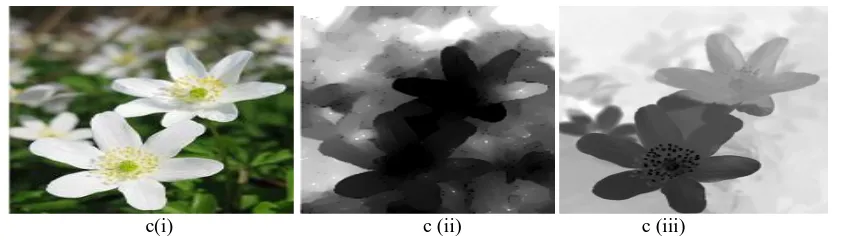
Figure 4: Herec (i) is taken as input image, c(ii) is the result obtained from defocus magnification and in c(iii) result obtained from spectrum contrast method
Here we have discussed some of the methods for estimating defocus map we have taken an input image then find out its blur map by various techniques and finally restores all in focus images. In Figure 3(a), S. Bae and F. Durand[2] show the results of using defocus map to magnify the current defocus effects in the original images. By seeing the result from resultant all in focus image which preservethe sharpness of focused regions but in contrast it is enhancing the blurriness of the out-of-focus regions.Figure 3(b), Yu-Wing Tai, Michael S. Brown [5] show their results for estimating defocus maps. It used the estimated defocus map to improve the quality of the images through deconvolution. After enhancement it can be see that mean value of the edge pixels LC’s is larger.And larger value indicates that image contain more sharp edges which indicate higher quality of image. The results are much better than the previous methods can be seen.In Figure 3(c),Chang Tang, ChunpingHou, and Zhanjie [8]compare its blur map from Bae and Durand blur mapc(ii) is the result of Bae and Durand and c(iii) is the result of Chang Tang, ChunpingHou, and Zhanjie andtheyconsidered the chromatic aberration caused due to wavelength-dependent variation of the index of refraction of lens to decrease the error of edge detection. Gaussian filter is used in orderto remove high-frequency noisebefore calculating spectrum contrast. This defocus map is more accurateand reliable compared to the results of other methods.
IV. CONCLUSIONS
ISSN(Online): 2319-8753 ISSN (Print): 2347-6710
I
nternational
J
ournal of
I
nnovative
R
esearch in
S
cience,
E
ngineering and
T
echnology
(An ISO 3297: 2007 Certified Organization)
Website: www.ijirset.com
Vol. 6, Issue 7, July 2017
Such distributions can be analyzed by using a Gaussian mixture model. Estimationaccuracy may be enhanced by incorporating this model in future.
REFERENCES
[1] R. Fergus, B. Singh, A. Hertsmann, S. T. Roweis,W. T. Freeman,” Removing camera shake from aSingleimage” in Proc. SIGGRAPH, 2006, pp. 787–794 .
[2] S. Bae and F. Durand, “Defocus magnification,”Comput.Graph. Forum, vol. 26, no. 3, pp. 571–579, 2007.
[3] A. Levin, Y. Weiss, F. Durand, and W. T. Freeman, “Understanding and evaluating blind deconvolutionalgorithms,” in Proc. IEEE CVPR, Aug. 2009, pp. 1964–1971
[4] Eric Kee, Sylvain Paris, Simon Chen, JueWang,“Modeling and removingspatially varying optical Blur”.
[5] Yu-Wing Tai, Michael S. Brown “single image defocus map estimation using local contrast prior ”in Proc. IEEE ICIP ,2009,pp.1797-1800. [6] A. Chakrabarti, T. Zickler, and W. T. Freeman, “Analyzing spatially varying blur,” in Proc. IEEE CVPR, Jun. 2010, pp. 2512–2519.
[7] F. Kriener, T. Binder, M. Wille, ‘’AcceleratingDefocus blur magnification," Proc. SPIE Vol.8667, March 18, 2013.
[8] Chang Tang, ChunpingHou, andZhanjieSong“Defocus map estimation from a single imageVia spectrum contrast’’,© 2013 Optical SocietOf America,Vol. 38, No. 10 / May 15, 2013.