An optimized Approach for Video
Watermarking to get Efficient Encryption
Maninder Kaur 1
Lecturer, Department of Electronics and Communication Engineering, Govt. Polytechnic College,
Khunimajra, Punjab, India1
ABSTRACT: A comprehensive approach for protecting and managing video copyrights with watermarking techniques is introduced. We propose a novel digital video watermarking scheme based on the scene change analysis and genetic algorithm. Robustness and fidelity are the essential requirements of a successful watermarking scheme. In previous work, a robustness scene-based watermarking scheme is proposed. We focus on improving the fidelity of the scheme in this paper. The fidelity of the scheme is enhanced by applying a genetic algorithm, which optimizes the quality of the watermarked video [3,6]. The effectiveness of this scheme is verified through a series of experiments. The watermark imperceptibility is calculated by PSNR, MSE, SSIM, BER, standard deviation and variance, obtaining sufficiently good visuality and the results from the proposed techniques are then compared with the existing technique
KEYWORDS: Digital Watermarking;; Discrete Cosine Transform (DCT); Structural Similarity Index Media(SSIM);Peak Signal to Noise ratio(PSNR);Bit Error Rate(BER)
I. INTRODUCTION
The runway footnote of the Internet in this era has rapidly increased the availability of digital facts such as audio, images as well as videos to the public. In spatial domain, image pixels are straightforwardly adjusted, that is, the pixel estimation of the image at the specific district is changed. They will be computationally less complex and simple to execute and likewise require less power. Execution of watermarking on Android stage in our work is a case of spatial domain technique for watermarking genuine time caught images. Frequency domain investigation includes the use of changes like DCT (Discrete Cosine Transform) and DWT (Discrete Wavelet Transform) to constant host. As we have discussed many of image watermarking algorithms are proposed on basis of spatial domain or transform based. But there are very limited algorithms which supports video watermarking so in this thesis a new approach for video watermarking is proposed. We propose a technique where video as media for watermarking is used for protection or copyright over internet by applying the Swarm intelligence algorithm which actually optimizes the location where the message is to be hidden. Thus, by creating a specific frame through optimization the information is much secured than before. We propose a technique where video as media for watermarking is used for protection or copyright over internet by applying the swarm intelligence algorithm which actually optimizes the location where the message is to b hidden. GA is used to find optimal location of embedding watermark in the video [1].
S.Aug et al[2] proposed a technique of optical crypto with adaptive steganography (AS) for audio and video sequence encryption as well as decryption. This technique is based on algorithm which is double random phase encoding so to encrypt and decrypt the audio and video sequences. The vital purpose of steganography algorithm is to hide as much information as watermark within the media as possible.
1.1 Overview of previous technique- DCT
The DCT domain allows a host signal (image or video) to be broken into distinct frequency bands, making it easier to embed watermark data into the middle frequency bands where these bands ignore the most visual vital parts of the host signal without overexposing themselves to remove through noise attacks and compression. The two dimensional DCT pair is given by
C(0,0)= ∑ ∑ ( , ) (1)
C(u,v) = ∑ ∑ f(x, y) [cos(2 + 1) ][cos(2y+1)v ] (2)
For u, v=1,2…N-1and IDCT is given by:
F(x,y)= C(0,0)+ ∑ ∑ ( , ) [cos(2 + 1) ][cos(2y+1)v ] (3)
Watermark extracted by DCT is not exactly what was embedded. After the extraction process in DCT technique watermark got dark due to addition of various noises during the embedding and extraction process of DCT technique which is the major drawback of this technique.
(a) (b)
Fig1 (a) original watermark, Figure1 (b) watermark extracted bye DCT
1. 2 Watermark embedding
The watermark signal Wi is directly embedded to the digital video sequence Vi in order to produce the watermarked video signal Vi
′:
1.3 Watermark extraction
The watermark can be extracted with or without using the original signal which is not watermarked. Extraction of the watermark without using the original signal that can be done by firstly high pass filtering the watermarked video sequence to remove the majority of the components of the video signal and generates a filtered watermarked video signal .The next step involves demodulation, where the watermarked video signal which is filtered is multiplied by the same pseudo noise signal Pi which was used for embedding. It continues by summation of window length with the chip rate and yielding the sum Sj for the Jth information or data bit [2].
=∑ (. ). P V =∑ P .
( ). V ……∑1
+ (5) ∑ (. ). P P .α …….∑2
Where the two terms defines as ∑1 and ∑2 represents the correlation sum of the filtered video signal and the filtered
watermark [2].
Let us assume that the sum ∑1 is zero. This means that the video signal has been filtered out in V and that
Pi.αi.bi ≈Pi.αi.bi Pi.ai.bi≈ (Pi.ai.bi ) ̅which implies that the high pass filtering has an ignorable impact on the white pseudo noise watermark signal. Under these suspicions, we have
∑1 +∑2≈ = . . (6)
Subsequently, s j is a computation of the inserted data bit in the video format:
sign( ) = ( . .cr) =sign( ) = (7)
II. PROPOSEDALGORITHM–GENETICALGORITHMBASEDWATERMARKING
evolutionary computation, GA is a vital enhancement method [9]. Here we utilize this procedure to upgrade the execution of our proposed plan.
2. 1 Steps of Data Encoding
[1] Selection a Video for data encryption and select the watermark image [2] Calculate the high visuality of each frame.
[3] Selection of four video frames which has high visuality. [4] Find out the location for data hiding with the Genetic algorithm. [5] Selected watermark image dividing into no. of blocks.
[6] Divided blocked image also divide into four subsections According to frames [7] Now embed the watermark into selected frames.
[8] Data hiding into iterative process. [9] Create final video.
2.2 Steps of data decoding
[1] Select encrypted video for extraction the information from the video. [2] After selection of video select the frame which has watermarked embedded. [3] Then extract pixel information from the video no. of frames.
2.3 Genetic operators
The beginning chromosomes are produced with the above detail. At that point, the genetic algorithmic administrators are applied to the chromosomes for streamlining with the fitness capacity, which are reproduction, mutation, and crossover.
2.3.1 Fitness function
The fitness capacity f is a measure of benefit we need amid improvement. Therefore, the reciprocal of image similarity indicators (maximum absolute different MAD) is chosen to be the fitness function. The definition of fitness function f is then
f =∑ ∑ | ( , )
( , )| (8) Where I' and I are the estimations of intensity of the similar pixel position inside of a video outline or frame before and after inserting individually.
2.3.2 Reproduction
Reproduction is a procedure that the chromosomes of children are produced by fitness capacity estimations of their old fogies or parents.
2.3.3 Crossover
After N legitimate chromosomes of parents and M chromosomes of crossover are produced, crossover administrator is connected to these chromosomes of children. Firstly, the as of late imitated chromosomes are arbitrarily mated in a pair or couple. At that point a position p of an integer somewhere around 1 and the length of a chromosome (L) less 1 is chosen aimlessly for every random pair where p ≦ L-1.
2.3.4 Mutation
Mutation is the irregular change of bit qualities with little probability inside of a chromosome. Mutation brings some irregularity into the streamlining in this manner, new mixes of watermarks and video frames are created. This builds the shot of drawing closer the optimal generally, the optimization procedure is slow.
III.RESULTSANDDISCUSSION
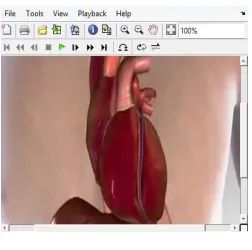
Fig 6 video of heart failure attack
Figure 7 represents the watermark which is extracted by previous and proposed technique. Total frames of original video are 21 in which the watermark is embedded by both the techniques and justify that proposed algorithm can give better result in all cases.
(a) (b) (c)
Fig7 (a) Original watermark (b) extracted watermark by DCT (c) extracted watermark by GA
IV.EXPERIMENTALRESULTS
A number of video sequences are used for performance evaluation of the proposed scheme or algorithm. The medical videos were used in our experimental work for the ultimate purpose of applying the proposed genetic algorithm in telemedicine applications and also for evaluating the performance of any watermarking system, Peak Signal to Noise Ratio (PSNR) is considered as a common measure of the visual quality of the watermarking system. To calculate the PSNR, first the Mean Square Error (MSE) between the original and watermarked frame and bit error rate (BER) is computed as follows [1,12.2]
4.1 Peak signal-to-noise ratio (PSNR)
Peak signal-to-noise ratio, often abbreviated PSNR, is an engineering term for the ratio between the maximum possible power of a signal and the power of corrupting noise that affects the fidelity of its representation
= 10 (9) Where Q is the quality factor
Table 1: PSNR table between proposed and DCT
PSNR DCT GA
Frame 1 42.3231 53.4154
Frame 2 42.3207 53.6436
Frame 3 42.3201 53.6346
Frame 4 42.3171 53.5863
Frame 5 42.3116 53.5461
Frame 6 42.3108 53.5141
Frame 7 42.3044 53.5235
Frame 9 42.2964 53.5417
Frame 10 42.2969 53.5984
Frame 11 42.2916 53.4490
Frame 12 42.2896 53.6211
Frame 13 42.2829 53.5887
Frame 14 42.2805 53.5519
Frame 15 42.2766 53.5887
Frame 16 42.2746 53.5899
Frame 17 42.2663 53.6072
Frame 18 42.2632 53.6422
Frame 19 42.2605 53.3427
Frame 20 42.2567 53.3711
Frame 21 42.2509 53.4450
As, the value of PSNR should be more so it is observed from the graph the value of PSNR of GA algorithm is more than PSNR value of DCT technique for every frame. In some frames the difference is small as these frames have lower fitness function so difference between Peak Signal to Noise Ratio is less and frame with highest fitness function are showing larger difference between Peak Signal to Noise Ratio of the two methods Higher PSNR value indicates the higher quality of the image (better). Proposed method improves the quality of video and watermark embedded is more secure.
Fig8 PSNR graph between Proposed and DCT
4.2 Mean square error
MSE stands for mean square error. Mean Square Error (MSE) of an estimator is one of many ways to quantify the difference between values implied by an estimator and the true values of the quantity being estimated.
=
× ∑ ∑ ( , )− ( , ) . (10)
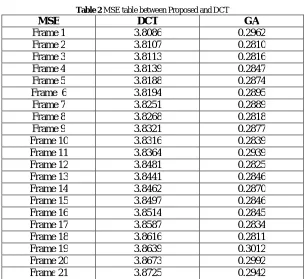
Table 2 MSE table between Proposed and DCT
MSE DCT GA
Frame 1 3.8086 0.2962
Frame 2 3.8107 0.2810
Frame 3 3.8113 0.2816
Frame 4 3.8139 0.2847
Frame 5 3.8188 0.2874
Frame 6 3.8194 0.2895
Frame 7 3.8251 0.2889
Frame 8 3.8268 0.2818
Frame 9 3.8321 0.2877
Frame 10 3.8316 0.2839
Frame 11 3.8364 0.2939
Frame 12 3.8481 0.2825
Frame 13 3.8441 0.2846
Frame 14 3.8462 0.2870
Frame 15 3.8497 0.2846
Frame 16 3.8514 0.2845
Frame 17 3.8587 0.2834
Frame 18 3.8616 0.2811
Frame 19 3.8639 0.3012
Frame 20 3.8673 0.2992
Frame 21 3.8725 0.2942
The difference occurs because of randomness or because the estimator doesn't account for information that could produce a more accurate estimate. Mean square error should be minimized. Table 4.24 shows that proposed method gives least MSE as comparative to the other method for every frame.
Fig 9: MSE graph between Proposed and DCT
4.3 Bit error rate
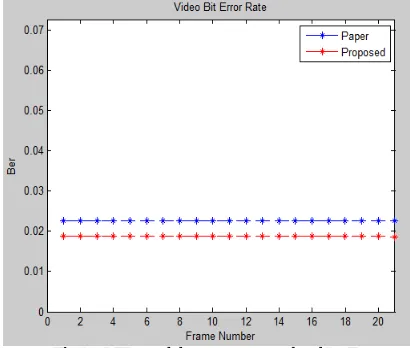
BER is the number of bit errors per unit time and it is also defined as the inverse of PSNR.
=
Table 3: Bit error rate table between proposed and DCT
BER DCT GA
Frame 1 0.0236 0.0187
Frame 2 0.0236 0.0186
Frame 3 0.0236 0.0186
Frame 4 0.0236 0.0187
Frame 5 0.0236 0.0187
Frame 6 0.0236 0.0187
Frame 7 0.0236 0.0187
Frame 8 0.0236 0.0186
Frame 9 0.0236 0.0187
Frame 10 0.0236 0.0187
Frame 11 0.0236 0.0187
Frame 12 0.0236 0.0186
Frame 13 0.0237 0.0187
Frame 14 0.0237 0.0187
Frame 15 0.0237 0.0187
Frame 16 0.0237 0.0187
Frame 17 0.0237 0.0187
Frame 18 0.0237 0.0186
Frame 19 0.0237 0.0187
Frame 20 0.0237 0.0187
Frame 21 0.0237 0.0187
The number of bit errors is the number of received bits of a data stream of a communication channel that have been altered due to noise, interference, distortion or bit synchronization errors. The difference occurs because of randomness or because the estimator doesn't account for information that could produce a more accurate estimate. Bit error should be minimized.
V. CONCLUSION
Video transcoding is a legal operation which is widely used to rework video for end user so as to convey secure data. In many previous algorithms of watermarking the embedded watermark was not able to survive video transcoding, as this operation includes combination of various aggressive attacks. As a consequence of the encoding operation, the embedded watermark may get lost. To reduce the problems of existing literature a new algorithm has been proposed that has integrated the DCT technique to enhance the results further. The proposed algorithm is designed and implemented in MATLAB using image processing toolbox. To protect the nature of the video, 21 frames which are specifically chosen are separated into blocks and the blocks of high entropies are chosen for watermarking. At that point watermark data is implanted to the chosen blocks. The devotion of the first watermarking plan is enhanced by applying genetic algorithm while the heartiness of the plan is protected. The comparison among DCT technique and the proposed algorithm is also drawn based upon performance parameters (mean square error, peak signal to noise ratio, structural similarity index media, variation bit error rate and standard deviation). From results and discussion of the newly proposed GA algorithm and existing technique it can be concluded that GA performs better in almost all cases.
VI.FUTURESCOPE
The main scope of the proposed algorithm is to improve the security and authenticity of embedded watermark and also the fidelity of the original watermarking scheme is improved by applying genetic algorithm while the robustness of the scheme is preserved. The drawback of this algorithm is that while encryption of watermark in video it consumes a lot of time. In future the time will be to reduced for the encryption of the watermark so as to make this scheme more effective.
REFERENCES
1. Potdar, V. M., Han, S., & Chang, E., “A survey of digital image watermarking techniques,” IEEE International Conference on Industrial
Informatics, pp. 709-716, 2005.
2. Poornima, R., & Iswarya, R. J. “An Overview of Digital Image Steganography” IJCSES International Journal of Computer Science &
Engineering Survey pp. 23-31, 2009.
3. Al Shatnawi, A. M, “A new method in image steganography with improved image quality,” Applied Mathematical Sciences pp. 3907-3915,
2009.
4. Sohag, S. A., Islam, M. K. & Islam, M. B. “A Novel Approach for Image Steganography using dynamic substitution and secret key,”
AJER American Journal of Engineering Research Volume-02, Issue-09 pp.34-28, 2009.
5. Agrawal, A.Singh, V. “Securing Video Data: A Critical Review,” IEEE International Journal of Advanced Research in Computer and
Communication Engineering pp. 45-51,2010
6. Li, C., & Fucheng “The study on digital watermarking based on word document,” IEEE in Mechatronic Sciences, Electric Engineering and
Computer Proceedings International Conference pp. 2265-2268, 2010
7. Cedillo-Hernandez, A., Cedillo-Hernandez, M., Garcia-Vazquez, M., Nakano-Miyatake, M., Perez-Meana, H., & Ramirez-Acosta, A. (2014).
Transcoding resilient video watermarking scheme based on spatio-temporal HVS and DCT. Signal Processing, 97, 40-54.
8. Khamrui, A., & Mandal, J. K. (2013). A Genetic Algorithm based Steganography Using Discrete Cosine Transformation (GASDCT). Procedia
Technology, 10, 105-111.
9. Luo, Y., Cheng, L. Z., Chen, B., & Wu, Y. (2005). Study on digital elevation mode data watermark via integer wavelets. Ruan Jian Xue Bao(J.
Softw.),16(6), 1096-1103.
10. Poornima, R., & Iswarya, R. J. (2013). An Overview of digital image Steganography. International Journal of Computer Science & Engineering
Survey (IJCSES), 4(1), 23-31.
11. Sohag, S. A., Islam, D. M. K., & Islam, M. B. (2013). A Novel Approach for Image Steganography Using Dynamic Substitution and Secret
Key. American Journal of Engineering Research (AJER) Volume-02, Issue-09.
12. Guizani, S., & Nasser, N. (2012, August). An audio/video crypto—Adaptive optical steganography technique. In Wireless Communications and
Mobile Computing Conference (IWCMC), 2012 8th International (pp. 1057-1062). IEEE.
13. Ghasemi, E., Shanbehzadeh, J., & Fassihi, N. (2012). High Capacity Image Steganography Based on Genetic Algorithm and Wavelet
Transform. Intelligent Control and Innovative Computing (pp. 395-404). Springer US.
14. Chan, P. W., & Lyu, M. R. 2011, June. Digital video watermarking with a Genetic algorithm. In Proceedings 2005 International Conference on
Digital Archive Technologies (ICDAT'05), Taipei, Taiwan (pp. 139-153).
15. M. Thapa, S.K. Sood, „‟On Secure Digital Image Watermarking Techniques,‟ Journal of Information Security, pp. 169-184, November 2011.
16. N. K. Cauvery, „‟Water Marking on Digital Image using Genetic Algorithm,‟‟ IJCSI International Journal of Computer Science Issues, Vol. 8,
17. P. Surekha, S. Sumathi, „‟Implementation of Genetic Algorithm for a DWT based image watermarking scheme,‟‟ ICTACT Journal on Soft Computing: Special issue on Fuzzy in Industrial and Process Automation, Vol 02, pp 244-253, July 2011.
18. Cheddad, A., Condell, J., Curran, K., & Mc Kevitt, P. (2010). Digital image steganography: Survey and analysis of current methods. Signal
processing,90(3), 727-752.
19. Al-Taweel, S. A., Sumari, P., Alomari, S. A., & Husain, A. J. (2009). Digital video watermarking in the discrete cosine transform
domain. Journal of Computer Science, 5(8), 536.
20. Potdar, V. M., Han, S., & Chang, E. (2005, August). A survey of digital image watermarking techniques. In Industrial Informatics, 2005.