Variation of Strength and Workability of
Concrete due to Application of Admixture
RHEOBUILD 620
Dwipjyoti Mishra
Ph.D. Student, Department of Civil Engineering, Assam Engineering College, Jalukbari, Guwahati, India
ABSTRACT: When admixture is added to concrete water content can be reduced up to 20% and above.When admixture is added .In this study the strength of the concrete is studied due to reduction of water content ranging from 5%-20% using water reducing admixture RHEOBUILD 620. RHEOBUILD 620 is composed of synthetic polymers specially designed to impart rheoplastic qualities to concrete. RHEOBUILD 620 is a sulphonated naphthalene polymer based formulation having slump retaining capabilities.
Three concrete cubes of 150 mm x 150 mm x 150 mm size are made keeping constant water cement ratio for each 5%, 10%, 15% and 20% of weight of concrete to study the effect of admixture on concrete. The water cement ratio is 0.45 for M 25 grade of concrete.The compressive strength of concrete decreases for increasing admixture content of concrete. The slump of Concrete reduces for increasing admixture content of concrete.
KEYWORDS: Admixture, concrete, RHEOBUILD 620, strength, workability
I. INTRODUCTION
In the recent times, it is difficult to point out another material of construction which is as versatile as concrete. It is by far, the most widely used construction material, which is constantly expanding and reshaping in this booming time of development of the infrastructure. With the recent advances in concrete has now become possible to control the various factors and to obtain a concrete of certain specific requirements. This fact has led to a classification of concrete mixes into two broad categories, viz, the nominal mix and the design mix.
Aggregate and cement paste are the two essential ingredients of concrete. Workability of the mass is provided by the lubricating effect of the paste and is influenced by the degree of dilution of paste. The strength of concrete is however limited by the strength of paste, since minerals present in aggregates are far stronger than that of paste compound. Essentially the permeability of concrete is governed by the quality and homogeneity of the paste, since little water flows through aggregates either under pressure or by capillarity. Further, the predominant contribution to drying and shrinkage in concretes is attributed to the paste only.
The more dilute the paste, greater is the spacing between cement particles, and thus weaker will be the ultimate paste structure. However, workability increases with greater degree of dilution. Thus, for more workable mixes, the strength of concrete varies as an inverse function of the water cement ratio. This paradox has given rise to the need of designing the proportion on any concrete mix to get the required strength without compromising with its workability requirements. Grades up to M 20 are attached to nominal mixes are called nominal mixes. Whereas, for grades above M 20, there are no such specified mix proportion and mix design has to be carried out in such occasions to fix the required mix proportion in accordance to the quality of the materials to be used. As such, mixes above grade of M 20 are called design mixes. With the given materials, the four variable factors to be considered in connection with designing a concrete mix are (1) Water-cement ratio, (2) Cement content or cement-aggregate ratio, (3) Gradation of the aggregates and (4) Consistency (workability character) of the cement paste.
the strength requirement. Water cement ratio expresses the degree of dilution of the paste and the cement content varies directly with the amount of paste. Gradation of aggregate is controlled by varying the amount of given fine and coarse aggregate. Required consistency is established on the basis of practical requirements of placing conditions. In brief, the effort is proportioning is to use a minimum amount of paste that will lubricate the mass while fresh and after hardening will bind the aggregate particles together and fill the space between them. Any excess of paste involves greater cost, greater shrinkage and greater susceptibility to percolation of water and therefore attracting more aggressive water and weathering action. These effects can thus be controlled by minimizing the voids using good gradation of aggregates.
In the nominal mix, there are prescriptive specifications, where the proportions of the ingredients and their characteristics are specified with the hope that adherence to such prescriptive specification will result in satisfactory performance.
In the design mix, it is found the performance oriented specifications wherein the requirements of the desirable properties of concrete are specified.
1.1 Definition of concrete mix design:
Concrete mix design is defined as the process of selecting suitable ingredients of concrete and determining their relative proportions with the object of producing concrete of certain minimum strength and durability as economically as possible. Thus the two main objects of designing a mix are to achieve the stipulated minimum strength and durability and to make the concrete in the most economical manner.
1.1.1. Concept of Mix Design:
For designing a mix it is needed to determine the proportions of the given constituents, viz., cement, water, coarse and fine aggregates, which would produce the concrete of specified properties both in the fresh and hardened states as economically as possible. In the fresh state, workability is important .So the designing is carried out for a particular compressive strength with adequate workability so that fresh concrete can be properly placed and compacted to achieve the required durability.
1.2. Admixture:
Admixtures is defined as a material, other than cement, water and aggregates, that is used as an ingredient of concrete and is added to the batch immediately before or during mixing.
A number of different types of admixtures can be used such as plasticizers, super plasticizers, retarders and retarding plasticizers, accelerators and accelerating plasticizers, air entraining admixtures, damp proofing and water proofing admixtures etc .
Water reducing Concrete admixtures and Superplasticizer are widely used to improve the mechanical and structural properties of fresh and hardened concrete. These admixtures are more frequently used in pre-stressed concrete, slender components with congested and densely packed reinforcement, beams and slabs pre-cast elements and long slender columns.
1.2.1. Admixture used for study:
II. BACKGROUND
2.1 Water reducing admixture:
Water-reducing admixtures are groups of products that are added to concrete to achieve certain workability (slump) at a lower w/c than that of control concrete (Rixom and Mailvaganam 1986). Water-reducing admixtures are used to improve the quality of concrete and to obtain specified strength at lower cement content. They also improve the properties of concrete containing marginal- or low-quality aggregates and help in placing concrete under difficult conditions .Water reducers have been used primarily in bridge decks, low-slump concrete overlays, and patching concrete.
2.2 Types:
It can be classified into 2 types according to their water reducing capacity. 1) ordinary water reducing admixture
2) super plasticizer
Use of ordinary water reducing admixture permit the reducing of water to the extent upto 15% without reducing workability while . In case of super plasticizer possible water reducing upto 30%.
2.3 Effect of Water-reducing Admixtures on Concrete:
Use of water reducers usually reduces water demand 7-10%. A higher dosage of admixtures leads to more reduction; however, excess retardation may be encountered . Many of the water-reducing admixtures tend also to retard the setting time of the concrete. This effect is counteracted in Type A and Type E chemical admixtures by adding other acceleration chemicals such as calcium chloride (Admixtures and ground slag 1990) or triethanolamine (TEA). HC admixtures tend to increase bleeding and should be used with care in high-slump concrete. Lignosulfonate-based admixtures perform better in this regard because they entrain air; normal dosages of lignin admixtures may add 1-2% of entrained air to the concrete. All water-reduced concretes usually lose slump more quickly than do equivalent concretes without the admixtures. However, this loss generally does not create problems when conventional water reducers (HC, PC, and lignins types) are used . It is well known now that using water-reducing admixtures increases concrete strength. Increases in compressive strength are as much as 25% greater than would be anticipated from the decrease in w/c . For flexural strength, an increase of 10% for concrete at 7 days to 1 year has been reported for lignosulfonate and hydroxycarboxylic admixtures . Freeze-thaw resistance and other durability aspects can also be improved when water-reducing admixtures are properly used in concrete.
Although using admixtures in concrete improves concrete's properties, misusing any kind of admixtures will negatively affect these properties. It is therefore important to follow the manufacturer's recommendations whenever admixtures are used.
2.4 Advantages of water reducing admixture:
1) Water-reducing admixtures improve concrete’s plastic (wet) and hardened properties, while set-controlling admixtures are used in concrete being placed and finished in other than optimum temperatures. Both, when used appropriately, contribute to good concreting practices.
2) Water reducers do essentially that: reduce the amount of mixing water required to obtain a given slump. This can result in a reduction of the water-cementitious ratio (w/c ratio), which leads to increased strengths and more durable concrete.
3) Reducing the w/c ratio of concrete has been identified as the most important factor to making durable, high-quality concrete. On the other hand, sometimes the cement content may be lowered while maintaining the original w/c ratio to reduce costs or the heat of hydration for mass concrete pours.
4) Water-reducing admixtures also reduce segregation and improve the flow ability of the concrete. Therefore, they are commonly used for concrete pumping applications as well.
5) Shortens the setting time of cement and therefore increases the rate of gain of strength.
7) Reduces segregation and increase density and compressive strength.
8) Cures concrete faster and therefore uniform curing in winter and summer can be achieved. 9) Early use of concrete floors by accelerating the setting of concrete.
10) Reduces water requirements, bleeding, shrinkage and time required for initial set. 11) Reduction in permeability.
12) Where early strength development is required in prestressed concrete or casting of floor, where early access for finishing equipment is required.
III. METHODS
The following main steps are performed to study the effect of water reducing admixture on concrete mix. These are as follows.
Step1- First the different tests of the ingredients of concrete viz. cement, Fine Aggregate, Coarse Aggregate, Water and admixture are performed.
Step2- Evaluation of the proportion of the ingredients for different grade of concrete based on IS 10262-2009.
Step3- Addition of water reducing admixture (RHEOBUILD 620) into the concrete. The quantity of admixture is considered in percentage of weight of cementitious material.
Step4- Preparation of the cube of 15 cm × 15 cm × 15 cm and determination of compressive strength of concrete at 28 days.
IV. EXPERIMENTAL RESULTS
4.1. Introduction:
The influence of admixture on concrete has been studied for grade of concrete M 25. The admixture is considered in percentage of weight of concrete. The admixture here used mixed with concrete randomly. The admixture is used of 0.0% (i.e. No admixture), 5%, 10%, 15% and 20% in each grade of concrete. For each percentage of admixture three cubes of size 15 cm × 15 cm × 15 cm are made and finally tested the compressive strength of concrete with and without admixture. The average of the three results of same percentage of admixture is considered to see the effect of admixture on the concrete. The test results and observation are mentioned below.
4.2. Tested properties of ingredients:
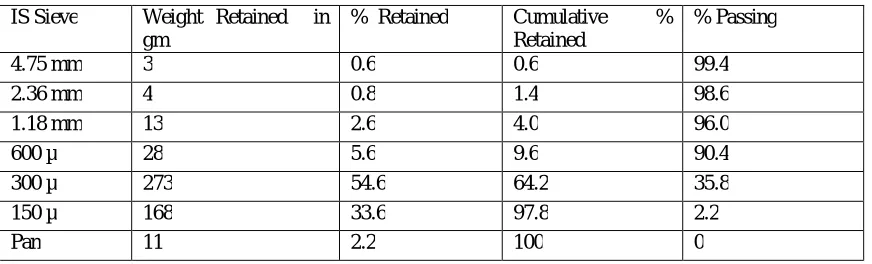
The Tested Results of Considered Fine Aggregate is tabulated below in Table 4.1.
Table 4.1.The Tested Results of Considered Fine Aggregate Total wt.- 500gm.
The properties of the tested ingredients are tabulated below in Table 4.2. IS Sieve Weight Retained in
gm
% Retained Cumulative % Retained
% Passing
4.75 mm 3 0.6 0.6 99.4
2.36 mm 4 0.8 1.4 98.6
1.18 mm 13 2.6 4.0 96.0
600 µ 28 5.6 9.6 90.4
300 µ 273 54.6 64.2 35.8
150 µ 168 33.6 97.8 2.2
Table 4.2.The Tested Results of Considered coarse Aggregate Total wt.- 3000gm.
Table 4.3. Test Results of the Ingredients
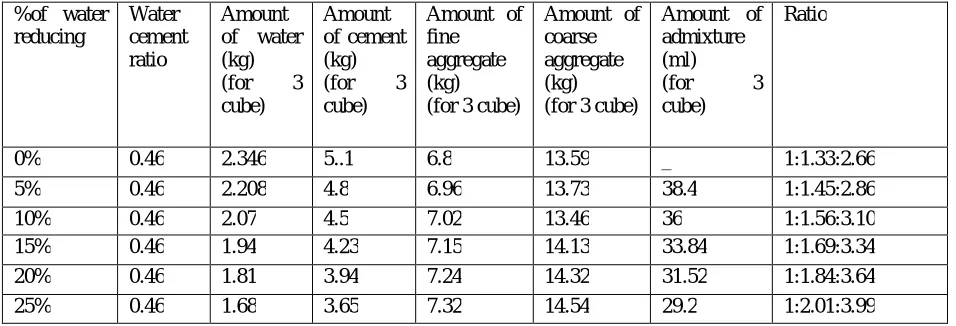
Table 4.4. Proportion of different ingredient in the concrete mixer: Total quantities for 1 cubes = 8.5 kg , Total quantities for 3 cubes = (8.5*3) =25.5 kg IS Sieve Weight Retained in
gm
% Retained Cumulative % Retained
% Passing
40 mm 0 0 0 100
20 mm 35 1.17 1.17 98.83
10 mm 2835 94.5 95.67 4.33
4.75mm 127 4.23 99.9 0.1
Sr. No Items Results
1 Cement Used Ordinary Portland Cement
(OPC)- 43 Grade 2 Specific gravity of cement 3.16
3 Specific gravity of coarse aggregate 2.65 4 Specific gravity of fine aggregate 2.63 5 Water absorption of coarse aggregate .88 % 6 Water absorption of fine aggregate 2.02 % 7 Water surface content of coarse aggregate 1.01% 8 Water surface content of fine aggregate 1.01%
9 Zone of Fine aggregate Iv
10 Coarse aggregate of 20 mm aggregate conforming to IS 383-1970
%of water reducing
Water cement ratio
Amount of water (kg) (for 3 cube)
Amount of cement (kg) (for 3 cube)
Amount of fine aggregate (kg) (for 3 cube)
Amount of coarse aggregate (kg) (for 3 cube)
Amount of admixture (ml)
(for 3 cube)
Ratio
Table 4.5. Casting three cubes of each and taking average of the three cubes. The results are as follows:
Sl No Percentage of Reducing amount of water
Avg. Compressive Strength at 28 Days Slump in mm
1 0 % 26.89 N/mm2 95
2 5 % 25.81 N/mm2 90
3 10 % 20.37 N/mm2 55
4 15 % 13.93 N/mm2 30
5 20 % 11.56 N/mm2 20
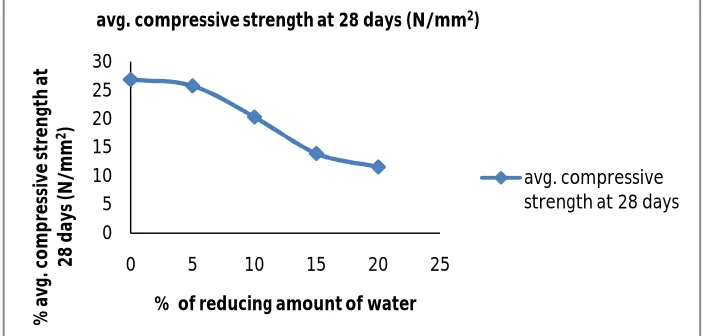
The following graph shows the Compressive Strength of Concrete which reduces drastically when water content reduces beyond 5%.
Fig 4.1. 28 Days avg. Compressive Strength of M 25 Grade for different admixture content.
The following graph shows 0-5% reduction of water is suitable to get required slump .
Fig 4.2. Slump of M 25 Grade for different admixture content.
0 5 10 15 20 25 30
0 5 10 15 20 25
% a vg . c o m p re ss iv e s tr e n gt h a t 2 8 d ay s (N /m m 2)
% of reducing amount of water avg. compressive strength at 28 days (N/mm2)
avg. compressive strength at 28 days
0 10 20 30 40 50 60 70 80 90 100
0 5 10 15 20 25
sl u m p (m m )
% of reducing amount of water Slump in mm
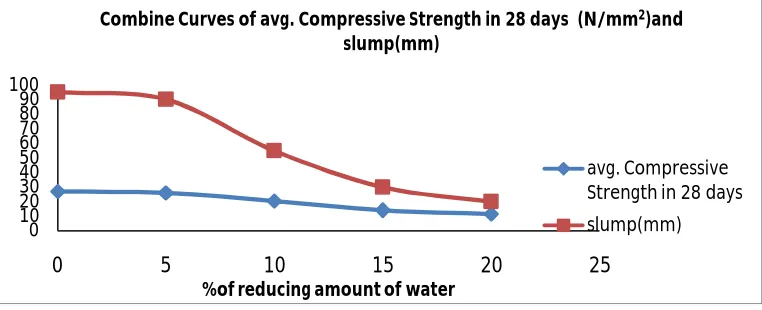
The following graph 0-5% reduction of water is suitable to get required strength of concrete after addition of admixture.
Fig 4.3. Combine Curves of avg. Compressive Strength in 28 days (N/mm2) and slump(mm) of M 25 Grade for different admixture content.
V. CONCLUSION
The following major conclusions may be drawn from this study :
1) 0-5% reduction of water is suitable to get required strength of concrete after addition of admixture. 2) The Compressive Strength of Concrete reduces drastically when water content reduces beyond 5% 3) 0-5% reduction of water is suitable to get required slump.
REFERENCES
[1] Basile et. Al., “Influence of different Sulfonated Polymers on the fluidity of cement paste”, Proceedings of Third International Conference CANMET/ACI Ottawa, pp.209-220 , 1989.
[2] Coliepradi, M., “Concrete Admixtures Hand Book” , 2nd edition Noyes Publications, pp.359 , 1995.
[3] Hewlett,P.C., “Superplasticizing admixtures in concrete”, Cement and Concrete Association publication,vol.45,No.30,1976.
[4] IS 10262 ., “Recommended Guidelines for Concrete Mix Design.” New Delhi , 2009.
[5] IS 383., “Specification for Coarse and Fine Aggregates from Natural Sources for Concrete.” New Delhi, 1970. [6 ] Shetty, M. S., “Concrete Technology.” , S. Chand & Company Ltd., Ram Nagar, New Delhi- 110 055. 1982
0 10 20 30 40 50 60 70 80 90 100
0 5 10 15 20 25
%of reducing amount of water
Combine Curves of avg. Compressive Strength in 28 days (N/mm2)and
slump(mm)
avg. Compressive Strength in 28 days