Volume 2010, Article ID 640186,13pages doi:10.1155/2010/640186
Research Article
Joint Linear Processing for an Amplify-and-Forward MIMO Relay
Channel with Imperfect Channel State Information
Batu K. Chalise
1and Luc Vandendorpe
21Center for Advanced Communications, Villanova University, Villanova, PA 19085, USA
2Communication and Remote Sensing Laboratory, Universit`e catholique de Louvain, Place du Levant, 2,
1348 Louvain la Neuve, Belgium
Correspondence should be addressed to Batu K. Chalise,[email protected]
Received 22 March 2010; Accepted 5 August 2010
Academic Editor: Kostas Berberidis
Copyright © 2010 B. K. Chalise and L. Vandendorpe. This is an open access article distributed under the Creative Commons Attribution License, which permits unrestricted use, distribution, and reproduction in any medium, provided the original work is properly cited.
The problem of jointly optimizing the source precoder, relay transceiver, and destination equalizer has been considered in this paper for a multiple-input-multiple-output (MIMO) amplify-and-forward (AF) relay channel, where the channel estimates of all links are assumed to be imperfect. The considered joint optimization problem is nonconvex and does not offer closed-form solutions. However, it has been shown that the optimization of one variable when others are fixed is a convex optimization problem which can be efficiently solved using interior-point algorithms. In this context, an iterative technique with the guaranteed convergence has been proposed for the AF MIMO relay channel that includes the direct link. It has been also shown that, for the double-hop relay case without the receive-side antenna correlations in each hop, the global optimality can be confirmed since the structures of the source precoder, relay transceiver, and destination equalizer have closed forms and the remaining joint power allocation can be solved using Geometric Programming (GP) technique under high signal-to-noise ratio (SNR) approximation. In the latter case, the performance of the iterative technique and the GP method has been compared with simulations to ensure that the iterative approach gives reasonably good solutions with an acceptable complexity. Moreover, simulation results verify the robustness of the proposed design when compared to the nonrobust design that assumes estimated channels as actual channels.
1. Introduction
The application of relays for cooperative communications has received a lot of interest in recent years. It is well known that the channel impairments such as shadowing, multipath fading, distance-dependent path losses, and interference often degrade the link quality between the source and destination in a wireless network. If the link quality degrades severely, relays can be employed between the source and destination nodes for assisting the transmission of data from the source to destination [1]. In the literature, various types of cooperative communications such as amplify-and-forward (AF), decode-and-amplify-and-forward [1], coded-cooperation [2], and compress-and-forward [3] have been presented. In [4], the outage and ergodic capacities have been analyzed for a three-node network where one of the nodes relays the messages of another node towards the third one. Among several cooperation schemes [1–4], the AF scheme is more
attractive due to its simplicity since the relay simply forwards the signal and does not decode it. Recently, space-time coding strategies have been developed for relay networks [5]. In [6], the authors study distributed beamforming for a cooperative network which consists of a transmitter, a receiver, and an arbitrary number of relay nodes. The common things among aforementioned works are that the transmitter, receiver, and the relays are all single-antenna nodes and the channel state information (CSI) (either instantaneous or second-order statistics of the channel) is assumed to be error-free.
communications has been solved in [12], where the sources and destinations are single antenna nodes. The optimal design of multiple AF MIMO relays in a point-to-point communication scenario has been considered in [13, 14] to minimize the mean-square error (MSE) and satisfy the quality of service (QoS) requirements. These works also assume perfect knowledge of CSI. Recently, the joint robust design of AF MIMO relay and destination equalizer has been investigated in [15] for a double-hop (without direct link) MIMO relay channel. To the best source of our knowledge, the joint optimization of the source precoder, MIMO relay, and the destination equalizer has not been considered in the literature for the case where the CSI is imperfect and the direct link is included. Although the path attenuation for the direct link is much larger than that for the link via relay, due to the fading of the wireless channels, there can be still a significant number of instantaneous channels during which the direct link is better than the relay link. As a result, we consider the direct link in our analysis and exploit the benefit provided by the relay channel in terms of diversity. Moreover, in practice, channel estimation is required to obtain the CSI, where the estimation errors are inevitable due to various factors such as the limited length of the training sequences and the time-varying nature of wireless channels. The performance degradation due to such estimation errors can be mitigated by using robust designs that take into account the possible estimation errors. As a result, robust methods are highly desired for practical applications. The robust techniques can be divided mainly into worst-case and stochastic approaches [16]. The worst-case approach [17, 18] considers that the errors belong to a predefined uncertainty region, where the objective is to optimize the worst system performance for any error in this region. The stochastic approach guarantees a certain system performance averaged over channel realizations [19]. The latter approach has been used in [20] to minimize the power of the transmit beamformer while satisfying the QoS requirements for all users. In the sequel, we use stochastic approach for the robust design.
In this paper, we deal with the joint robust design of source precoder, relay transceiver, and destination equalizer for an AF MIMO relay system where the CSI is considered to be imperfect at all nodes. A stochastic approach is employed in which the objective is to minimize the average sum mean-square error ( If the channel estimation is perfect at the receiver, the minimum mean-square error (MMSE) matrixX
can be related to the rate using the relationr= −log det(X). However, if the receiver does not have perfect estimation of the channel, the relation between the rate and MMSE matrix is not straightforward. Consequently, for our current system model where both the estimates of source-relay and relay-destinationchannels are imperfect, deriving rate expression and solving the optimization problem based on that expres-sion are still an open issue.) under the source and relay power constraints. The considered joint optimization is nonconvex and also does not lead to closed-form solutions. However, it has been shown that the optimization of one parameter when others are fixed is a quadratic convex-optimization problem that can be easily solved within the framework of
convex optimization techniques. We first propose an iterative approach both for the MIMO relay channels with and with-out the direct link. Although the iterative method guarantees fast convergence for the case with the direct link, the global optimality cannot be proven since the joint optimization problem is nonconvex. As a result, in the second part of this paper, we limit the joint optimization problem for the case without the direct link in which the source-relay
andrelay-destination MIMO channels have only transmit-side antenna correlations. In the latter case, it is shown that structures of the optimal source precoder and relay transceiver have closed forms, where the remaining joint power allocation problem can be approximately formulated into a Geometric Programming (GP) problem. With the help of computer simulations, we compare the solutions of the iterative technique and the GP approach under high signal-to-noise ratio (SNR) approximation for the case without the direct link. This comparison is helpful to conclude that the iterative approach gives reasonably good solutions with an acceptable complexity.
The remainder of this paper is organized as follows. The system model for MIMO relay channel is presented in
Section 2. InSection 3, the iterative approach is described for jointly optimizing the source precoder, relay transceiver, and destination equalizer for the MIMO relay channel with the direct link. The closed-form solutions and the approximate GP problem formulation are provided inSection 4 for the MIMO relay channel without the direct link where single-side antenna correlations have been consingle-sidered for source-relayandrelay-destinationchannels. InSection 5, simulation results are presented to show the performance of the proposed robust and nonrobust methods, and inSection 6, conclusions are drawn.
Notations . Upper (lower) bold face letters will be used for matrices (vectors); (·)∗, (·)T, (·)H, E{·},In, and · denote
conjugate, transpose, Hermitian transpose, mathematical expectation, n×n identity matrix, and Frobenius norm, respectively. tr(·), vec(·), CM×M, denote the matrix
trace operator, vectorization operator, space of M × M matrices with complex entries, and the Kronecker product, respectively.
2. System Model
We consider a cooperative communication system that consists of a source, a relay, and a destination which are all multiantenna nodes. The block diagram is shown in
S F
Source H1
M H0
NR NT
ND Z
Relay
H2
W1/2 Destination
S
Figure1: Cooperative MIMO relay channel.
end of two time slots, the destination linearly combines the symbol vectors received from the source and relay [1]. It is assumed that the estimates of the source-relay, relay-destination, and source-destination channels are available instead of their exact knowledge. The MIMO channels are considered to be spatially correlated block-fading frequency-flat Rayleigh channels. The signal received by the relay is given by
yr=H1Fs+nr, (1)
wheres ∈CNS×1is the complex source signal of lengthN
S,
F ∈ CM×NS is the precoder that maps theN
S×1 symbol vector intoMsource antennas,H1 ∈ CNR×M is the MIMO channel between the source and relay, andnr∈CNR×1is the additive Gaussian noise vector at the relay. We also assume that the elements ofsare statistically independent with the zero-mean and unit variance, that is, E{ssH} = I
NS. The
precoderFat the source operates under the power constraint PS = tr(FFH) ≤ PSmax, wherePSmax is the maximum power of the source. We consider nr ∼ NC(0,σr2INR), that is, the
entries of nr are zero-mean circularly symmetric complex Gaussian (ZMCSCG) with the varianceσ2
r. In order to ensure that the symbolscan be recovered at the destination, it is assumed thatND,NR, andNTare greater than or equal toNS. The signal received by the destination in first timeslot can be expressed as follows:
yd,1=H0Fs+nd,1, (2)
where H0 ∈ CND×M is the MIMO channel between the source and destination and nd,1 ∈ CND×1 is the additive Gaussian noise vector at the destination and followsnd,1 ∼
NC(0,σd2IND). The MIMO relay processes the signalyrusing
the linear operatorZ∈CNT×NR and forwards the following
signal to the destination in the second timeslot:
yo=ZH1Fs+Znr, (3)
where the relay transceiver Z operates under the power constraintPR =E{yHoyo} ≤ PRmaxwith total relay power of
PRmax. The signal received by the destination in the second timeslot is
yd,2=H2ZH1Fs+H2Znr+nd,2, (4)
where H2 ∈ CND×NT is the MIMO channel between the relay and destination andnd,2is the additive noise described
as nd,2 ∼ NC(0,σd2IND). The double-sided spatially
corre-latedsource-relay,relay-destinationandsource-destinationare modelled according to Kronecker model as follows:
H1=Σ11/2Hw1Ψ11/2,
H2=Σ12/2Hw2Ψ12/2,
H0=Σ10/2Hw0Ψ10/2,
(5)
whereΣ1∈CNR×NR,Σ2∈CND×ND, andΣ0∈CND×ND are the receive-side spatial correlation matrices, andΨ1 ∈ CM×M,
Ψ2∈CNT×NT, andΨ0 ∈CM×Mare the transmit-side corre-lation matrices for the channelsH1,H2, andH0, respectively. The elements of Hw
1, Hw2, and Hw0 are ZMCSCG random variables with the unit variance. Note that the transmit and receive spatial correlation matrices are positive semidefinite matrices and are a function of the antenna spacing, average direction of arrival/departure of the wavefronts at/from the transmitter/receiver, and the corresponding angular spread (see [21] and the references therein). The spatial correlation matrices represent the second-order statistics of the channels which vary slowly and can be precisely estimated. However, estimation of the fast fading partsHw1,Hw2, andHw0 of the spatially correlated MIMO channels can lead to a significant amount of estimation error. For the linear minimum mean-square error (MMSE) estimation, we can write the following error model [22]:
Hw
1 =Hw1 +Ew1,
Hw2 =Hw2 +Ew2,
Hw
0 =Hw0 +Ew0,
(6)
whereHw
1,Hw2, andH0ware the estimated CSI, andEw1,Ew2, and
Ew
0 are the corresponding channel estimation errors whose elements are ZMCCSG random variables with the variances σ2
e,1,σe2,2, andσe2,0, respectively. Substituting (6) into (5), the error modelling for the actual channelsH1,H2, andH0can be simply given by
H1=Σ11/2H1wΨ11/2+Σ11/2Ew1Ψ11/2H1+E1,
H2=Σ12/2H2wΨ12/2+Σ21/2Ew2Ψ21/2H2+E2,
H0=Σ10/2H0wΨ10/2+Σ01/2Ew0Ψ01/2H0+E0,
which shows that the errorsE1,E2, andE0are also double-sided correlated like the MIMO channels. The destination recovers the source signalsby linearly combining the signals
yd,1(2) andyd,2(4) of two time slots as follows:
s=W1yd,1+W2yd,2, (8)
whereW1,W2 ∈CNS×ND denote the linear operators for the signals received from the direct and relay links, respectively. The MSE betweensandscan be defined as follows:
M(F,Z,W1,W2)=E
(s−s)(s−s)H (9)
where the MSE matrix depends onF,Z,W1andW2and the mathematical expectation is only taken with respect to noise and signal realizations. Considering thatnr,nd,1,nd,2ands are statistically independent and applying (2) and (4) into (8), we can write (9) as follows:
M(F,Z,W1,W2)=W1 ⎡ ⎢
⎣H0FFHHH0 I
+σn2dIND
⎤ ⎥ ⎦WH1
−(W1H0+W2H2ZH1)F−(W1H0F)H
−(W2H2ZH1F)H
+W1H0FFHHH1ZHHH2WH2 H
+ ⎛ ⎜
⎝W1H0FFHHH1ZHHH2 II
WH2 ⎞ ⎟ ⎠
+W2 ⎡ ⎢
⎣H2ZH1F(H2ZH1F)H III
+σ2
nrH2Z(H2Z) H
IV
+σ2 ndIND
⎤ ⎥ ⎦WH
2 +INS.
(10)
For the given channel estimates H1,H2, andH0, the MSE matrix of (10) is random due to the random errors E1,
E2, and E0. Since the exact errors are not known and only the covariance matrices of these errors are known, we need to derive the average MSE matrix. This can be done by averaging the MSE matrix (10) over the independent errors
E1,E2, andE0. Hence, we can write
EE0{I} =H0FF HHH
0 + EE0
E0FFHEH0
=H0FFHHH0 + tr
FFHΨ0
Σ0,
(11)
whereΣ0=σe2,0Σ0, and we have applied (7) and used the facts thatE0 is zero-mean and EX{XAXH} = tr(A)σx2I forX ∼
NC(0,σx2I). Similarly, sinceE0,E1, andE2are independent, we can easily show that
EE0,E1,E2{II} =EE0,E1,E2
H0+E0
FFHH1+E1 H
ZHH2+E2 H
=H0FFHHH1ZHHH2.
(12) Furthermore, we can write
EE1,E2{III} =EE2
H2ZEE1
H1FFHHH1
ZHHH2
, (13) where the inner expectation is
EE1
H1FFHHH1
=EE1
H1+E1 H
FFHH1+E1
=H1FFHHH1 + tr
FFHΨ1
Σ1
A
(14)
andΣ1=σe2,1Σ1. Substituting the result of (14) into (13), we have
EE1,E2{III} =EE2
H2ZAZHHH2
=H2ZAZHHH2 + tr
ZAZHΨ2
Σ2,
(15)
whereΣ2=σe2,2Σ2. Applying similar steps, we can also get EE2{IV} =H2ZZ
HHH 2 + tr
ZZHΨ
2
Σ2. (16) Using the results of (11) to (16), the average MSE matrix can be written as follows:
M(F,Z,W1,W2)=EE1,E2,E0{M(F,Z,W1,W2)}
=W1
⎡ ⎢ ⎢ ⎢
⎣H0FFHHH0 + tr
FFHΨ
0
Σ0+σn2dIND
Am
⎤ ⎥ ⎥ ⎥ ⎦WH1
+W1H0FFHHH1ZHHH2
Bm
WH2
+W1H0FFHHH1ZHHH2WH2 H
+W2 ⎡ ⎢ ⎢ ⎢
⎣H2ZAZ HHH2 + tr
ZAZ HΨ2
Σ2+σn2dIND
Cm
⎤ ⎥ ⎥ ⎥ ⎦WH2
−
⎛ ⎜
⎝W1H0F+W2 H2ZH1F
Dm
⎞ ⎟ ⎠
−W1H0F+W2H2ZH1F H
+INS,
whereA=A+σ2
nrINR. The instantaneous relay power can be
obtained as follows: PR=tr
EyoyHo
=trZH1FFHHH1ZH
+σn2rtr
ZZH, (18) where expectation is taken w.r.t. noise and signal realizations. After including the estimation error E1 in (18), the relay power averaged over E1 can be expressed with the help of (14) as follows:
PR=tr
ZAZ H. (19)
3. Joint Optimization: Iterative Approach
The objective of joint optimization is to minimize the sum of the average MSE (17) under power constraints of the source and relay. This optimization problem can be expressed as follows:
min
F,Z,W1,W2
fmse=trM(F,Z,W1,W2)
s.t. trFFH≤Pmax
S ,
trZAZ H≤Pmax
R .
(20) The constraints of the optimization problem (20) do not depend onW1andW2. As a result, the optimalW1andW2 can be easily obtained in terms ofFandZ. Unfortunately, after substituting such optimalW1andW2into the objective function of (20), the resulting objective function in terms of
FandZappears to be a nontractable nonconvex problem. This fact will be later shown in this section. The joint optimization problem (20) is a nonconvex problem and does not offer closed-form solutions. However, it can be easily observed that the considered problem is a convex problem over one optimization variable when others are fixed. Hence, we propose to solve this optimization problem using iterative technique, where each optimization variable is updated at a time considering others as fixed. The iterative algorithm may be implemented as follows. The destination estimates thesource-destinationandrelay-destinationchannels and the relay estimates thesource-relaychannel, separately with the help of training sequence. The relay sends the estimated
source-relay channel to the destination where the iterative algorithm is executed. The destination feedbacks optimally designedFandZto the source and relay, respectively. The channel is considered to remain constant within a block but vary from one block to another, where the block consists of training signal and useful data ( Notice that the adaptation of the source precoder and relay transceiver matrices in fast fading scenario can be impractical if the design is based on instantaneous channels [23]. Therefore, robust designs based on channel covariance information [20] can be appropriate for such a scenario. ) .
Remark 1. It is worthwhile to mention here that the mini-mization of the sum of the source and relay powers under the MSE constraint can also be solved by using the iterative framework that we are proposing in the sequel. Moreover,
the quality of fairness approach such as minimizing the sum of the source and relay powers while fulfilling the SNR/MSE requirements of each symbol stream can also be handled by the proposed iterative method. For conciseness, the latter two methods are not considered in this paper.
After solving the first-order partial derivative of the objective function of (20) w.r.t toW1, we get
W1=
FHHH0 −W2BHm
A−m1. (21)
Substituting (21) into the objective of (20), the latter can be expressed in terms ofW2,Z, andFas follows:
trM(F,Z,W2)
=trW2
Cm−BmA−m1Bm
WH2
−W2Dm−DHmWH2
+NS + trW2BHmA−m1H0F+FHHH0A−m1
×BmWH2 −H0F
.
(22)
Now, solving the derivative of (22) w.r.t toW2, we get the optimalW2as follows:
W2=
DHm−FHHH0A−m1Bm
Cm−BHmA−m1Bm
−1
. (23) The optimal W1 can be obtained by substitutingW2 from (23) into (21). Using the results of (21) and (23) and then resubstitutingAm,Bm, andCm, (22) can be written in terms
ofFandZas follows: trM(F,Z)=tr(G)−tr
H2ZH1FGG
H2ZH1F H
× H2ZH1FG
H2ZH1F H
+Γ !−1"
, (24) where
G=INS−F HHH
0 ⎡ ⎢ ⎢ ⎢
⎣H0FFHHH0+tr
FFHΨ
0
Σ0+σn2dIND
ΣN
⎤ ⎥ ⎥ ⎥ ⎦
−1
H0F
=
⎡ ⎢ ⎢
⎣FHHH0Σ−N1H0F
Γt
+INS
⎤ ⎥ ⎥ ⎦
−1 ,
Γ=H2Z
Σ1tr
FFHΨ 1
+σ2
nrIND
ZHHH 2
+ trZAZ HΨ2
Σ2+σn2dIND.
I −(XHX+I)−1. Applying the same fact and after some
manipulations, we get
trM(F,Z)
=tr ⎛ ⎜ ⎝G
⎡ ⎢ ⎣INS+G
H/2FHHH
1ZHHH2Γ−1H2ZH1F
Y
G1/2 ⎤ ⎥ ⎦
−1⎞ ⎟ ⎠
=tr#G−1+Y$−1,
(26)
where second equality is obtained after simple steps using the fact thatGis a positive definite square matrix. Notice that
Yis only related to the MMSE of the double-hop channel, where the sum MMSE is fmmse,DH = tr (INS+Y)
−1. With these observations, we can formulate the following lemma:
Lemma 1. The sum MMSE of the MIMO relay system with
the direct link is upper bounded by the sum MMSE of the direct link and source-relay-destination link.
Proof. This Lemma can be easily proven by using the properties of the positive (semi) definite matrices. SinceG−1 is positive definite andYandΓtare positive semidefinite, we can show that
G−1+YG−1−→G−1+Y−1 G−→trG−1+Y−1
≤tr(G) fmmse,DL,
(27)
G−1+Y=Γt+INS+YINS+Y−→
Γt+
INS+Y
−1
INS+Y
−1
−→
trG−1+Y−1≤trI NS+Y
−1
fmmse,DH. (28)
The results of (27) and (28) prove the Lemma.
It can be seen that the minimization of (26) under source and relay power constraints is a nontractable problem. We have noticed that even in the case of the nonrobust design, such an objective is difficult to handle. This difficulty has motivated us to use the iterative optimization based on the MSE function (17) for whichW1andW2have been already determined in terms ofZandF(see (21) and (23)). In the following, we show the optimizations over Zand F when other variables are fixed.
(1)Optimization overZ. With some straightforward manip-ulations of (17) and using the fact that tr(XXH) = X2,
the average sum MSE (objective function of (20)) can be alternatively expressed as follows:
fmse=%%%W1H0+W2H2ZH1
F−INS
%% %2
+ trFFHΨ1
trBZΣ1ZH
+σn2rtr
ZHBZ
+ trZAZ HΨ 2
trW2Σ2WH2
+σ2 ndtr
W1WH1 +W2WH2
+ trW1Σ0WH1
trFFHΨ0
,
(29)
where B = HH2WH2W2H2. Applying the following results [24]:
vec(XWY)=YT&Xvec(W),
trXHYXW=vec (X)HWT&Yvec(X)
(30)
and denotingzLvec(Z)∈CNTNR×1, we can write
fmse=%%%%vecW1H0F
+H1F T&
W2H2 '
zL−vec
INS%%%%
2
+zHLDzL+s3+s4,
(31) where
D=s1
ΣT1&B
' +σ2
nr
INR
&
B+s2
AT&Ψ 2
,
s1tr
FFHΨ
1
, s0tr
FFHΨ 0
, s2tr
W2Σ2WH2
, s3σn2dtr
W2WH2
, s4σn2dtr
W1WH1
+ trW1Σ0WH1
s0.
(32)
The optimization problem w.r.t. Z can be thus written as follows:
P1: min
zL fmse
s.t.
PR= %%
%%AT⊗INT
1/2
zL %%
%%2≤PRmax.
(33)
Noting thatzHLDzL = D1/2zL2, the optimization problem (33) can be written as follows:
P1: min
zL,t1,t2
t2
1+t22 s.t. %%
%%vecW1H0F
+H1F T&
W2H2 '
×zL−vec
INS%%%%≤t1,
%% %D1/2z
L%%%≤t2, %%
%%AT&INT
1/2
zL %%
%%≤(PmaxR .
Using the notationt[t1,t2]T, the fact thatt21+t22=tTtand introducing an auxiliary variablet≥0, the problem (34) can be formulated as the following standard convex optimization problem:
P1: min
zL,t,t
ts.t.
)
I2 t
tT t
*
0,
%%
%vecW1H0F
+H1F T
⊗W2H2 '
zL
−vecINS%%≤a Tt,
%% %D1/2z
L%%%≤bTt, %%
%%AT⊗INT
1/2
zL %%
%%≤(Pmax
R ,
(35)
whereaT =[1, 0],bT =[0, 1], and the quadratic inequality
constrainttTt≤tis converted to a linear matrix inequality
constraint (LMI) using Schur-Complement theorem [16].
Remark 2. Notice that when other variables are fixed,Zcan be optimized by solving the Karush-Kuhn-Tucker (KKT) conditions, where the Lagrangian multiplier that arises due to the relay power constraint can be obtained by using the bisection algorithm like in [15]. However, in order to make the proposed iterative approach applicable for other related problems briefly discussed in the beginning of this section and also for the optimization overFin the sequel, we propose to formulate our optimization problem in the convex form P1, which has been proven to be computationally efficient and flexible to accommodate even a large number of convex constraints [16].
(2)Optimization overF. First, we define the following scalars that do not depend onF:
s5tr
BZΣ1ZH
, s6tr
BZZH,
s7tr
ZZHΨ2
, s8tr
ZΣ1ZHΨ2
.
(36)
After some simple steps and again using the fact that tr(XXH)= X2in (17), the average sum MSE (20) can also be expressed as follows:
fmse=%%%W1H0+W2H2ZH1
F−INS
%% %2
+s2tr
FFHΨ 0
+σ2
nrs6+s3 ×s2tr
FHEF+ (s5+s2s8) tr
FFHΨ1
+s2s7σn2r+σ
2 ndtr
W1WH1
,
(37)
wheres2=tr(W1Σ0WH1) andE=HH1ZHΨ2ZH1. Noting that vec(XY) = (I⊗X) vec(Y) [24] and applying (30), we can write
fmse=%%%I&W1H0+W2H2ZH1
fL−vec
INS
%%%2
+s2s7σn2r+σ
2 nrs6
+fLH
s2
INS
&
E+s2
INS
& Ψ0
+ (s5+s2s8)
×INS
& Ψ1
fL+s3+σn2dtr
W1WH1
, (38) wherefL=vec(F)∈CMNS×1. The relay power in terms offL can be expressed as follows:
PR=s9+fLH
s10
INS
& Ψ1
+INS
&
QfL, (39)
where we have useds9 σn2rtr(ZZ H),s
10 tr(ZΣ1ZH), and
Q HH1ZHZH1. The optimization problem w.r.t.Fcan be now formulated as follows:
P2: min
fL
fmse s.t.
fL2≤PmaxS ,
s9+ %% %%INS
&
(s10Ψ1+Q) 1/2
fL %% %%2≤Pmax
R .
(40) Finally, like in the case of the optimization overZ, we can transform (40) into the following convex problem:
P2: min
fL,t,t
t s.t. )
I2 t
tT t
*
0,
%% %INS
&
W1H0+W2H2ZH1
fL−vec
INS
%%%
≤aTt, %%%S1/2fL%%%≤bTt,
fL ≤ (
Pmax
S ,
%% %%INS
&
(s10Ψ1+Q) 1/2
fL %%
%%≤(Pmax R −s9,
(41) whereS=[s2(INS
E)+s2(INS
Ψ0)+(s5+s2s8)(INS
Algorithm 1. The iterative algorithm for joint optimization ofW1,W2,ZandF.
(1) Initialize the algorithm withZ0andF0such that the source and relay power constraints are satisfied.
(a)repeat
(b) UpdateWi2using (23).
(c) UpdateWi1using (21) and (23).
(d) UpdateZiby solving the convex problemP1. (e) UpdateFiby solving the convex problemP2. (f)i=i+ 1;
(2)untilboth|fmse,i−fmse,i+1|is smaller than a thresh-old, where the indexidenotes theith iteration.
Remark 3. In the case of the relay channel without the direct link, the optimization problem over destination equalizer,
Z and F can be iteratively solved by omitting all terms containingH0andW1in (23),P1, andP2.
Remark 4. If the channel estimates are perfect, (21), (23), P1, andP2 can be changed to shorter forms by using the fact thatσ2
e,1=σe2,2 =σe2,0=0. The resulting equations and optimization problems correspond to the perfect CSI case.
3.1. Computational Complexity. The computational com-plexity ofAlgorithm 1mainly depends on the work loads of the convex optimization problemsP1andP2which consist of second-order cone (SOC) as well as SDP constraints. An enormous amount of effort will be required to compute the exact computational complexity ofP1andP2, and thus their exact complexity analysis is beyond the scope of this paper. However, using the results of [26], we determine the worst-case computational complexity ofP1 andP2. InP1, there are 3 SOC constraints where the first SOC constraint has a dimension (also the size of the cone) with 2N2
S + 1 real variables and the remaining two SOC constraints have the same size of 2NTNR+ 1. The SOC constraints inP1consist of 2NTNR+ 2 real optimization variables. The only one SDP constraint of P1 has a size of 3 with 3 real optimization variables. Therefore, according to [26], the computational load ofP1per iteration isO((2NTNR+ 2)2(2NS2+ 4NTNR+ 3) + 81). The number of iterations required can be upper bounded byO(2√3). Hence, the overall worst-case complex-ity ofP1isO(2
√
3((2NTNR+ 2)2(2NS2+ 4NTNR+ 3) + 81)). Similarly, we can compute the worst-case computational load for P2. The first SOC constraint in P2 has a size of 2N2
S + 1 while the other SOC constraints are of the same size of 2MNS+ 1. The SOC constraints consist of 2MNS+ 2 real optimization variables. Like in the case of P1, the single SDP constraint is of size 3 with 3 real optimization variables. Thus (see also [26]), we find thatP2 has a work load ofO((2MNS+ 2)2(2NS2+ 6MNS+ 4) + 81) per iteration, where the required number of iterations is upper bounded by O(√3 + 2). As a result, the worst-case complexity of P2 is O((
√
3 + 2)((2MNS+ 2)2(2NS2 + 6MNS+ 4) + 81)). Notice that in practice the interior-point algorithms used for
solvingP1andP2behave much better than predicted by the aforementioned worst-case analysis [27].
3.2. Convergence Analysis. It can be shown that the proposed iterative method converges. It has been already discussed that the optimization problem is convex w.r.t. each variable when the others are fixed. For the given F and Z, the solutions given by (21) and (23) correspond to the MMSE receiver. As a result, we have tr(M(Fi,Zi,Wi+1
1 ,Wi2+1)) ≤ tr(M(Fi,Zi,Wi
1,Wi2)). Similarly, for the givenW1,W2, and
F, the optimization problem (20) is convex w.r.t. Z and, thus, the problemP1provides optimal solution forZwhich means that tr(M(Fi,Zi+1,Wi
1,Wi2))≤tr(M(Fi,Zi,Wi1,Wi2)). Finally, for the given W1, W2, and Z, problem (20) is convex w.r.t. F and, hence, the problem P2 gives optimal solution forFthereby confirming tr(M(Fi+1,Zi,Wi
1,Wi2))≤ tr(M(Fi,Zi,Wi
1,Wi2)). Therefore, it can be found that with each update of W1, W2, F, and Z, the objective function decreases and the iterative method converges. It will be later shown via numerical results that the iterative algorithm gives satisfactory performance with acceptable convergence speed. However, the global optimality of the solutions of the iterative method for the relay channel with the direct link cannot be guaranteed as the joint problem is nonconvex. In the next section, the joint optimization problem will be restricted to a double-hop MIMO relay, where receive antenna correlations are assumed to be negligible for each hop. In this case, the optimization problem turns to the joint power allocation, for which the global optimality can be guaranteed under high-SNR approximation.
4. Joint Power Allocation with
GP: Without Direct Link
Due to severe shadowing, hotspots, and so forth, the destination may be out of the coverage area of the source. In such a scenario, it is reasonable to consider that the direct link between the source and destination does not exist. In the latter case of the relay channel without the direct link, the sum MSE can be expressed in terms ofFandZ(see also (28)) as follows:
fmmse= fmmse,DH
=trINS+F HHH
1ZHHH2Γ−1H2ZH1F −1
.
(42)
The objective is to minimize the average sum MSE (42) under the constraints of source and relay powers. Thus, the optimization problem is
min
Z,F tr(MMSE(Z,F)) s.t. tr
FFH≤Pmax
S ,
trZAZ H≤Pmax
R ,
(43)
where the MMSE matrix is MMSE(Z,F) = [INS+ FHHH
1ZHHH2Γ−1H2ZH1F]
−1
this case, d is said to be majorized by λ, and the Schur-concave function can be defined as f(λ(MMSE(Z,F))) ≤
f(d(MMSE(Z,F))), where f(x) stands for the function ofx. It is clear that the minimum of this function is obtained if the diagonal elements ofMMSE(Z,F) become its eigenvalues [8]. This can occur whenMMSE(Z,F) is a diagonal matrix with its elements in decreasing order. Let the singular value decompositions ofH1andH2be
H1=U1Λ11/2VH1, H2=U2Λ12/2VH2, (44)
where the diagonal elements of Λ1 andΛ2 are considered to be in the decreasing order. If these elements are not in decreasing order, some permutation matrices can be applied to make the diagonal elements ofΛ1andΛ2in the decreasing order [8]. This means that, in (44), the permutation matrices are implicitly included. The closed-form expressions for the optimalZandFare difficult to obtain in general. However, for the double-hop channels without receive-side antenna correlations, that is, when Σ1 = INR and Σ2 = IND, the
optimalZandFthat diagonalize the MMSE matrix can be given by
Z=V2Λ1Z/2UH1, F=V1Λ1F/2, (45)
whereΛZandΛFare the diagonal matrices with the elements
in decreasing order. Substituting (44) and (45) into the MMSE matrix and after some straightforward steps, we get
fmmse=tr
ΛFT/2ΛT/12ΛZT/2ΛT/22Γ−D1
×ΛT/F2ΛT/12ΛZT/2ΛT/2 2T+INS
'−1 ,
(46)
where
ΓD=
σ2 e,1tr
BΛ1F/2ΛT/F2
+σ2
nr
Λ12/2ΛZ1/2ΛT/Z2ΛT/2 2
+ trCΛ1Z/2Λ11/2ΛF1/2ΛT/F2ΛT/12ΛT/Z2σ2 e,2IND+σ
2 e,2·
trCΛ1Z/2ΛT/Z2
σe2,1tr
BΛ1F/2ΛT/F2
+σn2r
IND+σ
2 ndIND.
(47)
In (47), we useB =VH
1Ψ1V1andC =VH2Ψ2V2. Similarly, the source and relay powers become
PS=tr
Λ1F/2ΛT/F2, PR=tr
Λ1Z/2Λ11/2ΛF1/2ΛT/F2ΛT/12ΛT/Z2
+ trΛ1Z/2ΛT/Z2
σ2
e,1tr
BΛ1F/2ΛT/F2
+σ2
nr
.
(48)
Letq = min(M,NS) and v = min(NT,NR), and{ (
λF}j qj=1
and let{(λkZ} v
k=1be the nonzero diagonal elements ofΛ 1/2 F
andΛ1Z/2, respectively, in the decreasing order. For brevity,
we also define
dσ2 e,1tr
BΛ1F/2ΛT/F2
+σ2
nr
⎛ ⎝σ2
e,1 q
+
i=1
Bi,iλiF+σn2r
⎞ ⎠
etrCΛ1Z/2Λ11/2Λ1F/2ΛT/F2ΛT/1 2ΛT/Z2
σ2
e,2σe2,2 p
+
i=1
Ci,iλiZλiFλi1.
f σ2 e,2tr
CΛ1Z/2ΛT/Z2σ2 e,1tr
BΛ1F/2ΛT/F2+σ2 nr
σe2,2 v
+
i=1
Ci,iλiZ
⎡ ⎣+q
i=1
Bi,iλiFσe2,1+σn2r
⎤ ⎦,
(49) whereBi,iandCi,iare theith diagonal elements ofBandC,
respectively, andp=min(NT,NR,M,NS). SinceBandCare positive semidefinite, we haveBi,i ≥0 andCi,i ≥0 for alli.
Using (47) and (49), the sum MMSE can be finally expressed as follows:
fmmse= R
+
r=1
1 1 +λrFλrZλr1λr2
/dλrZλr2+e+f +σn2d
,R
r=1 1 1 + SNRr
,
(50)
where SNRr = λrFλrZλr1λr2/(dλrZλr2+e+ f +σn2d) is the SNR
of each data stream provided thatNS is also smaller than or equal to M and R = min(NT,NR,M,NS, andND). It is interesting to note that when the channel estimates are perfect, that is, whenσ2
e,1=σe2,2=0, the sum MMSE of (50) reduces to the objective function of [28]. Applying (48), the joint power allocation problem can be formulated as follows:
min
λFj
q j=1,{λ
k Z}
v k=1
fmmse s.t.
q
+
j=1
λFj≤PSmax
p
+
m=1
λm
ZλmFλm1 +d v
+
k=1
λk
Z≤PRmax,
(51)
which is a nonlinear and nonconvex problem. Since this problem is nonconvex, the global optimal solution is difficult to obtain. Considering the fact that the global optimal solutions of the problems similar to the nonrobust version of (51) can be obtained only with very high computational cost (see [29,30]), the authors of [31] use an iterative waterfilling technique to solve the nonrobust form of (51). However, we have noticed that it is hard to solve (51) using the waterfilling method of [31]. The major difficulty arises from the fact that the first-order partial derivatives of the corresponding Lagrangian function w.r.t.λr
Ffor the fixed{λrZ} R
r=1and w.r.t.
λr
Z for the given{λrF} R
r=1 do not lead to equations that are decoupled inλr
FandλrZ, respectively. It is easier to see that
λkZ, for allk ∈ {1,. . .,R}. Furthermore, although iterative
waterfilling method is computationally efficient, it does not guarantee the global optimal solution. In the following, we use an alternative approach based on GP technique. Note that the optimization problem (51) is not a GP problem but a signomial programming (SP) problem [16] which can be iteratively solved as a GP problem after approximating the required posynomial terms by monomial terms. It is known that the SPs do not guarantee global optimality and the computational cost is high. Thus, using the high-SNR approximation, (51) can be solved as a GP whose global optimality can be confirmed. In this regard, we have
fmmse≤ R
+
r=1
dλr
Zλr2+e+ f +σn2d
λrFλrZλr1λr2
. (52)
Using the upper bound (52), the power optimization prob-lem can be expressed as follows:
min
λFj
q j=1,{λ
k Z}
v k=1
R
+
r=1
tr s.t.
dλr
Zλr2+e+f +σn2d≤trλ r
FλrZλr1λr2, ∀r q
+
j=1
λFj ≤PSmax,
p
+
m=1
λm
ZλmFλm1 +d v
+
k=1
λk
Z≤PRmax,
(53) which is a GP problem that can be solved efficiently to guarantee the global optimality.
Remark 5. Notice that the joint power allocation problem is nonconvex even for the case without channel estimation errors [32]. In such a nonrobust design, it has been shown in [28] that the lower and upper bounds can be established for the MSE for each data stream. Unfortunately, this is not the case for the proposed robust design due to the fact that the termse, f, anddare again functions ofλkZ, for allk =
1,. . .,vandλFj, for all j = 1,. . .,q. It is also worthwhile to
note that several optimization problems which can be solved using the GP method and still provide solutions close to the optimal solution of the sum MSE minimization problem are; (a) maximization of the minimum of the SNRs of the data streams and (b) maximization of the geometric mean of the SNRs of the data streams, both under the source and relay power constraints.
5. Numerical Results and Discussions
In this section, the performance of the proposed methods will be investigated. The proposed robust designs are also compared with the nonrobust case, where the channel estimation errors are not taken into account. Notice that the nonrobust design corresponds to the so called na¨ıve design, where the optimization problems of interest are
solved assuming that there are no errors in channel estimates (see also Remark 4) although in reality the estimates are erroneous. For all numerical simulations, we takeNS = 3,
M = 4, NR = 3, NT = 4, and ND = 3. The spatial covariance matrices for source-relay, relay-destination, and
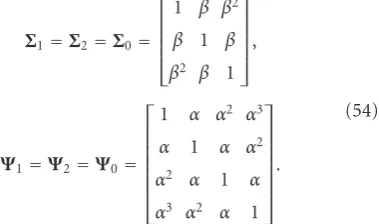
source-destination channels are modelled according to the widely used exponential correlation model. In our examples, we take
Σ1=Σ2=Σ0= ⎡ ⎢ ⎢ ⎢ ⎣
1 β β2
β 1 β β2 β 1 ⎤ ⎥ ⎥ ⎥ ⎦,
Ψ1=Ψ2=Ψ0= ⎡ ⎢ ⎢ ⎢ ⎢ ⎢ ⎢ ⎣
1 α α2 α3
α 1 α α2
α2 α 1 α
α3 α2 α 1 ⎤ ⎥ ⎥ ⎥ ⎥ ⎥ ⎥ ⎦ .
(54)
In all cases, the optimization problemsP1,P2, and (53) are solved using the CVX software [33]. The SNRs for source-relay,source-destination, andrelay-destination channels are defined as SNRsr = PSmax/σn2r, SNRsd = P
max
S /σn2d, and
SNRrd = PRmax/σn2d, respectively. Throughout all examples,
we take Pmax
S = PRmax = 0 dBw and vary the values ofσn2r
andσ2
nd to change SNRsr, SNRsd, and SNRrd. The estimated
channels are generated according to (7), so that the elements of actual channels H1,H2, andH0 have the variance of 1. For all results, we compute the average MSE by taking 200 realizations of the estimated channels.
The convergence behaviour of the proposed iterative method as a function of iteration index is illustrated in
Figure 2 for the relay channel with the direct link. The parameters in this figure are set as α = 0.2, β = 0.1, σe2,1 = σe2,2 = 0.01, and σe2,0 = 0.03. We take three sets of SNRs as SNRsr = SNRsd = SNRrd = 10 dB, SNRsr = SNRsd =SNRrd =20 dB and SNRsr =10 dB, and SNRsd = SNRrd=0 dB. It can be seen from this figure that the iterative method converges in about 15 iterations. The convergence is faster for the lower values of the SNR. The effect of different initializations on the convergence behaviours of the iterative method is also displayed inFigure 2. The convergence speed for the cases where F and Z are initialized to randomly generated matrices of ZMCSCG random variables is similar to the cases where F and Z are initialized to the matrices proportional to identity (i.e.,F∝IandZ∝I). Moreover, it can be noticed fromFigure 2that different initializations lead to the similar solutions. InFigure 3, the performance of the iterative method as a function of the iteration index is illustrated for the relay channel without the direct link. We takeα = 0.3,β = 0, andσe2,1 = σe2,2 = 0.01 in this figure. As a reference, the performance of the GP problem which gives optimal solution under high-SNR assumption is also displayed in Figure 3. It can be noticed fromFigure 3 that the difference between the solutions of the iterative method and GP method is negligible after 10–15 iterations.
The performance of the proposed iterative method for the MIMO relay channel with the direct link is shown in
Figure 4for different values ofσ2
0 0.2 0.4 0.6 0.8 1 1.2 1.4
Su
m
M
S
E
0 5 10 15 20 25 30
Iteration index SNRsr,rd,sd=20 dB ,F,Z∞I SNRsr,rd,sd=10 dB ,F,Z∞I SNRsr,rd,sd=10 dB ,F,Zare ZMCSCG SNRsr,rd,sd=20 dB ,F,Zare ZMCSCG
SNRsr=10 dB,SNRrd,sd=0 dB ,F,Zare ZMCSCG SNRsr=10 dB,SNRrd,sd=0 dB ,F,Z∞I
Figure 2: Convergence behaviour of the iterative approach for
different initializations with the direct link (α = 0.2, β = 0.1, σ2
e,1=σe2,2=0.01,σe2,0=0.03, andPmaxS =PRmax=0 dB).
0.2 0.25 0.3 0.35 0.4 0.45 0.5 0.55 0.6 0.65 0.7
Su
m
M
S
E
0 5 10 15 20 25 30
Iteration index SNRsr,rd=20 dB , iterative method SNRsr,rd,=20 dB, GP-power allocation
SNRsr=15 dB, SNRrd=20 dB, GP-power allocation SNRsr=15 dB,SNRrd=20 dB , ilterative method
Figure3: Convergence performance of the iterative approach and
the GP power allocation method for the case without the direct link (α=0.3,β=0,σ2
e,1=σe2,2=0.01, andPSmax=PmaxR =0 dB).
nonrobust method which considers the estimated channels as actual channels and the performance of the robust method without a source precoder [15] (the case withF∝cIwherec is the positive scaling factor chosen for satisfying the source power constraint) are also displayed in this figure. We keep α = 0.4,β = 0.6, and SNRsr = 30 dB and change SNRsd
10−2 10−1 100
Su
m
M
S
E
0 5 10 15 20 25 30
SNRrd=SNRsd(dB) Prop.robustσ2
e=0.005
Non-robustσ2 e=0.005
Robust withF∞I,σ2 e=0.005
Prop.robustσ2 e=0.008
Non-robustσ2 e=0.008
Robust withF∞I,σ2 e=0.008
Figure4: Sum MSE as a function of SNR (SNRrd=SNRsd) for the
relay channel with the direct link (α =0.6,β=0.4,σ2
e,1 =σe2,2 = σ2
e,0=σe2, andPSmax=PRmax=0 dB).
and SNRrd from 0 to 30 dB. The threshold for stopping the iterative process is set to 1e−4. It can be noticed from this figure that in all cases, the MSE decreases when the SNR increases and when the variance of the channel estimation errorσ2
e decreases. Furthermore, the proposed robust design
outperforms both the nonrobust method and the robust method with F ∝ cI [15]. In Figure 5, the performance between the proposed iterative method and the GP power allocation method for the relay channel without the direct link is compared. This figure displays the sum MSE as a function of the correlation coefficientαfor different values of SNRsd and SNRrd. We keep β = 0,σe2 = 0.01 and =
1e−4 forFigure 5. It can be observed from this figure that the proposed robust methods significantly outperform the nonrobust method. Moreover, the performance gap between the iterative approach and the GP power allocation method is negligible forα≤0.4. Forα >0.4, the iterative approach outperforms the GP method. In all cases, the sum MSE increases with the increasing values of correlation coefficient.
6. Conclusions
0.1 0.15 0.2 0.25 0.3 0.35 0.4 0.45 0.5
Su
m
M
S
E
0 0.1 0.2 0.3 0.4 0.5 0.6 0.7 0.8
α
Robust-iterative,SNRsr=30 dB, SNRrd=20 dB Robust-GP, SNRsr=30 dB, SNRrd=20 dB Non-robust-iterative, SNRsr=30 dB, SNRrd=20 dB Robust-iterative, SNRsr,rd=30 dB
Robust-GP, SNRsr,rd=30 dB Non-robust-iterative, SNRsr,rd=30 dB
Figure5: Sum MSE as a function ofαfor the relay channel without
the direct link (β=0,σ2
e,1=σe2,1=0.01, andPSmax=PRmax=0 dB).
using GP technique under high-SNR approximation. Simu-lation results confirm the efficiency and good performance of the iterative approach for the MIMO relay channel with and without the direct link. Furthermore, the proposed robust methods significantly outperform the nonrobust method when the channel estimates are imperfect.
Acknowledgments
This work is supported by the European project NEW-COM++, the Wallone region project COSMOS, and the concerted action SCOOP. B. K. Chalise is currently with the Center for Advanced Communications, Villanova Univer-sity, Villanova, PA 19085, USA, (Phone: +1-610-519-7371, Fax: +1-610-519-6118, Email: [email protected]). L. Vandendorpe is with the Communication and Remote Sensing Laboratory, Universit`e catholique de Louvain, Place du Levant, 2, B-1348 Louvain la Neuve, Bel-gium, (Phone: +32-10-472312, Fax: +32-10-472089, Email:
[email protected]). The first author completed his part of contribution when he was with the Communica-tion and Remote Sensing Laboratory, Universit`e Catholique de Louvain.
References
[1] J. N. Laneman and G. W. Wornell, “Exploiting distributed spatial diversity in wireless networks,” inProceedings of the Allerton Conference on Communication, Control, and Comput-ing, Monticello, Ill, USA, October 2000.
[2] M. Janani, A. Hedayat, T. E. Hunter, and A. Nosratinia, “Coded cooperation in wireless communications: space-time
transmission and iterative decoding,” IEEE Transactions on Signal Processing, vol. 52, no. 2, pp. 362–371, 2004.
[3] G. Kramer, M. Gastpar, and P. Gupta, “Cooperative strategies and capacity theorems for relay networks,”IEEE Transactions on Information Theory, vol. 51, no. 9, pp. 3037–3063, 2005. [4] R. U. Nabar, H. B¨olcskei, and F. W. Kneub¨uhler, “Fading relay
channels: performance limits and space-time signal design,”
IEEE Journal on Selected Areas in Communications, vol. 22, no. 6, pp. 1099–1109, 2004.
[5] Y. Jing and H. Jafarkhani, “Using orthogonal and quasi-orthogonal designs in wireless relay networks,”IEEE Transac-tions on Information Theory, vol. 53, no. 11, pp. 4106–4118, 2007.
[6] V. Havary-Nassab, S. Shahbazpanahi, A. Grami, and Z.-Q. Luo, “Distributed beamforming for relay networks based on second-order statistics of the channel state information,”IEEE Transactions on Signal Processing, vol. 56, no. 9, pp. 4306–4316, 2008.
[7] B. Wang, J. Zhang, and A. Høst-Madsen, “On the capacity of MIMO relay channels,”IEEE Transactions on Information Theory, vol. 51, no. 1, pp. 29–43, 2005.
[8] O. Mu˜noz-Medina, J. Vidal, and A. Agust´ın, “Linear transceiver design in nonregenerative relays with channel state information,”IEEE Transactions on Signal Processing, vol. 55, pp. 2593–2604, 2007.
[9] X. Tang and Y. Hua, “Optimal design of non-regenerative MIMO wireless relays,”IEEE Transactions on Wireless Commu-nications, vol. 6, no. 4, pp. 1398–1406, 2007.
[10] C.-B. Chae, T. Tang, R. W. Heath Jr., and S. Cho, “MIMO relaying with linear processing for multiuser transmission in fixed relay networks,”IEEE Transactions on Signal Processing, vol. 56, no. 2, pp. 727–738, 2008.
[11] R. Zhang, C. C. Chai, and Y.-C. Liang, “Joint beamforming and power control for multiantenna relay broadcast channel with QoS constraints,”IEEE Transactions on Signal Processing, vol. 57, no. 2, pp. 726–737, 2009.
[12] B. K. Chalise and L. Vandendorpe, “MIMO relay design for multipoint-to-multipoint communications with imperfect channel state information,”IEEE Transactions on Signal Pro-cessing, vol. 57, no. 7, pp. 2785–2796, 2009.
[13] A. S. Behbahani, R. Merched, and A. M. Eltawil, “Optimiza-tions of a MIMO relay network,”IEEE Transactions on Signal Processing, vol. 56, no. 10, pp. 5062–5073, 2008.
[14] W. Guan, H. Luo, and W. Chen, “Linear relaying scheme for MIMO relay system with QoS requirements,”IEEE Signal Processing Letters, vol. 15, pp. 697–700, 2008.
[15] X. Chengweng, M. Shaodan, and W. Yik-Chung, “Robust joint design of linear precoder and destination equalizer for dual-hop amplifyand-forward MIMO relay systems,” IEEE Transactions on Signal Processing, vol. 58, no. 4, pp. 2273–2283, 2010.
[16] S. Boyd and L. Vandenberghe, Convex Optimization, Cam-bridge University Press, CamCam-bridge, UK, 2004.
[17] S. A. Vorobyov, A. B. Gershman, and Z.-Q. Luo, “Robust adaptive beamforming using worst-case performance opti-mization: a solution to the signal mismatch problem,”IEEE Transactions on Signal Processing, vol. 51, no. 2, pp. 313–324, 2003.
[19] X. Zhang, D. P. Palomar, and B. Ottersten, “Statistically robust design of linear MIMO transceivers,” IEEE Transactions on Signal Processing, vol. 56, pp. 3678–3689, 2008.
[20] B. K. Chalise, S. Shahbazpanahi, A. Czylwik, and A. B. Gershman, “Robust downlink beamforming based on outage probability specifications,”IEEE Transactions on Wireless Com-munications, vol. 6, no. 10, pp. 3498–3503, 2007.
[21] J. Luo, J. R. Zeidler, and S. McLaughlin, “Performance analysis of compact antenna arrays with MRC in correlated Nakagami fading channels,”IEEE Transactions on Vehicular Technology, vol. 50, no. 1, pp. 267–277, 2001.
[22] T. Yoo and A. Goldsmith, “Capacity of fading MIMO channels with channel estimation error,” in Proceedings of the IEEE International Conference on Communications (ICC ’04), pp. 808–813, Paris, France, June 2004.
[23] S. Zhou and G. B. Giannakis, “Optimal transmitter eigen-beamforming and space-time block coding based on channel correlations,”IEEE Transactions on Information Theory, vol. 49, no. 7, pp. 1673–1690, 2002.
[24] R. A. Horn and C. R. Johnson, Topics in Matrix Analysis, Cambridge University Press, Cambridge, UK, 1991.
[25] A. Beck, “Quadratic matrix programming,”SIAM Journal on Optimization, vol. 17, no. 4, pp. 1224–1238, 2007.
[26] M. S. Lobo, L. Vandenberghe, S. Boyd, and H. Lebret, “Applications of second-order cone programming,” Linear Algebra and Its Applications, vol. 284, no. 1–3, pp. 193–228, 1998.
[27] Y. C. Eldar, A. Ben-Tal, and A. Nemirovski, “Robust mean-squared error estimation in the presence of model uncertain-ties,”IEEE Transactions on Signal Processing, vol. 53, no. 1, pp. 168–181, 2005.
[28] C. Li, X. Wang, L. Yang, and W.-P. Zhu, “A joint source and relay power allocation scheme for a class of MIMO relay systems,”IEEE Transactions on Signal Processing, vol. 57, no. 12, pp. 4852–4860, 2009.
[29] W. Zhang, U. Mitra, and M. Chiang, “Optimization of amplify-and-forward multicarrier two-hop transmission,” submitted toIEEE Transactions on Communications.
[30] R. Cendrillon, W. Yu, M. Moonen, J. Verlinden, and T. Bostoen, “Optimal multiuser spectrum balancing for digital subscriber lines,”IEEE Transactions on Communications, vol. 54, no. 5, pp. 922–933, 2006.
[31] Y. Rong, X. Tang, and Y. Hua, “A unified framework for optimizing linear nonregenerative multicarrier MIMO relay communication systems,”IEEE Transactions on Signal Process-ing, vol. 57, no. 12, pp. 4837–4851, 2009.
[32] I. Hammerstrom and A. Wittneben, “Power allocation for amplify and forward MIMO-OFDM relay links,”IEEE Trans-actions on Wireless Communications, vol. 6, no. 5, pp. 1774– 1786, 2007.