R E S E A R C H
Open Access
Performance analysis of cognitive
underlay two-way relay networks with
interference and imperfect channel state
information
Hoang Van Toan
1, Vo Nguyen Quoc Bao
2*and Khoa N. Le
3Abstract
In this paper, we evaluate two-way relay communication systems in cognitive radio environments. The proposed model includes two subsystems: a primary system and a secondary system. The primary system consists of a primary transmitter and a primary receiver while the secondary includes two terminals exchanging their data via an
intermediate relay node. Each network node is equipped with a single antenna and operates under a half-duplex mode. The channel state information (CSI) interference from the secondary node to the primary receiver is assumed imperfect. Using analytical methods, this paper derives the interference probability from the secondary system to the primary receiver and an optimal back-off control power coefficient for the secondary transmitter. To evaluate the secondary system quality, an explicit expression for the system outage probability (OP) and its closed form in the high signal-to-noise region (SNR) is presented. Theoretical results are verified using Monte-Carlo simulation.
Keywords: Cognitive radio, Imperfect CSI, Two-way relaying, Underlay approach
1 Introduction
Rapid development of wireless networks coupling with a large number of users and requirements for high-speed wireless services leads to radio frequency spectrum scarcity. Many researchers have enhanced the spectrum efficiency using various methods such as multiplexing and modulation, which are also useful for overcoming fad-ing severity. However, it appears that the current available approaches only enhance a portion of the vast available spectral efficiency rather than potentially being long-term approaches for the next wireless generation sys-tems. Recently, cognitive radio has been proposed as a promising technique to address spectral efficiency prob-lem. It is clear that cognitive radio techniques widen radio spectrum access, where unlicensed users are allowed to operate in the same frequency band allocated to licensed users. Therefore, in the current cognitive radio medium,
*Correspondence:[email protected]
2Department of Wireless Communications, Posts and Telecommunications Institute of Technology, 11 Nguyen Dinh Chieu, Dakao Ward, District 1, Ho Chi Minh City, Vietnam
Full list of author information is available at the end of the article
there are two main systems: the primary system and the secondary system. To detect spectral opportunities, var-ious spectrum sensing algorithms are presented, where energy detection-based spectrum sensing is an effective and simple detection technique [1–3].
Cognitive radio techniques have not only attracted researchers from academia worldwide but also gaining attention from the industry and governments. As such, these techniques have increasingly become one of the main research areas, and many findings have been pub-lished on the topic including the use of (i) multiple input, multiple output (MIMO) technologies [4, 5], (ii) relay selection [6, 7], (iii) multi-hop relaying [8,9], (iv) physi-cal layer security [10], (v) energy harvesting technologies [11, 12], and (vi) a new system model to analyze system quality [13–15].
In conventional wireless systems, the two-way transmis-sion technique not only enhances spectral efficiency but also allows extended coverage [16]. Therefore, this tech-nique has received considerable researchers’ attention in recent years. For this technique, there are two basic signal processing methods being employed at the intermediate
relay node: AF (amplify and forward) and DF (decode and forward). Most existing studies apply these methods in two-phase two-way or three-phase two-way relay trans-mission protocols [17]. Furthermore, some studies have evaluated two-way systems in Nakagami-m fading [18] and also in other fading channels [19].
Combining the two-way relay transmission technique with cognitive radio, one significantly increases system spectral efficiency. In [20], Duy et al. analyzed the quality of two-way relay transmission secondary systems in which their model includes three-phase DF relay intermediate nodes. Furthermore, they obtained exact expressions for the system outage probability in Rayleigh fading. For two-way DF relaying systems in cognitive radio environments, Afana et al. derived exact expressions for the system out-age probability and bit error rate in a two-way system, consisting of several relay nodes, primary transmitters and primary receivers [21–23] which are important find-ings for further developments on cognitive relay radio techniques. However, Afana’s analytical results are only correct for system models with a large number of relay nodes and a limited number of primary receivers. To over-come this bottleneck, the authors in [24] offered exact expressions for the system outage probability where the numbers of relay nodes and primary receivers are allowed to be arbitrary in Nakagami-m fading. Considering AF two-way relay transmission systems employing massive MIMO , the authors in [25] solved for the optimal beam-forming power allocation and optimal coefficients. One of the most important contributions to the literature is pre-sented by Zhang et al. [26], in which the authors evaluated system quality and gave exact expressions for system out-age probability when considering interference effects from the primary transmitter to the secondary network nodes. It is noted that the common feature of most current con-tributions is only to consider two-way systems for perfect channel state information (CSI).
It is also clear that because of continuous random vari-ation of fading channels and channel estimvari-ation errors, perfect CSI is practically difficult to acquire. For cog-nitive radio systems, if the transmitters in the sec-ondary system do not have perfect CSI, these equipments don’t effectively and efficiently control their required transmit power, increasing interference to the primary receivers and subsequently affect the primary system operation. Therefore, cognitive radio system quality eval-uation under imperfect CSI conditions is necessary as the findings can be used to verify theoretical prediction against practical data. In [27], the authors considered a system model that has two secondary terminals and a number of intermediate relay nodes in cognitive radio environments. Their proposed system is mathematically modeled and solved to obtain optimal beamforming for two cases: perfect CSI and imperfect CSI. However, these
authors did not consider interference effects from the pri-mary transmitters to the secondary system. Considering mutual interference between the primary network and the secondary network, the authors in [28] focused on analyzing the system under imperfect CSI condition. In addition, relay systems’ quality is analyzed in cognitive radio environments for imperfect CSI such as [29] evalu-ated the multi-stage secondary system quality, while [30] studied a cooperative transmission secondary system in Nakagami-mfading.
To the best of our knowledge, the findings on evaluating two-way relay transmission system’ quality in cognitive radio environments considering interference from the pri-mary transmitters to the secondary system with imperfect CSI from the secondary network nodes to the primary receivers are not yet available. The contribution of the paper thus are:
• Deriving the interference probability from the secondary system to primary receivers for imperfect CSI;
• Obtaining power back-off coefficients for secondary network nodes’ transmitters to ensure satisfactory interference probability from primary receivers is achieved;
• Deriving an exact expression for the secondary system outage probability;
• Offering an asymptotic outage probability (OP) formula for the secondary system in the high SNR region and determining the system diversity order.
The paper is organized as follows: Section 2 outlines the proposed system model. The outage probability for the secondary system is studied in Section 3 while Section 4 presents simulation results. Section 5 con-cludes the main findings of this paper and gives possible future work.
2 System model
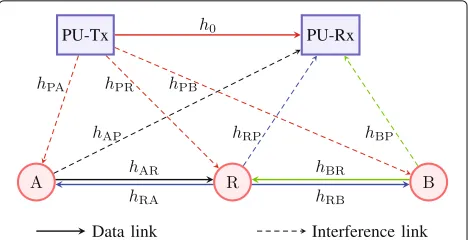
Figure1shows the system model which includes network nodes of the primary network and the secondary network. The primary network consists of a primary transmitter PU-Tx and a primary receiver PU-Rx while the secondary network consists of two terminals A and B exchanging data via the intermediate relay node R. It is assumed that each network node is equipped with a singe antenna and operates in the half-duplex mode.
The channel coefficient from node X to node Y is denoted ashXY, where X, Y∈ {A, B, R, P}. The interference
channel from the secondary nodes to the primary receiver (PU-Rx) ishXP, and the interference channel from the
pri-mary transmitter (PU-Tx) to secondary nodes ishPXwith
Fig. 1Cognitive underlay two-way relaying networks with interference and imperfect channel state information
gain from node X to node Y, |hXY|2, is an
exponential-distributed random variable having the cumulative distri-bution function (CDF) and probability density function (PDF) given as
F|hXY|2(z)=1−e− z
λXY, (1)
f|hXY|2(z)=
1
λXY e−
z
λXY, (2)
where λXY = E{|hXY|2} with E{.} being expectation
operator.
The two-way relay transmission process between node A and node B occurs in three phases, and relay node R processes its received signals using DF relaying. In the first phase, node A transmits its signals to node R. Then, node B transmits its signals to node R in the second phase. Finally, the relay decodes and encodes its received signals from node A and node B before broadcasting these signals to the two terminals in the third phase.
Since the secondary system operates at the primary sys-tem frequency band, the transmit power of the secondary network nodes has to be adjusted to ensure that interfer-enceIpto the receiver PU-Rx is kept under a threshold. Thus, if the secondary nodes fully possess the interference CSI at the primary receiver, the best transmit power of the secondary nodes can be defined as
PX=
Ip
|hXP|2
, X∈ {A, B, R}. (3)
However, in practice, perfect CSI of the interference links from secondary transmitters to the primary receiver is not available at the corresponding secondary transmit-ters because of channel estimation errors or time-varying impairments, is possibly caused by the combination of channel estimation error, mobility, feedback delay, and limited feedback. Therefore, interference channel coeffi-cients from the secondary node X to the primary receiver Y are often estimated as hXPˆ , which are different from
the exact channel coefficients, mathematically described as [31]
ˆ
hXP=ρhXP+
1−ρ2ξ
XP, (4)
where ξXP is a complex symmetric zero-mean
Gaus-sian random variable with the variance λXP, and ρ is
a correlation coefficient between the real channel and the estimated channel. This correlation coefficient can be determined using a pilot symbol modulated parameter (PSAM) [32]. For Rayleigh fading channels, the joint PDF
ofhXPˆ 2and|hXP|2is defined as [31]
f
|hXP|2,hˆXP
2(x,y)= e−
x+y
(1−ρ2)λXP
1−ρ2λ2 XP
I0
2ρ√xy
1−ρ2λ XP
,
(5)
whereI0(x) = π1 0πexcosθdθ is the zeroth-order
modi-fied Bessel function of the first kind.
From (5), we obtain the PDF of|ˆhXP|2as [33]
f hˆXP
2(y)= ∞
0 e−
x+y
(1−ρ2)λXP
1−ρ2λ2 XP
I0
2ρ√xy
1−ρ2λXP
dx
= λ1
XP e−
y
λXP. (6)
As a result, the best transmit power of the secondary network nodes for imperfect CSI can be defined as
PX= Ip
hˆXP
2, X∈ {A, B, R}. (7)
In the first phase, the received signal at node R from node A can be written as
yAR=
˜Ip
hˆAP
2hARxA+
PPU−TxhPRxP+n1R, (8)
where xX is the transmit symbol of node X with
E|xX|2
= 1;nkR ∼N(0,N0)is additive white Gaussian
noise (AWGN) at phasekwith zero mean and variance ofN0. In addition,xPandPPU−Txare the transmit symbol
and the transmit power of the primary transmitter PU-Tx, respectively, withE|xP|2
= 1. Similarly, we can write the received signal at node R from node B in the second phase as
yBR=
I˜p
hˆBP
2hBRxB+
PPU−TxhPRxP+n2R. (9)
γAR=
In the third phase, relay node R adjusts its transmit power to keep interference at the primary receiver input under a thresholdIp. The received signal at terminal X
with X∈ {A, B}in the third phase is given as terminal node X, andxR is the transmit symbol of relay node R withE|xR|2=1.
Thus, the simultaneous signal power to interference ratio at the two terminals A and B can be given by
γRA=
In this section, we study the performance of primary and secondary networks. For the primary networks, we consider the interference probability. For the secondary networks, we derive the system outage probability and its asymptotic expression at high SNR regime.
3.1 Primary networks: interference probability analysis
The interference probability is defined as the proba-bility that the interference from secondary transmitters received at the primary transmitters is greater than the interference threshold,Ip. Considering three
communica-tions phases for the secondary networks, we may write the primary interference probability using the theorem of total probability as follows:
PI=Pr Using the result in [29], we straightforwardly arrive at
PI=0.875, (16)
2 is for Rayleigh fading
channels.
To reduce PI, we adopt the back-off technique, i.e.,
reducing the secondary transmit power to obtain accept-able interference. Denoting δX with 0 ≤ δX ≤ 1 as the
back-off power control coefficient of node X, the transmit power of nodeXcan be rewritten as
¯
PX=δXPX= δX
Ip
|ˆhXP|2
. (17)
Applying Lemma 1 in [29], after tedious manipula-tions, we finally obtain the closed-form expression for the interference probability as
Applying the arithmetic-geometric inequality ([34], Eq. (11.116)) for three positive numbers1−ϕA
2 ,
From (19), it appears that the interference probability can achieve its minimum if and only ifδA=δB=δR=δ,
for an equi-correlation coefficient ρ in all interference channels.
Although the back-off power control technique is useful in obtaining satisfactoryPI, it also degrades the secondary
network performance. Thus, it is necessary to calculate the back-off power control peak coefficient for a given
PI. Using the analysis method as in [29], we can find the
back-off power control peak coefficient as follows:
δmax=
3.2 Secondary two-way relaying networks
receiving nodes using the back-off coefficient. In particu-lar, we obtain the SNR at R in the first and second phase, respectively, as follows:
For the third phase, we have the SNRs at A and B, respectively, as
γ
RA=δRγRA, (24)
and
γRB =δRγRB. (25)
For two-way DF relaying, the secondary system outage probability can be written as
OP=1−PrγAR> γth,γBR> γth,γe> γth
andγthis the given SNR threshold.
Assuming that γAR, γBR, andγe are independent of
each other, we may write
OP=1−PrγAR> γth
In order to derive the exact expression of the system outage probability, we consider the following Lemma.
Lemma 1Let X and Y are exponentially distributed ran-dom variables with meansλXandλY, respectively, and Z is a random variable defined as Z= PYX+1, whereP>0, P∈
Then, the exact closed-form expression for the system OP is stated in Theorem1.
Theorem 1For a given ρ, the closed-form expression for the system outage probability over Rayleigh fading channels is
where Ei(·) is the exponential integral [27, Eq. (8.211)], m1 = δγAIpλAR
ProofFrom (26), we can see that the explicit expression for the system outage probability in (28) can be defined after determining the CDF ofγAR ,γBR , andγe.
We first consider the CDF ofγAR . Using the conditional probability, we can write the CDF ofγAR as
Substituting (34) and (2) into (35), we have Making use the fact thatγRA andγRBare correlated due
to the common random variablehˆRP
Applying Lemma1for the second term in (39), where
X,Y, andz correspond |hRA|2, |hPA|2, and δxγRIthP, respec-exact expression for the secondary system outage proba-bility, when the interference CSI to the primary receiver is imperfect as in (31).
3.2.1 Asymptotic system outage probability at high SNR regime
By using 1−e−x x→≈0x, the approximate CDF expression forγAR ,γBR , andγeover the high SNR region can be
calcu-lated, so that the corresponding asymptotic system outage probability can be found.
ProofWe start the proof from the definition of
Based on the exponential approximate property, we are able to find the approximate CDF forγAR as
Fγ
Utilizing similar analytical steps, we find the approxi-mate CDF expression forγBR as
Fγ
For the approximate CDF expression forγe, from (39),
we have
We first calculateI1as follows:
I1=Pr
Similarly, we haveI2given by
I2=Pr define the approximate CDF expression forγeas
Fγe(γth) closed-form CDF expression for γe in the high SNR
Therefore, it can be seen that over the high SNR region, the system outage probability is proportional to I1
p. It
can be shown that over the high SNR region, the system diversity is one.
4 Numerical results and discussion
In this section, the analytical results are verified using Monte-Carlo simulation. It is assumed that the system network nodes lie on a plane coordinate system Oxy, and the distance between node A and node B is nor-malized to 1. Therefore, for simulation purposes, the two secondary terminals are placed at A[0; 0], B[1; 0], PU-Tx[0; 1], and PU-Rx[1; 1], respectively, and the relay node is located at R[0,5; 0]. dMN is the physical
dis-tance between two network nodes M and N, where M, N ∈ {A, B, R, PU−Rx, PU−Tx}. For free-space path loss transmission, we haveλMN=d−MNη, whereηis a path
loss exponent, 2 ≤ η ≤ 6. For simulation purposes, the following are also used:η=3,γth=1.25,δA=δB=δR=
δmax, andP= 20 dB.
Figure2shows the secondary system interference prob-ability to the primary receiver (PI) as a function ofρfor
three cases:δ=0.35,δ=0.5, andδ=0.75. It can be seen that our theoretical prediction and the simulation results are consistent, verifying our analyses. Furthermore,PIis
an inverse function ofρ, and there appears a singularity forρ→11.
In Fig.3, the secondary system outage probability for (i) when the correlation coefficientρis varied and (ii)PI
=0.05,P= 20 [dB] is presented, from which our analytical results are consistent with the simulation results, verifying our derivation approach. Furthermore, the severity of the correlation coefficientρto the secondary system quality
Fig. 2Effect of the correlation coefficient on the interference probabilityPIto the primary receiver
Fig. 3Effect of the correlation coefficient on the secondary system outage performance
is revealed when the secondary transmitters adjust their power following the back-off powerδmax.
Figure4presents the secondary system outage probabil-ity when the interference channel to the primary receiver is imperfect with a correlation coefficient ρ = 0.98 for
P=20 dB. The system is also simulated forPI=0.2,PI =
0.1, andPI = 0.05. It can be seen from Fig.4that
reduc-ing the interference probability degrades the secondary system quality. This is because the decrease in the inter-ference probabilityPIleads to the decrease of the back-off
factor. Therefore, the secondary network nodes’ transmit power decreases, hence increasing the secondary system outage probability.
5 Conclusion
This paper studies the DF two-way relay transmission sys-tem in cognitive radio environments. Furthermore, our proposed model considers the primary transmitter inter-ference to the secondary system and evaluates the system quality when the interference CSI from the secondary transmitters to the primary receiver is imperfect. This paper has derived the interference probability to the pri-mary receiver, the maximum back-off power factor which is used to keep interference under a threshold level. For the secondary system, an exact expression for the system outage probability and its asymptotic expression for the high SNR region have been obtained. These new find-ings have been verified using the Monte-Carlo simulation results. Further studies on two-way relay systems with imperfect CSI at the primary transmitters will be reported in a separate publication.
Endnote
1ρcan be assumed less than 1 to avoid the singularity.
Acknowledgements
The authors would like to thank the reviewers for their thorough reviews and helpful suggestions.
Funding
This research work was funded by Vietnam National Foundation for Science and Technology Development (NAFOSTED) under Grant No. 102.04-2014.32.
Availability of data and materials
Not applicable.
Authors’ contributions
HVT and VNQB proposed the system model, derived the system performance, and performed the simulation and manuscript writing. KNL contributed in the manuscript preparation and manuscript revision. All authors read and approved the final manuscript.
Authors’ information
Not applicable.
Competing interests
The authors declare that they have no competing interests. Publisher’s Note
Springer Nature remains neutral with regard to jurisdictional claims in published maps and institutional affiliations.
Author details
1Le Quy Don Technical University, Hanoi, Vietnam.2Department of Wireless Communications, Posts and Telecommunications Institute of Technology, 11 Nguyen Dinh Chieu, Dakao Ward, District 1, Ho Chi Minh City, Vietnam. 3Western Sydney University, Sydney, Australia.
Received: 26 July 2017 Accepted: 22 February 2018
References
1. MR A Singh, RK Bhatnagar, Mallik, Cooperative spectrum sensing in multiple antenna based cognitive radio network using an improved energy detector. IEEE Commun. Lett.16(1), 64 (2012)
2. MR A Singh, RK Bhatnagar, Mallik, Performance of an improved energy detector in multihop cognitive radio networks. IEEE Trans. Veh. Technol.
65(2), 732 (2016)
3. D Goel, VS Krishna, M Bhatnagar, Selection relaying in
decode-and-forward multi-hop cognitive radio systems using energy detection. IET Commun.10(7), 753 (2016)
4. G Scutari, DP Palomar, S Barbarossa, Cognitive MIMO radio. IEEE Signal Process. Mag.25(6), 46 (2008)
5. A Alsharoa, H Ghazzai, MS Alouini, Optimal transmit power allocation for MIMO two-way cognitive relay networks with multiple relays using AF strategy. IEEE Wireless Commun. Lett.3(1), 30 (2014)
6. K Ho-Van, Exact outage analysis of modified partial relay selection in cooperative cognitive networks under channel estimation errors. IET Commun.10(2), 219 (2016)
7. VNQ Bao, TQ Duong, Exact outage probability of cognitive underlay DF relay networks with best relay selection. IEICE Trans. Commun.E95.B(6), 2169 (2012)
8. HK Boddapati, MR Bhatnagar, S Prakriya, in2016 IEEE Globecom Workshops (GC Wkshps). Ad-hoc relay selection protocols for multi-hop underlay cognitive radio networks. (Washington, 2016), pp. 1–6
9. HK Boddapati, S Prakriya, MR Bhatnagar, in2017 IEEE Int. Conf. Commun. Workshops (ICC Workshops). Throughput analysis of cooperative multi-hop underlay CRNs with incremental relaying. (Paris, 2017), pp. 379–385 10. AG Fragkiadakis, EZ Tragos, IG Askoxylakis, A survey on security threats
and detection techniques in cognitive radio networks. IEEE Commun. Surveys & Tutorials.15(1), 428 (2013)
11. Y Zhang, W Han, D Li, P Zhang, S Cui, Power versus spectrum 2-D sensing in energy harvesting cognitive radio networks. IEEE Trans. Signal Process.
63(23), 6200 (2015)
12. DK Nguyen, M Matthaiou, TQ Duong, H Ochi, inProc. 2015 IEEE Int. Conf. Commun. Workshop (ICCW). RF energy harvesting two-way cognitive DF relaying with transceiver impairments. (London, 2015), pp. 1970–1975 13. Z Xing, Z Yan, Y Zhi, X Jia, W Wenbo, Performance analysis of cognitive
relay networks over Nakagami-m fading channels. IEEE J. Sel. Areas Commun.33(5), 865 (2015)
14. B Zhong, Z Zhang, Opportunistic two-way full-duplex relay selection in underlay cognitive networks. IEEE Systems J.PP(99), 1 (2016) 15. PS Bithas, AA Rontogiannis, K Berberidis, inProc. 2014 Int. Conf. Wireless
and Mobile Comput. Netw. Commun. (WiMob). SINR analysis of cognitive underlay systems with multiple primary transceivers in Nakagami-m fading, (Larnaca, 2014), pp. 500–505
16. R Boris, W Armin, Spectral efficient protocols for half-duplex fading relay channels. IEEE J. Sel. Areas Commun.25(2), 379 (2007)
17. L Song, Relay selection for two-way relaying with amplify-and-forward protocols. IEEE Trans. Veh. Technol.60(4), 1954 (2011)
18. Y Jing, F Pingzhi, TQ Duong, L Xianfu, Exact performance of two-way AF relaying in Nakagami-mfading environment. IEEE Trans. Wireless Commun.10(3), 980 (2011)
19. Z Chensi, G Jianhua, L Jing, R Yun, M Guizani, A unified approach for calculating the outage performance of two-way AF relaying over fading channels. IEEE Trans. Veh. Technol.64(3), 1218 (2015)
20. TT Duy, HY Kong, Exact outage probability of cognitive two-way relaying scheme with opportunistic relay selection under interference constraint. IET Commun.6(16), 2750 (2012)
21. A Afana, A Ghrayeb, V Asghari, S Affes, inProc. IEEE 14th Workshop Signal Process. Adv. Wireless Commun. (SPAWC). On the performance of spectrum sharing two-way relay networks with distributed beamforming. (2013), pp. 365–369
22. A Afana, A Ghrayeb, V Asghari, S Affes, Distributed beamforming for spectrum-sharing systems with AF cooperative two-way relaying. IEEE Trans. Commun.62(9), 3180 (2014)
23. A Afana, A Ghrayeb, VR Asghari, S Affes, Distributed beamforming for two-way DF relay cognitive networks under primary-secondary mutual interference. IEEE Trans. Veh. Technol.64(9), 3918 (2015)
24. HV Toan, VNQ Bao, inProc. 2016 International Conference on Advanced Technologies for Communications (ATC). Opportunistic relaying for cognitive two-way network with multiple primary receivers over Nakagami-m fading. (Hanoi, 2016), pp. 141–146
25. Y Cao, C Tellambura, Cognitive beamforming in underlay two-way relay networks with multi-antenna terminals. IEEE Trans Cogni. Commun. Netw.1(3), 294 (2015)
26. X Zhang, Z Zhang, J Xing, R Yu, P Zhang, W Wang, Exact outage analysis in cognitive two-way relay networks with opportunistic relay selection under primary user’s interference. IEEE Trans. Veh. Technol.64(6), 2502 (2015) 27. P Ubaidulla, S Aissa, inProc. IEEE 22nd Int. Symp. Personal Indoor and Mobile
Radio Commun. (PIMRC). Distributed cognitive two-way relay beamformer designs under perfect and imperfect CSI, (Toronto, 2011), pp. 487–492 28. SH Safavi, M Ardebilipour, S Salari, Relay beamforming in cognitive
29. VNQ Bao, TQ Duong, C Tellambura, On the performance of cognitive underlay multihop networks with imperfect channel state information. IEEE Trans. Commun.61(12), 4864 (2013)
30. K Ho-Van, PC Sofotasios, S Freear, Underlay cooperative cognitive networks with imperfect Nakagami-m fading channel information and strict transmit power constraint: interference statistics and outage probability analysis. J. Commun. Netw.16(1), 10 (2014)
31. HA Suraweera, PJ Smith, M Shafi, Capacity limits and performance analysis of cognitive radio with imperfect channel knowledge. IEEE Trans. Veh. Technol.59(4), 1811 (2010)
32. X Tang, MS Alouini, AJ Goldsmith, Effect of channel estimation error on M-QAM BER performance in Rayleigh fading. IEEE Trans. Commun.47(12), 1856 (1999)
33. M Schwartz, WR Bennett, S Stein,Communication systems and techniques. (Wiley-IEEE Press, New York, 1995)