R E S E A R C H
Open Access
Optimization of a MIMO
amplify-and-forward relay system with channel state
information estimation error and feedback
delay
Ying Zhang
*, Danni Zhao, Huapeng Zhao, Yinjiang Chen and Ning Kang
Abstract
This paper addresses the robust design of a multiple-input multiple-output amplify-and-forward relay system against channel state information (CSI) mismatch due to estimation error and feedback delay. The estimation error and feedback delay are expressed using appropriate models, from which we derive the conditional mean square error (MSE) between the desired and the received signals upon the estimated CSI. The conditional MSE is then minimized to optimize the relay beamforming matrix with relay transmission power constraint. It is shown that the proposed optimization problem reduces to the conventional minimum MSE problem when CSI mismatch vanishes. By analyzing the structure of the optimal beamforming matrix, the optimization problem is simplified so that it can be directly solved using the genetic algorithm (GA). To further reduce the computational load, we develop a relaxed version of the optimization problem. It is found that the relaxation enables us to efficiently solve the problem using water filling strategy. Computer simulations show that both GA and water filling solutions are superior to
conventional solutions without CSI mismatch consideration, while the water filling is 1000 times faster than the GA.
Keywords: Channel state information mismatch, Conditional expectation, Multiple-input multiple-output, Minimum mean square error, Relay network
1 Introduction
Relaying technique is capable of extending communica-tion range and coverage by providing link to shadowed users via relay nodes. From the perspective of signal pro-cessing, the cooperative relays can be viewed as a virtual antenna array which provides spatial diversity to com-bat frequency/time fading of channels. Attracted by its obvious merits, relaying technique has received extensive study in recent years [1–3].
The advantages of multiple-input multiple-output (MIMO) systems can be exploited in relay communica-tions by accommodating multiple antennas at the nodes [4]. Recently, many works concentrate on designing non-regenerative MIMO relay systems. With perfect channel state information (CSI) assumption of all hops, optimal
*Correspondence: [email protected]
College of Electronic Engineering, University of Electronic Science and Technology of China, Xiyuan Avenue, 610066 Chengdu, China
designs of MIMO amplify-and-forward (AF) relay net-works were proposed [5–9]. To take CSI mismatch into account, robust design of a three-node MIMO relay sys-tem against CSI mismatch for linear non-regenerative MIMO relays was established in [10], where quality of service was attained by minimizing the averaged trans-mission power subject to mean square error (MSE) con-straints at each data stream. Assuming the CSI uncertainty lies in a norm bounded region, two performance met-rics, mutual information and MSE, were adopted to design the MIMO AF relay precoders in [11]. With the goal to minimize the MSE between the transmitted and the esti-mated symbol, Zhang proposed a robust precoder for MIMO AF relay systems against channel estimation error [12]. In [13], MSE minimization criterion was proposed to deal with CSI mismatch, and a closed-form solution was derived. In [14], two schemes aiming to maximize the signal-to-interference noise ratio were proposed to deal with CSI mismatch. In [15], the channel quantization
error was considered and robust precoding schemes were proposed based on zero forcing and minimum MSE cri-terion. Also, a novel precoding scheme for MIMO relay systems in the presence of imperfect CSI was introduced in [16], where a base station precoding matrix and a relay station precoding matrix were created.
All the aforementioned algorithms focus on enhancing robustness against CSI estimation error. Besides CSI esti-mation error, other factors can also cause mismatch. In [17], quatized CSI feedback was considered and a strategy of scaling quantization quality of both two-hop links was proposed. Besides, channel feedback delay also has a sig-nificant influence on the performance of an AF relay sys-tem [18]. Therefore, it is highly desirable to consider both CSI estimation error and feedback delay when designing the MIMO AF relay system.
This paper presents a robust design of a MIMO AF relay system against CSI feedback delay and estimation error. The conditional MSE between the desired and received signals upon the estimated CSI is derived based on models of CSI feedback delay and estimation error. The condi-tional MSE is minimized subject to relay power constraint to optimize the beamforming matrix. Two solutions, one global and one relaxed, are proposed. Computer simu-lations show that both solutions outperform the MMSE strategy in terms of bit error rate (BER). It is also shown that ignoring the feedback delay results in higher BER. Although the relaxed solution is not as good as the global solution, it requires 1000 times less CPU time than the global solution. Hence, the relaxed solution provides a fast option for practical use.
2 Relay system mode
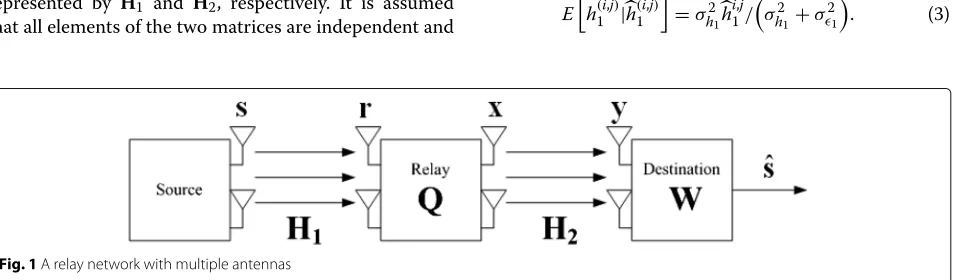
Figure 1 depicts a relay network consisting of a source node, a relay node, and a destination node, where the source and destination nodes are equipped withM anten-nas, and the relay node is equipped with Lantennas. It is assumed thatL ≥ M. Direct link between the source node and the destination node is supposed to be absent. Frequency flat fading channels are considered. The source to relay and relay to destination channel matrices are represented by H1 and H2, respectively. It is assumed that all elements of the two matrices are independent and
identically distributed complex Gaussian variables with zero mean and variancesσh2
1andσ 2
h2.
The output of the system, denoted bys, is given by
s=WH2QH1s+Wn, (1)
wheresis the transmitted signal,Wdenotes the equaliza-tion matrix at the destinaequaliza-tion node,Qdenotes the relay beamforming matrix andn=H2Qn1+n2is the additive noise at the destination node.n1andn2are the additive complex Gaussian noises with zero mean and covariance
σ2
1INr andσ22INs, respectively.
In the conventional MMSE strategy, Q and W are
optimized by minimizingEs−s22s,nsubject to relay transmission power constraint [19]. This criterion is opti-mal if the estimated channel matrices are the same as the real ones. However, due to estimation error and feed-back delay, there is usually certain mismatch between the estimated and the real channel matrices in practice. Therefore, a more realistic algorithm should take the CSI mismatch into account when designingQandW.
3 Models of CSI feedback delay and estimation error
3.1 Source to relay CSI
Denote the(i,j)th element ofH1ash(1i,j). The maximum likelihood (ML) estimate of h(1i,j) is represented by hi1,j. According to the stochastic error model [20],h(1i,j)andhi1,j
are related by
hi,j
1 =h
(i,j)
1 +
(i,j)
1 , (2)
where (1i,j) denotes the estimation error which is mod-eled by a complex Gaussian variable with zero mean and varianceσ21 =σ12/(N1−1).N1is the number of training samples to obtainh(1i,j), andσ12is the noise level at relay node.
Based on the Bayesian theory, the conditional expecta-tion ofh(1i,j)uponhi1,jis given by
E
h(1i,j)|h(1i,j)
=σ2
h1h
i,j
1/
σ2
h1+σ 2
1
. (3)
Conditional correlation ofh(1i,j)andh1(k,l)uponh(1i,j)and
3.2 Relay to destination CSI
Since the estimated CSI needs to be fed back from the des-tination to relay, due to channel temporal variation, the estimated CSI is actually an early version of the real CSI. Denote the(i,j)thelement ofH2ash(2i,j). According to the channel temporal variation model,hτ(2i,j)which represents an early version ofh(2i,j)is related toh(2i,j)via [21]
h2(i,j)=ρh2τ(i,j)+ζ(i,j), (5) whereρ is the normalized correlation coefficient calcu-lated asρ = J0(2πfdτ).J0 denotes the first kind Bessel function of order zero, andfd is the maximum Doppler
frequency.ζ(i,j)in (5) is a complex Gaussian variable with zero mean and variance1−ρ2σh2
2.
Denote the estimate of hτ(2i,j) byhτ(2i,j). Based on the stochastic error model, the relationship betweenhτ(2i,j)and
hτ(2i,j)is given by the number of training samples and the noise level in estimatinghτ(2i,j), respectively.
With (5) and (6), using the Bayesian theory, the condi-tional expectation ofh(2i,j)uponhτ(2i,j)is given by [21]
4 Robust design of a MIMO AF relay system
4.1 Minimum conditional MSE criterion
Taking CSI mismatch ofH1andH2into account, the pro-posed objective function is to minimize the conditional MSE between the transmitted and received signals subject to relay power constraint, which is given as follows:
min
wherePris the upper bound of relay transmission power.
Assuming thats andnare independent, based on (1), setting the gradient of (9a) with respect to WH to zero yields the optimalW
Wopt=σs2EHH|H1 ,H2 (Rn)−1, (10)
whereWoptdenotes the optimal solution ofW, andRn=
σ2 (shown on the top of next page).
max
It is observed from (11a) thatQis contained in the inver-sion manipulation; therefore, direct optimization of (11) is difficult. To facilitate the solution of (11), the structure of optimalQis analyzed and it is found that optimalQhas the form of
Qopt=V21UH1, (12)
whereQopt is the optimalQ,1 is anM×Mdiagonal matrix, andVH2 andU1are unitary matrices constituted by right- and left-singular vectors ofH2andH1, respectively. The proof of (12) is provided in Appendix A. Using (12), (11) is equivalently expressed as
b=σ2 H2, respectively. Details of transformation from (11) to (13) are presented in Appendix B. The optimization prob-lem (13) is easier to solve than (11). Once the optimal1is derived,QoptandWoptare computed using (12) and (10), respectively.
which are equivalent to (24) and (25) of [19]. Therefore, the minimum conditional MSE criterion reduces to the MSE criterion when the CSI mismatch vanishes.
4.2 Global solution by genetic algorithm
It is observed from (13) that multiplyingφiby a constant
maximizes the relay power and the value of the objective function (13a). Therefore, the optimalφican be obtained
while (13b) achieves equality. Based on this observation, the values of chromosomes in genetic algorithm (GA) is optimized within 0 and 1, then multiplied with a constant
αwhich is obtained when (13b) achieves equality, i.e.,
α= Pr
M
i=1σs2|φi|2|λ1,i|2+σs2σh21|h1 |φi|2+σ12|φi|2
.
(18)
Substitutingαφiinto (13a) yields the value of the fitness
function of GA.
4.3 Relaxed solution by water filling strategy
It is observed from (13a) that the terms ofb andc con-tainφi,i=1,. . .,M, which prevent deriving an analytical
solution to (13). To avoid high computational loads of using the global searching algorithm, a relaxed version of (13) is proposed here.
From (13a), it is noted that increasing the values ofband
creduces the value ofJ(1), which means
J(1)≥J(1)max, (19)
where J(1)max is computed from (13a) using bmax and
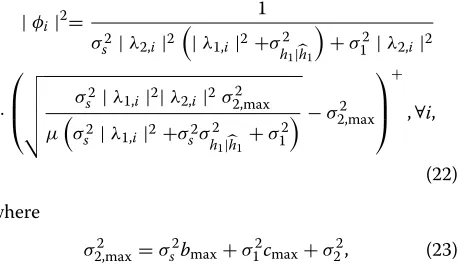
cmax. Here,bmaxandcmaxdenote the maximum values ofb andc, respectively. From the relay power constraint (13b),
the possible values ofbmaxandcmaxare straightforward to derive and are given below:
bmax=
Substituting (20) and (21) into (13), and using the Lagrange multiplier technique, the solution of the relaxed version of (13) is given by
|φi|2= should be chosen such that (13b) is satisfied.
5 Computer simulations
To demonstrate validity and advantages of the proposed strategy, the following simulation scenarios are devised. The channel coefficients are assumed to be complex Gaussian variables with zero mean and varianceσh2
1 and
σ2
h2. The signal-to-noise ratio (SNR) of the backward and forward channels are defined as SNR1 = σs2σh21/σ
2 1 and SNR2=Prσh22/σ22L, respectively. The source is generated from a QPSK constellation. It is assumed that the number of data samples is 120, containingNtr=20 training
sam-ples. The number ofMis 4. The relay transmission power
Pris 0 dB. The BER is derived from 100 independent trials
for all the plots. The proposed algorithm is compared with the conventional MMSE strategy and the robust method which only considers CSI estimation error.
Figure 2 plots the BER versus SNR1 with L = 4,
SNR2 = 10 dB, and ρ = 0.90. Because CSI
0 5 10 15 20 −2.2
−2 −1.8 −1.6 −1.4 −1.2 −1 −0.8
SNR
1 (dB)
BER
conventional water filling correlation ignored proposed water filling proposed algorithm using GA
Fig. 2BER versus SNR2withL=4, SNR2=10 dB, andρ=0.90
using GA yields smaller BER than that of the proposed water filling method.
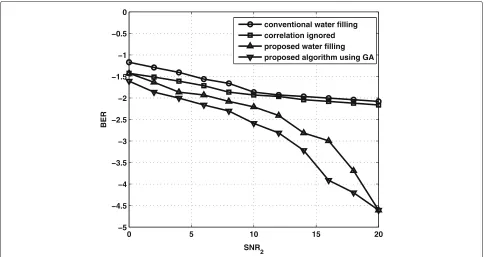
In Fig. 3, we assume a better communication environ-ment. The SNR1is fixed at 20 dB, and the value ofρ is assumed as 0.95. Figure 3 shows the BER versus the value of SNR2. It can be seen that the performance of all the methods becomes better as the value of SNR2increases.
Compared with Fig. 2, all the methods give smaller BER when SNR1 = 20 dB and SNR2=10 dB, since the value ofρincreases. As SNR2increases beyond 10 dB, the per-formance of the conventional water filling technique and the robust method against CSI estimation error do not have significant improvement, while BER of the proposed methods continue to decrease.
0 5 10 15 20
−5 −4.5 −4 −3.5 −3 −2.5 −2 −1.5 −1 −0.5 0
SNR2
BER
conventional water filling correlation ignored proposed water filling proposed algorithm using GA
4 5 6 7 8 9 10 −6
−5 −4 −3 −2 −1 0
L
BER
conventional water filling correlation ignored proposed water filling proposed algorithm using GA
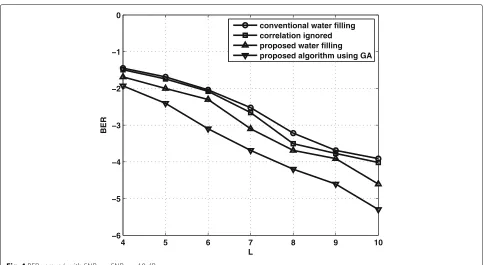
Fig. 4BER versusLwith SNR1=SNR2=10 dB
Figure 4 plots BER versus the value of L with SNR1
and SNR2 equal to 10 dB. It is natural to see that
the BER of all the methods decrease as the number of antennas equipped on relay increases. Furthermore, it is observed that the increase ofLfavors the improvement of performance of the conventional water filling technique
and the robust algorithm against CSI estimation error. The gap between these two methods and the proposed methods becomes smaller.
In Fig. 5, plots of BER versus the value of ρ are
given. BERs of all the methods increase as the value of
ρ decreases. It is verified that channel correlation has
0.9 0.92 0.94 0.96 0.98 1
−3.5 −3 −2.5 −2 −1.5 −1
ρ
BER
conventional water filling correlation ignored proposed water filling proposed algorithm using GA
0 0.05 0.1 0.15 0.2 0.25 0.3 0.35 0.4 0.45 0.50.5
SNR1=SNR2=10 dB,L=M=4,ρ=0.90
proposed algorithm using GA proposed water filling conventional water filling correlation ignored
Fig. 6CDF of BER with SNR1=SNR2=10 dB,ρ=0.90, andL=4
significant compact on the performance of all the meth-ods. The proposed methods outperform the conventional MMSE method for all values ofρ. Whenρ = 1, perfor-mance of the proposed methods and the robust algorithm against CSI estimation error become same.
Figure 6 shows the cumulative distribution function (CDF) of BER with SNR1=SNR2=10 dB,ρ=0.90, and
L = 4. It is observed that the proposed methods yield smaller BER at a high probability than that of the other methods.
To compare computational time of the GA and the relaxed solution, 100 independent trials are conducted. The number of antennas at all the nodes are assumed to be the same. From Table 1, it is observed that the relaxed solution cost far less computational time than that of the GA.
6 Conclusions
In this paper, we consider the robust design of an AF relay system against CSI mismatch. A relay system equipped with multiple antennas is considered. The conditional expectation of the mean square error is minimized with respect to precoding matrix and equalization coefficient. Computer simulations show that when the estimated
Table 1Computational time (second) comparison of 100 independent trials withM=L
Methods L=4 L=8 L=16 L=32
GA 140.78 176.75 396.56 2739.67
Relaxed solution 0.103 0.164 0.214 0.360
CSI is different from the real CSI, the proposed strat-egy outperforms the MMSE strategies with perfect CSI assumption. The advantages include lower BER with dif-ferent values ofρ, SNR1, SNR2, andL. Also, the proposed strategy is more likely to give small BER compared to the conventional MMSE strategy. Therefore, the proposed strategy is more reliable to be used in real applications.
Appendix A
From (26) and (27), it is straightforward to show that ∀z,f(z|)≥f(z|=0). (28) SupposeA,B, andare non-negative matrices, then
tr(A+)−1B≤trA−1B. (29)
Therefore, (28) and (29) gives the result that
Appendix B
Proof of Lemma 1From the theorem, we have
EHHH |H1,H2 Similarly, it can be derived that
Rn=
Using (30)–(32), we have (33)
trHHσs2E
In a similar way, (11b) can be calculated as (13b).
Acknowledgements
This work was supported by grants from the Central University Research Founding (ZYGX2014J018), National Science Foundation of China (61671121), and UESTC Research Start-up funding (ZYGX2016KYQD106).
Competing interests
The authors declare that they have no competing interests.
Received: 25 June 2015 Accepted: 13 September 2016
References
1. JN Laneman, DNC Tse, GW Wornell, Cooperative diversity in wireless networks: efficient protocols and outage behavior. IEEE Trans. Inf. Theory.
50(12), 3062–3080 (2004)
2. CS Patel, GL Stuber, TG Pratt, Statistical properties of amplify and forward relay fading channels. IEEE Trans. Veh. Technol.55(1), 1–9 (2006) 3. G Zheng, Collaborative-relay beamforming with perfect CSI: optimum and
distributed implementation. IEEE Signal Proc. Lett.16(4), 257–260 (2009) 4. B Wang, J Zhang, A Host-Madsen, On the capacity of MIMO relay
channels. IEEE Trans. Inf. Theory.51(1), 29–43 (2005)
5. C-C Chien, H-J Su, H-J Li, Joint beamforming and power allocation for MIMO relay broadcast channel with individual SINR constraints. IEEE Trans. Veh. Technol.63(4), 1660–1677 (2014)
6. V Havary-Nassab, S Shahbazpanahi, A Grami, Z-Q Luo, Distributed beamforming for relay networks based on second-order statistics of the channel information. IEEE Trans. Signal Process.56(9), 4306–4316 (2008) 7. O Munoz, J Vidal, A Augustin, Linear transceiver design in
non-regenerative relays with channel state information. IEEE Trans. Signal Process.55(6), 2593–2604 (2007)
8. X Tang, Y Hua, Optimal design of non-regenerative MIMO wireless relays. IEEE Trans. Wirel. Commun.6(4), 1398–1407 (2007)
9. Y Rong, X Tang, Y Hua, A unified framework for optimizing linear non-regenerative multicarrier MIMO relay communication systems. IEEE Trans. Signal Process.57(12), 4837–4851 (2009)
10. Y Rong, in2010 Australian Communications Theory Workshop. Robust design for linear non-regenerative MIMO relays, (Canberra, 2010), pp. 87–92
11. H Shen, J Wang, Robust optimization for amplify-and-forward MIMO relaying from a worst-case perspective. IEEE Trans. Signal Process.61(21), 5458–5471 (2013)
12. Z Zhang, J Xu, L Qiu, Robust ARQ precoder optimization for AF MIMO relay systems with channel estimation errors. IEEE Trans. Wirel. Commun.
12(10), 5236–5247 (2013)
13. C Xing, S Ma, YC Wu, Robust joint design of linear relay precoder and destination equalizer for dual-hop amplify-and-forward MIMO relay systems. IEEE Trans. Signal Process.58(4), 2273–2283 (2010)
14. Z Wang, W Chen, J Li, Efficient beamforming for MIMO relaying broadcast channel with imperfect channel estimation. IEEE Trans. Signal Process.
61(1), 419–426 (2012)
15. B Zhang, Z He, K Niu, L Zhang, Robust linear beamforming for MIMO relay broadcast channel with limited feedback. IEEE Signal Proc. Lett.17(2), 209–212 (2010)
16. Y Cai, RC de Lamare, LL Yang, M Zhao, Robust MMSE precoding based on switched relaying and side information for multiuser MIMO relay systems. IEEE Trans. Veh. Technol.64(12), 5677–5687 (2015)
17. W Xu, X Dong, WS Lu, MIMO relaying broadcast channels with linear precoding and quantized channel state information feedback. IEEE Trans. Signal Process.58(10), 5233–5245 (2010)
18. HA Suraweera, TA Tsiftsis, Effect of feedback delay on amplify-and-forward relay networks with beamforming. IEEE Trans. Veh. Technol.60(3), 1265–1271 (2011)
19. W Guan, H Luo, Joint MMSE transciever design in non-regenerative MIMO relay systems. IEEE Commun. Lett.12(7), 517–519 (2008)
20. R Mo, YH Chew, C Yuen, Information rate and relay precoder design for amplify-and-forward MIMO relay networks with imperfect channel state information. IEEE Trans. Veh. Technol.61(9), 3958–3968 (2012) 21. AP Liavas, Tomlinson-Harashima precoding with partial channel
knowledge. IEEE Trans. Commun.53(1), 5–9 (2005)
Submit your manuscript to a
journal and benefi t from:
7Convenient online submission
7Rigorous peer review
7Immediate publication on acceptance
7Open access: articles freely available online
7High visibility within the fi eld
7Retaining the copyright to your article