Volume 2006, Article ID 91919, Pages1–10 DOI 10.1155/ASP/2006/91919
Efficient Closed-Loop Schemes for MIMO-OFDM-Based WLANs
Xiayu Zheng,1Yi Jiang,2and Jian Li1
1Department of Electrical and Computer Engineering, University of Florida, Gainesville, FL 32611-6130, USA 2Department of Electrical and Computer Engineering, University of Colorado, Boulder, CO 80309-0425, USA
Received 28 December 2005; Revised 18 July 2006; Accepted 13 August 2006
The single-input single-output (SISO) orthogonal frequency-division multiplexing (OFDM) systems for wireless local area net-works (WLAN) defined by the IEEE 802.11a standard can support data rates up to 54 Mbps. In this paper, we consider deploying two transmit and two receive antennas to increase the data rate up to 108 Mbps. Applying our recent input multiple-output (MIMO) transceiver designs, that is, the geometric mean decomposition (GMD) and the uniform channel decomposition (UCD) schemes, we propose simple and efficient closed-loop MIMO-OFDM designs for much improved performance, compared to the standard singular value decomposition (SVD) based schemes as well as the open-loop V-BLAST (vertical Bell Labs layered space-time) based counterparts. In the explicit feedback mode, precoder feedback is needed for the proposed schemes. We show that the overhead of feedback can be made very moderate by using a vector quantization method. In the time-division duplex (TDD) mode where the channel reciprocity is exploited, our schemes turn out to be robust against the mismatch between the uplink and downlink channels. The advantages of our schemes are demonstrated via extensive numerical examples.
Copyright © 2006 Xiayu Zheng et al. This is an open access article distributed under the Creative Commons Attribution License, which permits unrestricted use, distribution, and reproduction in any medium, provided the original work is properly cited.
1. INTRODUCTION
The single-input single-output (SISO) orthogonal freque-ncy-division multiplexing (OFDM) systems for wireless local area networks (WLAN) defined by the IEEE 802.11a stan-dard can support data rates up to 54 Mbps [1]. Improv-ing the data rate to over 100 Mbps is a major goal of the next-generation WLANs [2,3]. The input multiple-output (MIMO) communication technology is widely re-garded as a key to achieve such a high data rate.
Assuming that the channel state information (CSI) is available at both the transmitter and the receiver, the MIMO channel can be decoupled, using singular value decomposi-tion (SVD), into multiple orthogonal subchannels (or eigen-modes) on each subcarrier [4]. To maximize the channel throughout, power allocation and bit loading should be ap-plied to the subchannels in both the spatial and frequency domains (see, e.g., [5] and the references therein). However, bit loading is often not adopted in practice, such as in the IEEE 802.11 standards, due to its complexity. If the same constellation is used across all the subchannels, the weaker eigenmodes corresponding to the smaller singular values of the channel matrices tend to experience deeper fading [4], which degrades the overall system performance significantly. In [6], a power allocation method was proposed based on the minimum mean-squared error (MMSE) criterion for the
MIMO systems. This method tends to put more power on the weaker subchannels, which may cause significant capac-ity loss.
In this paper we propose simple and efficient closed-loop designs for MIMO-OFDM-based WLANs. We focus on the IEEE 802.11a standard, although our schemes are also ap-plicable to other standards including the US standard IEEE 802.11g and the European standard HIPERLAN/2 [7]. Our schemes combine the recently proposed geometric mean de-composition (GMD) and uniform channel dede-composition (UCD) transceiver designs [8,9] with horizontal encoding and successive (noniterative) decoding. (An idea similar to GMD appeared in the independent work of [10].) GMD and UCD decompose each MIMO channel into multiple equal gain subchannels for each subcarrier, which allows our de-signs to obviate the need of any power allocations. The simu-lation results show that our closed-loop schemes enjoy multi-dB improvement compared to the standard singular value decomposition (SVD) based schemes as well as the open-loop V-BLAST (vertical Bell labs layered space-time) based counterparts.
Input data
S/P
Convolution encoder
Convolution encoder
Interleaving and data-mapping
Interleaving and data-mapping
N22
precoders
IFFT+CP and P/S IFFT+CP
and P/S
x1k x1k
x2k x2k
Figure1: Transmitter design for MIMO-OFDM-based WLAN.
unit sphere. We show that the 2×2 unitary precoder matrix for each frequency subcarrier can be quantized by 6 bits with very small performance degradations. In the time-division duplex (TDD) mode, where the channel reciprocity principle holds [3], our schemes do not require any precoder feedback. With a simple modification, our schemes can be made quite robust against the uplink-downlink channel mismatches.
The remainder of this paper is organized as follows. Section 2describes the 2×2 MIMO channel model with spa-tial correlations.Section 3presents our closed-loop MIMO WLAN system configuration, including the precoder and equalizer designs, and the successive soft decoding approach. In Section 4, we consider the explicit feedback mode and provide two quantization methods for precoder feedback, where a new vector quantization algorithm is proposed. In Section 5, we consider the TDD mode and show that the proposed schemes can be made quite robust against the uplink-downlink channel mismatches. Numerical examples are given inSection 6to demonstrate the effectiveness of our schemes. We conclude the paper inSection 7.
Notation
We use bold upper case letters to denote matrices and bold lower case letters for column vectors. We use (·)T to denote the transpose and (·)∗ to denote the Hermitian transpose. · stands for the Euclidean norm and · Ffor the Frobe-nius norm.INis theN×Nidentity matrix; det(·) is the de-terminant of a matrix andE[·] denotes the expectation op-eration.
2. CHANNEL MODEL
Consider a 2×2 MIMO channel with spatial correlations, where the channel can be modeled as [11]:
h(t)=R1r/2
h11(t) h12(t)
h21(t) h22(t)
R1t/2, (1)
with Rt andRr quantifying the spatial correlations of the channel fading at the transmitter and the receiver, respec-tively, and
hi j(t)= L−1
l=0
h(i jl)δ
t−lTs
, 1≤i, j≤2, (2)
denoting the frequency-selective channel link between the
jth transmit andith receive antennas (withLbeing the chan-nel length andTsthe sampling period). The random vari-ables {h(i jl)}2i,j=1,l = 1,. . .,L, are assumed to be indepen-dently distributed zero-mean, circularly symmetric complex Gaussian variables. ApplyingNc-point fast Fourier transform (FFT) to h(t), we obtain the channel response in the fre-quency domain:
H(n)= L−1
l=0
hlTs
e−j2πnl/Nc, 1≤n≤N
c. (3)
We denote by
HkH
f(k)=
H11
f(k) H12
f(k)
H21
f(k) H22
f(k)
, 1≤k≤N,
(4)
the flat fading channel matrix at the kth data subcarrier (Nc=64 andN=48 for IEEE 802.11a), with f(k), 1≤k≤
N, denoting the data subcarrier mapping function in [1].
3. CLOSED-LOOP MIMO WLAN SYSTEM DESIGN
3.1. System description
Our MIMO-OFDM transmitter scheme is shown inFigure 1. We adopt the horizontal encoding method [12], where the two parallel branches perform encoding, bit interleaving, and data mapping separately. Letxikdenote theith encoded data symbol, i = 1, 2, on thekth subcarrier, and letxk = [x1k x2k]T. On each of theNdata subcarriers, the transmit-ter applies a 2×2 precoder matrixPk to obtainxk =Pkxk, 1≤k ≤N. Denote byxiktheith element ofxk. Thenxikis the symbol to be transmitted in theith branch at thekth sub-carrier. Consequently each precoded branch is OFDM mod-ulated using anNc-point IFFT and is added with a cyclic pre-fix (CP) before transmission. The length of CP is assumed to be longer than the channel lengthL, and therefore the inter-symbol interference (ISI) can be completely eliminated at the receiver side.
Output P/S Viterbi
decoder (soft) Viterbi decoder
(soft) Deinterleaving
and soft-demapping
Deinterleaving and soft-demapping
Encoder and interleaving
N22
equalizers (soft-output) S/P
and remove CP+FFT
S/P and remove
CP+FFT
y1k y1k
y2k y2k
Figure2: Receiver design for MIMO-OFDM-based WLAN.
estimates the reverse channel, that is, the one from the re-ceiver to the transmitter, via training pilots, it can calculate the precoders Pk,k = 1,. . .,N, to be used in the forward channel, that is, from the transmitter to the receiver.
Assuming accurate synchronization, frequency offset es-timation and channel eses-timation, the receiver first removes the CP and applies anNc-point FFT to each received branch as shown inFigure 2. Then the received signal vector at the
kth data subcarrier is
yk=HkPkxk+zk, k=1, 2,. . .,N, (5)
wherezk∼N(0,σz2I) denotes the circularly symmetric com-plex Gaussian noise. The key components of our closed-loop designs are the precoderPkat the transmitter and the corre-sponding equalizers at the receiver, as we describe next.
3.2. Precoder and equalizer design
We design the precoder and equalizer based on our GMD and UCD transceiver design schemes [8,9]. Both schemes are based on the following theorem [8].
Theorem 1. Any rankKmatrixH∈CM×Nwith singular val-uesλH,1≥λH,2≥ · · · ≥λH,K >0can be decomposed into
H=QRP∗, (6)
where(·)∗ denotes the conjugate transpose,R ∈ RK×K is an upper triangular matrix with equal diagonal elements ri = (Kn=1λH,n)1/K,1≤i ≤K, andQ ∈CM×K andP∈CN×K are semiunitary matrices.
Consider the channel model (5). In the explicit feedback mode, the GMD scheme [8] starts with the GMD matrix decompositionHk = QkRkP∗k at the receiver, to obtainPk, which is the unitary precoder to be fed back to the transmit-ter. Utilizing the precoderPkat the transmitter as in (5) leads to the following received data vector:
yk=QkRkxk+zk, k=1, 2,. . .,N. (7)
At the receiver, multiplyingykbyQ∗k yields
yk=Rkxk+zk, (8)
whereRk=Q∗kHkPkis a 2×2 upper triangular matrix with equaldiagonal andzk∼N(0,σz2I). The information symbols inxkcan then be detected successively starting from the sec-ond element ofxk(seeSection 3.3).
The UCD scheme [9] is somewhat more complicated than GMD. Like GMD, the UCD scheme has two implemen-tations forms of which one can be regarded as a combina-tion of a linear precoder with an MMSE V-BLAST equalizer. Compared to GMD, which suffers from capacity loss at low-to-moderate SNR, UCD is strictly capacity lossless and can achieve the optimal diversity-multiplexing gain tradeoff[13]. The details are omitted here due to limited space.
Both GMD and UCD obviate the need of bit loading and power allocation at the transmitter and require only the feed-back of the unitary precodersPk,k=1,. . .,N. In the TDD mode, the forward channel is estimated at the transmitter and therefore the precodersPkcan be calculated at the trans-mitter.
3.3. Successive soft decoding
Note that Rk is an upper triangular matrix. As shown in Figure 2, we adopt the schemes of deinterleaving, soft-demapping and the low-complexity soft Viterbi decoder used in [2] for each branch separately. We first detect the data se-quence of the lower branch to get the soft information. As-suming successful decoding of the data of the lower branch, we can cancel the interference due to the lower branch com-pletely before decoding the upper branch, as is denoted by the feedback link at the lower part ofFigure 2. The interfer-ence cancelation process of each subcarrierkusing GMD is outlined as follows.
(1) Initial stage
Calculate
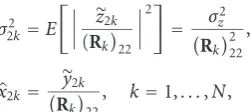
σ2 2k=E
z2k (Rk
22
2
= σz2 Rk
2 22
,
x2k=y2k Rk
22
, k=1,. . .,N,
(9)
the second entry ofyk. Note thatσ22kalong withx2kprovides the soft information for the lower branch. We can decode the lower branch data sequence by using the soft Viterbi decoder.
(2) Cancellation stage
Calculate
σ12k=E
z1k
Rk)11
2= σz2 Rk)211
=σ22k,
x1k=
y1k−
Rk
12x2k
Rk
11
, k=1,. . .,N,
(10)
whereσ12k along withx1k provides the soft information for the upper branch. Herex2k is the reconstructed data sym-bol sequence obtained from the Viterbi-decoder of the lower branch. Note that σ2
1k = σ22k because Rk has equal diago-nal. Given the soft information for the upper branch, we can also decode the upper branch data sequence by using the soft Viterbi decoder.
For UCD, the successive soft decoding procedure is sim-ilar. Because σ2
1k = σ22k, the two branches have effectively the same output SNR. In contrast, the SVD-based or the conventional V-BLAST-based methods lead to two subchan-nels with unbalanced gains. For the systems with a fixed symbol constellation across all the subchannels, the weaker subchannel dominates the overall packet-error-rate (PER) performance, although iterative decoding between the two branches is helpful for reducing the PER of V-BLAST [12].
4. PRECODER QUANTIZATION
In the explicit feedback mode, the channel is estimated at the receiver. We compute the precodersPk,k=1,. . .,N, at the receiver and feed them back to the transmitter. In the follow-ing, we present two quantization approaches to reduce the overhead of precoder feedback.
4.1. Scalar quantization
A simple scalar quantization scheme is as follows. Note that a 2×2 unitary precoder can be represented by
P(θ,φ)=
⎡
⎣ cosθ −sinθe−jφ
sinθejφ cosθ
⎤
⎦, 0≤θ < π, 0≤φ <2π.
(11)
Denote
Pθn1,φn2
=
⎡
⎣ cosθn1 −sinθn1e−jφn2 sinθn1ejφn2 cosθn1
⎤
⎦, (12)
where θn1 = πn1/N1, 0 ≤ n1 ≤ N1−1, φn2 = 2πn2/N2, 0≤n2≤N2−1, withN1andN2denoting the quantization levels ofθn1 andφn2, respectively. After obtaining the pre-coderPkusing GMD or UCD, we quantizePkto the “closest” (via round off) grid point in (12). Hence for each subcarrier
k, we only need to feed the index (n1,n2) back to the trans-mitter, which requires log2(N1N2) bits. To reduce the effect of quantization error and improve the robustness for GMD, instead of applying the original equalizerQ∗k at the receiver, we instead useQ∗k obtained by the QR decomposition:
HkP
θn1,φn2
QkRk, k=1,. . .,N. (13)
Note thatP(θn1,φn2) is known at the receiver. We also need to replace Rk by Rk in our interference cancelation stage. Clearly, whenN1andN2are reasonably large,Rkis approx-imately equal toRkand the two diagonal elements ofRkare almost the same, that is, the gains of the two branches remain almost the same. However, largerN1andN2also mean more feedback overhead. In practice, we need to chooseN1andN2 to achieve a reasonable tradeoffbetween feedback overhead and performance.
Similarly, we can apply the MMSE V-BLAST algorithm [14] to HkP(θn1,φn2) to obtain the equalizer when using UCD.
4.2. Vector quantization
Vector quantization can be adopted to further reduce the overhead of precoder feedback. We present a geometric ap-proach to perform vector quantization. Suppose we quantize the precoderP(θ,φ) to beP(θ,φ), where (θ,φ) correspond to an element in a codebook known to both the transmit-ter and receiver. Instead of transmitting the desired data vec-torP(θ,φ)xkat the transmitter, wherexkis the encoded data vector, we transmitP(θ,φ)xk. To optimize the quantization scheme, we minimize the following cost function:
d=EP(θ,φ)xk−P(θ,φ)xk2
=Exk∗P(θ,φ)−P(θ,φ)∗P(θ,φ)−P(θ,φ)xk
, (14)
with respect toθandφ. This cost function measures the aver-age distortion caused by the finite rate precoder quantization. Here the expectation is overxk. After some straightforward algebra, we obtain
P(θ,φ)−P(θ,φ)∗P(θ,φ)−P(θ,φ)
=2I2−2
cosθcosθ+ sinθsinθcos(φ−φ)I2. (15)
Because the value ofE[xk2] does not affect our quantiza-tion problem, without loss of generality, let E[xk2] = 1. Then
d=2−2cosθcosθ+ sinθsinθcos(φ−φ)
2−2ζ. (16)
to the 2D unit sphere{v∈R3:v =1}. Any point on the 2D unit sphere with angles (θ,φ) can be represented in the Cartesian coordinate asv =[cosθ sinθcosφ sinθsinφ]T, where the first element ofv is the (1, 1)-element ofP(θ,φ) and the second and third elements ofv, respectively, are the real and imaginary parts of the (2, 1)-element of P(θ,φ). EachP(θ,φ) corresponds to a pointvon the 2D unit sphere. Similarly, any point on the 2D unit sphere with angles (θ,φ) can be represented by the Cartesian coordinatev =
cosθ sinθcosφ sinθsinφT. We see thatζ is just the in-ner product betweenvandv. Defineψas the angle between vandv. Thenζ=cosψand
d=(2−2 cosψ)= v−v2
. (17)
Based on this derivation, we conclude that a good codebook {vi}Ni=v1should be distributed on the unit sphere as uniform as possible.
We use the following steps to determine the codebook. First, we generate a training set{vn,n=1, 2,. . .,Nt}via ran-domly pickingNt points on the 2D unit sphere, whereNtis a very large number. Next, starting with an initial codebook (obtained via the splitting method [15]), we iteratively up-date the codebook [15] until no further improvement on the minimum distance is observed based on the following crite-ria.
(1) Nearest neighbor condition (NNC): for a given code-book{vi}iN=v1, assign a vectorvnto theith region
Si=
vn:vn−vi2≤vn−vj2,∀j=i
, (18)
whereSi,i=1, 2,. . .,Nv, is the partition set for theith code vector.
(2) Centroid condition (CC): for a given partitionSi, the updated optimum code vectors{vi}Ni=v1satisfy
vi=arg min
vi=1
Evn−vi2|vn∈Si
, i=1, 2,. . .,Nv.
(19)
As shown in the appendix, the solution to the above opti-mization problem is
vi= vi
vi
, i=1, 2,. . .,Nv, (20)
wherevi=
vn∈Sivn/
vn∈Si1 is the mean vector for the
par-tition setSi,i=1, 2,. . .,Nv.
Hence, for each subcarrierk, we first map the precoder Pkas a pointvon the 2D unit sphere. According to the NNC criterion, we obtain the quantized vectorvfrom the code-book with indexi. The indexiis fed back to the transmitter to reconstruct the precoderP(θ,φ). In this case the overhead of feedback is log2(Nv) bits per subcarrier.
5. ROBUST TRANSCEIVER DESIGN IN THE TDD MODE
In the TDD mode, the channel reciprocity can be exploited to obviate the need of precoder feedback in high through-put MIMO WLAN system [3]. However, there is always a
mismatch between the forward channel (from transmitter to receiver) and reverse channel (from receiver to transmit-ter) due to channel variations and/or amplifier mismatches, which poses major difficulties of utilizing the conventional closed-loop schemes [16].
Our closed-loop schemes can be modified to be robust against the mismatches and be backward compatible with the standard open-loop V-BLAST receiver [8]. Denote byHkthe forward channel assumed by the transmitter and byHkthe actual channel matrix at thekth data subcarrier. We may de-note the channel mismatch as follows:
Hk=Hk+αE, 1≤k≤N, (21)
whereEis a matrix whose elements are independently and identically distributed (iid) complex-valued Gaussian vari-ables with zero-mean and variance σ2 = E[H
k2F]/4, and
αdetermines the level of channel mismatch. At the transmit-ter, the precodersPk,k=1,. . .,N, are obtained based onHk,
k=1,. . .,N. The pilot (for channel estimation) and data se-quences are both precoded using precodersPk,k=1,. . .,N, before transmission, which leads to the following received signals instead of (7):
yk=HkPkxk+zk, k=1, 2,. . .,N. (22)
Assuming perfect channel estimation at the receiver, the esti-mated channel matrix on thekth data subcarrier is the “vir-tual channel”HkPk. As inFigure 2, an equalizerQ∗k is applied to thekth subcarrier to yield
yk=Q∗k
HkPkxk+zk
, (23)
where the equalizerQ∗k is obtained from the QR decomposi-tion ofHkPk, that is,HkPk=QkRk. Hence
yk=Rkxk+zk, (24)
and we can apply successive soft decoding as described in Section 3.3to retrieve the transmitted data on thekth data subcarrier. Note that the channel gains of the two branches are usually unbalanced due to the mismatches betweenHk and Hk. However, for some small α, the output SNRs of the two branches should be close, which results in only marginal performance loss, as shown with numerical exam-ples inSection 6.
Similarly, for UCD, the precoderPkis calculated accord-ing to the UCD procedure based onHkand the receiver in-volves an MMSE V-BLAST equalizer.
6. NUMERICAL EXAMPLES
We present several numerical examples to demonstrate the superior performance of the proposed schemes. The system parameters used here are based on the IEEE 802.11a stan-dard. For the two transmit and two receive antenna systems, the 64-QAM modulation and the channel coding rate of
with length 16 which are discarded at the receiver to remove ISI. Therefore the total data rate is 2×log264×3/4×48/64× 20×64/(64 + 16) = 108 Mbps. The channel between each transmit and receive antenna pair is generated according to the Chayat model [17] with 50 ns root-mean-squared (RMS) delay spread (here the sampling period is Ts = 50 ns). We assume that the channels are perfectly estimated at the re-ceiver. The data are formatted into packets consisting of 1000 information bytes. According to IEEE 802.11a, the goal is to achieve the packet-error-rate (PER) of 0.1.
For the purpose of comparison, we also implement the following three standard schemes.
The first is a simple SVD-based scheme. For this scheme, both the transmitter and receiver apply unitary rotations to diagonalize the channel matrix at each subcarrier, which yields 2×48 =96 orthogonal data subchannels. No bit al-location is involved here, since otherwise 256-QAM or larger constellations would be used, which would pose difficulties in the hardware implementations due to the phase noise is-sues, and so forth. The input power is uniformly allocated to all the 96 data subchannels. One encoder/decoder is suffi -cient in this case because the SVD completely eliminates the interference between subchannels and no successive decod-ing is needed.
The second scheme is similar to the first, except that the power allocation (PA) algorithm of [6] is applied at each sub-carrier. Because the two subchannels at each subcarrier is usually highly unbalanced, this power allocation algorithm tends to compensate the weaker one with more power.
The third is an open-loop MMSE V-BLAST-based scheme. Just like the proposed GMD and UCD schemes, it applies two independent encoders and decoders for succes-sive interference cancelation. Of course, unlike GMD and UCD, the two data branches have usually unbalanced chan-nel gains. Improvement can be achieved via iterative decod-ing as described in the followdecod-ing. After decoddecod-ing the lower branch, we can decode the upper branch with the influence from the lower branch canceled. Now given the decoded data from the upper branch, we can obtain improved decoding of the lower branch by removing the influence of the data from the upper branch. This procedure can be iterated.
We also include the channel outage probability curve as a benchmark. Channel outage probability is defined as the probability that the instantaneous mutual information of the channel,
I(SNR)=20×48 64×
64 64 + 16
×
48
k=1 log
det
I2+ SNR
2 HkH
∗
k
,
(25)
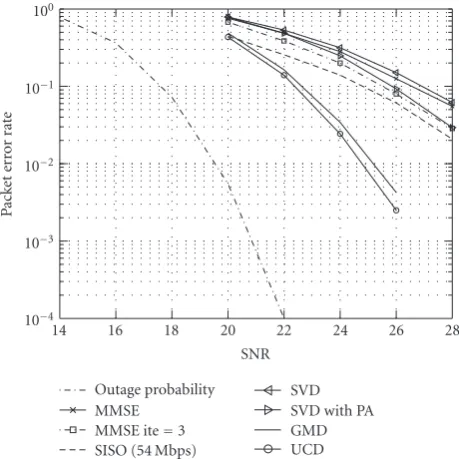
is less than 108. The channel outage probability is the lower bound of the PER performance of any MIMO scheme. An information-theoretically optimal scheme combined with a capacity-achieving code should be able to achieve this curve. First, we consider channels without spatial correlation, that is, Rr = I2 andRt = I2 (cf. (1)).Figure 3shows the PER performances of the proposed GMD/UCD schemes, the closed-loop SVD with and without PA, and the open-loop
14 16 18 20 22 24 26 28
10 4 10 3 10 2 10 1 100
SNR
Pa
ck
et
er
ro
r
ra
te
Outage probability MMSE
MMSE ite=3 SISO (54 Mbps)
SVD SVD with PA GMD UCD
Figure3: Performance comparison of MIMO WLAN (108 Mbps)
schemes for uncorrelated channels in the absence of quantization errors.
MMSE V-BLAST [18] based scheme. We assume perfect pre-coder feedback. It can be seen from Figure 3that the pro-posed closed-loop designs have more than 4 dB SNR im-provement over the MMSE V-BLAST scheme at PER equal to 0.1, although one can have a 1 dB gain by applying itera-tive decoding. The SVD-based method without PA has per-formance inferior to the open-loop MMSE V-BLAST-based scheme. The scheme based on SVD with PA performs better, but there is still more than 3 dB loss compared to the GMD and UCD schemes. The dashed line represents the perfor-mance of the 802.11a system with data rate 54 Mbps. It is remarkable that compared with the SISO scheme, our simple closed-loop 2×2 schemes can double the data rate and at the same time save 2.5 dB in total transmission power. More-over, the PER curves of the GMD and UCD schemes have de-creasing slopes much steeper than the other methods, which implies much improved diversity gain. There is still a gap of about 4.5 dB between the UCD scheme and the outage prob-ability curve. Combined with a capacity achieving code, such as a Turbo code and a low density parity check code (LDPC) [19], the proposed schemes should close the gap further.
0 10 20 30 40 50 10
5 0 5 10 15 20 25 30
Index of data subcarrier
Output
SNR
(dB)
Eigensubch. 1 Eigensubch. 2 GMD UCD
Figure 4: Output SNRs of the subchannels obtained via GMD,
UCD, and SVD, with input SNR=22 dB.
This figure provides insight into the reason why GMD and UCD perform significantly better than the SVD-based meth-ods. We can also see that UCD outperforms GMD when the channel is close to singular, like the one at the 30th subcar-rier.
In the second example, we consider a spatially correlated channel with
Rr=
1 0.7 0.7 1
, Rt=
1 0.3 0.3 1
, (26)
while all the other parameters remain the same as the first example. The results are given inFigure 5. Compared with Figure 3, in Figure 5all the MIMO-OFDM schemes suffer from performance degradations due to the spatial fading cor-relations. However, the relative advantage of the proposed closed-loop schemes is even more prominent in this scenario. Specifically, the UCD scheme has a more than 4 dB gain over the SVD-based schemes and approximately a 6 dB gain over the open-loop MMSE V-BLAST scheme at PER equal to 0.1. Indeed, we expect that the eigen-subchannels obtained by SVD should have more disparate channel gains in the pres-ence of fading correlations. Despite the fading correlations, the proposed GMD and UCD systems at the 108 Mbps data rate still provide better PER performance than the SISO sys-tem at half the data rate.
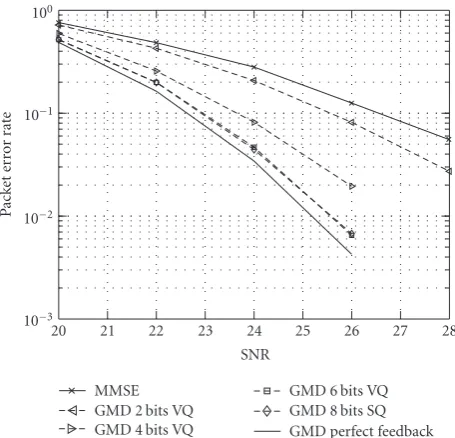
We consider next the effect of quantized precoder on system performance. We use 8-bit scalar quantization with
N1=24andN2=24(cf.Section 4.1) andm-bit vector quan-tization withNv=2m,m=2, 4, 6, (cf.Section 4.2) to quan-tize the precoderPk of each data subcarrier. Figures6 and 7show that the 6-bit vector quantization performs equally well as the 8-bit scalar quantization. By using the 6-bit
vec-10 15 20 25 30 35
10 4 10 3 10 2 10 1 100
SNR
Pa
ck
et
er
ro
r
ra
te
Outage probability MMSE
SISO (54 Mbps) SVD
SVD with PA GMD UCD
Figure5: Performance comparison of MIMO WLAN (108 Mbps)
schemes for correlated channels in the absence of quantization er-rors.
20 21 22 23 24 25 26 27 28
10 3 10 2 10 1 100
SNR
Pa
ck
et
er
ro
r
ra
te
MMSE GMD 2 bits VQ GMD 4 bits VQ
GMD 6 bits VQ GMD 8 bits SQ GMD perfect feedback
Figure 6: Performance comparison of the proposed closed-loop schemes for uncorrelated channels with 8-bit scalar quantization and various vector quantization bit rates per subcarrier in the ex-plicit feedback mode for GMD.
20 21 22 23 24 25 26 27 28 10 3
10 2 10 1 100
SNR
Pa
ck
et
er
ro
r
ra
te
MMSE UCD 2 bits VQ UCD 4 bits VQ
UCD 6 bits VQ UCD 8 bits SQ UCD perfect feedback
Figure 7: Performance comparison of the proposed closed-loop schemes for uncorrelated channels with 8-bit scalar quantization and various vector quantization bit rates per subcarrier in the ex-plicit feedback mode for UCD.
20 21 22 23 24 25 26
10 3 10 2 10 1 100
SNR
Pa
ck
et
er
ro
r
ra
te
GMDα=0 GMDα=5% GMDα=10%
Figure 8: Performance comparison of the proposed closed-loop schemes for uncorrelated channels under channel mismatches with different error parameters in the TDD mode for GMD.
Finally, we consider the TDD mode. Figures8and9show that our closed-loop schemes are quite robust against the mismatches between the channel matrices obtained at the transmitter and the receiver. Our closed-loop schemes suf-fer from less than 0.2 dB loss at PER = 0.1 even when the error parameter is as high asα=0.1.
20 21 22 23 24 25 26
10 3 10 2 10 1 100
SNR
Pa
ck
et
er
ro
r
ra
te
UCDα=0 UCDα=5% UCDα=10%
Figure 9: Performance comparison of the proposed closed-loop schemes for uncorrelated channels under channel mismatches with different error parameters in the TDD mode for UCD.
7. CONCLUSIONS
We have presented simple and efficient closed-loop de-signs for MIMO-OFDM-based WLANs as a promising tech-nology for the next-generation wireless LAN communica-tions. By combining the recent GMD and UCD transceiver designs and the horizontal encoding architecture, we can achieve multi-dB improvement over the closed-loop SVD-based schemes and the open-loop MMSE V-BLAST architec-ture. The advantage of our schemes is even more prominent when the fading channels are spatially correlated. We have also proposed an efficient algorithm for the quantization of 2×2 unitary precoders. Using only a 6-bit vector quanti-zation at each data subcarrier, the system can achieve per-formance very close to the perfect precoder feedback, which represents a very moderate feedback overhead in the explicit feedback mode. In the TDD mode, when the channel reci-procity mechanism is available, we can modify our closed-loop designs to be robust against the mismatches between the forward channel and reverse channel. The extensive nu-merical experiments validate the superior performance of the proposed schemes. Finally, we remark that, although our dis-cussions focus on the 2×2 system, our schemes can be readily extended to the case of more transmit and more receive an-tennas.
APPENDIX
Letvn [vn1 vn2 vn3]T = [cosθ sinθcosφ sinθsinφ]T, andvi [vi1 vi2 vi3]T. The optimization problem in (19) becomes
min
vn∈Si
vn−vi2
The Lagrangian corresponding to the constrained optimiza-tion problem is
Lvi,λ
=
vn∈Si
3
l=1
vnl−vil
2 +λ
3
l=1
v2 il−1
. (A.2)
From the first derivative conditions:
∂Lvi,λ
∂vil =
0, l=1, 2, 3, (A.3)
andvi =1, we have
vil=
vn∈Sivnl
3
l=1 vn∈Sivnl
2, l=1, 2, 3. (A.4)
Definevi = [vi1 vi2 vi3]T, wherevil =
vn∈Sivnl/
vn∈Si1, l=1, 2, 3. Then we obtain
vi= vi vi.
(A.5)
ACKNOWLEDGMENTS
This work was supported in part by the National Science Foundation Grant CCR-0104887 and the work of Xiayu Zheng was also supported in part by the University of Florida Alumni Fellowship.
REFERENCES
[1] IEEE Standard 802.11a-1999, “Supplement to information technology-telecommunications and information exchange between systems-local and metropolitan area networks-specific requirements—part 11: wireless LAN medium access control (MAC) and physical layer (PHY) specifications: high speed physical layer (PHY) in the 5 GHz band,” 1999. [2] J. Liu and J. Li, “A MIMO system with backward compatibility
for OFDM-based WLANs,”Eurasip Journal on Applied Signal Processing, vol. 2004, no. 5, pp. 696–706, 2004.
[3] IEEE 802.11-04/0889r6, “TGn Sync proposal technical specifi-cation,” May 2005.
[4] S. Nanda, R. Walton, J. Ketchum, M. Wallace, and S. Howard, “A high-performance MIMO OFDM wireless LAN,” IEEE Communications Magazine, vol. 43, no. 2, pp. 101–109, 2005. [5] P. Xia, S. Zhou, and G. B. Giannakis, “Adaptive MIMO-OFDM
based on partial channel state information,”IEEE Transactions on Signal Processing, vol. 52, no. 1, pp. 202–213, 2004. [6] H. Sampath and A. J. Paulraj, “Joint transmit and receive
op-timization for high data rate wireless communication using multiple antennas,” inProceedings of the 33rd Asilomar Con-ference on Signals, Systems and Computers (ACSSC ’99), vol. 1, pp. 215–219, Pacific Grove, Calif, USA, October 1999. [7] ETSI, “Broadband radio access networks (BRAN); HIPERLAN
type 2: physical (PHY) layer,” ETSI TS 101 475 V1.2.2, Febru-ary 2005.
[8] Y. Jiang, J. Li, and W. W. Hager, “Joint transceiver design for MIMO communications using geometric mean decomposi-tion,”IEEE Transactions on Signal Processing, vol. 53, no. 10, pp. 3791–3803, 2005.
[9] Y. Jiang, J. Li, and W. W. Hager, “Uniform channel decomposi-tion for MIMO communicadecomposi-tions,”IEEE Transactions on Signal Processing, vol. 53, no. 11, pp. 4283–4294, 2005.
[10] J.-K. Zhang, A. Kavˇci´c, and K. M. Wong, “Equal-diagonal QR decomposition and its application to precoder design for successive-cancellation detection,”IEEE Transactions on Infor-mation Theory, vol. 51, no. 1, pp. 154–172, 2005.
[11] C.-N. Chuah, D. N. C. Tse, J. M. Kahn, and R. A. Valenzuela, “Capacity scaling in MIMO wireless systems under corre-lated fading,”IEEE Transactions on Information Theory, vol. 48, no. 3, pp. 637–650, 2002.
[12] X. Li, H. Huang, G. J. Foschini, and R. A. Valenzuela, “Ef-fects of iterative detection and decoding on the performance of BLAST,” inProceedings of IEEE Global Telecommunications Conference (GLOBECOM ’00), vol. 2, pp. 1061–1066, San Francisco, Calif, USA, November-December 2000.
[13] L. Zheng and D. N. C. Tse, “Diversity and multiplexing: a fun-damental tradeoffin multiple-antenna channels,”IEEE Trans-actions on Information Theory, vol. 49, no. 5, pp. 1073–1096, 2003.
[14] B. Hassibi, “A fast square-root implementation for BLAST,” inProceedings of the 34th Asilomar Conference on Signals, Sys-tems and Computers (ACSSC ’00), vol. 2, pp. 1255–1259, Pa-cific Grove, Calif, USA, October-November 2000.
[15] Y. Linde, A. Buzo, and R. Gray, “An algorithm for vector quan-tizer design,”IEEE Transactions on Communications, vol. 28, no. 1, pp. 84–95, 1980.
[16] G. Lebrun, J. Gao, and M. Faulkner, “MIMO transmission over a time-varying channel using SVD,”IEEE Transactions on Wireless Communications, vol. 4, no. 2, pp. 757–764, 2005. [17] N. Chayat, “Tentative criteria for comparison of modulation
methods,” document: IEEE P802.11-97/96, September 1997. [18] G. J. Foschini, G. D. Golden, R. A. Valenzuela, and P. W.
Wolni-ansky, “Simplified processing for high spectral efficiency wire-less communication employing multi-element arrays,”IEEE Journal on Selected Areas in Communications, vol. 17, no. 11, pp. 1841–1852, 1999.
[19] B. Lu, G. Yue, and X. Wang, “Performance analysis and design optimization of LDPC-coded MIMO OFDM systems,”IEEE Transactions on Signal Processing, vol. 52, no. 2, pp. 348–361, 2004.
Xiayu Zheng received the B.S. and M.S. degrees in electrical engineering and in-formation science from the University of Science and Technology of China (USTC), Hefei, China, in 2001 and 2004, respec-tively. He is currently pursuing the Ph.D. degree with the Department of Electrical and Computer Engineering, University of Florida, Gainesville. His research interests are in the areas of signal processing and wireless communications.
Yi Jiangreceived the B.S. degree in electrical engineering and information science from the University of Science and Technology of China (USTC), Hefei, China, in 2001. He received the M.S. and Ph.D. degrees from the University of Florida, Gainesville, both in electrical engineering, in 2003 and 2005, respectively. In the Summer of 2005, he was a Research Consultant with Informa-tion Science Technologies Inc. (ISTI), Fort
Jian Lireceived the M.S. and Ph.D. degrees in electrical engineering from The Ohio State University, Columbus, in 1987 and 1991, respectively. From July 1991 to June 1993, she was an Assistant Professor with the Department of Electrical Engineering, University of Kentucky, Lexington. Since August 1993, she has been with the De-partment of Electrical and Computer Engi-neering, University of Florida, Gainesville,