Volume 2006, Article ID 21930, Pages1–11 DOI 10.1155/ASP/2006/21930
Temporal Scalability through Adaptive
M
-Band Filter
Banks for Robust H.264/MPEG-4 AVC Video Coding
C. Bergeron,1C. Lamy-Bergot,1G. Pau,2and B. Pesquet-Popescu2
1EDS/SPM, THALES Communications, 92704 Colombes Cedex, France
2TSI Department, Ecole Nationale Sup´erieure des T´el´ecommunications, 75634 Paris Cedex 13, France
Received 15 March 2005; Revised 4 September 2005; Accepted 19 September 2005
This paper presents different structures that use adaptiveM-band hierarchical filter banks for temporal scalability. Open-loop and closed-loop configurations are introduced and illustrated using existing video codecs. In particular, it is shown that the H.264/MPEG-4 AVC codec allows us to introduce scalability by frame shuffling operations, thus keeping backward compatibility with the standard. The large set of shuffling patterns introduced here can be exploited to adapt the encoding process to the video content features, as well as to the user equipment and transmission channel characteristics. Furthermore, simulation results show that this scalability is obtained with no degradation in terms of subjective and objective quality in error-free environments, while in error-prone channels the scalable versions provide increased robustness.
Copyright © 2006 C. Bergeron et al. This is an open access article distributed under the Creative Commons Attribution License, which permits unrestricted use, distribution, and reproduction in any medium, provided the original work is properly cited.
1. INTRODUCTION
Modern wireless communication applications relying on the use of video services and video streaming are facing a prob-lem that high-speed wired networks seemed to have over-come: for them, the available bandwidth is still a limiting fac-tor. Moreover, IP wireless networks have to cope with both bit errors and packet losses. This is why a new generation of standards, such as H.264/MPEG-4 AVC finalized in May 2003 [1] jointly by ISO MPEG and ITU-T, and also the new wavelet-based codecs solutions proposed within the scalable video coding (SVC) group, such as [2], take into account the interaction with the network (for the former, through the network abstraction layer concept). Such codecs provide significant compression efficiency improvement when com-pared to the other existing standards such as MPEG-2 or MPEG-4; and that is why they are so attractive for multi-media applications over wireless communication links. How-ever, H.264/MPEG-4 AVC does not support scalability, which is a very efficient tool to adapt to the bandwidth variations and to the error-prone nature of the wireless channels. Tem-poral scalability can be achieved using B frames in profiles that support them, which is not the case of H.264/MPEG-4 AVC baseline profile. Solutions are currently being proposed in the literature and within the SVC standardisation group to address this limitation, generally by introducing modifi-cations to the H.264/MPEG-4 AVC syntax to integrate
pro-gressive fine granular scalability coding or subband decom-positions [3, 4]. In parallel, solutions relying on motion-compensated (MC) spatio-temporal subband decomposi-tions are being proposed, first with a classical dyadic subband decomposition [5], then by exploiting a nonlinear lifting im-plementation [6], and making use of efficient 3D entropy coding algorithms [7]. Such solutions are unfortunately not compliant with basic H.264/MPEG-4 AVC decoders and of-ten introduce a higher level of complexity, which may not be acceptable for the use in small and cheap mobile equipments. Following the approach initiated in [8] where the in-troduction of temporal scalable solutions fully compliant with H.264/MPEG-4 AVC has been proposed and inter-preted in the framework of adaptiveM-band hierarchical fil-ter banks, in this paper we show that this framework can be further generalized to include dyadic temporal decom-positions and also to introduce scalability inside both open-loop and closed-open-loop temporal prediction structures. In par-ticular, we show that the resulting hierarchical representa-tion of H.264/MPEG-4 AVC frames inside a group of pic-tures (GOP) preserves the coding performance of the orig-inal nonscalable scheme in an error-free environment, and improves the subjective and objective qualities of the se-quences transmitted over error-prone channels.
2 xt
x2t
x2t+1
2 − Q
Q z
z
¯ x2t
¯ ht 1/2
Figure1: Open-loop prediction scheme: one level of decomposi-tion.
application of these filter banks to the temporal prediction compliant with the H.264/MPEG-4 AVC standard is pro-posed and discussed. InSection 3.3the adaptation of this fil-ter bank scheme to the case of H.264/MPEG-4 AVC where the number of reference frames should be limited, namely, for simple levels, is considered.Section 4describes a practi-cal setup for easily applying filtering in a conformant way to an H.264/MPEG-4 AVC codec, through the application of an interleaver, as well as the simulation chain model considered for testing the various shuffling configurations, both in error-free and error-prone environments. Finally, inSection 5 ex-perimental results are presented and inSection 6the conclu-sions are drawn.
2. M-BAND HIERARCHICAL FILTER BANKS
Temporal scalability is achieved by introducing a hierarchy among the frames encoded in a group of pictures. This is true for both classical closed-loop temporal differential pulse code modulation (DPCM) schemes, and for motion-compensated wavelet decompositions, using open-loop schemes based on motion-compensated temporal filter banks. In both cases, some constraints are introduced in the temporal prediction in order to create successive layers of importance. In this sec-tion we point out the analogies between the two approaches, by describing a common framework based on temporal sub-band decompositions.
Let us consider the lifting form of the motion-compen-sated wavelet decompositions [9]. Basically, the desired tem-poral dyadic filter bank is represented in its lifting form with one (or several)predict andupdatesteps involving motion compensation. In designing these structures, particular at-tention should be paid to the motion prediction direction in the temporal operators so as to facilitate the filtering along motion trajectories. In order to simplify the comparison, our model will not include the update step (which is however essential for the good performances of these schemes). For a bidirectional prediction (from past and future frames, as commonly used in the 5/3 filter banks), the basic scheme is il-lustrated inFigure 1, where the input frames (at timest∈N) are denoted byxt, and the resulting temporal detail frames, corresponding to high temporal frequencies, are denoted by
ht. After the quantization blockQ, the same frames are
de-noted by ¯xt, respectively, ¯ht. In this one-level decomposition, the even-indexed frames (following the notation inFigure 1) will enter the approximation subband, while the error pre-diction frames will yield the detail subband.
2 xt
x2t
x2t+1
2 − Q
Q z
z
¯ x2t
¯ ht 1/2
Figure2: Basic closed-loop prediction scheme.
2
2 2
2 x4t
x4t+2
x4t+3 x4t+1
−
− Q
Q Q Q
¯ h1
t,2
¯ h1
t,1
¯ h2
t ¯ x4t
x2t
x2t+1 z
z
z 1/2
−
+
1/2 z
1/2
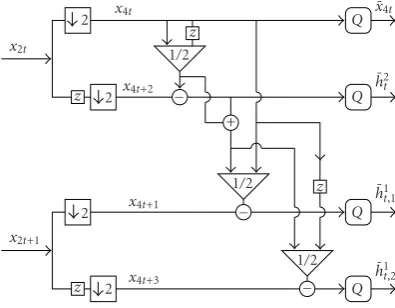
Figure3: Open-loop scheme with 4 temporal subbands (2 tempo-ral decomposition levels).
By just changing the place of one of the quantizers in
Figure 1, we get a prediction based on the previously recon-structed frames, as illustrated inFigure 2(here, for the sake of simplicity, the inverse quantization and the spatial direct and inverse transforms have been omitted).
By iterating the splitting into odd and even frames, we obtain a four-band polyphase decomposition, on which the successive application of the previous prediction scheme leads to an approximation subband (containing the equiv-alent to the intraframes), a detail subband at the coarse reso-lution level similar to a B frame in the base layer (denoted in
Figure 3byh2t), and two detail frames at the finest resolution level, h1t,1andh1t,2, similar to B frames in the enhancement
layer. Note that this hierarchical structure can be seen as con-sisting of two levels of a wavelet decomposition without the update lifting step.
The two-level structure in Figure 3 can be transposed into a closed-loop structure, equivalent to a four-band de-composition, as illustrated inFigure 4.
The previous open-loop and closed-loop subband compositions can be extended to an arbitrary number of de-composition levels, involving groups of frames counting a power of two number of frames.1
1Note also that in [8] we have introduced temporal subband
x2t
x2t+1
2
2
2
2 z
z
z
z x4t
x4t+2
x4t+1
x4t+3 Q
Q
Q
Q 1/2 1/2 1/2
x4t
h2t
h1t,1
h1 t,2
−
+
−
−
Figure4: Closed-loop scheme with 4 temporal subbands (2 tem-poral decomposition levels).
A common property of these structures is that each GOP is independently decodable, which is a very useful feature in error-prone environments, in order to avoid error propaga-tion.
3. APPLICATION TO THE H.264/MPEG-4 AVC VIDEO STANDARD
Relying on the motion-compensated temporal subband de-compositions presented inSection 2, in this section we show that the existing properties of the H.264/MPEG-4 AVC stan-dard allow us to build a hierarchical representation inside the GOPs without requiring any modification or addition to the standardized codec, thus remaining fully compliant with each of the standard profiles.2
Moreover, contrarily to previous video coding standards that were using simple reference modes, for which the pre-diction of interframes could only be done with respect to a given preceding picture, it is important to point out that H.264/MPEG-4 AVC allows the usage of up to 16 different frames as reference in some levels, for each P-slice. In prac-tice, this capability means that several previous frames (in encoding order) can be used as references for the current frame.
Considering groups of pictures ofNframes, denoted by their original time reference{0, 1, 2,. . .,N−1}, the aim of our approach is to intelligently distribute the frames so that the encoding process that will follow is done efficiently. As a matter of fact, the classical prediction order in the GOP may not be the most efficient one from a temporal scalability standpoint because (a) one wants to obtain a regular frame rate when using the temporal scaling, and (b) a better com-pression efficiency can be obtained when placing the refer-ence frames closer to the predicted ones in display order [8]. The classical decomposition, which we call “Normal”
con-2In the baseline profile, this approach corresponds to using predictive (P)
frames. But this method could also be easily generalized with B frames for other profiles. As a consequence, the proposed temporal scalability feature is the only one compatible with all the profiles.
0 1
2 3
4 5
6
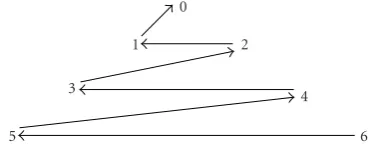
Figure5: Normal configuration, GOP size=7. The arrows are di-rected towards the reference frame.
0
1 2
3 4 5 6
7 8 9 10 11 12 13 14
Figure6: Zigzag configuration, GOP size=15.
figuration, is presented inFigure 5in the case of a GOP size
N =7. The dependencies between frames are illustrated by the arrows in the figure which shows that frame 1 depends on frame 0, frame 2 on frame 1 and consequently also on frame 0, and so forth. This can be obtained from the closed-loop scheme inFigure 4, by considering only unidirectional pre-dictions and as many levels as the number of frames in the GOP.
Three different approaches for temporal scalability are considered in the following:
(i) symmetric filtering schemes, meaning that a unique intraframe, which is taken for these configurations to be actually an instantaneous decoding refresh (IDR) frame, is considered as a main reference for the whole GOP; in our approach by frame shuffling, it is placed in the middle of the GOP (in output display order); (ii) asymmetric filtering schemes, where each intraframe
is used as a reference by two consecutive GOPs; (iii) a combination of the above two approaches, taking
into account possible limits in terms of frame refer-ence buffer sizes, to meet the eventually more restric-tive requirements of certain levels of the standard and practical implementations.
3.1. Symmetric filtering schemes
A first decomposition configuration ensuring the temporal scalability features, that we will call “Zigzag” configuration, is illustrated in Figure 6forN = 15. Firstly introduced in [8], this regular pattern corresponds to the subband decom-position for GOP of sizeN=2L−1,L∈N. It is obtained as follows:
(i) select a reference frame (the intraframe) for the first level having the temporal index at the median value
of the GOP, where the median index is median =
(GOPsize+ 1)/2; define each part separated by the
me-dian as sub-GOP;
0 1
2 3 4 5 6 7
8 9 10 11 12 13 14 15 16 17 18
Figure7: Generalized Zigzag configuration withR=3, GOP size=
19.
In practice, one sees that the first resolution level consists only of the intraframe which is placed at the median value of the GOP (and not at the beginning of the GOP as usual). In this configuration, dependencies between frames are very important, as each frame ican depend (based on the effi -ciency of the compression mechanism and of the considered sequence) on thei−1 previous ones. In practice, one observes that the coding efficiency is smaller for the first levels, since the temporal distance between the predicted and the refer-ence frames can be greater than one. Still, simulation results show that this is in practice compensated by the fact that the latest frames offer better compression rate, as they are closer to their main reference frames.
This Zigzag decomposition is obviously very efficient for
N = 2L−1, which corresponds to a fully regular reparti-tion pattern of the subband decomposireparti-tion, but can easily be used in other cases, at the cost of some loss in compression efficiency. In particular, one can think to generalize the de-composition to other subsampling factorsR(greater than 2), as well as for other values ofN. This hierarchical structure can be achieved as follows [8]:
(i) selectR−1 reference frames at each level (e.g., with the intraframe being the first of them) at equal temporal distance in the GOP, that is, having temporal indices
mi= i(GOPsize+ 1)/Rfori=1,. . .,R−1; each part
of the GOP between these frames is defined as a sub-GOP;
(ii) repeat for each sub-GOP: takeR−1 reference frames uniformly distributed in the sub-GOP and define
ac-cordinglyRremaining sub-GOPs.
Figure 6then corresponds toN = 15 andR = 2 for each level. Another illustration is given inFigure 7for a GOP of 19 frames, with subframe rateR=3 and three temporal levels.
In such generalizations, note that for values ofNdifferent from 2L−1, that we call “irregular”Nvalues, many different decompositions can be proposed that will have similar per-formances. As a consequence, when considering such irregu-lar values ofN, it is recommended to consider adaptation of the generalized pattern based on regular repartition of refer-ence frames at each level.
To illustrate the advantage of this Zigzag scalable struc-ture, we introduce other GOP reorganizations that corre-spond to structures with smaller gaps between the frames at the first level of importance. Two such decompositions that can be seen as variations of the Zigzag shuffling are consid-ered. The first, called the “Christmas Tree” decomposition, is obtained as follows:
(i) select a first reference frame (the intraframe) placed at the median position in the GOP, where the median
0
1 2
3 4
5 6
Figure8: Christmas Tree configuration, GOP size=7.
0
1 4
2 5
3 6
Figure9: Mirror configuration, GOP size=7.
temporal index is median = (GOPsize + 1)/2, and
define the two parts separated by the median as sub-GOPs;
(ii) repeat alternatively for each sub-GOP (e.g., by begin-ning with the left sub-GOP): use the frame closest to the median one as reference and remove it from the sub-GOP frame set.
The “Mirror” decomposition is obtained as follows:
(i) select a first reference frame (the intraframe) and place it at the median position in the GOP, where the median index is median = (GOPsize+ 1)/2, and define the
parts separated by the median frame as sub-GOPs; (ii) repeat for each sub-GOP: use the frame closest to the
median one as reference and define the set of remain-ing frames as a new sub-GOP.
Illustrated, respectively, in Figures8and9forN =7, these Christmas Tree and Mirror configurations will provide better results in terms of compression as with these configurations, each frame is at closer distance to its main reference than in Zigzag. However, this is obtained at the cost of a less efficient temporal scalability. Indeed, if the last refinement levels are lost, the reconstructed sequence presents long frozen subse-quences.
Note also that the Mirror configuration is somehow dif-ferent from the Zigzag and Christmas Tree ones in the sense that the two sub-GOPs on each side of the intraframe are in fact independent from each other. Therefore, the Mirror configuration can be considered a first type of limited refer-ence configurations, close to those that will be presented in
Section 3.3.
3.2. Asymmetric filtering schemes
1
2 3
−15 0
4 5 6 7
8 9 10 11 12 13 14 15
Figure10: Dyad configuration, GOP size=16.
1 2
3
−15 0
4 5 6
7 8 9 10 11 12 13 14
Figure11: Generalized Dyad configuration, GOP size=15.
will call “Dyad” configuration, is a regular repartition pat-tern that corresponds to a closed-loop 2L-band filter bank, as described inSection 2,Figure 4. It can be obtained as follows:
(i) select a reference frame (the intraframe) placed at the extremity of the GOP (e.g., at the right extremity, when the other considered intraframe is the one of the previous GOP), and define the set of remaining frames as sub-GOP;
(ii) apply the Zigzag decomposition to the sub-GOP.
This is illustrated inFigure 10forN =16. A generalization can here be done, following the generalization of the Zigzag decomposition principle. As an example, we give inFigure 11
a decomposition pattern forN=15.
In this Dyad configuration, the dependency on the in-traframes is even more important, as any error in a frame at the first level leads to errors in two consecutive GOPs. In turn, the compression efficiency is better than that of the Zigzag decomposition, as the number of high quality refer-ences is higher.
3.3. Limited references filtering schemes
Due to some practical limitations, coming either from the use of given levels [10] in the standard profiles or from practical implementation limitations, the configurations pre-sented in the previous sections may not be realistic, as the codec may not be allowed to use up to 16 references in its pre-diction algorithm. As such, it becomes important to propose decompositions with a limited number of reference frames, this number being intimately linked to the total memory necessary to implement the encoding and decoding process. Naturally, such a limitation leads to some degradation in terms of compression efficiency, but it first meets the require-ments of any level for any profile in H.264/MPEG-4 AVC (hence also any practical implementation), and second it
en-0
1 8
2 5 9 12
3 4 6 7 10 11 13 14
Figure12: Tree configuration, GOP size=15.
0 9
1 3 6 10 13 16
2 4 5 7 8 11 12 14 15 17 18
Figure13: Tree configuration, GOP size=19.
sures that the error propagation can be further reduced in erroneous environments.
Considering first the unidirectional schemes presented in
Section 3.1, the reduction of the number of reference frames can be done by imposing that a frame can only use reference frames from the upper levels. This “Tree” configuration (il-lustrated inFigure 12forN=15 and inFigure 13forN=19 andR=3) is obtained as follows:
(i) apply the Zigzag decomposition to assign to each frame its corresponding level of refinement;
(ii) repeat for each frame: choose as reference frame (or father) the closest one between those in the refine-ment level immediately above. When two frames can be equivalently chosen as reference, select the one that is the closest to its own father, and so on. If no dis-crimination can be done, choose, for instance, the one closest to the intraframe.
In this Tree configuration, the dependencies between frames are clearly reduced, which will be a major advantage in a noisy environment, as errors occurring at lower refine-ment levels will be less likely to propagate.
Considering now the Dyad scheme and its generalization, as presented inSection 3.2, the reduction of the number of references can be done similarly to the symmetric case by imposing again that a frame can only use reference frames from the upper levels. This “Limited Dyad” configuration is obtained as follows:
(i) apply the Dyad decomposition to assign to each frame its corresponding level of refinement;
(ii) repeat for each frame: choose as reference frame (or fa-ther) the closest one from those in the refinement level immediately above. When two frames can be equiv-alently chosen as reference, select the one that is the closest to its own father, and so on. If no discrimina-tion can be done, choose, for instance, the one closest to the intraframe.
Limited Dyad configuration is illustrated in Figures14
0
−15
1 5 12
2 6 9 13
3 4 7 8 10 11 14 15
Figure14: Limited Dyad configuration, GOP size=16.
0
−14
1 8
2 5 9 12
3 4 6 7 10 11 13 14
Figure15: Limited Dyad configuration, GOP size=15.
on the number of reference frames clearly reduces the depen-dencies between frames, which will ensure that error propa-gation is limited in an error-prone environment. However, as for the other configurations, the loss of intraframes will affect all the frames that reference them.
4. IMPLEMENTATION DETAILS
The purpose of the schemes presented in the previous sec-tions is to introduce temporal scalability within an a priori nonscalable configuration, such as the one provided by the
H.264/MPEG-4 AVC codecs. The scheme shuffles the frames
in a GOP to distribute them as regularly as possible.
The practical implementation of the different schemes presented inSection 3is easily done in a standard compati-ble codec based on the consideration that two different frame numbering solutions do exist in the H.264/MPEG-4 AVC standard. The first, frame num, corresponds to the decod-ing order of access units, but does not necessarily indicate the final display order that the decoder will use. The second, POC orpicture order count, corresponds to the display order of the decoded frames (or fields) that will be used by the de-coder for the display order. Considering now the number of reference frames to be used, here again the practical imple-mentation is quite easily managed thanks, in the case of non-limited models, to the existence of a reference buffer of up to 16 different frames for any P-slice, and in the case of limited models, to the existence of memory management standard-ised functions that can be used to remove given frames from the reference buffer or mark given frames not to be used as reference. The only drawback of this scheme is that the shuf-fling operation introduces a delay and the necessity of frame buffering, both at the encoder and the decoder sides.
As presented in Section 3, the most important frames, corresponding to those decoded from the lowest frame rates, can be regularly distributed along the time frame. The in-tervals between those most important frames are then filled
with less important ones, that are decoded only at higher frame rates. A temporal scalability enhanced H.264/MPEG-4 encoder can thus be implemented by first performing a rearrangement of the frames according to their encod-ing order before the source encoder, and then by classical H.264/MPEG-4 AVC encoding.
The advantage of being able to define different scalable configurations at the encoder side, while not needing to transmit any supplementary information to the decoder or predefining the said configuration during an initialisation phase, is that the chosen configuration can adapt either to the sequence actually being transmitted or to the channel condi-tions. As an example, transmitting over an erroneous channel may favor limited reference schemes, in order to avoid error propagation. Also, the choice of the frame shuffling pattern can be made based on GOP particularities. For instance, to better take into account some scene cuts, the frames corre-sponding to such changes will be coded with higher qual-ity (the choice of the pattern will then be made such that they are placed at a low level of temporal resolution) and consequently ensure high rendering quality thanks to a bet-ter adaptivity of the codec. This GOP analysis and shuffling may lead however to a delay in sequence transmission, which needs to be compatible with the time constraints of the ap-plication. Finally, in a less adaptive mode, the choice of the configuration can be made based on the capabilities of the encoder and the decoder, in particular when they are im-plemented on low-memory/CPU platforms. The simulation chain used to obtain and test the scalability features is pre-sented in Figure 16. The shuffling operation is applied di-rectly on the video sequence to be encoded by means of an interleaver (denoted byΠin the figure), before the standard H.264/MPEG-4 AVC encoding process which is only mod-ified to the extent of inserting knowledge of the used shuf-fling table, corresponding to the different scalability config-urations presented, to permit the insertion of the correct display order values in the POC fields. The fully compli-ant H.264/MPEG-4 AVC code stream can then be sent over the transmission channel, which can be error-prone, as in case of transmission over wireless links, or error-free, as in case of transmission with an efficient forward error correc-tion/automatic repeat-request mechanism.
5. SIMULATION RESULTS
The simulations used the joint verification model (JM) ver-sion 8.4 [11], with some modifications, to ensure that the number of frames that can be used as reference corresponds to the actual number of decomposition patterns. Indeed, some of the proposed patterns need more reference frames than the maximum number implemented by JM8.4.
Standard compliant H.264 decoder
H.264 decoder H.264
encoder Temporal scalability
enhanced H.264 encoder
Channel A B C · · · Π D B F · · ·
1 2 3· · ·
Figure16: Simulation chain. The block denoted byΠcorresponds to the interleaver.
Table1: Average PSNR (over the entire sequence) at 64 kbps and 128 kbps for different configurations of the symmetric hierarchical subband tree H.264/MPEG-4 AVC codec for QCIF 15 Hz video se-quences and GOP size 2L−1.
Sequence Bit rate
(kbps) Configuration
Av. PSNR (dB) GOP size 7 GOP size 15 Akiyo 64 Normal 40.19 43.09 Akiyo 64 Mirror 40.41 43.36 Akiyo 64 Christ. Tree 40.33 43.15 Akiyo 64 Tree 40.32 43.34 Akiyo 64 Zigzag 40.32 43.25 Foreman 64 Normal 32.19 33.35 Foreman 64 Mirror 32.54 33.71 Foreman 64 Christ. Tree 32.36 33.38 Foreman 64 Tree 32.48 33.58 Foreman 64 Zigzag 32.28 33.28 Mobile 128 Normal 27.94 29.66 Mobile 128 Mirror 28.32 30.30 Mobile 128 Christ. Tree 28.26 29.96 Mobile 128 Tree 28.30 30.12 Mobile 128 Zigzag 28.27 30.03
It can be observed that the scalability feature is obtained in each case with small (less than 1% in the worst case, com-pared with the mirror configuration—at the tested bit rates, this is independent of the bit rate, but it may slightly depend on the sequence characteristics) or no quality degradation. This confirms the advantage of placing the intraframe at the median position of the GOP (in the display order), which reduces the maximum distance between a predicted frame and its reference. By comparing the differences between dif-ferent configurations (which are quite small), the advantage of choosing the configuration according to the actual trans-mission conditions, that is to say to adapt the configuration choice either to the transmission channel, to the sequence ac-tually been transmitted, or to the encoder or decoder capaci-ties, as mentioned inSection 4, becomes obvious. Still, it can be observed that the Tree and Mirror configurations obtain here the best performance among all configurations. This can be partly explained by a particularity of the H.264/MPEG-4 AVC codec syntax, which relies on variable-length codes for indicating the considered reference frames. The Tree and Mirror patterns, ensuring that frames mostly use as reference the closest one in decoding order, have then an advantage when compared to the others.
Table2: Average PSNR at 64 kbps and 128 kbps for the different configurations of the Dyad hierarchical subband tree H.264/MPEG-4 AVC codec for QCIF 15 Hz video sequences and GOP size 2L.
Sequence Bit rate
(kbps) Configuration
Av. PSNR (dB) GOP size 16 Akiyo 64 Dyad 43.59 Akiyo 64 Limited Dyad 43.85 Foreman 64 Dyad 33.58 Foreman 64 Limited Dyad 33.79 Mobile 128 Dyad 30.21 Mobile 128 Limited Dyad 30.52
Results obtained for the same three sequences and same target bit rates for different asymmetric decompositions and regular GOP size equal to 2Lare presented inTable 2, where the average PSNR is computed over the entire sequence. Comparing the two asymmetric configurations, it can be ob-served that, like for the symmetric ones, the limited version performs better than the Dyad one, based on Zigzag decom-position, for the same syntactical reasons. Based on this ob-servation, we can now compare the results for a GOP size of 16 with those obtained for symmetric decompositions and GOPs of size 15. One can observe a quality gain of 0.1 to 0.5 dB. Yet, this is obtained at the cost of a higher dependency on the intraframes, which again highlights the importance of choosing the hierarchical configuration in error-prone envi-ronments according to the actual transmission conditions, and not only based on pure average PSNR considerations.
A second set of simulations have been conducted in an erroneous context, to observe the impact of transmission er-rors in various configurations. In our experiments, we se-lected a scenario where one frame in the GOP (the sixth frame when the first frame of the GOP is frame 0) is impaired (completely black) at the decoder.3
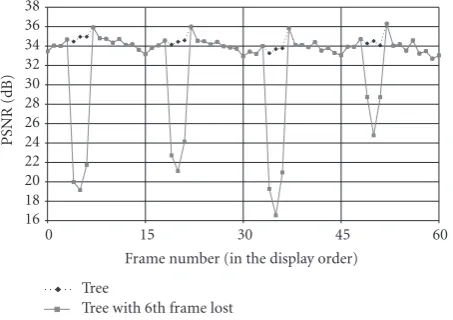
We observed the corresponding PSNR evolution of the whole GOP. Figures17,18, and19present the PSNR evolu-tion for Foreman QCIF, 15 Hz, 64 kbps, GOP size = 15 for Normal, Zigzag, and Tree configurations in the case of loss in information in the 6th frame in the GOP (i.e., frame number 5 in the encoding order) which appears in different scalable modes in the enhancement level. In these figures, thex-axis
3A black frame at the decoder can be obtained if the NAL header is
60 45
30 15
0
Frame number (in the display order) 16
18 20 22 24 26 28 30 32 34 36 38
PSNR
(dB)
Normal
Normal with 6th frame lost
Figure17: Foreman PSNR evolution for the Normal configuration in an error-free and an erroneous environment (every 6th coded frame impaired). Thex-axis indicates the frame number in the out-put (display) order.
60 45
30 15
0
Frame number (in the display order) 16
18 20 22 24 26 28 30 32 34 36 38
PSNR
(dB)
Zigzag
Zigzag with 6th frame lost
Figure18: Foreman PSNR evolution for the Zigzag configuration in an error-free and an erroneous environment (every 6th coded frame impaired). Thex-axis indicates the frame number in the out-put (display) order.
indicates the frame number in the output (display) order. As foreseen from the results presented inTable 1, the three con-figurations have similar results in error-free environments. However, this changes greatly when errors occur. As a mat-ter of fact, the degradation is quite noticeable for the Normal configuration, due to the error propagation from the erro-neous frame to the end of the GOP. The Zigzag configura-tion presents the same number of frames affected by the er-ror propagation, but the frame shuffling reduces the impact of errors due to the fact that most of those frames are partly predicted from correct ones. Finally, the Tree configuration limits the error propagation to a small set of frames, which in counterpart are more deeply degraded due to the fact that when compared to Normal case they rely on only a small set of reference frames, with one of their main reference being impaired.
60 45
30 15
0
Frame number (in the display order) 16
18 20 22 24 26 28 30 32 34 36 38
PSNR
(dB)
Tree
Tree with 6th frame lost
Figure19: Foreman PSNR evolution for the Tree configuration in an error-free and an erroneous environment (every 6th coded frame impaired). Thex-axis indicates the frame number in the output (display) order.
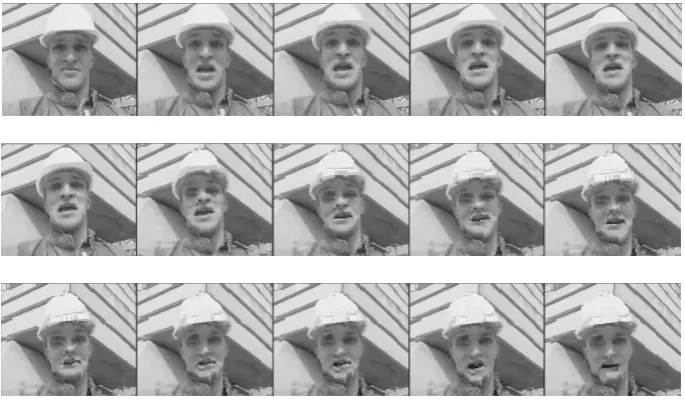
We conducted informal subjective evaluation of the de-coded sequences affected by frame loss. The corresponding visual results obtained for one entire GOP are presented in
Figure 20for the Normal configuration, inFigure 21for the Zigzag one, and inFigure 22for the Tree one. The degrada-tion due to the impaired frame is clearly more annoying in the Normal case as it leads to the degradation of the entire second part of the GOP, whereas it is quite acceptable in the Zigzag case, where the degradations are less distinguishable. They are even less important in the “Tree” case, where only three frames are degraded. The concealment in this later case is very easy, the impaired frame (6th in the display order) be-ing restored by frame copy from its main reference (and, due to this, looking visually “good,” even though it is not correct, i.e., it is not equivalent to the original frame) and the two frames depending on it (5th and 7th in the display order) be-ing the only ones predicted from an erroneous frame (more sophisticated concealment techniques can also be applied). The PSNR results for these three frames are quite low, but vi-sually (seeFigure 22) even the simple concealment technique we used (frame copy from the main reference) provides very satisfactory results.
Figure20: Visual results over a GOP (N =15) in an erroneous environment for the Normal configuration, Foreman sequence (6th frame impaired).
Figure21: Visual results over a GOP (N=15) in an erroneous environment for the Zigzag configuration (6th frame impaired).
(i) use Limited Dyad configuration by default;
(ii) when detecting at the receiver side that an intraframe has been impaired, inform the encoding side by the back channel and suggest to select a symmetric con-figuration, for instance, Tree, and use it up until a suf-ficient number of frames have been received without errors.
Figure 23illustrates the results obtained when comparing the use of a nonadaptive Limited Dyad configuration over several GOPs with the use of the adaptive method proposed above, where the intraframe of the second GOP has been
im-paired (i.e., the 17th frame in encoding order and the 32th one in decoding order). The advantage of going back for one GOP to Tree configuration is obvious, while Limited Dyad remains the best choice when the channel is error-free.
6. CONCLUSIONS
Figure22: Visual results over a GOP (N=15) for the Tree configuration in an erroneous environment (6th frame impaired).
80 70 60 50 40 30 20 10 0
Frame number (in the display order) 0
5 10 15 20 25 30 35 40
PSNR
(dB)
Dyad configuration Adaptive configuration
Figure23: Foreman PSNR evolution comparison in noisy environ-ment: Dyad configuration versus Adaptive mode.
been compared in error-free and error-prone environments and the advantage provided by scalability in terms of robust-ness has been shown. By analysing the dependencies between frames in these configurations, one can predict not only the error propagation, but also the impact of the sequence fea-tures on the ability to perform error concealment.
ACKNOWLEDGMENT
This work was partially supported by the European Commu-nity through project IST-FP6-001812 PHOENIX and project IST-FP6-1-507113 DANAE.
REFERENCES
[1] Joint Video Team (JVT) of ISO/IEC MPEG ITU-T VCEG,
Draft ITU recommendation and final draft international
stan-dard of joint video specification (ITU-T Rec. H.264/ISO/IEC 14 496-10 AVC), Doc JVT-G050r1, Geneva, Switzerland, May 2003.
[2] J.-R. Ohm,Registered Responses to the Call for Proposals on Scalable Video Coding. ISO/IEC JTC1/SC29/WG11 MPEG, doc. M10569, proposal S16, Munich, Germany, March 2004. [3] L. Blaszak, M. Domanski, A. Luczak, and S. Mackowiak, “AVC
video coders with spatial and temporal scalability,” in Proceed-ings of Picture Coding Symposium (PCS ’03), pp. 41–47, Saint-Malo, France, April 2003.
[4] H. Schwarz, D. Marpe, and T. Wiegand,Subband extension for H.264/AVC, Doc JVT-K023, Munich, Germany, March 2004. [5] J.-R. Ohm,Multimedia Communication Technology:
Represen-tation, Transmission and Identification of Multimedia Signals, Springer, Berlin, Germany, 2004.
[6] G. Pau, C. Tillier, B. Pesquet-Popescu, and H. Heijmans, “Mo-tion compensa“Mo-tion and scalability in lifting-based video cod-ing,”Signal Processing: Image Communication, vol. 19, no. 7, pp. 577–600, 2004, special issue on wavelet video coding. [7] J. Xu, Z. Xiong, S. Li, and Y.-Q. Zhang, “Three-dimensional
embedded subband coding with optimized truncation (3D-ESCOT),” Applied and Computational Harmonic Analysis, vol. 10, no. 3, pp. 290–315, 2001.
[8] C. Bergeron, C. Lamy-Bergot, and B. Pesquet-Popescu, “Adap-tive M-band hierarchical filterbank for compliant temporal scalability in H.264 standard,” inProceedings of IEEE Inter-national Conference on Acoustics, Speech, and Signal Processing (ICASSP ’05), vol. 2, pp. 69–72, Philadelphia, Pa, USA, March 2005.
[9] B. Pesquet-Popescu and V. Bottreau, “Three-dimensional lift-ing schemes for motion compensated video compression,” inProceedings of IEEE International Conference on Acoustics, Speech, and Signal Processing (ICASSP ’01), vol. 3, pp. 1793– 1796, Salt Lake City, Utah, USA, May 2001.
[11] Joint verification model for H.264 (JM 8.4), July 2004,http:// iphome.hhi.de/suehring/tml.
C. Bergeronwas born in Oyonnax, France, in 1978. He received the Electrical Engi-neering degree from the Ecole Superieure d’Ingenieurs de Nice Sophia-Antipolis (ESINSA) in 2001, and the Master’s degree (Diplome d’Etudes Approfondies) in signal and image processing from the Ecole Doctorale de Nice Sophia-Antipolis in 2003. He is currently a Ph.D. student at the Image and Signal Processing Department
of Ecole Nationale Superieure des Telecommunications (ENST), in collaboration with THALES Communications. His research interests include video source coding, H.264, error protection techniques, and joint source and channel decoding.
C. Lamy-Bergot was born in Vernon, France, in 1972. She received in 1996, both the Electrical Engineering degree and Master’s degree (Dipl ˆome d’Etudes Appro-fondies) from the Ecole Nationale Sup´er-ieure des T´el´ecommunications (ENST), Paris, France, and the Ph.D. degree in 2000. She was with Philips Research France, from 2000 to 2002, where she worked as a Re-search Scientist on joint source and
chan-nel coding techniques. She joined THALES Communications as a Senior Scientist in digital communications in September 2002 to work in the Signal Processing and Multimedia Department. She has participated in national and European projects such as RNRT-VIP, IST-2KAN, and IST-NEWCOM and is currently leading IST PHOENIX project. Her fields of interest include iterative decoding techniques, space time codes, high-efficiency modulations, error correction codes, unequal error protection, soft output decoding, and joint source and channel coding techniques.
G. Pau was born in Toulouse, France, in 1977, and received the M.S. degree in sig-nal processing in 2000 from Ecole Centrale de Nantes. From 2000 to 2002, he worked as a Research Engineer at Expway where he actively contributed to the standardiza-tion of the MPEG-7 binary format. He is currently a Ph.D. candidate in the Signal and Image Processing Department, ENST-Telecom, Paris. His research interests
in-clude subband video coding, motion-compensated temporal filter-ing, and adaptive nonlinear wavelet transforms.
B. Pesquet-Popescureceived the Engineer-ing degree in telecommunications from the “Politehnica” Institute, Bucharest, in 1995, and the Ph.D. degree from the Ecole Nor-male Sup´erieure de Cachan in 1998. In 1998, she was a Research and Teaching As-sistant at Universit´e Paris XI, and in 1999 she joined Philips Research France, where she worked for two years as a Research Sci-entist in scalable video coding. Since
Octo-ber 2000, she has been an Associate Professor in multimedia at the Ecole Nationale Sup´erieure des T´el´ecommunications (ENST). Her