Towards a Sandbox for the Deobfuscation
and Dissection of PHP Malware
Submitted in partial fullment
of the requirements of the degree of
Bachelor of Science (Honours)
of Rhodes University
Peter Mark Wrench
Abstract
The creation and proliferation of PHP-based Remote Access Trojans (or web shells) used in both the compromise and post exploitation of web platforms has fuelled research into automated methods of dissecting and analysing these shells. In the past, such shells were ably detected using signature matching, a process that is currently unable to cope with the sheer volume and variety of web-based malware in circulation. Furthermore, many malware tools disguise themselves by making extensive use of obfuscation techniques designed to frustrate any eorts to dissect or reverse engineer the code. Advanced code engineering can even cause malware to behave dierently if it detects that it is not running on the system for which it was originally targeted. To combat these defensive techniques, this thesis presents a sandbox-based environment that accurately mimics a vulnerable host and is capable of semi-automatic semantic dissection and syntactic deobfuscation of PHP code.
Acknowledgements
During the course of this research, I was privileged to work with and enjoy the support of my supervisor, Professor Barry Irwin, without whose knowledge and guidance this project would never have reached completion.
I am also deeply and variously indebted to Dr Karen Bradshaw, for her thorough editing, the Department of Computer Science at Rhodes University, for the use of their excellent facilities and equipment, and my family, for their unwavering love and support.
Contents
1 Introduction 1
1.1 Problem Statement . . . 1
1.2 Research Goals . . . 2
1.3 Document Structure . . . 3
2 Literature Review 4 2.1 Introduction . . . 4
2.2 PHP Overview . . . 5
2.2.1 Language Features . . . 5
2.2.2 Performance and Use . . . 6
2.2.3 Security . . . 7
2.3 Web Shells . . . 7
2.4 Code Obfuscation . . . 8
2.5 Methods of Obfuscation . . . 9
2.5.1 Layout Obfuscation . . . 9
2.5.1.1 Format Modication . . . 9
2.5.1.2 Identier Name Modication . . . 9
2.5.2 Data Obfuscation . . . 10
2.5.2.1 Storage and Encoding Modication . . . 10
2.5.2.2 Data Aggregation . . . 11
2.5.2.3 Data Ordering . . . 11
CONTENTS ii
2.5.3.1 Computation Modication . . . 12
2.5.3.2 Code Aggregation . . . 13
2.5.3.3 Code Ordering . . . 13
2.6 Code Obfuscation and PHP . . . 13
2.7 Deobfuscation Techniques . . . 14
2.7.1 Pattern Matching . . . 14
2.7.2 Program Slicing . . . 15
2.7.3 Statistical Analysis . . . 15
2.7.4 Partial Evaluation . . . 15
2.8 Existing Deobfuscation Systems . . . 16
2.8.1 LOCO . . . 16
2.8.1.1 Features . . . 16
2.8.1.2 Limitations . . . 16
2.8.2 PHP Deobfuscation using the evalhook Module . . . 17
2.8.2.1 Features . . . 17
2.8.2.2 Limitations . . . 17
2.9 Code Dissection . . . 17
2.10 Dissection Techniques . . . 18
2.10.1 Static Approaches . . . 18
2.10.1.1 Signature Matching . . . 18
2.10.1.2 Pattern Matching . . . 18
2.10.2 Dynamic Approaches . . . 19
2.10.2.1 API Hooking . . . 19
2.10.2.2 Sandboxes and Function Overriding . . . 19
2.11 Existing Code Dissection Systems . . . 20
2.11.1 Eureka . . . 20
2.11.1.1 Features . . . 20
CONTENTS iii
2.11.2 CWSandbox . . . 21
2.11.2.1 Features . . . 21
2.11.2.2 Limitations . . . 21
2.12 Summary . . . 22
3 Design and Implementation 24 3.1 Scope and Limits . . . 24
3.2 Architecture, Operating System and Database . . . 25
3.3 Web Server . . . 27
3.3.1 Choice of Apache . . . 27
3.3.2 Apache Compilation and Conguration . . . 28
3.4 Implementation Language . . . 30
3.4.1 Choice of PHP . . . 31
3.4.2 PHP Conguration . . . 32
3.5 The Decoder . . . 33
3.5.1 Structure and User Interface . . . 34
3.5.2 Class Outline . . . 35
3.5.3 The Decode() Function . . . 36
3.5.4 The ProcessEvals() Function . . . 37
3.5.5 The ProcessPregReplace() Function . . . 38
3.5.6 Information Gathering . . . 40
3.5.7 Pretty Printing . . . 41
3.6 The Sandbox . . . 43
3.6.1 Structure and User Interface . . . 43
3.6.2 Class Outline . . . 43
3.6.3 The Runkit Sandbox Class . . . 45
3.6.4 Function Redenition and Classication . . . 48
3.6.5 Shell Execution and the Logging of Function Calls . . . 49
CONTENTS iv
4 Results 52
4.1 PHP Web Shells . . . 53
4.2 Decoder Tests . . . 53
4.2.1 Prevalence of Idiomatic Obfuscation Functions in the Sample of Shells 53 4.2.2 Single-level Eval() and Base64_decode() . . . 55
4.2.3 Eval() with Auxiliary Functions . . . 56
4.2.4 Single-level Preg_Replace() . . . 56
4.2.5 Multi-level Eval() and Preg_replace() with Auxiliary Functions . . 58
4.2.6 Information Gathering . . . 60
4.2.7 Full Shell Test . . . 61
4.3 Sandbox Tests . . . 62
4.3.1 Function Copy . . . 62
4.3.2 Overriding and Classication of System Functions . . . 63
4.3.3 Full Shell Tests . . . 64
4.3.3.1 cmd.php . . . 64
4.3.3.2 connect-back.php . . . 65
4.3.3.3 sosyete.php . . . 67
4.4 Summary . . . 68
5 Conclusion 69 5.1 Chapter Summary . . . 69
5.2 Future Work . . . 70
5.2.1 System Structure . . . 70
5.2.2 Implementation Language . . . 71
5.2.3 Comprehensive Storage . . . 71
5.2.4 Similarity Analysis and a Webshell Taxonomy . . . 71
5.2.5 Decoder and Sandbox Improvements . . . 72
CONTENTS v
References 73
A Code Samples from the Decoder Class 82 A.1 The decode() Function . . . 82 A.2 The processEvals() Function . . . 83 A.3 The processPregReplace() Function . . . 85
B Code Samples from the Sandbox Class 87 B.1 The redefineFunctions() Function . . . 87 B.2 The captureOutput() Function . . . 88
List of Figures
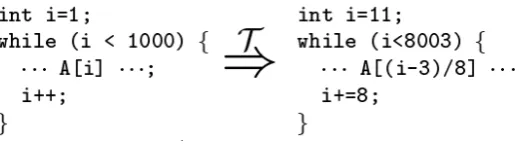
2.1 Variable encoding example (Collberg et al., 1997) . . . 10
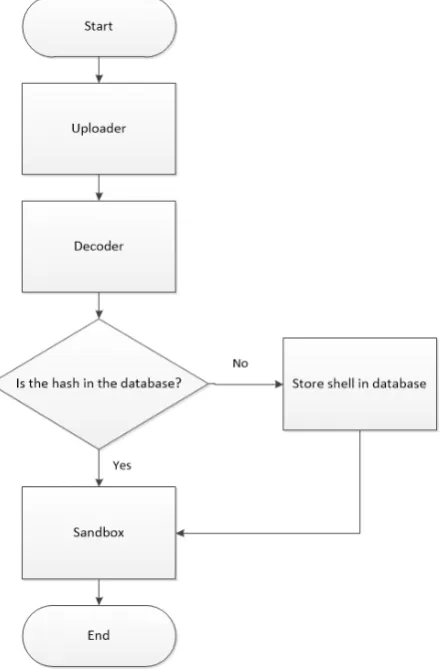
3.1 The path of a web shell though the system . . . 26
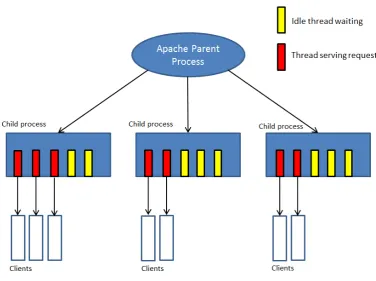
3.2 Thread management on a production server . . . 29
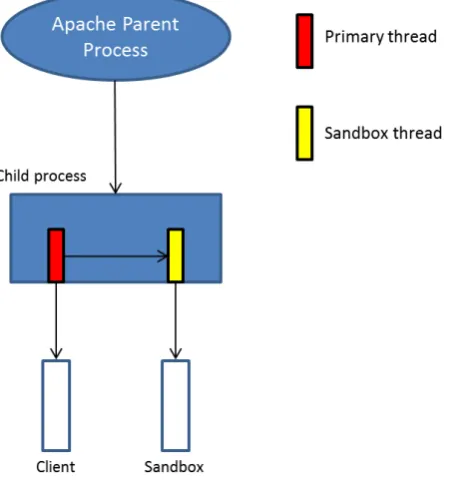
3.3 Thread management in the shell analysis system . . . 30
3.4 The decoder's user interface . . . 34
3.5 Decoder class diagram . . . 35
3.6 The sandbox's user interface . . . 44
3.7 Sandbox class diagram . . . 44
3.8 Settings and status indicators of the Runkit Sandbox class (The PHP Group, 2013j) . . . 47
4.1 Total number of calls to idiomatic obfuscation and string manipulation functions made from the sample of shells . . . 54
4.2 Total number of calls to idiomatic obfuscation and string manipulation functions made from the sample of shells . . . 54
List of Tables
3.1 Commonly used PHP code execution functions . . . 31
3.2 Information gathered by the decoder . . . 34
3.3 Functions that the system can process . . . 37
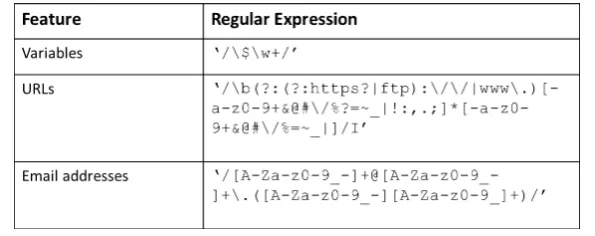
3.4 Regular expressions used for information gathering . . . 40
3.5 Conguration options of the Runkit Sandbox class (The PHP Group, 2013k) 46 C.1 Command execution functions . . . 90
C.2 Code execution functions . . . 90
C.3 Information disclosure functions . . . 91
C.4 Filesystem functions . . . 91
C.5 Miscellaneous functions . . . 92
D.1 Shells contained in the system database . . . 93
List of Listings
3.1 A common obfuscation idiom . . . 33
3.2 Typical usage of preg_replace() . . . 36
3.3 Typical usage of eval() . . . 37
3.4 Psuedo-code for the decode() function . . . 38
3.5 Psuedo-code for the processEvals() function . . . 39
3.6 Psuedo-code for the processPregReplace() function . . . 39
3.7 Call to the preg_replace_all() function . . . 40
3.8 Extract from c99.php showing a reference to an update server . . . 41
3.9 The removeComments() function . . . 42
3.10 The removeBlankLines() function . . . 42
3.11 The formatLines() function . . . 42
3.12 Psuedo-code for the constructor of the Sandbox class . . . 45
3.13 Pseudo-code for the redefineFunctions() function . . . 48
3.14 Output handler for the Runkit Sandbox object . . . 50
3.15 Example of a function redenition . . . 50
4.1 Single-level eval() with a base64-encoded argument . . . 55
4.2 Expected decoder output with the script in Listing 4.1 as input . . . 55
4.3 Actual decoder output with the script in Listing 4.1 as input . . . 56
4.4 Extract of a single-level eval() with multiple auxiliary functions . . . 56
4.5 Extract of the expected decoder output with the script in Listing 4.4 as input 57 4.6 Extract of the actual decoder output with the script in Listing 4.4 as input 57 4.7 Single-level preg_replace() with explicit string arguments . . . 57
LIST OF LISTINGS ix
4.8 Expected decoder output with the script in Listing 4.7 as input . . . 58
4.9 Actual decoder output with the script in Listing 4.7 as input . . . 58
4.10 Extract of a simple preg_replace() statement . . . 59
4.11 Extract of an eval() construct encapsulated in the preg_replace() state-ment in Listing 4.10 . . . 59
4.12 Extract of the actual decoder output with the script in Listing 4.10 as input4.12 . . . 59
4.13 Extract of a single-level eval() containing obfuscated variable, URL and email address information . . . 60
4.14 Actual decoder output with the script in Listing 4.13 as input . . . 60
4.15 Information gathering results with the script in Listing 4.13 as input . . . . 60
4.16 Extract of the outermost obfuscation layer . . . 61
4.17 Extract of the decoder output with the script in Listing 4.16 as input . . . 61
4.18 Actual decoder output with the script in Listing 4.16 as input . . . 62
4.19 Script calling an overridden function and the corresponding copied function 63 4.20 Sandbox output and results with the script in Listing 4.19 as input . . . . 63
4.21 Script calling three exploitable functions . . . 64
4.22 Sandbox results with the script in Listing 4.21 as input . . . 64
4.23 Extract of the cmd.php web shell . . . 65
4.24 Sandbox results and output with the script in Listing 4.23 as input . . . . 66
4.25 Extract of the connect-back.php web shell . . . 66
4.26 Sandbox results and output with the script in Listing 4.25 as input . . . . 66
4.27 Extract of the sosyete.txt web shell . . . 67
4.28 Sandbox results and output with the script in Listing 4.27 as input . . . . 67
A.1 Code from the decode() function . . . 82
A.2 Code from the processEvals() function . . . 83
A.3 Code from the processPregReplace() function . . . 85
B.1 Code from the redefineFunctions() function . . . 87
Chapter 1
Introduction
1.1 Problem Statement
The overwhelming popularity of PHP as a hosting platform (Tatroe, 2005, The PHP Group, 2013m) has made it the language of choice for developers of Remote Access Tro-jans (or web shells) and other malicious software (Sunner, 2007, Cholakov, 2008). Web shells are typically used to compromise and monetise web platforms by providing the attacker with basic remote access to the system, including le transfer, command ex-ecution, network reconnaissance and database connectivity (Kazanciyan, 2012). Once infected, compromised systems can be used to defraud users by hosting phishing sites, perform Distributed Denial of Service (DDOS) attacks, or serve as anonymous platforms for sending spam or other malfeasance (Landesman, 2007).
The proliferation of such malware has become increasingly aggressive in recent years, with some monitoring institutes registering over 70 000 new threats every day (AV Test, 2009, Kaspersky, 2011). The sheer volume of software and the rate at which it is able to spread make traditional, static signature-matching infeasible as a method of detection (Christo-dorescu et al., 2005, Preda et al., 2007). Previous research has found that automated and dynamic approaches capable of identifying malware based on its semantic behaviour in a sandbox environment fare much better against the many variations that are constantly being created (Christodorescu et al., 2005, Moser et al., 2007, Hyung Chan Kim, 2009, Burguera et al., 2011). Furthermore, many malware tools disguise themselves by mak-ing extensive use of obfuscation techniques designed to frustrate any eorts to dissect or reverse engineer the code (Christodorescu & Jha, 2004, Li et al., 2009). Advanced code engineering can even cause malware to behave dierently if it detects that it is not run-ning on the system for which it was originally targeted (Sharif et al., 2008b). To combat
1.2. RESEARCH GOALS 2
these defensive techniques, this project intended to create a sandbox environment that accurately mimics a vulnerable host and is capable of semi-automatic semantic dissection and syntactic deobfuscation of PHP code.
1.2 Research Goals
In response to the problem detailed in Section 1.1, two primary objectives were identied. The rst was the development of a sandbox-based component capable of safely executing and dissecting potentially malicious PHP code. This sandbox was designed to mimic a vulnerable host and allow the code to run as it usually would, but without negatively aecting the machine on which it is being run. The purpose of creating such a system was to analyse the behaviour of shell scripts and identify any potentially malicious actions that they might undertake. As such, it forms the dynamic component of the full shell analysis system information about the shell's functioning is extracted at runtime. The sandbox component is able to log calls to functions that have the potential to be exploited by an attacker and make the user aware of such calls by specifying where they were made in the code.
The second major goal was the development of an auxiliary component for performing normalisation and deobfuscation of input code prior to execution in the sandbox envir-onment. Code normalisation is the process of altering the format of a script to promote readability and understanding, while deobfuscation is the process of revealing code that has been deliberately disguised (Preda & Giacobazzi, 2005). The decoder component was designed to analyse code for syntactic structures and functions that are typically associ-ated with code obfuscation (such as eval() and preg_replace()) and replace these with the code they were intended to disguise. In addition to this fuctionality, the decoder is capable of extracting useful information in the form of variable names, URLs and email addresses from PHP scripts.
1.3. DOCUMENT STRUCTURE 3
1.3 Document Structure
This thesis begins with an overview of relevant literature in the elds of code deobfuscation and dissection in Chapter 2. It includes a short overview of PHP, its inherent security characteristics, and a description of the common structure of shells written in the language. Various approaches to obscuring code and preventing analysis are then explored, along with techniques for reversing them. The chapter also includes a brief summary and discussion of existing systems capable of dissecting PHP code.
Chapter 3 outlines the design and implementation of the system. It begins with a de-scription of the environment in which the system was developed (including the machine architecture, operating system, web server and implementation language) before moving on to discuss the two major system components: the decoder and the sandbox. The chapter then concludes with a description of the structure and important functional units of each of these components.
The system described in Chapter 3 was subjected to tests designed to gauge its ecacy. The results of these tests, which ranged from unit tests designed to test specic function-ality to more comprehensive, system-wide tests, are presented in Chapter 4.
Chapter 2
Literature Review
2.1 Introduction
The deobfuscation and dissection of PHP-based malware is a non-trivial task with no well-dened solution. Many dierent techniques and approaches can be found in the literature, each with their own advantages and limitations. In an attempt to evaluate these approaches, this chapter begins in Section 2.2 by providing an overview of the PHP language itself, including its notable features, performance relative to other languages, usefulness, inherent security characteristics and most particularly its role as the language of choice for developers of Remote Access Trojans(RATs) and other malware. Section 2.3 provides a brief overview of the structure and capabilities of a typical PHP web shell. The concept of code obfuscation and the many methods of achieving it are discussed in Sections 2.4 and 2.5, before moving on to discuss techniques for reversing obfuscation and briey exploring existing systems capable of automated code deobfuscation in Sections 2.6, 2.7 and 2.8 respectively. Sections 2.9, 2.10 and 2.11 cover code dissection, the two main approaches that are often followed in pursuit of it, and the properties and uses of sandboxes before comparing two widely-used frameworks for analysis. In closing, the chapter summary discusses the viability of PHP as an implementation language, the feasibility and ideal characteristics of an automated deobfuscation system, and nally the approach that should be followed when developing a complete system for the dissection of PHP-based malware.
2.2. PHP OVERVIEW 5
2.2 PHP Overview
PHP (the recursive acronym for PHP: Hypertext Preprocessor)1 is a general purpose
scripting language that is primarily used for the development and maintenance of dynamic web pages (Argerich, 2002, The PHP Group, 2013p). First conceived in 1994 by Rasmus Lerdof (Argerich, 2002), the power and ease of use of PHP has enabled it to become the world's most popular server-side scripting language by numbers (The PHP Group, 2013n). Using PHP, it is possible to transform static web pages with predened content into pages capable of displaying dynamic content based on a set of parameters. Although originally developed as a purely interpreted language, multiple compilers have since been developed for PHP, allowing it to function as a platform for standalone applications (Tatsubori et al., 2010, The PHP Group, 2013o). Since 2001, the reference releases of PHP have been issued and managed by The PHP Group (Doyle, 2011).
2.2.1 Language Features
Much of the popularity of PHP can be attributed to its relatively shallow learning curve. Users familiar with the syntax of C++, C#, Java or Perl are able to gain an understanding of PHP with ease, as many of the basic programming constructs have been adapted from these C-style languages (Argerich, 2002, The PHP Group, 2013a). As is the case with more recent derivatives of C, users need not concern themselves with memory or pointer management, both of which are dealt with by the PHP interpreter (McLaughlin, 2012). The documentation provided by the PHP group is concise and comprehensively describes the many built-in functions that are included in the language's core distribution (The PHP Group, 2013c). The simple syntax, recognisable programming constructs and thorough documentation combine to allow even novice programmers to become reasonably procient in a short space of time.
PHP is compatible with a vast number of platforms, including all variants of UNIX, Win-dows, Solaris, OpenBSD and Mac OS X (Argerich, 2002). Although most commonly used in conjunction with the Apache web server, PHP also supports a variety of other servers, such as the Common Gateway Interface, Microsoft's Internet Information Services, Nets-cape iPlanet and Java servlet engines (The PHP Group, 2013e). Its core libraries provide functionality for string manipulation, database and network connectivity, and le system support (Argerich, 2002, Doyle, 2011, The PHP Group, 2013o), giving PHP unparalleled exibility in terms of deployment and operation.
2.2. PHP OVERVIEW 6
As an open source language, PHP can be modied to suit the developer. In an eort to ensure stability and uniformity, however, reference implementations of the language are periodically released by The PHP Group (Doyle, 2011). This rapid development cycle en-sures that bug xes and additional functionality are readily available and has contributed directly to PHP's reputation as one of the most widely supported open source languages in circulation today (Argerich, 2002, Sklar, 2008). An abundance of code samples and programming resources exist on the Internet in addition to the standard documentation (The Resource Index Online Network, 2005, The PHP Group, 2013f, Zend Technologies, 2013), and many extensions have been created and published by third party developers (The PHP Group, 2013g).
2.2.2 Performance and Use
PHP is most commonly deployed as part of the LAMP (Linux, Apache, MySQL and PHP/Perl/Python) stack (Bughin et al., 2008). It is a server-side scripting language in that the PHP code embedded in a page will be executed by the interpreter on the server before that page is served to the client (Doyle, 2011). This means that it is not possible for a client to know what PHP code has been executed they are only able to see the result. The purpose of this preprocessing is to allow for the creation of dynamic pages that can be customised and served to clients on the y (Argerich, 2002).
When implemented as an interpreted language, studies have found that PHP is noticeably slower than compiled languages such as Java and C (Wu et al., 2000, Titchkosky et al., 2003). However, since version 4, PHP code has been compiled into bytecode that can then be executed by the Zend Engine, dramatically increasing eciency and allowing PHP to outperform competitors written in other languages (such as Axis2 and the Java Servlets Package) (Cecchet et al., 2003, Suzumura et al., 2008, Trent et al., 2008). Performance can be further enhanced by deploying commonly-used PHP scripts as executable les, eliminating the need to recompile them each time they are run (Atkinson & Suraski, 2004).
2.3. WEB SHELLS 7
2.2.3 Security
A study of the United States National Vulnerability Database2 performed in April 2013
found that approximately 30% of all reported vulnerabilities were related to PHP (Coelho, 2013). Although this gure might seem alarmingly high, it is important to note that most of these vulnerabilities are not vulnerabilities associated with the language itself, but are rather the result of poor programming practices employed by PHP developers. In 2008, for example, a mere 19 core PHP vulnerabilities were discovered, along with just four in the language's libraries (Coelho, 2013). These numbers represent a small percentage of the 2218 total vulnerabilities reported in the same year (Coelho, 2013).
Apart from a lack of knowledge and caution on the part of PHP developers, the most plausible explanation for the large number of vulnerabilities involving PHP is that the language is specically being targeted by hackers. Because of its popularity, any exploit targeting PHP can potentially be used to compromise a multitude of other systems run-ning the same language implementation (Coelho, 2013). PHP bugs are thus highly sought after because of the high pay-o associated with their discovery. This mentality is clearly demonstrated in the recent spate of exploits targeting open source PHP-based Content Management Systems like phpBB, PostNuke, Mambo, Drupal and Joomla, the last of which has over 30 million registered users (Miller, 2006, Open Source Matters, 2013).
2.3 Web Shells
RATs are small scripts designed to be uploaded onto production servers (Landesman, 2007). They are so named because they will often masquerade as a legitimate program or le. Once in place, these shells act as a backdoor, allowing a remote operator to control the server as if they had physical access to it (Kazanciyan, 2012). Any server that allows a client to upload les (usually via the HTTP POST method) is vulnerable to infection by malicious web shells.
In addition to basic remote administration capabilities, most web shells include a host of other features, some of which are listed below (Landesman, 2007):
• The ability to include remote les • Access to the local lesystem • Keystroke logging
2.4. CODE OBFUSCATION 8
• Registry editing
• The ability to send email • Packet sning capabilities
The structure of a web shell can vary according to its intended function. Smaller, more limited shells are better at avoiding detection, and are often used to secure initial access to a system. These shells can then be used to upload a more powerful RAT when it is less likely to get noticed (Sunner, 2007).
2.4 Code Obfuscation
Code obfuscation is a program transformation intended to thwart reverse engineering attempts (Preda & Giacobazzi, 2005). The resulting program should be functionally identical to the original, but may produce additional side eects in an attempt to disguise its true nature (Borello & Me, 2008).
In their seminal work detailing the taxonomy of obfuscation transforms, Collberg et al. (1997) dene a code obfuscator as a potent transformation that preserves the observable behaviour of programs. The concept of observable behaviour is dened as behaviour that can be observed by the user, and deliberately excludes the distracting side eects mentioned above, provided that they are not discernible during normal execution. A transformation can be classied as potent if it produces code that is more complex than the original (Preda & Giacobazzi, 2005).
All methods of code obfuscation can be evaluated according to three metrics (Borello & Me, 2008):
• Potency the extent to which the obfuscated code is able to confuse a human reader • Resilience the level of resistance to automated deobfuscation techniques
• Cost the amount of overhead that is added to the program as a result of the
transformation
2.5. METHODS OF OBFUSCATION 9
dicult to understand. Manual deobfuscation in particular is so time-consuming and error-prone that it is often not worth the eort. (Laspe, 2008)
2.5 Methods of Obfuscation
Although the number of code obfuscation methods is limited only by the creativity of the obfuscator, the common ones listed below fall neatly into the three categories of layout, data and control obfuscation (Linn & Debray, 2003). Each category boasts methods of varying potency, and a powerful obfuscator should employ methods from each category to achieve a high level of obfuscation.
2.5.1 Layout Obfuscation
Perhaps the most trivial form of obfuscation, layout obfuscation is concerned with the modication of the formatting and naming information in a program (Ertaul & Venkatesh, 2004).
2.5.1.1 Format Modication
The removal of formatting information such as line breaks and white space from source code is the most common method of obfuscation (Collberg et al., 1997). It can only be performed on programs written in languages that do not depend on formatting as a structural device and is of low potency, as it removes very little semantic content and is easily processed by automated deobfuscation systems (Collberg et al., 1997). This method is resilient to manual deobfuscation owing to the decrease in code readability, however, and can be performed without adding any overhead to the original program (Collberg et al., 1997).
2.5.1.2 Identier Name Modication
2.5. METHODS OF OBFUSCATION 10
Figure 2.1: Variable encoding example (Collberg et al., 1997)
2.5.2 Data Obfuscation
The obscuring of data structures in a program by modifying how they are stored, accessed, grouped and ordered is known as data obfuscation (Collberg et al., 1997). It is considered more powerful than layout obfuscation as it obscures the semantics of a program and is able to stymie some automated deobfuscation systems (Sharif et al., 2008b). Programs written using object-oriented languages in particular store much of their semantic inform-ation in the form of data structures. Data obfuscinform-ation is thus of paramount importance when attempting to obscure code written in these languages (Collberg et al., 1997).
2.5.2.1 Storage and Encoding Modication
Modifying the data storage characteristics of a program changes the way data structures are stored in memory (Ertaul & Venkatesh, 2004). Typical examples of this type of obfuscation include variable splitting (parts of a single variable stored in many dierent locations) and the conversion of static data (such as a string) to procedural data (such as a function that produces the same string at runtime). The former makes it dicult to discern the purpose of a variable (it could be a variable fragment with no individual value) and the latter removes static data that may contain information that could be used to aid in the reverse engineering process (Linn & Debray, 2003).
2.5. METHODS OF OBFUSCATION 11
2.5.2.2 Data Aggregation
Modications to the way data are grouped in a program can also serve to obscure the data structures contained therein (Ertaul & Venkatesh, 2004). Three common examples of this type of obfuscation are listed below:
• Scalar variables such as integers can be merged into a single variable provided that
the single variable is suciently large to accommodate the scalar variables with no loss in precision. It is possible, for example, to store two 32-bit integers in one 64-bit integer, although this would then require major changes to how each variable is referenced in the rest of the program. (Collberg et al., 1997)
• Structures such as arrays can be merged, split, folded or attened to increase their
complexity. These techniques all complicate access to the arrays and further remove them from the data they are intended to represent (attening a two-dimensional array that was intended to represent a chess board, for example, will make it more dicult to extract this representation during the obfuscation process). (Linn & Debray, 2003)
• Class inheritance relationships can be complicated by splitting a single class into
multiple classes or by introducing fake classes into the inheritance hierarchy. The result of these operations is a class structure in which classes no longer represent complete entities and relationships are convoluted and illogical. (Collberg et al., 1997)
2.5.2.3 Data Ordering
2.5. METHODS OF OBFUSCATION 12
2.5.3 Control Obfuscation
Perhaps the most important characteristic of a program that needs to be obscured during the obfuscation process is the control ow. Reverse engineering a program when the control ow and data structures are known is a trivial process as previously discussed, other obfuscation methods such as layout modication are simple to overcome. As is the case with the obfuscation of data, the aggregation and ordering of control ow statements are important and can be modied to increase the program's complexity and resilience. (Collberg et al., 1997)
2.5.3.1 Computation Modication
The modication of the computations involved in the determination of control ow (such as condition calculations in loops and predicate evaluation in if statements) is a powerful method of obfuscation, although it does introduce a signicant amount of overhead into the resulting program (Collberg et al., 1997). Computation modication can be achieved in the following ways:
• Irrelevant code (i.e., code that has no impact on the control ow) can be inserted
into a program to frustrate deobfuscators and make the reverse engineering process more time-consuming, as the deobfuscator has no way of knowing whether a section of code is irrelevant until it has been processed (Ertaul & Venkatesh, 2004).
• Loop conditions can be made arbitrarily complex without aecting the number of
iterations that will be performed. If the loop was intended to run eight times, for example, the condition could be i < 2 * (24 - 20) instead of i < 8. Once again, this technique is of a low potency, as it serves only to make the deobfuscation process more lengthy (Ertaul & Venkatesh, 2004).
• Dummy processes can be added to the program to distract reverse engineering
2.6. CODE OBFUSCATION AND PHP 13
2.5.3.2 Code Aggregation
Much like data aggregation, code aggregation merges dissimilar blocks of code and sep-arates similar blocks of code. Collberg et al. (1997) describe the twin goals of code aggregation as follows:
1. Code that a programmer has placed in a method (because it logically belonged together) should be scattered throughout the program
2. Code that has no logical relationship should be aggregated into a single method Further obscuring of the abstractions usually employed by programmers can be achieved through the use of inline and outline methods (Linn & Debray, 2003). Instead of ab-stracting commonly used code into a separate method, an obfuscator will include this code (as an inline method) wherever it is needed, eectively removing a semantically rich procedural abstraction that could be leveraged by a deobfuscator (Linn & Debray, 2003). Outline methods, by contrast, abstract a section of code that is not commonly used into a separate method, granting it an undeserved status as a procedural abstraction and potentially misleading any reverse engineering attempts (Collberg et al., 1997).
2.5.3.3 Code Ordering
When writing code, programmers tend to organise expressions and statements in a logical manner that makes the program easy to read and understand (Ertaul & Venkatesh, 2004). Since the goal of obfuscation is to discourage understanding, it follows that the ordering of code should be as random as possible. This is trivial for structures such as methods in classes, but in some cases the ordering of statements cannot be entirely randomised because of the dependencies that exist between them (a variable declaration cannot be placed below an expression that includes that variable, for example). In these cases, a dependency analysis of the two statements must be performed before any form of code reordering is attempted (Ertaul & Venkatesh, 2004). Although reordering is not a powerful method of obfuscation when used in isolation, its eectiveness increases when combined with code aggregation and computation modication (Ertaul & Venkatesh, 2004).
2.6 Code Obfuscation and PHP
2.7. DEOBFUSCATION TECHNIQUES 14
contains several functions that directly support the protection/hiding of code and which are often combined to form the following obfuscation idiom (Wysopal et al., 2010):
eval(gzinate(base64_decode(str_rot13($str))))
To begin with, the string containing the malicious code is encrypted using the rot13 al-gorithm. It is then encoded in base64 (using base64_encode()) before being compressed (using gz_deflate()). At runtime, the process is reversed. The resulting code is ex-ecuted through the use of the eval() function (Wysopal et al., 2010, The PHP Group, 2013c).
Although seemingly complex, code obfuscated in this manner can easily be neutralised and analysed for potential backdoors (see Section 2.3). Replacing the eval() function with an echo command will display the code instead of executing it, allowing the user to determine whether it is safe to run. This process can be automated using PHP's built-in function overriding mechanisms (Welling & Thomson, 2003), which are examined in more detail in Section 2.10.2.2.
2.7 Deobfuscation Techniques
The obfuscation methods described in the previous sections are all designed to prevent code from being reverse engineered. Given enough time and resources, however, a de-termined deobfuscator will always be able to restore the code to its original state. This is because perfect obfuscation is provably impossible, as is demonstrated by Barak et al. (2001) in their seminal paper On the (Im)possibility of Obfuscating Programs. Collberg et al. (1997) concur, postulating that every method of code obfuscation simply embeds a bogus program within a real program and that an obfuscated program essentially con-sists of a real program which performs a useful task and a bogus program that computes useless information. Bearing this in mind, it is useful to review the techniques that are widely employed by existing deobfuscation systems.
2.7.1 Pattern Matching
2.7. DEOBFUSCATION TECHNIQUES 15
& Debray, 2003). The resultant decrease in the size of the program greatly increases the eciency of the deobfuscator the larger the database, the greater the increase in eciency (Linn & Debray, 2003).
2.7.2 Program Slicing
Deobfuscators that employ program slicing techniques are able to split an obfuscated program into manageable units called slices that it can then evaluate both individually and in relation to other slices (Collberg et al., 1997). In this way, the system can avoid bogus code entirely and group similar code blocks together, reversing the eorts of the obfuscator and making the code more readable (Collberg et al., 1997). Advanced slicing systems are able to create chains of slices leading up to a target slice that represent the code blocks that were executed up to that point, even if said blocks are scattered throughout the program (Collberg et al., 1997).
2.7.3 Statistical Analysis
Like pattern matching, statistical analysis aims to remove unimportant code, but it is able to do so without knowledge of previously discovered bogus segments (Collberg et al., 1997). Instead, the deobfuscator will repeatedly test an expression in an obfuscated program and record the results (Sharif et al., 2008a). If the expression always returns the same value, it is likely to belong to the meaningless part of the obfuscated code and can safely be replaced with the value itself or removed from the program altogether (Collberg et al., 1997).
2.7.4 Partial Evaluation
2.8. EXISTING DEOBFUSCATION SYSTEMS 16
2.8 Existing Deobfuscation Systems
Several automatic tools exist online that are capable of deobfuscating PHP code (Sucuri Labs, 2012, Ballast Security, 2012). The source code for these tools is not available, however, and their features are not well documented or even disclosed, making them poor subjects to study. Instead, a brief summary of two generic deobfuscation systems is presented below, with a view to identifying features to replicate and pitfalls to avoid.
2.8.1 LOCO
LOCO is a interactive graphical environment in which a user can experiment and observe the eects of both obfuscation and deobfuscation transformations (Madou et al., 2006).
2.8.1.1 Features
Based on a visualisation tool called Lancet and an obfuscation infrastructure called Di-ablo, LOCO is able to expose the control ow of a program and show the eects of any obfuscating or deobfuscating actions on it. Users can choose either to execute and evaluate existing obfuscation/deobfuscation transformations or to develop and test trans-formations of their own. The environment's visualisation feature is particularly helpful when it comes to identifying aws in deobfuscation transformations, as the user can step through the program and identify the eects of the transformation at any point in the code. It also facilitates the manual deobfuscation of programs by allowing users to modify the source code and observe how each modication aects the ow of control. (Madou et al., 2006)
2.8.1.2 Limitations
2.9. CODE DISSECTION 17
2.8.2 PHP Deobfuscation using the evalhook Module
In a study attempting to analyse exploitation behaviour on the web, Canali and Balzarotti (2013) found it necessary to develop and implement an automated deobfuscator of PHP code.
2.8.2.1 Features
The system implemented by Canali and Balzarotti makes use of the evalhook PHP ex-tension, which attaches itself to all calls to dynamic code evaluation functions such as eval(). This means that any malicious code hidden in an eval() construct can be mon-itored in realtime. The system achieves a success rate of 24%, which is remarkable since it relies solely on one very specic deobfuscation technique. It is also fully automatic, requiring no human intervention during the deobfuscation process. (Canali & Balzarotti, 2013)
2.8.2.2 Limitations
As an auxiliary system to the main project, the deobfuscator lacks several of the deob-fuscation techniques discussed in Section 2.7. As a result of this, it is unable to correctly deobfuscate scripts encoded with proprietary tools such as Zend Optimiser or ionCube PHP Encoder (Canali & Balzarotti, 2013). The incorporation of other techniques could increase the robustness of the system, as well as its success rate (Canali & Balzarotti, 2013).
2.9 Code Dissection
2.10. DISSECTION TECHNIQUES 18
2.10 Dissection Techniques
All code dissection techniques can be classied as being either static or dynamic in nature (Binkley, 2007).
2.10.1 Static Approaches
Static analysis approaches attempt to examine code without running it (Christodorescu et al., 2007). Because of this, these approaches have the benet of being immune to any potentially malicious side eects. The lack of runtime information such as variable values and execution traces does limit the scope of static approaches, but they are still useful for exposing the structure of code and comparing it to previously analysed samples (Zaremski & Wing, 1995).
2.10.1.1 Signature Matching
A software signature is a characteristic byte sequence that can be used to uniquely identify a piece of code (Zaremski & Wing, 1995). Anti-malware solutions make use of static sig-natures to detect malicious programs by comparing the signature of an unknown program to a large database containing the signatures of all known malware if the signatures match, the unknown program is agged as suspicious. This kind of detection can easily be overcome by making trivial changes to the source code of a piece of malware, thereby modifying its signature (Zaremski & Wing, 1993).
2.10.1.2 Pattern Matching
2.10. DISSECTION TECHNIQUES 19
2.10.2 Dynamic Approaches
Dynamic approaches to analysis extract information about a program's functioning by monitoring it during execution (Christodorescu et al., 2007). These approaches examine how a program behaves and are best conned to a virtual environment such as a sandbox so as to minimise the exposure of the host system to infection (Christodorescu et al., 2007).
2.10.2.1 API Hooking
Application programming interface (API) hooking is a technique used to intercept function calls between an application and an operating system's dierent APIs (Sun et al., 2006). In the context of code dissection, API hooking is usually carried out to monitor the behaviour of a potentially malicious program (Berdajs & Bosnic, 2010). This is achieved by altering the code at the start of the function that the program has requested access to before it actually accesses it and redirecting the request to the user's own injected code (Berdajs & Bosnic, 2010). The request can then be examined to determine the exact behaviour exhibited by the program before it is directed back to the original function code (Sun et al., 2006).
The precision and volume of code required for correct API hooking mean that behaviour monitoring systems that make use of the technique are complex and time consuming to implement (Berdajs & Bosnic, 2010). They are also virtually undetectable and thoroughly customisable (only functions relevant to behaviour analysis need be hooked) (Berdajs & Bosnic, 2010).
2.10.2.2 Sandboxes and Function Overriding
A sandbox is a restricted programming environment that is used to separate running programs (Goldberg et al., 1996). Malicious code can safely be run in a sandbox without aecting the host system, making it an ideal platform for the observation of malware behaviour (Gong et al., 1997).
2.11. EXISTING CODE DISSECTION SYSTEMS 20
• The safe_mode_include_dir option can be used to specify a single directory from
which modules can be included in the sandbox.
• The open_basedir option can be used to specify a single directory that can be
accessed from within the sandbox.
• The allow_url_fopen option can be set to false to prevent code in the sandbox
from accessing content on the Internet.
• The disable_functions and disable_classes options can be used to disable any
functions and classes from being used inside the sandbox.
Of particular interest to a developer of a code dissection system is the runkit.internal conguration directive that can be used to enable the ability to modify, remove or rename functions within the sandbox (The PHP Group, 2013l). This can facilitate the dissection of PHP code by providing the functionality to replace functions associated with code ob-fuscation (such as eval()) with benign functions that merely report an attempt to execute a string of PHP code (The PHP Group, 2013l). Network activity could be monitored in much the same way calls to url_fopen() could be replaced by an echo statement that prints out the URL that was requested by the code.
2.11 Existing Code Dissection Systems
Two slightly dierent code dissection systems are presented below: the rst uses dynamic analysis and execution tracing and the second uses dynamic analysis and API hooking (Sharif et al., 2008a, Sunbelt Software, 2013).
2.11.1 Eureka
Designed by Sharif et al. in 2008, Eureka is a framework that aims to enable dynamic malware analysis (Sharif et al., 2008a, The PHP Group, 2013c).
2.11.1.1 Features
2.11. EXISTING CODE DISSECTION SYSTEMS 21
group these calls according to their functionality (Sharif et al., 2008a). Execution tracing is performed by logging all system calls made by a process bearing the malware's program ID and statistical analysis is performed on the program's memory space to determine when it terminates and if it terminates correctly (Sharif et al., 2008a).
2.11.1.2 Limitations
Eureka is unable to track the execution of malware that only reveals part of its source code during an execution stage and then re-encrypts the code once it has been run (Sharif et al., 2008a). It is also possible that a piece of malware capable of detecting API hooking could avoid certain system calls, thereby avoiding setting o the triggers that drive the framework (Sharif et al., 2008a).
2.11.2 CWSandbox
CWSandbox is a generic malware analysis tool that boasts automatic, eective and accur-ate software analysis (Sunbelt Software, 2013). It is automaccur-ated in the sense that it is able to produce detailed reports of malware activity with no user intervention and eective in the sense that it is able to produce a comprehensive list of the detected features (Sunbelt Software, 2013). It is correct in the sense that no false positives are returned (i.e. all the logged activity was a result of the actions of the malware) (Sunbelt Software, 2013).
2.11.2.1 Features
CWSandbox analyses malware dynamically in a sandbox environment. Because of this, it is able to bypass the problems faced by static analysers when faced with obfuscated code, as it is concerned solely with the behaviour of the code at runtime. As was the case with the Eureka framework, CWSandbox uses API hooking to determine malware behaviour. The system is able to monitor all calls to the Windows API during execution and determine whether each call has originated from the malware. (Sunbelt Software, 2013)
2.11.2.2 Limitations
2.12. SUMMARY 22
monitor calls to the kernel, this malware activity would go unnoticed. (Sunbelt Software, 2013)
2.12 Summary
The chapter began with a discussion on the merits of the PHP language. It was found to be a robust, fully-featured language that employs a simple, C-like syntax, making it easy to learn and use for development. As a language with a well-developed community, PHP enjoys regular updates and bug xes and is endowed with a comprehensive set of documentation and example code. Although the language is associated with many security aws, it was determined that these aws generally occur as a result of poor programming practice on the part of PHP developers rather than core issues with the language itself. Code obfuscation was introduced as an obstacle to automated code dissection. Various methods of obfuscation were presented and it was determined that a combination of these techniques greatly complicated the deobfuscation process. Techniques for reversing code obfuscation were then presented and it was found that even highly obfuscated code could be restored to its original state given enough time. Two existing deobfuscation systems were briey introduced and evaluated. LOCO, a graphical environment for observing the eects of obfuscating transforms, proved to be more a tool for developing a deobfuscation system than a system in itself. The second system made use of the evalhook module, employed only one deobfuscation technique, and was able to decode 24% of the scripts that it encountered.
The concept of code dissection was then introduced and discussed. The two main ap-proaches to dissection namely static and dynamic analysis were compared, and it was found that dynamic analysis techniques fared better against new types of malware, but were more complex to implement. Two existing code dissection systems were also compared: the rst, Eureka, was able to dissect most malware examples, but was stymied by code that only revealed part of its source during a given execution stage and then re-encrypted itself. CWSandbox was found to be a powerful commercial code analyser with only one observable aw it could not intercept system calls made directly to the kernel and was thus unable to dissect malware that behaved in this way.
2.12. SUMMARY 23
Chapter 3
Design and Implementation
The development of a system capable of analysing PHP shells required the design and construction of two main components: the decoder and the sandbox. The environment in which both of these components were developed and run is detailed in Section 3.2. Section 3.3 describes the choice of the Apache HTTP server and the manner in which it was congured, which is then followed by a description of PHP, the implementation language, and an outline of its useful features and extensions in Section 3.4. The design and implementation of the decoder responsible for code normalisation and deobfuscation is presented in Section 3.5 and the next stage of the analytical process, the sandbox capable of dynamic shell analysis, is described in Section 3.6. A summary of the design of the entire system is presented in Section 3.7.
3.1 Scope and Limits
The system was originally envisioned as consisting of three distinct components (the decoder, the sandbox, and the reporter) that would communicate via a database. As development progressed, it was found that a separate reporting component would necessi-tate complex communication between itself, the other components, and the database. For this reason, the design of the system was modied and each component was made respon-sible for reporting on its own activities. The closer coupling between the components and the feedback mechanisms allows information relating to each stage in the process of shell analysis to be relayed to the user as it occurs deobfuscation results are displayed during static analysis, and the results of executing the shell in the sandbox environment are displayed during dynamic analysis. Possible methods for constructing a comprehensive reporter capable of combining the results of both stages is discussed in Section 5.2.
3.2. ARCHITECTURE, OPERATING SYSTEM AND DATABASE 25
3.2 Architecture, Operating System and Database
While the deobfuscation and dissection of PHP shells is a nontrivial task, neither of the stages involved in the process is computationally intensive. It was thus not necessary to acquire any special hardware the system was simply developed and run on the lab machines provided by Rhodes University.
A core part of the system is the sandbox environment, which is designed to safely execute potentially malicious PHP code. This component relies heavily on the Runkit Sandbox class that forms part of PHP's Runkit extension package (The PHP Group, 2013k). Since this extension is not available as a dynamic-link library (DLL) or Windows binary, a decision was made to develop the system in a Linux environment. Ubuntu (version 12.10) was chosen because of its familiarity and status as the most popular (and therefore most widely supported) Linux distribution (Zachte, 2012). Another welcome byproduct of Ubuntu's popularity is the abundance of Ubuntu-specic tutorials for procedures such as setting up web servers, installing and conguring libraries, and setting le permissions, all of which were useful during the development period.
VMware Player1, a free virtualisation software package supplied by VMware Inc., is used
to run Ubuntu in a virtual machine environment (VMware Inc., 2013). The primary reason for this is to protect the host machine from being aected by any malicious actions performed by the PHP shells during execution and to provide greater control over the development environment. Although the Runkit Sandbox class can be congured to restrict the activities of such shells (see Section 3.6.3 for a full list of the conguration options that can be set), there is a still a risk that an incorrectly congured option or unforeseen action on the part of the shell could corrupt the system in some way. Backups of the virtual machine were therefore made on a regular basis. These backups had the added benet of acting as a version control system that permitted rollback in the event of system failure due to shell activity or errors that arose during development. Traditional version control systems such as Git would have worked well with just the source les, but since the project involved extensive recompilation and conguration of both PHP and Apache (see Sections 3.3 and 3.4), it proved more expedient to backup the entire virtual machine.
Both the decoder and the sandbox components make use of a MySQL database for the persistent storage of web shells. PHP scripts being analysed are stored by computing the MD5 hash of the raw code and using the resulting 32-bit string as the primary key. MD5 was chosen because it is faster than other common hashing algorithms such as SHA-1 and
3.2. ARCHITECTURE, OPERATING SYSTEM AND DATABASE 26
Figure 3.1: The path of a web shell though the system
SHA-256 (Dai, 2009). Each MD5 hash is then checked against the previously analysed code stored in the database to prevent duplication. Once the shell has been decoded, the resulting deobfuscated and normalised version of the code is stored alongside the hash and the raw code in the database. This deobfuscated code is what is then executed in the sandbox environment. A owchart depicting the passage of a shell through the system is shown in Figure 3.1.
3.3. WEB SERVER 27
3.3 Web Server
The PHP shells, which the system was created to dissect and analyse, are all designed to be uploaded onto web servers thereby providing remote access to an attacker (Huang et al., 2004). For this reason, many of the shells only function correctly when run in a web server environment advanced scripts fail to begin executing at all if they do not detect an HTTP server and its associated environment variables (Borders et al., 2007, Sharif et al., 2008b). The system was thus designed to closely mimic conditions that might be found on a real world web platform to facilitate correct shell execution and allow analysis to take place.
In pursuit of this goal, an Apache HTTP server2 was installed inside the virtual machine.
This server can be accessed via the loopback network interface by directing a web browser in the virtual machine to the default localhost address of 127.0.0.1. Although the virtual machine itself has no access to the broader Internet, shells executing inside the sandbox are barred from making web requests as an added precaution. This restriction was achieved by modifying the conguration options of the Runkit Sandbox class (see Section 3.6 for full details of how the sandbox was congured).
3.3.1 Choice of Apache
As the world's most popular HTTP server, Apache is used to power over half of all websites on the Internet (NetCraft, 2013). Its rampant popularity made it an ideal choice for this project for two reasons: Firstly, as was the case with Ubuntu, many installation and conguration guides are available for Apache. Since it was necessary to compile the web server from its source code (Ubuntu's Advanced Packaging Tool does not allow conguration options relating to non-standard modules such as Runkit and PHP to be set, it simply performs a default install of commonly used modules), these guides and the documentation provided by the Apache Software Foundation proved invaluable. Secondly, Apache's popularity means that it is also well supported by the developers of web shells a signicant number of these shells are able to run on the Apache HTTP server. Apache was also chosen as the preferred web server because of its modular design and the abundance of modules available for use. Its behaviour can be modied by enabling and disabling these modules, allowing it to be tailored to suit the needs of any system designed to run on it. This modularity also allows it to be compatible with a wide variety of languages used for server-side scripting, including PHP, the language used to develop
3.3. WEB SERVER 28
this system. Furthermore, PHP's Runkit Sandbox class, a core part of the sandbox environment, requires that both the underlying web server and PHP itself support thread-safety. This was achieved by manipulating conguration options during the compilation process. A detailed description of exactly how this was performed is provided in Section 3.6.3.
In a system of this scale, server performance is not an important factor. Shells are up-loaded and processed individually instead of concurrently. In future, however, if the system were to be extended to automatically collect and process web shells, performance would become more of a concern and other approaches (such as multithreading or con-current programming) would have to be considered. Furthermore, the focus during de-velopment was on testing a proof of concept rather than developing a high-performance system able to be deployed in a production environment.
3.3.2 Apache Compilation and Conguration
As has already been stated, it was necessary to compile Apache from the source to gain access to the conguration options needed to enable the thread safety required by PHP's Runkit extension. Although this was the primary reason, compiling the server from its source code had other key advantages. It provided more exibility, as it was possible to choose only the functionality required by the system and no more this would not have been possible if the server was installed from a binary created by a third party. Further-more, the default install directory could be modied during compilation, which proved helpful when managing multiple versions of Apache and testing dierent conguration settings. Descriptions of the conguration options required specically for the system and the Runkit Sandbox in particular, but which are not included as part of the default install, are shown below:
--enable-so
The --enable-so conguration option was used to enable Apache's mod_so module, which allows the server to load dynamic shared objects (DSOs). Modules in Apache can either be statically compiled into the httpd binary or exist as DSOs that are separate from this binary (The Apache Software Foundation, 2013b). If a statically compiled module is updated or recompiled, Apache itself must also be recompiled. Since recompilation is a time-consuming process, PHP was compiled as a shared module so that it was only necessary to restart Apache when changes were made to the PHP installation.
3.3. WEB SERVER 29
Figure 3.2: Thread management on a production server
The --with-mpm=worker conguration option was included to specify the multi-processing module (MPM) that Apache should use. MPMs implement the basic behaviour of the Apache server, and every server is required to implement at least one of these modules (The Apache Software Foundation, 2013a). The default MPM is prefork, a non-threaded web server that allocates one process to each request. While this MPM is appropriate for powering sites that make use of non-thread-safe libraries, it was not chosen for this system because it is not compatible with PHP's Runkit Sandbox class. It was therefore necessary to specify the use of the worker MPM, a hybrid multi-process multi-threaded server that is able to serve more requests using fewer system resources while still maintaining the thread-safety demanded by the aforementioned class. Figures 3.2 and 3.3 demonstrate the dierences between these two server models.
3.4. IMPLEMENTATION LANGUAGE 30
Figure 3.3: Thread management in the shell analysis system
The client in Figure 3.3 is the uploader of the shell. This shell is then decoded and stored in the database before being handed over to the sandbox environment. All of these tasks are performed by the primary thread. When the sandbox environment then instantiates an instance of the Runkit Sandbox class, a new thread is created to execute the decoded shell script. Full details of the Runkit Sandbox class and the motivation behind the creation of a separate thread can be found in Section 3.6.3.
3.4 Implementation Language
The nal part of the LAMP stack is the scripting language used to generate dynamic web pages. Although Python was originally chosen for this purpose, during development it was found that PHP would be more suitable. The reasons for this choice are outlined in Section 3.4.1.
3.4. IMPLEMENTATION LANGUAGE 31
Table 3.1: Commonly used PHP code execution functions
3.4.1 Choice of PHP
As a language originally designed for web development, PHP is ideally suited to server-side scripting. Although other languages such as Python and Perl are also able to full this role, the existence of the Runkit extension and its embeddable sub-interpreter (the Runkit Sandbox) made PHP the language of choice, particularly for a system of this scale. If the system were to be expanded, a more robust and general pupose language like Python (with its true object orientation and multiple inheritance) could be used to implement the static analysis and system logic components, falling back on PHP only to execute code in the Runkit Sandbox. Section 5.2.2 contains further details of such an approach.
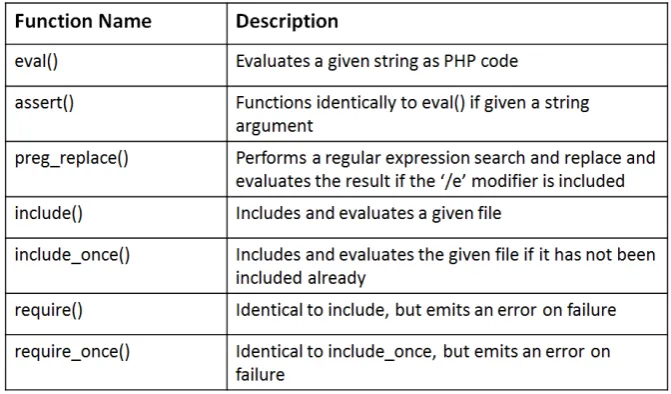
A multitude of libraries and standard functions exist for performing common server-side scripting tasks such as uploading les, communicating with a database and directing output to a browser. The language also has many functions that facilitate the execution of arbitrary PHP code from both local and remote sources (see Table 3.1). Although these functions are often exploited by the developers of web shells and can be responsible for many server vulnerabilities if not properly managed, they also proved useful for executing the aforementioned web shells in the sandbox environment, as is explained in Section 3.6.5.
3.4. IMPLEMENTATION LANGUAGE 32
as each component (apart from the database and a few supporting classes that were not required to interact with or provide feedback to the user) consisted simply of a PHP le containing both the HTML code and the class denition. Snippets of PHP located inside HTML elements were then used to call class methods, which returned the output that needed to be relayed to the user.
The primary reason for the use of PHP as opposed to other scripting languages such as Python and Perl is the existence of the Runkit extension. This package provides the means to redene user and system functions as well as classes, and, most importantly, contains the Runkit Sandbox class, an embeddable sub-interpreter that forms the basis of the sandbox (The PHP Group, 2013j). It is this class that facilitated the rapid de-velopment and prototyping of the system, as it already contains many of the functions and conguration settings required for a sandbox environment to function eectively (see Section 3.6.3). Since the Runkit extension already required the installation and congu-ration of PHP, it proved most expedient to code the entire system in the same language. If the system were to be expanded in any way, however, a more robust and fully-featured language would have to be considered (see Section 5.2.2).
3.4.2 PHP Conguration
As was the case with Apache, PHP was compiled from source and installed in the www-root directory for exibility and ease of modication. It was congured by manipulating conguration options during installation once again, the focus was on enabling thread safety and creating a sandbox-friendly environment.
--with-zlib
When developers of malware attempt to hide their work, they often employ compression functions such as gzdeflate() as part of the obfuscation process. Since the goal of the system is to remove such obfuscation, it is necessary to reverse these functions. The zlib software library facilitates reverse engineering of this kind by allowing the system to decompress compressed data using the gzinflate() function. Figure 3.1 depicts an obfuscation idiom that includes a call to the aforementioned function, where the string in brackets represents the obfuscated code.
--enable-maintainer-zts and --enable-runkit
3.5. THE DECODER 33
1 <? php
2 eval ( gzinflate ( base64_decode ("4+ VKK81LLsn ... "))); 3 ?>
Listing 3.1: A common obfuscation idiom
the --enable-maintainer-zts conguration option during the compilation process. The purpose of enabling thread safety was to provide an environment in which the Runkit extension could function - this extension was enabled using the last conguration option.
3.5 The Decoder
The rst of the major components developed for the system was the decoder, which is responsible for performing code normalisation and deobfuscation prior to execution in the sandbox environment. Code normalisation is the process of altering the format of a script to promote readability and understanding, while deobfuscation is the process of revealing code that has been deliberately disguised (Preda & Giacobazzi, 2005).
The decoder is considered a static deobfuscator in that it manipulates the code without ever executing it. The advantage of this approach is that it suers from none of the risks associated with malicious software execution, such as the unintentional inclusion of remote les, the overwriting of system les, and the loss of condential information. Static analysers are however unable to access runtime information (such as the value of a variable at any given time or the current program state) and are thus limited in terms of behavioural analysis.
The purpose of this component is to expose the underlying program logic and source code of an uploaded shell by removing any layers of obfuscation that may have been added by the shell's developer. This process is controlled by the decode function, which is described in Section 3.5.3. It makes use of two core supporting functions, processEvals() and processPregReplace(), the details of which are provided in Sections 3.5.4 and 3.5.5 respectively.
deobfusca-3.5. THE DECODER 34
Table 3.2: Information gathered by the decoder
Figure 3.4: The decoder's user interface
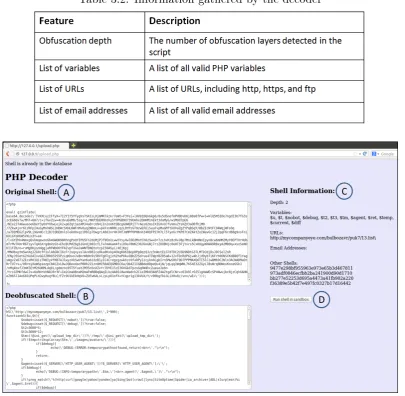
tion process in an attempt to transform it into a more readable form. The three pretty printing functions are discussed in Section 3.5.7.
3.5.1 Structure and User Interface
The decoder is contained in a single PHP le consisting of two parts: the Decoder class that houses the deobfuscation logic and contains methods for accessing the deobfuscation results, and a section of HTML that functions as the user interface. A screenshot of this interface is shown in Figure 3.4, and code snippets detailing the main functions of the Decoder class can be found in Appendix A.
3.5. THE DECODER 35
Figure 3.5: Decoder class diagram
its original form. Once the deobfuscation process has been completed, the results are displayed in area B directly below it. The area on the right (area C) displays the results obtained during information gathering, including the obfuscation depth, variables, URLs and email addresses.
Area C also displays the MD5 hashes of the other shells currently stored in the database. Shells are automatically added to this list once they have passed through the decoder. Button D is used to open the user interface for the sandbox environment, and also instructs the decoder to pass the shell to the Runkit Sandbox for execution.
3.5.2 Class Outline
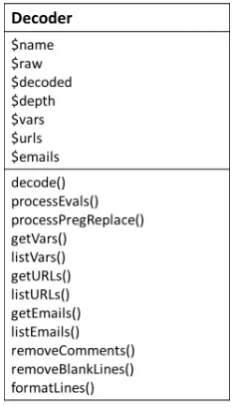
The Decoder class makes use of several properties to record information about the shells that it is designed to process (see Figure 3.5). These properties are all set by the con-structor, which requires only the name of the shell to begin decoding. This name and the raw shell code are both stored, along with variables to track the obfuscation depth and the results of the deobfuscation process. Variables, URLs and email addresses discovered during information gathering are also stored in arrays to be displayed to the user once decoding is complete.
3.5. THE DECODER 36
1 <? php
2 preg_replace ("/X/e", " print 15; ", "X"); 3 ?>
4
5 Output : 15
Listing 3.2: Typical usage of preg_replace()
amongst others. The MD5 hashing necessary to obtain a primary key for stored shells is also performed in this class. As is explained in Section 3.2, MD5 was chosen for this task because it is able to hash large les faster than competitors such as SHA-1 and SHA-256 (Dai, 2009).
Once the constructor has read the shell le, set up the necessary properties and made a successful connection to the database via the DB class, it calls the decode() function to begin the deobfuscation process. This function makes use of the processEvals() and processPregReplace() functions to deobfuscate the script. The functions relating to vari-ables, URLs and email addresses are used during the information gathering process (see Section 3.5.6), and the functions relating to the removal of comments and general code formatting are used during the code normalisation process (see Section 3.5.7).
3.5.3 The Decode() Function
The part of the Decoder class responsible for removing layers of obfuscation from PHP shells is the decode() function. It scans the code for the two functions most associated with obfuscation, namely eval() and preg_replace(), both of which are capable of ar-bitrarily executing PHP code. The eval() function interprets its string argument as PHP code, and preg_replace() can be made to perform an eval() on the result of its search and replace by including the deprecated '/e' modier (see Listing 3.2). Furthermore, eval() is often used in conjunction with auxiliary string manipulation and compression functions in an attempt to further obfuscate the actual code. This is shown in Listing 3.3.
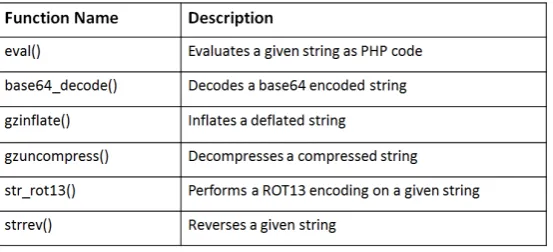
The gzinflate() and base64_decode() functions are examples of the aforementioned auxiliary functions that help to obscure code. The system is able to deal with any com-bination of the following functions shown in Table 3.3.
3.5. THE DECODER 37
1 <? php
2 eval ( gzinflate ( base64_decode ( str_rot (" HJ6 = DFG ... "))); 3 ?>
4
5 Output : Hello World
Listing 3.3: Typical usage of eval()
Table 3.3: Functions that the system can process
this process is repeated until neither of the functions is detected in the code. Some pretty printing is then performed to get the output into a readable format, the functions that carry out the information gathering are called, and the decoded shell is stored in the database alongside the raw script. The full pseudo-code of this process is presented in Listing 3.4.
After both the processEvals() and processPr