R E V I E W
Targeting IL-5 in COPD
This article was published in the following Dove Press journal: International Journal of Chronic Obstructive Pulmonary Disease
Dharani K Narendra Nicola A Hanania
Section of Pulmonary, Critical Care and Sleep Medicine, Baylor College of Medicine, Houston, TX, USA
Abstract:Many patients with chronic obstructive pulmonary disease (COPD) continue to
experience exacerbations despite receiving standard-of-care treatments. Novel approaches to COPD treatment focus on understanding and targeting molecular mechanisms of airway inflammation, airway obstruction, remodeling and lung destruction. Several identified phe-notypes and endotypes of COPD will pave the future path for a more personalized approach to therapy. Although well known to be associated with neutrophilic inflammation, COPD may also be driven by eosinophilic inflammation both at stable states and during exacerba-tion. Targeting eosinophilic inflammation has been successful in managing severe eosino-philic asthma and may hold promise in certain phenotypes of COPD. The most promising biologic treatments at an advanced stage of development are agents blocking interleukin (IL)-5 or its receptor. This review examines our current understanding of the eosinophilic inflammation in COPD and the rationale for IL-5 targeting agents.
Keywords:COPD, airway inflammation, eosinophils, IL-5, mepolizumab, benralizumab
Introduction
Chronic obstructive pulmonary disease (COPD) is a common airway disease asso-ciated with significant morbidity and mortality worldwide. The Global initiative for Obstructive Lung Disease (GOLD) defines COPD as a common preventable and treatable disease, characterized by progressive airflow limitation that triggered by the response in the airways and the lung to noxious particles or fumes.1The pathogenesis of airflow limitation in COPD is driven by airway inflammation, airway remodeling of small airways (chronic bronchitis) as well as parenchymal lung destruction (emphy-sema). Globally, there are about 251 million cases of COPD accounting for an estimated of more than 3 million deaths; about 5% of total deaths globally the year 2016.2In fact, COPD accounts for most deaths from chronic lower respiratory disease and is currently the third leading cause of death in the United States.3
In the year 2017, GOLD refined the assessment tool for COPD that focused on spirometry, symptom assessment and assessment of risk of exacerbations. Management goals of COPD include improving symptoms and reducing future exacerbations. Recurrent exacerbations of COPD impose a significant burden on patient and health care cost, contributes to decline in lung function, quality of life, and is associated with negative impact on mental health and high mortality.4,5
Phenotypes and endotypes of COPD
COPD is a heterogeneous disease with varying clinical presentations (phenotypes) and underlying pathobiological mechanisms (endotypes).6–8 Identifying phenotypes and endotypes of COPD will lead to a more precise approach to this impactful disease.
Correspondence: Nicola A Hanania Section of Pulmonary, Critical Care and Sleep Medicine, Baylor College of Medicine, 1504 Taub Loop, Houston, TX 77030, USA
Tel +1 713 873 3454 Email [email protected]
International Journal of Chronic Obstructive Pulmonary Disease
Dove
press
open access to scientific and medical research
Open Access Full Text Article
International Journal of Chronic Obstructive Pulmonary Disease downloaded from https://www.dovepress.com/ by 118.70.13.36 on 22-Aug-2020
Quantitative cell counts in sputum in patients with symptoms of bronchitis provide a reliable (although not practical) method to assess airway inflammation. Based on the cellular inflammatory substrate, COPD phenotypes include: 1) neu-trophilic, 2) eosinophilic, 3) mixed eosinophilic and neutro-philic and 4) paucigranulocytic.9Blood biomarkers such as blood eosinophils may correlate with sputum eosinophils in patients with eosinophilic airway inflammation.9
Neutrophilic airway inflammation is the most predomi-nant type seen in COPD and is mediated by non-Th2 (Helper T cells type 2) mechanisms and is typically steroid non-responsive. The most common etiology/trigger of this subtype includes cigarette smoking, air pollution, ozone exposure, occupational exposure and infections.
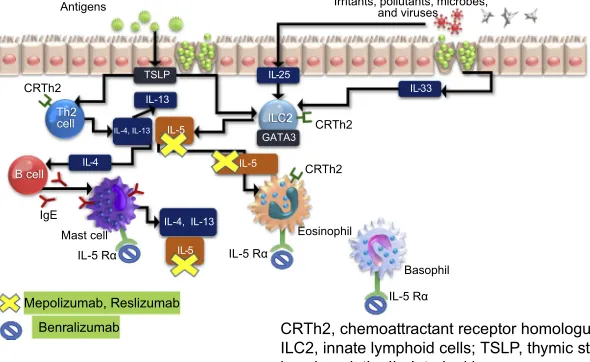
Eosinophilic airway inflammation which is most com-monly encountered in asthma has been also described in some patients with COPD.10 T2 airway inflammation which encompasses eosinophilic inflammation is propa-gated by both the adaptive and innate immune response. Alarmins including the cytokines IL-33, IL-25 and thymic stromal lymphopoietin (TSLP) are produced by epithelial cells that have been exposed to pollutants or other envir-onmental triggers including allergens. In the case of aller-genic triggers, these cytokines initiate an adaptive immune response via dendritic cells that stimulate naïve T cells to differentiate into Th2 cells, which produce IL-5, IL-13 and IL-4. Non-allergen triggers can initiate an innate immune response potentially occurs via stimulation of type 2 innate lymphoid cells (ILC-2), which has been associated with the production of type 2 effector cytokines (5 and IL-13) and eosinophilic airway inflammation (See Figure 1).
Role of eosinophils in COPD
It is estimated that eosinophilic inflammation is present in up to 40% cases of COPD.11 Elevated concentrations (>3%) found in sputum of a subset of patients with COPD.12 Furthermore, approximately 1 in 5 exacerbations is thought to be associated with an eosinophilic exacerbation.13–15 Indeed, airway biopsies and sputum taken during an acute exacerbations show an increased number of eosinophil con-centrations compared with stable COPD. Eosinophils release eosinophilic cationic protein (ECP) and eosinophil peroxi-dase (EPO) which are toxic to bronchial epithelial cells and cause the release of cytokines which drive airway inflammation.12Furthermore, airway eosinophilia has been shown to predict an increased risk of exacerbations11 and lung tissue and airway remodeling as well as an increased expression of interleukin (IL)-5.16 From the Genetic Epidemiology of COPD (COPDGene) study and the Evaluation of COPD Longitudinally to Identify Predictive Surrogate Endpoints (ECLIPSE) study, stratified analyses confirmed that the increased exacerbation risk associated with an eosinophil count of 300 cells/µL or greater was driven by subjects with a history of frequent exacerbations.17
Targeting eosinophilic in
fl
ammation
in COPD
Reducing eosinophilic airway inflammation in asthma has also been shown to reduce the risk of exacerbation.13–15 Clinically, an eosinophilic phenotype of COPD has been defined by the presence of a peripheral blood eosinophil count of 3% or more or >150–200 cells per cubic millimeter.
IL-4, IL-13
Antigens
TSLP
Th2
cell ILC2
IL-13
GATA3
CRTh2
B cell
IgE
Eosinophil CRTh2
CRTh2
IL-4 IL-5
IL-4, IL-13
Mast cell
Irritants, pollutants, microbes, and viruses
IL-33 IL-25
Basophil IL-5 Rα IL-5 Rα
IL-5 Rα
IL-5
IL-5
Mepolizumab, Reslizumab
Benralizumab CRTh2, chemoattractant receptor homologue from Th2 cells; ILC2, innate lymphoid cells; TSLP, thymic stromal
lymphopoietin; IL, Interleukin;
Figure 1T2 inflammatory pathway and the target site for anti-IL-5 agents.
Abbreviations:CRTh2, chemoattractant receptor homolog from Th2 cells; ILC2, innate lymphoid cells; TSLP, thymic stromal lymphopoietin; IL, Interleukin.
International Journal of Chronic Obstructive Pulmonary Disease downloaded from https://www.dovepress.com/ by 118.70.13.36 on 22-Aug-2020
Roche and colleagues18 analyzed data from Effect of indacaterol Glycopyrronium vs Fluticasone Salmeterol on COPD exacerbations (FLAME) trial on the role of blood eosinophils in predicting the response of patients with COPD to inhaled corticosteroid efficacy. The FLAME trial compared ICS responsiveness to blood eosinophil percen-tage (2%, 3% and 5%) and absolute blood eosinophil count (<150 cells/µL, 150–300 cells/µL and >300 cells/µL). The indacaterol/glycopyrronium combination was found to be more effective than fluticasone/salmeterol in preventing acute exacerbations of COPD in all patients and in sub-groups with different blood eosinophil range. However, other studies reveal contradicting results and suggest that a high baseline eosinophil count predicts response to ICS in COPD patients at high risk of exacerbation.18,19However, Lipson et al randomized 10,355 patients with COPD, com-paring 52 weeks of a once-daily fluticasone furoate (an inhaled glucocorticoid), umeclidinium (LAMA) and vilan-terol (LABA) versus fluticasone furoate–vilanterol or ume-clidinium–vilanterol.20 The annual rate of moderate or severe exacerbations was lower with triple therapy than with either dual-therapy, regardless of eosinophil level, although a greater reduction in the exacerbations was observed in patients with eosinophil levels of at least 150 cells/µL.
In addition to corticosteroids, other medications target-ing eosinophils that are available or in development include those that block IL-5/IL-5 receptor alpha (IL-5Rα), IL-13/IL-4 receptor alpha (IL-4Rα), chemoattractant receptor–homologous molecules (DP2), IL-25, IL-33 and thymic stromal lymphopoietin (TSLP).
Targeting IL-5
Over the last decade, several monoclonal antibodies and molecular therapies have been developed to target eosino-philic inflammation and some are approved in the treat-ment of severe asthma.21,22
Interleukin 5 (IL-5) is a homodimer cytokine involved in eosinophil differentiation, recruitment, maturation, acti-vation and degranulation.23 The IL-5 receptor (IL-5R) consists of an IL-5-specific alpha subunit that interacts in conformational dynamic ways with the receptors β subu-nit, an aggregate of domains it shares with binding sites of IL-3 and granulocyte-macrophage colony-stimulating fac-tor. IL-5 and IL-5R driven allergic and inflammatory immune responses are characterized in numerous diseases, such as asthma, atopic dermatitis, chronic obstructive pul-monary disease, eosinophilic gastrointestinal diseases,
hyper-eosinophilic syndrome, eosinophilic granulomatosis with polyangiitis (EGPA) and eosinophilic nasal polyposis. Sputum concentrations of IL-5 correlate with the degree of eosinophilia and response to glucocorticoids for patients with stable COPD and soluble IL-5Rαis increased during virus-induced COPD exacerbations.24
Molecular targets of IL-5 include monoclonal antibodies against circulating IL-5 (mepolizumab, reslizumab) or the IL-5 receptor-alpha (benralizumab). Figure 1 shows their site of action of available anti-IL-5 medications. Below, we pro-vide details on clinical trials that have been completed with some of these agents in the eosinophilic COPD phenotype.
Mepolizumab
Mepolizumab is a humanized, IgG1 monoclonal antibody that targets circulating IL-5, which inhibits binding of IL-5 to the alpha chain of IL-5 receptor and neutralizes its effect.25,26 Mepolizumab has been approved as an-add on maintenance treatment of severe eosinophilic asthma.27
Post-hoc analysis of two trials, MENSA and DREAM in severe asthma showed that mepolizumab was associated with lower exacerbation rates (needing systemic steroids or hospitalization) than placebo among patients with severe eosinophilic asthma with clinical features of COPD.28 Furthermore, mepolizumab was evaluated in a pilot randomized clinical trial in COPD with eosinophilic bronchitis by Dasgupta et al,29 as a proof of principle, single center, randomized placebo-controlled, parallel group, double-blinded 6 month trial and 4 month follow-up. The primary objective was to determine if mepolizu-mab could decrease sputum eosinophil percentage in COPD patients with sputum eosinophilia. Other outcomes assessed on blood eosinophilia, lung function, exacerba-tion rate, symptoms and quality of life, sputum hyaluronan and versican. Eighteen patients were randomly assigned to mepolizumab (n=8) and placebo (n=10). Patients received monthly infusions of mepolizumab 750 mg or placebo in addition to their inhalers. Mepolizumab reduced sputum eosinophil counts from 11% to 0.5% at 6 months vs placebo 7% to 2% (p<0.05). Blood eosinophils decreased from 0.7+0.5 cells mm–3 to 0.03+0.05 cells mm–3 (p<0.05). There was no significant difference in pre-and post-bronchodilator spirometry measures, residual volume, total lung capacity, diffusion capacity, sputum hyaluronan, versican or radiological evidence of remodeling or patient-related outcomes at 3 and 6 months. This study also analyzed an important result that decrease in sputum and blood eosinophils were not associated with significant
International Journal of Chronic Obstructive Pulmonary Disease downloaded from https://www.dovepress.com/ by 118.70.13.36 on 22-Aug-2020
improvements in lung functions parameters, exacerbation rates, sputum markers of remodeling and health-related quality of scores.
Mepolizumab was evaluated for patients with eosino-philic COPD in two multicenter, Phase III randomized, controlled, clinical trials for the prevention of exacerba-tion. The Mepolizumab vs Placebo as Add-on Treatment for Frequently Exacerbating COPD Patients Characterized by Eosinophil Level trial (METREO) Phase III study (NCT02105961) evaluated two dosages of mepolizumab (100 mg and 300 mg, every 4 weeks) versus placebo (n=674) for 62 weeks for patients with ≥2 exacerbations or ≥1 severe exacerbations in the previous year while on triple therapy including inhaled corticosteroids and an eosinophilic phenotype (≥150 cells/μL at screening or
≥300 cells/μL during the previous year).28 The Mepolizumab vs Placebo as Add-on Treatment for Frequently Exacerbating COPD Patients trial (METREX) Phase III study (NCT02105948) compared mepolizumab 100 mg every 4 weeks with placebo (n=837) over 52 weeks for patients with COPD who had ≥2 moderate exacerbations (ie, treated with systemic glucocorticoids, antibiotics, or both in association with worsening of COPD) or≥1 severe exacerbations (ie, leading to hospita-lization) in the previous year. Patients with both eosino-philic (≥150 cells/μL at screening or≥300 cells/μL during the previous year) and noneosinophilic (<150 cells/μL at screening and no evidence of≥300 cells/μL in the previous year) phenotypes were included, and results were analyzed for those with baseline blood eosinophil counts≥150 cells/ μL versus <150 cells/μL. The primary endpoint for both studies was the annual rate of moderate or severe exacer-bations. Secondary endpoints include time to first exacer-bation, rate of exacerbations requiring emergency department visit, hospitalization or both, mean change from baseline at week 52 in St George’s Respiratory questionnaire (SGRQ-C) and COPD assessment test score (CAT score).
In the METREO study, the exacerbation rate ratios in the 100 mg and 300 mg mepolizumab groups compared with placebo were 0.80 and 0.86 (p=0.07 and p=0.14, respectively). In the METREX study, mepolizumab reduced the mean annual exacerbation rate for patients with eosinophilia (n=462) (1.40 versus 1.71 exacerba-tions/year;p=0.04), but no significant benefit over placebo was observed in the overall population. In both studies, there were no statistically significant differences observed between the two groups in patient-reported outcomes.
In a post-hoc meta-analysis of the eosinophilic patient populations (≥300 cells/μL at screening or during the pre-vious year) from the combined trials demonstrated that the rate of moderate (leading to systemic glucocorticoid treat-ment, antibiotic treatment or both) or severe (leading to hospitalization or resulting in death) exacerbations was 23% lower for patients treated with mepolizumab 100 mg compared with placebo recipients (rate ratio, 0.77). The meta-analysis also demonstrated greater treatment effects with mepolizumab versus placebo with increasing screening blood eosinophil counts for exacerbations trea-ted with systemic glucocorticoids but not in patients whose exacerbations were treated with antibiotics. This differen-tial response to mepolizumab according to the trigger of exacerbation (microbial or non-microbial) is quite interest-ing and requires further exploration in future studies. It also remains unclear whether all exacerbations during treatment with mepolizumab require treatment with sys-temic steroids. No significant differences in adverse events were observed.
In May 2018, FDA did not approve mepolizumab for treatment of COPD and stated that the drug failed to demonstrate efficacy for the new indication and that stu-dies included patients who may have had asthma-COPD overlap (ACO) which may have reflected the potential benefit of the drug in these subsets. Future mepolizumab studies for COPD are in the planning stage to address these concerns.
Benralizumab
Benralizumab is humanized afucosylated, anti–IL-5Rα monoclonal antibody that prevents IL-5 signaling by bind-ing to the IL-5Rα receptor. It binds to natural killer cells which release proapoptotic proteins such as granzymes and perforins causing rapid and direct depletion of eosi-nophils and basophils via enhanced antibody-dependent cell-mediated cytotoxicity.30 Benralizumab has been approved for severe eosinophilic asthma based on two large Phase III clinical trials.31,32
Benralizumab was thefirst anti-IL5 to be evaluated in COPD. In a Phase IIa clinical trial, Brightling and colleagues33 conducted a randomized, double-blind, pla-cebo-controlled study in adults 40–85 years old, with moderate-to-severe COPD, at least one acute exacerbation of COPD, and a sputum eosinophil count of 3.0% or more within the previous year (NCT01227278). Participants were randomly assigned (1:1) via computer-generated per-muted block randomization (block size of four), with an
International Journal of Chronic Obstructive Pulmonary Disease downloaded from https://www.dovepress.com/ by 118.70.13.36 on 22-Aug-2020
T able 1 Agents targeting IL-5 in COPD Age nt/T rials Dose , fr equency Study design, duration, number of subjects Outcomes Mepolizumab (Anti-IL5) Dasgupta et al, 29 NCT01463644 A pilot phase II 750 mg monthly IV Single center , Randomized, dou-ble blind, placebo contr olled 24 w eeks 18 patients Primar y : Mepolizumab reduced sputum eosinophil counts fr om 11% to 0.5% at 6 months vs placebo 7% to 2% ( p <0.05). Blood eosinophils decr eased fr om 0.7+0.5 cells.mm − 3to 0.03+0.05 cells mm −
3(p
<0.05). Secondar y : No signi fi cant differe nce in the lung function parameters, exacerbation rates, sputum mark ers of re modeling, health-r elated quality of life score s. Pa vord et al, 28
NCT02105948 (METREX), Phase
III
NCT02105961 (METREO), Phase
III 100 mg subcuta-neous q 4 w eeks 300 mg subcuta-neous q 4 w eeks Multicenter Randomized, double blind, placebo contr olled 52 w eeks 1,510 patients Primar y : Signi fi cantly reduction in the annual exacerbation rate vs placebo for patients with eosinophilic phenotype (patients with blood eosinophil counts 150 cells/ μ L at scre ening or ≥ 300 cell/ μ L within the pr e vious (1.40 versus 1.71; n=462; p =0.04); differe nce was not signi fi cant in the ov erall population Secondar y : Signi fi cant reduction in time to fi rst moderate/sev er e exacerbation in the eosinophilic population (192 versus 141 da ys; p =0.04); no statistically signi fi cant differ ences in an y other endpoints betw een gr oups Primar y : Rate ratios for exacerbations w er e 0.80 ( p =0.07) and 0.86 ( p =0.14) versus placebo for 100-mg and 300-mg dosages of mepolizumab, respectiv ely Secondar y : No statistical signi fi cance in an y endpoints versus placebo in either gr oup . Benralizumab IL-(IL5R α receptor anta gonist) Brightling et al, 33 NCT01227278 Phase IIa 100 mg subcuta-neous q 4 w eeks Single center randomized, dou-ble blind, placebo contr olled 56 w eeks 101 patients Primar y : Annualized rate of acute exacerbations of COPD: benralizumab 0.95, placebo 0.92 (no signi fi cant differe nce) Secondar y : Signi fi cant incr ease in pr e-br onchodilator FEV 1 ve rsus placebo (0.13 L versus − 0.06 L; p =0.014); no signi fi cant differ ences betw een gr oups in change fr om baseline for mean SGRQ-C , CRQ-SAS, BODE scor es; no differe nce in tr eatment-emergent adv erse e ve nts betw een tre atment gr oups. Criner et al, GALA THEA 34 Phase III Celli et al, TERRANO V A 35 Phase III Undisclosed dosage Multicenter Randomized, double blind, placebo contr olled 56 – 60 w eeks Results ar e not ye t released, pr eliminar y data rev ealed no differ ence in primar y outcome in decr easing exacer -bations in patients with COPD . Abbre viations: BODE, BMI, Airwa y Obstruction, Dyspnea, Ex er cise tolerance; CRQ-SAS, Chr onic respirator y Questionnair e-Standar dized dyspnea domain; IV , Intra venous; Q, e ver y; SGRQ-C , St. George ’ s Respirator y Questionnair e-COPD .
International Journal of Chronic Obstructive Pulmonary Disease downloaded from https://www.dovepress.com/ by 118.70.13.36 on 22-Aug-2020
interactive voice or web-response system, to receive pla-cebo or 100 mg for 52 weeks. Benralizumab subcuta-neously, every 4 weeks (three doses), then every 8 weeks (five doses) over 48 weeks. One hundred and one patients were randomized to receive Benralizumab (51) versus Placebo (50) and 88 patients completed the study. Benralizumab did not reduce annualized rate of exacerba-tions compared to placebo, rate of 0.95 versus 0.92 in the overall population but was associated with significant improvement in pre-bronchodilator FEV1 compared with placebo (0.13 L versus–0.06 L;p=0.014) as early as week 4. In sub-analysis, there was a 31% reduction in exacer-bations with benralizumab versus placebo treatment for patients with baseline blood eosinophils ≥200 cells/μL. Patients with blood eosinophils≥200 cells/μL also exhib-ited significant improvement in FEV1 (p=0.035), but patients with lower eosinophil counts did not. Adverse events were similar in the two groups.
More recently, two Phase III studies (GALATHEA and TERRANOVA, NCT02138916 and NCT02155660), ran-domized, double-blinded, 56-week placebo-controlled multicenter trials assessing safety and efficacy of benrali-zumab as an add-on therapy to dual or triple inhaled therapy compared to placebo in patients with moderate-to-severe COPD with history of exacerbation across a range of blood eosinophils. Press releases about the
ana-lysis of GALATHEA34 on May 11, 2018, and
TERRANOVA35released on May 30, 2018, revealed that these trials failed to meet primary endpoint of statistically significant reduction of exacerbations in patients with COPD.
Reslizumab
Reslizumab is a humanized anti-IL-5 monoclonal antibody approved for severe eosinophilic persistent asthma for patients aged 18 years. Like mepolizumab, this drug acts on circulating IL-5 and neutralizes its effect. However, this drug is administered intravenously and it is weight based (3 mg per kilogram every 4 weeks). Although approved in asthma, it has not been evaluated in the COPD population.
Conclusion
The fact that COPD is a heterogeneous disease with multi-ple phenotypes and endotypes has led to the examination of novel targets for therapy that target specific pathologic mechanisms. For such treatments to work, biomarkers are needed to identify the most appropriate patients. The use of blood eosinophil count has been used to determine a
subgroup of patients with eosinophilic phenotype of COPD. Despite conflicting evidence, blood eosinophils appear to predict COPD exacerbations and response to some anti-inflammatory medications such as inhaled cor-ticosteroids. IL-5 is an important effector cytokine in driv-ing eosinophilic airway inflammation in both asthma and COPD. The results of the anti-IL-5/IL-5Rα clinical trials in asthma confirmed the efficacy and safety of such agents in severe eosinophilic asthma (Table 1). The efficacy and safety of two of the agents currently approved for treat-ment of severe eosinophilic asthma have now been exam-ined in large clinical trials in the eosinophilic COPD population. However, preliminary data from these studies, although encouraging, have not shown consistent results. Several factors may have contributed to this inconsistency of results. The cutoff values for blood eosinophils used to enroll patients with COPD in these studies were similar to those used in asthma studies. Future studies need to be more restrictive in the inclusion criteria of the patient population enrolled to allow for better selection of patients who would respond to such treatments.
Disclosure
DKN has no conflicts of interest to disclose in this work. NAH received honoraria for serving as consultant or on advisory boards for GSK, Astra Zeneca, Sanofi/ Regeneron, Novartis, Boehringer Ingelheim, Sunovion, Mylan and Gossamer Bio. His institutions have received research grant support on his behalf from Astra Zeneca, GSK, Boehringer Ingelheim.
References
1. Vogelmeier CF, Criner GJ, Martinez FJ, et al. Global strategy for the diagnosis, management, and prevention of chronic obstructive lung
disease 2017 report: GOLD executive summary.Arch Bronconeumol.
2017;53(3):128–149. doi:10.1016/j.arbres.2017.02.001
2. https://www.who.int/news-room/fact-sheets/detail/chronic-obstructive-pulmonary-disease-(copd); 2017. Accessed February 25, 2019. 3. Croft JB, Wheaton AG, Liu Y, et al. Urban-rural county and state
differences in chronic obstructive pulmonary disease–United States,
2015. Morb Mortal Wkly Rep. 2018;67(7):205–211. doi:10.15585/
mmwr.mm6707a1
4. Donaldson GC, Seemungal TA, Bhowmik A, Wedzicha JA.
Relationship between exacerbation frequency and lung function
decline in chronic obstructive pulmonary disease. Thorax. 2002;57
(10):847–852.
5. Hurst JR, Vestbo J, Anzueto A, et al. Susceptibility to exacerbation in
chronic obstructive pulmonary disease. N Engl J Med. 2010;363
(12):1128–1138. doi:10.1056/NEJMoa0909883
6. Han MK, Agusti A, Calverley PM, et al. Chronic obstructive
pulmon-ary disease phenotypes: the future of COPD.Am J Respir Crit Care
Med. 2010;182(5):598–604. doi:10.1164/rccm.200912-1843CC
International Journal of Chronic Obstructive Pulmonary Disease downloaded from https://www.dovepress.com/ by 118.70.13.36 on 22-Aug-2020
7. Lange P, Halpin DM, O‘Donnell DE, MacNee W. Diagnosis,
assess-ment, and phenotyping of COPD: beyond FEV(1).Int J Chron Obstruct
Pulmon Dis. 2016;11(Spec Iss):3–12. doi:10.2147/COPD.S85976
8. Balkissoon R. New treatment options for COPD: how do we decide
phenotypes, endotypes or treatable traits?Chronic Obstr Pulm Dis
(Miami). 2018;5(1):72–80. doi:10.15326/jcopdf.5.1.2018.0128
9. Dasgupta A, Neighbour H, Nair P. Targeted therapy of bronchitis in
obstructive airway diseases.Pharmacol Ther. 2013;140(3):213–222.
doi:10.1016/j.pharmthera.2013.07.001
10. Tashkin DP, Wechsler ME. Role of eosinophils in airway infl
amma-tion of chronic obstructive pulmonary disease.Int J Chron Obstruct
Pulmon Dis. 2018;13:335–349. doi:10.2147/COPD.S152291
11. Singh D, Kolsum U, Brightling CE, Locantore N, Agusti A,
Tal-Singer R. Eosinophilic inflammation in COPD: prevalence and
clin-ical characteristics. Eur Respir J. 2014;44(6):1697–1700.
doi:10.1183/09031936.00162414
12. Saha S, Brightling CE. Eosinophilic airway inflammation in COPD.
Int J Chron Obstruct Pulmon Dis. 2006;1(1):39–47.
13. Siva R, Green RH, Brightling CE, et al. Eosinophilic airway
inflammation and exacerbations of COPD: a randomised controlled
trial. Eur Respir J. 2007;29(5):906–913. doi:10.1183/
09031936.00146306
14. Couillard S, Larivee P, Courteau J, Vanasse A. Eosinophils in COPD
exacerbations are associated with increased readmissions. Chest.
2017;151(2):366–373. doi:10.1016/j.chest.2016.10.003
15. Saetta M, Di Stefano A, Maestrelli P, et al. Airway eosinophilia in
chronic bronchitis during exacerbations.Am J Respir Crit Care Med.
1994;150(6 Pt 1):1646–1652. doi:10.1164/ajrccm.150.6.7952628
16. Chung KF, Adcock IM. Multifaceted mechanisms in COPD: infl
am-mation, immunity, and tissue repair and destruction.Eur Respir J.
2008;31(6):1334–1356. doi:10.1183/09031936.00018908
17. Yun JH, Lamb A, Chase R, et al. Blood eosinophil count thresholds and exacerbations in patients with chronic obstructive pulmonary
disease. J Allergy Clin Immunol. 2018;141(6):2037–2047.e2010.
doi:10.1016/j.jaci.2018.04.010
18. Roche N, Chapman KR, Vogelmeier CF, et al. Blood eosinophils and response to maintenance chronic obstructive pulmonary disease
treat-ment. Data from the FLAME trial. Am J Respir Crit Care Med.
2017;195(9):1189–1197. doi:10.1164/rccm.201701-0193OC
19. Keene JD, Jacobson S, Kechris K, et al. Biomarkers predictive of
exacer-bations in the SPIROMICS and COPDGene cohorts.Am J Respir Crit
Care Med. 2017;195(4):473–481. doi:10.1164/rccm.201607-1330OC
20. Lipson DA, Barnhart F, Brealey N, et al. Once-daily single-inhaler
triple versus dual therapy in patients with COPD.N Engl J Med.
2018;378(18):1671–1680. doi:10.1056/NEJMoa1713901
21. Bel EH, Ten Brinke A. New anti-eosinophil drugs for asthma and
COPD: targeting the trait! Chest. 2017;152(6):1276–1282.
doi:10.1016/j.chest.2017.05.019
22. Markham A. Benralizumab: first global approval.Drugs. 2018;78
(4):505–511. doi:10.1007/s40265-018-0876-8
23. Varricchi G, Bagnasco D, Borriello F, Heffler E, Canonica GW.
Interleukin-5 pathway inhibition in the treatment of eosinophilic
respira-tory disorders: evidence and unmet needs. Curr Opin Allergy Clin
Immunol. 2016;16(2):186–200. doi:10.1097/ACI.0000000000000251
24. Caramori G, Adcock IM, Di Stefano A, Chung KF. Cytokine
inhibi-tion in the treatment of COPD.Int J Chron Obstruct Pulmon Dis.
2014;9:397–412. doi:10.2147/COPD.S42544
25. Mepolizumab: 240563, anti-IL-5 monoclonal antibody –
GlaxoSmithKline, anti-interleukin-5 monoclonal antibody –
GlaxoSmithKline, SB 240563. Drugs R D. 2008;9(2):125–130.
doi:10.2165/00126839-200809020-00006
26. GSK. Nucala prescribing information. Available from: https://www. accessdata/fda.gov/drugsatfda_docs/label/2015/125526Orig1s000Lbl. pd. Accessed November 2018.
27. Ortega HG, Liu MC, Pavord ID, et al. Mepolizumab treatment in
patients with severe eosinophilic asthma.N Engl J Med. 2014;371
(13):1198–1207. doi:10.1056/NEJMoa1403290
28. Pavord ID, Chanez P, Criner GJ, et al. Mepolizumab for eosinophilic
chronic obstructive pulmonary disease. N Engl J Med. 2017;377
(17):1613–1629. doi:10.1056/NEJMoa1708208
29. Dasgupta A, Kjarsgaard M, Capaldi D, et al. A pilot randomised clinical trial of mepolizumab in COPD with eosinophilic bronchitis.
Eur Respir J. 2017;49:3. doi:10.1183/13993003.02486-2016
30. Kolbeck R, Kozhich A, Koike M, et al. MEDI-563, a humanized anti-IL-5 receptor alpha mAb with enhanced antibody-dependent
cell-mediated cytotoxicity function.J Allergy Clin Immunol. 2010;125
(6):1344–1353.e1342. doi:10.1016/j.jaci.2010.04.004
31. FitzGerald JM, Bleecker ER, Nair P, et al. Benralizumab, an anti-interleukin-5 receptor alpha monoclonal antibody, as add-on treat-ment for patients with severe, uncontrolled, eosinophilic asthma (CALIMA): a randomised, double-blind, placebo-controlled phase 3
trial. Lancet (London, England). 2016;388(10056):2128–2141.
doi:10.1016/S0140-6736(16)31322-8
32. Bleecker ER, FitzGerald JM, Chanez P, et al. Efficacy and safety of
benralizumab for patients with severe asthma uncontrolled with
high-dosage inhaled corticosteroids and long-acting beta2-agonists
(SIROCCO): a randomised, multicentre, placebo-controlled phase 3
trial. Lancet (London, England). 2016;388(10056):2115–2127.
doi:10.1016/S0140-6736(16)31324-1
33. Brightling CE, Bleecker ER, Panettieri RA Jr., et al. Benralizumab for chronic obstructive pulmonary disease and sputum eosinophilia: a
randomised, double-blind, placebo-controlled, phase 2a study.Lancet
Respir Med. 2014;2(11):891–901. doi:10.1016/S2213-2600(14)
70187-0
34. Benralizumab Efficacy in Moderate to Very Severe Chronic
Obstructive Pulmonary Disease (COPD) With Exacerbation History (GALATHEA) NCT02138916; 2018.
35. Efficacy and Safety of Benralizumab in Moderate to Very Severe
Chronic Obstructive Pulmonary Disease (COPD) With Exacerbation History (TERRANOVA) NCT02155660; 2018.
International Journal of Chronic Obstructive Pulmonary Disease
Dove
press
Publish your work in this journal
The International Journal of COPD is an international, peer-reviewed journal of therapeutics and pharmacology focusing on concise rapid reporting of clinical studies and reviews in COPD. Special focus is given to the pathophysiological processes underlying the disease, inter-vention programs, patient focused education, and self management
protocols. This journal is indexed on PubMed Central, MedLine and CAS. The manuscript management system is completely online and includes a very quick and fair peer-review system, which is all easy to use. Visit http://www.dovepress.com/testimonials.php to read real quotes from published authors.
Submit your manuscript here:https://www.dovepress.com/international-journal-of-chronic-obstructive-pulmonary-disease-journal
International Journal of Chronic Obstructive Pulmonary Disease downloaded from https://www.dovepress.com/ by 118.70.13.36 on 22-Aug-2020