Recent shell-model results for exotic nuclei
Yutaka Utsuno1,2,a, Takaharu Otsuka2,3,4, Noritaka Shimizu2, Michio Honma5, Takahiro Mizusaki6, Yusuke Tsunoda3, and Takashi Abe3
1Advanced Science Research Center, Japan Atomic Energy Agency, Tokai, Ibaraki 319-1195, Japan 2Center for Nuclear Study, University of Tokyo, Hongo, Bunkyo-ku, Tokyo 113-0033, Japan
3Department of Physics, University of Tokyo, Hongo, Bunkyo-ku, Tokyo 113-0033, Japan
4National Superconducting Cyclotron Laboratory and Department of Physics and Astronomy, Michigan State
University, East Lansing MI 48824, USA
5Center for Mathematical Sciences, University of Aizu, Ikki-machi, Aizu-Wakamatsu, Fukushima 965-8580,
Japan
6Institute for Natural Sciences, Senshu University, Tokyo, 101-8425, Japan
Abstract.We report on our recent advancement in the shell model and its applications to exotic nuclei, focusing on the shell evolution and large-scale calculations with the Monte Carlo shell model (MCSM). First, we test the validity of the monopole-based universal interaction (VMU) as a model interaction by performing large-scale
shell-model calculations in two different mass regions using effective interactions which partly compriseVMU. Those calculations are successful and provide a deeper insight into the
shell evolution beyond the single-particle model, in particular showing that the evolution of the spin-orbit splitting due to the tensor force plays a decisive role in the structure of the neutron-richN ∼28 region and antimony isotopes. Next, we give a brief overview of recent developments in MCSM, and show that it is applicable to exotic nuclei that involve many valence orbits. As an example of its applications to exotic nuclei, shape coexistence in32Mg is examined.
1 Introduction
One of the major challenges for nuclear theory is to explain and predict the properties of all nuclei in a single framework. Exotic nuclei provide good testing grounds for probing its predictive power.
Particularly important for this goal are determining the effective nuclear force unambiguously and
establishing methodology of many-body problems which treats many-body correlations appropriately and accurately. This also applies to the shell model, one of the most successful nuclear-structure models in light to medium-heavy mass regions [1–4]. As for the former issue, although microscopic
theories of effective interaction have been developed over decades, some empirical corrections are still
needed for describing a wide range of nuclei belonging to a given shell. In particular, the monopole
components of effective interactions—the parts responsible for the evolution of the shell structure—
are known to be subject to modification [2, 3, 5]. This so-called shell evolution plays a decisive role in the structure of exotic nuclei, and has been attracting much interest in this field. As for the latter
ae-mail: [email protected] DOI: 10.1051/
C
Owned by the authors, published by EDP Sciences, 2014 /201
issue, while the shell model can treat many-body correlations straightforwardly by diagonalizing a many-body Hamiltonian matrix spanned by all the possible Slater determinants in a given valence shell, the dimension of the matrix immediately becomes too big to handle with the increase of the number of valence orbits and the number of valence particles [6].
In this paper, we report on recent advancement in shell-model description concerning exotic nuclei
from the above points of view. Regarding the shell evolution, we are devoted to the effect of the
tensor-force driven shell evolution of [7], which could be called Otsuka mechanism, on many-body properties such as the fragmentation of single-particle strength and the onset of deformation. It is
shown that the monopole-based universal interactionVMU[8], initially used to describe the evolution
of spherical single-particle energies, is quite promising also as a shell-model interaction. With respect to solving many-body problems, we focus on recent advancement in the Monte Carlo shell model,
which enables one to perform shell-model calculations beyond current computational limit (∼1010in
theM-scheme) in good accuracy.
2 Shell evolution due to the effective interaction
2.1 RefinedVMUinteraction
-3 -2 -1 0
V
m (MeV)
GXPF1B refined VMU
-1 0 1
V
m (MeV)
(a) T=0 central forces
(b) T=1 central forces
f7-f7 f5-f5 f7-f5 p3-p3 p1-p1 p3-p1 f7-p3 f7-p1 f5-p3 f5-p1
f7-f7 f5-f5 p3-p3 p1-p1 f7-f5 f7-p3 f7-p1 f5-p3 f5-p1 p3-p1
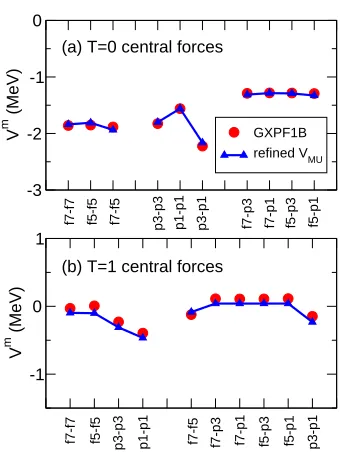
Figure 1.Comparison of the monopole matrix elements for the p f shell between the central forces of GXPF1B and the refinedVMU.
In order to obtain a simple and universal effective
interaction that describes the shell evolution, the
monopole-based universal interaction (VMU) has been
proposed recently [8]. The originalVMU consists of
a central force and a tensor force. Its tensor part is
taken from theπ+ρmeson exchange force. The use
ofπ+ρas the effective tensor force has a microscopic
basis called “Renormalization Persistency” [8, 9] that
the bare tensor force persists in the effective
interac-tion. On the other hand, the central component is, in principle, much more complicated because of strong
renormalization. A key idea ofVMUis that, at least as
far as the monopole matrix elements are concerned, a Gaussian central force leads to a good approximation
of the realistic effective interactions from which the
π+ρtensor force is taken away [8].
Although the originalVMUis very simple but
use-ful, there is room for refinement. One is to include the two-body spin-orbit force. In contrast to the central force and the tensor force, the spin-orbit force does not always cause a visible shell evolution, but some-times plays a dominant role as shown later. In the present study, the spin-orbit part is taken from that of the M3Y interaction [10]. Another possible refine-ment is associated with the central part. A careful comparison between the simple Gaussian force and the tensor-subtracted realistic force shows some
dis-agreement about the strength of monopole interactions between higher nodal orbits such as those
within 1s1/2 (see Fig. 1 of [8]). We remedy this defect by introducing density dependence in the
Vc(r,R)=D(R)
X
S,T
fS,TPS,Texp
−(r/µ)2instead of Eq. (3) of [8]. The additional termD(R), where
R=|r1+r2|/2, represents the density (or center-of-mass) dependence. In the same way as [11],D(R)
is assumed to take a form ofD(R) = 1+AdF(R), where F(R) is proportional to the Woods-Saxon
potential given byF(R) = {1+exp ((R−R0)/a)}−1 withR0 = 1.2A1/3 fm and a = 0.6 fm. Here,
Ais fixed to be 16 for simplicity. D(R) behaves like 1+Ad atR ∼ 0 and like 1 atR ∼ ∞. The
six parameters fS,T, µandAd are determined so as to obtain a good fit to the central force of the
GXPF1B interaction [12] for the monopole part. The resulting values are f0,0=−140 MeV, f1,0=0,
f0,1=0.6f0,0,f1,1 =−0.6f0,0,µ=1.2 fm, andAd =−0.4, giving a good agreement with GXPF1B as
shown in Fig. 1. This refinedVMUinteraction is used as shell-model interactions which dominate the
shell evolution and its related phenomena.
It is noted that, as discussed in [8], the shell evolution is affected by the central force and the tensor
force in different ways. The tensor force strongly changes the spin-orbit splitting owing to the Otsuka
mechanism [7]. On the other hand, the central force, hardly contributing to the modification of the spin-orbit splitting as presented in [8], works in such a way that the evolution depends on the node
number instead. In this sense, the central force is responsible for thel2term in terms of the Nilsson
model.
2.2 Neutron-richN∼28region
The neutron-rich N ∼ 28 region is a good testing ground for proving the shell evolution due to
the tensor force because a direct test of the spin-orbit splitting can be carried out by comparing the distribution of spectroscopic strengths for one-proton removal reactions. Among them are very clear
data for48Ca measured with the (e,e0p) reaction [13], carrying crucial information on the spin-orbit
splitting for the protonsdshell. The evolution of the proton 0dspin-orbit splitting in going from40Ca
to48Ca is dominated by the cross-shell interaction, hsd0f
7/2|V|sd0f7/2iin particular. It is stressed
that describing spectroscopic strengths is beyond single-particle models because they are in general highly fragmented.
Bearing this in mind, we have proposed a new shell-model interaction named SDPF-MU [14] to
test our scheme described in Sect. 2.1 for constructing effective interactions. The cross-shell part is
taken from the refinedVMU interaction. The intra-shell parts are based on USD [1] and GXPF1B
[12], successful semi-empirical interactions for thesdshell and thep fshell, respectively. Since USD
and GXPF1B are effective interactions for the 0~ωspace, SDPF-MU is designed for the model space
consisting of pure~ωconfigurations. While it is applicable to unnatural parity states by taking the
model space composed of the 1p−1hstates, we restrict ourselves in this paper to the 0p−0hstates
only.
Spectroscopic strengths for one-proton removal from48Ca are compared between the (e,e0p)
ex-periment [13] and the shell-model calculation with SDPF-MU [14]. The calculation has excellently reproduced the experimental distribution of the spectroscopic strengths, and has presented that the
distribution is quite sensitive to the tensor force. We have concluded in [14] that the proton 0d
spin-orbit splitting is∼2 MeV reduced in going from40Ca to48Ca because of the tensor force and that the
reduction is well described by theVMUinteraction.
The shell evolution due to the tensor force also changes nuclear deformation. A good example is
found in neutron-rich silicon isotopes [14]. The 2+
1 level in42Si, measured at GANIL recently [15], is
located very low, and thus indicates the disappearance of theN=28 magic number. The shell-model
calculation with SDPF-MU well reproduces the evolution of the 2+
1 levels in silicon isotopes. On the
other hand, the 2+
1 level in42Si is calculated to be too high when the tensor force is removed from
is clearly seen in the potential energy surface (PES): the energy minimum is located at a strongly-deformed oblate shape and at a spherical shape for the former and the latter, respectively [14].
The strong deformation in42Si is induced by the quenching of shell gaps among the orbits
be-longing to the same major shell. This is known as the Jahn-Teller effect [16]. On the neutron side,
theN =28 shell gap in silicon isotopes is reduced from the one in calcium isotopes because of the
tensor force and the central force working cooperatively. The reduction of theN = 28 shell gap
alone, however, does not explain the origin of the strong deformation in42Si because deformation is
less pronounced in44S in spite of its narrowerN =28 shell gap. Hence, the proton shell gap must
be taken into consideration, too. As discussed in [14], silicon isotopes prefer an oblate deformation
to a prolate deformation or a spherical shape when thed5/2 orbit is close to s1/2. The same is
ap-plied to neutron deformation for nuclei withN = 28 involving f7/2 and p3/2. As a result, gaining
much correlation energy, coherent oblate deformation between protons and neutrons occurs. This is a
kind of the Jahn-Teller effect which is promoted by the shell evolution due to the tensor force, and is
named “tensor-force-driven Jahn-Teller effect” [14]. While this strong mixing between ajorbit and a
j−2 one is in accordance with the quasi-SU(3) scheme [3, 17], the picture presented in [14] gives an
intuitive explanation as to whyZ=14 andN=28 prefer an oblate deformation to a prolate shape.
0 1 2 3
0 0.25 0.5 0.75 1
C
2 S
0.25
0.75 0.5
1.1 MeV 1.9 MeV
E* (MeV) 37
S
35
Si
Figure 2.Low-lying energy levels and their spec-troscopic factors obtained by one-neutron transfer reactions to37S (upper) and35Si calculated with
SDPF-MU. The red, blue and green lines stand for 0f7/2, 1p3/2and 1p1/2, respectively.
The two-body spin-orbit force can also be
probed in the sd-p f shell region as discussed by
Sorlin an Porquet [18]. Comparing between36S and
34Si, two additional protons in36S predominantly
occupy the 1s1/2orbit because both nuclei are nearly
spherical. When 1s1/2 is occupied, the tensor force
has no effect. In addition, the spin-orbit splitting is
hardly changed by the central force. On the other hand, the two-body spin-orbit force has relatively
large monopole matrix elements for 1s1/2-1p1/2and
1s1/2-1p3/2which can be opposite in sign, thus
play-ing a dominant role in the evolution of the 1p
spin-orbit splitting. The low-lying levels in37S and35Si
calculated with SDPF-MU are shown in Fig. 2 to-gether with their spectroscopic factors. For both
nu-clei, the level dominated by 1p3/2and the one
domi-nated by 1p1/2are clearly seen, and the splitting
be-tween them is changed from 1.9 MeV to 1.1 MeV
in going from37S to35Si. This result quantitatively
agrees with a recent experiment [18], confirming the validity of the spin-orbit force in the M3Y interac-tion.
2.3 Antimony isotopes
With the proton number 51, antimony isotopes are expected to have one-proton single-particle states
on top of the tin (Z=50) core as low-lying states and thus to provide a good opportunity for probing
the shell evolution. A recent experiment of the Sn(α,t) reaction by Schifferet al. has found that the
spectroscopic strengths for the 7/2+
1 and the 11/2−states are rather stable from N = 62 to 74 and
that they are probably close to unity [19]. The evolution of theg7/2-h11/2 splitting based on [19],
indicating considerable reduction of the spin-orbit splitting for largerN, can only be accounted for by
The single-particle character of low-lying levels in antimony isotopes is, however, a controversial
issue. Sorlin and Porquet have claimed [21], on the basis of the (3He,d) reactions leading to
spectro-scopic strength∼0.5 [22], that the 11/2−states are strongly correlated states rather than pureh
11/2
single-particle states, affected by states such asπd5/2⊗ν(3−1). Hence nuclear-structure calculations
that can describe those correlated wave functions are needed to extract quantitative information on the
shell evolution due to the effective interaction.
We have performed shell-model calculations for antimony isotopes in the full 1d5/2-0g7/2-0h11/2
-2s1/2-1d3/2space. In order to obtain good tin-core states, we have adopted a semi-empirical
neutron-neutron interaction named SNBG3 [23] whose matrix elements are adjusted to fit experimental levels
in tin isotopes including 3−
1 states. The proton-neutron interaction, which is to be examined in this
study, is taken from the refinedVMU interaction with one modification: the overall strength of the
central force is multiplied by 0.84 so as to achieve a good fit to experimental one-proton separation energies along the antimony isotope chain. The proton single-particle energies are determined to
reproduce experimental one-proton levels in133Sb.
50 60 70 80
N -2
-1 0 1 2 3
E - E(7/2
+ 1
) (MeV)
ESPE1 ESPE2 shell model ESPE1 ESPE2 shell model
5/2+
11/2
-Figure 3. The 11/2−
1 and 5/2+1 levels relative to 7/2+1
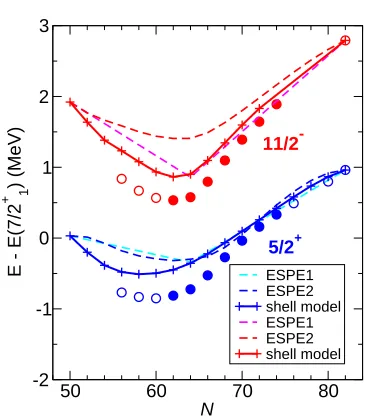
in antimony isotopes compared between experiment (circles) and theory (lines). The filled and open circles are experimental levels whose spectroscopic factors have been measured and unmeasured, respectively. See the text for details.
The calculated energy levels in antimony isotopes are compared with experimental data in Fig. 3, well reproducing the evolution of the energy levels. In order to see the interplay be-tween the shell evolution and correlation, the
effective single-particle energies (ESPE) [24]
are also presented in Fig. 3. The ESPE1 is the usual ESPE: filling configurations are as-sumed. In the present case, sub-shell closures
at N = 50, 64 and 82 are considered.
Be-sides the ESPE1 which includes no correlation, neutron-neutron correlation can be taken into account in the ESPE by replacing the neutron filling wave function with the ground state of tin isotopes obtained by the shell-model calcu-lation. The ESPE2 is defined in this manner.
The ESPE1 follows the experimental 11/2−
1 lev-els rather well as demonstrated already [7], but
the 11/2−
1 levels calculated with the ESPE2 are
shifted∼0.5 MeV higher around the mid-shell
isotopes. This is due to the fragmentation of the neutron occupation numbers, which makes the evolution of the levels milder. When proton-neutron correlation is included in the full
shell-model calculation, 11/2−
1 levels are pulled down
again around the mid-shell isotopes, and are close to experimental data.
The spectroscopic factors for the 5/2+
1,
7/2+
1, and 11/2−1 states calculated with the shell model are reduced to∼0.6 for113−125Sb, supporting
the values extracted from the (3He,d) reactions [22]. This sizable deviation from the single-particle
limit accounts for the evolution of the magnetic moment fromN = 82 to lower neutron numbers.
Nevertheless, the evolution of the 11/2−
single-particle energies because of the cancellation between neutron-neutron correlation energy and proton-neutron correlation energy.
3 Advanced Monte Carlo shell model
3.1 Brief overview of recent development
The Monte Carlo shell model (MCSM) has been proposed in 1995 in order to overcome the limit of the conventional exact-diagonalization method for performing shell-model calculations (see [25] for a review of its early development). The many-body wave function adopted by MCSM is usually expressed with a small number of selected deformed Slater determinants with symmetry restoration.
When this number, called MCSM basis dimensionNb, increases, the energy of the MCSM wave
function is converging typically at around Nb ∼ 100 even if the total dimension is several orders
larger. MCSM is thus characterized as importance truncation. Although MCSM has been success-fully applied to several systems beyond exact diagonalization [25], application to huge model spaces consisting of many major shells was not feasible at that time [25] because of the limitation of realistic computational time.
Aiming at extending the applicability of MCSM, we have recently developed MCSM further (See [26] for a review of recent advancement). The computer code is completely renewed to be a hybrid parallel code using OpenMP and MPI in order to run on modern supercomputers such as the K com-puter [27]. Furthermore, a novel method for estimating the exact solution in good accuracy has been
introduced [29]. The energy calculated with MCSM is converging for a sufficiently largeNb, but it is
nevertheless difficult to find the exact energy from the plot of the energies as a function ofNb. The
new method utilizes energy variancehH2i − hHi2, which vanishes for eigenstates, as a measure of
proximity to the exact solution. More specifically, an energy plot is drawn as a function of the energy
variance instead ofNb, and the plot is extrapolated to the point whose energy variance vanishes. See
[28] for more details about the energy-variance extrapolation method. This method has been applied to MCSM and confirmed to work very well [29]. As another methodological advancement, the new
MCSM method generates basis states more efficiently than the original method does. In the original
method, candidates for a new basis state are generated in a stochastic way, and the one that gives the lowest energy is adopted among them. On the other hand, the new MCSM searches for a local minimum of energy by implementing the conjugate gradient method [30], thus reaching lower energy.
Large-scale calculations are facilitated also by efficient use of computational resources. At the
level of single-core efficiency, it is desirable to reach as close as possible to theoretical peak
perfor-mance. From this aspect, the new MCSM code implements an efficient method for computing the
Hamiltonian overlap which is the most time-consuming part in the total calculation [31]. The high
efficiency is attributed to transformation to a multiplication of dense matrices which requires much
less memory access than arithmetic operations. The resulting performance typically attains∼ 80%
of the theoretical peak performance, which is a factor of 5-10 larger than that of the original MCSM.
High parallel efficiency is also important. For this purpose, the ratio of computation to the amount of
communication is enlarged in the new code: while the computation of one quantum-number-projected matrix element is divided by the number of cores in the original code, multiple matrix elements are
treated at the same time in the new code. As a result, the parallel efficiency achieved by the new
MCSM code is excellent even on a system with tens of thousands of CPU cores [26].
3.2 Applications to exotic nuclei
0 20 40 60 80 100 120 140 Q0(fm2)
0 10 20 30 40 50 60 70 80 Q2 (fm 2)
32Mg01+
-134.9 -133.9 -132.9 -131.9 -130.9 -129.9 -128.9 -127.9 -126.9 -125.9 -124.9 -123.9 -122.9
0 20 40 60 80 100 120 140 Q0(fm2) 0 10 20 30 40 50 60 70 80 Q2 (fm 2)
32Mg02+
-134.9 -133.9 -132.9 -131.9 -130.9 -129.9 -128.9 -127.9 -126.9 -125.9 -124.9 -123.9 -122.9
0 20 40 60 80 100 120 140 Q0(fm2)
0 10 20 30 40 50 60 70 80 Q2 (fm 2)
32Mg03+
-134.9 -133.9 -132.9 -131.9 -130.9 -129.9 -128.9 -127.9 -126.9 -125.9 -124.9 -123.9 -122.9
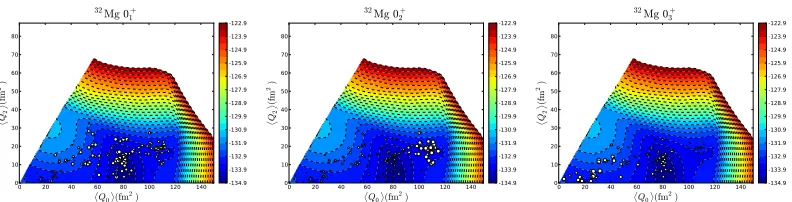
Figure 4.Distribution of the MCSM basis states for the 0+
1(left), 0+2 (center) and 0+3 (right) states in32Mg plotted
on the potential energy surface. The position and the size (i.e., area) of each circle represent the deformation of each basis state and its overlap probability with the MCSM wave function, respectively.
ab initioshell model [32], exotic nuclei provide good opportunities for the advanced MCSM because a very large model space is often needed to examine the appearance and disappearance of magic numbers. Currently the most intensively and extensively studied is the neutron-rich chromium-nickel region, the results of which were reported in this conference [33]. Here, we show a preliminary result
on the “island of inversion” region [34], in which theN =20 magic number is known to disappear.
We now focus on the low-lying 0+states in32Mg because an anomalously low 0+state has been found
recently [35]. Using an interaction for the fullsd-p f shell based on SDPF-MU [14], the lowest three
0+states are calculated with MCSM. In order to clarify the shape fluctuation of the wave functions
obtained with MCSM, we adopt a visualization method introduced in [26]: for each MCSM wave function of interest, overlap probabilities with the basis states are calculated, and then the distribution of the overlap probabilities against intrinsic deformation is plotted as shown in Fig. 4. While the
ground state is dominated by the 2p-2hstates with deformations around the energy minimum on the
potential energy surface, the 0+
2 and 0+3 states are dominated by the 4p-4hand 0p-0hstates with larger
and smaller deformations, respectively. It would be interesting to investigate whether those wave functions are able to explain the two-neutron transfer data [35].
4 Summary
Two important ingredients of nuclear-structure theory are effective interaction and many-body
prob-lems. In this paper, we survey our recent advancement in those issues in the framework of the shell
model. Applied to theN ∼28 neutron-rich region and antimony isotopes, the monopole-based
uni-versal interactionVMU [8] is shown to be quite useful not only as an interaction that gives the shell
evolution but also as a shell-model effective interaction. More specifically, we have demonstrated that
theπ+ρmeson-exchange tensor force accounts for the evolution of the spin-orbit splitting by means
of excellent agreement in the distribution of spectroscopic factors in48Ca and in the evolution of the
energy levels in antimony isotopes. Those results support the universality of the effective tensor force
suggested by microscopic effective-interaction theories [8, 9]. We have also developed large-scale
shell-model calculations with the Monte Carlo shell model (MCSM) in several aspects, achieving
accurate estimate of the exact energy, high efficiency in the generation of basis states, and high
Acknowledgements
This work was in part supported by JSPS KAKENHI Grant Numbers 21740204 and 23244049, and by the SPIRE Field 5, the MEXT of Japan. This work is a part of the CNS-RIKEN joint research project on large-scale nuclear-structure calculations.
References
[1] B. A. Brown and B. H. Wildenthal, Ann. Rev. Nucl. Part. Sci.38, 29 (1988).
[2] M. Honma, T. Otsuka, B. A. Brown, and T. Mizusaki, Phys. Rev. C69, 034335 (2004).
[3] E. Caurieret al, Rev. Mod. Phys.77, 427 (2005).
[4] A. Holt, T. Engeland, M. Hjorth-Jensen, and E. Osnes, Nucl. Phys. A634, 41 (1998).
[5] J. B. McGrory, B. H. Wildenthal, and E. C. Halbert, Phys. Rev. C2, 186 (1970).
[6] G. F. Bertsch, D. J. Dean, and W. Nazarewicz, SciDAC Review6, 42 (2007).
[7] T. Otsukaet al., Phys. Rev. Lett.95, 232502 (2005).
[8] T. Otsukaet al., Phys. Rev. Lett.104, 012501 (2010).
[9] N. Tsunoda, T. Otsuka, K. Tsukiyama, and M. Hjorth-Jensen, Phys. Rev. C84, 044322 (2011).
[10] G. Bertsch, J. Borysowicz, H. McManus, and W. G. Love, Nucl. Phys. A284, 399 (1977).
[11] B. A. Brown, W. A. Richter, R. E. Julies, and B. H. Wildenthal, Ann. Phys.182, 191 (1988).
[12] M. Honma, T. Otsuka, and T. Mizusaki, RIKEN Accelerator Progress Report41, 32 (2008).
[13] G. J. Kramer, H. P. Blok, and L. Lapikás, Nucl. Phys. A679, 267 (2001).
[14] Y. Utsunoet al., Phys. Rev. C86, 051031(R) (2012).
[15] B. Bastinet al., Phys. Rev. Lett.99, 022503 (2007).
[16] H. A. Jahn and E. Teller, Proc. R. Soc. London, Ser. A161, 220 (1937).
[17] A. P. Zuker, J. Retamosa, A. Poves and E. Caurier, Phys. Rev. C52, R1741 (1995).
[18] O. Sorlin and M. -G. Porquet, Phys. Scr.T152, 014003 (2013).
[19] J. P. Schifferet al., Phys. Rev. Lett.92, 162501 (2004).
[20] T. Otsuka, T. Matuo and D. Abe, Phys. Rev. Lett.97, 162501 (2006).
[21] O. Sorlin and M. -G. Porquet, Prog. Part. Nucl. Phys.61, 602 (2008).
[22] M. Conjeaudet al., Nucl. Phys. A117, 449 (1968).
[23] SNBG3 is a variant of SNBG1 of M. Honmaet al.[RIKEN Accelerator Progress Report45, 35
(2011) ], constructed to fit energy levels in tin isotopes including 3−
1 states, too.
[24] Y. Utsuno, T. Otsuka, T. Mizusaki, and M. Honma, Phys. Rev. C60, 054315 (1999).
[25] T. Otsukaet al., Prog. Part. Nucl. Phys.47, 391 (2001).
[26] N. Shimizuet al., Prog. Theor. Exp. Phys.2012, 01A205 (2012).
[27] K Computer, http://www.aics.riken.jp/en/.
[28] T. Mizusaki and M. Imada, Phys. Rev. C65, 064319 (2002);ibid.67, 041301 (2003).
[29] N. Shimizuet al., Phys. Rev. C82, 061305(R) (2010).
[30] N. Shimizuet al., Phys. Rev. C85, 054301 (2012).
[31] Y. Utsuno, N. Shimizu, T. Otsuka, and T. Abe, Comput. Phys. Commun.184, 102 (2013).
[32] T. Abeet al., Phys. Rev. C86, 054301 (2012).
[33] Y. Tsunodaet al., contribution to this conference.
[34] E. K. Warburton, J. A. Becker, and B. A. Brown, Phys. Rev. C41, 1147 (1990).