Developing a high-temperature solvent-free system for
efficient biosynthesis of octyl ferulate
Shang-Ming Huanga, Ping-Yu Wub, Jiann-Hwa Chenb, Chia-Hung Kuoc,*,
Chwen-Jen Shieha,*
aBiotechnology Center, National Chung Hsing University, 250 Kuo-Kuang Road,
Taichung 402, Taiwan
bGraduate Institute of Molecular Biology, National Chung Hsing University, 250
Kuo-Kuang Road, Taichung 402, Taiwan
cDepartment of Seafood Science, National Kaohsiung Marine University, 142 Haijhuan
Road, Nanzih District, Kaohsiung 81143, Taiwan
*Author to whom correspondence should be addressed.
Dr. Chia-Hung Kuo (telephone +886-7-361-7141 ext. 3646; fax +886-7-364-0634; e-mail [email protected])
Dr. Chwen-Jen Shieh (telephone +886-4-2284-0450 ext. 5121; fax +886-4-2286-1905; e-mail [email protected])
ABSTRACT
Ferulic acid esters have been suggested as a group of natural chemicals with sunscreen
function. The study aimed to utilize an environment-friendly enzymatic method to
produce octyl ferulate by esterification of ferulic acid with octanol.The Box-Behnken
design with response surface methodology (RSM) was adopted to evaluate the effects
of synthesis variables, including reaction temperature (70–90 °C), enzyme amount
(1,000–2,000 PLU) and stir speed (50–150 rpm), on the molar conversion of octyl
ferulate. According to the joint test, both the reaction temperature and enzyme amount
had great impacts on the molar conversion. RSM-developed second-order polynomial
equation further showed great ability on data-fitting. Based on ridge max analysis, the
optimum parameters for the biocatalyzed reaction were: 72 h reaction time, 92.2 °C
reaction temperature, 1,831 PLU enzyme amount and 92.4 rpm stir speed, respectively.
Finally, the molar conversion of octyl ferulate under optimum condition was verified to
be 93.2 ± 1.5%. In conclusion, high yield of octyl ferulate synthesized by commercial
immobilized lipase under elevated temperature conditions has been suggested, which
our findings could broaden the utilization of the lipase and provide a biocatalytic
approach, instead of the chemical method, for ferulic acid ester synthesis.
Keywords: ferulic acid esters, octyl ferulate, esterification, Box-Behnken design,
1. Introduction
Ferulic acid (FA) is one of the phenolic acids and abundantly exists in fruits and
vegetables. FA has been demonstrated having many bioactivities such as antioxidation
[1], excellent ultraviolet-absorbing activity [2,3], and potential health benefits against
cardiovascular diseases, inflammatory diseases and cancers [4], etc. However, FA is a
small and polar compound but only with limited solubility in oils. Due to the poor
solubility of FA in a lipophilic medium, the applications of FA in food, cosmetics, and
other nutraceutical industries were commonly limited owing to their low dissolution
rate [5,6]. Thus, it is essential to improve the solubility of FA to increase its practicality
as food antioxidants. A related study has been reported that the ester form of FA has
better antioxidant activity than the acid form itself as well as the antioxidant activity of
ferulate ester as compared to BHT [7]. To overcome the problem of poor solubility,
pharmaceutical particle technology of chemical modifications has attracted much
attention [8–13]. However, it is much difficult to synthesize such derivatives chemically,
as FA is susceptible to oxidation under certain pH conditions [7,14,15]. Thus,
enzymatic biosynthesis of FA lipids has been considered as an attractive alternative to
conventional chemical processes [16]. However, environment-friendly preparation of
hydrophobic derivatives of FA is still a challenge for researchers.
esterification of FA with monosaccharides [17]. The water-soluble derivative of
glyceryl ferulate biosynthesized by esterification of FA with glycerol using pectinase
[18], and the solvent-free enzymatic transesterification of ethyl ferulate (EF) with
triolein having a higher EF conversion of 77% [19], which were also reported. In
additional, hydrophobic feruloylated derivatives can be produced by the esterification
of FA with alcohols. The strategy of esterification of hydrophilic FA with lipophilic
molecules, such as aliphatic alcohols, can be used to alter its solubility in a lipophilic
medium. However, the reaction rate of FA condensation with alcoholic substrates is
slow and might be that FA could conjugate with a carboxyl group and a bulky
noncarboxylic region [20].
Lipases are the most commonly used among the biocatalysts in synthetic organic
chemistry [21,22]. It has been extensively used to obtain chiral alcohols and carboxylic
acids, due to their excellent chiral recognition [23]. The isoform B of the lipase from
Candida Antarctica (CAL-B) is one of the most employed among them and possesses
the high enantioselectivity for a broad range of substrates [24,25]. Novozym® 435 is a
commercial enzyme prepared by immobilization of CAL-B onto a macroporous acrylic
polymer resin. Novozym® 435 is a versatile biocatalyst, mainly used to perform the
hydrolysis of oils and fats, under specific conditions, also capable of catalyzing
the Novozym® 435 have shown the presence of a short oligopeptide helix that may act
as a lid, and it has been found to adopt different conformations as a function of detergent
concentration, suggesting high mobility of the active environment [27]. The expression
of catalytic activity requires that the enzyme active site should be flexible. Novozym®
435 is very active in organic solvents, which is needed to react under the condition of
lower water activity in esterification process [28], suggesting that the enzyme could be
adsorbed on this biocatalyst mainly by hydrophobic interactions [29,30]. Evidence that
an increase in enzyme hydration is accompanied by an increase in the molecular
mobility of enzymes [31,32]. Although Novozym® 435 had been used in the
lipase-catalyzed synthesis of ferulate esters, the yield remained low (17%) after the reaction
by several days [33]. Moreover, it has been reported that during the synthesis of ferulic
esters by direct esterification with ferulic acid, the catalytic activity of the enzyme might
be severely affected by the hydrophilicity of ferulic acid [34,35]. In fact, solvent-free
reaction systems, an eco-friendly method minimizing the environmental pollution,
could be applied in the lipase-catalyzed synthesis of ferulate esters, which might
decrease the reaction time but increase the yield of synthesized esters [36,37].
Additionally, the solvent-free reaction system is a condition commonly with a simple
mixture of substrates and offers some reaction advantages including maximization of
and cost savings in reactor design in large-scale process and chemical product
separation/purification [38]. However, in the case of FA esterification, developing a
solvent-free system operated at high temperature was required to increase the yield of
FA esters.
As mentioned above, ferulic acid (FA) has been suggested as one of the natural
nutraceuticals with biological function, but FA exhibits poor solubility and low stability
in various solvent systems might limit its application. The aim of the present work was
tending to develop a simple and environmentally-friendly biocatalytic method, instead
of a chemical catalytic method, for the preparation of FA esters. In this study, the
lipase-catalyzed esterification of FA with octanol to form octyl ferulate under solvent-free
condition was conducted, followed by optimizing processes with an experimental
design using RSM to evaluate the best experimental conditions. Finally, the
thermodynamic and optimum effects on solvent-free reaction system of
lipase-catalyzed biosynthesis of FA was evaluated.
2. Materials and methods
2.1. Materials
Immobilized lipase Novozym® 435 (10,000 U/g; propyl laurate units (PLU) from
purchased from Novo Nordisk Bioindustrials Inc. (Copenhagen, Denmark). Ferulic
acid (FA), octanol, hexanol, 2-methyl-2-butanol, methanol and acetic acid were
purchased from the Sigma Chemical Co. (St. Louis, MO). A molecular sieve 4Å was
purchased from Davison Chemical (Baltimore, MD, USA). All other reagents and
chemicals, unless otherwise noted, were of analytical grade.
2.2. Enzymatic synthesis of octyl ferulate
All materials were dehydrated by a molecular sieve 4 Å for 24 h before use. Ferulic
acid (20 mM) and Novozym® 435 were well mixed with octanol (1 mL) in the sealed
10 mL dark vials, and placed in a water bath for 72 h, under different experimental
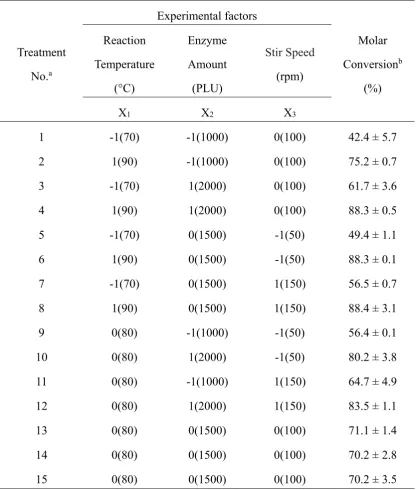
conditions of temperatures, enzyme amount and stir speed as Table 1 design. The liquid
samples were further analyzed by high-performance liquid chromatography (HPLC).
Samples were centrifuged and diluted with hexanol/2-methyl-2-butanol (1:100). The
analysis was done according to the procedure modified by Huang et al. [38]. The flow
rate was 1.0 mL/min, and sampling was detected at the wavelength of 325 nm. The
molar conversion was calculated based on the peak areas of the sample.
2.3. Experimental design
A 3-level-3-factor Box-Behnken requiring 15 experiments was employed in this
study. To avoid bias, the 15 runs were performed in a random order. The variables and
temperature (70–90°C), enzyme amount (1,000–2,000 PLU) and stir speed (50–150
rpm). All of the experiments were performed at a reaction time of 72 h. Table 1 shows
the independent factors (xi), levels and experimental design regarding coded and
uncoded values.
2.4. Statistical analysis
Each data was analyzed by the response surface regression (RSREG) procedure
with SAS software to fit the equation of second-order polynomial shown in Equation 1:
Y = 0+ i i+ ii i2+ ij i j
3
(1)
where Y is the molar conversion of octyl ferulate; β0 is a constant, βi, βii and βij are
constant coefficients; and xi and xj are uncoded independent variables. The suffixes i
and j are seen in the above equation with the three independent variables denoting: x1
for reaction temperature, x2 for enzyme amount and x3 for stir speed. The option of a
ridge max option in the SAS software was employed to compute the estimated ridge of
3. Results and discussion
3.1. Primary experiment
Lipase-catalyzed synthesis of octyl ferulate from ferulic acid (20 mM), Novozym®
435 (1,500 PLU) and octanol were carried out in a water bath at a reaction time of 72
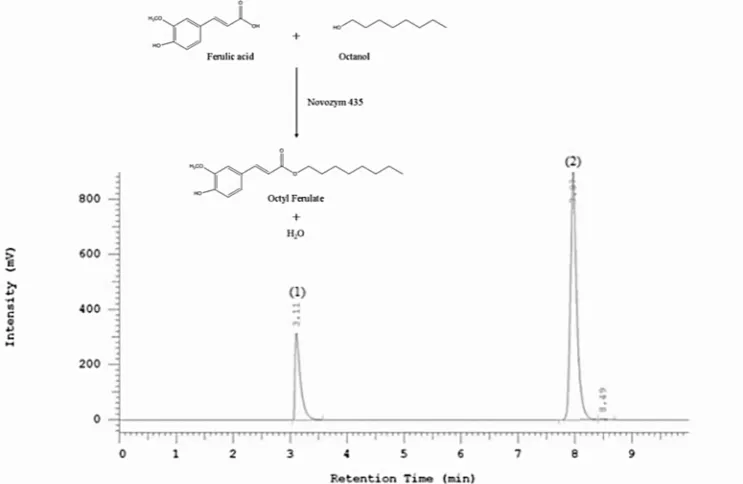
h. The octyl ferulate catalyzed by Novozym® 435, and the liquid samples analyzed by
high-performance liquid chromatography (HPLC) are shown in Figure 1. Moreover,
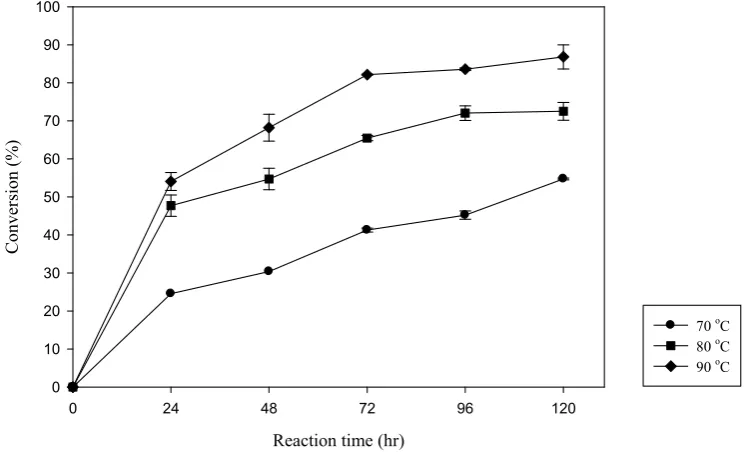
the effects of reaction temperature and reaction time on molar conversion of octyl
ferulate are shown in Figure 2, illustrating that a higher molar conversion was obtained
after the reaction time of 24 hours as well as by an increase of reaction temperature.
Also, the higher the reaction temperature, the faster the reaction could be observed
without deterioration of enantioselectivities [39]. It is a known fact that the reaction
temperature is a crucial parameter in biocatalysis. However, the elevated temperature
may result in inactive enzymes. From the report, enzymatic transesterification of ethyl
ferulate (EF) and monostearin for feruloylated lipids production was investigated,
which the optimum reaction temperature was 74°C [9]. A novel enzymatic route of
feruloylated structured lipids synthesis by the transesterification of EF with castor oil
in a solvent-free system was investigated. The study indicated that high EF conversion
was obtained under the reaction temperature of 90°C [22]. The reaction temperature
reaction. Therefore, the experiments at three different temperatures (70, 80 and 90°C)
were carried out to investigate the influence of temperature on biosynthesis reaction.
As shown in Figure 2, the molar conversion increased with elevating reaction
temperature. At a reaction temperature of 90°C, molar conversion reached the highest
value of a molar conversion of 88.4%, and the fastest reaction rate (reflected by the
slope of the linear part of the curves) was also observed. When the reaction time
surpassed 72 h, the time course was leveled-off. The reason may be that the viscosity
of the reaction mixture was gradually increased over reaction time, leading to a decrease
in mutual solubility and inhibit the diffusion of substrates [40]. Thus, reducing mass
transfer and unfavorable interactions between enzyme particles and substrates might
occur in the process. However, longer reaction time could lead to a higher molar
conversion. Thus, the following experimental design was conducted on the reaction
time of 72 h.
3.2. Model fitting
In order to systematically understand the relationships between reaction
temperature, enzyme amount and stir speed for the synthesis of octyl ferulate, a
3-level-3-factor Box-Behnken design (BBD) was applied to carry out a total of 15 treatments
(experiments), followed by determining the experimental data for process optimization
was the development and evaluation of a statistical approach to understanding the
relationship between experimental variables and lipase-catalyzed responses well. Thus,
the process could be optimized before the scaling-up procedure to save the production
costs and time to obtain a high-quality product. Compared with the
single-factor-at-a-time design, which has been adopted most often in literature, the RSM combined with
a BBD employed in this study was more efficient in reducing experimental runs and
time for investigating the optimized biosynthesis of octyl ferulate.
The experimental conditions and results of a 3-level, 3-factor BBD are shown in
Table 1. The RSREG procedure for SAS was used to fit the second-order polynomial
Equation (1) to the experimental data-percent mole conversions. Among these various
treatments, the highest molar conversion (88.4 ± 3.1%) was treatment 8 (reaction
temperature 90°C, enzyme amount 1,500 PLU and stirring speed 150 rpm), and the
lowest molar conversion (42.4 ± 5.7%) was treatment 1 (reaction temperature of 70°C,
enzyme amount of 1,000 PLU and stirring speed of 100 rpm). From the SAS output of
RSREG, the second-order polynomial Equation (1) is given below:
Y = −299.1 + 5.6825 + 0.6625 + 0.22 − 0.0031 − 0.0035
−0.0005 − 0.02025 − 0.00059 + 0.00091 (1)
Further, the analysis of variance (ANOVA) indicated that the second-order
represent the relationship between the experimental response (molar conversion) and
significant variables, having a very small p-value (0.0001) as well as a satisfactory
coefficient of determination (R2 = 0.9887). Furthermore, the overall effects of the three
synthesis variables on the molar conversion were further analyzed by a joint test. The
results revealed that reaction temperature (X1) and enzyme amount (X2) were the most
important factors, exerting a statistically significant overall effect (p < 0.001) on the
responded molar conversion. The stirring speed (X3) was insignificant statistically on
the responded molar conversion.
3.3. Optimal synthesis conditions
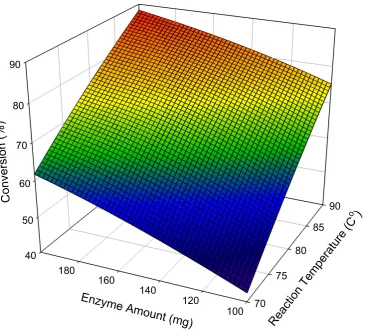
The optimum biosynthesis of octyl ferulate was further determined by the ridge
max analysis (Figure 3), indicating that the maximum molar conversion was 91.74 ±
2.3% at 72 h, temperature 92.2°C, enzyme amount 1,831 PLU and stir speed 92.4 rpm.
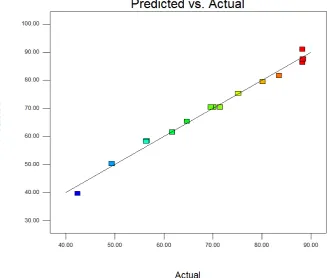
Figure 4 represents the correlation between the experimental values and the predicted
values of the RSM model for average cutting speed. A verification experiment
performed at the suggested optimum conditions could obtain a molar conversion of 93.2
± 1.5%, which was close to the RSM-predicted molar conversion; thus, the predicted
model was successfully established. In this study, the lipase-catalyzed biosynthesis of
octyl ferulate could be carried out with an easy method.
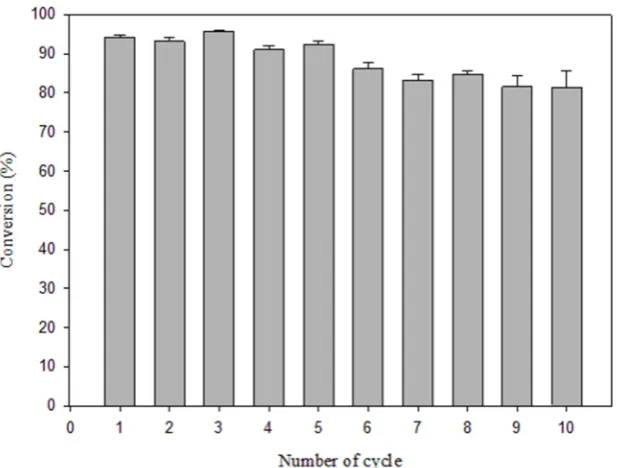
ferulate synthesis was also determined under optimum conditions. The lipase was
recovered from the medium after the reaction, followed by being reused directly in the
next batch. When the batch of immobilized lipase was reused five times, the molar
conversion of octyl ferulate remained higher than 90% with very little loss of enzymatic
activity (Figure 5). The data indicated that the immobilized lipase could keep
enzymatic stability under the conditions of long-term octanol exposure and high
reaction temperature (90°C). Thus, the result confirmed that the lipase could be
effectively applied for the synthesis of octyl ferulate and that the enzymatic stability
was high enough to permit reuse.
4. Conclusions
In this study, the esterification of ferulate with octanol catalyzed by lipase in a
solvent-free medium was investigated. The immobilized Novozym®435 could be well
used to synthesize octyl ferulate. Both 3-level-3-factor BBD and RSM were employed
successfully for the experimental design and data analysis. An environmentally friendly
experimental model for the octyl ferulate synthesis was well built, and the optimal
conditions for biosynthesis were respectively in a reaction time of 72 h, a reaction
temperature of 92.2°C, enzyme amount of 1,831 PLU and stir speed of 92.4 rpm.
Synthesis of octyl ferulate under this optimal condition was performed to obtain a molar
temperature significantly affected the efficiency of lipase-catalyzed ester synthesis
under the solvent-free system. Overall, as compared to the chemical methods, our
present study suggests that the lipase-catalyzed environmental-friendly synthesis of
esters under solvent-free reaction system at higher reaction temperature without marked
loss of enzymatic activity could offer a significant reference for industrial preparation
process.
Acknowledgments
The authors are very appreciative of all the support from the Ministry of Science
and Technology under the grant number of MOST-101-2313-B-005-040-MY3.
Conflicts of interest
There is no any conflict of interest regarding the publication of this article.
References
[1] Liu, J.; Wen, X.Y.; Lu, J. F.; Kan, J.; Jin, C.H. Free radical mediated grafting of
chitosan with caffeic and ferulicacids: Structures and antioxidant activity. Int. J.
Biol. Macromol. 2014, 65, 97–106.
[2] Choo, W.S.; Birch, E.J. Radical scavenging activity of lipophilized products from
lipase-catalyzed transesterification of triolein with cinnamic and ferulic acids.
[3] Itagaki, S.; Kurokawa, T.; Nakata, C.; Saito, Y.; Oikawa, S.; Kobayashi, M. In
vitro and in vivo antioxidant properties of ferulic acid: A comparative study with
other natural oxidation inhibitors. Food Chem. 2009, 114, 466–471.
[4] Mancuso, C.; Santangelo, R. Ferulic acid: Pharmacological and toxicological
aspects. Food Chem. Toxicol. 2014, 65, 185–195.
[5] Karboune, S.; St-Louis, R.; Kermasha, S. Enzymatic synthesis of structured
phenolic lipids by acidolysis of flaxseed oil with selected phenolic acids. J. Molec.
Catal. B: Enzym. 2008, 52–53, 96–105.
[6] Zheng, Y.; Branford-White, C.; Wu, X.M.; Wu, C.Y.; Xie, J.G.; Quan, J.
Enzymatic synthesis of novel feruloylated lipids and their evaluation as
antioxidants. J. Amer. Oil Chem. Soc. 2010, 87, 305–311.
[7] Kikuzaki, H.; Hisamoto, M.; Hirose, K.; Akiyama, K.; Taniguchi, H. Antioxidant
properties of ferulic acid and its related compounds. J. Agric. Food Chem. 2002,
50, 2161–2168.
[8] Reddy, K.K.; Ravinder, T.; Kanjilal, S. Synthesis and evaluation of antioxidant
and antifungal activities of novel ricinoleate-based lipoconjugates of phenolic
[9] Sun, S.D.; Song, F.F.; Bi, Y.L.; Yang, G.L.; Liu, W. Solvent-free enzymatic
transesterification of ethyl ferulate and monostearin: Optimized by response
surface methodology. J. Biotechnol. 2012, 164, 340–345.
[10] Xin, J.; Zhang, L.; Chen, L.; Zheng, Y.; Wu, X.; Xia, C. Lipase-catalyzed synthesis
of ferulyl oleins in solvent-free medium. Food Chem. 2009, 112, 640–645.
[11] Yang, Z.; Guo, Z.; Xu, X. Enzymatic lipophilisation of phenolic acids through
esterification with fatty alcohols in organic solvents. Food Chem. 2012, 132,
1311–1315.
[12] Yang, H.; Mu, Y.; Chen, H.; Xiu, Z.; Yang, T. Enzymatic synthesis of feruloylated
lysophospholipid in a selected organic solvent medium. Food Chem. 2013, 141,
3317–3322.
[13] Fang, X.; Shima, M.; Kadota, M.; Tsuno, T.; Adachi, S.Suppressive effect of alkyl
ferulate on the oxidation of linoleic acid. Biosci. Biotech. Biochem. 2006, 70, 457–
461.
[14] Yang, X.Z.; Diao, X.J.; Yang, W.H.; Li, F.; He, G.W.; Gon, G.Q.; Xu, Y.G.Design,
synthesis and antithrombotic evaluation of novel dabigatran prodrugs containing
[15] Giuliani, S.; Piana, C.; Setti, L.; Hochkoeppler, A.; Pifferi, P.G.; Williamson, G.;
Faulds, C.B. Synthesis of pentylferulate by a feruloyl esterase from Aspergillus
niger using water-in-oil microemulsions. Biotechnol. Lett. 2001, 23, 325–330.
[16] Saija, A.; Tomaino, A.; Cascio, R.L.; Trombetta, D.; Proteggente, A.; Pasquale, A.
D.; Uccella, N.; Bonina, F.Ferulic and caffeic acids as potential protective agents
against photooxidative skin damage. J. Sci. Food Agric. 1999, 79, 476–480.
[17] Stamatis, H.; Sereti, V.; Kolisis, F.N. Enzymatic synthesis of hydrophilic and
hydrophobic derivatives of natural phenolic acids in organic media. J. Molec.
Catal. B: Enzym. 2001, 11, 323–328.
[18] Matsuo, T.; Kobayashi, T.; Kimura, Y.; Tsuchiyama, M.; Tsuchiyama, M.; Oh, T.;
Sakamoto, T.; Adachi, S. Synthesis of glyceryl ferulate by immobilized ferulic
acid esterase. Biotechnol. Lett. 2008, 30, 2151–2156.
[19] Compton, D.L.; Laszlo, J.A.; Berhow, M.A.Lipase-catalyzed synthesis of ferulate
esters. J. Amer. Oil Chem. Soc. 2000, 77, 513–519.
[20] Kobayashi, T.; Adachi, S.; Matsuno, R. Lipase-catalyzed condensation of
pmethoxyphenethyl alcohol and carboxylic acids with different steric and
[21] Zagozda, M.; Plenkiewicz, J. Biotransformations of
2,3-epoxy-3-arylpropanenitriles by Debaryomyces hansenii and Mortierella isabellina cells.
Tetrahedron Asymmetr. 2008, 19, 1454–1459.
[22] Sun, S.D.; Zhu, S.; Bi, Y.L. Solvent-free enzymatic synthesis of feruloylated
structured lipids by the transesterification of ethyl ferulate with castor oil. Food
Chem. 2014, 158, 292–295.
[23] Bornscheuer, U.T.; Kazlauskas, R.J. Hydrolases in Organic Synthesis,
Wiley-VCH: Weinheim, 2006; pp. 61–183.
[24] Xu, D.; Li, Z.; Ma, S. Novozym-435-catalyzed enzymatic separation of racemic
propargylic alcohols. A facile route to optically active terminal aryl propargylic
alcohols. Tetrahedron Lett. 2003, 44, 6343–6346.
[25] Jacobsen, E.E.; van Hellemond, E.; Moen, A.R.; Prado, L.C.V.; Anthonsen, T.
Enhanced selectivity in Novozym 435 catalyzed kinetic resolution of secondary
alcohols and butanoates caused by the (R)-alcohols. Tetrahedron Lett. 2003, 44,
8453–8455.
[26] Rajendran, A.; Palanisamy, A.; Thangavelu, V.Lipase catalyzed ester synthesis
[27] Uppenberg, J.; Hansen, M.T.; Patkar, S.; Jones, T.A. The sequence, crystal
structure determination and refinement of two crystal forms of lipase B from
Candida Antarctica. Structure 1994, 2, 293–308.
[28] Jaeger, K.E.; Eggert, T.Lipases for biotechnology. Curr. Opin. Biotechnol. 2002,
13, 390–397.
[29] Mei, Y., Miller, L., Gao, W., Gross, R. A.Imaging the distribution and secondary
structure of immobilized enzymes using infrared microspectroscopy.
Biomacromolecules 2003, 4, 70–74.
[30] Cabrera, Z.; Fernandez-Lorente, G.; Fernandez-Lafuente, R.; Palomo, J.M.;
Guisan, J.M.Novozym 435 displays very different selectivity compared to lipase
from Candida Antarctica B adsorbed on other hydrophobic supports. J. Mol. Catal.
B: Enzym. 2009, 57, 171–176.
[31] Burke, P.A.; Griffin, R.G.; Klibanov, A.M.Solid-state nuclear magnetic resonance
investigation of solvent dependence of tyrosyl ring motion in an enzyme.
Biotechnol. Bioeng. 1993, 42, 87–94.
[32] Affleck, R.; Xu, Z.F.; Suzawa, V.; Focht, K.; Clark, D.S.; Dordick, J.S.Enzymatic
catalysis and dynamics in low-water environments. Proc. Natl. Acad. Sci. USA
[33] Compton, D. L.; Laszlo, J. A.; Berhow, M. A. Lipase-catalyzed synthesis of
ferulate esters. J. Amer. Oil Chem. Soc. 2000, 77, 513–519.
[34] Iwai, M.; Okumura, S.; Tsujisaka, Y. Synthesis of terpene alcohol esters by lipase.
Biol. Chem. 1980, 44, 2731–2732.
[35] Langrand, G.; Rondot, N.; Triantaphylides, C.; Baratti, J. Short chain flavour
esters synthesis by microbial lipases. Biotechnol. Lett. 1990, 12, 581–586.
[36] Sun, S.; Song, F.; Bi, Y.; Yang, G.; Liu, W. Solvent-free enzymatic
transesterification of ethyl ferulate and monostearin: optimized by response
surface methodology. J. Biotechnol. 2012, 164, 340–345.
[37] Sun, S.; Zhu, S.; Bi, Y. Solvent-free enzymatic synthesis of feruloylated structured
lipids by the transesterification of ethyl ferulate with castor oil. Food Chem. 2014,
158, 292–295.
[38] Huang, K. C; Li, Y.; Kuo, C. H.; Twu,Y. K.; Shieh, C. J. Highly efficient Synthesis
of an emerging lipophilic antioxidant: 2-ethylhexyl ferulate. Molecules 2016, 21,
478–489.
[39] Bezerra, M.A.; Santelli, R.E.; Oliveira, E.P.; Villar, L.S.; Escaleira, L.A. Response
surface methodology (RSM) as a tool for optimization in analytical chemistry.
[40] Jeon, N.Y.; Ko, S.J.; Won, K.H.; Kang, H.Y.; Kim, B.T.; Lee, Y.S.; Lee, H.
Synthesis of alkyl (R)-lactates and alkyl (S,S)-O-lactyllactates by alcoholysis of
Figure captions
Figure 1. Scheme of octyl ferulate biosynthesis and HPLC chromatogram of ferulic
acid and octyl ferulate. Peak 1 of HPLC chromatogram is ferulic acid, and peak 2 is
octyl ferulate.
Figure 2. Effects of reaction time and temperature on Novozym® 435-catalyzed
synthesis of octyl ferulate. The reaction was carried out at a reaction temperature of
70-90 °C and enzyme amount of 1,500 PLU in a water bath.
Figure 3. Response surface plots are showing the relationships between the molar
conversion of octyl ferulate synthesis and reaction parameters (reaction temperature
and enzyme amount).
Figure 4. Comparison of the experimental data with those predicted by the RSM model.
Table 1
Box-Behnken design experiments and observed data of molar conversion.
Treatment No.a Experimental factors Molar Conversionb (%) Reaction Temperature (°C) Enzyme Amount (PLU) Stir Speed (rpm)
X1 X2 X3
1 -1(70) -1(1000) 0(100) 42.4 ± 5.7
2 1(90) -1(1000) 0(100) 75.2 ± 0.7
3 -1(70) 1(2000) 0(100) 61.7 ± 3.6
4 1(90) 1(2000) 0(100) 88.3 ± 0.5
5 -1(70) 0(1500) -1(50) 49.4 ± 1.1
6 1(90) 0(1500) -1(50) 88.3 ± 0.1
7 -1(70) 0(1500) 1(150) 56.5 ± 0.7
8 1(90) 0(1500) 1(150) 88.4 ± 3.1
9 0(80) -1(1000) -1(50) 56.4 ± 0.1
10 0(80) 1(2000) -1(50) 80.2 ± 3.8
11 0(80) -1(1000) 1(150) 64.7 ± 4.9
12 0(80) 1(2000) 1(150) 83.5 ± 1.1
13 0(80) 0(1500) 0(100) 71.1 ± 1.4
14 0(80) 0(1500) 0(100) 70.2 ± 2.8
15 0(80) 0(1500) 0(100) 70.2 ± 3.5
aThe treatments were run in a random order.
Reaction time (hr)
0 24 48 72 96 120
C
onver
sion (%
)
0 10 20 30 40 50 60 70 80 90 100
70 oC
80 oC
90 oC
40 50 60 70 80 90 70 75 80 85 90 100 120 140 160 180 C on ve rs io n (% ) Rea ctio
n Te mpe
ratu re (C
o )
Enzyme Amount (m
g)