Communication
1
Cross-Modal Priming Effect of Rhythm on Visual
2
Word Recognition and its Relationships to Music
3
Aptitude and Reading Achievement
4
Tess S. Fotidzis 1,*, Heechun Moon 2, Jessica R. Steele 3 and Cyrille L. Magne 4
5
1 Middle Tennessee State University; [email protected]
6
2 University of South Alabama; [email protected]
7
3 Middle Tennessee State University; [email protected]
8
4 Middle Tennessee State University; [email protected]
9
* Correspondence: [email protected]; Tel.: +1-847-372-0370
10
11
Abstract: Recent evidence suggests the existence of shared neural resources for rhythm processing
12
in language and music. Such overlaps could be the basis of the facilitating effect of regular musical
13
rhythm on spoken word processing previously reported for typical children and adults, as well as
14
adults with Parkinson’s disease and children with developmental language disorders. The present
15
study builds upon these previous findings by examining whether musical rhythmic priming also
16
influences visual word processing, and the extent to which such cross-modal priming effect of
17
rhythm is related to individual differences in musical aptitude and reading skills. EEG was
18
recorded while participants listened to a rhythmic tone prime, followed by a visual target word with
19
a stress pattern that either matched or mismatched the rhythmic structure of the auditory prime.
20
Participants were also administered standardized assessments of musical aptitude and reading
21
achievement. ERPs elicited by target words with a mismatching stress pattern showed an
22
increased fronto-central negativity. Additionally, the size of the negative effect correlated with
23
individual differences in musical rhythm aptitude and reading comprehension skills. Results
24
support the existence of shared neurocognitive resources for linguistic and musical rhythm
25
processing, and have important implications for the use of rhythm-based activities for reading
26
interventions.
27
Keywords: implicit prosody; rhythm sensitivity; event related potentials; reading achievement;
28
musical aptitude
29
30
1. Introduction
31
Music and language are complex cognitive abilities that are universal across human cultures.
32
Both involve the combination of small sound units (e.g., phonemes for speech, and notes for music)
33
which in turn, allow us to generate an unlimited number of utterances or melodies, in accordance
34
with specific linguistic or musical grammatical rules (e.g., [1]). Of specific interest for the present
35
study is the notion of rhythm. In music, rhythm is marked by the periodic succession of acoustic
36
elements as they unfold over time, and some of these elements may be perceived as stronger than
37
others. Meter is defined as the abstract hierarchical organization of these recurring strong and
38
weak elements that emerge from rhythm. It is this metrical structure that allows listeners to form
39
predictions and anticipations, and in turn dance or clap their hands to the beat of the music [2].
40
Similarly, in speech, the pattern of stressed (i.e., strong), and unstressed (i.e., weak) syllables
41
occurring at the lexical level contributes to the metrical structure of an utterance. There is
42
increasing support for the existence of rhythmic regularities in speech, despite the apparent lack of
43
physical periodicity of the stressed syllables when compared to the rhythmic structure of music
44
(e.g., [3]). During speech production, rhythmic adjustments, such as stress shifts, may take place
45
to avoid stress on adjacent syllables, and these stress shifts may give rise to a more regular
46
alternating pattern of stressed and unstressed syllables [4]. For example, “thirteen” is normally
47
stressed on the second syllable, but the stress can shift to the first syllable when followed by a word
48
with initial stress (e.g., “thirteen people”). These rhythmic adjustments may play a role in speech
49
perception, as suggested by findings showing that sentences with stress shifts are perceived as
50
more natural than sentences with stress clashes, despite that words with shifted stress deviate from
51
their default metrical structure [5].
52
In music, the Dynamic Attending Theory (DAT) provides a framework in which auditory
53
rhythms are thought to create hierarchical expectancies for the signal as it unfolds over time [6,7].
54
According to the DAT, distinct neural oscillations entrain to the multiple hierarchical levels of the
55
metrical structure of the auditory signal, and strong metrical positions act as attentional attractors,
56
thus making acoustic events occurring at these strong positions easier to process. Similarly,
57
listeners do not pay equal attention to all parts of the speech stream, and speech rhythm may
58
influence which moments are hierarchically attended to in the speech signal. For instance, detection
59
of a target phoneme was found to be faster if it was embedded in a rhythmically regular sequence
60
of words (i.e., regular time interval between successive stressed syllables), thus suggesting that
61
speech rhythm cues, such as stressed syllables, guide listeners’ attention to specific portions of the
62
speech signal [8]. Further evidence suggests that predictions regarding speech rhythm and meter
63
may be crucial for language acquisition [9], speech segmentation [10], word recognition [11], and
64
syntactic parsing [12].
65
Given the structural similarities between music and language, a large body of literature has
66
documented which neuro-cognitive systems may be shared between language and music (e.g.,
67
[3,13,14]), and converging evidence support the idea that musical and linguistic rhythm perception
68
skills partially overlap [15–17]. In line with these findings, several EEG studies revealed a priming
69
effect of musical rhythm on spoken language processing. For instance, listeners showed a more
70
robust neural marker of beat tracking and better comprehension when stressed syllables aligned
71
with strong musical beats in sung sentences [18]. Likewise, EEG findings demonstrated that
72
spoken words were more easily processed when they followed musical primes with a metrical
73
structure that matched the word metrical structure [19]. A follow-up study using a similar design
74
showed this benefit of musical rhythm on speech processing may be mediated by cross-domain
75
neural phase entrainment [20].
76
The purpose of the present study was to shed further light on the effect of musical priming on
77
language processing (e.g., [18–20]). The first specific aim was to examine whether such
cross-78
domain rhythmic priming effect is also present when target words are visually presented. To this
79
end, participants were presented with rhythmic auditory prime sequences (either a repeating
80
pattern of long-short or short-long tone pairs), followed by a visual target word with a stress
81
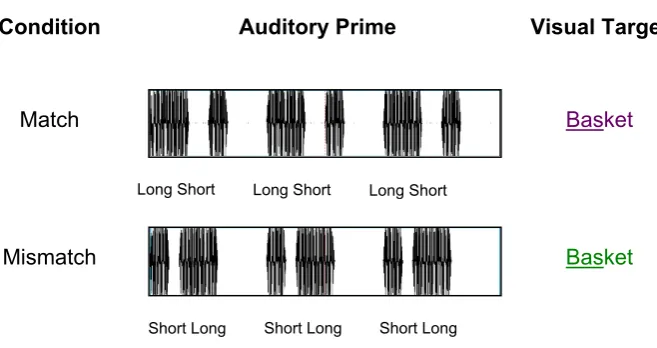
pattern that either matched, or mismatched, the temporal structure of the prime (See figure 1).
82
Based on previous literature (e.g., [16,19,21]), we predicted that words that do not match the
83
temporal structure of the rhythmic prime would elicit an increased centro-frontal negativity.
85
A second aim of the study was to determine whether such rhythmic priming effect would be
86
related to musical aptitude. Musical aptitude has been associated with enhanced perception of
87
speech cues that are important correlates of rhythm. For instance, individuals with formal musical
88
training better detect violations of word pitch contours [22,23] and syllabic durations (e.g., [24])
89
than non-musicians. In addition, electrophysiological evidence shows that the size of a negative
90
ERP component elicited by spoken words with an unexpected stress pattern correlates with
91
individual differences in musical rhythm abilities [16]. Thus, in the present study, we expected the
92
amplitude of the negativity elicited by the cross-modal priming effect to correlate with individual
93
scores on a musical aptitude test, if the relationship between musical aptitude and speech rhythm
94
sensitivity transfers to the visual domain.
95
Finally, the third study aim was to test whether the cross-modal priming effect present in the
96
ERPs correlated with individual differences in reading achievement. Mounting evidence suggests
97
a link between sensitivity to auditory rhythm skills (both linguistic and musical) and reading
98
abilities (e.g. [25–28]). As such, we collected individuals’ scores on a college readiness reading
99
achievement test to examine whether the cross-modal ERP effect correlated with individual
100
differences in reading comprehension skills.
101
2. Materials and Methods
102
2.1 Participants
103
Eighteen college freshman students took part in the experiment (14 females, mean age =
104
19.5, age range: 18-22). All were right-handed, native English speakers with less than two years of
105
formal musical training. None of the participants were enrolled in a Music major. The study was
106
approved by the Institutional Review Board at Middle Tennessee State University, and written
107
consent was obtained from the participants prior to the start of the experiment.
108
109
2.2 Standardized Measures
110
The Advanced Measures of Music Audiation (AMMA; [29]) was used to assess participants’
111
musical aptitude. The AMMA has been used previously to measure the correlation between
112
musical aptitude and index of brain activities (e.g., [16,30–32]). This measure was nationally
113
standardized with a normed sample of 5,336 U.S. students and offers percentile ranked norms for
114
both music and non-music majors. Participants were presented with 30 pairs of melodies and asked
115
to determine whether the two melodies of each pair were the same, tonally different, or rhythmically
116
Figure 1. Rhythmic cross-modal priming experimental paradigm. The auditory prime (long-short. or short-long sequence) is followed by a target visual word with a stress pattern that either match, or mismatch the prime (Note: stressed syllable is underlined).
Basket
Basket
Auditory Prime Visual Target
Match
Mismatch
Condition
Long Short Long Short Long Short
different. The AMMA provides separate scores for rhythmic and tonal abilities. For non-Music
117
majors, reliability scores are 0.80 for the tonal score and 0.81 for the rhythm score [29].
118
The reading scores on the American College Testing (ACT) were used to examine the
119
relationship between reading comprehension and speech rhythm sensitivity. The ACT reading
120
section is a standardized achievement test that comprises short passages from four categories (prose
121
fiction, social science, humanities, and natural science) and 40 multiple-choice questions that test the
122
reader’s comprehension of the passages. Scores range between 1 and 36.
123
124
2.3 EEG Cross-Modal Priming Paradigm
125
Prime sequences consisted of a rhythmic tone pattern of either a long-short or short-long
126
structure repeated three times. The tones consisted of a 500 Hz sine wave with a 10 ms rise/fall, and
127
a duration of either 200 ms (long) or 100 ms (short). In long-short sequences, the long tone and short
128
tone were separated by a silence of 100 ms, and each of the three successive long-short tone pairs was
129
followed by a silence of 200 ms. In short-long sequences, the short tone and long tone were
130
separated by a silence of 50 ms, and each of the three successive short-long tone pairs was followed
131
by a silence of 250 ms.
132
Visual targets were composed of 140 English real-word bisyllabic nouns and 140 pseudowords,
133
which were all selected from the database of the English Lexicon Project [33]. Pseudowords were
134
matched to the real words in terms of syllable count and word length and were used only for the
135
purpose of the lexical decision task. Half of the real words (N = 70) had a trochaic stress pattern (i.e.,
136
stressed on the first syllable, for example, “basket”). The other half consisted of fillers with an
137
iambic stress pattern (i.e., stressed on the second syllable, for example, “guitar”).
138
Short-long and long-short prime sequences were combined with the visual target words to create
139
two experimental conditions in which the stress pattern of the target word either matched or
140
mismatched the rhythm of the auditory prime.
141
We choose to analyze only the ERPs elicited by trochaic words for several reasons. First,
142
trochaic words comprise the predominant stress pattern in English (85–90% of spoken English words
143
according to [34]), and consequently, participants will likely be familiar with their pronunciation.
144
Second, because stressed syllables correspond to word onset in trochaic words, this introduces fewer
145
temporal jitters than for iambic words when computing ERPs across trials. This scenario is
146
particularly problematic for iambic words during silent reading, because there is no direct way to
147
measure when participants read the second syllable. Third, participants were recruited from a
148
university located in the southeastern region of the United States, and either originated from this
149
area, or have been living in the area for several years. It is well documented that the Southern
150
American English dialect tends to place stress on the first syllable of many iambic words despite that
151
these types of words are stressed on the second syllable in standard American English (e.g., [35] ).
152
As such, rhythmic expectations are less clear to predict for iambic words.
153
154
2.4 Procedure
155
Participants’ musical aptitude was first measured using the AMMA [29]. Following
156
administration of the AMMA test, participants were seated in a soundproofed and electrically
157
shielded room. Auditory prime sequences were presented through headphones, and target stimuli
158
were visually presented on a computer screen placed at approximately 3 feet in front of the
159
participant. Stimulus presentation was controlled using the software E-prime 2.0 Professional with
160
Network Timing Protocol (Psychology software tools, Inc., Pittsburgh, PA). Participants were
161
presented with 5 blocks of 56 stimuli. The trials were randomized within each block, and the order
162
of the blocks was counterbalanced across participants. Each trial was introduced by a fixation cross
163
displayed at the center of a computer screen that remained until 2 seconds after the onset of the visual
164
target word. Participants were asked to read the target word and to press one button if they thought
165
it was a real English word, or another button if they thought it was a nonword. The entire
166
experimental session lasted 1.5 hours.
2.5 EEG Acquisition and Preprocessing
169
EEG was recorded continuously from 128 Ag/AgCL electrodes embedded in sponges in a
170
Hydrocel Geodesic Sensor Net (EGI, Eugene, OR) placed on the scalp, connected to a NetAmps 300
171
amplifier, and using a MacPro computer. Electrode impedances were kept below 50 kOhm. Data
172
was referenced online to Cz and re-referenced offline to the averaged mastoids. In order to detect
173
the blinks and vertical eye movements, the vertical and horizontal electrooculograms (EOG) were
174
also recorded. The EEG and EOG were digitized at a sampling rate of 500Hz. EEG preprocessing
175
was carried out with NetStation Viewer and Waveform tools. The EEG was first filtered with a
176
bandpass of 0.1 to 30 Hz. Data time-locked to the onset of trochaic target words was then segmented
177
into epochs of 1100 ms, starting with a 100 ms prior to the word onset and continuing 1000 ms
post-178
word-onset. Trials containing movements, ocular artifacts, or amplifier saturation were discarded.
179
ERPs were computed separately for each participant and each condition by averaging together the
180
artifact-free EEG segments relative to a 100 ms pre-baseline.
181
182
2.6 Data Analysis
183
Statistical analyses were performed using MATLAB and the FieldTrip open source toolbox [36].
184
A planned comparison between the ERPs elicited by mismatching trochaic words and matching
185
trochaic words was performed using a cluster-based permutation approach. This non-parametric
186
data-driven approach does not require the specification of any latency range or region of interest a
187
priori, while also offering a solution to the problem of multiple comparisons (see [37]).
188
To relate the ERP results to the behavioral measures (i.e., musical aptitude and reading
189
comprehension), an index of sensitivity to speech rhythm cues was first calculated from the ERPs
190
using the mean of the significant amplitude differences between ERPs elicited by matching and
191
mismatching trochaic words at each channels, and time points belonging to the resulting clusters (see
192
[16,38] for similar approaches). Pearson correlations were then tested between the ERP cluster sum
193
difference and the participants’ scores on the AMMA and ACT reading section, respectively.
194
3. Results
195
3.1. Metrical Expectancy
196
Overall, participants performed well on the lexical decision task, as suggested by the mean
197
accuracy rate (M = 98.82%, SD = .85). A paired samples t-test was computed to compare accuracy
198
rates for real target words in the matching (M = 99.83%, SD = 0.70), and mismatching (M = 99.42 %,
199
SD = 1.40) rhythm conditions. No statistically significant differences were found between the two
200
conditions, t(35) = 1.54, p = .13, two-tailed.
201
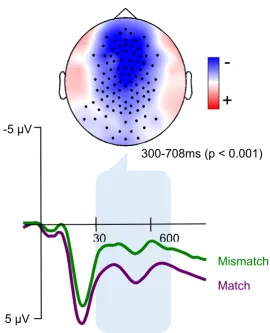
Analyses of the ERP data revealed that target trochaic words that mismatched the rhythmic
202
prime elicited a significantly larger negativity from 300 to 708 ms over a centro-frontal cluster of
203
electrodes (p < 0.001, See Figure 2).
205
Figure 2. Rhythmic priming ERP effect. Grand-average ERPs recorded for matching (purple), and mismatching (green) trochaic target words, averaged for the significant group of channels in the cluster. The latency range of the significant clusters is indicated in blue. (Note: Negative amplitude values are plotted upward. The topographic map shows the mean differences in scalp amplitudes in the latency range of the significant clusters. Electrodes belonging to the cluster are indicated with a black dot.)
1.1.Brain-Behavior Correlations
206
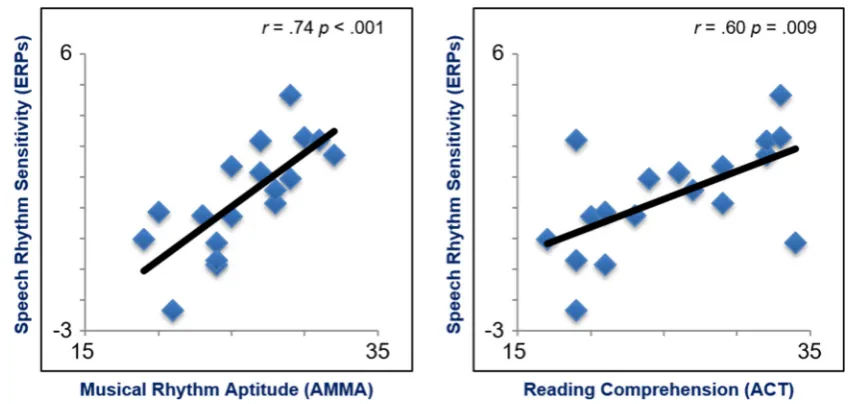
A statistically significant strong correlation was found between the size of the negative effect
207
elicited by mismatching trochaic words and the AMMA rhythm scores (r = .74, p < .001), suggesting
208
that the higher the musical rhythm aptitude, the larger the negativity elicited in response to
209
mismatching trochaic words (see Figure 3, left panel). By contrast, the correlation between the
210
negativity and the tonal score was not statistically significant (r = .30, p = .23). The maximum
211
Cook’s distance for the reported correlations indicated no undue influence of any data point on the
212
fitted model (i.e., max Cook’s d < .5).
213
A statistically significant moderate correlation was found between the size of the negative
214
effect elicited by mismatching trochaic words and ACT reading scores (r = 0.6, p = 0.009), suggesting
215
that the higher the reading achievement, the larger the negativity elicited in response to
216
mismatching trochaic words (see Figure 3, right panel). The maximum Cook’s distance for the
217
reported correlation indicated no undue influence of any data point on the fitted model (i.e., max
218
Cook’s d < .5).
219
220
300-708ms (p < 0.001)
-+
Match
Mismatch
-5 µV
5 µV
221
222
223
4. Discussion
224
The current study aimed to examine the cross-modal priming effect of musical rhythm on
225
written word processing and investigate whether such effect would relate to individual differences
226
in musical aptitude and reading comprehension. As hypothesized, trochaic target words that did
227
not match the rhythmic structure of the auditory prime were associated with an increased
228
negativity over the centro-frontal part of the scalp. This finding is in line with previous ERP
229
studies on speech rhythm and meter [11,16,21,24,39–42]. It has been generally proposed that this
230
negative effect either reflects an increased N400 [11,40], or a domain-general rule-based
error-231
detection mechanism [16,21,24,42–44]. The fact that similar negative effects have been reported in
232
response to metric deviations in tone sequences (e.g., [45,46]) further supports the latter
233
interpretation.
234
While the aforementioned studies were conducted either in the linguistic or musical domain,
235
the negative effect observed for mismatching target word was generated by musical prime
236
sequence in the present experiment. Cason and Schön (2012; [19]) previously reported a
cross-237
domain priming effect of music on speech processing, which was reflected by a similar increased
238
negativity when the metrical structure of the spoken target word did not match the rhythmic
239
structure of the musical prime. Several other findings have since shown that temporal
240
expectancies generated by rhythmically regular musical primes can facilitate spoken language
241
processing in typical adults (e.g., [20,47]), and children [48,49], as well as adults with Parkinson’s
242
disease [50], children with cochlear implants [51], and children with language disorders [52]. This
243
beneficial effect may stem from the regular rhythmic structure of the musical prime, which
244
provides temporally predictable cues to which internal neural oscillators can anchor [20]. The
245
present findings support and extend this line of research by showing this negativity is elicited even
246
when the target words were visually presented, thus suggesting that musical rhythm can not only
247
induce metrical expectations across distinct cognitive domains, but also across different sensory
248
modalities [53]. These findings also provide additional evidence in favor of the view that
249
rhythm/meter processing relies on overlapping neural systems in language and music [15,17,18].
250
We further investigated whether this cross-modal priming effect was related to individual
251
differences in musical aptitude. Interestingly, our results showed a significant correlation between
252
the size of the brain response elicited by unexpected stress patterns and the AMMA rhythm
253
subscore, but not the tonal subscore. This is in line with previous ERP studies showing that adult
254
musicians performed better than non-musicians at detecting words pronounced with an incorrect
255
stress pattern [24]. In addition, this enhanced sensitivity to speech meter was associated with
256
larger electrophysiological responses to incorrectly pronounced words, which was interpreted as
257
reflecting more efficient early auditory processing of the temporal properties of speech.
258
Robust associations have also been found between musical rhythm skills and speech prosody
259
perception, even after controlling for years of music education [15]. Noteworthy for the present
260
experiment, individual differences in brain sensitivity to speech rhythm variations can be explained
261
by variance in musical rhythm aptitude in individuals with less than two years of musical training.
262
For instance, in a recent experiment [16], participants’ musical aptitude was assessed using the
263
same standardized measure of musical abilities (i.e., AMMA) as in the present study. Participants
264
listened to sequences consisting of four bisyllabic words for which the stress pattern of the final
265
word either matched or mismatched the stress pattern of the preceding words. Words with a
266
mismatching stress pattern elicited an increased negative ERP component with the same scalp
267
distribution and latency as the one found in the current data. More importantly, participants’
268
musical rhythm aptitude significantly correlated with the size of the negative effect. Thus, in light
269
of the aforementioned literature, the present results confirm and extend previous data suggesting a
270
possible transfer of learning between the musical and linguistic domains (See [54] for a review).
271
While our present study was correlational (and conducted with non-musicians), data from recent
272
longitudinal studies using randomized control trials indeed showed promising results of
rhythm-273
based intervention for the development of language skills in children with reading disorders [55],
274
and typical peers [56].
275
Adding to the growing literature showing a relationship between sensitivity to speech rhythm
276
and reading skills, our results revealed a significant positive correlation between the scores on the
277
ACT reading subtest and the size of the negative ERP effect elicited by mismatching stress patterns.
278
Previous studies have mainly focused on typically developing young readers using several novel
279
speech rhythm tasks in conjunction with standardized measures of reading abilities, and results
280
consistently showed a correlation between performances on the speech rhythm tasks and
281
individual differences in word reading skills (e.g., [57–60]). It has been proposed that early
282
sensitivity to speech rhythm cues may contribute to the development of phonological
283
representations [25]. However, sensitivity to speech rhythm cues still explains unique variance in
284
word reading skills after controlling for phonological processing skills (e.g., [61]), thus suggesting
285
that it also makes a significant contribution to reading development independently of phonological
286
awareness.
287
More directly related to the present study, research with older readers and adults suggests that
288
knowledge of the prosodic structure of words continues to play a role in skilled reading. For
289
instance, visual word recognition is facilitated when primed by word fragments with a matching
290
stress pattern [62,63]. Two other studies conducted on typical adults focused on lexical stress
291
perception in isolated multisyllabic words [64,65], and found a significant relationship with reading
292
comprehension. Likewise, adult struggling readers usually show lower performance than their
293
typical peers on tasks measuring perception of word stress patterns or auditory rhythms [66–69]
294
(but see [68,70]).
295
Finally, the fact that we found a “metrical” negativity to visual targets, despite that
296
participants were not allowed to sound out the words, further supports theories proposing that
297
information about the metrical structure of a word is part of its lexical representation and
298
automatically retrieved during silent reading [71,72]. Taken together, these results provide
299
compelling evidence that the role of rhythm skills in reading comprehension persists in adult
300
skilled readers.
301
One potential limitation of the current research is the use of ACT reading scores, which may
302
not be fully representative of the participants’ reading skills. In particular, phonemic awareness,
303
decoding, and fluency, which are components known to greatly contribute to reading
304
comprehension [73], cannot be teased apart in the ACT reading subsets. Future research using a
305
more comprehensive battery of language and reading assessments would thus allow to more fully
306
understand which reading components are more closely related to speech rhythm perception skills.
5. Conclusions
308
The present data confirm and extend previous studies showing facilitating effects of regular
309
musical rhythm on spoken language processing (e.g., [19,47,51]), by demonstrating this is also the
310
case for written language processing. We propose that this cross-modal effect of rhythm is mediated
311
by the automatic retrieval of the word metrical structure (i.e., implicit prosody) during silent reading.
312
Finally, because we found that the negativity associated with this cross-modal priming effect of
313
rhythm correlated with individual differences in musical aptitude and reading achievement, this
314
further supports the potential clinical and education implications of using rhythm-based intervention
315
for populations with language or learning disabilities.
316
317
Author Contributions: T.S.F. collected the data and wrote the paper. H.M. collected and analyzed the data.
318
J.R.S. wrote and edited the paper. C.L.M. conceived the idea, designed the experiments, and wrote the paper.
319
Funding: This study was funded by NSF Grant # BCS-1261460 awarded to Cyrille Magne. The funding sources
320
had no role in study design; in the collection, analysis and interpretation of data; in the writing of the report; nor
321
in the decision to submit the article for publication.
322
Conflicts of Interest: The authors declare no conflict of interest.
323
References
324
1. Lerdahl, F.; Jackendoff, R. An overview of hierarchical structure in music. Music Percept. An Interdiscip. J.1984,
325
1, 229–252.
326
2. London, J. Hearing in Time: Psychological Aspects of Musical Meter; 1st ed.; Oxford University Press: Oxford,
327
2004; ISBN 0-19-516081-9.
328
3. Patel, A. D. Music, Language, and the Brain; Oxford University Press: New York, 2008; ISBN
978-0-19-975530-329
1.
330
4. Liberman, M.; Prince, A. On stress and linguistic rhythm. Linguist. Inq.1977, 8, 249–336.
331
5. Henrich, K.; Alter, K.; Wiese, R.; Domahs, U. The relevance of rhythmical alternation in language processing: An
332
ERP study on English compounds. Brain Lang.2014, 136, 19–30, doi:10.1016/J.BANDL.2014.07.003.
333
6. Jones, M. R.; Boltz, M. Dynamic attending and responses to time. Psychol. Rev.1989, 96, 459–491.
334
7. Large, E. W.; Jones, M. R. The dynamics of attending: How people track time-varying events. Psychol. Rev.1999,
335
106, 119–159.
336
8. Quené, H.; Port, R. F. Effects of timing regularity and metrical expectancy on spoken-word perception. Phonetica
337
2005, 62, 1–13, doi:10.1159/000087222.
338
9. Jusczyk, P. W. How infants begin to extract words from speech. Trends Cogn. Sci.1999, 3, 323–328.
339
10. Mattys, S. L.; Samuel, A. G. How lexical stress affects speech segmentation and interactivity: Evidence from the
340
migration paradigm. J. Mem. Lang.1997, 36, 87–116.
341
11. Magne, C.; Astésano, C.; Aramaki, M.; Ystad, S.; Kronland-Martinet, R.; Besson, M. Influence of syllabic
342
lengthening on semantic processing in spoken French: Behavioral and electrophysiological evidence. Cereb.
343
Cortex2007, doi:10.1093/cercor/bhl174.
344
12. Schmidt-Kassow, M.; Kotz, S. A. Entrainment of syntactic processing? ERP-responses to predictable time intervals
345
during syntactic reanalysis. 2008, doi:10.1016/j.brainres.2008.06.017.
346
13. Jantzen, M. G.; Large, E. W.; Magne, C. Editorial: Overlap of neural systems for processing language and music.
347
Front. Psychol.2016, 7, 876, doi:10.3389/fpsyg.2016.00876.
348
14. Peretz, I.; Vuvan, D.; Lagrois, M.-E. ´; Armony, J. L. Neural overlap in processing music and speech. Phil. Trans.
349
R. Soc. B2015, 370, 20140090, doi:10.1098/rstb.2014.0090.
350
15. Hausen, M.; Torppa, R.; Salmela, V. R.; Vainio, M.; Särkämö, T. Music and speech prosody: A common rhythm.
Front. Psychol.2013, 4, 566, doi:10.3389/fpsyg.2013.00566.
352
16. Magne, C.; Jordan, D. K.; Gordon, R. L. Speech rhythm sensitivity and musical aptitude: ERPs and individual
353
differences. Brain Lang.2016, 153–154, 13–19, doi:10.1016/j.bandl.2016.01.001.
354
17. Peter, V.; Mcarthur, G.; Thompson, W. F. Discrimination of stress in speech and music: A mismatch negativity
355
(MMN) study. Psychophysiology2012, 49, 1590–1600, doi:10.1111/j.1469-8986.2012.01472.x.
356
18. Gordon, R. L.; Magne, C. L.; Large, E. W. EEG correlates of song prosody: A new look at the relationship between
357
linguistic and musical rhythm. Front. Psychol.2011, 2, 352, doi:10.3389/fpsyg.2011.00352.
358
19. Cason, N.; Schön, D. Rhythmic priming enhances the phonological processing of speech. Neuropsychologia2012,
359
50, 2652–2658, doi:10.1016/j.neuropsychologia.2012.07.018.
360
20. Falk, S.; Lanzilotti, C.; Schön, D. Tuning neural phase entrainment to speech. J. Cogn. Neurosci.2017, 29, 1378–
361
1389, doi:10.1162/jocn_a_01136.
362
21. Rothermich, K.; Schmidt-Kassow, M.; Schwartze, M.; Kotz, S. A. Event-related potential responses to metric
363
violations: rules versus meaning. Neuroreport2010, 21, 580–584, doi:10.1097/WNR.0b013e32833a7da7.
364
22. Magne, C.; Schön, D.; Besson, M. Musician children detect pitch violations in both music and language better than
365
nonmusician children: Behavioral and electrophysiological approaches. J. Cogn. Neurosci.2006, 18, 199–211,
366
doi:10.1162/jocn.2006.18.2.199.
367
23. Schön, D.; Magne, C.; Besson, M. The music of speech: Music training facilitates pitch processing in both music
368
and language. Psychophysiology2004, 41, 341–349, doi:10.1111/1469-8986.00172.x.
369
24. Marie, C.; Magne, C.; Besson, M. Musicians and the metric structure of words. J. Cogn. Neurosci.2011, 23, 294–
370
305, doi:10.1162/jocn.2010.21413.
371
25. Goswami, U. A temporal sampling framework for developmental dyslexia. Trends Cogn. Sci.2011, 15, 3–10,
372
doi:10.1016/j.tics.2010.10.001.
373
26. Harrison, E.; Wood, C.; Holliman, A. J.; Vousden, J. I. The immediate and longer-term effectiveness of a
speech-374
rhythm-based reading intervention for beginning readers. J. Res. Read.2018, 41, 220–241,
doi:10.1111/1467-375
9817.12126.
376
27. Holliman, a. J.; Williams, G. J.; Mundy, I. R.; Wood, C.; Hart, L.; Waldron, S. Beginning to disentangle the
377
prosody-literacy relationship: a multi-component measure of prosodic sensitivity. Read. Writ.2014, 27, 255–266,
378
doi:10.1007/s11145-013-9443-6.
379
28. Linguistic Rhythm and Literacy; Thomson, J., Jarmulowicz, L., Eds.; Trends in Language Acquisition Research;
380
John Benjamins Publishing Company: Amsterdam, 2016; Vol. 17; ISBN 978 90 272 4407 9.
381
29. Gordon, E. E. Predictive validity study of AMMA: A one-year longitudinal predictive validity study of the Advanced
382
Measures of Music Audiation; GIA Publications: Chicago, 1990;
383
30. Schneider, P.; Scherg, M.; Dosch, H. G.; Specht, H. J.; Gutschalk, A.; Rupp, A. Morphology of Heschl’s gyrus
384
reflects enhanced activation in the auditory cortex of musicians. Nat. Neurosci. 2002, 5, 688–694,
385
doi:10.1038/nn871.
386
31. Seppänen, M.; Brattico, E.; Tervaniemi, M. Practice strategies of musicians modulate neural processing and the
387
learning of sound-patterns. Neurobiol. Learn. Mem.2007, 87, 236–247, doi:10.1016/J.NLM.2006.08.011.
388
32. Vuust, P.; Brattico, E.; Seppänen, M.; Näätänen, R.; Tervaniemi, M. The sound of music: Differentiating musicians
389
using a fast, musical multi-feature mismatch negativity paradigm. Neuropsychologia 2012, 50, 1432–1443,
390
doi:10.1016/J.NEUROPSYCHOLOGIA.2012.02.028.
391
33. Balota, D. A.; Yap, M. J.; Hutchison, K. A.; Cortese, M. J.; Kessler, B.; Loftis, B.; Neely, J. H.; Nelson, D. L.;
392
Simpson, G. B.; Treiman, R. The English Lexicon Project. Behav. Res. Methods 2007, 39, 445–459,
393
doi:10.3758/BF03193014.
394
34. Cutler, A.; Carter, D. M. The predominance of strong initial syllables in the English vocabulary; 1987; Vol. 2;.
35. Thomas, E. R. Rural white southern accents. In A Handbook of Varieties of English: A Multimedia Reference Tool;
396
Kortmann, B., Schneider, E. W., Eds.; Mouton de Gruyter: New York, 2004; pp. 300–324.
397
36. Oostenveld, R.; Fries, P.; Maris, E.; Schoffelen, J.-M. FieldTrip: Open source software for advanced analysis of
398
MEG, EEG, and invasive electrophysiological data. Comput. Intell. Neurosci. 2011, 2011, 1–9,
399
doi:10.1155/2011/156869.
400
37. Maris, E.; Oostenveld, R. Nonparametric statistical testing of EEG- and MEG-data. J. Neurosci. Methods2007,
401
doi:10.1016/j.jneumeth.2007.03.024.
402
38. Lense, M. D.; Gordon, R. L.; Key, A. P. F.; Dykens, E. M. Neural correlates of cross-modal affective priming by
403
music in Williams syndrome. Soc. Cogn. Affect. Neurosci.2014, 9, 529–37, doi:10.1093/scan/nst017.
404
39. Bohn, K.; Knaus, J.; Wiese, R.; Domahs, U. The influence of rhythmic (ir)regularities on speech processing:
405
Evidence from an ERP study on German phrases. Neuropsychologia 2013, 51, 760–71,
406
doi:10.1016/j.neuropsychologia.2013.01.006.
407
40. Domahs, U.; Wiese, R.; Bornkessel-Schlesewsky, I.; Schlesewsky, M. The processing of German word stress:
408
evidence for the prosodic hierarchy. Phonology2008, 25, 1–36, doi:10.1017/S0952675708001383.
409
41. McCauley, S. M.; Hestvik, A.; Vogel, I. Perception and bias in the processing of compound versus phrasal stress:
410
Evidence from event-related brain potentials. Lang. Speech2012, 56, 23–44, doi:10.1177/0023830911434277.
411
42. Moon, H.; Magne, C. Noun/verb distinction in English stress homographs: An ERP study. Neuroreport2015, 26,
412
753–757, doi:10.1097/WNR.0000000000000417.
413
43. Rothermich, K.; Schmidt-Kassow, M.; Kotz, S. A. Rhythm’s gonna get you: Regular meter facilitates semantic
414
sentence processing. Neuropsychologia2012, 50, 232–244, doi:10.1016/j.neuropsychologia.2011.10.025.
415
44. Schmidt-Kassow, M.; Kotz, S. A. Attention and perceptual regularity in speech. Neuroreport2009, 20, 1643–1647,
416
doi:10.1097/WNR.0b013e328333b0c6.
417
45. Brochard, R.; Abecasis, D.; Potter, D.; Ragot, R.; Drake, C. The “Ticktock” of our internal clock: Direct brain
418
evidence of subjective accents in isochronous sequences. Psychol. Sci.2003, 14, 362–366,
doi:10.1111/1467-419
9280.24441.
420
46. Ystad, S.; Magne, C.; Farner, S.; Pallone, G.; Aramaki, M.; Besson, M.; Kronland-Martinet, R.
421
Electrophysiological study of algorithmically processed metric/rhythmic variations in language and music. Eurasip
422
J. Audio, Speech, Music Process.2007, doi:10.1155/2007/30194.
423
47. Cason, N.; Astésano, C.; Schön, D. Bridging music and speech rhythm: Rhythmic priming and audio–motor
424
training affect speech perception. Acta Psychol. (Amst).2015, 155, 43–50, doi:10.1016/j.actpsy.2014.12.002.
425
48. Gordon, R. L.; Shivers, C. M.; Wieland, E. A.; Kotz, S. A.; Yoder, P. J.; Devin McAuley, J. Musical rhythm
426
discrimination explains individual differences in grammar skills in children. Dev. Sci. 2015, 18, 635–44,
427
doi:10.1111/desc.12230.
428
49. Chern, A.; Tillmann, B.; Vaughan, C.; Gordon, R. L. New evidence of a rhythmic priming effect that enhances
429
grammaticality judgments in children. J. Exp. Child Psychol.2018, 173, 371–379, doi:10.1016/j.jecp.2018.04.007.
430
50. Kotz, S. A.; Gunter, T. C. Can rhythmic auditory cuing remediate language-related deficits in Parkinson’s disease?
431
Ann. N.Y. Acad. Sci, doi:10.1111/nyas.12657.
432
51. Cason, N.; Hidalgo, C.; Isoard, F.; Roman, S.; Schön, D. Rhythmic priming enhances speech production abilities:
433
Evidence from prelingually deaf children. Neuropsychology2015, 29, 102–107, doi:10.1037/neu0000115.
434
52. Przybylski, L.; Bedoin, N.; Herbillon, V.; Roch, D.; Kotz, S. A.; Tillmann, B. Rhythmic auditory stimulation
435
influences syntactic processing in children With developmental language disorders. Neuropsychology2013, 27,
436
121–131, doi:10.1037/a0031277.
437
53. Brochard, R.; Tassin, M.; Zagar, D. Got rhythm… for better and for worse. Cross-modal effects of auditory rhythm
438
on visual word recognition. Cognition2013, 127, 214–219, doi:10.1016/J.COGNITION.2013.01.007.
54. Gordon, R. L.; Magne, C. L.; Magne, C. L. Music and the brain: Music and cognitive abilities. In The Routledge
440
Companion to Music Cognition; Ashley, R., Timmers, R., Eds.; Routledge: New York, 2017; pp. 49–62.
441
55. Gordon, R. L.; Fehd, H. M.; McCandliss, B. D. Does music training enhance literacy skills? A meta-analysis.
442
Front. Psychol.2015, 6, doi:10.3389/fpsyg.2015.01777.
443
56. Francois, C.; Chobert, J.; Besson, M.; Schon, D. Music training for the development of speech segmentation. Cereb.
444
Cortex2013, 23, 2038–2043, doi:10.1093/cercor/bhs180.
445
57. Holliman, A. J.; Wood, C.; Sheehy, K. Sensitivity to speech rhythm explains individual differences in reading
446
ability independently of phonological awareness. Br. J. Dev. Psychol. 2008, 26, 357–367,
447
doi:10.1348/026151007X241623.
448
58. Holliman, A. J.; Wood, C.; Sheehy, K. A cross-sectional study of prosodic sensitivity and reading difficulties. J.
449
Res. Read.2012, 35, 32–48, doi:10.1111/j.1467-9817.2010.01459.x.
450
59. Whalley, K.; Hansen, J. The role of prosodic sensitivity in children’s reading development. J. Res. Read.2006, 29,
451
288–303, doi:10.1111/j.1467-9817.2006.00309.x.
452
60. Wood, C. Metrical stress sensitivity in young children and its relationship to phonological awareness and reading.
453
J. Res. Read.2006, 29, 270–287, doi:10.1111/j.1467-9817.2006.00308.x.
454
61. Holliman, A. J.; Gutiérrez Palma, N.; Critten, S.; Wood, C.; Cunnane, H.; Pillinger, C. Examining the independent
455
contribution of prosodic sensitivity to word reading and spelling in early readers. Read. Writ.2017, 30, 509–521,
456
doi:10.1007/s11145-016-9687-z.
457
62. Cooper, N.; Cutler, A.; Wales, R. Constraints of lexical stress on lexical access in English: Evidence from native
458
and non-native listeners. Lang. Speech2002, 45, 207–228, doi:10.1177/00238309020450030101.
459
63. Friedrich, C. K. Neurophysiological correlates of mismatch in lexical access. BMC Neurosci. 2005, 6, 64,
460
doi:10.1186/1471-2202-6-64.
461
64. Chan, J. S.; Wade-Woolley, L. Explaining phonology and reading in adult learners: Introducing prosodic awareness
462
and executive functions to reading ability. J. Res. Read.2018, doi:10.1111/1467-9817.12083.
463
65. Heggie, L.; Wade-Woolley, L. Prosodic awareness and punctuation ability in adult readers. Read. Psychol.2018,
464
39, 188–215, doi:10.1080/02702711.2017.1413021.
465
66. Leong, V.; Hämäläinen, J.; Soltész, F.; Goswami, U. Rise time perception and detection of syllable stress in adults
466
with developmental dyslexia. J. Mem. Lang.2011, 64, 59–73, doi:10.1016/J.JML.2010.09.003.
467
67. Leong, V.; Goswami, U. Assessment of rhythmic entrainment at multiple timescales in dyslexia: Evidence for
468
disruption to syllable timing. Hear. Res.2014, 308, 141–161, doi:10.1016/J.HEARES.2013.07.015.
469
68. Mundy, I. R.; Carroll, J. M. Speech prosody and developmental dyslexia: Reduced phonological awareness in the
470
context of intact phonological representations. J. Cogn. Psychol. 2012, 24, 560–581,
471
doi:10.1080/20445911.2012.662341.
472
69. Thomson, J. M.; Fryer, B.; Maltby, J.; Goswami, U. Auditory and motor rhythm awareness in adults with dyslexia.
473
J. Res. Read.2006, 29, 334–348, doi:10.1111/j.1467-9817.2006.00312.x.
474
70. Dickie, C.; Ota, M.; Clark, A. Revisiting the phonological deficit in dyslexia: Are implicit nonorthographic
475
representations impaired? Appl. Psycholinguist.2013, 34, 649–672, doi:10.1017/S0142716411000907.
476
71. Breen, M.; Clifton, C. Stress matters: Effects of anticipated lexical stress on silent reading. J. Mem. Lang.2011,
477
64, 153–170, doi:10.1016/j.jml.2010.11.001.
478
72. Magne, C.; Gordon, R. L.; Midha, S. Influence of metrical expectancy on reading words: An ERP study. In Speech
479
Prosody 2010 Conference Proceedings; 2010; pp. 1–4.
480
73. Teaching Children To Read: An Evidence-Based Assessment of the Scientific Research Literature on Reading and
481
Its Implications for Reading Instruction. (Report No. NIH-00-4769); Bethesda, MD, 2000.