ABSTRACT
Jiong Lin. Assessing the Value of Model Calibration for Signalized Intersections. (Under the
direction of Dr. Nagui Rouphail.)
The Highway Capacity Manual (HCM) provides the most widely used methodologies for
evaluating the quality of service on highway and street facilities. However, many users contend that the HCM models they are using are not accurate in emulating some real world conditions. In this thesis, the HCM control delay model for signalized intersections is assessed to identify where and when such deficiencies occur.
Four signalized intersections within the Chicago central business district (CBD) area are selected
to assess the accuracy of the HCM control delay model. The lane groups studied include three
through lane groups and one permissive left-turn lane group. Input data (e.g. lane group volumes,
proportion of vehicles arriving on green, effective green time, etc.) for the HCM model and
empirical data (e.g. actual measured control delay) were collected cycle by cycle in the field.
Saturation flow rates estimated from (a) the HCM default parameter values, (b) field calibration
and (c) statistical optimization are entered into the HCM control delay model, respectively, to
calculate control delays. Then, the control delays calculated from the model are contrasted to
those measured from the field.
For the through lane groups, the analysis indicates that the control delay calculated using the
from field measurements, and this indicates that the HCM control delay model is reliable. For the
ASSESSING THE VALUE OF MODEL CALIBRATION
FOR SIGNALIZED INTERSECTIONS
by JIONG LIN
A thesis submitted to the Graduate Faculty of North Carolina State University In partial fulfillment of the requirements for
The Degree of Master of Science
CIVIL, CONSTRUCTION, AND ENVIRONMENTAL ENGINEERING
Raleigh, NC 2004
APPROVED BY:
Dr. Joseph E. Hummer Dr. Billy M. Williams
Dr. Nagui M. Rouphail Chair of Advisory Committee
ii
BIOGRAPHY
Jiong Lin was born in Beijing, China. After graduation from Northern Jiaotong University in
Beijing, China, where she received a Bachelor of Science degree in Transportation Engineering
in July 1995, she worked for Civil Aviation Management Institute of China as an assistant
professor for eight years. In September 2001, she received her Master of Business Administration
iii
ACKNOWLEDGEMENTS
Many people have assisted me in the completion of my graduate thesis. I would first like to
acknowledge Dr. Nagui Rouphail, my academic advisor, who had spent a lot of time and spirits
with me on the thesis structure formulation, provided guidance on research materials. His
constructive and most helpful comments on my thesis draft deserve to be sincerely appreciated.
I would also like to thank Dr. Joseph Hummer and Dr. Billy Williams for serving on my thesis
committee and giving suggestions for ways to improve my research.
Last, I would like to thank my husband, Xuejun, for his understanding and support. Without his
iv
TABLE OF CONTENTS
List of Tables ... vi
List of Figures... viii
CHAPTER 1. INTRODUCTION... 1
1.1 Background ...1
1.2 Problem Statement ...1
1.3 Objectives and Scope ...2
1.4 Organization...3
CHAPTER 2. LITERATURE REVIEW ... 5
2.1 HCM Methodology ...5
2.1.1 Uniform Delay...6
2.1.2 Incremental Delay ...7
2.1.3 Initial Queue Delay...8
2.2 General Statistical Validation Methods...10
2.3 Validation Using Microscopic Simulation Model ...13
2.4 Bayesian Analysis ...14
2.5 Effect of Opposing Flow on permissive Left-turn Capacity ...16
2.6 Summary of Literature Review ...17
CHAPTER 3. METHODOLOGY AND DATA... 19
3.1 Method Description...19
3.2 Data Collection and Description ...23
3.2.1 Wells-Grand Intersection...25
3.2.2 LaSalle-Ohio Intersection...27
3.2.3 LaSalle-Ontario Intersection ...29
3.2.4 LaSalle-Grand Intersection...30
3.2.5 Summary of Input Information for Studied Lane Groups ...32
3.3 Field Measurement of Saturation Flow Rate at Signalized Intersection ...32
v
CHAPTER 4. RESULTS ... 36
4.1 Summary of Saturation Flow Rate and kI-value of Studied Lane Groups...36
4.2 Southbound Through Lane Group at Wells-Grand Intersection ...39
4.3 Southbound Through Lane Group at LaSalle-Ohio Intersection ...46
4.4 Northbound Through Lane Group at LaSalle-Ontario Intersection ...51
4.5 Northbound Permissive Left-turn Lane Group at LaSalle-Grand Intersection ...60
4.6 Overall Summary ...68
CHAPTER 5. CONCLUSIONS AND RECOMMENDATIONS... 77
5.1 Conclusions ...77
5.2 Recommendations ...79
CHAPTER 6. REFERENCE... 81
APPENDIX A. SUMMARY OF FIELD MEASUREMENTS... 82
APPENDIX B. FIELD MEASUREMENT OF INTERSECTION CONTROL DELAY ... 87
APPENDIX C. SUMMARY OF LANE GROUP CONTROL DELAY ... 89
vi
List of Tables
Table 3.1 Summary of Fixed Input Data for Studied Lane Groups... 32 Table 3.2 Summary of Average Saturation Flow Rates ... 33 Table 3.3 Summary of Control Delay Statistics ... 35 Table 4.1 Summary of Saturation Flow Rates, kI-values and Corresponding Control Delay MSEs by
Different Methods... 37 Table 4.2 Comparison of Control Delay MSE Using the HCM Default Saturation Flow Rate and kI
with/without Default Arrival Type ... 39 Table 4.3 Comparison of Control Delay MSE with Field Calibrated Saturation Flow Rate
and/or kI... 39 Table 4.4 Maximum Difference (sec) at Specified Assurance Levels for the Southbound Through
Lane Group at Wells-Grand Intersection... 45 Table 4.5 Maximum Difference (sec) at Specified Assurance Levels for the Southbound Through
Lane Group at LaSalle-Ohio Intersection... 50 Table 4.6 Maximum Difference (sec) at Specified Assurance Levels for the Northbound Through
Lane Group at LaSalle-Ontario Intersection... 56 Table 4.7 The Optimal MSEs and Corresponding Saturation Flow Rates (veh/h/ln) and kI Values for
the Two Study Periods at LaSalle-Ontario Intersection ... 57 Table 4.8 Summary of Sensitivity Analysis for the Control Delay MSE for Cycles 29 through 48
at LaSalle-Ontario Intersection... 59 Table 4.9 Maximum Difference (sec) at Specified Assurance Levels for the Northbound Permissive
Left-turn Lane Group at LaSalle-Ontario Intersection ... 65 Table 4.10 Comparison of Control Delay for Cycle 18 and Cycle 45 ... 67 Table 4.11 Comparison of Control Delay Using 5-minute Data for the Northbound Permissive
Left-turn... 68 Table 4.12 Statistical Relationship between Control Delay Estimated Using the HCM Model and the
Field Measurements for Through Lane Groups... 72 Table 4.13 Statistical Relationship between Control Delay Estimated Using the HCM Model and the
Field Measurements for Permissive Left-turn Lane Groups... 75 Table A.1 Summary of Field Measurements for Southbound Through Lane Group
at Wells-Grand Intersection... 83 Table A.2 Summary of Field Measurements for Southbound Through Lane Group
at LaSalle-Ohio Intersection ... 84 Table A.3 Summary of Field Measurements for Northbound Through Lane Group
at LaSalle-Ontario Intersection... 85 Table A.4 Summary of Field Measurements for Northbound Left-turn Lane Group
vii
Table C.1 Summary of Control Delay (sec/veh) for Southbound Through Lane Group at Wells-Grand Intersection... 90 Table C.2 Summary of Control Delay (sec/veh) for Southbound Through Lane Group
at LaSalle-Ohio Intersection ... 91 Table C.3 Summary of Control Delay (sec/veh) for Northbound Through Lane Group
at LaSalle-Ontario Intersection... 92 Table C.4 Summary of Control Delay (sec/veh) for Northbound Permissive Left-turn Lane Group
at LaSalle-Grand Intersection ... 93 Table D.1 The Control Delay Estimated by the HCM Model Using the Cycle-by-cycle Saturation
viii
List of Figures
Figure 3.1 Wells-Grand Intersection Configurations and Signal Timing Plan... 26
Figure 3.2 LaSalle-Ohio Intersection Configurations and Signal Timing Plan... 28
Figure 3.3 LaSalle-Ontario Intersection Configurations and Signal Timing Plan ... 30
Figure 3.4 LaSalle-Grand Intersection Configurations and Signal Timing Plan... 31
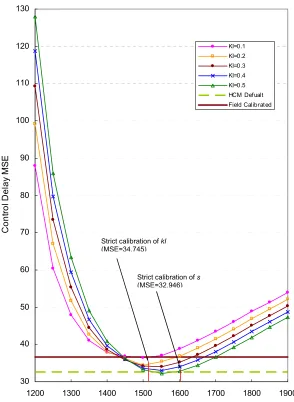
Figure 4.1 Control Delay MSE vs. Saturation Flow Rate, s, and Parameter, kI, for the Southbound Through Lane Group at Wells-Grand Intersection ... 41
Figure 4.2 Comparisons of Control Delay for the Southbound Through Lane Group at Wells-Grand Intersection... 42
Figure 4.3 Distributions of Control Delay for the Southbound Through Lane Group at Wells-Grand Intersection... 43
Figure 4.4 Distributions of LOS for the Southbound Through Lane Group at Wells-Grand Intersection ... 44
Figure 4.5 Control Delay MSE vs. Saturation Flow Rate, s, and Parameter, kI, for the Southbound Through Lane Group at LaSalle-Ohio Intersection ... 47
Figure 4.6 Comparison of Control Delay for the Southbound Through Lane Group at LaSalle-Ohio Intersection ... 48
Figure 4.7 Distributions of Control Delays for the Southbound Through Lane Group at LaSalle-Ohio Intersection ... 48
Figure 4.8 Distribution of LOS for the Southbound Through Lane Group at LaSalle-Ohio Intersection ... 50
Figure 4.9 Control Delay MSE vs. Saturation Flow Rate, s, and Parameter, kI, for the Northbound Through Lane Group at LaSalle-Ontario Intersection ... 53
Figure 4.10 Comparisons of Control Delay for the Northbound Through Lane Group at LaSalle-Ontario Intersection... 54
Figure 4.11 Distributions of Control Delay for the Northbound Through Lane Group at LaSalle-Ontario Intersection... 54
Figure 4.12 Distribution of LOS for the Northbound Through Lane Group at LaSalle-Ontario Intersection... 55
Figure 4.13 Distributions of Control Delay for the Northbound Through Lane Group with Different Saturation Flow Rates at LaSalle-Ontario Intersection ... 58
Figure 4.14 Sensitivity Analysis of the Control Delay MSEs vs. Decrease of Proportion of Arriving on Green for Cycles 29 through 48 at LaSalle-Ontario Intersection ... 60
ix
Figure 4.16 Comparisons of Control Delay for the Northbound Permissive Left-turn Lane Group at LaSalle-Grand Intersection ... 62 Figure 4.17 Distributions of Control Delay for the Northbound Permissive Left-turn Lane Group
at LaSalle-Grand Intersection ... 63 Figure 4.18 Distributions of LOS for the Northbound Permissive Left-turn Lane Group
at LaSalle-Grand Intersection ... 64 Figure 4.19 Comparison of Control Delays Obtained from the HCM Model with Cycle-by-cycle
Saturation Flow Rate against Field Measurement ... 66 Figure 4.20 Comparison of Control Delay Estimated Using the HCM Model to the Field
Measurements for Through Lane Groups... 71 Figure 4.21 Comparison of Control Delay Estimated Using the HCM Model to the Field
1
CHAPTER 1. INTRODUCTION
1.1Background
The Highway Capacity Manual (HCM) published by the Transportation Research Board provides
traffic engineers and researchers alike with the most widely used methodologies for evaluating
the quality of service on highway and street facilities. It is the primary document presenting
methods for assessing capacity and level of service for elements of the surface transportation
system not only in the United States, but also in many other countries in the world. The first
edition of the HCM was published in 1950. The second and third editions were published in 1965
and 1985, respectively. The latest edition of the HCM was published in 2000.
A continuing concern about the HCM procedures is the following: are the models presented in
the HCM reliable enough and applicable to all highway and street facilities under a variety of
operating conditions? A sound model should reflect real world conditions. Many users contend
that the HCM models they are using are not accurate, and the models have some limitations in
emulating some real world conditions. While one cannot expect the models to fit all empirical
data, there is a need for a rigorous assessment of where and when such deficiencies occur.
1.2Problem Statement
By far, the most widely used chapter in the HCM is the signalized intersection analysis. In
particular the control delay model for signalized intersections is the key to estimate the level of
service (LOS) at all signalized intersections. A host of variables and parameters need to be input
to the model in order to calculate control delay. Some of the variables can be measured directly
from the field, such as intersection geometry, intersection signal timing, and lane group volumes,
2
values are typically used. Lane group saturation flow rate, one of the most important variables, is
a typical derivative variable that enters into the calculation of control delay. That variable is
derived from the functional relationship between an ideal saturation flow rate and several
adjustment factors including lane widths, heavy vehicle percentages, number of bus stops,
pedestrian volumes, number of parking maneuvers, etc.
The HCM recommends the use of a locally calibrated saturation flow rate wherever possible. The
implication is that a properly calibrated model will yield an acceptable delay estimate and
consequently a more realistic level of service. This assumption needs to be verified against field
observations. Since the delay model parameters including the saturation flow rate can be directly
observed in the field (e.g. demand, duration of the analysis period), it can be assumed that any
discrepancies between the observed and estimated HCM delay may be due to errors in the delay
model formulation itself.
1.3Objectives and Scope
The nature of traffic operations at signalized intersections may vary from site to site, such as
traffic flow, drivers’ characteristics, and intersection geometry, etc. The purpose of this research
is to assess the HCM 2000 control delay model for signalized intersections with various
un-calibrated and un-calibrated saturation flow rates. Input data (e.g. lane group volumes, proportion of
vehicles arriving on green, effective green time, cycle length, etc.) for the HCM model and
empirical data (e.g. actual measured control delay) are collected from the field. Saturation flow
rates estimated from (a) HCM formulae, (b) field calibration and (c) statistical optimization are
3
control delays calculated from the model are compared to the control delay measured from the
field. The following questions are to be answered at the end of this research:
• To what extent does the un-calibrated HCM saturation flow rate and corresponding delay
estimate adequately predict field delay at signalized intersections?
• What is gained, in terms of prediction power, by using a field calibrated saturation flow
rate and delay model parameters?
• What is the remaining error in predicting control delay when an optimal saturation flow
rate and delay parameters are used? and,
• Are there differences in delay estimation for through and permitted left-turn lane groups?
Four signalized intersections within Chicago central business district (CBD) area are selected for
this research. All signals selected are pre-timed. The lane groups being studied include three
through lane groups and a permissive left-turn lane group. Traffic data were collected cycle by
cycle during one-hour study period. Instead of peak 15-minute analysis period, the length of one
cycle is used as the unit of analysis period to estimate average control delay in the HCM control
delay model. Comparison and analysis of saturation flow rates, distribution of control delay, and
distribution of level of service (LOS) are conducted to evaluate the reliability and applicability of
the HCM 2000 control delay model.
1.4Organization
There are five chapters in this thesis. Chapter 1 is the introduction. Literature review is provided
in Chapter 2, which includes the HCM methodology and other methods of model calibration and
validation. Chapter 3 introduces the methodology that is employed in this research and a
4
lane groups, in which the assessment of the reliability of the HCM 2000 control delay model is
performed. In the final part, Chapter 5, uncertainties of the HCM 2000 control delay model are
5
CHAPTER 2. LITERATURE REVIEW
The HCM 2000 control delay model for signalized intersections is reviewed in this chapter.
Three methodologies for model calibration and validation are also reviewed. Koutsopoulos et al.
(2) summarize the general statistical methods to validate traffic models. Rouphail et al. (3, 4) use
microscopic simulation to assess a generalized delay model that is based on HCM 1994 delay
model. Sacks et al. (5, 6) apply a Bayesian methodology to calibrate and validate the HCM 2000 control delay model. The estimation of permissive left-turn capacity is much more complicated, which is effected by the opposing flow. Mousa et al. (7) discuss the effect of opposing platoon on permissive left-turn capacity.
2.1HCM Methodology
The HCM 2000 (1) defines control delay at signalized intersections as the average control delay
experienced by all vehicles that arrive in the analysis period, including delays incurred beyond
the analysis period when the lane group is oversaturated. The HCM 2000 control delay model for
signalized intersections includes three parts: uniform delay, incremental delay, and initial queue
delay. HCM 2000 (1) describes the average control delay per vehicle for a given lane group as:
3 2
1(PF) d d
d
d = + + Eq. (2.1)
where
d = control delay per vehicle (sec/veh);
d1 = uniform control delay assuming uniform arrivals (sec/veh);
6
d2 = incremental delay to account for effect of random arrivals and oversaturation queues,
adjusted for duration of analysis period and type of signal control; this delay component assumes that there is no initial queue for lane group at start of analysis period (sec/veh); and
d3 = initial queue delay, which accounts for delay to all vehicles in analysis period due to
initial queue at start of analysis period (sec/veh).
The progression adjustment factor is determined by the proportion of vehicles arriving on green.
Good progression means that most vehicles arrive on green and the average delay per vehicle is
low. On the other hand, with poor progression, most vehicles arrive on red and experience longer
delay at the intersection. The progression adjustment factor in HCM 2000 (1) is defined as:
) / ( 1
) 1 (
C g
f P
PF PA
− −
= Eq. (2.2)
where
P = proportion of vehicles arriving on green;
g = effective green time (sec);
C = cycle length (sec); and
fPA= supplemental adjustment factor for early and late platoons arriving during green.
The proportion of vehicles arriving on green may be either measured in the field or estimated
from arrival type.
2.1.1 Uniform Delay
The estimate of uniform delay in HCM 2000 (1) is based on the assumptions of uniform arrivals
7 ] / ) , 1 [min( 1 ) / 1 ( 5 . 0 2 1 C g X C g C d − −
= Eq. (2.3)
where X is the volume/capacity ratio or degree of saturation for lane group, which is given by:
sg vC c v
X = = Eq. (2.4)
where
v = demand flow rate for lane group (veh/h);
s = saturation flow rate for lane group (veh/h); and
c = capacity of lane group (veh/h).
X values beyond 1.0 are not applicable in the computation of uniform delay, but are transferred to the second delay term, d2.
2.1.2 Incremental Delay
As presented in HCM 2000 (1), the incremental delay accounts for non-uniform arrivals,
temporary cycle failures, and oversaturated flow conditions. HCM 2000 (1) defines incremental
delay as + − + − = cT kIX X X T
d 900 ( 1) ( 1)2 8
2 Eq. (2.5)
where
d2 = incremental delay to account for effect of random and oversaturation queues,
adjusted for duration of analysis period and type of signal control (sec/veh); this delay component assumes that there is no initial queue for lane group at the start of analysis period;
T = duration of analysis period (h);
8
k = incremental delay factor that is dependent on controller settings and v/c ratio; and
I = upstream filtering/metering adjustment factor.
According to the definition given by HCM 2000 (1), the parameter k is included in the above equation to incorporate the effect of controller type on delay. For pre-timed signals, a value of k
= 0.5 is used, which is based on a queuing process (M/D/1) with random arrivals and uniform
service time equivalent to the lane group capacity. The incremental delay adjustment factor
accounts for the effects of filtered arrivals from upstream signals. The default value of I =1 is based on the assumption that arrivals each cycle follow a Poisson distribution so that the variance
in arrivals equals the mean. An I-value of less than 1.0 is used for nonisolated intersections. This reflects how an upstream signal could decrease the variance in the number of arrivals per cycle at
the subject intersection. Incremental delay is sensitive to the degree of saturation for lane group
(X). When X>1.0, the control delay increases dramatically.
2.1.3 Initial Queue Delay
When there is unmet demand at the end of an analysis period, where the volume/capacity ratio is
greater than 1.0, an initial queue occurs at the beginning of the following analysis period.
Vehicles arriving in this following time period inevitably experience additional delay since the
initial queue must first clear the intersection. In these cases, the initial queue delay must be
considered. HCM 2000 (1) estimates initial queue delay using the following equation,
cT t u Q
9
where
Qb = the initial queue at the start of period T (veh);
c = lane group capacity (veh/h);
T = duration of analysis period (h);
t = duration of unmet demand in T (h); and
u = delay parameter.
The parameters t and u are estimated by the following equations:
t = 0 if Qb = 0, else
− = )] , 1 min( 1 [ , min X c Q T
t b , and
u = 0 if t<T, else
)] , 1 min( 1 [ 1 X Q cT u b − − =
When there is initial queue, the computation of uniform control delay (d1) must be evaluated
using X = 1.0 for the period (t) during which the initial queue clear the intersection and using the actual X value for the remainder of the analysis period (T-t). In these cases, a time-weighted value of d1 is used, as indicated below,
T t T PF d T t d
d1 = s* + u* *( − ) Eq. (2.7)
where
ds = saturated delay (i.e. d1 evaluated for X = 1.0); and
10
2.2General Statistical Validation Methods
Statistical methods are widely used in the process of model calibration and validation.
Comparisons between field observations and results from model calculations using statistical
methods give analysts significant confidence on whether the model is effective or not.
Koutsopoulos et al. (2) suggest that the selection of appropriate methods and their application for
validating traffic models depends on the nature of the output data. Single-valued measures of
performance (MOPs), for example, average delay, are appropriate for small-scale application in
which one statistic summarizes the performance of a traffic network system. Multivariate MOPs,
for example, time-dependent flow, capture the temporal and/or spatial distribution of a MOP to
describe the dynamics of a system. Three statistical approaches for model validation are
discussed.
• Goodness-of-fit measures
Statistics including root mean square error (RMSE), root mean square percent error
(RMSPE), mean error (ME), and mean percent error (MPE) can be used as
goodness-of-fit measures to evaluate the overall performance of traffic models.
RMSE and RMSPE penalize large errors at a higher rate relative to small errors. These
two measures are given by:
∑
= − = N n obs n n Y Y N RMSE 1 2 mod ) ( 1Eq. (2.8)
∑
= − = Nn nobs
obs n n Y Y Y N RMSPE 1 2 mod 1
Eq (2.9)
where Ynobs and Ynmodare the averages of observed and model estimated measurements at
11
ME and MPE indicate the existence of systematic under-prediction or over-prediction in
the model estimated measurements. They are given by:
∑
= − = N n obs n n Y Y N ME 1 mod ) ( 1Eq. (2.10)
∑
=
−
= N
n nobs
obs n n Y Y Y N MPE 1 mod ) ( 1
Eq. (2.11)
ME and MPE are more useful when applied to measurements at each point in space than
to all measurements jointly.
Koutsopoulos et al. (2) state another measure, Theil’s inequality coefficient, U, which
provides information on the relative error. It is given by:
∑
∑
∑
= = = + − = N n obs n N n n N n obs n n Y N Y N Y Y N U 1 2 1 2 mod 1 2 mod ) ( 1 ) ( 1 ) ( 1Eq. (2.12)
where U is bounded (0≤U≤1). U = 0 implies a perfect fit between the observed and modeled measurements. U = 1 implies the worst possible fit.
• Hypothesis testing and Confidence intervals
Besides the classic hypothesis tests, such as two-sample t-test, Mann-Whitney test, and
two-sample Kolmogorov-Smirnov test, Koutsopoulos et al. (2) recommend using test for
the equality of the mean of observed and modeled measurements, by which no
assumptions like normal distribution and/or equal variance are needed. The statement of
hypothesis is given as following:
12 f obs obs obs t n s n s Y Y ˆ , 2 / 2 mod 2 mod mod ) ( ) ( ≥ α + −
Eq. (2.13)
where Yobs,Ymod,sobs,and smodare the sample means and standard deviations of the
observed and model estimated measurements, respectively. nobs and nmod are the
corresponding sample size. fˆ is the modified number of degrees of freedom, and is
given by: ) 1 ( ) ( ) ( ) 1 ( ) ( ) ( ˆ 2 4 mod 2 mod 4 mod 2 mod mod − + − + = obs obs obs obs obs n n s n n s n s n s
f Eq. (2.14)
The corresponding (1-α) confidence interval is given by:
obs obs f obs n s n s t Y Y 2 mod 2 mod ˆ , 2 /
mod ) ( ) ( )
( − ± α + Eq. (2.15)
Koutsopoulos et al. (3) also discuss a regression procedure that can be used to validate
traffic models using an F-test of the joint equality of the means and variances of the field
and modeled measurements. Assuming there are N different input data sets, for pairs of
observations ( , mod),
n obs
n y
y n = 1, …, N, the following regression is performed:
obs n n
n n
obs
n y y y
y − )=
β
+β
( + )+ε
( mod
1 0
mod Eq. (2.16)
The hypothesis that the observed and model outputs are drawn from identical
13
2.3Validation Using Microscopic Simulation Model
Usually, a comparison between field observed data and model calculated results is one of the
most effective methods to assess traffic models. In some cases, however, it is extremely difficult
to obtain field data due to various limitations, for instance, limited availability of funds. For
these cases, other methods may be used, from which the outputs are considered the same as or
very close to data obtained through field observation. Rouphail et al. (3, 4) propose a generalized
delay model for inclusion in the update of HCM 1994, where the TRAF-NETSIM microscopic
simulation model is used to verify this delay model for oversaturated conditions and for
vehicle-actuated traffic signals.
In this case, TRAF-NETSIM outputs were compared with field data for undersaturated conditions and were found to be in general agreement. A total of 180 scenarios were analyzed in Rouphail et al.’s research (3), and 20 replications were conducted for each scenario with different random-number seeds to obtain a reasonably accurate estimate of the average delay. Delay curves for analysis periods of 15- and 30-min for HCM 1994 delay model, generalized delay model, and TRAF-NETSIM simulation model were plotted together in a figure. The plot indicates that the generalized delay model corresponds closely to the simulated delay values, but the HCM model doesn’t. A conclusion is drawn that the proposed generalized delay model is more suitable than the HCM 1994 delay equation for use
under oversturated conditions.
For validating the generalized delay model for vehicle-actuated traffic signals (4), similar inputs
(such as traffic volumes, average queue discharge headway, and average signal timings) were
entered into TRAF-NETSIM and the generalized delay model. Delay values obtained from
14
performed and plots of TRAF-NETSIM delays against model estimated delays for all volume
levels and signalization alternatives were generated. The analysis and plots show that the mean
square error (mean of the squared difference between simulated delay and model delay) is low
and the slope of the regression line passing through the origin is close to 1.0. This indicates that
the generalized model delays and TRAF-NETSIM delays are comparable.
In addition, the delays calculated from the HCM 1994 delay model and the generalized model were compared with delay data collected from the field (4). Regression analysis indicates that the mean square error for the HCM 1994 delay model is almost twice of that for the generalized
delay model. The slope of the regression line passing through the origin for the generalized
model delays is closer to 1.0 than that for the HCM 1994 model delays. It is evident from the
mean square errors and slopes that the delay values estimated with the generalized model are
closer to values observed in the field than the delays estimated by the HCM 1994 delay model.
Since the generalized delay model and TRAF-NETSIM yield comparable delays and the
generalized model delays were comparable to field observed delays, a conclusion is drawn that
the generalized delay model is an improvement over the HCM 1994 delay model for estimating
delays at vehicle-actuated traffic signals.
2.4Bayesian Analysis
Bayarri et al (5) point out that a model is a biased representation of reality and accounting for this
bias is the central issue for model validation. Furthermore, models alone could not provide
evidence of bias. Either expert opinion or field data is necessary to assess the bias – they focus on
the latter. Let xi be the input and u be the tuning parameters. They statistically model “reality =
15 ) ( ) , ( )
( M i i
i
R x y x u b x
y = + Eq. (2.17)
When field data x1, x2, …, xn are obtained, the model is:
F i i i M F i i R i
F x y x y x u b x
y ( )= ( )+ε = ( , )+ ( )+ε Eq. (2.18)
where: yF and yM denote field and model outputs, respectively, yR(xi) the value of “real”
process at input xi, b(xi) the model bias which is an unknown function and treating it requires
non-standard techniques, and εiR the independent normal random errors with mean zero and
variance λF.
Batista Paulo et al. (6) used the Bayesian methodology in calibrating and validating the HCM
control delay model. The parameters that can be obtained by calibration through the use of field
data are classified into three categories: a) parameters that can be directly estimated, perhaps with
error, from field data; b) parameters not directly measurable; and c) tuning parameters that are
not “real” but are required by the model. According to this research (6), Bayesian analysis
provides an attractive path to simultaneously calibrate the parameters of type (a), (b) and (c) and
deal with the possible presence of model bias. Therefore, calibration and assessment of validity
can be done in one combined analysis. Bayesian analysis determines the posterior distribution of
model parameters and inputs, given the observed field data. The resulting distribution will then
reflect the actual uncertainty in the parameters and inputs, adjudicate between the tuning
parameters and the possible model bias thereby providing resistance to over-tuning, and quantify
and assess the model bias.
To predict the real process, yR(x
i), Batista Paulo et al. (6) used the bias-corrected prediction to
verify the delay model. At given x,
[
]
∑
=+
= N
n i i
M
R y x u b x
N x y 1 ) ( ) , ( 1 ) (
16
Assuming u was the posterior mean of the tuning parameters, they defined the pure model prediction of reality with the estimate of the bias, bˆ(x), as
) ˆ , ( ) ( ˆ ) (
ˆ x y x y x u
b = R − M Eq. (2.10)
Tolerable difference was also introduced to indicate if the model was reliable for the reality. The expression is stated as (6):
[
"reality"−prediction ≤δ
]
>α
Pr Eq. (2.21)
where δ is the tolerable difference, and α is the acceptable probability. For the bias-corrected prediction, the expression can be stated as (15):
[
( , )+ ( )− ˆ ( ) ≤δ
]
>α
Pr y x u b x yR xi i
M Eq. (2.22)
If δ is small enough within the probability α, the model is valid. If δ is greater than a tolerable value, the model may not be reliable.
2.5Effect of Opposing Flow on permissive Left-turn Capacity
The estimation of permissive left-turn capacity is much more complicated than that for through
movements, which not only depends on the conditions of the approach but also on the opposing
flow. Mousa et al. (7) indicates that the observed left-turn capacity is inversely proportional to
the platoon ratio and flow rate on the opposing approach, e.g. progression for through traffic may
have an adverse effect on the opposing permissive left-turns.
Left-turn data were measured in an exclusive left-turn lane which was opposed by one lane of
through traffic. Data were collected only from cycles when left-turn queues spilled over to the
next cycle (i.e. demand > capacity). They examined data through several regression models to
determine whether there was an effect of measured parameters on the permissive left-turn
capacity. The regression results showed that the estimate of the permissive left-turn capacity
decreased as opposing flow rate increased and good progression on the opposing approach
17
In addition, Mousa et al. (7) performed two analyses to validate the 1985 HCM left-turn capacity
estimation procedure with field data, the 1985 HCM procedure with default saturation flow rates
and the 1985 HCM procedure with saturation flow rates estimated from field observations. It was
found that the ratio of observed to 1985 HCM capacities decreased as progression of opposing
flow improved. This indicates that the 1985 HCM method may overestimate left-turn capacities
under these conditions relative to the poor progressive situations.
2.6Summary of Literature Review
The 2000 HCM control delay model for signalized intersection, which includes three terms,
uniform delay, incremental delay, and initial queue delay, is described in this chapter. Methods
for model calibration and validation are also reviewed. Koutsopoulos et al. (2) summarized a few
widely used statistical methods in the process of model calibration and validation, including
goodness-of-fit measures, hypothesis testing and confidence interval. Rouphail et al. (3,4) used
microscopic simulation model (TRAF-NETSIM) to validate a generalized delay model and the
1994 HCM control delay model for oversaturated conditions and for vehicle-actuated traffic
signals, because it was considered that the simulation model could reflect the field situations.
Batista Paulo et al. (6) applied the Bayesian methodology to calibrate and validate the HCM 2000
control delay model. Since the Bayesian methodology can simultaneously calibrate the particular
parameters and deal with the possible presence of model bias, the calibration and validation can
be done in one combined analysis. The data used in Rouphail et al.’s and Batista Paulo et al.’s
research for the HCM control delay model calibration and validation were collected from through
lane group only. The permissive left-turn situation was not considered. Mousa et al.’s (7)
18
improvement of progression on the opposing approach can cause a decrease of left-turn capacity.
Most of the studies reviewed are focused on the methodologies and procedures of the HCM delay
model calibration and validation. However, there is no published research on assessing the value
19
CHAPTER 3. METHODOLOGY AND DATA
This chapter describes the methodology employed in this research to assess the HCM control
delay model. Various un-calibrated and calibrated saturation flow rates are used in the HCM
delay model to calculate model delays, and the model delays are then compared with field
measurements. Data collection for four selected lane groups is described, including intersection
configuration, traffic volume, signal display, and so on.
3.1Method Description
In the HCM control delay model for signalized intersections, the input parameters, including
cycle length (C), effective green time (g), analysis period (T), traffic flow rate (v), proportion of vehicles arriving on green (P), and initial queue (Qb), are measured directly from the field. Cycle
length (75seconds) is used as the duration of analysis period (T) instead of the 15-minute period that is used in most other studies using the HCM methodology, since the measurement of average
field delay in this research is based on cycle by cycle measurements.
The degree of saturation (X) is determined by lane group saturation flow rate (s) because g and C
are fixed for pre-timed signals. The HCM procedure uses the default ideal saturation flow rate
with considerations of adjustments for other factors to compute the lane group saturation flow
rate. It may or may not reflect the field situation. The alternatives use field calibrated and
statistically optimized saturation flow rates.
In the incremental delay (d2) equation, the incremental delay factor (k) and upstream
filtering/metering adjustment factor (I) are difficult to directly measure in the field. Because k
20
Then, the HCM control delay model can be described as (see Section 2.1 for definitions of the parameters): ) ( 1 ) 1 ( ) ( C g f P P PF PA − −
= Eq. (3.1)
− − = − − = C g sg vC C g C C g X C g C s v d ,. 1 min 1 ) 1 ( 5 . 0 ] ) , 1 [min( 1 ) 1 ( 5 . 0 ) , ( 2 2
1 Eq. (3.2)
+ − + − = cT kIX X X T kI s v
d ( , , ) 900 ( 1) ( 1)2 8
2 Eq. (3.3)
cT t u Q s Q v d b b ) 1 ( 1800 ) , , ( 3 +
= Eq. (3.4)
where v, P, Qb are input variables for the model, and they change from cycle to cycle. s and kI
are the two tuning parameters in the HCM delay model and they are assumed to be constant for individual intersections during the one-hour study period. The total control delay in the ith
cycle with no initial queue presence (Qb = 0) is given by
) , , ( ) ( ) , ( ) , , ,
(v P s kI d1 v s PF P d2 v s kI
dModel i i = i i + i Eq. (3.5)
The total control delay in the ith cycle where an initial queue is present (Q
b>0) is given by
) , , ( ) , , ( ) ( ) , ( ) / 1 ( 5 . 0 ) , , , ,
( , 1 d2 v skI d3 v Q, s T t T P PF s v d T t C g C kI s Q P v
d i i i bi
i i i i b i i
Model = − + − + +
Eq. (3.6)
As the output, delays estimated by the HCM model (dModel) are to be compared to delays measured from the field (dField). If the difference between model delay and the mean field
21
the HCM delay model reflects the real world situation. On the other hand, if the comparison
shows significant differences between the model delay and the mean field measured delay, e.g.
the difference is out of the specified tolerable range, the HCM control delay model may not be
comparable to the field measurement for the particular lane group. The following expression can
be used for assessing the reliability of the model,
(
dModel −dField ≤δ
)
>α
Pr Eq. (3.7)
where δ is the maximum difference, and α is assurance level (acceptable probability).
The “traditional” statistic, mean square error (MSE), is selected to assess the goodness-of-fit of control delay on a cycle-by-cycle basis.
[
]
21 ) , , , , ( ) , , ( 1
∑
= − = N i bi i i Model bi i iField v P Q y v P Q s kI
y N
MSE Eq. (3.8)
where N is the number of cycles observed. The smaller the value of MSE, the smaller the difference between the delays obtained from the HCM model and field measurement.
The HCM control delay model parameters, s and kI,are specified first before assessing the HCM control delay model, and they are estimated using three different methods in this research.
• Estimate s and kI using HCM 2000 Equation with Default Values
The default value of ideal saturation flow rate, s, is 1900veh/h/ln in HCM 2000(1). Given the effects of other factors, such as proportion of heave vehicles, lane utilization, etc., the
adjusted saturation flow rate is described in HCM 2000 (1) as
Rpb Lpb RT LT LU a bb p g HV w
ideal N f f f f f f f f f f f
s
s= ⋅ ⋅ ⋅ ⋅ ⋅ ⋅ ⋅ ⋅ ⋅ ⋅ ⋅ ⋅ Eq. (3.9)
s = adjusted saturation flow rate for subject lane group (veh/h);
sideal = base saturation flow rate per lane (pc/h/ln). Default value is 1900veh/h/ln;
22 fw = adjustment factor for lane width;
fHV = adjustment factor for heavy vehicles in traffic stream;
fg = adjustment factor for approach grade;
fp = adjustment factor for existence of a parking lane and parking activity adjacent to
lane group;
fbb = adjustment factor for blocking effect of local buses that stop within intersection
area;
fa = adjustment factor for area type;
fLU = adjustment factor for lane utilization;
fLT = adjustment factor for left turns in lane group;
fRT = adjustment factor for right turns in lane group;
fLpb = pedestrian adjustment factor for left-turn movements; and
fRpb = pedestrian-bicycle adjustment factor for right-turn movements.
As specified in HCM 2000 (1), the default k value 0.5 is used in HCM delay model for pre-timed signals. The default value of I is equal to 1 with the assumption of a Poisson arrival process. So kI = 0.5 is used in the HCM model to calculate control delay.
• Calibrate s and kI from Field Observations
23
calibrated saturation flow rate refers to the average of measured saturation flow rates for all cycles.
For intersections with a pre-timed signal, k = 0.5 is used. The parameter I is affected by filtered arrivals from upstream signals. Usually, an I-value less than 1.0 is used for nonisolated intersections. The I-value can be calculated from field data as the ratio of the variance to the mean number of arrivals per cycle for the subject lane group. The number of vehicles arriving vary across cycles and intersections. Different I-values are used for the lane groups studied in this research.
• Optimize s and kI
A range of saturation flow rate is specified for each lane group and the range for an individual lane group may be different from that for others. For intersections with a pre-timed signal k = 0.5 is used. And usually, an I-value less than 1.0 is used for nonisolated intersections.Therefore, the range of the kI value can be specified as 0.1 through 0.5 in increments of 0.1. The control delay MSEs are calculated using Equation 3.8 with different combinations of saturation flow rate s and kI. The saturation flow rate that minimizes MSE is the optimized saturation flow rate for a particular value of kI. In other words, the delay calculated using the optimized saturation flow rate for a particular value of kI is the closest value to the control delay measured in the field.
3.2Data Collection and Description
Four signalized intersections located in the Chicago central business district (CBD) area are
24
during peak hours. The delays during peak hours are longer than that during any other time
period of a day and are reasonably easy to measure. Information of vehicles passing through the
intersections was recorded by video cameras set on the roof of nearby buildings during the AM
or PM peak hour on May 25th, 2000 and September 27th, 2000. Traffic data including volumes,
effective green time, and saturation flow rate, etc. for lane groups studied in this research were
manually extracted from the video.
Data collected from the field (video) for each intersection/movement studied include:
y Cycle Length: For all intersections studied, the cycle length is 75 seconds. That is, there
were 48 cycles in AM or PM peak hour during which data were collected.
y Effective Green Time: Effective green time for each studied movement was measured
cycle by cycle. The duration of effective green time is from the time when the front axle
of the first vehicle crosses the stop bar after the beginning of green time to the time when
the front axle of the last vehicle crosses the stop bar before the end of yellow time, and
the following vehicle has to stop to wait for the next green time. Since driver behavior
varies, e.g. some are aggressive but some are conservative, the effective green time for
the same movement may vary from cycle to cycle. The difference may be even more than
a few seconds. The average effective green time for each movement in each cycle is used
to calculate control delays using the HCM model.
y Intersection Timing Plan: Intersection timing plan includes green time, yellow time, and
all red time, all of which varied from intersection to intersection.
y Lane Width: Information cannot be obtained from the field. Twelve-foot lane width was
assumed for all intersections.
25
y Number of Vehicles Arriving per Cycle: Measured.
y Number of Heavy Vehicles and Buses: Measured.
y Number of Vehicles Arriving on Green per Cycle: For each cycle, the number of vehicles
that arrive at stop line or join the queue (stationary or moving) while the green signal is
displayed was counted.
y Bus Stops: No bus stopping at the intersections was observed during the data collection
periods.
y Parking Maneuvers: No parking within 250 feet of the intersection was permitted in the
lane groups studied.
y Queuing Vehicle Discharging Headway: Headways were measured to obtain saturation
flow rate for the studied movements. See Section 3.3 for a detailed description of field
measurement of saturation flow rate.
y Number of Vehicles Delayed per Cycle. See Section 3.4 for the detailed description of
field measurement of control delay at signalized intersections.
Traffic information was collected cycle by cycle. Thus 48 sets of data for each studied lane group
were collected for analysis.
3.2.1 Wells-Grand Intersection
Wells St. is a one-way north-south street where traffic flows from north to south. Grand Ave. is
an east-west street with two-way traffic. Figure 3.1 shows the intersection configuration and the
signal timing plan. The southbound through lane group on Wells St. was selected for analysis.
26
a) Intersection Configuration (* subject lane group)
b) Signal Timing Plan
Figure 3.1 Wells-Grand Intersection Configurations and Signal Timing Plan
Traffic data for the AM peak hour (7:50am-8:50am) on May 25th, 2000 were collected cycle by
cycle. See Table A.1 in Appendix A for a summary of field data. The southbound through
movement had poor progression during the AM peak hour. In most cycles, more than 50 percent
of vehicles arrived on red. Vehicles experienced longer delay compared to movements that had
good progression. No oversaturated conditions occurred during the AM peak hour. In other
27
Therefore, when the control delays are calculated using the HCM control delay model, the initial
queue delay component did not need to be considered.
There were cycles in which uncommon factors affected vehicles that discharged during the green
time. They are labeled “unusual cycles”. The delay in these cycles may be longer than that in
“other cycles”. The “unusual cycles” include:
• Cycle 5, 15, 17, 23, and 27: In these cycles, a downstream queue blocked vehicles from discharging at the intersection. The southbound vehicles could not pass through the
intersection or had to move slowly at the beginning of the green phase of these cycles,
thus significantly reducing the saturation flow rate.
• Cycle 6: An emergency vehicle entered the intersection from the north during the green time. Vehicles in both through lanes stopped aside to let it proceed.
• Cycle 42: A construction vehicle traveling from east to west blocked the intersection while the southbound movement had a green phase. Southbound vehicles on both through
lanes had to stop until the intersection was cleared.
3.2.2 LaSalle-Ohio Intersection
28
a) Intersection Configuration (* subject lane group)
b) Signal Timing Plan
Figure 3.2 LaSalle-Ohio Intersection Configurations and Signal Timing Plan
Traffic data for the AM peak hour (7:30am-8:30am) on Sep. 27th, 2000 were collected cycle by
cycle. See Table A.2 in Appendix A for the summary of field data. The southbound through
movement had good progression for most of cycles during the Am peak hour, e.g. more than 50
percent of the vehicles arrived on green. Oversaturation occurred in some cycles during the AM
peak hour due to heavy through traffic. In other words, an initial queue was present at the
beginning of red phase in some cycles. When control delay is calculated using the HCM delay
29
Only one unusual cycle appeared during the AM peak hour. In Cycle 12, a police car entered the
intersection from the north during green time and all southbound vehicles stopped for a few
seconds to let it pass through.
3.2.3 LaSalle-Ontario Intersection
LaSalle St. has been described in the previous section. Ontario St. is one block to the north of Ohio St., which is an east-west road with one-way traffic from east to west. Figure 3.3 shows the intersection configuration and signal timing plan. The northbound through movement on LaSalle St. was selected for analysis. There are three approaching lanes and three receiving lanes for the southbound though movement.
30
which vehicles experienced longer delay due to downstream queue include Cycles 16, 23, 29 through 36, 38, 40, 42, 44, 46, and 47.
a) Intersection Configuration (* subject lane group)
b) Signal Timing Plan
Figure 3.3 LaSalle-Ontario Intersection Configurations and Signal Timing Plan
3.2.4 LaSalle-Grand Intersection
31
LaSalle St. was selected for analysis. There is one exclusive northbound left-turn lane on LaSalle St. and the signal phase for this movement is permissive only.
a) Intersection Configuration (* subject lane group)
b) Signal Timing Plan
Figure 3.4 LaSalle-Grand Intersection Configurations and Signal Timing Plan
Traffic data for AM peak hour (from 8:50AM to 9:50AM) on Sep. 27th, 2000 were collected
cycle by cycle. Since there were no left-turn vehicles arriving in Cycle 20, 26 and 31, data for 45
cycles were analyzed. See Table A.4 in Appendix A for the summary of field data. Because the
32
until opposing queuing vehicles discharge and acceptable gaps in that stream appear. Since
opposing traffic had excellent progression, left-turn vehicles couldn’t find an acceptable gap
before opposing platoon vehicles discharged completely, and most gaps appeared just before the
end of green time. However, because left-turn traffic volume was low, all left-turn vehicles were
able to make the turn during the limited green time and no vehicles failed to cross the intersection
in these cycles. For vehicles arriving on red or at the beginning of green time, the delay is long.
However, for vehicles arriving at time close to the end of green, delay is short or close to zero.
3.2.5 Summary of Input Information for Studied Lane Groups
In summary, three through lane groups and a left-turn lane group are studied in this research.
Specific information for the intersections and lane groups has been described in Section 3.2.1
through Section 3.2.4. Table 3.1 shows the summary of the fixed input information used in the
computations for the HCM delay model. Other parameters, such as the lane group volume and
the number of vehicles arriving on green, all vary from cycle to cycle.
Table 3.1 Summary of Fixed Input Data for Studied Lane Groups
Intersection Subject Lane Group
Cycle Length, C (sec)
Number of Lanes
Effective Green Time, g (sec)
Analysis Period, T
Wells-Grand SB Through 2 31.0
LaSalle-Ohio SB Through 3 28.7
LaSalle-Ontario NB Through 3 35.1
LaSalle-Grand NB Left-turn
75
1 39.7
75 sec (0.021 h)
3.3Field Measurement of Saturation Flow Rate at Signalized Intersection
Saturation flow rates of the studied lane groups are measured directly in the field, cycle by cycle.
33
Appendix H of Chapter 16, HCM 2000 is used. Time is recorded when the front axle of each
vehicle crosses the stop line. The measurement starts when the front axle of the first vehicle in
the queue passes the stop line and ends when the front axle of the last queued vehicle passes the
stop line during the same green time. Usually, saturation flow rate is achieved after about 10 to
14 seconds of green, which corresponds to the front axle of the fourth to sixth passenger car
crossing the stop line after the beginning of green. The analyst selected the fourth vehicle as the
starting point to measure the saturation headways. The average headway to obtain the saturation
flow rate is calculated as:
) 4 (
4
− − =
n T T
h last , and
h
s= 3600 Eq. (3.10)
where
h = average headway (sec);
s = saturation flow rate (veh/h/ln);
T4 = the time that the front axles of the fourth queuing vehicle crossing the stop line;
Tlast = the time that the front axles of the last queued vehicle crossing the stop line; and
n = number of vehicles in queue.
The field measured saturation flow rate for each studied lane group in the analysis period is
defined as the average of saturation flow rates measured in 48 cycles, including all normal and
unusual cycles. Table 3.2 summarizes the average saturation flow rates of the studied lane groups.
Table 3.2 Summary of Average Saturation Flow Rates
Intersection Lane Group Subject Measured Saturation Flow Rate (veh/h/ln) Standard Error (veh/h/ln)
Wells-Grand SB Through 1712 33
LaSalle-Ohio SB Through 2030 26
LaSalle-Ontario NB Through 1603 48
34
The field-observed saturation flow rates appear to vary by lane group even among the through
lane groups. The saturation flow rate of the southbound through movement at LaSalle-Ohio
intersection is the highest. The saturation flow rate of the northbound left-turn movement at
LaSalle-Grand intersection is significantly low due to the permissive only signal phase and the
need to yield to opposing traffic.
3.4Field Measurement of Control Delay at Intersections
Field control delay was manually measured in the field on a cycle by cycle basis. The proposed
HCM 2000 field delay method described in Appendix A of Chapter 16 in the HCM 2000 was
adopted. According to this method, delay is not measured directly during vehicle deceleration
and acceleration. However, a reasonable estimate of control delay can be obtained using the
method. A worksheet was developed for recording observations and computations of average
control delay. See Appendix B for the description of field measurements.
The method requires that the range of intervals for counting the number of vehicles-in-queue to
be between 10 and 20 seconds, and that the regular intervals not be an integer divisor of the cycle
length. Since the cycle length is 75 seconds the analyst used 12 seconds for a count interval. The
count started at the beginning of the red phase for the studied lane groups. At the locations where
the video cameras were set up, signal displays for studied lane groups cannot be seen directly.
For Wells-Grand intersection, queue counts started when the eastbound and westbound traffic
started to move during their green phase. An error between the start time and the actual beginning
of the red time for southbound movement exists, but is not significant and doesn’t affect the
results. For LaSalle-Ohio, LaSalle-Ontario and LaSalle-Grand intersections, the beginning of the
35
traffic, which is identical to that for the studied lane groups. Control delay was calculated from
manual counting of queuing vehicles cycle by cycle. See Table A.1 through Table A.4 in
Appendix A for manually measured delays for the studied lane groups. Table 3.3 presents the
summary statistics of control delay for 48 cycles for each studied lane group.
Table 3.3 Summary of Control Delay Statistics
Intersection Lane Group Subject Mean Control Delay (sec/veh) Standard Deviation (sec/veh) Standard Error (sec/veh)
Wells-Grand SB Through 25.55 3.47 0.50
LaSalle-Ohio SB Through 10.63 4.95 0.71
LaSalle-Ontario NB Through 16.22 8.48 1.22
36
CHAPTER 4. RESULTS
In this chapter, saturation flow rate and kI-value are estimated for each studied lane group using the HCM delay equation with default values, field calibration, and optimization, respectively.
Comparisons of control delay mean square error (MSE) and corresponding parameters, saturation
flow rate and kI, are conducted for each studied lane group. Control delay obtained from (a) field measurements, (b) the HCM control delay model using default parameter values, (c) field
calibrated and (d) optimized saturation flow rate and kI are plotted against cycle number. The delays obtained for each cycle are grouped into preset intervals and the delay distributions are
compared. Once delays have been estimated for each lane group, the appropriate level of service (LOS) for each lane group is determined on a cycle-by-cycle basis based on the LOS criteria for signalized intersections (1). Further, the distribution of LOS is analyzed to identify if the HCM control delay model reflects the real performance of these lane groups. Finally, the reliability of the HCM control delay model is evaluated. All results are analyzed in detail and possible factors contributing to the discrepancies are discussed for each studied lane group.
4.1Summary of Saturation Flow Rate and kI-value of Studied Lane Groups
The adjusted saturation flow rates and kI-value were estimated for each studied lane group using the HCM delay equation with default values, field calibrated saturation flow, and optimization,
respectively. Data for 48 cycles for each through movement and for 45 cycles for the left-turn
37
These saturation flow rates and kI-values will be used in the HCM control delay model to obtain control delays.
Table 4.1 Summary of Saturation Flow Rates, kI-values and Corresponding Control Delay MSEs by Different Methods
Movement/Intersection Calibration Method
Adjusted Saturation flow Rate
(veh/h/ln) kI MSE
HCM Default 1591 0.5 16.840
Field Calibrated 1712 0.22 8.244 SB Through /
Wells-Grand
Optimized 1900 0.5 8.146
HCM Default 1500 0.5 73.299
Field Calibrated 2030 0.44 13.681 SB Through /
LaSalle-Ohio
Optimized 2100 0.3 13.253
HCM Default 1517 0.5 32.685
Field Calibrated 1603 0.22 36.738 NB Through /
LaSalle-Ontario
Optimized 1550 0.5 32.225
Default 206 0.5 427.323
Field Calibrated 284 0.39 158.542 NB Left-turn /
LaSalle-Grand
Optimized 320 0.5 151.303
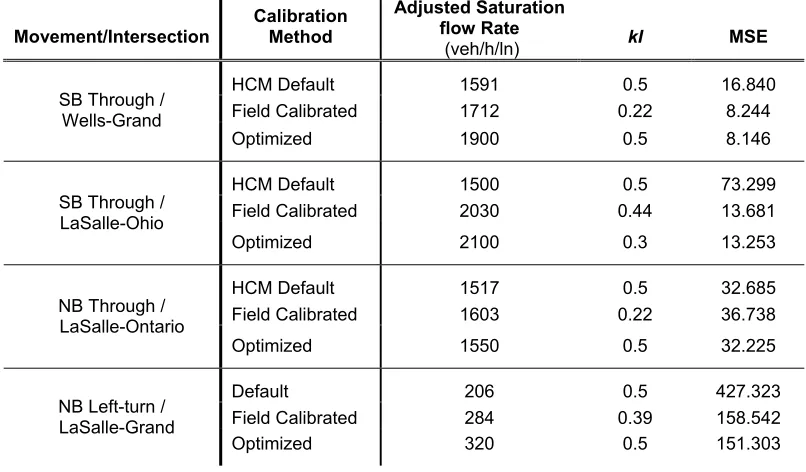
From Table 4.1, it can be seen that the saturation flow rate calculated using the HCM 2000 is
consistently the lowest when compared with the field calibrated and optimized values. For the
southbound through lane group at LaSalle-Ohio intersection, there is a significant difference
between the saturation flow rate calculated using the HCM equation with default values and that
obtained using field calibration or optimization. The calibrated and optimized saturation flow
rates even exceed the ideal saturation flow rate (1900 veh/h/ln) used in the HCM. However, for
northbound through lane group at Ontario-LaSalle intersection, the saturation flow rate estimated
using the three different methods are close, and the differences are less than 100 veh/h/ln.
38
calibrated values is quite close to that using the optimized values. However, in most cases, the MSEs are significantly high when the HCM default saturation flow rate and kI-value are used.
Only for the southbound through lane group at LaSalle-Ontario intersection, the control delay MSE based on the HCM default values is smaller than that based on field calibrated values. It is evident that the HCM control delay model may not accurately reflect the operation of studied lane groups when the HCM default values are used.
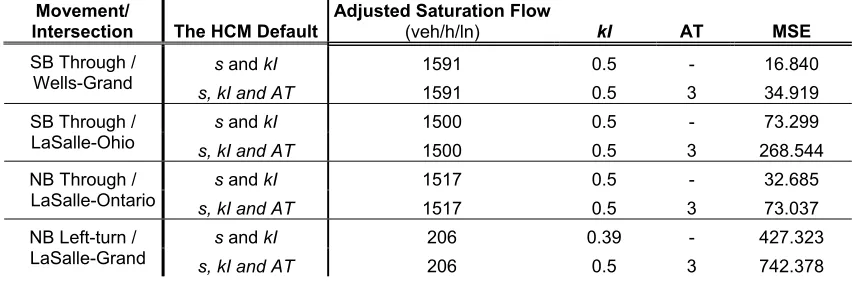
Usually, arrivals are assumed when estimating control delay using the HCM delay model, that is, Arrival Type 3 (AT3) is used. Table 4.2 shows the control delay MSE using the HCM default saturation flow rate and kI with/without default arrival type. For all studied lane groups, if the proportion of vehicles arriving on green is not considered cycle by cycle, the control delay MSE increases significantly. This indicates that the consideration of arrival type or proportion of vehicles arriving on green is necessary. The default arrival type may not appropriately reflect the real conditions of the studied lane groups. The analysis of the control delay using the HCM default saturation flow rate and kI-value for the individual lane groups in the following sections in this chapter is based on the incorporating cycle-by-cycle proportion of vehicles arriving on green.
The tuning parameters, saturation flow rate (s) and kI, may be not calibrated simultaneously. Table 4.3 shows the control delay MSEs with field calibrated saturation flow rate and/or kI. When only saturation flow rate is calibrated, the default value of kI = 0.5 is used, and when only