RECONSTRUCTING THE UNKNOWN LOCAL VOLATILITY FUNCTION
THOMAS F. COLEMAN∗, YUYING LI∗, AND ARUN VERMA∗
Abstract. Using market European option prices, a method for computing a smooth local volatility function in
a1-factor continuous diffusion model is proposed. Smoothness is introduced to facilitate accurate approximation of the local volatility function from a finite set of observation data. Assuming that the underlying indeed follows a1-factor model, it is emphasized that accurately approximating the local volatility function prescribing the1 -factor model is crucial in hedging even simple European options, and pricing exotic options. A spline functional approach is used: the local volatility function is represented by a spline whose values at chosen knots are de-termined by solving a constrained nonlinear optimization problem. The optimization formulation is amenable to various option evaluation methods; a partial differential equation implementation is discussed. Using a synthetic European call option example, we illustrate the capability of the proposed method in reconstructing the unknown local volatility function. Accuracy of pricing and hedging is also illustrated. Moreover, it is demonstrated that, using different implied volatilities for options with different strikes/maturities can produce erroneous hedge fac-tors if the underlying follows a1-factor model. In addition, real market European call option data on the S&P 500 stock index is used to compute the local volatility function; stability of the approach is demonstrated.
∗Computer Science Department and Cornell Theory Center, Cornell University, Ithaca, NY 14850. Research
partially supported by the Applied Mathematical Sciences Research Program (KC-04-02) of the Office of Energy Research of the U.S. Department of Energy under grant DE-FG02-90ER25013.A000 and NSF through grant DMS-9505155 and ONR through grant N00014-96-1-0050.
1. Introduction. An option pricing model establishes a relationship between the traded
derivatives, the underlying asset and the market variables, e.g., volatility of the underlying
asset [4, 25]. Option pricing models are used in practice to price derivative securities given
knowledge of the volatility and other market variables.
The celebrated constant-volatility Black-Scholes model [4, 25] is the most often used
option pricing model in financial practice. This classical model assumes constant volatility;
however, much recent evidence suggests that a constant volatility model is not adequate [27,
28]. Indeed, numerically inverting the Black-Scholes formula on real data sets supports the
notion of asymmetry with stock price (volatility skew), as well as dependence on time to
expiration (volatility term structure). Collectively this dependence is often referred to as the
volatility smile. The challenge is to accurately (and efficiently) model this volatility smile.
In practice, the constant-volatility Black-Scholes model is often applied by simply using
different volatility values for options with different strikes and maturities. In this paper, we
refer to this approach as the constant implied volatility approach. Although this method works
well for pricing European options, it is unsuitable for more complicated exotic options and
options with early exercise features. Moreover, as will be illustrated in §4, this approach
can produce incorrect hedge factors even for simple European options, assuming that the
underlying follows a1-factor model.
A few different approaches have been proposed for modeling the volatility smile. One
class of methods (Merton [26]) assumes a Poisson jump diffusion process for the
underly-ing asset. Stochastic volatility models (Hull and White [20]) have also been used. Das and
Sundaram [10] indicate that neither of these types of models sufficiently explains the implied
volatility structure.
Finally, there is the1-factor continuous diffusion approach: an underlying asset with the
initial valueSinitis assumed to satisfy:
dSt
St =µ(St, t)dt+σ
∗(S
t, t)dWt, t∈[0, τ], τ >0, (1)
where Wt is a standard Brownian motion, τ is a fixed trading horizon, and µ, σ∗: + ×
[0, τ] → are deterministic functions. The function σ∗(s, t) is called the local volatility function. The advantages of the1-factor continuous diffusion model, compared to the jump
or stochastic model, include that no non-traded source of risk such as the jump or stochastic
hedge options with the underlying asset, is maintained. Completeness is ultimately important
since it allows for arbitrage pricing and hedging [17].
There may be dispute regarding whether a1-factor model (1) is the best way to model an
underlying process. Our research will not shed light to this dispute. Instead, we demonstrate
the importance of accurately approximating the local volatility function in pricing and hedging
derivatives when the underlying follows a1-factor model (1).
In order to price complex exotic options using a1-factor diffusion model (1), the
volatil-ity functionσ∗(s, t)needs to be approximated. Volatility is the only variable in this1-factor
model which is not directly observable in the market. Similar to the implied volatility in the
constant volatility model, one possible idea is to imply this local volatility function from the
market option price data. Indeed, it is established [1, 17] that the local volatility function can
be uniquely determined from the European call options of all strikes and maturities, under
the no arbitrage assumption of the observable European call option prices. Unfortunately, the
market European option prices are typically limited to a relatively few different strikes and
maturities. Therefore the problem of determining the local volatility function can be regarded
as a function approximation problem from a finite data set with a nonlinear observation
func-tional. Due to insufficient market option price data, this is a well-known ill-posed problem.
Computational methods have been proposed to solve this ill-posed problem [1, 2, 5, 13,
14, 17, 22, 23, 27]. Most of these methods [1, 5, 13, 14, 17, 22, 27] overcome the ill-posedness
of the problem by assuming the existence of a complete spanning set of European call option
prices, which, in practice, requires use of extrapolation and interpolation of the available
market option prices [5, 13, 22, 27]. This can be problematic because potentially erroneous
non-market information are introduced into the data. Rubinstein proposes to compute the
implied probability without any exogenous assumption on the model for the local volatility
function [22, 27]. In [1] the local volatility is computed at each discretization nodal point
with a PDE approach. The methods [2, 23] use a regularization approach to the ill-posed local
volatility approximation problem. The closeness of the local volatility to a prior is used in [2]
and smoothness is used in [23].
The local volatility function approximation problem is ill-posed: there are typically an
infinite number of solutions to the problem. It is not difficult to find a local volatility function
σ(s, t) that matches the market option price data. However, for accurately pricing exotic
to reconstruct as accurately as possible the volatility functionσ∗(s, t)in the diffusion model
(1). Accurately approximating this volatility function is especially important for computing
hedge factors, even for simple European call/put options, see§4.
Smoothness of the function has long been used as a regularization criterion for function
approximation with a finite observation data [29, 30, 31]. Splines have known to possess good
approximation theoretical properties for a model both when the function is fixed and smooth
and when it is a sample function from a stochastic process [31]. However, approximating
the local volatility function from a finite set of option prices is more complex, compared to
a standard function approximation problem, since the (observation) option price functional is
nonlinear. Nevertheless, it is intuitive that smoothness regularization will play a similar role
here.
In [23] the lack of sufficient market option price data is overcome by regularizing with
smoothness of the local volatility function. The local volatility is computed at each
discretiza-tion point to match the given opdiscretiza-tion prices with an addidiscretiza-tional objective of minimizing the
change of the derivative∇σ(s, t). Unfortunately, this approach requires the solution of a very
large-scale nonlinear optimization problem: the dimension is equal to the total number of
discretization points. In addition, it requires determination of a regularization parameter.
In this paper, we propose a spline functional approach: a local volatility functionσ(s, t)
is explicitly represented by a spline with a fixed set of spline knots and end condition. The
volatilities at the spline knots uniquely determine a local volatility function. We choose the
number of spline knots to be no greater than the number of option prices and they are placed
with respect to the given data. The spline is determined by solving a constrained nonlinear
optimization problem to match the market option prices as closely as possible. The
dimen-sion of the optimization problem is typically small, depending on the number of option prices
available. The approximation properties of the spline allow an accurate and smooth
approxi-mation of the local volatility function prescribing the1-factor model in a region within which
the volatility values are significant for pricing available options.
We start with the motivation for our proposed inverse spline approximation formulation
for the local volatility in §2. Computational issues for solving the proposed optimization
problem are discussed in§3. Numerical examples illustrating the reconstructed local
volatil-ity surfaces from the European call option prices are described in§4. Using a European call
illus-trate the capability of the proposed method for accurately reconstructing the local volatility
function. A S&P 500 European index call option example with the real market data is also
used to illustrate the smoothness of the local volatility function and the stability of the
pro-posed approach. In§5, concluding remarks are given.
2. Local Volatility Function Approximation with Splines. Assume that the
underly-ing asset follows a continuous1-factor diffusion process with the initial valueSinit:
dSt
St =µ(St, t)dt+σ
∗(S
t, t)dWt, t∈[0, τ],
for some fixed time horizon [0, τ], Wt is a Brownian motion, and µ(s, t), σ∗(s, t): + ×
[0, τ] → are deterministic functions sufficiently well behaved to guarantee that (1) has a unique solution [24]. Note that in this notationσ∗(s, t) can be negative as well as positive.
(The conventional notion of positive volatility corresponds to σ∗(s, t)2in our notation.) For
simplicity, we assume that the instantaneous interest rate is a constantr >0and the dividend
rate is a constantq > 0(A general stochastic interest derivative pricing can be priced, e.g.,
[19]). Given Sinit, r andq, and under the no arbitrage assumption [25], an option with the
volatilityσ(s, t), strike priceK, and maturityT has a unique pricev(σ(s, t), K, T).
Assume that we are given m market option (bid,ask)-pairs, {(bidj,askj)}mj=1,
corre-sponding to strike prices/expiration times{(Kj, Tj)}mj=1. Let
vj(σ(s, t))def= v(σ(s, t), Kj, Tj), j = 1,· · ·, m.
We want to approximate, as accurately as possible, the local volatility function σ∗(s, t) :
+×[0, τ]→ from the requirement that
bidj ≤vj(σ(s, t))≤askj, j= 1,· · ·, m.
(2)
Since the observation data{(bidj,askj, Kj, Tj)}mj=1is finite and the restriction is on the
op-tion values{vj(σ(s, t))}mj=1, problem (2) can be considered an inverse function approximation
problem from a finite observation data. LetHdenote the space of measurable functions in the
region[0,+∞)×[0, τ]. The inverse function approximation problem (2) can be written as an
optimization problem:
min
σ(s,t)∈H
m
j=1
[bidj−vj(σ(s, t)))]++ m
j=1
[vj(σ(s, t))−askj)]+,
wherex+ def= max(x,0). This is a nonlinear piecewise differentiable optimization problem:
to overcome nondifferentiability in (3), one can alternatively solve a variational least squares
problem:
min
σ(s,t)∈H
m
j=1
(vj(σ(s, t))−¯vj)2,
(4)
where ¯vj def= bidj+2askj. Since the observation data is finite, problems (2,3,4) are severely
underdetermined: there are typically an infinite number of solutions. It is easy to find a
functionσ(s, t)that matches the market option price data [2, 5, 17, 13, 14, 22, 23, 27].
The local volatility reconstruction problem (2,3,4) is a complicated nonstandard function
approximation problem. The option price functionalv(σ(s, t), K, T)is nonlinear in the local
volatility functionσ(s, t). It is a nonlinear inverse function approximation problem.
In most of the proposed methods [1, 2, 5, 17, 13, 14, 22, 27] matching the market option
price data has been emphasized; it is often the only objective. However, a functionσ(s, t)
which matches the finite set of market option prices can be very different from the local
volatilityσ∗(s, t)which prescribes the1-factor model for the underlying, see§4 for an
exam-ple. Moreover, the price¯vjgenerally has error (for example when a bid-ask spread exists). In
addition, the option valuevj(σ(s, t))can only be computed numerically using a tree method or a PDE approach (there is no closed form solution for a general1-factor model (1)). Hence,
it may not be desirable to insist thatvj(σ(s, t))match exactly the observed market pricev¯j
forj= 1,· · ·, m. For pricing and hedging of exotic options, it is more important to compute
a local volatility functionσ(s, t)which is as close as possible to the local volatility function
σ∗(s, t). In other words, in addition to calibrating the market option price data sufficiently
ac-curately, we would like to reconstruct, as accurately as possible, the local volatility function
σ∗(s, t)of the diffusion model (1).
Smoothness has long been used [29, 30, 31] as a regularization condition for a function
approximation problem with a limited observation data. In addition, smoothness of the local
volatility function can be important in computational option valuation schemes. Convergence
of a PDE finite difference method, for example, depends on the smoothness of the function
σ(s, t).
local volatility function. The regularized optimization problem
min
σ(s,t)∈H
m
j=1
(vj(σ(s, t)))−v¯j)2+λ∇σ(s, t)2
(5)
is used in [23] whereλis a positive constant and · 2denotes theL2norm. The change of
the first order derivative is minimized depending on the regularization parameterλfor which
determining a suitable value may not be easy. In addition, computational implementation
of this method requires solving a large-scale discretized optimization problem: for a PDE
implementation, the dimension is N M whereN is the number of discretization points ins
andM is the number of discretization points int. A simple gradient descent algorithm is
used in [23]. Since the optimization problem is (5) highly nonlinear, with such a method, the
computed solution is typically inaccurate. To use a more sophisticated optimization algorithm,
the Jacobian matrix of the vector function(v1,· · ·, vm)needs to be evaluated but this becomes
extremely costly due to the large dimension of the discretized problem.
Splines have long been used in approximating smooth curves and surfaces (see, e.g.,
[16]). They have also been used as a tool for regularizing ill-posedness of function
approx-imations from finite observation data [31]. In a typical 1-dimensional spline interpolation
setting, assuming valuesfi, i = 1,· · ·, m, of the dependent variablef(x)corresponding to values xi, i = 1,· · ·, m, are given, a spline is chosen to fit the data(fi, xi), i = 1,· · ·, m.
Given the number of knotspand their locations, the freedom of the spline is the coefficient of
each spline segment. The cubic spline has long been used by craftsman and engineers as the
mechanic spline. It is the smoothest twice continuously differentiable function that matches
the observations; the minimizer of
min
f(x)∈S
b
a (f
(x))2dx, subject to f(x
i) =fi, i= 1,· · ·, m,
is a natural cubic spline, whereS is the Sobolev space of functions whose first order
deriva-tives are continuously differentiable and the second order derivaderiva-tives are square integrable
(assumingm ≥ 2). For mechanical splines, this corresponds to minimize the elastic strain
energy. For2-dimensional surface fitting, the bicubic spline defined on a regular grid is twice
continuously differentiable [3, 16]. The bicubic spline has a similar variational minimization
property. Advantages of spline interpolation include its fast convergence on many types of
meshes, computational efficiency, and insensitivity to roundoff errors [3].
Approximating the local volatility function by a spline is particularly reasonable if the
function? Assume that the underlying follows the 1-factor diffusion process (1). Let there
be given observable arbitrage-free market European call pricesv(K, T)for all strikesK ∈
[0,∞)and all maturitiesT ∈ (0, τ]. From Proposition 1 in [1], the local volatility function
σ∗(s, t)of the diffusion process (1) that is consistent with the market is given uniquely by
(σ∗(K, T))2= 2 ∂v
∂T +qv(K, T) +K(r−q)∂K∂v K2∂2v
∂K2
.
(6)
This formula suggests that, assumingv(K, T)is sufficiently smooth (note that ∂K∂2v2 and ∂T∂v
already exist) and ∂K∂2v2 = 0,(σ∗(K, T))2is sufficiently smooth in the region(0,∞)×(0, τ] as well.
In this paper, we use a2-dimensional spline functional to directly approximate a local
volatility function1. Let the number of spline knotsp ≤ m. We choose a set of fixed spline
knots {(¯sj,¯tj)}pj=1 in the region[0,∞)×[0, τ]. Given{(¯si,¯ti)}pi=1 spline knots with
cor-responding local volatility valuesσ¯i def= σ(¯si,¯ti), an interpolating cubic splinec(s, t)with a
fixed end condition (in our computation the natural spline end condition is used) is uniquely
defined by settingc(¯si,¯ti) = ¯σi, i = 1,· · ·, p. We then determine the local volatility values
¯
σi(hence the spline) by calibrating the market observable option prices. The freedom in this problem is represented by the volatility values {¯σi} at the given knots{(¯si,¯ti)}. Ifσ¯ is a
p-vector,σ¯ = (¯σ1,· · ·,¯σp)T, then we denote the corresponding interpolating spline with the
specified end condition asc(s, t; ¯σ).
Let
vj(c(s, t; ¯σ))def= v(c(s, t; ¯σ), Kj, Tj), j = 1,· · ·, m.
To allow the possibility of incorporating additional a priori information,landuare lower and
upper bounds that can be imposed on the local volatilities at the knots. Thus, we define the
in-verse spline local volatility approximation problem: Givenpspline knots,(¯s1,¯t1)· · ·,(¯sp,¯tp),
solve for thep-vectorσ¯
min
¯
σ∈p f(¯σ)
def= 1
2
m
j=1
wj[vj(c(s, t; ¯σ))−¯vj]2
subject to l≤σ¯ ≤u,
(7)
where positive constants{wj}mj=1are weights, allowing account to be taken of different
ac-curacies ofv¯j or computedvj. The determination of an approximation in thel1 orl∞norm
instead may be a valuable alternative although the problem becomes even more difficult to
solve computationally. Note also that the formulation (7) is quite general: European call/put
or even more complicated option prices can be used to compute the spline approximation to
the local volatility functionσ∗(s, t).
The inverse spline local volatility problem (7) is a minimization problem with respect to
the local volatilityσ¯ at the spline knots. The computed volatility function has some
depen-dence on the number of knotspand the location of the knots{(¯si,¯ti)}pi=1. The choice of the
number of knots and their placement in spline approximation is generally a complicated issue
[16, 31]. The situation here is not typical for spline approximation due to the fact that the
dependent option price function is not the function to be approximated. Rather, it depends
on the values of the unknown volatility function in the region R+ ×[0, τ]. Moreover, the
dependence on the unknown volatility values is not uniform in the regionR+×[0, τ]. The
option premium depends little on the volatility values with smalltandsfar fromSinit. It is
convenient to view this as follows [1]: there exists a region centered aroundSinitwithin which
the volatility values are significant in pricing and hedging: we denote this region asDj for the optionvj, see Fig. 1 for illustration of its typical shape. We can at most expect to approximate
well the local volatilities in the regionD def= ∪mj=1Djfrom the market option data. In our ex-periments, we often choose the number of knots equal to the number of observations. In order
to construct and evaluate a spline efficiently, the spline knots can be placed in a rectangular
mesh covering the regionDand bicubic spline interpolation [3] can be used.
Significant Insignificant
Time t S
init
j T
Kj
FIG. 1. The Local Volatility in the Shaded RegionDjIs Significant in Pricing and Hedging
If the number of spline knots are chosen to be no more than the number of observation
data points, the degrees of freedom, compared to that of a (discretized) formulation of (3),
is significantly decreased (several orders of magnitude). In addition to gaining smoothness
of the local volatility function, formulation (7) significantly decreases the computational cost
the optimization problem.
It is not appropriate to choosepmuch larger thanmsince (7) may become
underdeter-mined. If one decides to use more spline knots, additional regularization, e.g.,
min
¯
σ∈p f(¯σ)
def= 1
2
m
j=1
wj[vj(c(s, t; ¯σ))−v¯j]2+λη(c(s, t; ¯σ))
subject to l≤σ¯≤u,
(8)
is more appropriate: hereλ >0is a regularization parameter andη(σ(s, t;σ))is a smoothing
norm for the tensor product splines [15]. (A referee has pointed out that this has recently been
considered in [21].)
In this paper, we focus on the formulation (7) and assumep is not greater thanm. In
order to solve the inverse local volatility problem (7), an optimization method will be needed
to evaluate the values of optionsvj(c(s, t; ¯σ)) for any splinec(s, t; ¯σ); the derivatives may
also be computed. We discuss this next.
3. The Computational Procedure. Our proposal is to approximate the local volatility
surface,σ∗(s, t), with a cubic splinec(s, t; ¯σ)by solving (7) for the vectorσ¯ = (¯σ1,· · ·,¯σp)T.
Problem (7), whenp≤m, is defined once thepknots(¯s1,¯t1),· · ·,(¯sp,¯tp)have been chosen
appropriately. To express (7) more succinctly, define a vector-valued functionF :p → m
where componentjofF is given byw
1 2
j[vj(c(s, t; ¯σ))−¯vj], forj= 1,· · ·, m. Therefore (7) can be rewritten:
min
¯
σ∈p f(¯σ)
def= 1
2F(¯σ)22
subject to l≤¯σ≤u.
(9)
Problem (9) is a box-constrained nonlinear least-squares problem inσ¯; there are a
vari-ety of optimization methods available to enable its solution. In our implementation we use
a trust region/interior point method [6, 7], in which a sequence of strictly feasible points
are generated: {σ¯(k)} ∈ int{F}, where F = {σ¯ ∈ p : l ≤ σ¯ ≤ u}. Moreover,
the sequence corresponds to a monotonically decreasing sequence of function values, i.e.,
f(k+1) < f(k), k= 1,· · ·,∞, wheref(k) =f(¯σ(k)). Under mild assumptions this approach
guarantees convergence, i.e.,σ¯(k)→σ¯∗, whereσ¯∗is a local minimizer for problem (9). The Jacobian of F with respect toσ¯ is required: J(¯σ) def= ∇F(¯σ). Note thatJ is an
approximateJ, e.g., [12], which can significantly reduce the cost. Under reasonable
assump-tions a superlinear rate of convergence can be achieved. We note that there are optimization
approaches that do not require the calculation (or approximation) of the Jacobian matrixJ;
however, they typically converge very slowly - we have not investigated those methods in this
work.
In this paper we explore two possibilities in the framework of our optimization approach:
1. Use of automatic differentiation [8] and/or finite-differencing to compute J(k) def= J(¯σ(k));
2. Use of a secant update to approximateJ(k)whenp=m.
3.1. The Problem Structure. The evaluation of f(¯σ)requires the evaluation of each component ofF, i.e.,w12
j[vj(c(s, t); ¯σ)−¯vj], forj= 1,· · ·, m. These are generalized Black-Scholes computations. There are several ways to approach this – we choose, as an example,
to use a standard PDE-discretization technique.
GivenSinit, r,q, and σ(s, t), letV(s, t)denote the option value of an underlying asset
with strike priceKand expiry dateT at(s, t),t∈[0, T]. Under the no arbitrage assumption,
the option value satisfies the following generalized Black-Scholes equation [25]
∂V
∂t + (r−q)s ∂V
∂s + 1
2σ(s, t)2s2 ∂2V
∂s2 =rV.
(10)
The boundary conditions for the European call option are :
lim
s→+∞
∂V(s, t) ∂s =e
−q(T−t), t∈[0, T],
V(0, t) = 0, t∈[0, T],
V(s, T) = max(s−K,0).
We use a Crank-Nicholson finite difference solution strategy for solving (10), based on
discretization on a uniform grid. Given a2-dimensional grid the numerical solution of (10) is
standard and discussed in several texts. Zvan et al [32] have a good discussion of complexity
issues. It is possible to increase efficiency by employing a number of computing techniques
such as vectorization and pipelining – description of these implementation aspects goes
be-yond the scope of this paper.
3.2. Computing the Jacobian and the gradient. The Jacobian matrixJ(¯σ)satisfies
J(¯σ) = ∂v ∂c ×
where ∂v∂c is anm-by-M N matrix, ∂∂cσ¯ is anM N-by-pmatrix.
It is useful to note that matrixC def= ∂∂cσ¯ is constant and therefore needs to be computed
just once for the entire problem (given a fixed discretization and spline knot placement). The
product ∂v∂c ×C can be computed directly using automatic differentiation (forward mode)
or approximately using finite differences (differencingv along the columns ofC). In either
case the work involved is O(p·ω(F))where ω(F)is the work (flops) required to evaluate
F. (In the finite-differencing case this is a tight bound whereas this bound can be undercut
considerably if automatic differentiation is used [18].)
The gradient off, with respect toσ¯, is simplyJTF. Therefore if the functionF and its JacobianJ have been computed as described above the gradient is given by a matrix-vector
multiplication.
If the secant method is used in the square case, i.e.,p =m, then the gradient is
approx-imated byA×F whereAis the secant approximation to the Jacobian. The Jacobian is not
computed (except, possibly, for secant method restarts) with this approach.
4. Computational Examples. We now describe some computational experience with
our proposed method for reconstructing the local volatility function σ∗(s, t) from limited
observation data. We illustrate how European call options can be used to approximate the
local volatility function.
We have implemented the proposed method in Matlab using a trust region
optimiza-tion algorithm with a PDE approach for funcoptimiza-tion and Jacobian evaluaoptimiza-tion. Without precise
knowledge of accuracy of the market data, the weights in the inverse spline local volatility
approximation problem (7) are simply set to unity: wj def= 1, j = 1,· · ·, m.The generalized
Black-Scholes PDE (10) is solved with a Crank-Nicolson finite difference method. Given any
¯
σ, the bicubic splinec(s, t; ¯σ)with the variational end condition (the second order derivative
at the end is zero) is computed and evaluated using the functions in the Matlab spline toolbox
[11]. We use a simple discretization scheme: a uniformly spaced mesh with N ×M grid
points in the region[0,2Sinit]×[0, τ]whereτ is the maximum maturity in the market option
data:
si=i2NS−init1, i= 0,· · ·, N−1,
tj =jMτ−1, j= 0,· · ·, M −1.
(11)
For simplicity, we have chosen the spline knots to be on a uniform rectangular mesh
Given a European option, we do not have an explicit knowledge of the region D. In our
ex-periments, we have used[γ1Sinit, γ2Sinit]×[0, τ]as an estimate ofDwithγ1 ∈ [.6, .8]and
γ2 ∈ [1.4,1.6]depending on the magnitude ofSinit. The number of spline knotsptypically
equals the number of observationm. In the event that the option prices are calibrated to high
precision, we have experimented withp < m.
4.1. Reconstructing Local Volatility, Pricing and Hedging. In order to demonstrate
the effectiveness of the proposed method in reconstructing the local volatility surface and its
accuracy in pricing and hedging, we consider a synthetic European call option example used
in [23]. In this example, the underlying is assumed to follow an absolute diffusion process:
dSt
St =µ(St, t)dt+σ
∗(S
t, t)dWt,
(12)
where the local volatility functionσ∗(s, t)is a function of the underlying only,
σ∗(s, t) = α s,
withα = 15, andWtrepresenting a standard Brownian motion. We use the same parameter setting as in [1]: Let the initial stock index beSinit = 100, the risk free interest rater= 0.05
and the dividend rateq= 0.02.
We consider, as market option data,22European call options on the underlying following
the absolute diffusion process (12). Eleven options have half year maturity with strike prices
[90 : 2 : 110]and another eleven options have one year maturity with the same strikes. Thus
the option strike and maturity vectors are given below
K = [90; 92;· · ·; 110; 90; 92;· · ·; 110]∈ 22,
T = [0.5; 0.5;· · ·; 0.5; 1; 1;· · ·; 1]∈ 22.
For the absolute diffusion process (12), the analytic formula for pricing European options
exists [9] and we set the market European option call price¯vjequal to this analytic value. The discretization parameters in (11) are set asM = 101andN = 51.
For this example the lower and upper bounds for the local volatility at the knotσ¯i are
li =−1andui = 1respectively (though no variable is at the bound at the computed solution
in this case). First, we letp =mand place the spline knots on the grid[0 : 20 : 200]×[0,1].
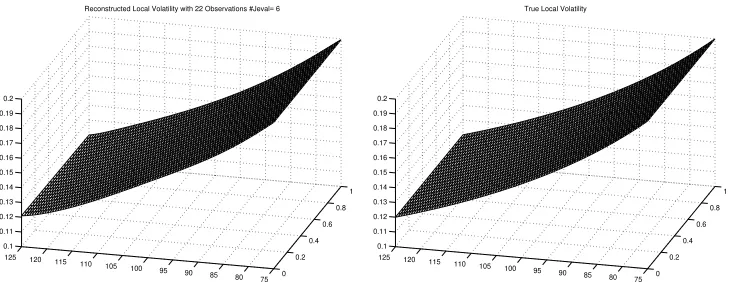
0
Reconstructed Local Volatility with 22 Observations #Jeval= 6
0
FIG. 2. The Reconstructed and True Local Volatility
optimization problem is relatively easy to solve. The optimization method requires7iterations
(6Jacobian evaluations) and the computed optimal objective function valuef(¯σ∗)is10−6.
Fig. 2 demonstrates the accuracy of this local volatility reconstruction: the reconstructed
spline surfacec(s, t; ¯σ∗)very accurately approximates the actual volatility surfaceσ∗(s, t)in
the neighborhood of the region[75,125]×[0,1]. To better observe accuracy of reconstruction,
the three plots on the left in Fig. 3 display the local volatility curves fort= 0,0.58andt= 1
respectively. Since the calibration error is very small and the reconstructed volatility surface
is nearly linear, we experimented with choosing the number of spline knots less thanm. The
three plots on the right of Fig. 3 display the local volatility curves reconstructed with eight
spline knots placed on the mesh[.4Sinit:.4Sinit: 1.6Sinit]×[0,1]. We observe that the local
volatility reconstruction remains excellent, with a slightly larger deviation whentis small and
sis far fromSinit.
To illustrate the accuracy of pricing using the reconstructed local volatilityc(s, t; ¯σ∗)
rather than the true local volatilityσ∗(s, t), we compare prices and hedge factors of a number
of European call options using both the true local volatility and the reconstructed volatility
surfaces. The hedge factors vega (sensitivity to the change in the volatility), delta (sensitivity
to the change in the underlying), gamma (sensitivity of delta to the change in the underlying
), rho (sensitivity to change in the interest rate) and theta (sensitivity to change in the
matu-rity) are computed using a finite difference approximation. A constant shift in both volatility
surfaces is used to calculate the vega hedge factor. For European call options with strikes and
maturities over the grid[85 : 5 : 110]×[.4 :.1 :.7], the results are shown in Table 1. These
re-75 80 85 90 95 100 105 110 115 120 125
Local Volatility Curves at t = 0.00
Index
Local Volatility Curves at t = 0.00
Exact Vol.
Local Volatility Curves at t = 0.58
Exact Vol.
Local Volatility Curves at t = 0.58
Local Volatility
Local Volatility Curves at t = 1.00
Exact Vol.
Local Volatility Curves at t = 1.00
Index
Local Volatility
Exact Vol. Reconstructed Vol.
max relative error average relative error
Price 7.8e−3 2.1e−3 Vega 9.8e−3 6.1e−3 Delta 4.8e−2 1.3e−2 Gamma 9.5e−2 5.9e−2 Rho 4.5e−3 2.0e−3 Theta 6.9e−3 2.2e−3
TABLE1
Accuracy of Pricing and Hedging
constructed volatility surfacec(s, t; ¯σ∗). Note that the PDE option evaluation with the chosen
discretization can generate errors of at least these magnitudes.
We emphasize that the formulation (7) is appropriate when the number of spline knotsp
is not greater than the number of observationsm. Ifpis much larger thanm, then formulation
(7) can become severely underdetermined. To illustrate the potential pitfalls of allowing too
much freedom in approximatingσ∗(s, t), we simulate the more realistic market situation when
there is a bid-ask spread in the given option prices by setting
¯
vj =exact price of optionj+.02rand
where rand is a Matlab generated random number. We compare the local volatility
reconstruc-tions using the spline knots on the rectangular meshes[.4Sinit:.4Sinit:1.6Sinit]×[0,1](p= 8)
and[0:.01Sinit:2Sinit]×[0,1](p= 202< M N). The plots on the left in Fig. 4 illustrate the
reconstructed local volatility curves using the rectangular mesh[.4Sinit:.4Sinit:1.6Sinit]×[0,1]
for knots. The plots on the right in Fig. 4 illustrate the reconstructed local volatility curves
using the rectangular mesh[0:2:2Sinit]×[0,1]for knots. Although the available option prices
are matched with very high accuracy (error about10−6) usingp = 202, the computed local
volatility surface does not resemble the true local volatility surfaceσ∗(s, t). Using eight knots
on the rectangular mesh[.4Sinit:.4Sinit: 1.6Sinit]×[0,1], on the other hand, yields a much
more accurate volatility surface, even though the calibration error of the available options is
larger (about10−4).
Next we illustrate that, assuming the underlying follows a continuous1-factor model (1),
a constant implied volatility approach can produce erroneous hedge factors even though the
option prices may be computed accurately. We use the same absolute diffusion model (12)
75 80 85 90 95 100 105 110 115 120 125
Local Volatility Curves at t = 0.00
Exact Vol. Local Volatility Curves at t = 0.0
Local Volatility
Local Volatility Curves at t = 0.58
Index
Local Volatility Curves at t = 0.58
Index
Local Volatility Curves at t = 1.00
Index
Local Volatility Curves at t = 1.00
Exact Vol. Reconstructed Vol.
underlying Sinit = 100 and the risk free interest rate r = 0.05 are used but the dividend
rate q is set to zero. We consider European call options with strikes and maturities at the
grid [80 : 4 : 120]×[.25, .5,1]. The spline knots are at the grid[0 : 20 : 2Sinit]×[0, .5,1].
Fig. 5 displays the price and hedge factors of options with maturity.25year using the true
local volatility, reconstructed volatility, and constant implied volatility. From these plots, we
see that the price and all the hedge factors computed using the reconstructed local volatility
function are fairly accurate approximation to the true values. Using the constant implied
volatility method, however, large errors exist in hedge factors (mostly noticeably in theta,
delta, gamma and vega).
In addition to choosing the number of spline knotsp, the placement of the knots requires
some care as well. The spline knots should be placed to cover the region Dwithin which
the values of the local volatility are significant in the option values. We have used the
uni-form spacing in the interval [0,2Sinit]and[.4Sinit,1.6Sinit]in this synthetic example but an
alternative is to place them nonuniformly with a more refined placement around s = Sinit.
Moreover, one need to avoid placing spline knots too closely together since this can lead to ill
conditioning of the Jacobian matrix∇F.
4.2. A S&P 500 Example Illustrating Smoothness and Stability. We consider now a
more realistic example of approximating the local volatility functionσ∗(s, t)from the
Euro-pean S&P 500 index EuroEuro-pean call options. We use the same EuroEuro-pean option data of October
1995 given in [1]. The market option price data (in the implied Black-Scholes constant
volatil-ity) is given in Table 2. Similar to [1], we use only the options with no more than two years
maturity in our computation. The initial index, interest rate and dividend rate are set as in [1],
Sinit =$590, r = 0.06, and q = 0.0262.
The discretization parameters in (11) are set as,
N = 101, and M = 101.
In order to solve the proposed inverse spline volatility problem (7), we compute the
mar-ket European call option prices with given strikes and maturities using the constant
volatil-ity Black-Scholes formula with the corresponding implied volatilvolatil-ity. The Matlab function
blsprice is used.
For this example the number of spline knotspequals the number of observationsmand
Maturity (in years) Strike (% of spot)
85% 90% 95% 100% 105% 110% 115% 120% 130% 140%
.175 .190 .168 .133 .113 .102 .097 .120 .142 .169 .200
.425 .177 .155 .138 .125 .109 .103 .100 .114 .130 .150
.695 .172 .157 .144 .133 .118 .104 .100 .101 .108 .124
.94 .171 .159 .149 .137 .127 .113 .106 .103 .100 .110
1 .171 .159 .150 .138 .128 .115 .107 .103 .099 .108
1.5 .169 .160 .151 .142 .133 .124 .119 .113 .107 .102
2 .169 .161 .153 .145 .137 .130 .126 .119 .115 .111
3 .168 .161 .155 .149 .143 .137 .133 .128 .124 .123
4 .168 .162 .157 .152 .148 .143 .139 .135 .130 .128
5 .168 .164 .159 .154 .151 .148 .144 .140 .136 .132
TABLE2
Implied Volatilities for S&P 500 Index Options
all the call option prices with maturity T ≤ 2in Table 2, the reconstructed local volatility
surface is given in Fig. 6. This optimization problem seems to be more nonlinear and difficult
to solve. After28iterations, the average error ofvj(c(s, t; ¯σ))−¯vj using the reconstructed local volatility is0.0076. The average error using the constant implied volatility via the PDE
implementation with this discretization, compared to the Black-Scholes analytic formula, is
0.0510.
The reconstructed local volatility surfaces can be slightly different if different spline knots
are chosen. In order to show that the local volatility surface reconstruction, pricing and
hedg-ing are relatively robust, we consider the second spline knots placement ushedg-ing the rectangular
meshK×[0 :.33 : 2]. The average price calibrating error for the market call options in this
case is.0027. The reconstructed volatility surface using this knot placement is shown in Fig.
7. Comparing Fig. 6 with Fig. 7, the reconstructed volatility surfaces are quite similar in
the region D, noting the shape ofD. For options with strikes and maturities over the grid
[.85 :.1 : 1.15]Sinit×[.85 :.1 : 1.15], the relative difference of pricing and hedging factor
with the two spline knot placements are shown in Table 3. We observe that indeed they are
acceptably close.
For pricing simple European call/put options, different implied volatilities are often used
in practice to price options of different strikes/maturities in order to accommodate volatility
smile. For pricing an exotic option such as a knock-out option, a constant volatility model
max rel. diff. avg. rel. diff.
Price 6.8e−3 1.4e−3 Vega 1.3e−2 2.7e−3 Delta 4.3e−2 1.6e−2 Gamma 8.8e−2 4.1e−2 Rho 5.3e−3 2.0e−3 Theta 4.9e−2 9.2e−3
TABLE3
Differences Between Using Two Rectangular Meshes for Knots
max rel. diff. avg. rel. diff.
Price 11% 6%
Vega 15% 9%
Delta 19% 11%
Gamma 27% 17%
Rho 12% 7%
Theta 29% 16%
TABLE4
Relative Difference in Pricing and Hedging Using Constant Volatility
maturities. In order to illustrate the potential error in using a constant volatility in pricing
exotic options, we examine here the price and hedge factors differences between using a
constant volatility model and the1-factor model with the reconstructed volatility function. We
use the same S&P 500 index option example and choose the the arithmetic average (which is
0.1319) of the implied volatilities withT ≤2as the constant volatility. We compare the prices
at a grid[.85:.1:1.15]Sinit×[.85:.1:1.15]of strike prices and maturity dates (different from
given market data). The results are in Table 4. These two methods give significantly different
prices: we notice as much as 11% relative difference. Similarly all the hedge factors computed
using the constant volatility have a large relative difference, we document the results in Table
4. To visualize the difference in detail, we plot the price and hedge factor curves for options
with1-year maturity in Fig.8.
4.3. Incorporate Additional Information. Using market option data to imply the
lo-cal volatility function in a diffusion model is a look-ahead technique. Frequently, historilo-cal
data has been used to estimate a constant volatility. The latter is a look-back technique. An
Tol Finite Difference quasi-Newton Update
Iterations Time Iterations Time J evals
1e−2 7 321.29 11 131.85 3 1e−3 10 401.43 18 193.91 4 1e−4 19 651.89 28 286.78 5 1e−5 25 795.45 36 332.13 6
TABLE5
Quasi Newton Results
approximation to the local volatility function.
In the proposed spline volatility formulation (7), there are two potential ways that a priori
information can be incorporated. The first is to use the simple bounds to limit the range of the
local volatilities at knots. The second possibility is to specify fixed local volatilities at some
chosen knots.
We have experimented with setting tighter bounds on the volatilityσ¯ for the S&P 500
index European call option example. We observe that, as long as the bounds are not too small
(l ≤ −.3, , u ≥ .3in the S&P 500 example), they can influence volatility values of small t
andsfar fromSinit but do not have much impact in the regionDwithin which the volatility
function is significant in market option prices. However, setting bounds too tight can impede
calibrating the market option prices. Therefore, unless one has reliable knowledge on the
bounds of the volatilities, they should be sufficiently large to ensure that the calibrating error
is sufficiently small. Similar remarks can be made if one wishes to set the volatilities at certain
knots to some fixed values.
Finally, we would like to illustrate the potential computational saving by using the
quasi-Newton updates. In Table 5 we present Matlab computational results using the finite
dif-ference and quasi-Newton update for Jacibian for the S&P 500 index option example with
different termination tolerances for optimization. We observe significant total speedup using
a quasi-Newton approach. The quasi-Newton approach takes more iterations to converge but
requires fewer Jacobian evaluations.
5. Concluding Remarks. Assuming that the underlying asset of options follows a
con-tinuous1-factor diffusion model, we propose a method of accurately approximating the local
volatility function σ∗(s, t) using a finite set of option prices. We emphasize that accurate
options (including simple European options) and pricing exotic options. Moreover, since the
market option data typically has bid-ask spreads, exact calibration of the option data (the
average of the bid-ask spreads) is not necessary and can be harmful.
Based on the formula (6) established in [1, 17], the local volatility functionσ∗(K, T)2
is smooth if the European call option value functionv(K, T)is sufficiently smooth. We use
a spline functional approach to reconstruct this local volatility function. After choosing the
number of spline knots and their placement, we represent a local volatility functionσ(s, t)by
an interpolating spline with a fixed end condition. The volatility values at knots are determined
by solving a small nonlinear optimization problem subject to simple bounds. The number of
variables in the optimization (7) is no greater than the number of option observations.
We solve the proposed inverse spline approximation optimization problem using a trust
region method, with the function and Jacobian evaluated using a PDE approach.
Computa-tional efficiency through structure exploitation within the framework of finite difference and
automatic differentiation is discussed.
We consider two European call options examples illustrating the capability of the
pro-posed method. In the first example, we consider synthetic European call options for which the
underlying follows a known absolute diffusion model. Option observation data is simulated
by evaluating a set of European call options using the analytic formula. The reconstructed
local volatility is compared to the true local volatility, indicating a fairly accurate
reconstruc-tion in the region within which the local volatility values are significant for opreconstruc-tion evaluareconstruc-tions.
With the same example, we illustrate that the constant implied volatility approach can produce
erroneous hedge factors, compared to that from the1-factor model, even for simple European
options. Moreover, when the observable option prices have bid-ask spreads, calibrating
mar-ket data exactly by using too many spline knots can lead to poor reconstruction of the true local
volatility function. In the second example, S&P 500 index European call options with market
option data of October 1995 are considered. We illustrate the smoothness of the reconstructed
local volatility and stability of the proposed method in pricing and hedging.
We have demonstrated the potential of the proposed spline volatility approach in
discov-ering, from a finite set of option prices, the local volatility function in the1-factor process
fol-lowed by the underlying. We plan to further investigate automatic techniques for the optimal
selection of the number of knotsp≤mand their placement. The importance of the proposed
be explored.
6. Acknowledgement. We would like to thank Yohan Kim for carefully reading the
manuscript and his useful comments. We also thank Bob Jarrow for his encouragement.
REFERENCES
[1] L. ANDERSEN ANDR. BROTHERTON-RATCLIFFE, The equity option volatility smile: an implicit
finite-difference approach, The Journal of Computational Finance, 1 (1998), pp. 5–32.
[2] M. AVELLANEDA, C. FRIEDMAN, R. HOLEMES,ANDD. SAMPERI, Calibrating volatility surfaces via
relative entropy minimization, Applied Mathematical Finance, 4 (1997), pp. 37–64.
[3] G. BIRKHOFF ANDC. R. DEBOOR, Piecewise polynomial interpolation and approximation, in Approxi-mation of Functions, H. L. Garabedian, ed., Elsevier (New York), 1965, pp. 164–190.
[4] F. BLACK ANDM. SCHOLES, The pricing of options and corporate liabilities, Journal of Political Econ-omy, 81 (1973), pp. 637–659.
[5] I. BOUCHOUEV ANDV. ISAKOV, The inverse problem of option pricing, Inverse Problems, 13 (1997), pp. L11–L17.
[6] M. A. BRANCH, T. F. COLEMAN,ANDY. LI, A subspace, interior and conjugate gradient method for
large-scale bound-constrained minimization, Tech. Report TR95-1525, Computer Science Department,
Cornell University, 1995.
[7] T. F. COLEMAN AND Y. LI, An interior, trust region approach for nonlinear minimization subject to
bounds, SIAM Journal on Optimization, 6 (1996), pp. 418–445.
[8] T. F. COLEMAN ANDA. VERMA, Structure and efficient Jacobian calculation, in Computational Differen-tiation: Techniques, Applications, and Tools, M. Berz, C. Bischof, G. Corliss, and A. Griewank, eds., SIAM, Philadelphia, Penn., 1996, pp. 149–159.
[9] J. C. COX ANDS. A. ROSS, The valuation of options for alternative stochastic processes, Journal of Financial Economics, 3 (1976), pp. 145–166.
[10] S. R. DAS ANDR. K. SUNDARAM, Of smiles and smirks: A term-structure perspective, Tech. Report NBER working paper No. 5976, Department of Finace, Harvard Business School, Harvard University, Boston, MA 02163, 1997.
[11] C.DEBOOR, Spline Toolbox for use with MATLAB, The Math Works Inc., 1997.
[12] J. E. DENNIS ANDR. B. SCHNABEL, Numerical Methods for Unconstrained Optimization, Prentice-Hall, 1983.
[13] E. DERMAN ANDI. KANI, Riding on a smile, Risk, 7 (1994), pp. 32–39.
[14] , The local volatility surface: Unlocking the information in index option prices, Financial Analysts Journal, (1996), pp. 25–36.
[15] P. DIERCKX, An algorithm forsurface fitting with spline functions, IMA Journal of Numerical Analysis, 1 (1981), pp. 267–283.
[18] A. GRIEWANK, Some bounds on the complexity of gradients, Jacobians, and Hessians, in Complexity in Nonlinear Optimization, P. Pardalos, ed., World Scientific Publishers, 1993, pp. 128–161.
[19] D. HEATH, R. JARROW,ANDA. MORTON, Bond pricing and the term structure of interest rates: A new
methodology for contingent claims valuation, Econometrica, 60 (1992), pp. 77–105.
[20] J. HULL ANDA. WHITE, The pricing of options on assets with stochastic volatilities, Journal of Finance, 3 (1987), pp. 281–300.
[21] N. JACKSON, E. S ¨ULI,ANDS. HOWISON, Computation of deterministic volatility surfaces, Tech. Report No. 98/01, Oxford University Computing Laboratory, 1998.
[22] J. JACKWERTH ANDM. RUBINSTEIN, Recovering probability distributions from option prices, The Journal of Finance, 51 (1996), pp. 1611–1631.
[23] R. LAGNADO ANDS. OSHER, Reconciling differences, Risk, 10 (1997), pp. 79–83.
[24] D. LAMBERTON ANDB. LAPEYRE, Introduction to Stochastic Calculus Applied to Finance, Chapman & Hall, 1996.
[25] R. MERTON, The theory of rational option pricing, Bell Journal of Economics and Management Science, 4 (1973), pp. 141–183.
[26] , Option pricing when underlying stock returns are discontinuous, Journal of Financial Economics, 3 (1976), pp. 124–144.
[27] M. RUBINSTEIN, Implied binomial trees, The Journal of Finance, 49 (1994), pp. 771–818. [28] D. SHIMKO, Bounds of probability, Risk, (1993), pp. 33–37.
[29] A. N. TIKHONOV ANDV. Y. ARSENIN, Solutions of Ill-posed Problems, W. H. Winston, Washington, D.C., 1977.
[30] V. N. VAPNIK, Estimation of Dependences Based on Empirical Data, Springer-Verlag, Berlin, 1982. [31] G. WAHBA, Splines Models for Observational Data, Series in Applied Mathematics, Vol. 56, SIAM,
Philadelphia, 1990.
80 90 100 110 120 130 140 150
0
0.5
1
1.5
2
550 600
650 0
0.1 0.2 0.3 0.4 0.5 0.6 0.7 0.8
stock index Reconstructed Volatility in the Subregion
time in years
local volatility
FIG. 6. Spline Knot Placement Is the Rectangular Mesh[.8Sinit:.066Sinit: 1.4Sinit]×[0 : 0.33 : 2]
0
0.5
1
1.5
2 500
550 600
650 700 0
0.1 0.2 0.3 0.4 0.5 0.6 0.7 0.8
stock index Reconstructed Volatility in the Subregion
time in years
local volatility
5000 550 600 650 700 750 800
500 550 600 650 700 750 800
−40
500 550 600 650 700 750 800
0
500 550 600 650 700 750 800
0
500 550 600 650 700 750 800
0