Forest-guided Supertagger Training
Yao-zhong Zhang† Takuya Matsuzaki†
†Department of Computer Science, University of Tokyo ‡School of Computer Science, University of Manchester
§National Centre for Text Mining
{yaozhong.zhang, matuzaki, tsujii}@is.s.u-tokyo.ac.jp
Jun’ichi Tsujii†‡§
Abstract
Supertagging is an important technique for deep syntactic analysis. A super-tagger is usually trained independently of the parser using a sequence labeling method. This presents an inconsistent training objective between the supertagger and the parser. In this paper, we pro-pose a forest-guided supertagger training method to alleviate this problem by incor-porating global grammar constraints into the supertagging process using a
CFG-filter. It also provides an approach to make the supertagger and the parser more tightly integrated. The experiment shows that using the forest-guided trained super-tagger, the parser got an absolute 0.68% improvement from baseline in F-score for predicate-argument relation recogni-tion accuracy and achieved a competi-tive result of 89.31% with a faster pars-ing speed, compared to a state-of-the-art HPSG parser.
1 Introduction
Deep syntactic analysis by lexicalized grammar parsing, which provides linguistic-rich informa-tion for many NLP tasks, has recently received more and more attention from the NLP commu-nity. To use a deep parser in real large-scale ap-plications, speed is an important issue to take into consideration. Supertagging is one of the speed-up technique widely used for lexicalized grammar parsing. A supertagger is used to limit the number of plausible lexical entries fed to the parser, this can greatly reduce the search space for the parser.
Supertagging was first proposed for Lexicalized Tree Adjoining Grammar (LTAG) (Bangalore and Joshi, 1999), and then successfully applied to Combinatory Categorial Grammar (CCG) (Clark, 2002) and Head-driven Phrase Structure Gram-mar (HPSG) (Ninomiya et al., 2006). In addi-tion, supertags can also be used for other NLP tasks besides parsing, such as semantic role label-ing (Chen and Rambow, 2003) and machine trans-lation (Birch et al., 2007; Hassan et al., 2007) to utilize syntactic information in the supertags.
In lexicalized grammar parsing, supertagging is usually treated as a sequence labeling task inde-pendently trained from the parser. Previous re-search (Clark, 2002) showed that even a point-wise classifier not considering context edge fea-tures is effective when used as a supertagger. To make up for the insufficient accuracy as a single-tagger, more than one supertag prediction is re-served and the parser takes the burden of resolving the rest of the supertag ambiguities.
In this paper, we propose an on-line forest-guided training method for a supertagger to make the training objective of a supertagger more closely related to the parsing task. We implemented this method on a large-scale HPSG grammar. We used a CFG grammar to approximate the original HPSG grammar in the supertagging stage and ap-plied best-first search to select grammar-satisfying supertag sequences for the parameter updating. The experiments showed that the HPSG parser is improved by considering structure constraints in the supertagging training process. For the stan-dard test set (Penn Treebank Section 23), we ac-complished an absolute 0.68% improvement from baseline in F-score for predicate-argument rela-tion recognirela-tion and got a competitive result of 89.31% with a faster parsing speed, compared to a state-of-the-art HPSG parser.
The remainder of the paper is organized as follows: in section 2 we provide the necessary background regarding HPSG parsing. In section 3, we introduce the on-line forest-guided super-tagger training method. Section 4 shows the ex-periment results and the related analysis. Section 5 compares the proposed approach with related work and section 6 presents our conclusions and future work.
2 Background
2.1 Statistical HPSG Parsing
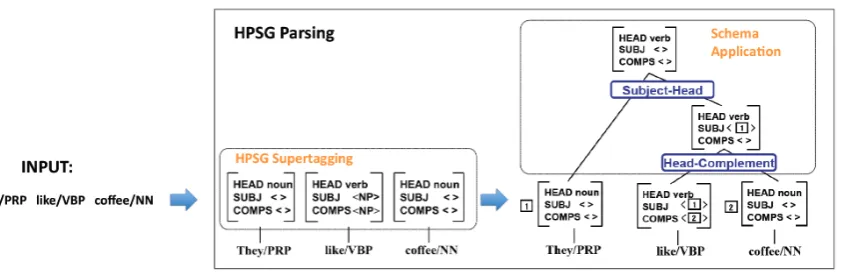
HPSG (Pollard and Sag, 1994) is a lexicalist grammar framework. In HPSG, a large number of lexical entries are used to express word-specific characteristics, while only a small number of rule schemata are used to describe general construc-tion rules. Typed feature structures named “signs” are used to represent both lexical entries and phrasal constituents. A classic efficient statisti-cal HPSG parsing process is depicted in Figure 1. Given a word and part-of-speech sequence(w, p) as input, the first step (called “supertagging”) in HPSG parsing is to assign possible lexical entries. In practice, for each word, more than one super-tag is reserved for the parser. Then, the parser searches the given lexical entry space to construct a HPSG tree using the rule schemata to com-bine possible signs. Constituent-based methods
and transition-based methods can be used for tree structure disambiguation. This parsing framework using supertagging is also used in other lexical-ized grammars, such as LTAG and CCG.
2.2 HPSG Supertagging
Like other lexicalized grammar, the lexical en-tries defined in HPSG are referred to as “super-tags”. For example, the word “like” is assigned a lexical entry for transitive verbs in non-3rd per-son present form, which indicates that the head syntactic category of “like” is verb and it has an NP subject and an NP complement. With such fine-grained grammatical type distinctions, the number of supertags is very large. Compared to the 45 part-of-speech (POS) tags defined in the PennTreebank, the HPSG grammar we used con-tains 2,308 supertags. The large number and the complexity of the supertags makes supertagging harder than the POS tagging task.
Supertagging can be formulated as a sequence labeling task. Here, we follow the definition of Collins’ perceptron (Collins, 2002). The train-ing objective of supertaggtrain-ing is to learn the map-ping from a POS-tagged word sentence w = (w1/p1, ..., wn/pn) to a sequence of supertags s = (s1, ..., sn). We use function GEN(w) to indicate all candidates of supertag sequences given input w. Feature function Φmaps a sam-ple(w,s)to a point in the feature spaceRd. θis the vector of feature weights. Given an inputw, the most plausible supertag sequence is found by the prediction function defined as follows:
F(w) = argmax
s∈GEN(w)
θ·Φ(w,s) (1)
2.3 CFG-filtering
Figure 1: HPSG parsing for the sentence “They like coffee.”
some features (e.g., the number agreement fea-ture) are ignored in the approximating CFG so that the set of possible signs can be approximated by a finite set of non-terminal symbols in the CFG. By this construction, some illegal trees may be included in the set of trees licensed by the ap-proximating CFG, but none of the well-formed trees (i.e., those satisfying all constraints in the grammar) are excluded by the approximation. We use the algorithm described by Kiefer and Krieger (2000) to obtain the approximating CFG for the original HPSG. The technical details regarding the algorithm can be found in Kiefer and Krieger (2000).
3 Forest-guided Training for Supertagging
3.1 Motivation
In lexicalized grammar parsing, a parser aims to
find the most plausible syntactic structure for a given sentence based on the supertagging results. One efficient parsing approach is to use predic-tion scores provided by the supertagger. Usu-ally, the supertagger is trained separately from the structure disambiguation in a later stage. This pipeline parsing strategy poses a potential prob-lem in that the training objective of a supertagger can deviate from the final parser, if the global grammar constraints are not considered. For ex-ample, the supertag predictions for some words can contribute to high supertagging accuracy, but cause the parser to fail. Therefore, considering the global grammar constraints in the supertagging training stage can make the supertagger and the
Algorithm 1: Forest-guided supertagger training Input:Training Sample(wi, si)i=1,...,N,
Number of iterations T 1:θ←(0, ...,0),θsum←(0, ...,0) 2:foriterN um←1to Tdo 3: fori←1 to Ndo
4: Generate supertag lattice using the point-wise classifier with currentθ
5: Selectsˆifrom the lattice whichcan construct a tree with largest sequence score
6: if( Nosˆisatisfied grammar constraints) ˆ
si ←arg maxs∈GEN(wi)θi·Φ(wi, si) 7: ifsˆi"=sithen
8: θi+1 ←θi+ Φ(wi, si)−Φ(wi,sˆi) 9: θsum←θsum+θi+1
Return:θsum/N T
parser more tightly related, which will contribute towards the performance of the parser.
3.2 Training Algorithm
Based on the motivation above, we propose a forest-guided supertagger training method to make the supertagger more tightly integrated with the parser. This method is based on the averaged perceptron training algorithm. The training pro-cess is given in Algorithm 1.
constraints are satisfied, we judge it by whether a possible syntactic tree can be constructed using the given supertag sequence. We do not require the constructed syntactic tree to be identical to the gold tree in the corpus. For this reason we call it “forest-guided”.
In the forest-guided training of the supertagger, an approximating CFG is used to filter out the supertag sequences from which no well-formed tree can be built. It is implemented as a best-first CFG parser wherein the score of a constituent is the score of the supertag (sub-)sequence on the fringe of the constituent, which is calculated us-ing the current value of the parameters. Note that the best-first parser canfind the best-scored super-tag sequence very efficiently given proper scoring for the candidate supertag set for each token; this is actually the case in the course of training except for the initial phase of the training, wherein the pa-rameter values are not well-tuned. The efficiency is due to the sparseness of the approximating CFG (i.e., the production rule set includes only a tiny fraction of the possible parent-children combina-tions of symbols) and highest-scored supertags of-ten have a well-formed tree on top of them.
As is clear from the above description, the use of CFG-filter in the forest-guided training of the supertagger is not essential but is only a subsidiary technique to make the training faster. The im-provement by the forest-guided training should however depend on whether the CFG approxi-mation is reasonably tight or not. Actually, we managed to obtain a manageable size out of a CFG grammar, which includes 80 thousand non-terminal symbols and 10 million rules, by elimi-nating only a small number of features (semantics, case and number agreement, andfine distinctions in nouns, adjectives and complementizers). We thus believe that the approximation is fairly tight.
This training algorithm can also be explained in a search-based learning framework (Hal Daum´e III and Daniel Marcu, 2005). In this framework, the objective of learning is to optimize the θ for the enqueue function to make the good hypothe-ses rank high in the search queue. The rank score r consists of two components: path score g and heuristic score h. In the forest-guided training
method,rcan be rewritten as follows:
r=g+h
=θ·Φ(x,yˆ) + [T ree(ˆy)]∗P enalty (2)
The heuristic parthchecks whether the super-tag candidate sequence satisfies the grammar con-straints: if no CFG tree can be constructed, -∞ penalty is imposed to the candidate sequence in the forest-guided training method.
4 Experiments
We mainly evaluated the proposed forest-guided supertagger training method on HPSG parsing. Supertagging accuracy1 using different training methods was also investigated.
4.1 Corpus Description
The HPSG grammar used in the experiments is Enju version 2.32. It is semi-automatically con-verted from the WSJ portion of PennTreebank (Miyao, 2006). The grammar consists of 2,308 supertags in total. Sections 02-21 were used to train different supertagging models and the HPSG parser. Section 22 and section 23 were used as the development set and the test set respectively. We evaluated the HPSG parser performance by la-beled precision (LP) and lala-beled recall (LR) of predicate-argument relations of the parser’s out-put as in previous works (Miyao, 2005). All ex-periments were conducted on an AMD Opteron 2.4GHz server.
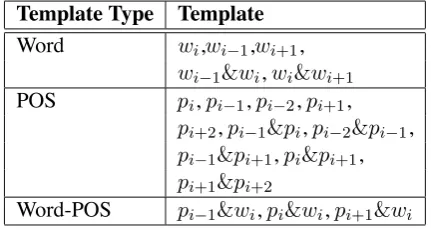
Template Type Template Word wi,wi−1,wi+1,
wi−1&wi,wi&wi+1 POS pi,pi−1,pi−2,pi+1,
pi+2,pi−1&pi,pi−2&pi−1,
pi−1&pi+1,pi&pi+1,
pi+1&pi+2
Word-POS pi−1&wi,pi&wi,pi+1&wi
Table 1: Feature templates used for supertagging models.
1“UNK” supertags are ignored in evaluation as in
previ-ous works.
4.2 Baseline Models and Settings
We used a point-wise averaged perceptron (PW) to train a baseline supertagger. Point-wise
classi-fiers have been reported to be very effective and with competitive results for the supertagging task (Clark, 2002; Zhang et al., 2009). The number of training iterations was set to 5. The features used in the supertaggers are described in Table 1. For comparison, these features are identical to the fea-tures used in the previous works (Matsuzaki et al., 2007; Ninomiya et al., 2007). To make the train-ing efficient, we set the default chart size limit for the forest-guided supertagger training to be 20k by tuning it on the development set.
We combined the supertagger trained under forest-guidance with a supertagging-based HPSG parser (Matsuzaki et al., 2007) and evaluated the contribution of the improved supertagger train-ing procedure for the final HPSG parsing by the accuracy of the predicate-argument relations out-put of the parser. The parser crucially depends on the supertagger’s performance in that it out-puts the first well-formed tree successfully con-structed on the highest scored supertag sequence. The highest-scored supertag sequences are enu-merated one by one in descending order in re-gards to their score. The enumeration is actu-ally implemented as n-best parsing on the super-tag candidates using an approximating CFG. The HPSG tree construction on a supertag sequence is done using a shift-reduce style parsing algorithm equipped with a classifier-based action selection mechanism.
The automatically assigned POS tags were given by a maximum entropy tagger with roughly 97% accuracy.
4.3 Supertagging Results
Although we mainly focused on improving thefi -nal HPSG parsing performance through the im-proved supertagger training, it is also very inter-esting to investigate the supertagger performance using different training methods. To evaluate the forest-guided training method for a supertagger, we also need to incorporate structure constraints in the test stage. To make fair comparisons, for the averaged perceptron trained supertagger we also add structure constraints in its testing.
Model Name Acc%
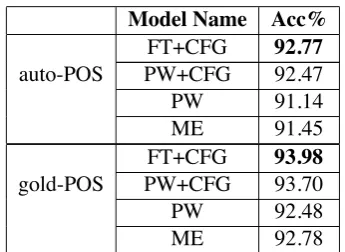
Table 2: Supertagging results in section 23. “FT” represents the forest-guided trained supertagger. “PW” is the baseline average perceptron trained supertagger. “ME” is the supertagger trained by using the maximum entropy method. “+CFG” in-dicates the use of the CFG-filter for the super-tagger results. The accuracy of automatically as-signed POS tags in this section is 97.39%.
For simplicity, throughout this paper, we call the forest-guided trained supertagger “FT” in short, while the “PW” is used to represent the base-line point-wise averaged perceptron supertagger. “ME” is the re-implemented maximum entropy supertagger described in Matsuzaki et al. (2007).
For the PW supertagger, the performance was roughly 0.3% below the ME supertagger. Simi-lar results were reported by Zhang et al. (2009), which used a Bayes point machine to reduce the gap between the averaged perceptron supertagger and the maximum entropy supertagger. Although we expected the ME supertagger using CFG-filter to give better results than the PW supertagger, im-plementing forest-guided supertagger training in a maximum entropy framework is different and more sophisticated than the current on-line train-ing method. Considertrain-ing that the performance of the PW supertagger and the ME supertagger were at a similar level, we chose the PW supertagger as our baseline.
!!!!!!!
!!!!!!!!!!
Training Method
Iter NUM
1 2 3 4 5 Total Time
FT 6684s 4189s 3524s 3285s 3086s ≈5.8h
PW 99s 116s 117s 117s 117s ≈10 min
ME / ≈3h
Table 3: Supertagger training time on section 02-21. “FT” and “PW” represent forest-guided training and point-wise averaged perceptron training separately. “ME” is the point-wise maximum entropy training reported in Matsuzaki et al. (2007).
the training and the testing stage. The super-tagging accuracy for different models is shown in Table 2. Firstly, incorporating grammar con-straints only in the testing phase (PW+CFG) gave an absolute 1.22% (gold POS) and 1.33% (auto POS) increase in F-score compared to the PW supertagger. Secondly, incorporating grammar constraints into both the training and the testing stage (FT+CFG) gave an additional 0.28% (gold POS) and 0.3% (auto POS) improvement over the PW+CFG supertagger with p-values 0.0018 (gold POS) and 0.0016 (auto POS).
This also indicates that the supertagger and the parser are closely related to each other. The orig-inal motivation for supertagging is using simple models to resolve lexical ambiguities, which can efficiently reduce the search space of the parser. A better supertagger can contribute to more
ef-ficient and more accurate lexicalized grammar parsing. Actually, a supertagger can act as a coarse parser for the whole parsing process as well, as long as the coarse parser is efficient. Since supertag disambiguation is highly constrained by the grammar, incorporating grammar constraints into supertagging (including training and testing) by using the CFG-filter can further improve the supertagging performance, as shown in Table 2.
As for the supertagger training time, incorpo-rating grammar constraints inevitably increases the training time. As shown in Table 3, the to-tal training time of forest-guided training (default settings, with chart size limited to 20k) was about 5.8 hours. For each iteration of the FT model, wefind that the training time gradually decreases with each successive iteration. This hints that we can do better model initialization to further reduce the training time.
4.4 HPSG Parsing Results
We evaluated the HPSG parsers using different supertagger training methods. For the baseline HPSG parser, a CFG-filter is already incorporated to accelerate the parsing process. In the follow-ing experiments, we fed the parser all the possi-ble supertag candidates with the prediction scores generated by the supertaggers. We controlled the upper bound of the chart size in the CFG-filter to make the parser more efficient.
Table 4 shows the results of the different pars-ing models. We first compared the baseline parsers using different supertaggers. The forest-guided supertagger improved thefinal FT parser’s F-score by 0.68% (statistically significant) over the PW parser using the PW supertagger, which did not consider global grammar constraints dur-ing the supertagger traindur-ing process. The parsdur-ing time of the FT parser was very close to that of the PW parser (108s vs. 106s), which was also
ef-ficient. The result empirically reflects that incor-porating the global grammar constraints into the supertagger training process can refine supertag predicting scores, which become more consistent and compatible with the parser.
per-Parser UP UR LP LR F-score Time†
FT Parser 92.28 92.14 89.38 89.23 89.31 108s
PW Parser 91.88 91.63 88.75 88.51 88.63 106s
Enju 2.3 92.26 92.21 88.89 88.84 88.86 775s
Table 4: Parser performance on Section 23. “FT Parser” represents baseline parser which uses forest-guided trained supertagger. “PW Parser” represents the baseline parser which uses the point-wise av-eraged perceptron trained supertagger. (†) The time is the total time of both supertagging and parsing and it was calculated on all 2291 sentences of the Section 23.
85 85.5 86 86.5 87 87.5 88 88.5 89
0.5k1k 1.5k2k 2.5k3k 3.5k4k 10k 15k 20k
HPSG Parsing F-score
Chart size limit in the parsing
Parser using the PW supertagger Parser using the 10k-train FT supertagger Parser using the 20k-train FT supertagger
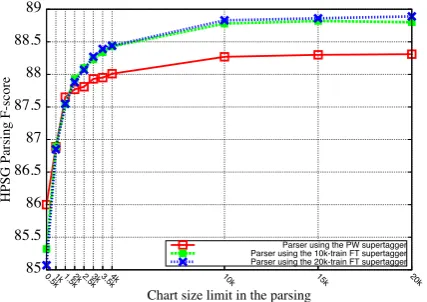
Figure 2: The F-score of the HPSG parsers on sec-tion 22 using different settings for the chart size limit in supertagger training and parsing.
formed 0.45% better than the Enju parser (default settings) in F-score. In addition, our shift-reduce style parser was faster than the Enju parser.
Beam size plays an important role for the forest-guided supertagger training method, since a larger beam size reduces the possibility of search errors. Precisely speaking, we control the beam size by limiting the number of edges in the chart in both the forest-guided supertagger training pro-cess and thefinal parsing. Figure 2 shows the re-sults of setting different limits for the chart size during supertagger training and parsing on the de-velopment set. The X-axis represents the chart size limitation for the parsing. “10k-train” rep-resents the chart size to be limited to 10k dur-ing FT supertagger traindur-ing phase. A similar representation is used for “20k-train”. There is no tree structure search process for the baseline PW supertagger. We evaluated the F-score of the parsers using different supertaggers. As shown in Figure 2, when the chart size of the parser was
more than 10k, the benefit of using forest-guided supertaggers were obvious (around an absolute 0.5% improvement in F-score, compared to the parser using the baseline PW supertagger). The performance of the parser using “10k-train” FT supertagger was already approaching to that of the parser using “20k-train” FT supertagger. When the chart size of the parser was less than 2000, the forest-guided supertaggers were not work. Simi-lar to the results showed in previous research (Hal Daum´e III and Daniel Marcu, 2005), it is better to use the same chart size limit in the forest-guided supertagger training and thefinal parsing.
5 Related Work
The existing work most similar to ours is Boullier (2003). He presented a non-statistical parsing-based supertagger for LTAG. Similar to his method, we used a CFG to approximate the original lexicalized grammar. The main difference between these two methods is that we consider the grammar constraints in the training phase of the supertagger, not only in the supertagging test phase and our main objective is to improve the performance of thefinal parser.
6 Conclusions and Future Work
In this paper, based on the observation that su-pertaggers are commonly trained separately from lexicalized parsers without global grammar con-straints, we proposed a forest-guided supertagger training method to integrate supertagging more tightly with deep parsing. We applied this method to HPSG parsing and made further significant im-provement for both supertagging (0.28%) and the HPSG parsing (0.68%) compared to the baseline. The improved parser also achieved a competitive result (89.31%) with a faster parsing speed, com-pared to a state-of-the-art HPSG parser.
For future work, we will try to weight the for-est trees for the supertagger training and extend this method to other lexicalized grammars, such as LTAG and CCG.
Acknowledgments
We are grateful to the anonymous reviewers for their valuable comments. We also thank Goran Topic and Pontus Stenetorp for their help proof-reading this paper. The first author was sup-ported by The University of Tokyo Fellowship (UT-Fellowship). This work was partially sup-ported by Grant-in-Aid for Specially Promoted Research (MEXT, Japan).
References
Bangalore, Srinivas and Aravind K. Joshi. 1999. Supertagging: An approach to almost parsing.
Computational Linguistics, 25:237–265.
Birch, Alexandra, Miles Osborne, and Philipp Koehn. 2007. CCG supertags in factored statistical machine translation. InProceedings of the Second Workshop on Statistical Machine Translation, pages 9–16.
Boullier, P. 2003. Supertagging: A non-statistical parsing-based approach. In In Proceedings IWPT-2003, volume 3, pages 55–65.
Chen, John and Owen Rambow. 2003. Use of deep linguistic features for the recognition and labeling of semantic arguments. InProceedings of EMNLP-2003, pages 41–48.
Clark, Stephen and James R. Curran. 2004. The importance of supertagging for wide-coverage ccg parsing. InProceedings of COLING-04, pages 282– 288.
Clark, S. and J.R. Curran. 2007. Perceptron train-ing for a wide-coverage lexicalized-grammar parser.
InProceedings of the Workshop on Deep Linguistic
Processing, pages 9–16.
Clark, Stephen. 2002. Supertagging for combinatory categorial grammar. InProceedings of the 6th In-ternational Workshop on Tree Adjoining Grammars
and Related Frameworks (TAG+ 6), pages 19–24.
Collins, M. 2002. Discriminative training meth-ods for hidden markov models: Theory and exper-iments with perceptron algorithms. InProceedings
of EMNLP-2002, pages 1–8.
Hal Daum´e III and Daniel Marcu. 2005. Learning as search optimization: Approximate large margin methods for structured prediction. InInternational
Conference on Machine Learning (ICML), pages
169–176.
Hassan, Hany, Mary Hearne, and Andy Way. 2007. Supertagged phrase-based statistical machine trans-lation. In Proceedings of ACL-2007, pages 288– 295.
Kiefer, Bernd and Hans-Ulrich Krieger. 2000. A context-free approximation of head-driven phrase structure grammar. InProceedings of IWPT-2000, pages 135–146.
Matsuzaki, Takuya, Yusuke Miyao, and Jun’ichi Tsu-jii. 2007. Efficient HPSG Parsing with Super-tagging and CFG-filtering. In Proceedings of
IJCAI-07, pages 1671–1676.
Miyao, Yusuke. 2005. Probabilistic disambiguation models for wide-coverage HPSG parsing. In Pro-ceedings of the 43rd Annual Meeting on Association for Computational Linguistics, pages 83–90.
Miyao, Yusuke. 2006.From Linguistic Theory to Syn-tactic Analysis: Corpus-Oriented Grammar
Devel-opment and Feature Forest Model. Ph.D.
Ninomiya, Takashi, Yoshimasa Tsuruoka, Takuya Matsuzaki, and Yusuke Miyao. 2006. Extremely lexicalized models for accurate and fast HPSG pars-ing. InProceedings of EMNLP-2006, pages 155– 163.
Ninomiya, T., T. Matsuzaki, Y. Miyao, and J. Tsujii. 2007. A log-linear model with an n-gram reference distribution for accurate HPSG parsing.In Proceed-ings of IWPT-2007, pages 60–68.
Pollard, Carl and Ivan A. Sag. 1994. Head-driven
Phrase Structure Grammar. University of Chicago
/ CSLI.
Prins, R. and G. Van Noord. 2001. Unsupervised Pos-Tagging Improves Parsing Accuracy And Pars-ing Efficiency. InProceedings of IWPT-2001, pages 154–165.