Adding Syntactic Annotations to Flickr30k Entities Corpus for Multimodal
Ambiguous Prepositional-Phrase Attachment Resolution
Sebastien Delecraz, Alexis Nasr, Frederic Bechet, Benoit Favre
Aix-Marseille Univ, Universit´e de Toulon, CNRS, LIS163 avenue de Luminy - Case 901 F-13288 Marseille - Cedex 9 - FRANCE
{firstname.lastname}@univ-amu.fr
Abstract
We propose in this paper to add to the captions of the Flickr30k Entitiescorpus some syntactic annotations in order to study the joint processing of image and language features for the Preposition-Phrase attachment disambiguation task. The annotation has been performed on the English version of the captions and automatically projected on their French and German translations.
Keywords:PP-attachments, Multimodal Corpus, Multilingual Corpus
1.
Introduction
Joint processing of image and text is a very active area of research. It is studied mostly in the context of natural lan-guage generation, for example for generating a textual de-scription of a video or an image. Recently open-domain language generation from images or videos received a lot of attention through the use of multimodal deep neural net-works (Vinyals et al., 2015). Theses models build a unified representation for both image and language features and generate in an end-to-end process a text directly from an image, without an explicit representation (syntactic or se-mantic) of the text generated.
In this paper we propose to study joint image and language processing for language parsing rather than generation. The main idea of this study is to check if the use of visual fea-tures extracted from an image can be useful in order to dis-ambiguate the linguistic analysis of a caption that describes the same image. To do so we propose a new framework for testing multimodal approaches on the specific task of am-biguous Prepositional-Phrase attachment (PP-attachment) resolution.
[image:1.595.315.530.291.521.2]PP-attachments are known to be an important source of er-rors in parsing natural language. The main reason being that, in many cases, correct attachments cannot be predicted accurately based on pure syntactic considerations: their prediction ask for precise lexical co-occurrences. Such in-formation is usually not found in treebanks that are lim-ited in their size and therefore do not model many bi-lexical phenomena. Besides, disambiguation may ask for non lin-guistic knowledge which is not present in treebanks. In this paper, we propose to create a corpus for support-ing PP-attachment disambiguation research by combinsupport-ing textual and visual information. The contribution of this study is the selection and the manual annotation of a corpus of ambiguous PP-attachments from the multimodal corpus Flickr30k Entities(Plummer et al., 2017). A full parse of the sentences containing a hand-corrected PP-attachment, which is compatible with the manual attachment is also produced. In addition, we use MT alignments to transfer the annotations to French and German translations from the Multi30k corpus (Elliott et al., 2016; Elliott et al., 2017).
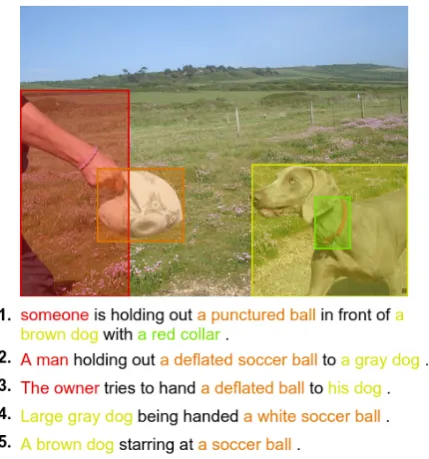
Figure 1: Example of theF30kEannotations. The image is described with five captions, each annotated with entities. Entities that corefer with a visual element in the image are linked to the corresponding bounding box.
Finally, for every preposition manually attached, a set of possible attachment alternatives for use in a reranking sys-tem is produced.
Preposition Occ. % Noun % Verb Dist.
in 4191 0.59 0.41 2.21
with 3018 0.59 0.41 2.47
for 1777 0.36 0.64 1.57
near 1452 0.65 0.35 1.69
through 1420 0.05 0.95 2.01
on 1359 0.26 0.74 2.03
next to 1342 0.08 0.92 3.23
from 1172 0.30 0.70 2.43
into 1123 0.08 0.92 2.32
over 941 0.39 0.61 2.38
by 890 0.10 0.90 2.60
at 720 0.20 0.80 2.75
of 700 0.97 0.03 1.03
around 589 0.18 0.82 2.26
in front of 570 0.11 0.89 3.72
under 544 0.18 0.82 3.29
behind 544 0.35 0.65 1.78
along 500 0.37 0.63 1.79
during 423 0.14 0.86 5.08
across 415 0.11 0.89 2.21
down 393 0.66 0.34 2.53
against 365 0.39 0.61 1.56
outside 356 0.38 0.62 2.28
towards 276 0.08 0.92 2.41
out of 252 0.13 0.87 2.08
beside 245 0.03 0.97 3.51
above 241 0.43 0.57 2.90
in the middle of 240 0.12 0.88 3.63
onto 210 0.08 0.92 2.34
outside of 206 0.12 0.88 3.30
inside 197 0.13 0.87 3.72
between 189 0.72 0.28 1.29
past 170 0.19 0.81 2.95
toward 167 0.34 0.66 1.53
on top of 166 0.14 0.86 2.93
like 159 0.34 0.66 1.32
among 142 0.37 0.63 2.13
after 126 0.10 0.90 3.12
away from 109 0.04 0.96 1.75
off 104 0.31 0.69 3.72
up 96 0.82 0.18 1.93
up to 86 0.12 0.88 2.35
before 71 0.10 0.90 4.14
atop 60 0.23 0.77 2.97
about 54 0.59 0.41 1.52
along with 54 0.15 0.85 4.98
underneath 49 0.18 0.82 3.16
without 46 0.54 0.46 2.98
out 42 0.29 0.71 4.43
at the top of 40 0.10 0.90 2.23
inside of 39 0.23 0.77 3.72
amongst 33 0.09 0.91 3.18
close to 33 0.15 0.85 4.42
upon 31 0.13 0.87 1.71
amidst 28 0.29 0.71 3.18
beneath 26 0.12 0.88 3.54
within 24 0.33 0.67 3.62
below 23 0.52 0.48 1.83
at the bottom of 22 0.18 0.82 2.86
Preposition Occ. % Noun % Verb Dist.
amid 22 0.18 0.82 5.00
in between 18 0.22 0.78 2.89
up against 16 0.06 0.94 3.69
ahead of 14 0.00 1.00 1.71
together with 13 0.08 0.92 2.54
such as 13 0.38 0.62 5.31
besides 12 0.42 0.58 2.33
beyond 10 0.70 0.30 3.30
on the top of 10 0.10 0.90 2.70
while 10 0.20 0.80 6.40
near to 10 0.10 0.90 4.10
[image:2.595.56.285.71.779.2]Total 29068 0.36 0.64 2.37
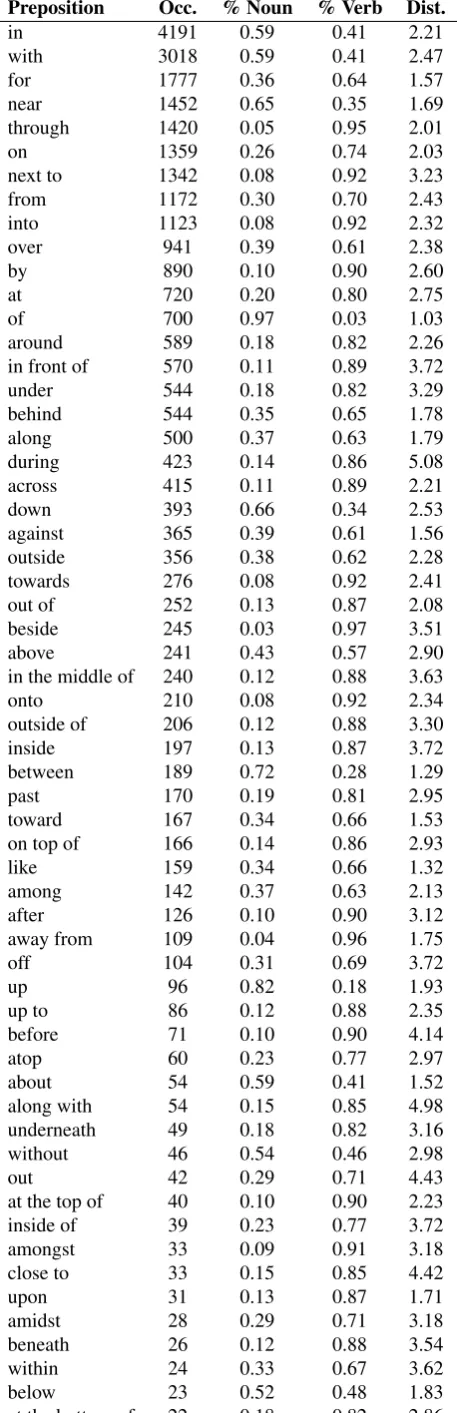
Table 1: Prepositions annotated with their occurrence num-ber in the corpus and statistics about their attachment.
Bounding boxes and the mentions in the captions have been paired together via coreference links. A total of244Ksuch links have been annotated.
Furthermore, each mention in the captions has been cate-gorized into eight coarse-grained conceptual types. These types are: people, body parts, animals, clothing, instru-ments, vehicles, scene, and other. One example of the cor-pus has been reproduced in Figure 1.
Captions in theF30kEcorpus are annotated at the concep-tual level, but no syntactic annotation is provided. Since our goal in this study is to evaluate several sets of multimodal features for the PP-attachment task, we needed to add such a level of annotation to the corpus.
We did not have the resources for manually annotating the whole F30kE caption corpus with syntactic annotations. Therefore we limited our effort to the manual annotation of PP-attachments in ambiguous contexts.
In order to select ambiguous PP-attachments we applied the following process: first the captions of F30kE were pro-cessed by a Part-Of-Speech tagger (Nasr et al., 2011); then a set of regular expressions on the POS labels were defined in order to select sentences that contain a preposition that can be attachment to more than one word; finally, the am-biguous prepositions have been manually attached to their correct syntactic governor.
Captions containing ambiguous PP-attachment have been identified using two simple rules: a preposition is consid-ered ambiguous if it is preceded by at least two nouns or a verb and a noun, in other word, the captions must match one of the following regular expressions:
• X* N X* N X* p X*
• X* V X* N X* p X*
Table 1 presents an overview of some statistics on the cor-pus. For each preposition, ordered by occurrence, we give the rate of attachment to a noun and a verb and the aver-age distance between the preposition and its governor. For readability, we did not display the25prepositions with less than10occurrences but the total counts are computed on the whole corpus. 64%of the prepositions occurrences are attach to a verb and the average distance between the prepo-sition and its governor is2.37words. The ten more frequent prepositions represent61.22%of the annotated corpus. For preposition with a highest average distance (> 3 words) that represent25prepositions (i.e. 4497attachments), the governor is a verb in74%of cases.
3.
A Multimodal Corpus for Syntactic Parse
Reranking
The annotation process described in the previous section only provides links between a preposition and its governor. We added syntactic annotations to the corpus in order to propose a task of multimodal reranking of syntactic parsing hypotheses on theF30kEcorpus.
The first step in this process was to parse all the captions manually annotated with PP-attachment with a transition-based dependency parser. The parser allows to set some dependencies, prior to parsing, and generate the most likely parse including these dependencies. In our case all the PP-attachments manually annotated were set, then the parser provided the best dependency parse compatible with these attachments. Although these automatic annotations can-not be considered asgoldlabels, they can be considered as fairly robust as the main source of ambiguities (and there-fore errors) is neutralized.
Once the best syntactic parse for each caption of the corpus is produced, we apply a method for generating alternative PP-attachment sites: given a sentence S, a parseT forS and a target prepositionp, we define a setGpof candidate
governors forp. The setGpis initialized withg, the actual
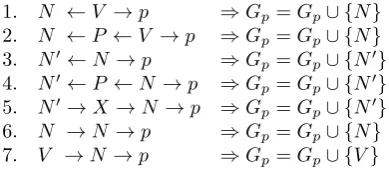
governor ofpin the parseT. The following rules are then applied toT and new potential governors are added toGp:
1. N ←V →p ⇒Gp=Gp∪ {N}
2. N ←P ←V →p ⇒Gp=Gp∪ {N}
3. N0←N →p ⇒Gp=Gp∪ {N0}
4. N0←P ←N →p ⇒Gp=Gp∪ {N0}
5. N0→X →N →p ⇒Gp=Gp∪ {N0}
6. N →N →p ⇒Gp=Gp∪ {N}
7. V →N →p ⇒Gp=Gp∪ {V}
These rules are inspired by the ideas of (Anguiano and Can-dito, 2011; Attardi and Ciaramita, 2007; Hall and Nov´ak, 2005). For example, the rule1is interpreted as follows: if target prepositionphas a verbal governor which has a noun N as a direct dependent, N is added as a candidate gov-ernor. In rule2, if the target prepositionpis dependent of a verbV, it can also be attached to any noun that is itself governed by another preposition attached toV. The appli-cation of all rules must meet a general condition which is that the tree produced must be projective. These rules have been designed in such a way that most possible governors are included in the setGp. The application of these rules on
the test set showed that in92.28%on the cases, the correct
governor is inGp.
Given the sentence a man throws a child into the air at a beach, and target preposition at that the parser has at-tached tochild, the two rules 4 and 7 apply, yieldingGp= {child, air, throws}
man throws child into air at
4. N P N∗ p
7. V∗ N p
Thanks to this process we have now for each caption with an ambiguous PP-attachment a set of syntactic parses that differ only by the governor chosen for the target preposi-tion. We can now introduce the task of multimodal syn-tactic parsing rerankingthat can take advantage of all the visual features available in theF30kEcorpus for finding the correct PP-attachment among all the possible parses.
4.
Baseline PP-attachment reranking
In order to calibrate future research, we provide baseline results for PP-attachment reranking. The task consists in selecting the correct attachment from a list of potential at-tachments. A classifier is first trained to detect incorrect PP-attachments, and then the highest scoring PP-attachment al-ternative is output.The classifier used as baseline is the Icsiboost classi-fier (Favre et al., 2007). ThisAdaboostclassifier is a com-bination of weak learners that learn a threshold for con-tinuous features, and a binary indicator for discrete ones. Training minimizes the exponential loss function by greed-ily selecting the best classifier and re-weighing the training set to focus on misclassified examples. This classifier is a strong baseline as it performs feature selection and has been shown to perform well on a range of tasks.
The features used to train the classifiers are defined for a governor-preposition-dependent triplet.
• (P)reposition: lemma of preposition
• (T)ext: part-of-speech and lemma of governor, depen-dent, both, and syntactic function of preposition, dis-tance between governor and preposition.
• Visual (C)oncepts: concept of governor, concept of dependent, concepts of both
• Visual (S)patial: the normalized distance between the top-left and bottom-right corners of the governor and dependent bounding boxes, the areas of those boxes, and the ratio between the areas of the governor and dependent boxes.
It is important to notice that the visual features in our study are limited to spatial information about bounding boxes and visual concepts. No image analysis of the content of the boxes is done since this level of information is covered by thevisual concept featureswhich attach to each box a con-cept tag related to its content.
Features Test Baseline 0.75
P+T 0.85
P+C 0.82
P+S 0.77
P+T+C 0.86
P+T+S 0.86
P+C+S 0.82
[image:4.595.129.212.66.179.2]P+T+C+S 0.86
Table 2: Baseline PP-attachment reranking accuracy on the test set.
5.
Multilingual Extension
We extend the corpus by taking advantage of the transla-tions produced for the WMT shared task on multimodal machine translation (Elliott et al., 2017). That corpus con-tains31,014German (Elliott et al., 2016) and French trans-lations from theFlickr30kcorpus created by professional translators (German) and crowd sourcing (French). One ar-bitrary caption was translated per image to both languages. Out of those31Ktranslations,5,225captions overlap with the gold standard PP attachment annotations.
In order to transfer the annotations across languages, we align them with the fast align program (Dyer et al., 2013) and merge forward and reverse alignments with the grow-diag-final-andheuristic. In order to improve the accuracy of the alignment, we concatenate the trans-lated sentences from theF30kEcorpus with the news com-mentaryBitextsand theFreedictbilingual dictionary. This process helps aligning common expressions by providing more evidence to the unsupervised algorithm. From the alignments, we propagate two types of informations. First, theFlickr30k Entities segments which include unique en-tity references and types. This propagation is available for the whole set of translated captions, and could be used for instance to train a phrase retrieval system in the images, a coreference tracking system or other type of systems ex-ploiting theFlickr30k Entitiesdata, but in French and Ger-man. The second type of information propagated is the PP-attachment gold standard. The mapping is performed by transferring the annotation of preposition, and the head word of the governing entity and the hypothesis generated by the baseline English parser, to the words they are aligned to in the target language. If the source language words are aligned to multiple words, we use the first word by word order in the sentence.
The resulting multilingual annotations are made available along with the rest of the corpus in order to foster parsing research in all of the three languages, as well as the inter-esting link between PP-attachment resolution and machine translation. The transfer results in30Ksentences with en-tity boundaries, types and idenen-tity in French and German, as well as 5,225 sentences with gold PP attachment hy-potheses and gold standard in those languages (Figure 2). The quality of transfer is highly dependent on the quality of the automatic alignment, a known difficult problem, for which the error rate is typically around30%. We analyzed a random sample of100alignments for the French subset,
EN Large furry dog[G walking]in the[H sand][P near]large rocks .
FR Un gros chien poilu[G marchant]dans le[H sable][P pr`es de]gros rochers .
DE Großer Hund mit langem Fell [G l¨auft] in der [P N¨ahe]
großer Felsen durch den[H Sand].
Figure 2: Example of annotations transferred from English to French and German. [P] represents the target preposi-tion, [H] is the baseline governor predicted by the parser for English, [G] represents the gold standard manually an-notated. Note that entities and coreference links are also transferred while not depicted in this figure.
and manually annotated incorrect propagations. The errors can come from the preposition, its gold governor, or pre-dicted governor not being aligned, or being aligned to a word with the wrong part-of-speech. Often multiword id-iomatic expressions in either language, that are character-ized by arbitrary head-words, usually result in wrong align-ment (to bike→faire du v´elo, wherebikeis aligned with v´elo, which might also be due to the fact thatbikecan both be a verb and a noun). Another frequent problem is the preposition being aligned to the wrong preposition in the target language when the target sentence contains several prepositions.
The result of this hand analysis is that21%of transfers in the sample are erroneous. The transfer quality could be improved by accounting for part of speech tags, for exam-ple by using a joint grammar of both languages to enforce constituent-level alignments. A better heuristic could also be devised for processing multiply aligned source words for which the choice of alignment is not always success-ful. Finally, enforcing that aligned entities should have the same semantic category could improve the confidence of the transfer. We have released all the tools used to gen-erate the transferred annotations in hope that they can be extended to improve the final result.
6.
Distributed Data
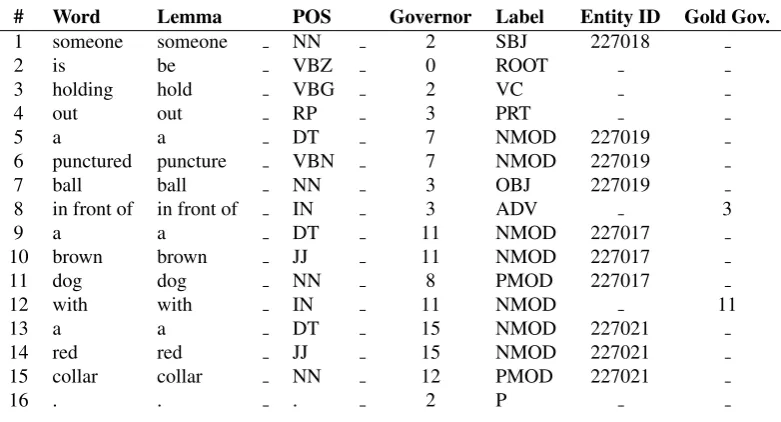
[image:4.595.304.541.68.226.2]# Word Lemma POS Governor Label Entity ID Gold Gov.
1 someone someone NN 2 SBJ 227018
2 is be VBZ 0 ROOT
3 holding hold VBG 2 VC
4 out out RP 3 PRT
5 a a DT 7 NMOD 227019
6 punctured puncture VBN 7 NMOD 227019
7 ball ball NN 3 OBJ 227019
8 in front of in front of IN 3 ADV 3
9 a a DT 11 NMOD 227017
10 brown brown JJ 11 NMOD 227017
11 dog dog NN 8 PMOD 227017
12 with with IN 11 NMOD 11
13 a a DT 15 NMOD 227021
14 red red JJ 15 NMOD 227021
15 collar collar NN 12 PMOD 227021
[image:5.595.101.492.66.277.2]16 . . . 2 P
Table 3: Example an annotated sentence in CoNLL format
CoNLL format (Table 3). Columns one to eight correspond to the standard CONLL columns, column nine corresponds to entity ID in theF30kEand column ten indicates whether the dependency is hand-corrected, such as words 8 and 12, or not, which is the case for all other words.
7.
Conclusion
We have proposed in this paper a corpus for supporting PP-attachment reranking research when attachments can be disambiguated with an image. The corpus was created by enriching the Flickr30k Entities corpus with 29,068 PP-attachments, from22,800captions describing15,700 im-ages, manually resolved by looking at the images.
We provide a testbed for reranking attachments generated from a forced parse with the correct attachment and a set of rules. A baseline classifier using reference visual features (concepts and spatial relations), and textual features yields PP-attachment accuracy of86%from an original accuracy of 75%form a standard transition-based parser. The cor-pus is enriched with multilingual annotations transfered to French and German through automatic alignment.
8.
Acknowledgements
This work has been carried out thanks to the support of French DGA in partnership with Aix-Marseille University as part of the “Club des partenaires D´efense”.
9.
Bibliographical References
Anguiano, E. H. and Candito, M. (2011). Parse correction with specialized models for difficult attachment types. In Proceedings of the Conference on Empirical Methods in Natural Language Processing, pages 1222–1233. Asso-ciation for Computational Linguistics.
Attardi, G. and Ciaramita, M. (2007). Tree revision learn-ing for dependency parslearn-ing. InHLT-NAACL, pages 388– 395.
Dyer, C., Chahuneau, V., and Smith, N. A. (2013). A sim-ple, fast, and effective reparameterization of ibm model 2. Association for Computational Linguistics.
Elliott, D., Frank, S., Sima’an, K., and Specia, L. (2016). Multi30k: Multilingual english-german image descrip-tions. InProceedings of the 5th Workshop on Vision and Language, pages 70–74.
Elliott, D., Frank, S., Barrault, L., Bougares, F., and Specia, L. (2017). Findings of the Second Shared Task on Multi-modal Machine Translation and Multilingual Image De-scription. In Proceedings of the Second Conference on Machine Translation, Copenhagen, Denmark, Septem-ber.
Favre, B., Hakkani-T¨ur, D., and Cuendet, S. (2007).
Icsiboost. http://code.google.come/p/
icsiboost.
Hall, K. and Nov´ak, V. (2005). Corrective modeling for non-projective dependency parsing. In Proceedings of the Ninth International Workshop on Parsing Technol-ogy, pages 42–52. Association for Computational Lin-guistics.
Nasr, A., B´echet, F., Rey, J., Favre, B., and Le Roux, J. (2011). Macaon: An nlp tool suite for processing word lattices. Proceedings of the ACL 2011 System Demon-stration, pages 86–91.
Plummer, B. A., Wang, L., Cervantes, C. M., Caicedo, J. C., Hockenmaier, J., and Lazebnik, S. (2017). Flickr30k en-tities: Collecting region-to-phrase correspondences for richer image-to-sentence models. International Journal of Computer Vision, 123(1):74–93.
Vinyals, O., Toshev, A., Bengio, S., and Erhan, D. (2015). Show and tell: A neural image caption generator. In Pro-ceedings of the IEEE conference on computer vision and pattern recognition, pages 3156–3164.
![Figure 2: Example of annotations transferred from Englishto French and German. [P] represents the target preposi-tion, [H] is the baseline governor predicted by the parserfor English, [G] represents the gold standard manually an-notated](https://thumb-us.123doks.com/thumbv2/123dok_us/818721.1097097/4.595.129.212.66.179/annotations-transferred-englishto-represents-governor-predicted-parserfor-represents.webp)