Statistical Dialogue Management using Intention Dependency Graph
Koichiro Yoshino1,2, Shinji Watanabe1, Jonathan Le Roux1, John R. Hershey1
1Mitsubishi Electric Research Laboratories, 201 Broadway, Cambridge, MA, 02139, USA
{watanabe,leroux,hershey}@merl.com
2School of Informatics, Kyoto University, Sakyo, Kyoto, 606-8501, Japan
Abstract
We present a method of statistical dia-logue management using a directed inten-tion dependency graph (IDG) in a par-tially observable Markov decision pro-cess (POMDP) framework. The transition probabilities in this model involve infor-mation derived from a hierarchical graph of intentions. In this way, we combine the deterministic graph structure of a con-ventional rule-based system with a statis-tical dialogue framework. The IDG also provides a reasonable constraint on a user simulation model, which is used when learning a policy function in POMDP and dialogue evaluation. Thus, this method converts a conventional dialogue manager to a statistical dialogue manager that uti-lizes task domain knowledge without an-notated dialogue data.
1 Introduction
Statistical approaches based on reinforcement learning, such as the Markov decision process (MDP) and partially observable Markov decision process (POMDP), have been successfully ap-plied to dialogue management (Levin et al., 2000; Williams and Young, 2007; Li, 2012). These ap-proaches allow us to consider all possible future actions of a dialogue system, and thus to obtain a new optimal dialogue strategy which could not be anticipated in conventional hand-crafted dialogue systems. Moreover, the statistical dialogue frame-work can be combined with conventional rule-based dialogue management in hybrid systems, (Williams, 2008; Lee et al., 2010), which com-bine the optimal dialogue strategy in the statistical approach with the lower cost of data and mainte-nance of the rule-based approach.
Our research focuses on a practical application of a hybrid statistical dialogue management based
on POMDP to conventional rule-based dialogue management via the use of an intention depen-dency graph (IDG). The IDG derives from the con-ventional rule-based dialogue system (Dahl et al., 1994; Bohus and Rudnicky, 2003), and it con-strains the transition matrix and provides a user simulation as a substitute for dialogue data.
The object of POMDP optimization is to pro-duce a policy that maps from user states to sys-tem actions such that the overall expected cost of the dialogue is minimized. Such optimiza-tion typically requires data from dialogue corpora, which are manually annotated with task-oriented dialogue-act tags. On the other hand, the benefit of a hybrid approach is that human domain knowl-edge can be used to constrain the possible user states in the dialogue manager. We follow this idea by using an IDG, which expresses the task-domain knowledge through a directed graph of states from more general intention categories to more specific parameters of the intention categories. Figure 1 shows an example of such a graph, where each node is associated with a (potentially partial) user intention. In previous studies, this kind of do-main knowledge is used to restrict the user state and system action state space (Lemon et al., 2006; Williams, 2008; Young et al., 2010; Varges et al., 2011). However, our approach does not restrict the possible system action states, but transfers the information structure to the definition of user sim-ulation and state transition probabilities. The sys-tem is allowed to consider all possible syssys-tem ac-tions by following the user states that reflect the IDG.
2 Statistical dialogue management
The main random variables involved at a dialogue turn tare as follows. st = i ∈ Is is the hidden true user statte at turnt. It is constrained by the hidden user goalg ∈ Ig and the true user state at the previous turn. ot = l ∈ Is is the observation
1: ROOT[] (=no specified request)
2: PLAY_MUSIC[artist=null, album=null]
4: PLAY_MUSIC[artist=$artist_name, album=null]
5: PLAY_MUSIC[artist=null, album=$album_name]
3: CONTROL_VOLUME[value=null]
6: CONTROL_VOLUME[value=$up_or_down]
1
3 2
4 5 6
[image:2.595.73.289.62.170.2]7 7: PLAY_MUSIC[artist=$artist_name, album=$album_name]
Figure 1: An example of a directed intention de-pendency graph.
of the user state by the system. It includes errors caused by automatic speech recognition (ASR), natural language understanding (NLU) and inten-tion understanding (IU). Uncertainty on the ob-servationot caused by errors in the preprocessor (ASR, NLU, and IU) is encompassed in the con-ditional probability Olit = p(ot = l|st = i). at = k ∈ K is the system action. ˆk is the op-timal system action that is acquired in the learn-ing step. The goal of statistical dialogue manage-ment is to output an optimal system actionˆat= ˆk given an observationot, based on the probability of st in a soft decision manner. The probability of the user statestgiven an observation sequence o1:tfrom1totwith confidenceO1:tis denoted by bti = p(st = i|o1:t;O1:t), and referred to as “be-lief”. To avoid clutter, we will usually omitO1:t.
2.1 Belief update
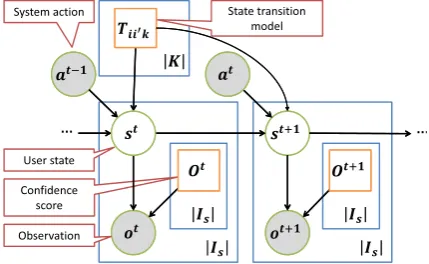
We consider a belief update equation based on the graphical model shown inFigure 2, assuming that the system actionsa1:t are given. We can obtain the following update equation frombtitobti′+1:
bti+1′ =p(st+1=i′|o1:t+1) (1)
∝∑
i
p(ot+1, i′|i)(bti)β, (2)
where β is a forgetting factor for the belief, and
0 ≤ β ≤ 1. Then, by introducing the system ac-tionat=kbased on the sum rule, we can rewrite p(ot+1, i′|i)in Eq. (2) as follows:
∑
k
p(ot+1, i′, k|i) =∑
k
p(ot+1, i′|i, k)δˆkk
=p(ot+1|i′)p(i′|i,ˆk) (3)
where p(k|i) = δˆkk is obtained by the decision
making step in the POMDP. We rewrite the dis-tributions in Eq. (3) as follows: p(i′|i,kˆ) = Tii′ˆk
࢚ ࢚
ࡵ࢙
࢙࢚ା
࢙࢚ା
࢚ା ࢚ା ࢇ࢚ି
ࢇ࢚ି
User state
Observation
State transition model System action
Confidence score
… … ࢙࢙࢚࢚
ࢇ࢚ ࢇ࢚
ࡵ࢙ ࡵ࢙
ࡷ
ࡵ࢙
ࡻ࢚
ࡻ࢚ ࡻࡻ࢚ା࢚ା
ࢀᇲ
[image:2.595.309.524.63.195.2]ࢀᇲ
Figure 2: Graphical model of user state sequences given system actionsat−1 andat. This graphical model shows user behavior that is observed from the system.
and p(ot+1 = l|i′) = Olit+1′ . Tii′kˆ are the user
state transition probabilities given system actionk,ˆ andOtli+1′ are the confidence scores given by the
pre-processor. In conventional studies, the state transition probabilities Tii′ˆk are learned from
an-notated data. In our scheme, the probabilities can be obtained by using the IDG, as described in Sec-tion 3.4. We finally obtain
bti+1′ ∝Otli+1′
∑
i
Tii′ˆk(bti)β. (4)
Once the system estimates the beliefbti, it can out-put the optimal actionaˆtasˆat =π∗({bti}|Is|
i=1). π
is called a policy function, and π∗ is an optimal policy function pre-computed in the learning step described in the following Section.
2.2 Learning step
The aim of the learning step in reinforcement learning is to acquire the best policy π∗. Many algorithms formulated to solve the reinforcement learning problem have been proposed (Shani et al., 2013). While most advanced algorithms re-quire transition probabilities Tii′kˆ that are
calcu-lated using annotated corpora, our approach aims at learning a POMDP without any data. We thus use one of the most basic algorithms, Q-learning (Watkins and Dayan, 1992), as it can acquire the policy without using transition probabilities. Q-learning relies on the estimation of a Q-function Q(bt, at), which computes the expected future re-ward of a system action at at dialogue turn t given the current beliefbt = {bti}|Is|
i=1 of the user
up-dates do not involve the transition probabilities Tii′kˆ, thus we can acquire the optimal policy
with-out requiring knowledge of this function. Given the Q-function, the optimal policy is determined
asπ∗(bt) = arg max
at
Q(bt, at).
3 Dialogue management using intention
dependency graph
3.1 Intention dependency graph
An intention dependency graph (IDG) is a repre-sentation of a user’s intention in a hierarchy, with broad categories of the intention at the top, and specific instantiations of those categories at the bottom, as shown in Figure 1. A child node in the graph represents a more specific intention than the parent node, so that the flow from top to bot-tom represents the completion of the full specifi-cation of an intention. However, the graph is not necessarily a tree, and hence there may be mul-tiple paths from a parent node to any descendent node. A node that is fully specified and actionable by the system can be considered a user goal. In node7, which is a child of node2, both the album and artist are specified, and the system has enough information to perform the desired action. Such a graph is automatically generated from task knowl-edge that is usually designed by hand for a conven-tional rule-based dialogue manager (Dahl et al., 1994; Bohus and Rudnicky, 2003), as a graphical user interface, and can be obtained by forming a taxonomy of the possible system actions. In our context, a node in this graph represents a hypothe-sis of the user’s intention and/or goal.
3.2 User simulator
Training a statistical dialogue management system in the absence of large amounts of dialogue data requires a user simulator to ensure adequate cov-erage of possible user states. In a general dialogue, the system action and the user state would follow a dialogue history and lead toward a user goal. The simulator thus samples user statesst+1 =i, at
ev-ery time step, tending toward a user goal g, and depending on the previous system action at =k. Thus, our approach defines the sampling distribu-tion p(i|g, k) by using IDG. Our approach gives uniform distribution to hypotheses that are out-putted by the IDG. We show an example IDG in Figure 1 and a dialogue example in Figure 6of Appendix.
3.3 Learning without any annotated data
We discuss the learning for the POMDP that uses our IDG. In our task, no data can be referred to and we cannot calculate the transition probability that is generally calculated from an annotated data for the belief update. This property makes it impos-sible to establish the exact value of the state-value function. In standard POMDP learning, sampling belief point approaches that select a small set of representative belief points such as point-based value iteration (PBVI) can be applied (Pineau et al., 2003). However, it is difficult to sample a small set of belief points without any tagged data. Therefore, we calculate the action-value function Q(bt, at), and simulate the noise with a grid-based approach (Lovejoy, 1991; Bonet, 2002). The grid-based approach can select points in accordance with a grid and a noise parameterηthat is released from the data. In our learning approach, a sam-ple of beliefbti = p(st = i|o1:t, O1:t)is given by p(ot+1 =l|i′) =Olit+1′ where
Otli+1′ =
{
1−η l=i′
η
|Is|−1 l̸=i
′. (5)
We tried noise η = {0.0,0.2,0.4,0.6,0.8,1.0}. The resulting policy does not reflect the belief up-date, but we can use the belief update method that follows the IDG.
3.4 State transition and belief update
The state transition probabilityTii′ˆkis one of the
most important components of the belief update in the POMDP framework. To obtain the transi-tion probabilities, we usually require user state and system action data with annotated tags. However, we cannot calculate the probability because of the lack of annotated data. Therefore, we define the state transition probability by using an IDG similar to user simulation, as discussed in Section 3.2. By employing time-invariant user goalg, time-variant user statest = iand time-variant best system ac-tionat= ˆkin Section 2, we can represent the state transition probabilities, as follows:
p(i′|i,ˆk) =∑
g
p(i′|g, i,ˆk)p(g|i,ˆk) (6)
Average rewards of 10000 dialogues
POMDP (β=0.2)
MDP
-100 -80 -60 -40 -20 0 20 40 60 80
[image:4.595.84.519.60.185.2]0% 20% 40% 60% 80% Noise
Figure 3: Average rewards of 10000 dialogues between the ob-tained dialogue manager and the user simulator.
-30 -20 -10 0 10 20 30 40
β=0 β=0.1 β=0.2 β=0.5 Average rewards of 10000 dialogues
20% 40% 60% 80% Noise
Figure 4: The effect of forgetting factorβas regards the average re-wards of 10000 dialogues.
3.5 4.0 4.5 5.0 5.5 6.0 6.5
β=0
β=0.1
β=0.2
β=0.5 Average dialogue turns in 10000 dialogues
20% 40% 60% 80% Noise
Figure 5: The effect of forgetting factorβ as regards the average di-alogue turns of 10000 didi-alogues.
goalgcan be estimated from the user stateiby us-ing the IDG. As a result, Eq. (6) is approximated as,
(6)∼=∑
g
p(i′|g,kˆ)
| {z }
simulator
p(g|i)
| {z }
goal model
(7)
Here,simulatoris the user simulator that is de-fined in Section 3.2, and goal model is a goal estimation model that can be calculated from an IDG. Our user simulator does not perform in ac-cordance withp(st+1 =i′|g, at= ˆk)exactly, but our model uses the track back of the user simulator that is defined in Section 3.2. The probability of a goal estimation model is defined asp(g|i), which expresses possible goals given a user statest=i.
4 Evaluations
We evaluate our statistical dialogue management approach, which uses the IDG. These are experi-mental evaluations with the user simulator that fol-lows Section 3.2. In the experiment, we used an IDG that had 957 states including 667 goals.
4.1 Evaluation of average reward
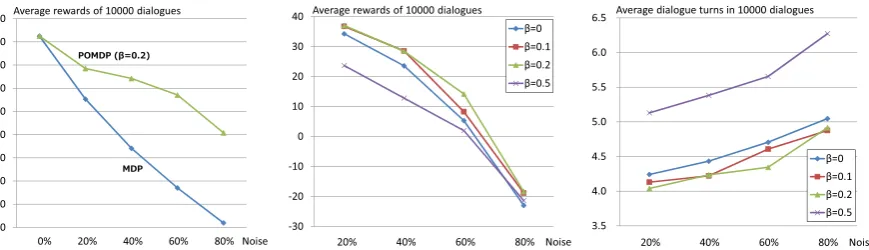
We evaluated dialogue managers in terms of the average reward for 10000 dialogues between the user simulator and the obtained dialogue man-ager. We simulated uniformly distributed noises that are defined on Eq. (5) for observation. We tried six grids that suppose a uniform distribu-tion given by Eq. (5). The parameters (η = {0.0,0.2,0.4,0.6,0.8,1.0}) were sampled in the Q-learning of the POMDP. We used parameters γ = 0.8andϵ = 0.2. The belief update defined in Section 3.4 was used for the dialogue evalua-tion. For comparison, we prepared an MDP based
dialogue manager that learned from observations without any noise. The average rewards result is shown in Figure 3. In this experimental result, the POMDP dialogue manager performed better than the MDP based dialogue manager (MDP) in noisy cases. The effects of forgetting factor β in terms of average reward and average dialogue turn are shown inFigure 4 andFigure 5. In this graph, the proposed POMDP framework, which includes state transition probabilities, works best at the pointβ = 0.2. These figures show that the approach depended on the forgetting factor and the robust setting ofβis left to future work.
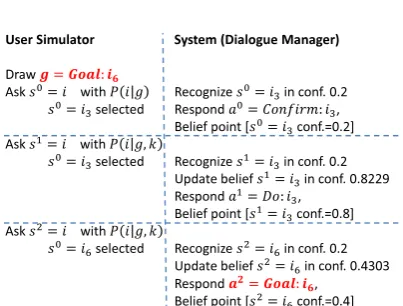
Figure 7in Appendix shows an example of di-alogue between the user simulator and the dia-logue manager. This example was obtained with η= 0.8, β= 0.2.
5 Conclusion and discussion
References
Dan Bohus and Alexander I. Rudnicky. 2003. Raven-claw: Dialog management using hierarchical task decom-position and an expectation agenda. In Proc. of EU-ROSPEECH.
Blai Bonet. 2002. An e-optimal grid-based algorithm for partially observable Markov decision processes. InProc. of ICML, pages 51–58.
Deborah A. Dahl, Madeleine Bates, Michael Brown, William Fisher, Kate Hunicke-Smith, David Pallett, Christine Pao, Alexander Rudnicky, and Elizabeth Shriberg. 1994. Ex-panding the scope of the ATIS task: The ATIS-3 corpus. InProc. of the workshop on Human Language Technol-ogy, pages 43–48.
Lucie Daubigney, Matthieu Geist, and Olivier Pietquin. 2012. Off-policy learning in large-scale POMDP-based dialogue systems. InIEEE-ICASSP, pages 4989–4992. M. Gaˇsi´c, F. Jurˇc´ıˇcek, S. Keizer, F. Mairesse, B. Thomson,
K. Yu, and S. Young. 2010. Gaussian processes for fast policy optimisation of POMDP-based dialogue managers. InProc. of SIGDIAL, pages 201–204.
F. Jurcicek, B. Thomson, S. Keizer, F. Mairesse, M. Gasic, K. Yu, and S. Young. 2010. Natural belief-critic: a rein-forcement algorithm for parameter estimation in statistical spoken dialogue systems. InProc. of INTERSPEECH. Cheongjae Lee, Sangkeun Jung, Kyungduk Kim, Donghyeon
Lee, and Gary Geunbae Lee. 2010. Recent approaches to dialogue management for spoken dialog systems.Journal of Computer Science and Engineering, 4(1):1–22. Oliver Lemon, Xingkun Liu, Daniel Shapiro, and Carl
Tol-lander. 2006. Hierarchical reinforcement learning of dia-logue policies in a development environment for diadia-logue systems: Reall-dude. InProc. of the 10th Workshop on the Semantics and Pragmatics of Dialogue, pages 185–186. Esther Levin, Roberto Pieraccini, and Wieland Eckert. 2000.
A stochastic model of human-machine interaction for learning dialog strategies. Speech and Audio Processing, IEEE Transactions on, 8(1):11–23.
William Li. 2012. Understanding user state and preferences for robust spoken dialog systems and location-aware assis-tive technology. Master’s thesis, Massachusetts Institute of Technology.
William S Lovejoy. 1991. Computationally feasible bounds for partially observed Markov decision processes. Opera-tions research, 39(1):162–175.
Teruhisa Misu and Hideki Kashioka. 2012. Simultaneous feature selection and parameter optimization for training of dialog policy by reinforcement learning. In Spoken Language Technology Workshop (SLT), 2012 IEEE, pages 1–6. IEEE.
George E Monahan. 1982. State of the art? a survey of partially observable Markov decision processes: Theory, models, and algorithms. Management Science, 28(1):1– 16.
S´ebastien Paquet, Ludovic Tobin, and Brahim Chaib-draa. 2005. An online POMDP algorithm for complex multi-agent environments. InProc. of AAMAS, pages 970–977. Joelle Pineau, Geoff Gordon, Sebastian Thrun, et al. 2003.
Point-based value iteration: An anytime algorithm for POMDPs. InProc. of IJCAI, volume 18, pages 1025– 1032. LAWRENCE ERLBAUM ASSOCIATES LTD. ShaoWei Png and Joelle Pineau. 2011. Bayesian
reinforce-ment learning for POMDP-based dialogue systems. In Proc. of IEEE-ICASSP, pages 2156–2159. IEEE. Guy Shani, Joelle Pineau, and Robert Kaplow. 2013. A
sur-vey of point-based POMDP solvers. Autonomous Agents and Multi-Agent Systems, 27(1):1–51.
Matthijs TJ Spaan and Nikos Vlassis. 2005. Perseus: Ran-domized point-based value iteration for POMDPs. Jour-nal of artificial intelligence research, 24(1):195–220. Sebastian Varges, Giuseppe Riccardi, Silvia Quarteroni, and
Alexei V Ivanov. 2011. POMDP concept policies and task structures for hybrid dialog management. InProc. of IEEE-ICASSP, pages 5592–5595.
Christopher JCH Watkins and Peter Dayan. 1992. Q-learning. Machine learning, 8(3):279–292.
Jason D Williams and Steve Young. 2007. Partially ob-servable Markov decision processes for spoken dialog sys-tems.Computer Speech & Language, 21(2):393–422. Jason D. Williams. 2008. The best of both worlds: Unifying
conventional dialog systems and POMDPs. In Proc. of INTERSPEECH.
Steve Young, Milica Gaˇsi´c, Simon Keizer, Franc¸ois Mairesse, Jost Schatzmann, Blaise Thomson, and Kai Yu. 2010. The hidden information state model: A practical frame-work for POMDP-based spoken dialogue management. Computer Speech & Language, 24(2):150–174.
A Dialogue examples
=: 7 =PLAY_MUSIC[artist=The Beatles, album= Abbey Road]
= 1: ROOT[]
Ask question on possible goals from 1: {: 1 =“What do you want me to do?”}
=: 1 =“What do you want me to do?”
ଵ
= 4: “Play The Beatles” (mumbled)
ASR/NLU/IU output: “Play $unknown_slot” ASR mistake
ଵ
= 2: PLAY_MUSIC[artist=NULL, album=NULL]
Launch a possible command from 2: {: 2 =“Please say album and/or artist.” Confirm: 2 =“Do you want to play music?”}
ଵ
=: 2 =“Please say album and/or artist” System selected : 2
ଶ
= 4: “Play The Beatles” (clearer)
ASR output: “Play The Beatles”; NLU/IU output: “Play $artist=[The Beatles]”
ଶ
= 4: PLAY_MUSIC[artist=The Beatles, album=NULL]
Launch a possible command from 4: {: 4 =“Please say specific album.”
: 4 =“I will play all albums of The Beatles.”
: 4 =“Do you want to play The Beatles?”}
ଶ
=: 4 =“Please say specific album” System selected : 4
ଷ
= 7: “Play Abbey Road by The Beatles”
ASR/NLU/IU output: “Play $album=[Abbey Road] by $artist=[The Beatles]”
ଷ
= 7: PLAY_MUSIC[artist=The Beatles, album= Abbey Road]
Launch a possible command from 7: {: 7 =“I will play Abbey Road by The Beatles.”
: 7 =“Do you want to play Abbey Road by The Beatles?”}
ଷ
[image:5.595.311.518.320.683.2]=: 7 =“I will play Abbey Road by The Beatles” System selected : 7
Figure 6: A dialogue example.
User Simulator
Draw ࢍ=ࡳࢇ: Ask ݏ
=݅ with ܲ ݅ ݃ ݏ
=݅ଷselected
Ask ݏଵ
=݅ with ܲ ݅ ݃,݇ ݏ
=݅ଷselected
Ask ݏଶ
=݅ with ܲ ݅ ݃,݇
ݏ
=݅selected
System (Dialogue Manager)
Recognize ݏ
=݅ଷin conf. 0.2 Respond ܽ
=ܥ݂݊݅ݎ݉:݅ଷ, Belief point [ݏ
=݅ଷconf.=0.2]
Recognize ݏଵ
=݅ଷin conf. 0.2
Update belief ݏଵ
=݅ଷin conf. 0.8229
Respond ܽଵ =ܦ:݅ଷ,
Belief point [ݏଵ
=݅ଷconf.=0.8]
Recognize ݏଶ
=݅in conf. 0.2
Update belief ݏଶ
=݅in conf. 0.4303
Respond ࢇ
=ࡳࢇ:,
Belief point [ݏଶ
=݅conf.=0.4]
[image:5.595.316.518.525.678.2]