R E S E A R C H
Open Access
Analysis of coevolution in nonstructural
proteins of chikungunya virus
Jaspreet Jain, Kalika Mathur, Jatin Shrinet, Raj K. Bhatnagar and Sujatha Sunil
*Abstract
Background:RNA viruses are characterized by high rate of mutations mainly due to the lack of proofreading repair activities associated with its RNA-dependent RNA-polymerase (RdRp). In case of arboviruses, this phenomenon has lead to the existence of mixed population of genomic variants within the host called quasi-species. The stability of strains within the quasi-species lies on mutations that are positively selected which in turn depend on whether these mutations are beneficial in either or both hosts. Coevolution of amino acids (aa) is one phenomenon that leads to establishment of favorable traits in viruses and leading to their fitness.
Results:Fourteen CHIKV clinical samples collected over three years were subjected to RT-PCR, the four non-structural genes amplified and subjected to various genetic analyses. Coevolution analysis showed 30 aa pairs coevolving in nsP1, 23 aa pairs coevolving in nsP2, 239 in nsP3 and 46 aa coevolving pairs in nsP4 when each non-structural protein was considered independently. Further analysis showed that 705 amino acids pairs of the non-structural polyproteins coevolved together with a correlation coefficient of≥0.5. Functional relevance of these coevolving amino acids in all the nonstructural proteins of CHIKV were predicted using Eukaryotic Linear Motifs (ELMs) of human.
Conclusions:The present study was undertaken to study co-evolving amino acids in the non-structural proteins of chikungunya virus (CHIKV), an important arbovirus. It was observed that several amino acids residues were coevolving and shared common functions.
Keywords:Chikungunya virus, Coevolution, Nonstructural proteins, Eukaryotic linear motifs
Background
Coevolution at the molecular level is an established phenomenon exhibited by organisms in order to optimize their physiological performance and serve as an effective determinant of fitness [1, 2]. Coevolution refers to syn-chronized changes that organisms or proteins undergo and can occur with respect to pathogen-host [3], as well as within the organism [4, 5], often revealing functional coordination regarding the interacting pairs. One of the most compelling examples of coevolution of host and pathogen can be witnessed in the retrovirus, mainly be-cause of their tolerance to mutagenesis [6]. Studies in HIV have shown that drug resistance is manifested by coevolu-tion of proteins in the virus under drug selective pressure [7, 8]. Selection advantage of coevolution may ultimately result in recombination events [9].
Chikungunya virus (CHIKV) is a re-emerging arbo-virus belonging to family Togaviridae. Known to exist as mixed populations of genomic variants, known as qua-sispecies, these variants confer phenotypic plasticity and adaptability to new environments [10, 11]. In spite of this, strong purifying selection plays a role in evolution of arboviruses [12]. Owing to its complicated life cycle that includes its survival in two disparate hosts, one in-vertebrate and the other in-vertebrate, several studies have be devoted to understand arbovirus fitness determinants [13–15] including host-specific fitness benefits [16, 17].
Owing to their small genome sizes, viruses lack the machinery for their replication and other processes and are mostly dependent on the host for these functions. In order to perform their functions, viruses have mastered motif mimicry based hijacking strategy wherein small motifs of the virus mimic host protein motifs. Recog-nized as Eukaryotic Linear Motif (ELM) or mini motif or Short Linear Motif (SLiM), these linear motifs function independent of the tertiary structure of the host protein
* Correspondence:[email protected]
Insect Resistance Group, International Centre for Genetic Engineering and Biotechnology, New Delhi 110067, India
and are also needed for post-translational modifications, cell signaling, cellular trafficking and play important role in virus maturation [18, 19].
A recent study describes homologous recombination in CHIKV where non-structural protein nsP3 is reported to be site for recombination [20]. The current study was undertaken to study the coevolving aa in the replication machinery of CHIKV, namely the non-structural proteins, nsP1, nsP2, nsP3 and nsP4. Further, using Eukaryotic Linear Motifs (ELM) [18], we predicted the functional relevance of the coevolving aa pairs. The results obtained in the present study revealed important intra-molecular coevolving aa residues of the replication complex of CHIKV. The study provided insights to functional signifi-cance of some of the coevolving aa with respect to human protein motifs.
Methods Sample collection
Fourteen patients from Safdarjung Hospital, New Delhi were recruited for the present study after obtaining their informed consent (Table 1). Blood was drawn from these patients, sera separated and subjected to ELISA for test-ing the presence of chikungunya virus IgM antibodies using IgM capture ELISA kits supplied by National Insti-tute of Virology (NIV), Pune. The sera samples were amplified once in C6/36 cells and once in VERO cells.
VNA extraction, RT-PCR, cloning and plasmid sequencing
Viral nucleic acid (VNA) was extracted from the stored samples using High Pure Viral Nucleic Acid kit (Roche, Germany). Non-structural genes of CHIKV (nsP1, nsP2, nsP3 and nsP4) were amplified individually using Titanium One–step RT-PCR Kit (Clontech, USA), using primers
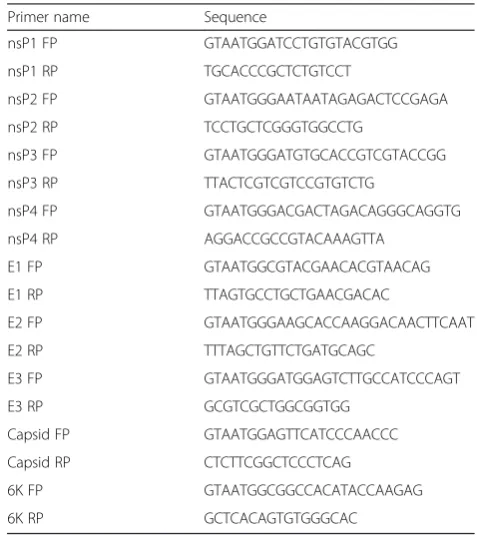
listed in Table 2. The whole genome of CHIKV was ampli-fied for three samples using gene specific primers (Table 2). The amplified products were purified using SureExtract PCR clean up/gel extraction kit (Nucleopore, India), cloned in pGEM-T Easy vector and sequenced. The sequences have been submitted to NCBI (GenBank) with Accessions numbers KU365282-KU365292.
Sequence and phylogenetic analysis
CHIKV gene sequences were trimmed and taken for fur-ther analysis. Phylogenetic analysis of 14 sequences of Delhi samples and 195 available complete genome and non-structural polyprotein sequences (nsP1, nsP2, nsP3 and nsP4) of CHIKV was performed using MEGA version 6 [21] MAFFT [22] was used to perform multiple aa se-quence alignment. For the construction of phylogenetic tree, neighbor-joining algorithm and Poisson distribution distance model were utilized. Reliability of the analysis was evaluated using bootstrap test with 1500 replications. Amino acid sequence analysis was performed on all the nonstructural proteins of all Delhi strains and compared with the sequences from India and rest of the world avail-able in various public databases.
Molecular sequence evolution analysis
All analysis involved 196 aa sequences (consisting of one consensus sequence representing all Delhi samples and 195 already available sequences). MEGA 6 software was used to conduct Evolutionary analyses using the Poisson correction model. The rate variation among sites was
Table 1Details of chikungunya samples used in the study
CHIKV ID Year of sample collection IgM status RT-PCR
IND-10-DEL1 2010 Negative Positive
IND-12-DEL15 2012 Not Done Positive
Table 2Primers used for gene amplification
modeled with a gamma distribution (shape parameter = 1). Substitution pattern and rates were estimated under the Jones-Taylor-Thornton [23] model (+G). A discrete Gamma distribution was used to model evolutionary rate differences among sites (5 categories, [+G]). Mean evolutionary rates of substitutions per site in these categories and the aa fre-quencies were also calculated. For estimating Maximum likelihood (ML) values, a tree topology was automatically computed. The maximum Log likelihood for this computa-tion was also calculated. Nucleotide diversity and Tajima test statistic [24] were deduced using MEGA6 and the se-lection pressure on polyprotein was deduced.
Coevolution analysis
Coevolution analysis of the replication complex of chi-kungunya virus was done using Coevolution analysis using Protein Sequences (CAPS) [25] software (consid-ering default setting for intra-molecular coevolution analysis without making use of any structural informa-tion (as there is no structural informainforma-tion present for chikungunya virus proteins in the public domain). It was used to identify groups of coevolving pairs with correlation coefficient >0.5 (Correlation Value). All the aa within each group coevolving with all the others within the same group were identified. Cytoscape [26] was used to generate networks of coevolving aa sites.
Eukaryotic Linear Motifs (ELM) analysis
Eukaryotic Linear Motifs (ELM) of all the non-structural proteins of chikungunya virus (CHIKV) were predicted separately using Eukaryotic Linear Motif resource server (ELM). As the virus purified from clinical samples were sequenced and used in this study, we predicted human’s linear motifs in CHIKV non-structural proteins. The ELM GO terms were retrieved from the ELM database and were used for predicting functional significance of the coevolving pairs. Currently, the database has 1594 ELM instances of Homo sapiens and GO terms related to these instances. The motif probability cutoff was taken as 100 (default value) andHomo sapienswas selected as the preferred species to predict the conserved peptide linear motif of human in chikungunya virus non-structural pro-teins. The motifs were filtered based on cell compartment terms. The ELMs with p-value≤0.001 were considered for further analysis.
Results
Patient samples were collected from Delhi region, India for three consecutive years 2010-2012. The year 2010 saw a major outbreak of chikungunya in Delhi following which there has been a steady decline of cases. The 14 samples used in this study were mainly IgM negative (n= 11), while two samples were IgM positive and IgM status was not available for one sample. All the 14 samples
were positive for CHIKV by Real-Time Quantitative Re-verse Transcription PCR (qRT-PCR). The samples were passaged once each in C6/36 and VERO cells; the nsPs amplified end to end, cloned in pGEM-T easy vectors and sequenced using Sanger’s dideoxy sequencing. The se-quences were trimmed and aligned with 195 nsPpolypro-tein sequences from the Genbank database. A total of 29 sequences from Indian strains and 166 sequences from across the globe were taken for further analysis.
Sequence and phylogenetic analysis of Delhi samples
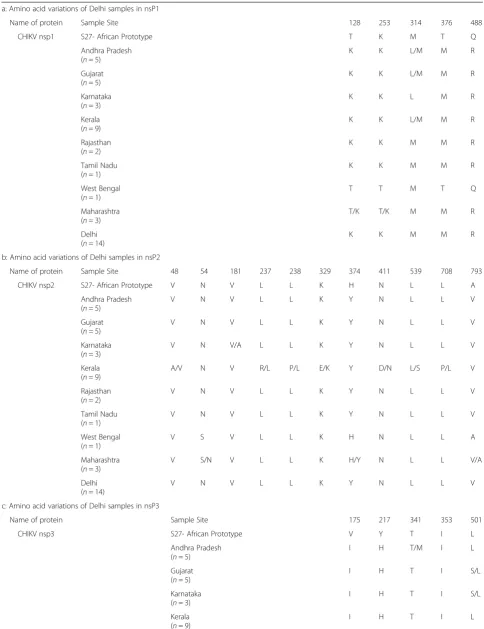
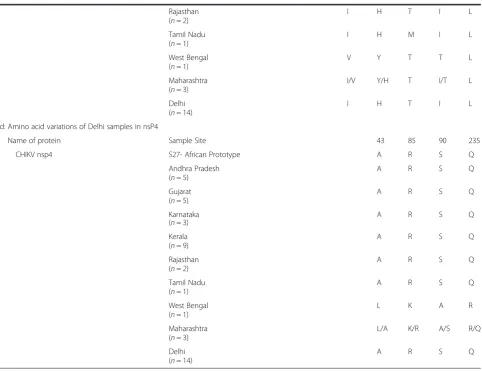
Amino acid sequence analysis was performed on the complete gene sequences of nsP1 (535aa), nsP2 (798aa), nsP3 (530aa), nsP4 (611aa). It was observed that all the sequences were high level of identity (99 %) amongst each other. With respect to the East/Central/South African (ECSA) prototype, S27, several variations were observed in the Delhi sequences. The nsPs sequences from other parts of the country, namely, Andhra Pradesh, Gujarat, Karnataka, Kerala, Maharashtra, Rajasthan, Tamil Nadu and West Bengal were also taken for this analysis. In-depth aa sequences analysis highlighted a total of 25 variations in the non-structural proteins. Details of all the mutations are provided in Table 3a-d.
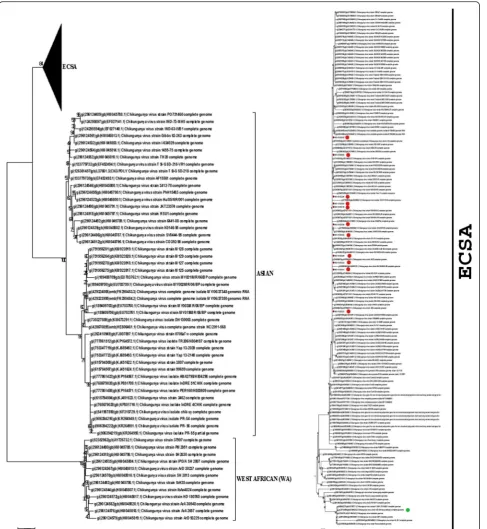
Phylogenetic analysis of the samples for all the nsPs revealed that they belonged to ECSA I subgroup 1 that belongs to Indian Ocean Lineage (IOL) (Fig. 1).
Estimation of evolutionary parameters based on phylogenetic analysis
Evolutionary parameters of two ECSA subgroups with the Delhi samples were checked using pairwise genetic divergence between groups. The analysis confirmed the occurrence of Delhi samples in the ECSA subgroup 1 as the genetic divergence between the two groups was 0.001 ± 0.000. Similarly the genetic divergence between ECSA subgroup 2 and Delhi samples was observed to be 0.010 ± 0.002.
Table 3Amino acid variations in Delhi samples in comparison with ESCA lineage and other Indian samples
a: Amino acid variations of Delhi samples in nsP1
Name of protein Sample Site 128 253 314 376 488
CHIKV nsp1 S27- African Prototype T K M T Q
Andhra Pradesh K K L/M M R
(n= 5)
Gujarat K K L/M M R
(n= 5)
Karnataka K K L M R
(n= 3)
Kerala K K L/M M R
(n= 9)
Rajasthan K K M M R
(n= 2)
Tamil Nadu K K M M R
(n= 1)
West Bengal T T M T Q
(n= 1)
Maharashtra T/K T/K M M R
(n= 3)
Delhi K K M M R
(n= 14)
b: Amino acid variations of Delhi samples in nsP2
Name of protein Sample Site 48 54 181 237 238 329 374 411 539 708 793
CHIKV nsp2 S27- African Prototype V N V L L K H N L L A
Andhra Pradesh V N V L L K Y N L L V
(n= 5)
Gujarat V N V L L K Y N L L V
(n= 5)
Karnataka V N V/A L L K Y N L L V
(n= 3)
Kerala A/V N V R/L P/L E/K Y D/N L/S P/L V
(n= 9)
Rajasthan V N V L L K Y N L L V
(n= 2)
Tamil Nadu V N V L L K Y N L L V
(n= 1)
West Bengal V S V L L K H N L L A
(n= 1)
Maharashtra V S/N V L L K H/Y N L L V/A
(n= 3)
Delhi V N V L L K Y N L L V
(n= 14)
c: Amino acid variations of Delhi samples in nsP3
Name of protein Sample Site 175 217 341 353 501
CHIKV nsp3 S27- African Prototype V Y T I L
Andhra Pradesh I H T/M I L
(n= 5)
Gujarat I H T I S/L
(n= 5)
Karnataka I H T I S/L
(n= 3)
Kerala I H T I L
size expansion (e.g., after a bottleneck or a selective sweep) and/or purifying selection.
Coevolution analysis
Coevolution analysis was performed using multiple se-quence alignment of both individual non-structural pro-teins (nsPs) and polyprotein of the complete nsPs. A total of 209 sequences, 195 CHIKV sequences present in the public domain and 14 CHIKV sequences obtained from Delhi was used in this analysis. The first round of analysis involved the complete sequences to identify the coevolving pairs. Subsequently, the mutation status of these pairs was examined in the Delhi samples. Details of the analysis for each of the nsPs and the whole poly-protein are described below.
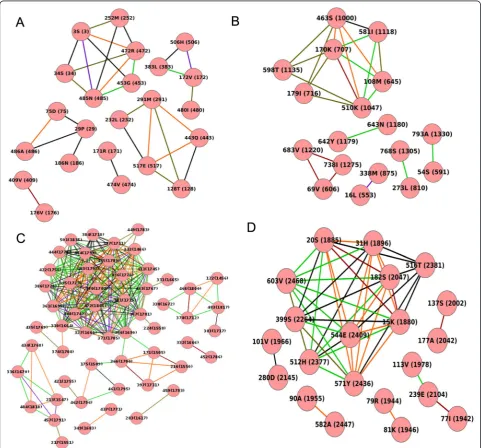
nsP1: nsP1 has 535 aa (aa) and the whole protein was taken for coevolution analysis. It was observed that 30 aa pairs involving 23 aa residues coevolved at a correlation >0.5, of which, seven aa pairs showed a correlation of 0.9-1.0 (Fig.2a). Mutations were seen in
all aa pairs coevolving with a correlation of 0.9-1.0. With respect to individual residues, aa residue at position three had the maximum number of five partners, of which, the most significant correlation (>0.9) was seen with aa residue 472(R).
nsP2: nsP2 has 798 aa (aa) and the whole protein was taken for coevolution analysis. It was observed that 23 aa pairs involving 18 aa residues coevolved at a correlation >0.5, of which, seven aa pairs showed a correlation of 0.9-1.0 (Fig.2b). Mutations were observed in all aa pairs that coevolved at a correlation >0.9. With respect to individual residues, aa residue at position 170 had the maximum number of five partners, of which, the most significant correlations (>0.9) were seen with aa residue 510(K) and 463(S).
nsP3: nsP3 has 530 aa (aa) and the whole protein was taken for coevolution analysis. It was observed that 239 aa pairs involving 41 aa residues coevolved at a
correlation >0.5, of which, 49 aa pairs showed a
Table 3Amino acid variations in Delhi samples in comparison with ESCA lineage and other Indian samples(Continued)
Rajasthan I H T I L
Maharashtra I/V Y/H T I/T L
(n= 3)
Delhi I H T I L
(n= 14) d: Amino acid variations of Delhi samples in nsP4
Name of protein Sample Site 43 85 90 235
CHIKV nsp4 S27- African Prototype A R S Q
Andhra Pradesh A R S Q
Maharashtra L/A K/R A/S R/Q
(n= 3)
Delhi A R S Q
correlation of 0.9-1.0 (Fig.2c). Mutations were seen in all aa pairs with a correlation of 0.9-1.0. With respect to individual residues, aa residue at position 361 had
the maximum number of 18 partners, of which, the most significant correlations (>0.9) was seen with seven aa residue (Fig.2c)
Fig. 1Phylogenetic analysis of nsPs. Total 209 nsP sequences (14 of CHIKV Delhi samples and 195 available in public domain) were aligned using MEGA 6.0 software to construct phylogenetic tree based on Neighbor-joining algorithm and Poisson distribution distance model. Bootstrap values were kept 1500 to ensure reliability.aPhylogenetic analysis of the Delhi sequences was done and its placement in CHIKV genotype group was determined.bInset of ECSA clade. All samples used for the study belonged to the ECSA clade. : represent samples from Delhi region and
nsP4: nsP4 has 661 aa (aa) and the whole protein was taken for coevolution analysis. It was observed that 46 aa pairs involving 21 aa residues coevolved at a correlation >0.5, of which, 19 aa pairs showed a correlation of 0.9-1.0 (Fig.2d). It was observed that all
these 19 aa pairs were found mutated with respect to the Delhi samples. With respect to individual residues, aa residue at position 15 had the maximum number of nine partners, of which, the most significant correlations (>0.9) was seen with five aa residue (Fig.2d)
Fig. 2Coevolution analysis of nsPs.a-dMSA of all CHIKV nsP sequences (total 209) were analyzed using CAPS software to study coevolving aa within individual nsPs. Mutated aa pairs with correlation value above 0.5 were used for construction of network using Cytoscape software. Edge color varies with correlation value: red (1.0), orange (~0.9), purple (~0.8), light green (~0.7), black (~0.6) and dark green (~0.5). Node names include aa residue positions in individual nsP (as well as in polyprotein)
Table 4Tajima’s neutrality test
M (number of sequences) S (Number of segregating sites ps (ps = S/n) Θ(Θ= ps/a1) Π(nucleotide diversity) D (Tajima test statistics)
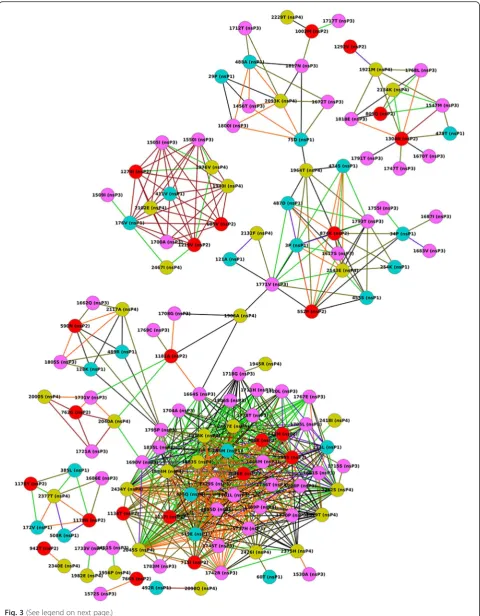
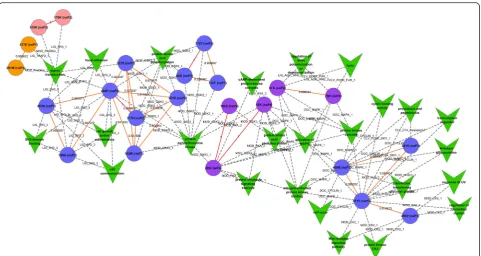
Polyprotein: The entire polyprotein of the non-structural proteins has 2475 amino acid (aa) and was taken for coevolution analysis. It was observed that 705 aa pairs involving 138 aa residues coevolved at a correlation >0.5, of which, 232 aa pairs showed a correlation of 0.9-1.0 (Fig.3). It is noteworthy that nsP3 has the highest number of coevolving residues i.e. 27 followed by 18, 16 and 13 coevolving residues in nsP4, nsP2 and nsP1 respectively. With respect to individual residues, aa residue at position 519 of nsP1 and at position 999 of nsP2 had the maximum number of 19 and 18 partners respectively coevolving at the most significant correlations (>0.9) (Fig.3).
ELM studies
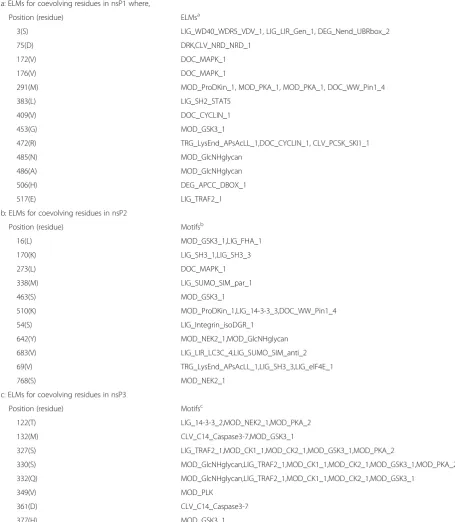
The linear motifs in this study were predicted using The Eukaryotic Linear Motif resource for Functional Sites in Proteins web server. The ELM instances present in the database are classified under different classes. In total, there are 240 different classes of motif with 2700 ex-perimentally validated classes, like cleavage sites (CLV), Degradation sites (DEG), Docking sites (DOC), Ligand binding sites (LIG), Post-translational modification sites (MOD) and Targeting sites (TRG). The ELMs of all non-structural proteins of CHIKV were predicted and further correlated with the intra-molecular coevolving sites of each non-structural protein. For the sake of stringency and functional relevance, coevolving sites with correlation cutoff value≥0.9 were only used for deducing their functional significance. The results of the aa residues of coevolving pair and their respective ELMs are shown in Table 5a-d. After filtering, total of seven pairs of coevolving residues of nsP1, fifteen pairs of nsP2, 83 pairs of nsP3 and 27 coevolving pairs of nsP4 were used for analysis. It is interesting to note that nsP3 despite of being the smallest protein (530 aa) in comparison to other non-structural protein was showing high number of coevolving pairs; this is may be due to the presence of hyper variable region towards its C-terminal. Many common motifs were found be-tween the aa residues of coevolving pair. With respect to nsP1, it was seen that 13 residues with correlation value > =0.9, showed ELMs with the humans (Table 5a). nsP2 has 13 residues (Table 5b), nsP3 showed 23 (Table 5c) and nsP4 has 14 residues (Table 5d) with correlation value above threshold and also has ELMs.
Discussion
One approach to identify beneficial mutations is by study-ing coevolvstudy-ing aa that result in establishment of novel and divergent strains within a short period of time. Functional attributes of these coevolving aa are associated with their interactions with host proteins [27]. Much advances have been made in studying protein coevolution at the molecular
level making use of both sequence information as well as protein structure information of the interacting pro-teins of both the host and the virus [28]. In case of CHIKV, as the complete structures of nsPs are pres-ently not available, we made use of sequence informa-tion to deduce the coevolving aa within the individual nsPs and between the nsPs in the polyprotein. Clinical samples collected over three consecutive years after a major outbreak were studied for coevolving aa in their nonstructural proteins. Analyzing the coevolving aa on the basis of their correlation coefficient values, our results have revealed that aa pairs having more than 0.9 correlation value have lesser number of coevolving partners thereby emphasizing the stringency of the technique. Of special mention is the analysis of the coevolving aa in nsP3 se-quences from across the globe. While analyzing this pro-tein, we observed that there were a variety of deletions in aa positions 376-382. Eighteen sequences isolated in the year 2014, mainly from South America (KR264951.1-KR264951.1, KP851709.1-KP851710.1, KJ451624.1) and Micronesia (KJ689452.1-KJ689453.1, KJ451622.2-KJ4516 23.1) showed deletion of four aa in position 379-382, whereas one sample each from Germany (KM673291.1), New Caledonia (HE806461.1), China (KF318729.1), Indonesia (FJ807897.1) two from Malaysia (FN295483.3, FN295484.2) and three from Brazil (KP164570.1-KP164571.1, KP164567.1) collected between 2006-2013 showed deletions in position 376-382. GO term analysis of this region using Eukaryotic Linear Motifs (ELMs) vealed that this motif present in the hyper variable re-gion of nsP3 might be playing a role in protein aa phosphorylation and could be important for virus sta-bility. Wet lab experiments are required to clearly understand the importance of this deletion both to the virus and to the host.
(See figure on previous page.)
Fig. 3Coevolution analysis of non-structural polyprotein. Complete polyprotein was analyzed for inter-molecular coevolving aa residues using CAPS software and network was generated similarly using Cytoscape software. Edge color varies with correlation value: red (1.0), orange (~0.9), purple (~0.8), light green (~0.7), black (~0.6) and dark green (~0.5) and individual nsPs have been differently colored (nsP1: blue, nsP2: red, nsP3: pink, nsP4: green)
Table 5The tables show the predicted ELMs for the coevolving residues along with the coevolving positions of amino acid residue of non-structural proteins of Chikungunya virus. The coevolving amino acid residues are written in the bracket“()”
a: ELMs for coevolving residues in nsP1 where,
Position (residue) ELMsa
3(S) LIG_WD40_WDR5_VDV_1, LIG_LIR_Gen_1, DEG_Nend_UBRbox_2
75(D) DRK,CLV_NRD_NRD_1
172(V) DOC_MAPK_1
176(V) DOC_MAPK_1
291(M) MOD_ProDKin_1, MOD_PKA_1, MOD_PKA_1, DOC_WW_Pin1_4
383(L) LIG_SH2_STAT5
409(V) DOC_CYCLIN_1
453(G) MOD_GSK3_1
472(R) TRG_LysEnd_APsAcLL_1,DOC_CYCLIN_1, CLV_PCSK_SKI1_1
485(N) MOD_GlcNHglycan
486(A) MOD_GlcNHglycan
506(H) DEG_APCC_DBOX_1
517(E) LIG_TRAF2_1
b: ELMs for coevolving residues in nsP2
Position (residue) Motifsb
16(L) MOD_GSK3_1,LIG_FHA_1
170(K) LIG_SH3_1,LIG_SH3_3
273(L) DOC_MAPK_1
338(M) LIG_SUMO_SIM_par_1
463(S) MOD_GSK3_1
510(K) MOD_ProDKin_1,LIG_14-3-3_3,DOC_WW_Pin1_4
54(S) LIG_Integrin_isoDGR_1
642(Y) MOD_NEK2_1,MOD_GlcNHglycan
683(V) LIG_LIR_LC3C_4,LIG_SUMO_SIM_anti_2
69(V) TRG_LysEnd_APsAcLL_1,LIG_SH3_3,LIG_eIF4E_1
768(S) MOD_NEK2_1
c: ELMs for coevolving residues in nsP3
Position (residue) Motifsc
122(T) LIG_14-3-3_2,MOD_NEK2_1,MOD_PKA_2
132(M) CLV_C14_Caspase3-7,MOD_GSK3_1
327(S) LIG_TRAF2_1,MOD_CK1_1,MOD_CK2_1,MOD_GSK3_1,MOD_PKA_2
330(S) MOD_GlcNHglycan,LIG_TRAF2_1,MOD_CK1_1,MOD_CK2_1,MOD_GSK3_1,MOD_PKA_2
332(Q) MOD_GlcNHglycan,LIG_TRAF2_1,MOD_CK1_1,MOD_CK2_1,MOD_GSK3_1
349(V) MOD_PLK
361(D) CLV_C14_Caspase3-7
predicted to play a role in signal transduction repre-sented by motif LIG_EVH1_2 and LIG_TRAF2_1. Her-pesviruses proteins have been shown to be recruited
through these motifs in TGFβsignaling and NF kb acti-vation [31, 32]. Pairing of this aa with residue 395S were seen to be involved in several functions, namely,
Table 5The tables show the predicted ELMs for the coevolving residues along with the coevolving positions of amino acid residue of non-structural proteins of Chikungunya virus. The coevolving amino acid residues are written in the bracket“()”(Continued)
378(T) MOD_GSK3_1
381(S) MOD_GSK3_1
395(S) LIG_SH3_3
397(V) LIG_SH3_3
408(R) CLV_PCSK_SKI1_1,MOD_N-GLC_1,DOC_CYCLIN_1,DOC_MAPK_1,MOD_PKB_1,TRG_ER_diArg_1
411(T) CLV_PCSK_SKI1_1,MOD_N-GLC_1,DOC_CYCLIN_1,DOC_MAPK_1,MOD_CK2_1,MOD_PKB_1
434(L) DEG_APCC_DBOX_1
436(P) DEG_APCC_DBOX_1
437(A) DEG_APCC_DBOX_1
452(Q) DOC_PP2B_LxvP_1
455(P) MOD_CK2_1
462(N) LIG_SH3_3,MOD_CK1_1
463(H) LIG_SH3_3
464(P) LIG_EVH1_2,LIG_SH3_3,MOD_GSK3_1
466(I) LIG_EVH1_2,MOD_GSK3_1
d: ELMs for coevolving residues in nsP4
Position (residue) Motifsd
113(V) MOD_CK2_1,MOD_GSK3_1,MOD_PKA_2
137(S) DOC_USP7_1,MOD_GSK3_1
15(K) DOC_MAPK_1,MOD_GSK3_1,MOD_PKA_2
182(S) LIG_14-3-3_3,MOD_CK1_1,MOD_GSK3_1
20(S) DOC_MAPK_1,MOD_GSK3_1,MOD_PKA_2
512(H) MOD_GSK3_1,MOD_NEK2_1
571(Y) MOD_CK2_1
582(A) LIG_SUMO_SIM_anti_2
603(V) DOC_MAPK_1,MOD_NEK2_2
77(I) LIG_Actin_WH2_2
79(R) CLV_PCSK_FUR_1,DOC_MAPK_1,LIG_Actin_WH2_2
81(K) CLV_PCSK_FUR_1,CLV_PCSK_PC1ET2_1,DOC_MAPK_1,LIG_Actin_WH2_2
90(A) LIG_FHA_1,LIG_SH2_STAT5,LIG_SH3_3,MOD_ProDKin_1,DOC_WW_Pin1_4
a
LIG_WD40_WDR5_VDV_1WDR5 WD40 repeat (blade 5,6)-binding ligand,LIG_LIR_Gen_1Atg8 protein family ligands,DEG_Nend_UBRbox_2N-degron,
CLV_NRD_NRD_1NRD cleavage site,DOC_MAPK_1MAPK docking motifs,MOD_ProDKin_1MAPK Phosphorylation Site,MOD_PKA_1PKA Phosphorylation site,DOC_WW_Pin1_4WW domain ligands,LIG_SH2_STAT5SH2 ligand,DOC_CYCLIN_1Cyclin recognition site,MOD_GSK3_1GSK3 phosphorylation site,
TRG_LysEnd_APsAcLL_1Endosome-Lysosome-Basolateral sorting signals,CLV_PCSK_SKI1_1PCSK cleavage site,MOD_GlcNHglycanGlycosaminoglycan attachment site,DEG_APCC_DBOX_1APCC-binding Destruction motifs,LIG_TRAF2_1TRAF2 binding site
b
MOD_GSK3_1GSK3 phosphorylation site,LIG_FHA_1FHA phosphopeptide ligands,LIG_SH3_1SH3 ligand,LIG_SH3_3SH3 ligand,DOC_MAPK_1MAPK docking motifs,LIG_SUMO_SIM_par_1SUMO interaction site,MOD_ProDKin_1MAPK Phosphorylation Site,LIG_14-3-3_314-3-3 ligand,DOC_WW_Pin1_4WW domain ligands,LIG_Integrin_isoDGR_1Integrin binding sites,MOD_NEK2_1NEK2 phosphorylation site,MOD_GlcNHglycanGlycosaminoglycan attachment site,LIG_LIR_LC3C_4Atg8 protein family ligands,LIG_SUMO_SIM_anti_2SUMO interaction site,TRG_LysEnd_APsAcLL_1Endosome-Lysosome-Basolateral sorting signals,LIG_eIF4E_1eIF4E binding motif
c
LIG_14-3-3_214-3-3 ligand,MOD_NEK2_1NEK2 phosphorylation site,MOD_PKA_2PKA Phosphorylation site,MOD_GSK3_1GSK3 phosphorylation site,
LIG_TRAF2_1TRAF2 binding site,MOD_CK1_1CK1 Phosphorylation site,MOD_PLKPlk phosphorylation site,LIG_SH3_3SH3 ligand,MOD_N-GLC_1
N-glycosylation site,DOC_CYCLIN_1Cyclin recognition site,MOD_PKB_1PKB Phosphorylation site,TRG_ER_diArg_1di Arginine retention/retrieving signal,
DOC_PP2B_LxvP_1Calcineurin (PP2B)-docking motif LxvP,LIG_EVH1_2EVH1 ligands
d
MOD_CK2_1CK2 Phosphorylation site,MOD_GSK3_1GSK3 phosphorylation site,MOD_PKA_2PKA Phosphorylation site,DOC_USP7_1USP7 binding motif,
LIG_14-3-3_314-3-3 ligand,MOD_CK1_1CK1 Phosphorylation site,MOD_NEK2_1NEK2 phosphorylation site,LIG_Actin_WH2_2Actin-binding motifs,
cell communication, SH3-binding domain, focal adhesion and signal transduction. Other functions of the coevol-ving pairs of nsP3 include cell communication and cell growth and maintenance (395(S)- 463(H)), cell cycle, pro-teolysis and peptidolysis (361(D)-411(T), 361(D)-408(R)), Wnt receptor signaling pathway, regulation of circardian rhythm, response to UV, protein kinase CK2 activity (411(T)-455(P)). transferringglycosyl group and activation of MAPK pathway (411(T)-408(R)). Involvement of ki-nases in virus activation through these motifs have been studied in papillomaviruses [33, 34].
With respect to nsP4, three coevolving pairs (five aa residues) were found to participate in functions like furin process, regulation of actin polymerization and depolymerization (79(R)-81(K)), cAMP-dependent protein kinase complex (20(S)-15(K)) and protein aa phosphorylation (20(S)-15(K), 20(S)-182(S)) (Fig. 4). Both nsP1 and nsP2 has one pair each of coevolving aa residues sharing common functions. 291(M)-517(E) coevolving pair of nsP1 and 170(K)-510(K) coevolving residues of nsP2 were predicted to play a role in sig-nal transduction process (Fig. 4).
Conclusions
Our study has provided insight on the coevolving aa in the nonstructural proteins of CHIKV. Further, we have also attempted to predict the functional relevance of these aa with respect to the host using ELMs. It should
be noted, however, correlation between coevolving pair of aa and ELMs in case of CHIKV require experimental validation.
Acknowledgements
We are thankful to the organizing committee of 20thInternational Bioinformatics workshop on Virus Evolution and Molecular Epidemiology (VEME), Trinidad and Tobago, West Indies for imparting beneficial knowledge for carrying out the Bioinformatics analysis.
Authors’contributions
SS and RKB planned the study. KM performed the cloning. JJ and JS analyzed the results. SS, JJ and JS wrote the manuscript. All authors read and approved the final manuscript.
Competing interests
The authors declare that they have no competing interests.
Financial support
Financial support for this study was received from the Department of Biotechnology, Ministry of Science and Technology (BT/PR14725/AGR/36/672/ 2010), India. JJ received financial support from Department of Biotechnology, Ministry of Science and Technology, India (DBT/CTEP/02/201500843) to attend VEME workshop, 2015 and their support is duly acknowledged.
Received: 29 February 2016 Accepted: 18 May 2016
References
1. Burton RS, Rawson PD, Edmands S. Genetic architecture of physiological phenotypes: empirical evidence for coadapted gene complexes. Am Zool. 1999;39:451–62.
2. Jothi R, Cherukuri PF, Tasneem A, Przytycka TM. Co-evolutionary analysis of domains in interacting proteins reveals insights into domain-domain interactions mediating protein-protein interactions. J Mol Biol. 2006; 362:861–75.
3. Sironi M, Cagliani R, Forni D, Clerici M. Evolutionary insights into host-pathogen interactions from mammalian sequence data. Nat Rev Genet. 2015;16:224–36.
4. Barreiro LB, Quintana-Murci L. From evolutionary genetics to human immunology: how selection shapes host defence genes. Nat Rev Genet. 2010;11:17–30.
5. Areal H, Abrantes J, Esteves PJ. Signatures of positive selection in Toll-like receptor (TLR) genes in mammals. BMC Evol Biol. 2011;11:368. 6. Zhang C, Cornette JL, Berzofsky JA, DeLisi C. The organization of human
leucocyte antigen class I epitopes in HIV genome products: implications for HIV evolution and vaccine design. Vaccine. 1997;15:1291–302.
7. Theys K, Deforche K, Libin P, Camacho RJ, Van Laethem K, et al. Resistance pathways of human immunodeficiency virus type 1 against the combination of zidovudine and lamivudine. J Gen Virol. 2010;91:1898–908. 8. Rhee SY, Liu TF, Holmes SP, Shafer RW. HIV-1 subtype B protease and
reverse transcriptase amino acid covariation. PLoS Comput Biol. 2007;3:e87. 9. Drummond DA, Silberg JJ, Meyer MM, Wilke CO, Arnold FH. On the
conservative nature of intragenic recombination. Proc Natl Acad Sci U S A. 2005;102:5380–5.
10. Coffey LL, Beeharry Y, Borderia AV, Blanc H, Vignuzzi M. Arbovirus high fidelity variant loses fitness in mosquitoes and mice. Proc Natl Acad Sci U S A. 2011;108:16038–43.
11. Pfeiffer JK, Kirkegaard K. Increased fidelity reduces poliovirus fitness and virulence under selective pressure in mice. PLoS Pathog. 2005;1:e11. 12. Jerzak G, Bernard KA, Kramer LD, Ebel GD. Genetic variation in West Nile
virus from naturally infected mosquitoes and birds suggests quasispecies structure and strong purifying selection. J Gen Virol. 2005;86:2175–83. 13. Weaver SC, Brault AC, Kang W, Holland JJ. Genetic and fitness changes
accompanying adaptation of an arbovirus to vertebrate and invertebrate cells. J Virol. 1999;73:4316–26.
14. Brault AC, Powers AM, Holmes EC, Woelk CH, Weaver SC. Positively charged amino acid substitutions in the e2 envelope glycoprotein are associated with the emergence of venezuelan equine encephalitis virus. J Virol. 2002; 76:1718–30.
15. Brault AC, Huang CY, Langevin SA, Kinney RM, Bowen RA, et al. A single positively selected West Nile viral mutation confers increased virogenesis in American crows. Nat Genet. 2007;39:1162–6.
16. Fitzpatrick KA, Deardorff ER, Pesko K, Brackney DE, Zhang B, et al. Population variation of West Nile virus confers a host-specific fitness benefit in mosquitoes. Virology. 2010;404:89–95.
17. Jerzak GV, Bernard K, Kramer LD, Shi PY, Ebel GD. The West Nile virus mutant spectrum is host-dependant and a determinant of mortality in mice. Virology. 2007;360:469–76.
18. Dinkel H, Van Roey K, Michael S, Kumar M, Uyar B, et al. ELM 2016-data update and new functionality of the eukaryotic linear motif resource. Nucleic Acids Res. 2015;p.gkv1291.
19. Davey NE, Trave G, Gibson TJ. How viruses hijack cell regulation. Trends Biochem Sci. 2011;36:159–69.
20. Casal PE, Chouhy D, Bolatti EM, Perez GR, Stella EJ, et al. Evidence for homologous recombination in Chikungunya Virus. Mol Phylogenet Evol. 2015;85:68–75.
21. Tamura K, Stecher G, Peterson D, Filipski A, Kumar S. MEGA6: Molecular evolutionary genetics analysis version 6.0. Mol Biol Evol. 2013;30:2725–9. 22. Kutoh E. Probable linagliptin-induced liver toxicity: a case report. Diabetes
Metab. 2014;40:82–4.
23. Jones DT, Taylor WR, Thornton JM. The rapid generation of mutation data matrices from protein sequences. Comput Appl Biosci. 1992;8:275–82. 24. Tajima F. Statistical method for testing the neutral mutation hypothesis by
DNA polymorphism. Genetics. 1989;123:585–95.
25. Fares MA, McNally D. CAPS: coevolution analysis using protein sequences. Bioinformatics. 2006;22:2821–2.
26. Shannon P, Markiel A, Ozier O, Baliga NS, Wang JT, et al. Cytoscape: a software environment for integrated models of biomolecular interaction networks. Genome Res. 2003;13:2498–504.
27. Thompson JN. The coevolutionary process. University of Chicago Press; 1994 Nov 15.
28. de Juan D, Pazos F, Valencia A. Emerging methods in protein co-evolution. Nat Rev Genet. 2013;14:249–61.
29. Welcker M, Singer J, Loeb KR, Grim J, Bloecher A, et al. Multisite phosphorylation by Cdk2 and GSK3 controls cyclin E degradation. Mol Cell. 2003;12:381–92.
30. Liu C, Li Y, Semenov M, Han C, Baeg G-H, et al. Control ofβ-catenin phosphorylation/degradation by a dual-kinase mechanism. Cell. 2002; 108:837–47.
31. Callebaut I. An EVH1/WH1 domain as a key actor in TGFβsignalling. FEBS Lett. 2002;519:178–80.
32. Lee H, Choi J-K, Li M, Kaye K, Kieff E, et al. Role of cellular tumor necrosis factor receptor-associated factors in NF-kB activation and lymphocyte transformation by herpesvirus saimiri STP. J Virol. 1999;73:3913–9. 33. Sharrocks AD, Yang S-H, Galanis A. Docking domains and substrate-specificity
determination for MAP kinases. Trends Biochem Sci. 2000;25:448–53. 34. Ma T, Zou N, Lin BY, Chow LT, Harper JW. Interaction between
cyclin-dependent kinases and human papillomavirus replication-initiation protein E1 is required for efficient viral replication. Proc Natl Acad Sci. 1999;96:382–7.
• We accept pre-submission inquiries
• Our selector tool helps you to find the most relevant journal • We provide round the clock customer support
• Convenient online submission • Thorough peer review
• Inclusion in PubMed and all major indexing services • Maximum visibility for your research
Submit your manuscript at www.biomedcentral.com/submit