Using Argument Mining to Assess the Argumentation Quality of Essays
Henning Wachsmuth, Khalid Al-Khatib, and Benno Stein
Faculty of Media, Bauhaus-Universität Weimar, Germany
{henning.wachsmuth,khalid.alkhatib,benno.stein}@uni-weimar.de
Abstract
Argument mining aims to determine the argumentative structure of texts. Although it is said to be crucial for future applications such as writing support systems, the benefit of its output has rarely been evaluated. This paper puts the analysis of the output into the focus. In particular, we inves-tigate to what extent the mined structure can be leveraged to assess the argumentation quality of persuasive essays. We find insightful statistical patterns in the structure of essays. From these, we derive novel features that we evaluate in four argumentation-related essay scoring tasks. Our results reveal the benefit of argument mining for assessing argumentation quality. Among others, we improve the state of the art in scoring an essay’s organization and its argument strength. 1 Introduction
Argument mining aims to determine the argumentative structure of natural language texts. Usually, this structure is composed of different types of argumentative discourse units, such as premises and conclu-sions, that together form one or more arguments in favor of or against some thesis.
One of the main proposed downstream applications of argument mining is writing support including automated grading, which will extend the capabilities of massive open online courses (MOOCs), thereby contributing to unlimited access and participation in education. To aid argumentative writing, we envi-sion a writing support system to proceed in three major steps: (1) Theminingof argumentative structure, (2) theassessmentof specific quality dimensions based on the mined structure, and (3) thesynthesisof suggestions for quality improvements. Figure 1 visualizes the resulting process. Several approaches to the mining step have been developed and evaluated in terms of the effectiveness of the mined structure. So far, however, the benefit of this structure remains largely unexplored (see Section 2 for details).
This paper puts the assessment step into the focus. We ask if, to what extent, and how the output of argument mining can be leveraged to assess the argumentation quality of a text. In particular, we consider these questions for persuasive student essays. Such an essay seeks to justify a thesis on a given topic via a composition of arguments. Different quality dimensions related to argumentation have been studied for persuasive essays, such as the clarity of the justified thesis (Persing and Ng, 2013). Also, argument mining has already been performed effectively on persuasive essays (Stab and Gurevych, 2014b).
We build on the outlined research in that we use argument mining to assess an essay’s argumentation quality. First, we adapt a state-of-the-art approach for mining argumentative discourse units (Section 3). Then, we apply the approach to all essays from the International Corpus of Learner English (Granger et al., 2009) in order to analyze their argumentative structure. We find statistically reliable patterns that yield insights into how students argue in essays. From these, we derive novel solely structure-oriented features for machine learning (Section 4). Finally, we tackle essay scoring for four argumentation-related quality dimensions: organization, thesis clarity, prompt adherence, and argument strength. In systematic experiments, we compare our features to strong baselines and to the state of the art (Section 5). The ob-served results provide clear evidence for the impact of argumentative structure on argumentation quality: Our features consistently do best among all structure-oriented approaches. Moreover, we outperform the state of the art of scoring the organization and the argument strength of persuasive essays.
This work is licenced under a Creative Commons Attribution 4.0 International License. License details: http:// creativecommons.org/licenses/by/4.0/
mining assessment synthesis
argumentative structure argumentation quality
text (input) suggestion (output)
organization 2.0 clarity 3.0 strength 3.0 x2 x1 x1
...
[image:2.595.76.524.64.128.2]1 2 3
Figure 1: The three major steps of the envisioned process of writing support systems.
Contributions Altogether, with this paper we provide the following contributions to research: 1. We examine the use of argument mining for assessing argumentation quality for the first time. 2. We reveal common patterns in the argumentative structure of persuasive essays statistically. 3. We provide the new state of the art approach to two argumentation-related essay scoring tasks. 2 Related Work
Several approaches to argument mining have been introduced, often grounded in argumentation theory: Matching the argumentation schemes of Walton et al. (2008), Mochales and Moens (2011) model each argument in legal cases as a conclusion with a set of premises. Based on (Freeman, 2011), Peldszus and Stede (2015) capture support and attack relations between argumentative discourse units of microtexts. Habernal and Gurevych (2015) adapt the fine-grained argument model of Toulmin (1958) for web texts. As detailed in Section 3, we rely on the essay-oriented model of Stab and Gurevych (2014a). For us, mining is a preprocessing step only, though. For statistical reliability, we restrict our view to the units of arguments. Like Moens et al. (2007), we classify units on the sentence level, but we consider four dif-ferent unit types. This results in a sequential structure comparable to argumentative zones (Teufel et al., 2009). The latter have also been exploited for downstream applications (Contractor et al., 2012).
Our focus is theanalysisof argumentative structure. Related structures have been analyzed before: To measure text coherence, Feng et al. (2014) build on discourse structure (Mann and Thompson, 1988), which is connected but not equivalent to argumentative structure (Peldszus and Stede, 2013). Faulkner (2014) classifies the stance of essays using argument representations derived from dependency parse trees. For essay scoring, Persing et al. (2010) detect the discourse function of each paragraph in an essay in order to align the resulting function sequence with known function sequences. Similarly, we capture a review’s overall structure in (Wachsmuth et al., 2014a) by comparing the local sentiment flow in the review to a set of common flow patterns that are learned through clustering. In (Wachsmuth et al., 2015), we further abstract the flows to optimize their domain generality in global sentiment analysis. Discourse structure, discourse functions, and sentiment flows serve as baselines in our experiments in Section 5. Unlike all mentioned approaches, however, we analyze the output of argument mining.
In particular, we use the mined structure to assess argumentation quality. While there is no common definition of such quality, Blair (2012) specifies the goals of relevance, acceptability, and sufficiency for arguments. To find accepted arguments in debate portals, Cabrio and Villata (2012) analyze attack rela-tions between arguments based on the framework of Dung (1995). Rinott et al. (2015) detect three types of evidence in Wikipedia articles, and Boltuži´c and Šnajder (2015) seek for the prominent arguments in online debates. Here, we are not interested in the quality of single arguments but rather in the quality of a complete argumentation, namely, the argumentation found in a persuasive essay.
We target quality dimensions of persuasive essays that are directly related to argumentation: organi-zation (Persing et al., 2010), thesis clarity (Persing and Ng, 2013), prompt adherence (Persing and Ng, 2014), and argument strength (Persing and Ng, 2015). In all four publications, sophisticated features are engineered to address a respective essay scoring task. The argument strength approach adopts ideas from the approach of Stab and Gurevych (2014b), but it finds structure heuristically only and, thus, does not perform argument mining. In the paper at hand, we fill this gap, i.e., we exploit the output of an argument mining approach trained on ground-truth data to assess the four quality dimensions.
essay level paragraph level sentence level
...
Argument1
Argument2
Argumentative structure
Argumentk
... ...
ADU type21
ADU type2m
...
... ...
...
[image:3.595.124.475.64.132.2]...
Figure 2: Application-oriented model of the argumentative structure of essays. Each paragraph is seen as an argument, defined as a sequence of sentence-level ADU types∈{Thesis, Conclusion, Premise, None}.
questions of an applied argumentation scheme. On manual annotations, they find correlations between an essay’s score and the number of answered questions. Closer to our work, Ong et al. (2014) analyze argu-mentative discourse units found with a simple heuristic algorithm. And Ghosh et al. (2016) even derive features from argument mining, although they hardly exploit structure. Either way, all these approaches assign overall essay scores only, leaving unclear to what extent argumentation quality is captured.
3 Mining Argumentative Structure
This paper doesnotaim at new approaches to argument mining. Still, the effectiveness of mining as well as the underlying argumentation model directly affect the analysis of argumentative structure. Therefore, we summarize our mining approach in the following.1
3.1 An Application-Oriented Model of Argumentative Structure
We focus on the argumentative structures of persuasive student essays. Such an essay states and justifies a thesis on some topic that is introduced by a given prompt. To capture an essay’s structure, we build on the work of Stab and Gurevych (2014a) who presented both an argumentation model for persuasive essays and an annotated corpus. By training a mining approach on this corpus, we expect to minimize the usual out-of-domain effectiveness drop (Blitzer et al., 2008), when using the approach on other essays.
Stab and Gurevych (2014a) distinguish four types of argumentative discourse units (called ADUs from here on) within essays:Thesis,Conclusion,Premise, andNone.2The authors define an ADU loosely as a
statement covering an entire sentence or less. Each conclusion in an essay supports or attacks a thesis, and each premise supports or attacks a thesis, conclusion, or other premise. Implicitly, these relations specify the essay’s arguments. In their corpus, less than 15% of all relations are attacks.
For our purposes, we simplify the model of Stab and Gurevych (2014b) in two respects: (1) We define each sentence in an essay to correspond to exactly one ADU. Thereby, we avoid the need to segment essays into ADUs.3 (2) We define each paragraph in an essay to correspond to exactly one
argument. Thereby, we avoid the need to identify relations between ADUs. As a result, we represent the argumentative structure of an essay as a sequence of arguments and each argument as a sequence of ADU types. Figure 2 sketches this application-oriented model.
The justification for our simplification is twofold: (1) We aim to capture argumentative structure only on an abstraction level that allows assessing argumentation quality. Abstraction reduces the search space of argument structures to explore, which benefits pattern recognition, but it also takes away information. While the right level is unknown, we hypothesize that students largely organize essays sequentially. This is in line with our previous research (Wachsmuth et al., 2015). (2) For successful pattern recognition, we need to mine argumentative structure effectively. Therefore, we omit potentially helpful structure such as attack relations, as all available data seems insufficient for reliably training respective approaches.
3.2 Approach
For tokenization, sentence splitting, and paragraph splitting, we apply our own algorithms from previous work (Wachsmuth, 2015), while we use the TreeTagger for part-of-speech tagging (Schmid, 1995). Given the sentences and paragraphs of an essay, our model then requires only to classify the ADU type of
ADU Type Training Test Total AAE Total
Thesis 72 18 90 90
Conclusion 325 93 418 429
Premise 652 181 833 1033
None 185 53 238 327
All types 1234 345 1579 1879
Table 1: Distribution of ADU type annotations in the modified dataset. Notice that the difference to the distribution in the original Argument Anno-tated Essays (AAE) corpus is moderate only.
# Feature Type Accuracy F1-score
1 Prompt similarity 44.9 41.8
2 Token n-grams 47.8 48.0
3 POS n-grams 41.2 43.5
4 General Inquirer classes 42.3 44.5
5 1st token n-grams 33.6 35.0
6 Sentence position 64.9 66.9
1–6 Complete feature set 74.5 74.5
Majority baseline 52.5 36.1
Stab and Gurevych (2014b) 77.3 72.6 Table 2: Effectiveness of our features in classifying ADU types compared to (Stab and Gurevych, 2014b).
each sentence. As Stab and Gurevych (2014b), we tackle this 4-class classification task with supervised machine learning. We employ six feature types that capture the content, style, and position of a sentence:4
Prompt Similarity The cosine, Euclidean, Manhattan, and Jaccard similarity of the sentence to the prompt of the given essay, once for all words and once for all non-function words.
Token n-Grams The frequency of each token 1- to 3-gram occurring in≥1% of the training sentences.
POS n-Grams The frequency of each part-of-speech 1- to 3-gram occurring in≥5% of these sentences.
General Inquirer Classes The frequency of each word class specified by the General Inquirer.5
1st Token n-Grams Indicators whether the first token 1-, 2-, and 3-gram of the sentence match those 1-, 2-, and 3-grams that are first in≥0.5% of all training ADUs.
Sentence Position Indicators whether a sentence is the first, second, or last within a paragraph and what its relative position is. The same for the sentence and the covering paragraph within the complete essay.
3.3 Experimental Set-up
We evaluated our approach to classify all ADU types in a persuasive essay based on the following set-up:
Data As indicated, we processed the Argument Annotated Essays (AAE) corpus of Stab and Gurevych (2014a), containing 90 persuasive student essays (72 for training, 18 for testing). In each essay, all theses, conclusions, and premises are annotated as ADUs of the respective types. Since we do not tackle ADU segmentation, we enlarged the annotations to span the whole covering sentence. If a sentence contained more than one ADU, we favored rarer classes to benefit training, i.e., we preferredThesisoverConclusion
overPremise. All unannotated sentences from an essay’s body were assigned the typeNone. Unlike Stab
and Gurevych (2014b), we ignored the titles of the 90 essays asNoneinstances; classifying a title based on its position is trivial, but it causes errors on essays without titles. Table 1 compares the numbers of annotations in our modified dataset to those of the original AAE corpus. Besides the ignored titles, the two resources differ considerably only in the number of premises.
Experiments For supervised learning, we used the default configuration of the SMO classifier in Weka 3.7 (Hall et al., 2009). We turned off its feature normalization, though, because we generally normalize all our feature values to the range[0,1]. On the training set of the derived dataset, we trained one classifier for each single feature type and for the complete feature set. We did not optimize any hyperparameters but simply measured the accuracy and weighted average F1-score of the default SMO on the test set. Comparison As a rough estimate, we compare the results of our approach to those of Stab and Gurevych (2014b) on the AAE corpus. While the comparability is only limited due to the slightly modified corpus, we do not primarily aim to outperform existing mining approaches but rather to imitate them. In order to ease the global interpretation of our results, we also report on themajority baseline.
3.4 Results
Table 2 presents the classification effectiveness of each evaluated feature type. The sentence position features dominate all other types with an accuracy of 64.9 and an F1-score of 66.9. Still, the others add
4The strongest type in (Stab and Gurevych, 2014b) uses the length of an ADU as well as the tokens in its covering sentence. As we classify complete sentences, these features help less here.
Premise: Secondly, most violent crimes are related to the abuse of guns, especially in some countries where guns are available for people. Conclusion: Eventually, guns will create a violent society if the trend continues. Premise: Take an example, in American, young adults and
even juveniles can get access to guns, which leads to the tragedies of school gun shooting. Premise: What is worse, some terrorists are able
to possess more advanced weapons than the police, which makes citizens always live in danger.
ADU flow (Premise, Conclusion, Premise)
Paragraph
(1x Premise, 1x Conclusion, 2x Premise) ADU change flow
Figure 3: The ADU flow and the ADU change flow for one paragraph of the AAE corpus (see Section 3).
to the effectiveness of the complete feature set. The complete feature set performs a little worse than Stab and Gurevych (2014b) in terms of accuracy (74.5 vs. 77.3) but better in terms of F1-score (74.5 vs. 72.6).
Thus, we conclude that our mining approach is at eye level with (Stab and Gurevych, 2014b). Moreover, our results appear reasonable within a 4-class classification task. We will see whether they suffice to rec-ognize discriminative argumentative structures and to leverage them for quality assessment.
4 Analyzing Argumentative Structure
This section analyzes the output of our mining approach to find statistically reliable patterns in the argu-mentative structure of persuasive essays. From these, novel features for machine learning are derived.
4.1 Statistically Reliable Patterns of Argumentative Structure
A persuasive essay is meant to compose a set of arguments in favor of or against a thesis, each combining a set of premises with a conclusion (Stab and Gurevych, 2014a). Such a tree-like structure allows for much variance, rendering a reliable pattern recognition hard. Above, we have hypothesized that essays largely argue sequentially. Given the model from Section 3, we hence restrict our view to the sequences of types of argumentative discourse units (ADUs) in essays. In accordance with our work on sentiment flows from (Wachsmuth et al., 2014b), we look at two kinds of patterns, both exemplified in Figure 3:
ADU Flow The sequence of all ADU types within one paragraph on an essay.
ADU Change Flow The sequence of all different ADU types within one paragraph on an essay.
4.2 Experimental Set-up
To get reliable insights into the structure of persuasive essays, we performed a straightforward analysis:
Data We took the International Corpus of Learner English (ICLE, version 2), containing 6085 English essays from students of 16 mother tongues (Granger et al., 2009). On average, an ICLE essay spans 7.6 paragraphs (standard deviation±5.2) and 33.8 sentences (±16.5) according to our preprocessing.
Experiments We applied the mining approach from Section 3 to all ICLE essays. Then, we computed the relative frequencies of all ADU flows and ADU change flows. In addition, we tested how much these frequencies differ within an essay’s first and last paragraph.
4.3 Results
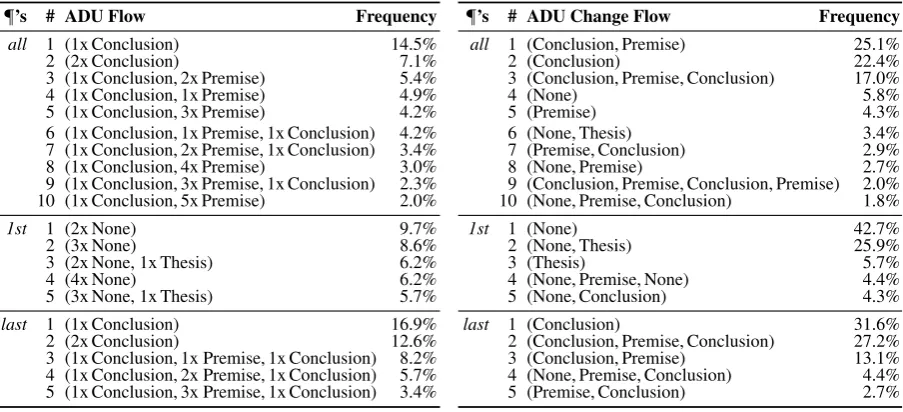
The top part of Table 3 lists the ten most frequent of the 2593 ADU flows found in the ICLE corpus. They cover about half of all paragraphs. The first two ADU flows consist of conclusions only, whereas the others show “real” argumentative structure. After a conclusion, two premises follow most often (5.4%). Still, the number of premises varies, bringing up the question whether a particular number benefits ar-gumentation quality. Patterns such as(1x Conclusion, 2x Premise, 1x Conclusion)may refer to restated conclusions but also to paragraphs that combine two arguments.
Overall, we see that all top ten ADU flows begin with a conclusion, i.e., our analysis reveals that students tend to (or are taught to) first state a claim and then argue for it. This is also supported by the top ten ADU change flows in Table 4: Every fourth paragraph matches the pattern(Conclusion, Premise), while only 2.9% order all premises first. Similarly,Noneserves for beginning a paragraph, while theses rather appear at the end. In total, the abstraction of ADU change flows seems to capture much diversity of arguments in persuasive essays: Together, the top ten represent 87.4% of all ICLE paragraphs, and all ADU types occur in at least one combination. Still, we found 319 different ADU change flows.
¶’s # ADU Flow Frequency
all 1 (1x Conclusion) 14.5%
2 (2x Conclusion) 7.1%
3 (1x Conclusion, 2x Premise) 5.4% 4 (1x Conclusion, 1x Premise) 4.9% 5 (1x Conclusion, 3x Premise) 4.2% 6 (1x Conclusion, 1x Premise, 1x Conclusion) 4.2% 7 (1x Conclusion, 2x Premise, 1x Conclusion) 3.4% 8 (1x Conclusion, 4x Premise) 3.0% 9 (1x Conclusion, 3x Premise, 1x Conclusion) 2.3% 10 (1x Conclusion, 5x Premise) 2.0%
1st 1 (2x None) 9.7%
2 (3x None) 8.6%
3 (2x None, 1x Thesis) 6.2%
4 (4x None) 6.2%
5 (3x None, 1x Thesis) 5.7%
last 1 (1x Conclusion) 16.9%
2 (2x Conclusion) 12.6%
[image:6.595.74.526.62.268.2]3 (1x Conclusion, 1x Premise, 1x Conclusion) 8.2% 4 (1x Conclusion, 2x Premise, 1x Conclusion) 5.7% 5 (1x Conclusion, 3x Premise, 1x Conclusion) 3.4% Table 3: The most frequent ADU flows inallICLE paragraphs as well as in the1standlastparagraphs.
¶’s # ADU Change Flow Frequency
all 1 (Conclusion, Premise) 25.1%
2 (Conclusion) 22.4%
3 (Conclusion, Premise, Conclusion) 17.0%
4 (None) 5.8%
5 (Premise) 4.3%
6 (None, Thesis) 3.4%
7 (Premise, Conclusion) 2.9%
8 (None, Premise) 2.7%
9 (Conclusion, Premise, Conclusion, Premise) 2.0% 10 (None, Premise, Conclusion) 1.8%
1st 1 (None) 42.7%
2 (None, Thesis) 25.9%
3 (Thesis) 5.7%
4 (None, Premise, None) 4.4%
5 (None, Conclusion) 4.3%
last 1 (Conclusion) 31.6%
2 (Conclusion, Premise, Conclusion) 27.2%
3 (Conclusion, Premise) 13.1%
4 (None, Premise, Conclusion) 4.4%
[image:6.595.78.524.307.394.2]5 (Premise, Conclusion) 2.7%
Table 4: The most frequent ADU change flows in the ICLE paragraphs (ignoring type repititions).
...
ADU n-grams ADU compositions
essay ADU flows
feature computation ... 0.500 0.200 0.200 0.100 0.333 0.222 0.111... 0.250 0.125 0.125... 0 1 2 > 2 0.333 0.000 0.333 0.333 0.333 0.667 0.000 0.000 0.667 0.333 0.000 0.000 0.667 0.333 0.000 0.000 min max mean med 0 3 1.667 2 0 1 0.667 1 0 0.667 2 0 0 1 0.333 0 n = 1
n = 2
n = 3 ADU
flow changes only
changes only + w/o none
0.333 0.333 0.333 ( ) ( ) ( ) 0.667 0.333 ( ) ( ) 0.333 0.333 0.333 ( ) ( ) ( ) ... w/o none 0.667 0.333 ( ) ( ) 0.667 0.333 ( ) ( ) w/o none
+ changes only
0.111
Figure 4: Sketch of the three feature types that we propose based on the output of argument mining.
4.4 Shallow Features for Statistical Significance
The found patterns suggest that persuasive student essays differ in the combination, ordering, and number of ADU types. For the assessment of argumentation quality, we capture these structural variations in the following three novel feature types. The types are kept shallow in order to benefit statistical significance:
ADU Flows The frequencies of all ADU flows in an essay. The hypothesis is that certain flows are fa-vorable. We also examine two flow abstractions: (1) considering changes only, as above, and (2) ignoring the non-argumentative typeNone. Arranging 0 to 2 of these abstractions allows for five flow variations.
ADU n-Grams The frequencies of all ADU typen-grams in an essay for somen≥1. The hypothesis is that certain combinations of ADU types are favorable.
ADU Compositions The proportions of paragraphs in an essay with a particular number of occurrences of a particular ADU type as well as summary statistics about each type (such as the minimum or mean). The hypothesis is that certain numbers of certain ADU types are favorable.
Figure 4 illustrates the computation of feature values of each type for a sample essay with three para-graphs. The exact feature type configuration that we used in our experiments is specified in Section 5. 5 Assessing Argumentation Quality
Finally, we analyze the benefit of mining argumentative structure for assessing argumentation quality. In particular, we evaluate the three presented feature types in argumentation-related essay scoring.
5.1 Essay Scoring Tasks
We consider four essay scoring tasks that were introduced in successive papers, each of which capturing a particular dimension of argumentation quality. These tasks can be summarized as follows:
Thesis Clarity Score the clarity of the explanation of the thesis that an essay argues for. A high score is assigned to essays, which make their thesis easy to understand (Persing and Ng, 2013).
Prompt Adherence Score the adherence of an essay’s content to the essay’s prompt. A high score is assigned to essays that consistently remain on the topic of the prompt (Persing and Ng, 2014).
Argument Strength Score the strength of the argument that an essay makes for its thesis. A high score is assigned to essays, which would convince most readers of their thesis (Persing and Ng, 2015).
Our proposed feature types solely focus on the argumentative structure of an essay—as opposed to the essay’s content or linguistic style. Accordingly, we hypothesize that the feature types are particularly successful in the organization task. To a minor extent, we expect that they also help for argument strength, because argument strength should emerge from all aspects of an essay. In contrast, the scoring of thesis clarity and prompt adherence rather seems to require an analysis of content and style respectively.
5.2 Approach
Analogue to the authors of the four mentioned papers, we tackle essay scoring with supervised regression. For this purpose, we consider our proposed feature types as well as several baseline features:
ADU Features (a) In terms of the feature types from Section 4, we rely on the following configurations:
a1 ADU flows. The frequency of each ADU flow that occurs in≥1% of all training essays. All five
flow variations described in Section 4 are taken into account.
a2 ADU n-grams. The frequency of each ADU 1-, 2-, and 3-gram that occurs in≥5% of all training
essays.+Indicators that capture the first and the last ADU 1-, 2-, and 3-gram.
a3 ADU compositions. The percentages of paragraphs with {0|1 |2|>2} occurrences of the type
{Thesis|Conclusion|Premise|None}.+The {minimum|maximum|mean|median} of each of
these ADU types per paragraph.+The percentage of each type in the first and in the last paragraph.
Flow Features (b) Persing et al. (2010) aligned sequences of four paragraph discourse functions:Body
(own argument),Rebuttal,Introduction, andConclusion. Since we cannot access their original approach, we approximate it—and also add further strong structure-oriented baseline approaches: In (Wachsmuth et al., 2014a) and (Wachsmuth et al., 2015), we captured the overall structure of a review by comparing the review’s sentiment flow to a set of common flow patterns and flow abstractions. Both the patterns and the abstractions were found in a training set before. To model the paragraph-level argumentative structure of persuasive essays, we adapt these patterns and abstractions in the following features:
b1 Function flows. All flow features defined in (Wachsmuth et al., 2014a) and (Wachsmuth et al., 2015)
based on paragraph discourse functions. Functions are found with the heuristic algorithm of Persing et al. (2010).Bodyis mapped to 1.0,Rebuttalto 0.0, and the remaining two functions to 0.5, in order to allow for numerical comparison between the flows.
b2 Sentiment flows. All flow features based on paragraph-level sentiment. A paragraph is assigned the
numerical sentiment value 1.0 (0.0), if it contains a positive (negative) but no negative (positive) sentence, otherwise 0.5. We find sentence sentiment with the algorithm of Socher et al. (2013).
b3 Relation flows. All flow features based on sentence-level discourse relations. Ten relation types from
(Mann and Thompson, 1988) are found with our rule-based algorithm (Wachsmuth et al., 2014a). For lack of an adequate mapping, we compare relation flows based on nominal differences only.
Standard Features (c) In order to be able to assess the impact of argumentative structure, we compare all structure-oriented features to two standard types of content and style features:
c1 Content. The frequency of each token 1-, 2-, and 3-gram that occurs in≥10% of all training essays.
+The minimum, maximum, and average prompt similarity (see Section 3.2) over all sentences.
c2 POS n-grams. The frequency of each part-of-speech 1-, 2-, and 3-gram that occurs in ≥ 10%,
400
300
200
100
0
1.0 1.5 2.0 2.5 3.0 3.5 4.0 score
# essays
argument strength (ø 2.76)
organization
(ø 3.05) adherenceprompt (ø 3.63)
[image:8.595.130.467.64.171.2]thesis clarity (ø 3.37)
Figure 5: Distribution of essays over the possible scores from [1.0, 4.0] in the datasets of the four tasks.
If we take a look back in time we are in a position to see man dreaming, philosophizing and using his imagination of whatever comes his way. We see man transcending his ego I a way and thus becoming a God - like figure. And by putting down these sacred words, what is taking shape in my mind is the fact that using his imagination Man is no longer this organic and material substance like his contemporary counterpart who is putting his trump card on science, technology and industrialization but Man is a way transcends himself through his imagination. For instance, if we take into account the Renaissance or Romantic periods of mankind and close our eyes we could see Shakespeare applying his imagination in the fancy world of his comedies: elf and nymphs circling the stage making it a dream that will lost forever in our minds. We could even hear their high-pitched weird chuckle piercing with a gentle touch our ears, but "open those eyes that must eclipse the day" and you'll wee the high-tech wiping out every trace of the human elevated spirit that have dominated over the previous centuries. What we see now is "deux aux machina" or the fake "God from the machine" who with the touch of a button could unleash Armageddon.
For poets and literate people of yore it was a common idea to transcend reality or to go beyond it by using their imagination not by using reason as we the homosapiens of our time do. For example, if we indulge in entertaining the idea of the film "The matrix" it has a lot to do with the period of Romanticism. But the difference is that a poet from that time could transcend reality, become one with Nature, and cruise wherever he wants using his imagination. Whereas now in the 21st century and in "The matrix" in particular the scientific type of Man thinks that at last he has succeeded in making travelling without boundaries via the virtual reality of his PC.
As a logical conclusion to my essay I would like to put only one thing. "Wouldn't it be better if imagination makes the world go round". If I was to answer this question, the answer would be positive, but given the aquisitive or consumer society conditions we live in let's make a match between imagination and science. It would be somewhat more realistic.
Prompt
Essay
Some people say that in our modern world, dominated by science and technology and industrialisation, there is no longer a place for dreaming and imagination. What is your opinion?
Scores Organization: 3.0 Thesis clarity: 2.0 Prompt Adherence: 4.0 Argument strength: 2.0
Introduction
Body
Body
Conclusion
None
[image:8.595.72.527.187.404.2]Conclusion Premise
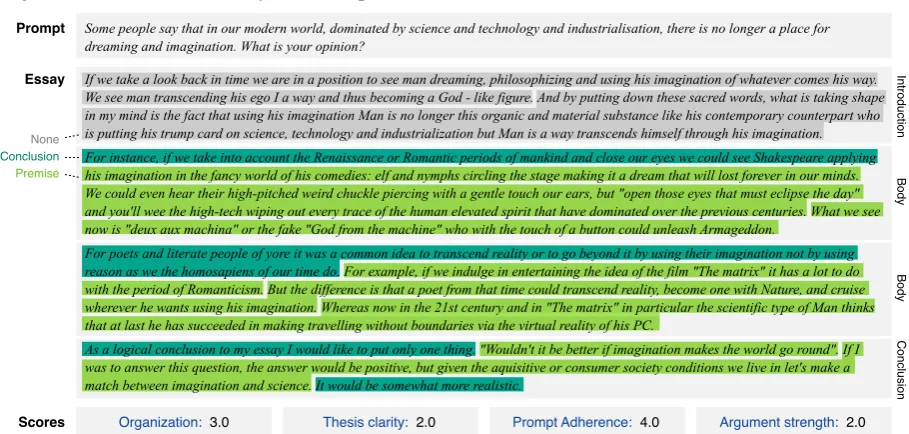
Figure 6: One essay from the four datasets together with its manually assigned scores as well as the ADU types (colored background) and discourse functions (vertical) automatically annotated by our algorithms.
5.3 Experimental Set-up
For direct comparison, we replicated the original experimental set-up of the authors of the aforemen-tioned papers on the datasets they provide for the four essay scoring tasks:
Data For each task, one distinct subset of the ICLE corpus (see Section 4) is manually annotated with half-point scores between 1.0 (worst) and 4.0 (best). These datasets cover 1003 (organization), 830 (the-sis clarity, prompt adherence), and 1000 essays (argument strength) respectively. For a rough overview, Figure 5 plots the numbers of scores in each dataset, indicating that only the organization and argument strength scores are Gaussian-like distributed. Exact numbers are found in the original papers. Figure 6 shows one essay included in all datasets with its scores and the annotations created by our algorithms.
Experiments We used linearε-SVR support vector machine regression from LibSVM in Weka 3.7 (Hall et al., 2009; Chang and Lin, 2011).6Each dataset has five predefined folds. As in the original set-up, we
performed cross-validation on these folds, training one LibSVM for each feature type and for different type combinations. Accordingly, we then also measured the mean absolute error (MAE) and the mean squared error (MSE) of regression.7 Different from the original set-up, we omitted a real optimization of
the LibSVM cost hyperparameter, but we simply set it permanently to 0.1 after a few initial tests.
Comparison We compare the proposed feature types to the described baseline features and to two gen-eral baselines: (d) Theaverage baseline, which assigns the mean score of the training essays to all test essays. Although trivial,dis quite strong under given the score distributions in Figure 5. (e) The lowest MAE and MSE values reported by the authors of the four tasks, calledPersing et al. bestbelow. To our knowledge, these results have not been beaten so far and, thus, define the state of the art until now.
6Persing and Ng (2014; 2015) relied on LibSVM, too. In the other two papers, SVMlightwas used (Joachims, 1999).
Organization Thesis Clarity Prompt Adherence Argument Strength
# Feature Type MAE MSE MAE MSE MAE MSE MAE MSE
a1 ADU flows 0.367±.022 0.234±.017 0.530±.030 0.461±.061 0.373±.033 0.247±.056 0.399±.010 0.242±.018
a2 ADU n-grams 0.369±.024 0.225±.031 0.530±.032 0.466±.065 0.372±.031 0.265±.053 0.398±.012 0.243±.017
a3 ADU compositions 0.347±.026 0.194±.020 0.529±.034 0.457±.062 0.365±.032 0.239±.046 0.390±.015 0.239±.023 a ADU features 0.336±.022 0.184±.020 0.537±.031 0.470±.056 0.368±.029 0.241±.044 0.392±.016 0.242±.023
b1 Function flows 0.368±.025 0.220±.037 0.541±.032 0.478±.063 0.370±.029 0.255±.042 0.403±.006 0.251±.011
b2 Sentiment flows 0.369±.014 0.228±.022 0.536±.031 0.481±.064 0.372±.035 0.257±.053 0.410±.009 0.259±.013
b3 Relation flows 0.426±.013 0.351±.033 0.541±.052 0.475±.074 0.368±.027 0.255±.048 0.408±.012 0.260±.014 b Flow features 0.355±.023 0.207±.026 0.559±.040 0.512±.059 0.377±.020 0.255±.038 0.415±.009 0.269±.013
c1 Content 0.415±.013 0.336±.025 0.501±.033 0.425±.064 0.362±.026 0.231±.046 0.395±.011 0.236±.018
c2 POS n-grams 0.407±.013 0.326±.032 0.528±.036 0.461±.063 0.361±.034 0.231±.048 0.387±.014 0.233±.019 c Standard features 0.408±.013 0.324±.027 0.505±.036 0.429±.065 0.357±.026 0.222±.040 0.384±.015 0.230±.020 a+ b1 0.321±.020 0.171±.019 0.551±.036 0.494±.064 0.372±.025 0.245±.038 0.400±.011 0.250±.019 a+ b2 0.328±.016 0.174±.016 0.546±.024 0.495±.049 0.374±.026 0.244±.043 0.402±.013 0.253±.018 a+ b3 0.341±.019 0.189±.018 0.544±.035 0.482±.067 0.367±.027 0.240±.043 0.405±.022 0.254±.022 a+b 0.329±.018 0.179±.020 0.565±.026 0.484±.057 0.379±.021 0.250±.037 0.421±.016 0.275±.016 a+ b1+ c1 0.315±.018 0.168±.020 0.524±.031 0.456±.057 0.361±.021 0.227±.033 0.391±.010 0.242±.019 a+ b1+ c2 0.315±.017 0.167±.017 0.546±.031 0.492±.056 0.362±.025 0.229±.033 0.389±.011 0.241±.020
* a+ b1+c 0.314±.018 0.167±.018 0.520±.032 0.450±.056 0.362±.021 0.226±.030 0.387±.012 0.238±.021 a+ b2+ c1 0.320±.016 0.167±.016 0.520±.023 0.457±.049 0.367±.024 0.230±.039 0.395±.013 0.247±.019
* a+ b2+ c2 0.316±.015 0.164±.013 0.548±.020 0.496±.046 0.364±.029 0.232±.041 0.393±.012 0.246±.019 a+ b2+c 0.320±.014 0.167±.014 0.520±.025 0.456±.051 0.363±.026 0.228±.037 0.392±.011 0.243±.020 a+ b3+ c1 0.333±.020 0.182±.017 0.520±.031 0.443±.060 0.360±.023 0.228±.037 0.397±.014 0.247±.023 a+ b3+ c2 0.326±.018 0.176±.014 0.537±.030 0.477±.057 0.363±.027 0.232±.039 0.393±.014 0.244±.024 a+ b3+c 0.328±.017 0.177±.014 0.515±.032 0.441±.054 0.359±.023 0.226±.037 0.390±.014 0.243±.024 a+b+ c1 0.321±.021 0.172±.018 0.543±.029 0.484±.055 0.376±.018 0.242±.033 0.413±.008 0.265±.014 a+b+ c2 0.315±.019 0.169±.016 0.557±.024 0.512±.049 0.375±.021 0.243±.033 0.411±.008 0.262±.014 a+b+c 0.315±.018 0.169±.015 0.543±.029 0.486±.054 0.375±.017 0.241±.032 0.409±.008 0.259±.014
a3+ c1 0.335±.022 0.182±.018 0.505±.036 0.431±.061 0.356±.029 0.221±.043 0.383±.016 0.230±.024
** a3+ c2 0.329±.018 0.177±.013 0.529±.033 0.463±.062 0.354±.033 0.221±.042 0.380±.016 0.229±.024
** a3+c 0.330±.017 0.178±.014 0.508±.036 0.435±.061 0.352±.027 0.216±.038 0.378±.017 0.226±.025 b+ c1 0.344±.024 0.196±.026 0.531±.014 0.464±.066 0.372±.015 0.242±.015 0.406±.012 0.257±.015 b+ c2 0.336±.018 0.189±.022 0.552±.013 0.450±.056 0.369±.022 0.242±.017 0.404±.015 0.255±.015 b+c 0.336±.018 0.189±.021 0.531±.015 0.465±.064 0.368±.017 0.237±.016 0.400±.015 0.250±.015 d Average baseline 0.425±.016 0.349±.030 0.545±.036 0.469±.084 0.370±.038 0.291±.055 0.407±.014 0.266±.018
[image:9.595.67.525.64.426.2]e Persing et al. best 0.323 0.175 0.483 0.369 0.348 0.197 0.392 0.244
Table 5: The mean average error (MAE) and the mean squared error (MSE)±their standard deviations for each evaluated feature type and type combination in the four essay scoring tasks. All values marked in bold outperform the former state of the art (calledPersing et al. besthere). The most significant results for organization and argument strength each are marked with * and ** respectively.
5.4 Results
Table 5 lists the two mean regression errors and their standard deviations for each single feature type in isolation and for a selection of feature type combinations, averaged over the respective five folds for each of the four evaluated essay scoring tasks.8
With respect to the single feature types in the upper part, we see that the ADU compositions (a3)
con-sistently perform best among all structure-oriented features (a1–a3, b1–b3) in all four tasks. The ADU
flows (a1) and ADU n-grams (a2) behave comparable to the function flows (b1) and sentiment flows (b2).
The relation flows (b3) compete with most others only in scoring prompt adherence, possibly suggesting
that the impact of discourse structure on argumentation quality is limited.9
Matching our hypothesis from Section 5.1, the structure-oriented features clearly outperform the stan-dard features (c) in scoringorganization, as shown in the left part of Table 5. In fact, c1 and c2 hardly
improve over the average baseline (d). In isolation, the complete ADU feature set (a) produces the lowest errors; an MAE of 0.336 and an MSE of 0.184. Since the quality of the organization of an essay naturally depends on the essay’s argumentative structure, this result underpins the adequacy of our features. More-over,aoutperforms the best values we measured without using ADU features (those ofb+c). Combined with function flows (a+ b1) or with sentiment flows (a+ b2), the ADU features already beat Persing et
8We did not perform explicit feature ablation tests, because they would provide limited insights only: As we did not optimize the LibSVM cost hyperparameter, leaving out one feature type does not necessarily lead to an increase of the regression errors.
9One reason for the low impact of b
al. best (e). The smallest MSE is achieved by the ADU features with sentiment flows and POS n-grams (a+ b2+ c2). According to a one-sided student t-test, the value 0.164 is significant atp <0.1.
As expected, all structure-oriented features fail in case ofthesis clarity, being only slightly better than the average baseline (d) if at all. The lowest errors (MAE 0.501, MAE 0.425) are observed for the content features (c1). Still, c1cannot compete withe—the respective approach of Persing and Ng (2013)
employs keyword features that were manually derived from the prompts of all essays.
For prompt adherence, at least the errors produced by the ADU compositions (a3) are close to those
of c1 and c2, which is why we additionally tested a3 in combination with the standard feature types. As
shown in the bottom part of Table 5, a3+cperforms best with an MAE of 0.352 and an MSE of 0.216.
These values are not significantly worse than the state of the art (e).
a3+calso minimizes the errors in scoringargument strength. Both the MAE of 0.378 and the MSE of
0.226 are significantly better than Persing et al. best (e) atp <0.1. Again, this observation supports our hypothesis: The strength of an essay’s argumentation will hardly ever be independent from the essay’s content, but it still benefits from a good argumentative structure. Interestingly, even a3 alone improves
overewith an MAE of 0.390 (vs. 0.392) and an MSE of 0.239 (vs. 0.244).
We conclude that our approach denotes the new state of the art for two essay scoring tasks. Under the assumption that the manual score annotations in the processed datasets are adequate, our hypothesis that the benefit of argument mining is high for scoring an essay’s organization turns out true. Compared to the findings of Persing et al. (2010), the obtained results thereby reveal that organization is not only about the ordering of discourse functions, but also about argumentative structure. In particular, the novel features that we proposed capture only such structural aspects. Accordingly, their impact is low for thesis clarity and also only fair for prompt adherence, underlining that these tasks are rather related to the content and style of an argumentation. In contrast, argument strength brings together structure and content, and this is indeed reflected by the moderate but significant benefit of our structure-oriented features there. 6 Conclusion
Although argument mining has become a hot topic, the question of what practical benefits it provides for applications has hardly been examined yet. In the paper at hand, we have approached this question for a specific but important task, namely, we have used argument mining to assess argumentation quality. Our results for persuasive student essays underpin the benefit of argument mining, revealing that the mined argumentative structure is particularly helpful for structure-related quality dimensions: Without putting emphasis on the content of arguments, we have improved the state of the art in scoring an essay’s organi-zation and even in scoring its argument strength. Our best-performing features capture the composition of types of units in arguments (such as premises and conclusions).
Similar to existing approaches, the mining algorithm we trained and applied in this paper misclassifies about one out of four units. So far, we could not analyze the impact of mining errors on the effectiveness of our essay scoring approaches, since ground-truth data is needed before that brings together argumen-tative structure and argumentation quality. A question that remains open in this regard is what model of argumentative structure proves most suitable. As adequate training data is still limited, we have modeled shallow unit types only, but we expect that considering attack and support relations, evidence types, or argumentation schemes will prove useful for quality assessment.
Naturally, other quality dimensions of argumentation will depend more on content, so our analysis of argumentative structure does not solve the assessment of argumentation quality in general. Also, essay structure is quite conventionalized, i.e., a transfer of our findings to other argumentative text genres requires further investigation. We plan to continue our research in this regard based on our new corpus for the analysis of argumentation strategies in news editorials (Al-Khatib et al., 2016).
In practice, our approach in its given form most notably contributes to educational applications that analyze argumentative texts, such as automatic grading and writing support systems. These systems need not only mine argumentative structure, but also evaluate the mined structure.10 To support argumentation
quality, another step is then to synthesize suggestions for improvements. We leave this to future work.
References
Khalid Al-Khatib, Henning Wachsmuth, Johannes Kiesel, Matthias Hagen, and Benno Stein. 2016. A News
Editorial Corpus for Mining Argumentation Strategies. InProceedings of the 26th International Conference on
Computational Linguistics.
J. Anthony Blair. 2012. Relevance, Acceptability and Sufficiency Today. InGroundwork in the Theory of
Argu-mentation, pages 87–100.
John Blitzer, Koby Crammer, Alex Kulesza, Fernando Pereira, and Jenn Wortman. 2008. Learning Bounds for
Domain Adaptation. InAdvances in Neural Information Processing Systems 21. MIT Press.
Filip Boltuži´c and Jan Šnajder. 2015. Identifying Prominent Arguments in Online Debates Using Semantic Textual
Similarity. InProceedings of the Second Workshop on Argumentation Mining, pages 110–115.
Jill Burstein, Karen Kukich, Susanne Wolff, Chi Lu, and Martin Chodorow. 1998. Enriching Automated Essay
Scoring Using Discourse Marking. InDiscourse Relations and Discourse Markers, pages 15–21.
Elena Cabrio and Serena Villata. 2012. Combining Textual Entailment and Argumentation Theory for Supporting
Online Debates Interactions. InProceedings of the 50th Annual Meeting of the Association for Computational
Linguistics: Short Papers, pages 208–212.
Chih-Chung Chang and Chih-Jen Lin. 2011. LIBSVM: A Library for Support Vector Machines. ACM
Transac-tions on Intelligent Systems and Technology, 2:27:1–27:27.
Danish Contractor, Yufan Guo, and Anna Korhonen. 2012. Using Argumentative Zones for Extractive
Summariza-tion of Scientific Articles. InProceedings of the 24th International Conference on Computational Linguistics,
pages 663–678.
Semire Dikli. 2006. An Overview of Automated Scoring of Essays. Journal of Technology, Learning, and
Assessment, 5(1).
Phan Minh Dung. 1995. On the Acceptability of Arguments and its Fundamental Role in Nonmonotonic
Reason-ing, Logic Programming and n-Person Games.Artificial Intelligence, 77(2):321–357.
Adam Robert Faulkner. 2014. Automated Classification of Argument Stance in Student Essays: A Linguistically
Motivated Approach with an Application for Supporting Argument Summarization. Dissertation, City University of New York.
Vanessa Wei Feng, Ziheng Lin, and Graeme Hirst. 2014. The Impact of Deep Hierarchical Discourse Structures
in the Evaluation of Text Coherence. InProceedings of the 25th International Conference on Computational
Linguistics: Technical Papers, pages 940–949.
James B. Freeman. 2011.Argument Structure: Representation and Theory. Springer.
Debanjan Ghosh, Aquila Khanam, Yubo Han, and Smaranda Muresan. 2016. Coarse-grained Argumentation
Features for Scoring Persuasive Essays. In Proceedings of the 54th Annual Meeting of the Association for
Computational Linguistics, pages 549–554.
Sylviane Granger, Estelle Dagneaux, Fanny Meunier, and Magali Paquot. 2009. International Corpus of Learner English (Version 2).
Ivan Habernal and Iryna Gurevych. 2015. Exploiting Debate Portals for Semi-Supervised Argumentation Mining
in User-Generated Web Discourse. InProceedings of the 2015 Conference on Empirical Methods in Natural
Language Processing, pages 2127–2137.
Mark Hall, Eibe Frank, Geoffrey Holmes, Bernhard Pfahringer, Peter Reutemann, and Ian H. Witten. 2009. The
WEKA Data Mining Software: An Update.SIGKDD Explorations, 11(1):10–18.
Thorsten Joachims. 1999. Advances in Kernel Methods. chapter Making Large-scale Support Vector Machine Learning Practical, pages 169–184. MIT Press, Cambridge, MA, USA.
William C. Mann and Sandra A. Thompson. 1988. Rhetorical Structure Theory: Toward a Functional Theory of
Text Organization. Text, 8(3):243–281.
Raquel Mochales and Marie-Francine Moens. 2011. Argumentation Mining. Artificial Intelligence and Law,
19(1):1–22.
Marie-Francine Moens, Erik Boiy, Raquel Mochales Palau, and Chris Reed. 2007. Automatic Detection of
Arguments in Legal Texts. InProceedings of the 11th International Conference on Artificial Intelligence and
Nathan Ong, Diane Litman, and Alexandra Brusilovsky. 2014. Ontology-Based Argument Mining and Automatic
Essay Scoring. InProceedings of the First Workshop on Argumentation Mining, pages 24–28.
Andreas Peldszus and Manfred Stede. 2013. From Argument Diagrams to Argumentation Mining in Texts: A
Survey.International Journal of Cognitive Informatics and Natural Intelligence, 7(1):1–31.
Andreas Peldszus and Manfred Stede. 2015. Joint Prediction in MST-style Discourse Parsing for Argumentation
Mining. InProceedings of the 2015 Conference on Empirical Methods in Natural Language Processing, pages
938–948.
Isaac Persing and Vincent Ng. 2013. Modeling Thesis Clarity in Student Essays. In Proceedings of the 51st
Annual Meeting of the Association for Computational Linguistics - Volume 1: Long Papers, pages 260–269.
Isaac Persing and Vincent Ng. 2014. Modeling Prompt Adherence in Student Essays. InProceedings of the 52nd
Annual Meeting of the Association for Computational Linguistics - Volume 1: Long Papers, pages 1534–1543.
Isaac Persing and Vincent Ng. 2015. Modeling Argument Strength in Student Essays. InProceedings of the 53rd
Annual Meeting of the Association for Computational Linguistics and the 7th International Joint Conference on Natural Language Processing, pages 543–552.
Isaac Persing, Alan Davis, and Vincent Ng. 2010. Modeling Organization in Student Essays. InProceedings of
the 2010 Conference on Empirical Methods in Natural Language Processing, pages 229–239.
Ruty Rinott, Lena Dankin, Carlos Alzate Perez, Mitesh M. Khapra, Ehud Aharoni, and Noam Slonim. 2015. Show
Me Your Evidence – An Automatic Method for Context Dependent Evidence Detection. InProceedings of the
2015 Conference on Empirical Methods in Natural Language Processing, pages 440–450.
Helmut Schmid. 1995. Improvements in Part-of-Speech Tagging with an Application to German. InProceedings
of the ACL SIGDAT-Workshop, pages 47–50.
Richard Socher, Alex Perelygin, Jean Wu, Jason Chuang, Christopher D. Manning, Andrew Y. Ng, and Christo-pher Potts. 2013. Recursive Deep Models for Semantic Compositionality Over a Sentiment Treebank. In Proceedings of the 2013 Conference on Empirical Methods in Natural Language Processing, pages 1631–1642. Yi Song, Michael Heilman, Beata Beigman Klebanov, and Paul Deane. 2014. Applying argumentation schemes
for essay scoring. InProceedings of the First Workshop on Argumentation Mining, pages 69–78.
Christian Stab and Iryna Gurevych. 2014a. Annotating Argument Components and Relations in Persuasive Essays. In Proceedings of the 25th International Conference on Computational Linguistics: Technical Papers, pages 1501–1510.
Christian Stab and Iryna Gurevych. 2014b. Identifying Argumentative Discourse Structures in Persuasive Essays. InProceedings of the 2014 Conference on Empirical Methods in Natural Language Processing, pages 46–56. Simone Teufel, Advaith Siddharthan, and Colin Batchelor. 2009. Towards Discipline-independent Argumentative
Zoning: Evidence from Chemistry and Computational Linguistics. InProceedings of the 2009 Conference on
Empirical Methods in Natural Language Processing, pages 1493–1502.
Stephen E. Toulmin. 1958.The Uses of Argument. Cambridge University Press.
Henning Wachsmuth, Martin Trenkmann, Benno Stein, and Gregor Engels. 2014a. Modeling Review
Argumen-tation for Robust Sentiment Analysis. InProceedings of the 25th International Conference on Computational
Linguistics: Technical Papers, pages 553–564.
Henning Wachsmuth, Martin Trenkmann, Benno Stein, Gregor Engels, and Tsvetomira Palakarska. 2014b. A
Review Corpus for Argumentation Analysis. InProceedings of the 15th International Conference on Intelligent
Text Processing and Computational Linguistics, pages 115–127.
Henning Wachsmuth, Johannes Kiesel, and Benno Stein. 2015. Sentiment Flow – A General Model of Web
Review Argumentation. InProceedings of the 2015 Conference on Empirical Methods in Natural Language
Processing, pages 601–611, Lisbon, Portugal.
Henning Wachsmuth. 2015. Text Analysis Pipelines—Towards Ad-hoc Large-scale Text Mining, volume 9383 of
Lecture Notes in Computer Science. Springer.
Douglas Walton, Christopher Reed, and Fabrizio Macagno. 2008. Argumentation Schemes. Cambridge University