Volume 5, No. 7, September-October 2014
International Journal of Advanced Research in Computer Science
RESEARCH PAPER
Available Online at www.ijarcs.info
Simulation and Analysis of Routing protocols in VANET using NS2 Simulator
Priyanka Goyal and Anish SoniDept. of Comp. Science and Engineering, HCTM Kaithal, Kurukshetra University Kurukshetra, India
Abstract: Vehicular Adhoc Network (VANET) is the emerging technology which enables the vehicles to communicate using wireless technologies. VANET is developed for providing the safety purpose and driving comfort to the people. VANET use the vehicle as moving nodes as in MANET (Mobile Adhoc Network). The communication among vehicles is done by using the efficient routing protocols which direct the routes. This communication can be direct within the vehicles or it can be between vehicles and road side units (RSUs).
In this paper we exploit three routing protocols of VANET which are GPSR, DSDV and BMFR by comparing their three parameters throughput, end to end delay and number of packets dropped during communication. As we study out of this three protocols BMFR and GPSR are position based routing protocol and DSDV is topology based routing. In this paper we also simulate these protocols using NS2 simulator and using the standard protocol i.e. IEEE 802.11 p in Vehicular Adhoc Network.
Keywords:- Vehicular Adhoc Network (VANET), Dedicated Short Range Communication (DSRC), Wireless Access in Vehicular Environment (WAVE), Mobile Adhoc Network (MANET), Road Side Units (RSUs).
I. INTRODUCTION
Many of people around the world die every year in car accidents and many more are injured. Implementations of safety information such as speed limits and road conditions are used in many parts of the world but still more work is required for safety purpose. Vehicular Ad Hoc Networks (VANET) when implemented, collect and distribute safety information to massively reduce the number of accidents by warns the drivers about the danger before they actually face it. VANETs are composed for a set of communicating vehicles equipped with wireless network devices that are able to interdependent upon each other without any pre-existing infrastructure (ad-hoc mode). The most important network technology available nowadays for establishing VANETs is the IEEE 802.11b (Wi-Fi) standard, nevertheless new standards as IEEE 802.11p or IEEE 802.16 (WiMax) are encouraging. The exchange of information among the vehicles provides a great opportunity for the development of new driver assistance systems. These systems will be able to distribute and to gather real time information about the other vehicles and the road traffic and environmental conditions. Such data will be processed and analyzed to facilitate the driving by providing the user with useful information.
This kind of networks are self-configuring networks composed of a collection of vehicles and elements of roadside infrastructure connected with each other without requiring an underlying infrastructure, sending and receiving information and warnings about the current traffic situation. Such network consists of sensors and On Board Units (OBU) installed in the car as well as Road Side Units (RSU) in Vehicle to Infrastructure communication (V2I). The data collected from the sensors on the vehicles can be displayed to the driver, sent to the RSU or even broadcasted to other vehicles depending on its nature and importance. The RSU further distributes this data, along with data from road sensors, weather centers, traffic control centers, etc to the vehicles and also present with commercial services such as
parking space booking, internet access and gas payment. V2I communication is shown in fig1.
A vehicle collects the protection and alternative info and re-distribute to alternative vehicles with the assistance of V2V and V2X communication, as for instance the warning message is shipped to drivers regarding the danger before they really face it.
In this paper we summarized the literature survey in 2nd section and then talk about the routing protocols which are being to be simulated in 3rd section. In next section result and conclusion is made on the basis of simulation in ns-2 simulator.
II. LITERATURE SURVEY
Ad hoc (or self-organizing) networks used without a predefined fixed (managed) infrastructure. Vehicular ad hoc networks (VANETs) based on 802.11-based WLAN technology have recently received considerable attention in many projects (e.g., VIC’S [4], CarTALK 2000 [2], NOW (Network-on- Wheels)) and industry groups (e.g., the Car2Car Communication Consortium [3].
Every channel is one hundred megacycle per second wide. In 2003, American Society for Testing and Materials (ASTM) sets ASTM-DSRC that was entirely supported 802.11 raincoat layer and IEEE 802.11a physical layer [5].
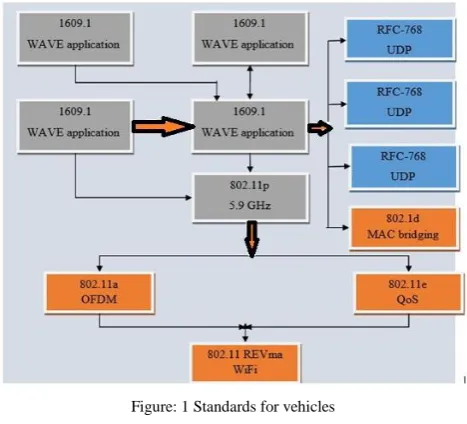
The main downside with IEEE 802.11a with rate of 54 Mbps is it suffers from multiple overheads. Transport eventualities demands high speed information transfer and quick communication due to its high topological amendment and high quality. For this the DSRC is renamed to IEEE 802.11p Wireless Access in conveyance Environments (WAVE) by the ASTM working party. One channel is restricted for safety communications only while two other channels are reserved for special purposes (such as critical safety of life and high power public safety). All the remaining channels are service channels which can be used for either safety or non-safety applications. Wireless Access in conveyance atmosphere (WAVE) pivots on IEEE 1609. Organization is being standardized as IEEE 802.11p for special conveyance communication. [1].
Figure: 1 Standards for vehicles
III. ROUTING PROTOCOLS
Routing protocols are divided into Topology primarily based, position primarily based, Cluster primarily based, Geo cast primarily based and broadcast based. During this section, we tend to survey on Topology based and position based routing protocols employed in VANET implementations.
A. Topology Based Routing Protocols:
Topology based routing protocol is divided into proactive and reactive routing protocols. In proactive routing protocols, no route discovery takes place as the routes are predefined. Maintenance of unused routes leads to high network load. AODV: Ad Hoc on Demand distance Vector Routing, DSDV: Destination-Sequenced Distance-Vector Routing, OLSR: Optimized Link State Routing Protocol, FSR: Fisheye state routing, CGSR: Cluster Head Gateway Switch Routing, WRP: The Wireless Routing Protocol, TBRPF: Topology Dissemination Based on Reverse-Path Forwarding, etc. are some of the proactive routing protocols [6].
a. Destination Sequenced Distance Vector (DSDV):
The Destination-Sequenced Distance-Vector (DSDV) Routing Algorithm is based on the idea of the classical
Bellman-Ford Routing Algorithm with certain improvements [7]. Every mobile station maintains a routing table that lists all available destinations, the number of hops to reach the destination and the sequence number assigned by the destination node. The sequence number is used to distinguish stale routes from new ones and thus avoid the formation of loops.
The stations periodically transmit their routing tables to their immediate neighbors. A station also transmits its routing table if a significant change has occurred in its table from the last update sent. So, the update is both time-driven and event-driven. The routing table updates can be sent in two ways: - a "full dump" or an incremental update. A full dump sends the full routing table to the neighbors and could span many packets whereas in an incremental update only those entries from the routing table are sent that has a metric change since the last update and it must fit in a packet. If there is space in the incremental update packet then those entries may be included whose sequence number has changed. When the network is relatively stable, incremental updates are sent to avoid extra traffic and full dump are relatively infrequent.
Figure: 2 DSDV Protocol
B. Position Based Routing:
Position is one in every of the first vital knowledge for vehicles. In VANET every vehicle necessarily to grasp its own position as well as its neighbor vehicle’s position. A routing protocol take in position data is called the position based mostly routing protocol. Position based mainly routing protocols need the knowledge concerning the physical location of collaborating vehicles be obtainable. This position is obtained by sporadically transmitted management messages or beacons to the direct neighbors. A sender will request the position of a receiver by suggests that of a location service. Position based mostly routing protocols square measure a lot of appropriate for VANETs since the transport nodes square measure renowned to maneuver on established ways. Since routing tables aren't employed in these protocols so no overhead is incurred once tracing a route [8].
ID, location, speed, and a timestamp. One amongst the most blessings of exploitation position primarily based routing protocol is that it's characteristic of not requiring maintenance of routes, that is extremely applicable for extremely dynamic networks like VANETs.
a. Greedy Perimeter Stateless Routing:
Greedy Perimeter Stateless Routing, GPSR, may be a correspondent and economical routing protocol for mobile, wireless networks. not like organized routing algorithms before it, that use graph-theoretic notions of shortest ways and transitive reachability to search out routes, GPSR utilizes the correspondence between geographic position and property in a very wireless network, by exploitation the positions of nodes to form packet forwarding choices. GPSR uses greedy forwarding to forward packets to nodes that square measure invariably more and more nearer to the destination. In regions of the network wherever such a greedy path doesn't exist (i.e., the sole path needs that one move briefly farther far away from the destination), GPSR recovers by forwarding in perimeter mode, during which a packet traverses in turn nearer faces of a flat sub graph of the complete radio network property graph, till reaching a node nearer to the destination, wherever greedy forwarding resumes [9].
In some cases, once salutation messages deviate because of temporary transmission errors, some vehicles become unaware of subsisting of its neighbors. But in some regions of the network, an area most might occur once a forwarding node has no neighbor that is nearer to the destination than itself. During this scenario GPSR uses a most advance recovery strategy known as perimeter routing that uses associate algorithmic rule of plane graph traversal to seek out how out of the native most region. Though this advancement, considering solely position info might lead packets to be forwarded in a very wrong direction and loses thus, smart candidates that guarantee its delivery. Since the topology of a transport network in urban or town setting is probably going to satisfy native most, we've turned recovery strategy of perimeter routing on throughout our experiments.
b. Border-node Most Forward Radius:
Next-hop forwarding technique like greedy forwarding theme for linear network doesn't support well in extremely mobile accidental network like conveyance accidental network. Therefore, alternative position primarily based protocols like MFR, GEDIR, Compass routing, etc. are used for VANET to boost its performance for non-linear network in an exceedingly high conveyance density setting. These protocols are often additional improvement by utilizing farthest one-hop node in an exceedingly dense and extremely mobile network. Border-node (based mostly primarily based), most Forward among Radius (B-MFR) (RAW, 2012) could be a position based routing protocol that uses Border Nodes with most projection.
The B-MFR [10] utilizes the border-node to avoid mistreatment interior nodes among the transmission vary for additional sending the packet. This technique selects the border-node as a next-hop node for forwarding packet from supply to destination. During this technique, a packet is shipped to the border-node with the best progress because the distance between supply and destination projected onto the road drawn from supply to Destination.
Border-node primarily based Most Forward within Radius routing (B-MFR) that uses the construct of border-node within the sender's communication vary to cut back the quantity of hops between offer and destination. The B-MFR utilizes the border-node to avoid mistreatment interior nodes inside the transmission vary for more transmittal the packet. Next-hop forwarding methodology like greedy forwarding theme for linear network doesn't support well in extremely mobile unexpected network like conveyance unexpected network.
B-MFR improves data delivery in various scenarios of VANET’s. Especially, B-MFR is designed to efficiently route the packets with small number of hops and therefore, small delay. Its uses the concepts of border-node of the sender’s communication range to minimize the number of the hops between source and destination.
c. Simulation and Implementation Result:
Simulations were carried for position based routing protocols the well-known GPSR, BMFR and a topology based routing protocol i.e. DSDV which is also well known protocol. The simulation carried out for 10, 20, 40 and 60 vehicles. This part discusses the parameters taken for comparison and the actual simulation results. We consider an open traffic scenario where vehicles are moving that are shown below in snapshot of NAM file in figure.
Figure: 3 Snapshot of NAM file
d. Parameters for simulation:
The three protocols discussed above were compared in terms of following parameters.
e. Packet delivery ratio:
Packet delivery ratio is the ratio of numbers of packets delivered to a destination to the number of packet sent by a source(s). It stands for the level of data delivered to the destination.
Mathematically Packet Delivery Ratio is given by: PDR = Sd/Ss * 100, Where
Sd = Sum of packet received by the destination(s) Ss = sum of packet sent by a source (s)
This parameter can alternatively be studied as packet drop ratio, which basically the ratio of packet dropped to the number of packet sent.
Graph 1: Average PDR of B-MFR, GPSR and DSDV
As shown in graph 1, the values of DSDV decrease when the numbers of nodes were increases. But in the case of B-MFR and GPSR, packet delivery ratio increases as number of nodes increases from 10 nodes to 60 nodes.
f. End to End Delay:
End to end delay refers to the time taken by a packet to reach the destination from the source. That is, the time difference between the time when the packet was received by the receiver and the time packet was sent by the source. This includes any delays that occur during transmission: a) Transmission delay
b) Propagation delay c) Processing delay d) Queuing delay
All these delays occur at each router. So mathematically end to end delay can be written as:
E= N (T+P+PR+Q), where
Lower the value of end to end delay better is protocol
Graph 2: Average End to End delay of GPSR, BMFR and DSDV
g. Throughput:
Throughput is the ratio of packets (bits) received to the time period over which the transmission takes place. Or in the other words throughput is the rate of successful message delivery.
Mathematically:
Throughput= Nb/T, where
Nb = number of bits (or data packets) successfully received. T = time for transmission.
Throughput is generally measured in bits per second or kilobits per second (kbps). Other than bps, throughput might sometime be measured in data packets received per second or per time unit. Higher the throughput better is the performance of the protocol.
Throughput is sometimes used to measure the bandwidth utilization of channel.
Graph 3: Average Throughput of GPSR, BMFR and DSDV
IV. CONCLUSION
In this paper, I mentioned many VANET protocols. Position of the vehicle is one of the foremost necessary information for vehicles. Position based mostly routing protocols would concerning the physical location of the collaborating vehicles to be created on the market. When analyzing the survey of protocols, it's found that the position based mostly routing has higher performance than topology based routing protocol in some manner as a result of there's no creation and maintenance of worldwide route from supply node to goal node. Within the position based routing protocol the average delay, higher turnout, and effective utilization and together helps to prevent the accidents on the road effectively. In future these protocols also can be used for any analysis in VANET.
These thesis work briefly describe the two position based routing protocols and one topology based routing protocol. Its included details of the three position based and topology based routing protocols i.e. GPSR, DSDV and BMFR. In the thesis work, discussion of the three routing protocols and drawn the conclusion that is routing protocols has its own advantages and disadvantages in particular senior. And benefits and drawbacks of VANET Routing protocols are mentioned. Judge the performance varied protocols in VANET will be evaluated supported varied performance parameters. Equivalence could also be done
between the routing protocols among the Overlay thus on. When number of nodes increases BMFR proves to be a better protocol in terms of packet delivery ratio and end to end delay as compared to GPSR and DSDV. GPSR shows better results in term of throughput.
V. REFERENCES
[1]. Ghassan Samara, Wafaa A.H. A1-Salihy, R. Sures, National Advanced IPv6 Center, Univeristi Sains, Penang, Malaysia, ”Security Issues and Challenges of Vehicular Ad Hoc Networks (VANET)”, IEEE 2009.
[2]. Li. F., Wang.Y. (2007): Routing in Vehicular Ad Hoc Networks: A Survey. IEEE Vehicular Magazine.
[3]. Uma Nagaraj, Dr. M. U. Kharat, Poonam Dhamal,”Study of Various Routing Protocols in VANET”, IJCST Vol. 4, ISSue 4, OCT.-DeC. 2011.
[4]. Raw R.S., Lobiyal D.K., “B-MFR Routing Protocol for Vehicular Ad hoc Networks”, IEEE, ICNIT 2010, Manila, Philippines 2010.
[5]. Benslimane, A. (2005). "Localization in Vehicular Ad Hoc Networks". Proceedings Systems Communications. Montreal, Que., Canada: IEEE.
[6]. Sangheethaa, S., Lakshmi, R., & Rani, S. (2013)." Intersection Based Traffic Aware Routing In VANET". International Journal of Digital Information and Wireless Communications (IJDIWC).
[7]. Ramesh, V., Subbaiah, D. P., Rao, N. K., & Janardhana Raju, M. (2010). "Performance comparison and analysis of DSDV and AODV for MANET", vol. 02, pp 183-188, International Journal on Computer Science and Engineering.
[8]. Bako, B., Schoch, E., Kargl, F., & Weber, M. (2008). "Optimized Position Based Gossiping in VANETs", 68th Vehicular Technology Conference. pp 1-5. IEEE.
[9]. Kim, Y.-J., Govindan, R., Karp, B., & Shenker, S. (2005). "Geographic Routing Made Practical, Second USENIX/ACM Symposium on Networked System Design and Implementation”. Berkeley, CA, USA: ACM DL. [10]. Priyanka Goyal, Anish Soni, Ashu Dalal & Arun Jain, “