ISSN(Online): 2319-8753
ISSN (Print): 2347-6710
I
nternational
J
ournal of
I
nnovative
R
esearch in
S
cience,
E
ngineering and
T
echnology
(An ISO 3297: 2007 Certified Organization)Vol. 6, Special Issue 11, May 2017
Effect of Shape and Plan Configuration on
Seismic Response of Structure
Dnyaneshkumar H. Lanjewar1, Prof. Ameya Khedikar2
Student, Department of Civil Engineering Tulsiramji Gaikwad College of Engg. And Technology Nagpur,
Maharashtra, India1
Assistant Professor, Department of Civil Engineering Tulsiramji Gaikwad Patil College of Engg. And Technology
Nagpur, Maharashtra, India2
ABSTRACT: Earthquake is a very important aspect to be considered while designing structures. Lot of work has been
reported by many researchers who worked to study the effect of structures with irregular plan and shape. Being inspired from the work contributed in the study on effects of earthquake on irregular shaped building in plan, this paper presents effects of plan and shape configuration on irregular shaped structures. Buildings with irregular geometry respond differently against seismic action. Plan geometry is the parameter which decides its performance against different loading conditions. The effect of irregularity (plan and shape) on structure have been carried out by using structural analysis software STAAD Pro. V8i. There are several factors which affect the behaviour of building from which storey drift and lateral displacement play an important role in understanding the behaviour of structure. Results are expressed in form of graphs and bar charts. It has been observed from the research that simple plan and configuration must be adopted at the planning stage to minimize the effect of earthquake.
KEYWORDS: Irregular building, Irregular plan, Irregular shape, Storey drift, Lateral displacement.
I. INTRODUCTION
Buildings are the complex system and multiple items have to be considered. Hence at the planning stage itself, architects and structural engineers must work together to ensure that the unfavourable features are avoided and good building configuration is chosen. If we have a poor configuration to start with, all that engineers can do is to provide a band-aid i.e. improve a basically poor solution as best as he can. [5]. Conversely, if we start off with a good configuration and reasonable framing system, even a poor engineer cannot harm its ultimate performance too much. But constructions can suffer diverse damages when they put under seismic excitations, although for same structural configuration, region, EQ damages in the systems are neither uneven nor homogenous. A desire to create an aesthetic and functionally efficient structure drives architects to conceive wonderful and imaginative structures. [5]. Sometimes the shape of building catches the eye of visitor, sometimes the structural system appeals, and in other occasions both shape and structural system work together to make the structure a Marvel. However, each of these choices of shapes and structure has significant bearing on the performance of building during strong earthquake. So the symmetry and regularity are usually recommended for a sound design of earthquake resistant structure.[3]
II. SYSTEM DEVELOPMENT
ISSN(Online): 2319-8753
ISSN (Print): 2347-6710
I
nternational
J
ournal of
I
nnovative
R
esearch in
S
cience,
E
ngineering and
T
echnology
(An ISO 3297: 2007 Certified Organization)Vol. 6, Special Issue 11, May 2017
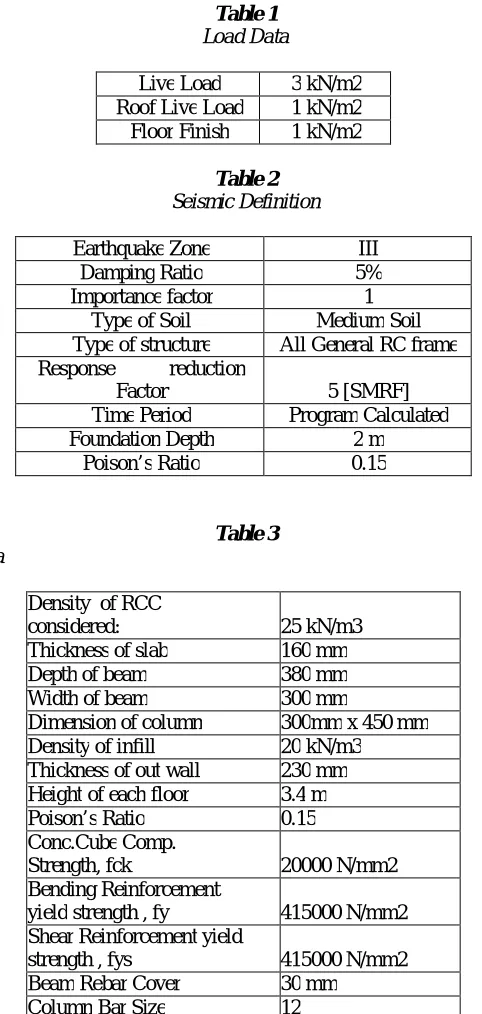
adopted in order to design buildings and overcome effect of earthquake on it. In this study I have performed static analysis as per IS 1893-2002. To study the effect of irregular plan and shape configuration I have developed 9 models in STAAD Pro V8i software. Various types of input data to model the all the 9 models were kept same to obtain the predicted behaviour. Various types of data adopted for creating the models are as under,
Table 1
Load Data
Live Load 3 kN/m2 Roof Live Load 1 kN/m2 Floor Finish 1 kN/m2
Table 2
Seismic Definition
Earthquake Zone III
Damping Ratio 5%
Importance factor 1
Type of Soil Medium Soil Type of structure All General RC frame Response reduction
Factor 5 [SMRF]
Time Period Program Calculated
Foundation Depth 2 m
Poison’s Ratio 0.15
Table 3
Geometric and Material Data
Density of RCC
considered: 25 kN/m3
Thickness of slab 160 mm
Depth of beam 380 mm
Width of beam 300 mm
Dimension of column 300mm x 450 mm Density of infill 20 kN/m3 Thickness of out wall 230 mm Height of each floor 3.4 m
Poison’s Ratio 0.15
Conc.Cube Comp.
Strength, fck 20000 N/mm2
Bending Reinforcement
yield strength , fy 415000 N/mm2 Shear Reinforcement yield
strength , fys 415000 N/mm2
Beam Rebar Cover 30 mm
ISSN(Online): 2319-8753
ISSN (Print): 2347-6710
I
nternational
J
ournal of
I
nnovative
R
esearch in
S
cience,
E
ngineering and
T
echnology
(An ISO 3297: 2007 Certified Organization)Vol. 6, Special Issue 11, May 2017
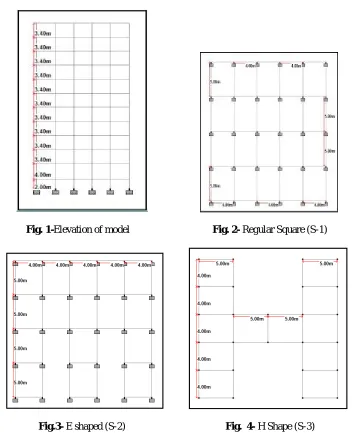
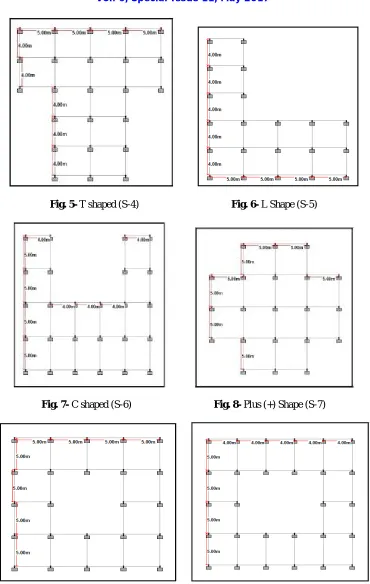
These 9 models are shaped by considering Plan irregularities i.e. the plan area for each structure is same only there is difference of geometry. For all types of structure total numbers of storeys are 12.The elevation is same for all the 9 models. Distribution of each storey height is shown below,
The specified shapes (PLAN) of models are as follows,
Fig. 1-Elevation of model Fig. 2- Regular Square (S-1)
ISSN(Online): 2319-8753
ISSN (Print): 2347-6710
I
nternational
J
ournal of
I
nnovative
R
esearch in
S
cience,
E
ngineering and
T
echnology
(An ISO 3297: 2007 Certified Organization)Vol. 6, Special Issue 11, May 2017
Fig. 5- T shaped (S-4) Fig. 6- L Shape (S-5)
Fig. 7- C shaped (S-6) Fig. 8- Plus (+) Shape (S-7)
ISSN(Online): 2319-8753
ISSN (Print): 2347-6710
I
nternational
J
ournal of
I
nnovative
R
esearch in
S
cience,
E
ngineering and
T
echnology
(An ISO 3297: 2007 Certified Organization)Vol. 6, Special Issue 11, May 2017
III. PERFORMANCE ANALYSES
In this area I have compared Lateral Displacement and Storey Drift of all 9 models with respect to each other in STAAD-PRO V8i software. By comparing the result one can easily observe the performance of structure and can predict the good shape among all shape structure which performs well against earthquake forces. Detailed study of each graph is shown below
ISSN(Online): 2319-8753
ISSN (Print): 2347-6710
I
nternational
J
ournal of
I
nnovative
R
esearch in
S
cience,
E
ngineering and
T
echnology
(An ISO 3297: 2007 Certified Organization)Vol. 6, Special Issue 11, May 2017
The response of structure against seismic forces changes with plan irregularity. The behaviour of the building towards these loads is observed. I have plotted graphs of individual structure for storey Drift and lateral Displacement. As a result show that plus shape building displaced more, these may be due to lesser weight and slender geometry as in comparison to other plans of buildings Considering all these above factors complex shaped buildings gave large response in terms of Nodal displacement and storey drift under the given loading conditions. Hence we may say simple shape geometry of structure must be adopted to minimize the effects of seismic actions.
IV. CONCLUSIONS
Effects on chosen models have been shown in the form of graph and bar chart in earlier part of performance analysis, by comparing various parameters such as nodal displacements and storey drifts. Hence from the obtained results following conclusions can be made,
1.Considering the effect of lateral displacement on different shapes of the building of the structure. it has been observed that, Plus-shape, L-shape ,H-shape, E- shape, T-shape and C-shape building have displaced more in both direction (X and Y) in comparison to other remaining simple shaped building (Core-rectangle, Core-square, Regular building)
2.The storey drift being the important parameter to understand the drift demand of the structure is considered while collecting the results from both the software as per (IS 1893-2002), limiting value of drift for the given structure as per (7.11.1) is 16 cm, which is not exceeded in any of the structure but L-shaped and C-shaped models showed larger drift than other shaped models.
3.Considering all these above conclusions made on analysis of irregular structures, we may finally say that simple geometry attracts less force and perform well during the effect of earthquake. It is inevitable to omit complex geometries but theses can be sorted into simpler one by providing seismic joint to reduce earthquake effect.
REFERENCES
[1] Eggert,V. Valmundsson, James M. Nau (1995)- “Seismic response of building frames with vertically structural irregularities”. Journal of Structural Engineering, Vol. 123, No. I, January, 1997. ©ASCE, ISSN 0733-9445/97/0001-00300041/ Paper No. 10825.
[2] A.D’Ambrisi, M. De Stefano, S. Viti(2008)- “Seismic performance of irregular 3D RC frames”.The 14 World Conference on Earthquake Engineering.
[3] Jack P. Moehle, Luis F. Alarcon (1985)- “Seismic analysis method for irregular building”. Journal of Structural Engineering, Vol. 112, No. 1, January, 1986. ©ASCE, ISSN 0733-9445/86/0001-0035. Paper No. 20289
[4] Jack P. Moehle(1983)- “Seismic response of vertically irregular structure” Journalof Structural Engineering, Vol. 110, No. 9, September, 1984. ©ASCE, ISSN 0733- 9445/84/0009-2002. Paper No. 19161.