ISSN(Online): 2320-9801 ISSN (Print): 2320-9798
I
nternational
J
ournal of
I
nnovative
R
esearch in
C
omputer
and
C
ommunication
E
ngineering
(An ISO 3297: 2007 Certified Organization)
Vol. 3, Issue 2, February 2015
An Efficient Global Prediction Based
Reversible Watermarking Using Ica and MLE
Algorithms
M Vignesh1, G Sureshkumar2, S Bhuvanesh3
PG Student, Dept. of CSE, Ranganathan Engineering College, Anna University, Chennai, Tamil Nadu, India1
Assistant Professor, Dept. of CSE, Ranganathan Engineering College, Anna University, Chennai, Tamil Nadu, India2
PG Student, Dept. of CSE, Maharaja Institute of Technology, Anna University, Chennai, Tamil Nadu, India3
ABSTRACT: The global prediction based Reversible watermarking enables the embedding the information in a multitude pointer without any loss of information. The variation development technique is a high-powered, reversible method for data embedding and watermarking. The proposed method image data-embedding technique called global prediction-error expansion with secret message encrypt it by the end user public key along with the secret key and implant both messages in a carrier using an prediction algorithm. The hidden-image is the result to get by running the algorithms select on the hidden message and original cover image. The algorithm of Maximum Likelihood expectation (MLE) and Independent component analysis (ICA) extracting the given varying information at the blind detection context manner. The proposed technique gives better exploits the correlation inherent in the adjacent pixel than the variation expansion scheme.
KEYWORDS: Reversible watermarking, Independent Component Analysis, Maximum Likelihood expectation.
I. INTRODUCTION
While classical watermarking introduces permanent distortions, reversible watermarking not only extracts the embedded data, but also recovers the original host signal/image without any distortion. So far, three major approaches have already been developed for image reversible watermarking. They are reversible watermarking based on lossless compression, on histogram shifting and on difference expansion.
For about ten years, several reversible watermarking schemes have been proposed for protecting images of sensitive content, like medical or military images, for which any modification may impact their interpretation [1]. These methods allow the user to restore exactly the original image from its watermarked version by removing the watermark. Thus it becomes possible to update the watermark content, as for example security attributes (e.g., one digital signature or some authenticity codes), at any time without adding new image distortions [2], [3].
The lossless compression based approach substitutes a part of the host with the compressed code of the substituted part and the watermark [1], [2], etc. In order to avoid artifacts, the substitution should be applied on the least significant bits area where the compression ratio is poor. This limits the efficiency of the lossless compression reversible watermarking approach.
ISSN(Online): 2320-9801 ISSN (Print): 2320-9798
I
nternational
J
ournal of
I
nnovative
R
esearch in
C
omputer
and
C
ommunication
E
ngineering
(An ISO 3297: 2007 Certified Organization)
Vol. 3, Issue 2, February 2015
Digital watermarking is one of the components of DRM that can be used to provide evidence of ownership and tampering. Digital watermarking has already been implemented in various products; however, its success is limited due to limited effectiveness and lack of legal support. This thesis examines digital watermarking from application oriented perspectives. Our aim is to advance the technology and propose cost efficient schemes to advance its use in protecting intellectual property and privacy.
Digital content has several advantages over analog content. It usually has higher quality and the quality does not degrade over time. Digital files are easy to edit: one can insert or delete information at exact locations. Also, unlike analog audio tape, film and VHS video, digital copies of original data have no loss in fidelity in general. Furthermore, digital content can be easily transmitted over a network such as the Internet. However, these advantages give rise to increasing concerns in copyright management and privacy protection [6]. Traditional connection-based security
II. RELATED WORK
In [2] authors discussed about well-known least significant bit (LSB) modification are proposed as the data-embedding method, which introduces additional operating points on the capacity-distortion curve. Lossless recovery of the original is achieved by compressing portions of the signal that are susceptible to embedding distortion and transmitting these compressed descriptions as a part of the embedded payload. Reversible data embedding algorithm used difference expansion in [4]. Authors used a common approach of high capacity reversible data embedding is to select an embedding area (for example, the least significant bits of some pixels) in an image, and embed both the payload and the original values in this area (needed for exact recovery of the original image) into such area. In [5] to hides the several bits in the difference expansion of vectors of adjacent pixels. The required general reversible integer transform and the necessary conditions to avoid underflow and overflow are derived for any vector of arbitrary length. In addition, to maximize the amount of data that can be hidden into an image, the embedding algorithm can be applied recursively across the color components. In [6] authors discussed about the Reversible contrast mapping (RCM) are a simple integer transform that applies to pairs of pixels. For some pairs of pixels, RCM is invertible, even if the least significant bits (LSBs) of the transformed pixels are lost. The data space occupied by the LSBs is suitable for data hiding. The embedded information bit-rates of the proposed spatial domain reversible watermarking scheme are close to the highest bit-rates reported so far. In [7] Authors had modified a new reversible watermarking scheme contribution is a histogram shifting modulation which adaptively takes care of the local specificities of the image content. By applying it to the image prediction-errors and by considering their immediate neighborhood, the scheme we propose inserts data in textured areas where other methods fail to do so.
III.PROPOSED ALGORITHM
A. Watermark Embedding
The watermark should be imperceptible so as not to affect the viewing experience of the image or the quality of the audio signal. In most applications the watermarking algorithm must embed the watermark such that this does not affect the quality of the underlying host data. A watermark–embedding procedure is truly imperceptible if humans cannot distinguish the original data from the data with the inserted watermark.
Geometric models can be very useful to better visualize the watermarking process using a number of regions based on the desirable properties of watermarking. One of these regions is the embedding region, which is the region that contains all the possible images resulting from the embedding of a message inside an un-watermarked image using some watermark embedding algorithm. Another very important region is the detection region, which is the region containing all the possible images from which a watermark can be successfully extracted using a watermark detection algorithm. The embedding region for a given watermarking system should ideally lie inside the intersection of the detection region and the region of acceptable fidelity, in order to produce successfully detected watermarks that do not alter the image quality very much. In figure 1 shows the Watermark Embedding process flow.
Let the image be denoted by I and the series of covariance’s be Covr = c1, c2…,cn were n is length of watermark
ISSN(Online): 2320-9801 ISSN (Print): 2320-9798
I
nternational
J
ournal of
I
nnovative
R
esearch in
C
omputer
and
C
ommunication
E
ngineering
(An ISO 3297: 2007 Certified Organization)
Vol. 3, Issue 2, February 2015
The watermark Embedding can be altering the covariance’s by the following formula:
Covrr_I' = Covrr_I + aX_I eq. (1)
B. ICA based Watermark Extraction
The result of blind embedding is that watermarks at texture and edge areas are stronger than flat areas. Besides, an intelligent detection technique based on Independent Component Analysis (ICA) is implemented for extraction without the use of previous knowledge of the watermark and even the transformation process.
ICA is a statistical technique for obtaining independent embedding sources S from their homogeneous mixtures X, when neither the original sources nor the actual mixing A are known. This is achieved by exploiting higher order signal statistics and optimization techniques. The result of the separation process is a de-mixing matrix W, which can be used to obtain the estimated unknown sources, S’ from their mixtures. This process is described by,
X = AS→ S’ = WX eq. (2)
C. Maximum Likelihood expectation for stenography method
A Maximum likelihood expectation (MLE) algorithm is an iterative method for finding maximum likelihood or maximum posterior estimates of parameters in statistical models, where the model depends on finding the unobserved secret key variables. The MLE algorithm includes two steps, (i) E-step (Expectation); (ii) M-step (Maximization).
The first step of this method the lost data is estimated by the using experimental data and existing estimate of the model parameters. This can be obtained by making use of the restrictive expectation. The estimation of the lost data is used in lieu of the original lost data. The second step is the likelihood (probability) function is maximized in such a way that the assumed data is the secret data is identified.
IV. PSEUDO CODE
Step 1: Load the input image and watermark image.
Step 2: Calculate the geometric models for watermark embedding using eq. (1).
Step 3: Insert the encryption key range (0-255) during the blind embedding linear correlation detection. Step 4: Calculate the watermark extraction using ICA process using eq. (2).
ISSN(Online): 2320-9801 ISSN (Print): 2320-9798
I
nternational
J
ournal of
I
nnovative
R
esearch in
C
omputer
and
C
ommunication
E
ngineering
(An ISO 3297: 2007 Certified Organization)
Vol. 3, Issue 2, February 2015
else break; end
Step 5: The key is calculated using MLE algorithm. Step 6: The output image is extracted with the secret key. Step 7: End.
V. SIMULATION RESULTS
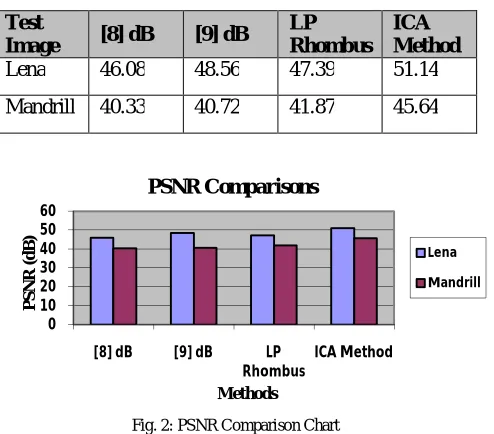
The simulation studies involve the deterministic the Kodak set is composed of 24 true color (24 bits) images of sizes 512 × 768. As far as we know, these images have been released by the Eastman Kodak Company for unrestricted usage. The proposed Reversible watermarking algorithm is implemented with MATLAB. The images are provided in Portable Network Graphics (PNG) format at ttp://www.r0k.us/graphics/kodak/. The Gray level versions of the full color test images have been computed as a weighted average of the three color channels, namely 0.2126R+0.7152G+ 0.0722B. Proposed algorithm is compared with the peak signal noise ratio (PSNR). Simulation time is calculated through the CPUTIME function of MATLAB. Our result shows that the PSNR metric of [8] dB, [9] dB, LP Rhombus with proposed ICA method performs better than the existing method.
For images with large textured or fine details regions, the local prediction appears to significantly outperform the other methods. For images with large uniform areas, the ICA method global prediction still seems to clearly outperform the other methods at embedding PSNR. Results for Lena and Mandrill are presented in Table 1.
Table -1: PSNR: Comparisons with Some Recent Results
Test
Image [8] dB [9] dB
LP Rhombus
ICA Method
Lena 46.08 48.56 47.39 51.14
Mandrill 40.33 40.72 41.87 45.64
Fig. 2: PSNR Comparison Chart
VI.CONCLUSION AND FUTURE WORK
In this paper, we review the reversible watermarking technique and effect of ICA and MLE based on the system measures. In contrast to the spatial-domain-based reversible watermarking based techniques can embed more bits of watermark and are more robust to attack. Online application of watermarking for video in the spatial domain becomes cumbersome due to associated high computational complexities involved. Watermarking is a very active research field with a lot of application domains. Although it is a relatively new field, it has created for hiding messages into digital
0 10 20 30 40 50 60
[8] dB [9] dB LP
Rhombus
ICA Method
P
S
N
R
(d
B)
Methods PSNR Comparisons
Lena
ISSN(Online): 2320-9801 ISSN (Print): 2320-9798
I
nternational
J
ournal of
I
nnovative
R
esearch in
C
omputer
and
C
ommunication
E
ngineering
(An ISO 3297: 2007 Certified Organization)
Vol. 3, Issue 2, February 2015
signals. In this proposed method, an attempt is made to implement the blind embedding for Digital Image Watermarking and Extraction using various ICA and MLE techniques.
In the future, the proposed work to extend for being used as a fragile watermarking technique.
REFERENCES
1. M. Goljan, J. Fridrich, and R. Du, “Distortion-free data embedding forimages,” Inf. Hiding, vol. 2137, pp. 27–41, Apr. 2001.
2. M. U. Celik, G. Sharma, A. M. Tekalp, and E. Saber, “Lossless generalized LSB data embedding,” IEEE Trans. Imag. Process., vol. 14, no. 2, pp. 253–266, Feb. 2005.
3. Z. Ni, Y. Q. Shi, N. Ansari, and W. Su, “Reversible data hiding,” IEEE Trans. Circuits Syst. Video Technol., vol. 16, no. 3, pp. 354–362, Mar. 2006.
4. J. Tian, “Reversible data embedding using a difference expansion,”IEEE Trans. Circuits Syst. Video Technol., vol. 13, no. 8, pp. 890–896,Aug. 2003
5. A. M. Alattar, “Reversible watermark using the difference expansion ofa generalized integer transform,” IEEE Trans. Image Process., vol. 13,no. 8, pp. 1147–1156, Aug. 2004.
6. D. Coltuc and J.-M. Chassery, “Very fast watermarking by reversible contrast mapping,” IEEE Signal Process. Lett., vol. 15, no. 4, pp. 255– 258, Apr. 2007.
7. P. Tsai, Y.-C. Hu, and H.-L. Yeh, “Reversible image hiding scheme using predictive coding and histogram shifting,” Signal Process., vol. 89, no. 6, pp. 1129–1143, 2009.
8. H.-T. Wu and J. Huang, “Reversible image watermarking on prediction errors by efficient histogram modification,” Signal Process., vol. 92, no. 12, pp. 3000–3012, 2012.
9. X. Zhang, “Reversible data hiding with optimal value transfer,” IEEE Trans. Multimedia, vol. 15, no. 2, pp. 316–325, Feb. 2013.
BIOGRAPHY
M Vignesh received the Bachelor of Engineering degree in Computer Science and Engineering from the Anna University Chennai, in 2013, where he is currently pursuing the Master of Engineering degree in Computer science and Engineering in Anna University Chennai.
G Sureshkumar received Master of Engineering Degree in Computer Science and Engineering from the Saveetha University Chennai,in 2012.He is currently working as a AssistantProfessor in REC Coimbatore. His current research in the field of Data mining.