Reversible Image Watermarking Using
Modified Reversible Contrast Mapping
S.Gayathri1, C.S.Manikanda Babu2
PG Scholar, Department of ECE (PG), Sri Ramakrishna Engineering College, Coimbatore, India1
Associate Professor (Sl. Grade), Department of ECE (PG), Sri Ramakrishna Engineering College, Coimbatore, India2
ABSTRACT: This paper proposes very large scale integration design of reversible image watermarking using
modified reversible contrast mapping algorithmic rule for digital images which will serve the purpose of media authentication in real time surroundings. The use of reversible contrast mapping on pair of pixels in imagesfor reversible watermarking offers a versatile integer transform that shows high embedding rate at low mathematical complexity and without necessitating additional data compression. Mathematically RCM may be explained as a form of flexible linear transformation on pair of pixels that controls distortion and leads to the detainment of the structural data of the watermarked image.The concepts used in modified reversible contrast mapping are M-ary modulation and adaptive distortion control. The M-ary modulation is used for sending two or more data bits at a time instead of sending one data bit at a time. The adaptive distortion control is used to improve data hiding capacity. Performance in robustness against common signal processing operations, namely noise addition, smoothing filtering and some form of geometric operation
KEYWORDS: Modified RCM, Reversible Watermarking, Generalized RCM
I.INTRODUCTION
Digital watermarking is expressed as a knowledge concealing technique that is developed for functions like identification, copyright protection and classification of digital media content. During this technique, a secret information referred to as watermark is embedded into the digital transmission content with in the decoder, watermark information is extracted from the watermarked signal in an exceedingly loss less manner though original signal can't be obtained back. In some necessary applications like military notional, rhetorical law and medical notional, distortion within the original signal might cause fatal results. For instance, a tiny low distortion in an exceedingly medical image might interfere with the accuracy of document identification. Distortion issues which can arise in an exceedingly applications will be fastened in a reversible watermarking technique.Reversible image watermarking algorithms can be divided into five groups. Lossless compression based algorithms, difference expansion based algorithms, and histogram shifting based algorithms, prediction error expansion based algorithms and integer to integer transform based algorithms. Performance of a watermarking algorithm is categorized into three parts. They are visual quality, payload capacity and computational complexity.
II. LITERATURE SURVEY
distortions in report work priority to the downstream techniques. In that applications, reversible watermarking instead of other watermarking is occupied. Reversible watermarking of digital image allows full extraction of the watermark along with the complete reconstruction of the cover work. In past years, reversible watermarking process are gaining popularity because of its increasing applications in important and sensitive areas, i.e., military information, health care, and law-enforcement. Due to the rapid evolution of reversible watermarking process, a latest survey of recent research in this field is highly desirable.
In 2001, Honsinger et al was introduced one of the first reversible watermarking method. They utilized modulo addition to achieve reversibility in their watermarking process. Macq developed a reversible watermarking approach by modifying the patchwork algorithm and used modulo addition. Although, proposed reversible techniques are the imperceptibility of their approaches is not magnificent. The watermarked images resulting from these techniques can’t tolerate from salt and pepper noise due to the use of modulo addition. A reversible watermarking technique without using modulo addition was then introduced by proposed the concept of compressing the least significant bit plane of cover image to make space for the watermark to be embedded. In 2013 Luo et al reported a reversible watermarking method using interpolation technique. The watermark bits are embedded in the unsampled pixels until no unsampled pixel is left. After that, the remaining of the watermark bits are inserted into the sampled pixels, which are interpolated using nearby watermarked pixels.
III. LIMITATION IN RCM-RW
Let (x, y) be the values of pixel pair in an image, then the pixel intensity values are bounded between [0, 255] for an 8-bits or pixel gray scale image. The forward integer transform for a pair of pixel values is defined. To prevent the overload and the under load problem, the transform pair is restricted within a sub-domain. The inverse transformation can perfectly restored the pixel pair values even if the least significant bits of the transformed pixel pairs are lost, except when both pair of pixels are odd set of values. The occurrence of odd pair of pixels is expected to below with respect to the total possibility of occurrence of other combinations, hence a large set of pair of pixels may be available for data embedding. The limitation is when the set of odd pairs selected and the inverse transformation fails to get back the exact values of the pixel pairs. The forward integer transform is defined as,
= 2 − , = 2 −
On the other hand, the inverse transform is defined as,
=(2 + ) 3 , =
( + 2 ) 3
IV. MODIFIED RCM
V. GENERALIZED RCM
Let (x, y)as a pair of pixel values of an 8-bit/pixel gray scale image. Generalized M-ary RCM forward transform form is given as,
x = (x + y) 2 +
N|(x−y)| 2
= ( + ) 2 −
N|(x−y)| 2
The symbols ‘M’ and ‘N’ are the positive integers. The generalized form of inverse transform is defined as,
= ( + )
2 +
2 |( − )| 2
= ( + )
2 −
2 |( − )| 2
The respective values of ‘M’ and ‘N’, forward transform pairs and inverse transform pairs under lossless communication, the proposed algorithm can perfectly retrieve the original information. Any combinations of integer values for ‘M’ and ‘N’ may be used for forming the set of transformation functions. Difference in intensity value between the forward transformed pair and its corresponding original pair of pixels is known as the embedding distortion. Distortion control is necessary in order to reduce the visual artifacts due to data hiding process. In RCM, each pair of pixel embeds one watermark bit. This is due to the fact that LSB of x contains information whether the pair of pixels is used for transformation, while LSB of y is available for data embedding. Application of linear sets of transformation functions followedby LSB substitution for data embedding may be reasonably considered as additivesignal insertion. It is assumed here that the host image behaves like a Gaussiannoise signal to the watermark embedding process.
VI. WATERMARK EMBEDDING AND EXTRACTION
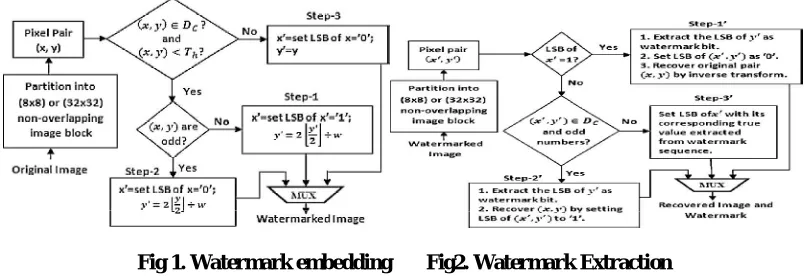
To realize reversible contrast mapping algorithm, the original image is partitioned into non overlapping groups of pixels pairs following either horizontally or vertically, like any space filling curve.
Fig 1. Watermark embedding Fig2. Watermark Extraction
as used in embedding. The marked image is partitioned a gain into pairs of pixels. Then any one step is followed subject to two different conditions check as. The process is repeated until it covers all the pixel pairs.
VII. OUTPUT FOR EMBEDDING AND EXTRACTION
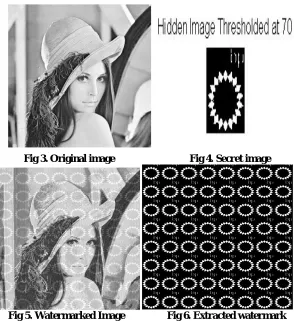
Fig 3. Original image Fig 4. Secret image
Fig 5. Watermarked Image Fig 6. Extracted watermark
Fig 3 shows the original image and fig 4 shows the secret image which is embedded in the original image. Fig 5 shows the watermarked image and fig 6 shows the extracted watermark.
VIII.PSNR& MSE
The simplest and the most widely used representation to quantify image/video signal quality is the PSNR value. For an 8 bit gray scale image, PSNR is defined by the following expression:
PSNR = 10log 255 MSE
Where MSE is the mean squared error. For two M×N images u (distorted or watermarked image) and v (original or host image), MSE is defined as
MSE = 1
TABLE I. COMPARISON OF RCM AND MODIFIED RCM
RCM MODIFIED RCM
MSE 17.9079 16.0725
PSNR 35.6004 36.0700
IX.CONCLUSION
A generalized form of M-ary RCM is developed for reversible image watermarking under distortion control framework. The optimal set of values for the distortion control is calculated from the optimization framework that improves watermark embedding rate, while meeting the threshold of the embedding distortion. The future work is implemented in FPGA for real time environment.
REFERENCES
1. Alattar AM (2003) Reversible watermark using difference expansion of triplets. In: Proceedings of the IEEE international conference on image processing, vol 1. Catalonia, pp 501–504
2. Alattar AM (2004) Reversible watermarking using the difference expansion of a generalized integer transform. IEEE Trans Image Process 13(8):1147–1156
3. Biao C, Weiming Z, Nenghai Y (2013) Reversible watermarking in JPEG images based on modified RZL codes and histogram shift. J Nat Sci Wuhan University 18(2):126–132
4. Caldelli R, Filippini F, Becarelli R (2010) Reversible watermarking techniques: an overview and a classification. EURASIP J InfSecur 2010:134546. doi:10.101155/2010/134546
5. Celik MU, Sharma G, Tekalp AM, Saber E (2005) Lossless generalized-LSB data embedding. IEEE Trans Image Process 14(2):253–266 6. Chang CC, Tai WL, Chen KN (2008) Lossless data hiding based on histogram modification for image authentication. In: Proc. of IEEE/IFIP
international conference on embedded and ubiquitous computing, pp 506–511
7. Luo L, Chen Z, Chen M, Zeng X, Xiong Z (2010) Reversible image watermarking using interpolation technique. IEEE Trans InfForensSecur 5(1):187–193
8. Maity D, Maity SP, Maity HK (2012) Modification in contrast mapping: reversible watermarking with performance improvement. In: International conference on signal processing and communications (SPCOM-2012). Indian Institute of Science, Bangalore
9. Maity HK, Maity SP (2014) FPGA implementation of reversible watermarking in digital images using reversible contrast mapping. J SystSoftw 96:93–104
10. Coltuc D, Tudoroiu A (2012) ‘Multibit versus multilevel embedding in high capacity difference expansion reversible watermarking’. In: Proc. 20th European signal processing conference Bucharest, pp 1791–1795
11. Khan A, Siddiqa A, Munib S, Malik SA (2014) ‘A recent survey of reversible watermarking techniques’. InfSci Elsevier 279:251–272. 12. Kim HJ, Sachnev V, Shi YQ, Nam J, Choo HG (2010) ‘A novel difference expansion transform for reversible data embedding’. IEEE Trans
InfForensSecur 3(3):456–465
13. L. D. Strycker, P. Termont, J. Vandewege, J. Haitsma, A. Kalker, M. Maes, and G. Depovere (2010), ‘Implementation of a real-time digital watermarking process for broadcast monitoring on Trimedia VLIW processor,’ IEE Proc. Vision, Image Signal Processing, vol. 147, no. 4, pp. 371–376.
14. Thodi DM, Rodriguez JJ (2014) ‘Prediction-error based reversible watermarking. In: International conference on image processing (ICIP),’ vol 3. Bucharest, pp 1549–1552
15. Thodi DM, Rodriguez JJ (2009) ‘Expansion embedding techniques for reversible watermarking. IEEE Trans Image Process’ 16(3):721–729 16. Tian J (2013) ‘Reversible data embedding using a difference expansion. IEEE Trans CircSyst Video Technol’ 13(8):890–896
17. Tseng HW, Hsieh CP (2009) ‘Prediction-based reversible data hiding’. InfSci 179(14):2460–2469
18. Wang F, Xie Z, Chen Z (2014) ‘High capacity reversible watermarking for audio by histogram shifting and predicted error expansion’. Sci World J 2014:656251. doi:10.101155/2014/656251