ABSTRACT
DAVIS, JOHN HOWELL. Implications of a Decrease in the Mature Size of Female Blue Crab, Callinectes sapidus. (Under the direction of Donna L. Wolcott.)
The size-at-maturity of female blue crabs is declining and the proportion of very
small mature females (<100mm carapace width (CW)) is increasing in North Carolina.
Decreasing mature size of the female may have an effect on the mating success and mortality
of size-disparate mating pairs. To test the effect of body size on mating behavior, I used
controlled mating experiments comparing size-disparate mating pairs with similarly-sized
mating pairs. Small males handled large females longer than any other mating pair
combination; however, no increase in injury or mortality was found. Neither large nor small
males transferred significantly different numbers of sperm to large and small females.
Size-disparity appears to have no effect on mating success in blue crabs, suggesting that diversity
of size-related genotypic traits can be preserved in the population. I also designed a
mathematical model to estimate the lifetime spawning potential of different size-cohorts of
female blue crabs subject to different mortality pressures. Cohorts of very small females
(<100mm CW) that are not subject to fishery mortality produce 5.1 – 58.1% more eggs over
two spawning seasons than larger, harvestable females (127-159mm CW), suggesting an
evolutionary advantage to maturing at smaller sizes. I also used the model to estimate the
efficacy of a proposed restriction on the commercial harvest of large females (>172mm CW),
intended to increase the spawning potential of large females in order to increase
population-wide recruitment, as well as the number of recruits that may possess a larger-size genotype.
The proposed seasonal (Sept. – Apr.) commercial harvest of large females produced an
since the large females compose less than 2% of the population, on average, the estimated
increase in spawning potential for the entire population was negligible (0.46%).
Additionally, the 5% tolerance of the regulation allows for the harvest of the entire
Implications of a Decrease in the Mature Size of Female Blue Crab, Callinectes sapidus
by
John Howell Davis
A thesis submitted to the Graduate Faculty of
North Carolina State University
In partial fulfillment of the
Requirements for the degree of
Master of Science
Marine, Earth and Atmospheric Sciences
Raleigh, NC
2006
Approved by:
Thomas G. Wolcott
David B. Eggleston
BIOGRAPHY
John Howell Davis was born in Spartanburg, SC, on August 1, 1976. Despite the
derision of his older brother, John showed an interest in science from an early age. He
excelled in biology and chemistry and attended a marine biology summer camp at Duke
University at the age of 16. Following graduation from the Spartanburg Day School in South
Carolina, John attended the University of South Carolina’s Honors College as a Carolina
Scholar. There, he majored in Biology and minored in Marine Science. He completed and
defended an honors thesis regarding intron evolution in a closely-related family of fishes.
John was a member of the Marine Science Undergraduate Society at USC, working with
Loggerhead turtle restoration and beach erosion issues on the coast of South Carolina. John
married Milli Wehr in 2000, with whom he suffered through Organic Chemistry at USC.
After a brief stint in Oregon, John returned with his family to the Carolinas in 2002 to attend
ACKNOWLEDGMENTS
I wish to thank my committee, Drs. Donna and Tom Wolcott, and Dr. David
Eggleston, for their advice and help with building and polishing this thesis. Many reams of
paper and red pens were sacrificed by them on my behalf in the editing process. I would like
to especially think Donna and Tom for their patience in helping me develop these ideas into
coherent scientific arguments. Thanks also go to Dr. Dan Rittschof and Gary Dickinson at
Duke University for so graciously allowing me to use their unpublished data for my
mathematical model. Special thanks to Dan for all of the help with my crab mating
experiments. I would like to thank Duke University for allowing me to use their facilities at
their laboratories near Beaufort, NC, free of charge. I wish to also thank my fellow graduate
students that helped me with so many forgotten small things: Sean Ramach, Dave Medici,
Geoff Sinclair, Linda Waters-Lindquist, Geoff Bell and Darren Parsons. Special thanks go to
all the crabbers that contributed their time and crabs to my project, including Mark Hooper,
Dell Newman, and especially Judy Cahoon and C&S Seafood.
I must also thank my family for their patience and moral support. My wife, Milli, had
to put up with much strife and trauma during my graduate career, though she did get to live at
the beach for one summer. Thanks to my boys, Rowan and Niall, for distraction from work.
TABLE OF CONTENTS
Page
LIST OF FIGURES ………...……….. v
LIST OF TABLES ……….. vi
CHAPTER 1: Implications of a reduced size-at-maturity to mating dynamics and reproductive potential of blue crabs in North Carolina …………..………. 1
Introduction ……….………. 1
Materials and Methods ………. 9
Results ………..……….. 14
Discussion ………..……… 17
References ……….. 22
Appendix ……… 27
CHAPTER 2: Size selection in the North Carolina blue crab population based on differential spawning potential ………...……….. 36
Introduction ……….…….. 36
Materials and Methods ……….. 41
Results ………..……….. 48
Discussion ………..……… 50
LIST OF FIGURES
Page
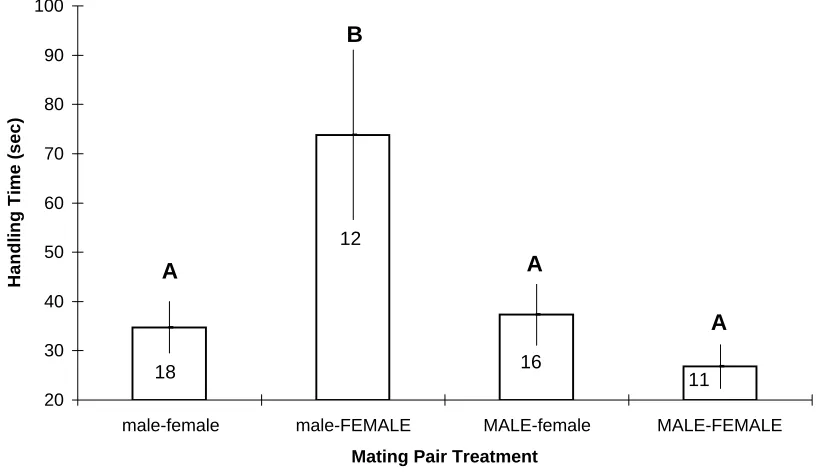
1. Mean handling time for male blue crabs to flip the female from the cradle-carry to the
mating position as a function of crab sex by size treatments ………...……….. 29
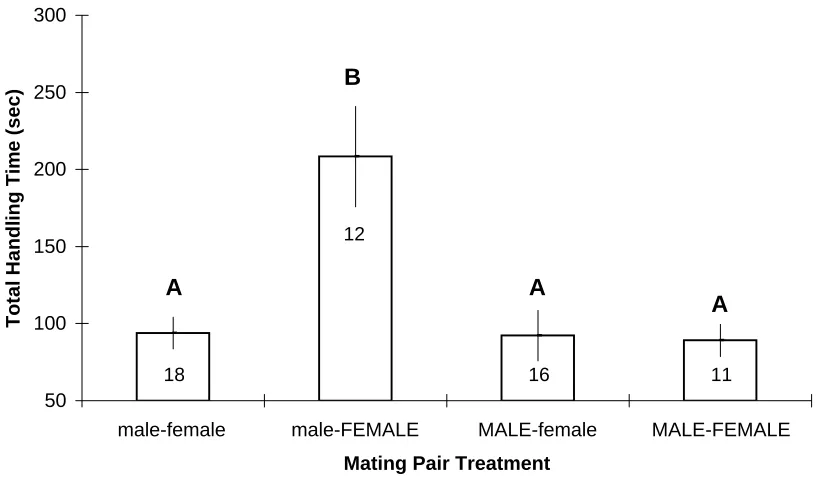
2. Mean sum handling time for the male crab to achieve all cradle-carry and mating
positions as a function of crab sex by size treatments ………... 30
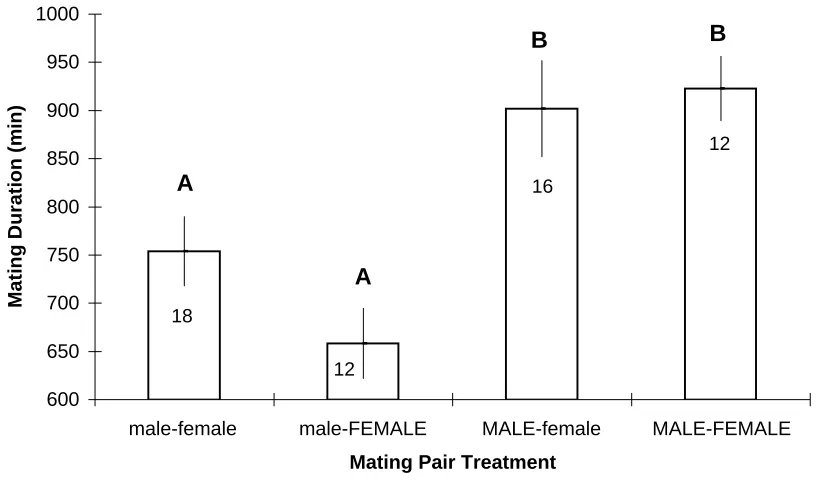
3. Mean duration of mating as a function of crab sex by size treatments ………. 31
4. Relationship between semen transferred to a female blue crab by a male and the duration
of mating ……… 32
5. Relationship between sperm transferred to a female blue crab by a male and the duration
of mating ……… 33
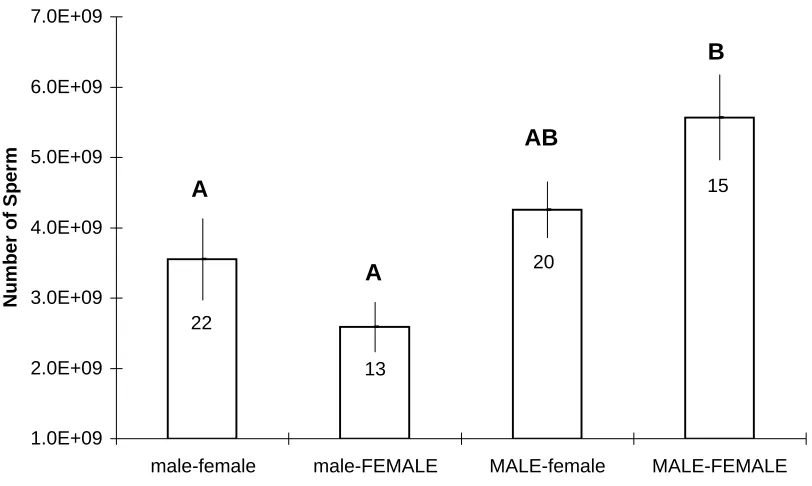
6. Mean number of sperm transferred by the male crab as a function of crab sex by size
treatments ……….. 34
7. Mean volume of semen transferred by the male crab as a function of crab sex by size
LIST OF TABLES
Page
1. Spawning potential (per crab in the initial cohort) of large (127-159 mm CW) and small
female blue crabs (72-100 mm CW) for spring and fall “peeler runs.” Two estimates
of natural (M) and fishery (F) mortality were used ……….……..………… 59
2. Spawning potential (per crab in the initial cohort) of the largest female blue crabs
(162-176 mm CW) are compared for cohorts subjected to the current, year-round harvest
regime and to no harvest. Two estimates of natural (M) and fishery (F) mortality
were modeled ………...….. 60
3. Spawning potential (per crab in the initial cohort) of the largest female blue crabs
(162-176 mm CW) are compared for cohorts subjected to the current, year-round harvest
regime and to a proposed seasonal harvest (Sept.-Apr.). Two estimates of natural (M)
Chapter 1: Implications of a reduced size-at-maturity to mating dynamics
and reproductive potential of blue crabs in North Carolina
Introduction
The blue crab (Callinectes sapidus) is the most valuable commercial fishery in North Carolina in terms of total landings, processing, employment, and amount of gear used (Henry
& McKenna 1998, NCDMF 2004). Over the past decade, North Carolina has been the top
producer of blue crabs in the U.S. at over 24% of the total harvest, with an annual average of
50 million pounds valued at over $37 million (NCDMF 2004). The economic impacts of the
commercial fishery are far-reaching throughout eastern North Carolina. Many commercial
crabbing operations are family businesses that have been passed down through many
generations. In some of the more rural areas of eastern NC, especially the western side of the
Pamlico and Albemarle Sounds where beach tourism is not a factor, the blue crab fishery
often is the primary livelihood. In 2002, the commercial fishery contributed an estimated
$53 million in sales, $32 million in total income, and more than 4000 full and part-time jobs
statewide (NCDMF 2004).
Landings of blue crabs in North Carolina have decreased in recent years, possibly a
consequence of declines in abundance of the blue crab stock indicated by most
fishery-independent survey indices (Eggleston et al. 2004). Spawning stock biomass has decreased and fishing mortality has sharply increased since 1996, often to levels well above estimates
of Maximum Sustainable Yield (MSY) (Eggleston et al. 2004). Concurrent with the
generally increasing exploitation rate from 1992-2002 is a decreasing number of legal-sized
(<100 mm carapace width (CW)) mature female crabs (Eggleston et al. 2004). These observed changes in phenotype are consistent with selection for a genotype producing
smaller size-at-maturity in female blue crabs. Small mature females are not susceptible to
the fishery, because they can pass through the mesh of crab pots, the most common gear
used. Additionally, cull rings in pots for hard crabs retain approximately 90% of females >
122 mm CW, 10% < 117 mm, and 0% < 100mm (Guillory et al. 2004). A female’s size is set at the molt-to-maturity, which is also her terminal molt (after which she can mate one or
more times during a receptive period of ~1 week) (Van Engel 1958). Consequently, small
females can spawn for the remainder of their natural lives while larger females are being
removed by the fishery.
No change in the mature size of the male blue crab has been detected, due to the lack
of survey data on the size-at-maturity of the male crab. Males attain sexual maturity over
successive molts and retain the ability to continue growing and molting, unlike the female, in
which size-at-maturity is easy to identify (for details of life history, see Appendix).
Size-selective harvest of the blue crab (only males > 127 mm CW can be harvested) may alter the
size structure of the males in the population simply by removing the majority of large males
while leaving the small ones (Jivoff 2003). This size-selective harvest may change the
mating dynamics of the population by allowing small males to mate repeatedly with reduced
competition from large males (Carver et al. 2005).
If the effective size-at-maturity for blue crabs has any heritable genetic component,
increased mating and spawning opportunities of small crabs relative to the larger, harvestable
crabs could result in a further decrease in the average size-at-maturity of future spawning
average reproductive potential per crab in the population (leading to a declining abundance)
(Prager et al. 1990, Jivoff 2003) and alter mating dynamics, which tend to favor larger crabs through male: male competition (Jivoff & Hines 1998, Jivoff 2003). Thus, it is important to
investigate the mating behavior and mating success of small crabs in order to understand
their potential genetic contribution to future generations.
It is well established that mortality selectively applied to one portion of the
population can drive genetic change in that population (Policansky 1993). Mortality that
differs according to size of the individuals imposes selection pressure on size-related
life-history traits such as average adult size, size-at-maturity, and growth rate. Due to the
difficulty of isolating genetic change from phenotypic plasticity, management of fisheries
generally ignores the possibility of genetic change. Simply documenting changes in a
population’s life-history traits over time does not necessarily establish the occurrence of
fishery-induced evolutionary change (Policansky 1993). For genetically-based changes in
phenotype to occur in response to fishing pressure, changes must be heritable (genetic), and
fishing pressure must result in different reproductive success for different genotypes
(Policansky 1993).
Many phenotypic traits are influenced by heritable genotypic variation in fish species
(Doyle 1983, Gall 1983, Wohlfarth 1983). Selective predation or mortality in the natural
environment, as occurs in size-selective fisheries, results in the evolution of a variety of traits
such as growth rate, color, morphology, and mating behaviors in freshwater crustaceans
(Strong 1973), fishes (Gross 1978, Endler 1980, Reznick 1982), and many other organisms
(Endler 1986). For example, genetically-controlled differences in growth rate among fishes
Shultz 1995). Many studies of short-lived fishes have demonstrated genetic adaptation to
different environments (Meffe & Snelson 1989, Taylor 1991, Bell & Foster 1994, Conover
1998). The rate of evolution can be quite rapid, occurring within a few generations (Reznick
et al. 1997, Hendry et al. 1998, Thompson 1998). Local adaptive variation within
populations can also be extensive, even in marine species that are often considered to have
few barriers to gene flow (Conover 1998).
The common mechanism for fishery-induced differential reproduction of different
genotypes is the size-selective nature of most fisheries, whether by gear selectivity or by
management restrictions on harvestable size (Policansky 1993). Selective removal of the
largest individuals in a population will reduce the potential genetic contribution of those
individuals to future generations, especially if the fishery allows them little or no opportunity
to mate and reproduce before harvest. Such fishery mortality will increase the reproductive
potential of smaller mature individuals that are not harvested. Most fisheries cause high
mortality, often 70% to 90% of the total population (Cushing 1968, Heard 1991, Rijnsdorp et al. 1991). Many exploited fish populations have been harvested for 50-100 generations, providing ample time for selection to produce observable genetic change.
Evolutionary change as a result of size-selective mortality has been documented in
both experimental and natural fish populations. Rapid genotypic changes were reported in
several life-history traits of an experimental population of Atlantic silverside, Menidia menidia (Conover & Munch 2002). Size-selective harvest produced significant changes in harvested biomass, mean weight, spawning stock biomass, egg size, and larval growth rate
after only four generations. Significant life-history evolution within 30-60 generations has
target of predation from adults to juveniles (Reznick et al. 1990). All of the guppies were reared in the same environment, eliminating environmental influences on life-history
variation within cohorts (Reznick et al. 1990). Divergence in several traits has also been shown within 30 generations between adjacent populations of guppies in New Zealand,
including growth rate and reproductive output (Quinn et al. 2001). Divergence of life-history traits between the two populations initially resulted from phenotypic plasticity (e.g.
habitat-specific growth rates) but also had a genetic component, as evidenced by a lower survival
rate of transplanted v. native populations.
Evolutionary change as a response to heavy exploitation by the fishery has been
reported for a number of important fishery species. Divergence has been reported between
fished grayling (Thymallus thymallus) populations due to different degrees and types of exploitation over 44-88 years (9-22 generations) (Haugen & Vøllestad 2001). The major
cause of phenotypic differences found between populations was adaptive evolution caused by
different mortalities under different fishing intensities. DNA comparisons support the
conclusion that genetic drift occurred between the populations (Haugen & Vøllestad 2001).
Age and length at maturation has shifted toward younger age and smaller length in many
exploited fish species such as North Sea plaice (Pleuronectes platessa) and Atlantic cod (Gadus morhua) due to evolution (Ernande et al. 2003, Grift et al. 2003, Barot et al. 2004). Short-term fluctuations from plastic responses are superimposed on a persistent, long-term
trend resulting from genetic selection.
Demonstrations of genetic selection in crustaceans have been limited primarily to
short-lived planktonic species, and are less common for large marine ones such as lobsters
plasticity v/s genetic change in the blue crab showed marked concurrent decreases in
spawning stock abundance and recruitment, larval abundance, and adult female size (and
thus, size-at-maturity) in the Chesapeake Bay (Lipcius & Stockhausen 2002). Many possible
genetic mechanisms were discussed for why female crabs were maturing at younger ages and
smaller sizes: optimization of mating opportunities when larger potential mates were sparse
(Smith & Jamieson 1991, Jamieson et al. 1998); maximizing lifetime fecundity in the absence of mate-competition with other females (Lipcius 1995); size-selective fishery
exploitation of large females resulting in selection for smaller females (Policansky 1993,
Jamieson 1999); and compensatory responses of the population to low densities such as
decreases in mean size, age or instar at maturity (Charnov et al. 1978, Charnov 1979, Hannah & Jones 1991, Wellbourn 1994, Sparkes 1996). Distinct genotypic influences on population
change were not identified, however; a combination of genetic mechanisms, phenotypic
plasticity and size-selective exploitation may have acted in concert to produce covariation in
female size and spawning stock abundance (Lipcius & Stockhausen 2002).
Differences in mating behavior and success attributable to differences in mature size
have been studied in the context of competition between individuals. The mating success
and seminal contribution of male crabs depend primarily on male: male interactions, which
favor large males (Jivoff 2003); however, at the low male: female sex ratios found in many
fished populations, competition between males is decreased (Jivoff & Hines 1998, Jivoff
2003). Since the size of a male crab does not affect its ability to subdue the female during
the pre-molt mating interactions (Jivoff 2003), in the absence of male: male competition,
transfer for mating pairs of disparately-sized mates has not been well studied for heavily
fished blue crab populations that are likely to have little male: male competition.
The potential consequence of reduced sperm transfer is a lower maximum
reproductive potential of the female, hence a reduced genetic contribution to subsequent
generations by both mates. Limitations to the amount of sperm available to females in the
population and the reproductive contribution of the male are rarely considered when
determining stock-recruit relationships (Kendall et al. 2001). The assumption that sperm and seminal fluid are in ample supply may be an oversimplification for many decapod
crustaceans (Ennis 1980, Smith & Jamieson 1991, Paul & Paul 1992). Recent research
suggests that female crabs may become sperm limited when males are overharvested, making
the number of sperm received during mating a potential limiting factor for their reproductive
potential (Kendall et al. 2001, Kendall et al. 2002, Hines et al. 2003).
The potential consequence of decreased amounts of seminal fluid (in contradistinction
to sperm) transferred to the female is a reduction in the reproductive potential of the male.
The seminal fluid, which makes up the bulk of the ejaculate, is thought to function primarily
as a “sperm plug,” which increases the chances that the first male’s sperm will fertilize the
eggs by limiting the amount of semen that can be transferred to the female by any subsequent
mates (Jivoff 1997, Wolcott et al. 2005). Multiple sperm plugs, indicating multiple matings, have been detected in field populations (Jivoff 1997). Reduced transfer of seminal fluid in
size-disparate mating pairs would enhance mating opportunities between that female and
subsequent males, thereby increasing sperm competition.
If pairings between crabs that do not differ greatly in size are more successful, then
actual genetic contribution of crabs in large: large mating pairs, however, is likely to be
retarded by size-selective fishery mortality on the large females (see Chap. 2). Conversely,
an increased mating success for a small: small mating pair vs. a small: large mating pair
could accelerate the decrease in size of mature female crabs that has been observed in the
blue crab population of North Carolina, because the small crabs are not subject to fishery
mortality (Eggleston et al. 2004).
Since the proportion of very small mature females in the population is increasing, and
larger males are selectively removed by the commercial harvest, leaving all of the smaller
mature males, I examined the ability of small females and males to mate with “normal-sized”
(much larger) crabs. A large disparity in size of the crabs in a mating pair may make it
difficult to complete the various cradle-carry and mating positions (see Appendix for details
of blue crab mating biology). Increased handling of a female that is much larger or smaller
than the male crab could increase stress, injury, or mortality for the female when she is soft
and vulnerable. I hypothesized that, when compared to pairings between crabs of similar
size, pairings of a small crab with a large crab would exhibit the following differences:
• More time needed for male to manipulate and position the female
• Decreased duration of mating
• Increased frequency of disengagement from cradle-carry or mating position
• Increased frequency of limb loss by the female due to handling during mating
• Increased mortality of females
Materials & Methods Study Site
Blue crab mating experiments were conducted during the summer and fall of 2004 at
the Duke Univ. Marine Laboratory on Piver’s Island, Beaufort, NC. Healthy, whole crabs
were purchased from local fishermen. All crabs were harvested using crab pots in the Jarrett
Bay portion of Core Sound, in Mill Creek and other tributaries of the Newport River north of
Morehead City, and in the White Oak River near Swansboro and Bogue Inlet, NC.
Experimental Protocol
Male crabs were grouped into two size classes based on their carapace width (CW)
(measured between the tips of the large lateral spines): “small” (< 120mm CW; mean size =
112.5mm) and “large” (> 150mm CW; mean size = 160.3mm). The small group represented
the smallest sexually mature males in the population; they were below the minimum legal
size of harvest (<127mm CW). I used only small males that met the observable criteria for
sexual maturity (abdomen completely free from the sternum, and the penes and second
pleopods inserted into the first pleopods; Van Engel 1990). The large group represents a
subset of the largest mating males in the local population.
Males were collected from mid-April through June and during September of 2004.
Males selected for experimentation had fully hardened shells; none were recently molted
“white-bellies.” To assure replete sperm stores, males were held and fed for 9-14 days
(Kendall et al. 2001) prior to the commencement of mating.
Female pre-pubertal (pp) crabs were collected from mid-April through mid-July and
from mid-September through mid-October of 2004. “Small” pp females were defined as
assure a mature post-molt size of < 100mm CW, but insufficient numbers of such small
individuals were obtainable. “Large” pp females were defined as those > 115mm CW (mean
size = 124.4mm). This cutoff value was chosen to achieve a difference of approximately
30mm in CW between the two groups after their molt to maturity, similar to the difference
between the small and large males used in this experiment.
All crabs were held in large, round tanks (diameter = 122 cm; volume = 1098 liters)
with filtered circulating seawater pumped from Bulkhead Channel near Bogue Sound, NC.
Salinity ranged from 27 – 33ppt and temperature from 18oC to 28oC. Fluorescent lighting was kept on 24 hours a day to facilitate video taping. Male crabs were fed daily with fish
(primarily menhaden, Brevoortia tyrannus, and croaker, Micropogonias undulatus) for the duration of the 9-14 day holding period. Densities in holding tanks were < 12 crabs per tank
for the large male crabs, or < 20 crabs per tank for the small male crabs or pp females. Dead
crabs and uneaten fish were removed twice daily. All female crabs were held for at least 24
hours to acclimate them to the laboratory environment before the commencement of mating
experiments. Female crabs were chosen for mating once they developed a distinct red line
along the edge of the swimming paddle, indicating imminent molt.
Crabs selected for mating experiments were placed together in mating tanks (glass
aquarium tanks holding approximately 70 liters of seawater, with aeration). Blinds were
placed between the tanks to prevent visual interaction between mating pairs. A male crab
was placed into the tank first and allowed at least 15 minutes to adjust. The female crab was
not introduced until the male crab ceased all aggressive behavior or movement induced by
Treatment #1 – small male with small female (N=37 mating trials; 22 completed matings)
Treatment #2 – small male with large female (N=22 mating trials; 13 completed matings)
Treatment #3 – large male with small female (N=25 mating trials; 20 completed matings)
Treatment #4 – large male with large female (N=22 mating trials; 15 completed matings)
Every 24 to 36 hours, as needed, dirty water and feces were slowly (5-10 min.)
siphoned out of the mating tanks while fresh seawater was added to keep the water level well
above the crabs. The water was changed only when the mating crabs were quiescent in a
cradle-carry or mating position, and never during or right after a period of active movement
or molting. To minimize possible stress to the crabs while water was being changed, the
hoses were kept as far from the crabs as possible and visual stimuli were minimized either by
dimming the lights or by putting an additional blind in front of the tank.
Behavior was either observed in real time or recorded with a video camera for all
mating pairs until mating (or attempts) ended. Video cameras were positioned beside each
mating tank so that all behaviors could be observed. Recordings included a time-stamp. The
following behavioral response variables were quantified: (1) the handling time required for
the male to position the female into the (a) initial cradle-carry before the female’s molt, (b)
cradle-carry after the female had molted and completely freed herself from her old shell, (c)
mating position, and (d) post-mating cradle-carry; and (2) duration of mating. Individual
handling times were defined as seconds required for the male to achieve a cradle-carry or
mating position (see Appendix), from the first attempts until the female was secured under
the male for at least 30 seconds. The duration of mating was recorded for each pair, starting
when the male achieved a mating position and ending when the male withdrew his gonopods
I also quantified the (3) frequency of disengagements from the cradle-carry or mating
position, (4) frequency of limb loss by the female, (5) mortality of the female, and (6) sperm
and seminal fluid transferred to the female. After all mating activities or mating attempts had
ceased for at least 6 hours, crabs were placed in plastic storage bags in a freezer for later
dissection.
Laboratory Dissection
In the laboratory, the carapace width of each crab was measured to the nearest
millimeter using dial calipers. The two spermathecae (sperm storage organs) were removed
from female crabs and weighed. The percent fullness of the organs was visually estimated.
The spermathecae were cut open and the contents removed. The spermatophores and the
seminal fluid (often hardened into a “sperm plug”) were extracted by scraping the
spermathecal wall and rinsing it with 30 psu seawater. The mass of the extracted seminal
fluid and sperm (if any) was calculated by subtracting the mass of the empty spermathecal
wall from the total mass. If only one spermatheca contained sperm and seminal fluid, its data
were doubled to estimate the contents had ejaculate been transferred to both. Lack of
ejaculate on one side was usually caused by a physical problem such as a broken gonopod on
the corresponding side of the male. All such males possessed a seminal vesicle replete with
sperm and seminal fluid on the side where no ejaculate was transferred, compared to a much
smaller, depleted vesicle on the side corresponding to the successful ejaculate transfer. It is
assumed that failure to transfer ejaculate on one side is not affected by size-disparity, as all
such males were able to achieve the mating position and appeared to be mating normally.
The fertilization of the female crab on one side occurred in only 5 of 70 pairs and in three of
The spermathecal contents were mixed in a Dounce homogenizer with 30 psu
seawater until all spermatophores were disintegrated into the supernatant. If the seminal
fluid had hardened into a sperm plug, it was minced with a scalpel or razor blade into pieces
< 2 mm before homogenization. Material adhering to the spermathecal wall was scraped off
with a scalpel and rinsed into the homogenate with 30 psu seawater. The spermathecal wall
was examined under the microscope to ensure that no sperm remained. The homogenized
supernatant was filtered through 35 µm Nitex cloth supported by a funnel, directly into a graduated cylinder. The filter was rinsed with 30 psu seawater to flush through any loose
sperm. The material remaining on the filter was examined under a microscope; if any sperm
were detected, it was rehomogenized and filtered again. This process was repeated as
necessary.
The filtrate was stained with eosin Y red dye (one drop of 1% eosin Y in 30 psu
seawater per 5 ml of sample volume). The total volume of the dyed supernatant was
recorded. The sample was poured into a dish and mixed with a magnetic stir bar for
approximately five minutes. The sperm cells in 10 µl aliquots were counted in a Petroff-Hausser spermacytometer under an oil-immersion microscope at 1000X. Two to three slides
were counted for each sample and averaged. The total number of sperm in the sample was
calculated by extrapolating from the spermacytometer volume counted to the total sample
volume.
For any mating pair that failed to mate or to transfer sperm to the female, the male
crab was examined to determine sexual maturity of the gonads as indicated by the presence
Statistics
One-Way Analysis of Variance (ANOVA) (alpha=0.05) was used to detect
significant differences between treatments for the following factors: the handling time
required to achieve the pre-molt cradle carry, the post-molt cradle carry, the flip of the
female into the mating position, and the flip of the female into the post-mating cradle carry;
the combined handling time for the previous four factors; the duration of mating; the weight
of spermathecal contents (amount of semen transferred to the female); and the number of
sperm transferred to the female. Data for handling times were log-transformed, and data for
number of sperm square-root-transformed, to satisfy assumptions of normality.
Homogeneity of variance was tested using Brown & Forsythe’s test (Brown & Forsythe
1974) as well as by visually comparing between treatments the distribution and range of
residuals. Tukey’s Studentized Range Test, which controls Type I error rate, was used for
contrast of means between treatment levels in cases where there was a significant treatment
effect.
Results
Both the time it took male crabs to “flip” females from a cradle carry to a mating
position, and the total handling time during mating, varied significantly with size disparity
between mates (one-way ANOVA; mating position, F = 5.02, df = 3, 63, p = 0.0035; total
handling; F = 9.97, df = 3, 53, p < 0.0001). Small males took significantly longer (mean =
74s) to flip large females from a cradle carry to a mating position than males in the other
treatments (means = 27-37s; Fig. 1). Similarly, total handling time over the entire
the other treatments (means = 89-94s; Fig. 2). No differences were found between treatments
for the handling time required to achieve the pre-molt cradle carry, the post-molt cradle
carry, or the flip of the female into the post-mating cradle carry (one-way ANOVA, all
p>0.05).
Large males mated for a significantly longer time than did small males (one-way
ANOVA; F = 8.29, df = 3, 54, p = 0.0001; Fig. 3). Large males mated for an average of
902-923 minutes, whereas small males mated for an average of 658-754 minutes (Fig. 3). For
males in a given size class, female size had no significant effect on mating duration (one-way
ANOVA, all p>0.05).
Volume of semen transferred to a female crab’s spermathecae was positively
correlated with the duration (min.) of mating (Fig. 4), as was the number of sperm transferred
(Fig. 5). The large male with small female treatment (#3) was excluded from the regression
analyses because the amount of semen and sperm that could be transferred was apparently
limited by the size of the females’ spermathecae (females were 100% full after mating).
Instances of male crabs disengaging from or “dropping” the female from the
cradle-carry position more than twice (3-4 times per treatment) did not occur often enough for
statistical analyses. Males that dropped the female only once or twice were not considered
due to the small amount of handling required for the male to re-cradle the female. These
disengagements almost always occurred before the female molted when she was still
protected by her shell. Even in pairs with 3+ drops, there was no injury or mortality.
Most mortality during the mating experiments occurred shortly after the mating pair
was combined and before the female had molted. Mortality later in the mating experiment
true for limb loss, which only occurred in ~5% of females (5 females with limb loss out of
70).
Large males mated with large females transferred significantly more sperm than did
small males with small females or small males with large females (one-way ANOVA;
F=5.23, df = 3, 66, p= 0.0027; Fig. 6). Large males mated to small females did not transfer
significantly more sperm than did all small males (Fig. 6), probably due to volume
limitations in the size of the spermathecae in small v. large females. Female size had no
effect on the number of sperm received. Small males transferred statistically similar numbers
of sperm to large and to small females (Fig. 6), as did large males.
Large females received significantly more semen from large males (mean = 5.8g)
than did small females (one-way ANOVA; F = 39.39, df = 3, 66, p < 0.0001; Fig. 7). No
difference was found in the amount of semen received from small males by large or small
females (Fig. 7). Large males mated to small females transferred significantly more semen
than did small males with small females, but not more than did small males mated to large
females (Fig. 7).
All females mated with large males had 100% full spermathecae after mating, except
one large female that received 80% and another 90%. Large females mated with small males
received ejaculate volumes ranging from 25% to 90% of their spermathecal capacity, with an
average of 49% fullness. Small females mated with small males received ejaculate volumes
Discussion
Differences in size between mates in paired blue crabs apparently do not reduce
reproductive potential, based on numbers of sperm transferred, below that expected when the
paired crabs are of similar size (Fig. 6). Female body size had no significant effect on the
number of sperm transferred by males within size groups; both large males well above the
legal fishery limit of 127mm CW and small males below the legal limit (< 120mm CW)
transferred similar numbers of sperm to large and small females, suggesting that sperm
transfer does not limit or affect the reproductive potential of males in size-disparate mating
pairs. Large males did transfer more sperm to large females than did small males, but this
result is probably due to the larger sperm stores possessed by larger males. A large male is
thought to have a higher reproductive potential when mating with a larger female, since her
fecundity per brood increases with body size (Prager et al. 1990); however, recent evidence suggests that this increased fecundity with size may be offset by a lower brood frequency
compared to relatively small females, resulting in statistically similar potential larval
production per unit time for all female crabs > 100 mm CW (Dickinson et al. in press). Female body size had no significant effect on the amount of seminal fluid received
from small males (Fig. 7). Large males did transfer larger ejaculates to large females than to
small females; however, those large males mated to small females were apparently limited by
the smaller capacity of the small females’ spermathecae. Seminal fluid transferred by blue
crabs hardens into a sperm plug shortly after mating, preventing subsequent copulation with
other males (Jivoff 1997, Wolcott et al. 2005). All of the females paired with large males were 100% full (except 2 large females, 80% and 90% full); the amount of seminal fluid
is achieved. Females paired with small males may retain the ability to mate again, due to the
significantly smaller amount of semen transferred by small males, resulting in a smaller
sperm plug that does not fill the females’ spermathecae. Additional mating opportunities
could increase the female’s potential lifetime fecundity, if it is likely to be limited by the
availability of sperm (Hines et al. 2003). Such additional matings could increase the total number of sperm received by these females to an amount similar to that transferred by a
single large male. Large male crabs in the field today, however, are at low male: female
ratios, mating more frequently, and providing less sperm and seminal fluid (Jivoff 2003),
unlike the seminally replete males used in my experiment. If male abundance is too low,
additional mating may not occur, increasing the possibility of sperm limitation (Hines et al.
2003).
I expected that size-disparate mating pairs would experience increased physical stress
as a consequence of increased handling and limb-loss, leading to increased mortality for the
female, which is soft and vulnerable during this time. Small males took longer to achieve the
post-molt flip of the female to a mating position when she was large; nevertheless, there was
no increase in injury or mortality of large females mated with small males. Unless the
(assumed) stress of prolonged handling led to delayed mortality, there apparently is no
evolutionary penalty for small: large pairings.
Pairwise Reproductive Benefits
There was no evidence that a small female benefits by mating with a small male. I
expected that a large male was more likely to injure or kill a small female, or that a large
male would be unable to manipulate a crab so much smaller than himself and fail to
no increase in injury or mortality, nor any difference in sperm contribution between large and
small males paired with small females, suggesting that small females can mate successfully
with any male in the population. The small females might benefit from the longer guarding
time provided by larger males (Jivoff & Hines 1998, Jivoff 2003). Longer guarding would
allow females more time to harden their shells under the protection of the male crab, but this
advantage may diminish under high fishing pressure; guarding time decreases at low male:
female sex ratios (Jivoff 2003).
Large males provided more sperm than did smaller males when paired with large
females, providing reproductive benefit to the large female, consistent with other reports of
greater sperm transfer by larger males (Jivoff & Hines 1998, Jivoff 2003). However, large
males in the field today may have depleted sperm stores because male: female sex ratios in
the population are low and the remaining males apparently are mating frequently, with short
inter-mating intervals (Jivoff 2003). Under these circumstances, a depleted large male may
also mate for a shorter duration. The amount of ejaculate the male crab has to offer appears
to be correlated with mating duration. The intense, size-selective harvest of males by the
commercial fishery has been implicated in altering the size-structure and sex ratio of the blue
crab mating population (Jivoff 2003, Eggleston et al. 2004, Carver et al. 2005). Such conditions negate most of the advantages to any female that preferentially mates with large
males.
If the average size of female crabs in North Carolina continues to decrease and the
proportion of very small “pygmy” females continues to increase, understanding the mating
dynamics and potential fecundity of these members of the population will become
trawl surveys in NC waters in increasing numbers (Eggleston et al. 2004) and anecdotal evidence from crab fisherman indicates that large males mate or attempt to mate with these
very small females. Recent evidence suggests that the spawning potential per unit time for
females < 100 mm CW is significantly lower than that of larger ones (127-159mm CW;
Dickinson et al. in press), which could contribute to further declines in recruitment and spawning stock abundance, if the proportion of pygmy females in the population continues to
increase.
A more important question may be whether the lifetime spawning potential of a large
female, or the reproductive benefit to a male by mating with a large female, will ever be
realized under intense fishery pressure (see Chap. 2). Reproductive potential of males
ultimately depends on the spawning potential of their mate(s). Females that spawn for two
full seasons are likely to become sperm limited (Hines et al. 2003); however, few large females will live long enough to realize their full reproductive potential before being
harvested. Chapter 2 examines the effect of fishery mortality on the reproductive potential of
female crabs.
Evolution of size-related life history traits is dependent on differences in the
reproduction of genotypes for size (Policansky 1993), and limited evidence for the blue crab
(Lipcius & Stockhausen 2002) suggests that there is at least some genetic influence to
size-at-maturity. The genotypic influence on the size-at-maturity of the crabs used in this
experiment is unknown. The growth rate and mature size of the blue crab can be affected by
physical environmental variables such as salinity and temperature (Fisher 1999). However,
over time independent of salinity differences (Eggleston et al. 2004), suggesting that the mature size of the females in my experiments is at least partially influenced by genotype.
Historically, fisheries theory has assumed that harvested fishery populations can
recover from harvesting and quickly return to a pre-fished equilibrium, and that over the long
term, harvest will not change the inherent dynamics of the population (Conover 2000). It has
become increasingly apparent, however, that rapid life-history evolution is occurring in
exploited wild fish species (Reznik et al. 1990, Haugen & Vøllestad 2001, Quinn et al. 2001) and that recovery of overexploited fish populations is unexpectedly slow (Hutchings 2000,
Hutchings & Reynolds 2004). If fisheries managers continue to ignore these
population-level changes and fail to investigate the underlying causes, their management strategies will
become increasingly ineffective, even potentially detrimental to the population of the
harvested species as well as to the viability of the fishery. My experiments suggest that crabs
representing all but the smallest sizes in the population are able to mate with each other
without any substantial differences in mortality or reproductive potential, indicating that the
diversity of size-related genotypic traits can be preserved in the population if fishery pressure
is reduced or changed to increase the mating opportunities and spawning potential of larger
crabs. However, as long as the commercial fishery preferentially harvests large individuals
while leaving smaller ones, genotypes for larger size are likely to decrease in the population,
making recovery of the size-structure of the population to a more “natural” state increasingly
References:
Barot S., M. Heino, L. O'Brien, U. Dieckmann. 2004. Long-term trend in the maturation reaction norm of two cod stocks. Ecological Applications 14 (4): 1257-1271.
Bell M. & S.A. Foster (eds.). 1994. The evolutionary biology of the threespine stickleback. Oxford Univ. Press, Oxford.
Brown M.B. & A.B. Forsythe. 1974. Robust tests for equality of variances. Journal of the American Statistical Association 69 (346): 364-367.
Carver A.D., T.G. Wolcott, D.L. Wolcott, A.H. Hines. 2005. Unnatural selection: Effects of a male-focused size-selective fishery on reproductive potential of a blue crab
population. Jour. of Exp. Mar. Biol. & Ecol. 319: 29-41.
Charnov E.L. 1979. Natural selection and sex change in pandalid shrimp: test of a life-history theory. Am. Nat. 113: 715-734.
Charnov E.L., D.W. Gotshall, J.G. Robinson. 1978. Sex ratio: adaptive response to population fluctuations in pandalid shrimp. Science 200: 204-206
Conover, D.O. 1998. Local adaptation in marine fishes: evidence and implications of stock enhancement. Bull. Mar. Sci. 62: 305-311.
Conover, D.O. 2000. Darwinian fishery science. Marine Ecology - Progress Series 208: 303-307.
Conover, D.O. & S.B. Munch. 2002. Sustaining fisheries yields over evolutionary time scales. Science 297: 94-96.
Conover, D.O. & E.T. Shultz. 1995. Phenotypic similarity and the evolutionary significance of countergradient variation. Trends Ecol. Evol. 10: 248-252.
Cushing D.H. 1968. Fisheries Biology: A Study in Population Dynamics. University of Wisconsin Press, Madison.
Dickinson G.H., D. Rittschof, C. Latanich. 2005. Spawning biology of the blue crab,
Callinectes sapidus. Bulletin of Marine Science (in press).
Eggleston, D., J. Hightower, E. Johnson. 2004. Population dynamics and stock assessment of the blue crab in North Carolina. Final Report for Contracts 99-FEG-10 and 00-FEG-11 to the North Carolina Fishery Resource Grant Program, NC Sea-Grant and NC Division of Marine Fisheries, 222 pp.
Endler J.A. 1980. Natural selection on color patterns in Poecilia reticulata. Evolution 34: 76-91.
Endler J.A. 1986. Natural Selection in the Wild. Monographs in Population Biology 21. Princeton University Press, Princeton, New Jersey.
Ennis G.P. 1980. Size-maturity relationships and related observations in Newfoundland populations of the lobster (Homarus americanus). Can. J. Fish. Aquat. Sci. 37: 945-956.
Ernande B., U. Dieckmann, M. Heino. 2003. Adaptive changes in harvested populations: plasticity and evolution of age and size at maturation. Proc. R. Soc. Lond. B 271: 415-423.
Fisher M.R. 1999. Effect of Temperature and Salinity on Size at Maturity of Female Blue Crabs. Transactions of the American Fisheries Society 128: 499-506.
Gall G.E. 1983. Genetics of fish: A summary of discussions. Aquaculture 33: 383-394.
Grift R.E., A.D. Rijnsdorp, S. Barot, M. Heino, U. Deickmann. 2003. Fisheries-induced trends in reaction norms for maturation in North Sea plaice. Mar. Ecol. Prog. Ser. 257: 247-257.
Gross H.P. 1978. Natural selection by predators on the defensive apparatus of the three-spined stickleback. Can. Jour. Zoo. 56: 398-413.
Guillory, V., R. Allemand, K. King, L. Bare. 2004. An evaluation of 5.87-cm and 6.03-cm escape rings for blue crab Callinectes sapidus traps. North American Journal of Fisheries Management 24: 1431-1434.
Hannah R.W. & S.A. Jones. 1991. Fishery-induced changes in the population structure of pink shrimp Pandalus jordani. Fish. Bull. (Wash DC) 89: 41-51.
Haugen T.O., L.A. Vøllestad. 2001. A century of life-history evolution in grayling. Genetica 112: 475.
Hendry A.P., J.E. Hensleigh, R.R. Reisenbichler. 1998. Incubation temperature, developmental biology, and the divergence of sockeye salmon within Lake Washington. Can. J. Fish. Aquat. Sci. 55: 1387-1394.
Henry L.T. & S. McKenna. 1998. Status and management of the blue crab fishery in North Carolina. Journal of Shellfish Research 17(2): 465-468.
Hines A.H., P.R. Jivoff, P.J. Bushmann, J. van Montfrans, S.A. Reed, D.L. Wolcott, T.G. Wolcott. 2003. Evidence for sperm limitation in the blue crab, Callinectes sapidus.
Bulletin of Marine Science 72(2): 287-310.
Hutchings, J.A. 2000. Collapse and recovery of marine fishes. Nature 406: 882-885.
Hutchings, J.A. & J.D. Reynolds. 2004. Marine fish population collapses: Consequences for recovery and extinction risk. BioScience: 54(4): 297-309.
Jamieson G.S. 1999. Selective effects of fishing on the population dynamics of crustaceans. Pp. 627-641 in J.C. von Vaupel Klein & F.R. Schram, eds., The Biodiversity Crisis & Crustacea: Proceedings of the Fourth International Crustacean Congress, Amsterdam, The Netherlands, July 20-24 1998.
Jamieson G.S., A. Phillips, B.D. Smith. 1998. Implications of selective harvests in
Dungeness crab (Cancer magister) fisheries. Can. Spec. Publ. Fish. Aquat. Sci. 125: 309-321.
Jivoff P.R. 1997. The relative roles of predation and sperm competition on the duration of the post-copulatory association between the sexes in the blue crab, Callinectes sapidus. Behavl. Ecol. Sociobiol. 40: 175-185.
Jivoff P.R. 2003. A review of male mating success in the blue crab, Callinectes sapidus, in reference to the potential for fisheries-induced sperm limitation. Bulletin of Marine Science 72 (2): 273-286.
Jivoff P.R. & A.H. Hines. 1998. Effect of female molt state and sex ratio on courtship behavior of the blue crab Callinectes sapidus. Marine Biology 131:533-542. Kendall M.S., D.L. Wolcott, T.G. Wolcott, A.H. Hines. 2001. Reproductive potential of
individual male blue crabs, Callinectes sapidus, in a fished population: depletion and recovery of sperm number and seminal fluid. Can. J. Fish. Aquat. Sci. 58: 1168-1177.
Lipcius R.N. 1995. Size-dependent timing of reproduction and molting in spiny lobsters and other long-lived decapods. In: Crustacean issues, Vol. 3. (ed. Wenner A.), pp. 129-148. Balkema Press, Rotterdam.
Lipcius R.N. & W.T. Stockhausen. 2002. Concurrent decline of the spawning stock, recruitment, larval abundance, and size of the blue crab Callinectes sapidus in Chesapeake Bay. Mar. Ecol. Prog. Ser. 226: 45-61.
Meffe G.K. & F.F. Snelson Jr. (eds). 1989. Ecology and Evolution of Livebearing Fishes (Poeciliidae). Prentice Hall, Englewood Cliffs, NJ.
NCDMF (North Carolina Department of Marine Fisheries). 2004. North Carolina fishery management plan, blue crab. Department of Environmental and Natural Resources, Morehead City, NC. 230p.
Paul A.J. & J.M. Paul. 1992. Second clutch viability of Chionoecetes bairdi Rathbun (Decapoda: Majidae) inseminated only at maturity molt. J. Crust. Biol. 12(3): 438-441.
Policansky D. 1993. Fishing as a cause of evolution in fishes. In: The Exploitation of Evolving Resources (ed. T.K. Stokes, J.M. McGlade & R. Lande), pp. 2-18. Berlin: Springer.
Prager M.H., J.R. McConaugha, C.M. Jones, P.J. Geer. 1990. Fecundity of blue crab,
Callinectes sapidus, in Chesapeake Bay: biological, statistical and management considerations. Bulletin of Marine Science 46(1): 170-179.
Quinn T.P., M.T. Kinnison, M.J.Unwin. 2001. Evolution of chinook salmon populations in New Zealand: pattern, rate and process. Genetica 112: 493-513.
Reznick D.A. 1982. The impact of predation on life history evolution in Trinadadian guppies: genetic basis of observed life history patterns. Evolution 36: 160-177.
Reznick D.A., H. Bryga, J.A. Endler. 1990. Experimentally induced life-history evolution in a natural population. Nature 346: 357-359.
Reznick D.A., F.H. Shaw, F.H. Rodd, R.G. Shaw. 1997. Evaluation of the rate of evolution in natural populations of guppies. Science 275: 1934-1937.
Rijnsdorp A.D., N. Daan, F.A. van Beek, H.J.L. Heessen. 1991. Reproductive variability in North Sea plaice, sole and cod. Journal du Conseil International pour l’Exploration de la Mer 47: 352-375.
Sparkes T.C. 1996. Effects of predation risk on population variation in adult size in a stream-dwelling isopod. Oceologia 106: 85-92.
Strong D.R., Jr. 1973. Amphipod amplexus, the significance of ecotypic variation. Ecology 54: 1383-1388.
Taylor E.B. 1991. A review of local adaptation in Salmonidae, with particular reference to Pacific and Atlantic Salmon. Aquaculture 98: 185-207.
Thompson J.N. 1998. Rapid evolution as an ecological process. Trends in Ecology & Evolution 13 (8): 329-332.
Van Engel W.A. 1958. The blue crab and its fishery in Chesapeake Bay: reproduction, early development, growth and migration. Comm. Fish. Rev. 20: 6-16.
Van Engel W.A. 1990. Development of the reproductively functional form in the male blue crab, Callinectes sapidus. Bull. Mar. Sci. 46: 13-22.
Wellbourn G.A. 1994. Size-biased predation and prey life histories: a comparative study of freshwater amphipod populations. Ecology 75: 2104-2117.
Wolcott, D.L., C.W.B. Hopkins, T.G. Wolcott. 2005. Early events in seminal fluid and sperm storage in the female blue crab Callinectes sapidus Rathbun: Effects of male mating history, male size, and season. Jour. of Exp. Mar. Biol. and Ecol. 319: 43-55.
Appendix
Blue crab life history & mating dynamics
The average life span of the blue crab is three years with a maximum of five to eight
years (Eggleston et al. 2004, NCDMF 2004). Blue crabs progress through an oceanic, planktonic larval (zoeal) stage and a postlarval (megalopal) stage before entering the
estuaries, at which point the juvenile crab assumes a heavier, hard shell and a benthic
lifestyle (NCDMF 2004). They reach maturity at approximately 12 to 18 months of age.
The exact age and growth rate of the blue crab is difficult to assess, since periodic molting of
the hard exoskeleton produces a discontinuous growth pattern, and salinity and water
temperature affects growth rate (Fisher 1990). Year-class strength of the blue crab
population is determined by the annual larval recruitment into the estuaries, which is affected
by the abundance of the spawning stock (Eggleston et al. 2004).
Female blue crabs attain sexual maturity in a single pubertal or terminal molt. The
transition to sexual maturity is easily identifiable in the female blue crab by the marked
change in the shape of the abdomen from triangular to rounded. The male blue crab,
however, often reaches sexual maturity over successive molts and exhibits few external signs
that can reliably indicate sexual maturity (Van Engel 1990). The male crab also possesses
the ability to continue growing and molting after sexual maturity has been achieved. For
these reasons, it is difficult to identify changes in size-at-maturity for the male crabs within
the population.
As a pre-pubertal (pp) female approaches the molt to maturity, she will pair with a
male crab. The male places the female in a pre-copulatory embrace or “cradle-carry”
(Van Engel 1958, Jivoff 1997). Females mate only immediately after the molt to maturity,
though the male can mate repeatedly throughout its lifetime (Van Engel 1958, Hines et al.
2003). Female crabs can mate with multiple males if she does not receive a full complement
of ejaculate from a single male. After the molt, the male flips the female onto her back and
mates for up to 12 hours before returning the female to an upright cradle-carry position. The
male will continue guarding the female for a variable amount of time, usually until her shell
is sufficiently hardened. The female crab stores the seminal contribution in two storage
organs or spermathecae and uses the sperm to fertilize multiple broods of eggs throughout its
lifetime.
Spawning usually occurs in the vicinity of inlets where the larvae exit the estuaries
and move offshore (NCDMF 2004). The female extrudes the eggs and broods them in an
egg “sponge” under her tail (telson) for approximately 15 days until they hatch. The number
of eggs per spawn ranges from 700,000 to 8,000,000, depending on the size of the female
Figure 1: Mean (+/- SE) handling time for male blue crabs to flip the female from the cradle-carry to the mating position as a function of crab sex by size treatments.
Different letters denote treatment means that varied significantly from one another as indentified with a Tukey's multiple comparisons test. Large crabs in capital letters; small crabs lower-case.
20 30 40 50 60 70 80 90 100
male-female male-FEMALE MALE-female MALE-FEMALE
Mating Pair Treatment
Handl
ing Ti
m
e
(
sec)
A
B
A
A
18
12
16
Different letters denote treatment means that varied significantly from one another as indentified with a Tukey's multiple comparisons test. Large crabs in capital letters; small crabs lower-case.
Figure 2: Mean (+/- SE) sum handling time for the male crab to achieve all cradle-carry and mating positions as a function of crab sex by size treatments.
50 100 150 200 250 300
male-female male-FEMALE MALE-female MALE-FEMALE
Mating Pair Treatment
T
o
tal
Han
d
li
n
g
T
im
e
(sec)
A A
A B
11 16
12
Figure 3: Mean (+/- SE) duration of mating as a function of crab sex by size treatments
Different letters denote treatment means that varied significantly from one another as indentified with a Tukey's multiple comparisons test. Large crabs in capital letters; small crabs lower-case.
600 650 700 750 800 850 900 950 1000
male-female male-FEMALE MALE-female MALE-FEMALE
Mating Pair Treatment
Ma
ti
ng D
u
ra
ti
on (
m
in
)
A
A
B B
18
12
16
Figure 4: Relationship between semen transferred to a female blue crab by a male and the duration of mating. N=42.
Large males paired with small females were excluded from the regression analysis, since the quantity of semen is likely affected by the limited size of the female crab's spermatecae.
y = 48.218x + 613.07
p < 0.0001; R2 = 0.3133
400 500 600 700 800 900 1000 1100 1200
0 1 2 3 4 5 6 7 8
Semen (g)
M
a
ti
ng Dur
a
ti
on (
m
in
Figure 5: Relationship between sperm transferred to a female blue crab by a male and the duration of mating. N=42.
Large males paired with small females were excluded from the regression analysis, since the quantity of sperm is likely affected by the limited size of the female crab's spermatecae.
y = 3E-08x + 671.89
p = 0.0082; R2 = 0.1621
400 500 600 700 800 900 1000 1100 1200
0.0E+00 2.0E+09 4.0E+09 6.0E+09 8.0E+09 1.0E+10 1.2E+10
Sperm Number
M
a
ti
ng Dur
a
ti
on (
m
in
Figure 6: Mean (+/- SE) number of sperm transferred by the male crab as a function of crab sex by size treatments.
Different letters denote treatment means that varied significantly from one another as indentified with a Tukey's multiple comparisons test. Large crabs in capital letters; small crabs lower-case.
1.0E+09 2.0E+09 3.0E+09 4.0E+09 5.0E+09 6.0E+09 7.0E+09
male-female male-FEMALE MALE-female MALE-FEMALE
N
u
m
b
er
of S
p
er
m
A
A
B
AB
22
13
20
Figure 7: Mean (+/- SE) volume of semen transferred by the male crab as a function of crab se by size treatments.
Different letters denote treatment means that varied significantly from one another as indentified with a Tukey's multiple comparisons test. Large crabs in capital letters; small crabs lower-case.
1.0 2.0 3.0 4.0 5.0 6.0 7.0
male-female male-FEMALE MALE-female MALE-FEMALE
Se
me
n
(
g
)
A
AB
B
C
22
13
20
Chapter 2: Size-selection in the North Carolina blue crab population based
on differential spawning potential
Introduction
The blue crab, Callinectes sapidus, has an important ecological role as a predator and scavenger in the coastal waters and estuaries of North Carolina. It also supports the most
important commercial fishery in the state, with average (1993-2002) annual landings of
approximately 50 million pounds valued at almost $35 million dollars (NCDMF 2004).
Recent data suggest that the population of NC blue crabs may be declining as a result of
heavy exploitation by the fishery (Eggleston et al. 2004). Steadily decreasing biomass and an increasing trend in fishery harvest, often above the estimated Maximum Sustainable Yield
(MSY) for the species, are of particular concern for the future viability of the commercial
fishery (Eggleston et al. 2004).
A declining trend in the average size of mature female crabs from 1987-2002 and an
increase in the proportion of extremely small (< 100mm carapace width (CW) as measured
from spine to spine) mature female crabs has been reported (Eggleston et al. 2004).
Selective removal of large individuals by the fishery may be contributing to the reduction in
size, possibly as a compensatory response of the population favoring earlier maturity under
intense exploitation (Bertelsen & Cox 2001). The mature size of the female is positively
correlated with fecundity, as measured by brood size (Prager et al. 1990, Dickinson et al. in press). However, smaller mature females may have artificially elevated fecundity because
producing broods while larger females have been harvested. If the decline in the average size
of mature females in the population continues, the concurrent size-dependent reduction in
fecundity will likely contribute to a decline in recruitment. A significant spawning
stock-recruitment relationship has been identified in the Chesapeake and Delaware Bays (Tang
1985, Lipcuis & Van Engel 1990, Helser & Kahn 1999) and in North Carolina (Eggleston et al. 2004). Reduced larval output per crab will have the same result as the lower larval output and recruitment related to reduced spawning stock abundance. Additionally, if the reduced
size-at-maturity of the small females has any genetic component, the potential increase in
their proportional contribution to the spawning stock, due to selective removal of larger
females, is likely to result in a further decline in size-at-maturity in future generations.
Observed changes in life-history traits could indicate either a shift in genotype or a
manifestation of phenotypic plasticity. Simply documenting changes over time does not
establish evolutionary change (Policansky 1993). There are many confounding factors that
make detection and measurement of evolutionary change difficult. Growth rate and
size-at-maturity can be significantly affected by environmental variables such as temperature and
salinity (Fisher 1999). Little is known about how much genetic influence there is on these
traits. Determining whether evolution occurs in the natural environment would require
observation of large numbers of individuals over multiple generations. Laboratory studies
would be impractical for this species, which inhabits many different environments during its
complex life cycle.
There is no direct evidence that distinguishes the genetic influences on life-history
traits from environmental and phenotypic influences in blue crabs; however, evolutionary
suggest that genetic change in the heavily fished North Carolina blue crab population is
likely. For example, differences in growth rate among fishes in different latitudes (climates)
can be affected by size-dependent winter mortality (Conover & Shultz 1995). Atlantic
silverside (Menidia menidia) subjected to size-selective harvest in laboratory populations showed significant changes in biomass, mean weight, and size-at-maturity in only four
generations (Conover & Munch 2002). Selection on the adult size of this species resulted in
the rapid evolution of multiple traits that influence population growth rate and productivity
(Conover & Munch 2002, Roff 2002). There are many reports of a decline in the size-at-age
of natural populations in response to fishing pressures. Examples include grayling
(Thymallus thymallus) (Haugen & Vollstad 2001), cod (Gadus morhua) (Chen & Mello 1999, Sinclair et al. 2002), Pacific salmon (Oncorhynchus spp.) (Ricker 1981), plaice (Pleuronectes platessa) (Grift et al. 2003), and red porgy (Pagrus pagrus) (Harris & McGovern 1997).
Environmentally-induced genetic change among crustaceans has been reported almost
exclusively in short-lived planktonic species, but rarely for large marine invertebrates such as
lobsters and crabs (Jamieson 1999). There has been a marked and concurrent decrease in
spawning stock abundance and recruitment, larval abundance, and adult female size (and
thus, size-at-maturity) of blue crabs in the Chesapeake Bay (Lipcius & Stockhausen 2002).
Many possible genetic mechanisms are discussed in Lipcius & Stockhausen (2002) for why
female blue crabs are maturing at younger ages and smaller sizes, including: optimizing
mating opportunities when larger potential mates were sparse (Smith & Jamieson 1991,