DEVELOPMENT OF VALIDATED RP-HPLC METHOD FOR THE
SIMULTANEOUS ESTIMATION OF ABACAVIR, LAMIVUDINE AND
ZIDOVUDINE IN COMBINED TABLET DOSAGE FORM
Vaishali P. Nagulwar1*, Kishor P. Bhusari2 1
.Government College of Pharmacy, Kathora Naka, Amravati-444604, Maharashtra, India.
2
.Sharad Pawar College of Pharmacy, Wanadongri, Nagpur-441110, Maharashtra, India.
ABSTRACT
Purpose: To develop an accurate, simple and reproducible RP-HPLC method for the simultaneous estimation of abacavir, lamivudine and
zidovudine in bulk drug and in combined tablet dosage form.
Method: The stock solutions were prepared in acetonitrile and methanol (3:2) followed by the further required dilutions with distilled
water. The mobile phase containing methanol: buffer (pH 3.0):
acetonitrile: tetrahydrofuran (35:60:5:0.4 v/v/v/v) was used at 271nm
at a flow rate of 0.6 mL/min. HPLC model Chemito LC 6600 equipped
with Knauer HPLC pump K-501 and Chemito UV-visible detector
connected to Chemito’s Chemitochrome C2000 data module,
Eurosphere 100-5 C18 (250 mm x 4.6 mm) with precolumn were used in present study.
Validation parameters like accuracy, precision, linearity, specificity and ruggedness were
performed to ascertain the correctness of the proposed method. Result: The proposed method has estimated abacavir 99.12% ± 0.64, lamivudine 99.55% ± 0.6 and zidovudine
99.76% ± 0.4 in standard mixture and 99.26% ± 0.49, 99.67% ± 0.51 and 99.68% ± 0.58
respectively in the marketed tablets. Conclusion: The present study gives an excellent method for the determination of all the three drugs in combined dosage formulation.
KEYWORDS: ABA, LAM, ZID, RP- HPLC.
INTRODUCTION
Abacavir (ABA), Lamivudine (LAM) and Zidovudine (ZID) belongs to potent nucleoside
analog reverse transcriptase inhibitor class of antiretroviral drugs. Literature review reveals
Article Received on 30 April 2014, Revised on 25 May 2014,
Accepted on 16 Jun 2014
*Correspondence for
Author
Vaishali P. Nagulwar
Government College of Pharmacy, Kathora Naka, Amravati-444604, Maharashtra, India.
some HPLC, [1]-[4] LC-MS/MS [5] and UV spectrophotometric [6] methods for their estimation
in pharmaceuticals and biological samples. None of the method has been found to estimate
the drugs in said combination as per the proposed technique. Hence the present method was
developed to quantify ABA, LAM and ZID in tablet dosage form by RP-HPLC.
MATERIALS AND METHODS Instrumentation and Materials
HPLC model CHEMITO LC 6600 equipped with KNAUER HPLC pump K-501 and
CHEMITO UV-visible detector connected to CHEMITO’S CHEMITOCHROME C2000
DATA MODULE, Eurosphere 100-5 C18 (250 mm x 4.6 mm) with precolumn, pH meter
model Environmental-Scientific Inst.Co-1012-E, Shimadzu’s 1601 UV–visible
spectrophotometer with a matched pair of 10mm quartz cells were utilized in the present
study. Chemicals like Acetonitrile, methanol, tetrahydrofuran, potassium dihydrogen
phosphate and o-phosphoric acid (LOBA, India Ltd), distilled water, pure drugs of ABA,
LAM and ZID (Cipla Ltd. Patalganga and Kurkumbh, INDIA) and tablets containing a
combination of ABA-300mg, LAM-150mg and ZID-300 mg were used in the development
of the proposed method.
Method
Preparation of Standard Stock Solutions: An accurately weighed quantity of ABA, LAM and
ZID (50 mg each) were transferred to three separate volumetric flasks (50 mL) and were
dissolved in acetonitrile (30 mL) a nd the volume was made up to 50 mL with methanol to
get solutions having concentration 1000 µg/mL. Following chromatographic conditions were
fixed and maintained throughout the method.
Column : Eurosphere 100-5 C18 (250 x 4.6 mm) with precolumn
Detection wavelength : 271 nm
Flow rate : 0.6 mL/min
Temp : Ambient
Injection volume : 20 µL
Mobile phase : Methanol: buffer ( pH 3.0):acetonitrile:tetrahydrofuran
(35:60:5:0.4 v/v/v/v)
The chromatographic conditions were set as per the given parameters and mobile phase was
allowed to equilibrate with stationary phase. Standard drug solution (ABA, LAM and ZID)
μV
Time (min)
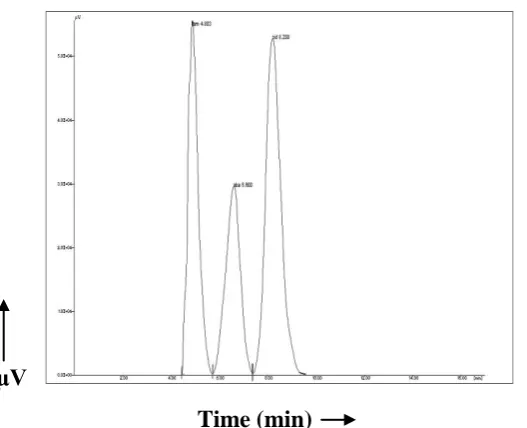
Fig.1: Chromatogram of ABA, LAM and ZID
Study of linearity range
The standard drug solutions were diluted with distilled water to get different concentrations
ranging from LAM as 5-15 µg/mL, ABA and ZID as 10-30 µg/mL respectively. The mobile
phase was allowed to equilibrate with stationary phase. Each of the standard solution was
injected separately and the chromatograms were recorded. The linearity graph was plotted as
concentration against detector response (peak area). The correlation coefficient (r) for ABA,
LAM and ZID were found to be 0.985, 0992 and 0.988 respectively.
Study of system suitability parameter
The system suitability tests were carried out and the results of system suitability tests are
[image:3.595.170.434.67.281.2]shown in Table 1.
Table 1: Data of system suitability tests Drug Retention
time(min)
Resolution Capacity factor
Column efficiency Theoretical plates
Asymmetric factor Per column (30cm)
ABA 6.61 1.922 1 595.31 0.91
LAM 4.87 0.000 1 709.89 1.32
ZID 8.21 1.435 1 816.93 1.21
Analysis of laboratory mixture by proposed method
Standard stock solutions of ABA, LAM and ZID were mixed in the ratio 2:1:2 respectively. The aliquot portions of stock solution of ABA, LAM and ZID were diluted with distilled
ABA, LAM and ZID, respectively. The chromatographic conditions were set as detailed
under the study of linearity range (10:5:10, 15:7.5:15, 20:10:20, 25:12.5:25 and 30:15:30
µg/mL) and each standard laboratory mixture was injected separately. The chromatograms
were recorded and the concentration of each drug was estimated by comparing peak area with
standard. The results of estimation of standard laboratory mixture are shown in Table 2.
Table 2: Analysis of standard laboratory mixture
S. No. Drug taken(µg/mL) % of drug estimated
ABA LAM ZID ABA LAM ZID
1 10 5 10 99.52 98.69 100.19
2 15 7.5 15 99.71 99.77 100.05
3 20 10 20 99.45 100.02 99.65
4 25 12.5 25 98.23 100.10 99.77
5 30 15 30 98.67 99.17 99.14
Drug Mean ±SD SE CV
ABA 99.12 0.64 0.28 0.0064
LAM 99.55 0.60 0.27 0.0060
ZID 99.76 0.40 0.18 0.0040
Analysis of tablets by proposed method
Tablets containing ABA (300 mg), LAM (150 mg) and ZID (300 mg) were finely powdered. An accurately weighed quantity of tablet powder equivalent to about ABA (25 mg) was
dissolved in acetonitrile (15 mL) in volumetric flask (25 mL). The volume was made up to 25
mL with methanol. The solution was filtered. The filtrate was diluted with distilled water to
get the concentration of ABA equivalent to 20 µg/mL. The equal volume of standard and
sample solution was injected separately and the chromatograms were recorded. The contents
of ABA, LAM and ZID were calculated and the results are shown in Table 3.
Table 3: Assay of ABA, LAM and ZID tablets by proposed method
S. No.
Quantity of tablet powder (g)
Amount of drug estimated(g/tab)
% of label claimed
ABA LAM ZID ABA LAM ZID
1 0.1877 0.2975 0.1503 0.2960 99.15 100.15 98.69
2 0.1876 0.2963 0.15.2 0.2991 98.74 100.09 99.70
3 0.1875 0.2966 0.1496 0.2995 98.85 99.69 99.82
4 0.1877 0.2993 0.1493 0.3003 99.76 99.51 100.08
5 0.1877 0.2994 0.1484 0.3004 99.78 98.89 100.12
Drug Mean ±SD SE CV
ABA 99.26 0.49 0.22 0.0049
LAM 99.67 0.51 0.23 0.0051
Average weight of tablet = 1.12615 g (Each tablet stated to contain ABA- 300 mg, LAM 150
mg and ZID- 300 mg).
Recovery studies
To an accurately weighed quantity of preanalysed tablet powder equivalent to 25 mg of ABA in volumetric flask (25 mL), about (5 mg each) of pure ABA, LAM and ZID were added. The
content was shaken for 15 min with acetonitrile (15 mL) and then the volume was made up to
25 mL with methanol. The solution was then filtered. An aliquot portion of the resultant
solution was appropriately diluted with distilled water to get final concentration within the
range of mixed standard. The results of recovery studies for ABA, LAM and ZID were found
to be satisfactory as 99.47 ± 0.48, 99.1 1± 0.36 and 99.3 ± 0.45 respectively.
Validation parameters
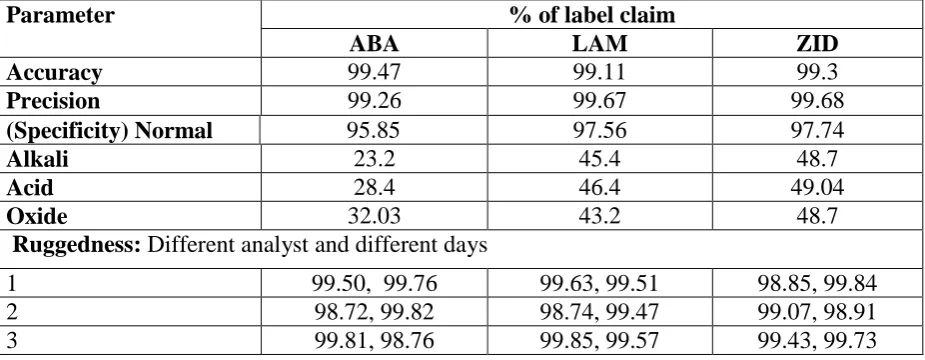
Validation of the proposed method was carried out as per ICH guidelines. The results of the
studies of validation parameters like accuracy, precision, specificity and ruggedness are given
[image:5.595.68.531.438.618.2]in Table 5.
Table 5: Results of validation studies
Parameter % of label claim
ABA LAM ZID
Accuracy 99.47 99.11 99.3
Precision 99.26 99.67 99.68
(Specificity) Normal 95.85 97.56 97.74
Alkali 23.2 45.4 48.7
Acid 28.4 46.4 49.04
Oxide 32.03 43.2 48.7
Ruggedness: Different analyst and different days
1 99.50, 99.76 99.63, 99.51 98.85, 99.84
2 98.72, 99.82 98.74, 99.47 99.07, 98.91
3 99.81, 98.76 99.85, 99.57 99.43, 99.73
RESULTS AND DISCUSSION
The proposed RP-HPLC method includes simultaneous determination of ABA, LAM and ZID in pharmaceutical formulation. The drugs shows better resolution in methanol: acetonitrile:
buffer pH 3.0: tetrahydrofuran (35:5:60:0.4 v/v/v/v) as compared to different proportions of
mobile phases. A flow rate was 0.6 mL/min. and the analysis was performed using UV
detector at wavelengths 271 nm. The retention times of ABA (6.61min), LAM (4.87 min)
ABA, 1.32 for LAM and 1.21 for ZID. The calibration curves showed linearity over the
concentration range from 10-30 μg/mL for ABA and ZID and 5-15 μg/mL for LAM. The r
values obtained with linear regression curve were above 0.98. Linearity data shows that
intensity of detector response is proportional to the concentration of analyzed substance. The
SD amongst replicate responses was less than 1% indicating precision of the method. The
mean recoveries obtained for ABA, LAM and ZID were 99.47, 99.11 and 99.3, respectively,
which confirms accuracy of the proposed method
CONCLUSION
The main advantage of the proposed method is its suitability for routine determination of ABA, LAM and ZID from their marketed tablet formulations since the proposed method is
simple, economical, precise and reproducible. Therefore it can be adopted for the estimation
of the drugs in said fixed dose combination.
ACKNOWLEDGMENTS
The authors are thankful to Cipla Ltd. Kurkumbh and Patalganga, India, for giving gift samples of pure drugs. They are also grateful to the Director, Sharad Pawar College of
Pharmacy, Nagpur for providing necessary facilities for research work.
REFERENCES
1. Djurdjevic P, Laban A, Markovic S, Stankov MJ. Chemometrically optimized RP-HPLC
method for the estimation of Abacavir, Lamivudine and Zidovudine in tablets. Anal Lett,
2004; 37: 2649-67.
2. Kumar DA, Rao GS, Rao S. Simultaneous method for the determination of Lamivudine,
Zidovudine and Abacavir in tablet dosage forms by RP-HPLC. E-J. Chem, 2010;
7:180-84.
3. Raja T, Lakshmana Rao A. Validated RP-HPLC method for the estimation of Abacavir,
Lamivudine and Zidovudine in pharmaceutical dosage form. Int. J. Pharm. Tech. Res,
2011; 3: 852- 57.
4. Pai NR, Desai AS. Simultaneous estimation method for some retroviral drugs from tablets
by RP- HPLC method. Ind. Drugs, 2005; 42: 681-84.
5. Robbins B, Poston PA, Neal EF, Slaughter C, Rodman JH. Simultaneous method for
measurement of intracellular triphosphate metabolites of Zidovudine, Lamivudine and
Abacavir (carbovir) in human peripheral blood mononuclear cells by combined anion
6. Nagulwar VP, Bhusari KP. Simultaneous estimation of Abacavir, Lamivudine and
Zidovudine in combined tablet dosage form by UV spectrophotometric method. Int. J.