Image Processing Using Artificial Networks and Neural Networks
Rajendra Babu GaddamAssociate Tech Specialist Tech Mahindra Limited, Maharashtra
Email Id: [email protected]
Abstract:Image processing using artificial neuronal networks (ANN) has been successfully used in various fields of activity such as geotechnics, civil engineering, mechanics, industrial surveillance, defense department, automatics and transport. Image preprocessing, date reduction, segmentation and recognition are the processes used in managing images with ANN. An image can be represented as a matrix, each element of the matrix containing color information for a pixel. The matrix is used as input data into the neuronal network. The small dimensions of the images, to easily and quickly help learning, establish the size of the vector and the number of input vectors. Artificial neural networks (ANNs) are very general function approximates which can be trained based on a set of examples. Given their general nature, ANNs would seem useful tools for nonlinear image processing. A range of experimental results lead to the conclusion that ANNs are mainly applicable to problems requiring a nonlinear solution, for which there is a clear, unequivocal performance criterion, i.e. high-level tasks in the image processing chain (such as object recognition) rather than low-level tasks.
Key words:artificial neuronal networks digital and satellite images; image preprocessing; date reduction; segmentation; recognition.
1.0INTRODUCTION:
Digital imaging is a process aimed to recognize objects of interest in an image by utilizing
electronic sensors and advanced computing techniques with the aim to improve image quality parameters It contains intrinsic difficulties due to the fact that image formation is basically a many-to-one-mapping, characterization of 3-d objects can be deduced from either a single image or multiple images. Several problems associated with low-contrast images, blurred images, noisy images, image conversion to digital form, transmission, handling, manipulation, and storage of large-volume images, led to the development of efficient image processing and recognition algorithms. Digital imaging or computer vision involves image processing and pattern recognition techniques Image processing techniques deal with image enhancement, manipulation, and analysis of images.
Image processing:
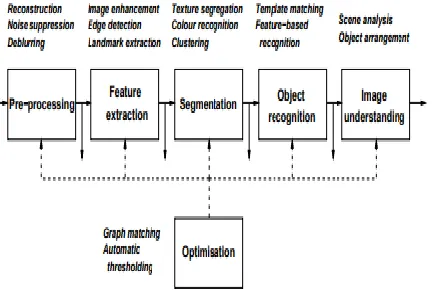
(features), and decisions made in previous stages of the chain (labels) or even object relation information There are many problems in image processing for which good, theoretically justifiable solutions exists, especially for problems for which linear solutions suffice. For example, for pre-processing operations such as image restoration, methods from signal processing such as the Wiener filter can be shown to be the optimal linear approach. However, these solutions often only work under
Figure:The image processing chain
Ideal circumstances; they may be highly computationally intensive when large numbers of linear models have to be applied to approximate a nonlinear model); or they may require careful tuning of parameters. Where linear models are no longer sufficient, nonlinear models will have to be used. This is still an area of active research, as each problem will require specific nonlinearities to be introduced. That is, a designer of an algorithm will have to weigh the different criteria and come to a good choice, based partly on experience. Furthermore, many algorithms quickly become intractable when nonlinearities are introduced. Problems further in the image processing chain, such object recognition and image understanding, cannot even (yet) be solved using standard techniques. For example, the task
of recognizing any of a number of objects against an arbitrary background calls for human capabilities such as the ability to generalize, associate etc.
ANNs for image processing:
As was discussed above, dealing with nonlinearity is still a major problem in image processing. ANNs might be very useful tools for nonlinear image processing:
• Instead of designing an algorithm, one could construct an example data set and an error criterion, and train ANNs to perform the desired input output mapping
• The network input can consist of pixels or measurements in images; the output can contain pixels, decisions, labels, etc., as long as these can be coded numerically no assumptions are made. This means adaptive methods can perform several steps in the image processing chain at once
• ANNs can be highly nonlinear; the amount of nonlinearity can be influenced by design, but also depends on the training data
Table advantages of digital imaging
1 Accurate data acquisition
2 Better combination of spatial and
contrast resolution
3 No degradation with time or copying
4 Compact storage/easy retrieval
5 Data
correction/manipulation/enhancement
Digital image processing methods arise from two principal application areas:
a) Improvement of image content for human interpretation and processing, and
b) Processing of scene data for machine perception. Some of their image processing methods include:
ii) Enhancement, restoration, and reconstruction, and
iii) Matching, description, and recognition. On the other hand, pattern recognition deals with object identification from observed pattern and images. In the last few years, significant advances have been made in pattern recognition, through the use of several new types of computer architectures that utilize very large-scale integrated circuits (VLSI) and solid state memories with a variety of parallel high-speed computers, optical and opt-digital computers, as well as a variety of neural network architectures and implementations. Artificial neural networks have shown great strength in solving problems that are not governed by rules, or in which traditional techniques have failed or proved inadequate. The inherent parallel architecture and the fault tolerant nature of the ANN is maximally utilized to address problems in variety of application areas relation to the imaging field Artificial neural networks find their application in pattern recognition (classification, clustering, feature selection), texture analysis, segmentation, image compression, color representation and several other aspects of image processing with applications in medical imaging, remote sensing, aerospace, radars, and military applications.
Enhancement and feature extraction:
After pre-processing, the next step in the image processing chain is extraction of information relevant to later stages In its most generic form, this step can extract low-level information such edges, texture characteristics etc. This kind of extraction is also called image enhancement, as certain general (perceptual) features are enhanced. As enhancement algorithms operate without a specific application in mind, the goal of using ANNs is to outperform traditional
methods either in accuracy or computational speed. The most well-known enhancement problem is edge detection, which can be approached using classification feed-forward ANNs. Some modular approaches, including estimation of edge strength or denoising, have been proposed. Morphological operations have also been implemented on ANNs, which were equipped with shunting mechanisms (neurons acting as switches). Again, as in pre-processing, prior knowledge is often used to restrict the ANNs. Feature extraction entails finding more application-specific geometric or perceptual features, such as corners, junctions and object boundaries. For particular applications, even more high-level features may have to be extracted, e.g. eyes and lips for face recognition. Feature extraction is usually tightly coupled with classification or regression; what variables are informative depends on the application, e.g. object recognition.
2.0Literature review:
medical applications which we categorized into four main medical applications that are widely used in breast cancer detection.
Juan A. Ramírez-Quintana (2005),Artificial Neural Networks (ANNs) have been useful for decades to the development of Image Processing algorithms applied to several different fields, such as science, engineering, industry, security and medicine. This close relationship between ANNs and Image Processing has motivated a study propose and deal with said algorithms. The information contained in these papers is analyzed, commented and then classified according to its contribution and applications.In regard to monitoring and measurement, ANNs present satisfactory results on classification tasks focused on product inspection, region detection in remote sensing and object detection. Works using ART and PNN report good findings in license plate and character detection. Most of the models used for shape and object analysis and interpretation are mainly spiking and oscillatory models. Also, the information provided in indicates that most of the SNN models are derived from the current research on the visual cortex. Therefore, it is expected that upcoming ANN models based on findings about the visual cortex may operate in a similar fashion to that of some animal visual system.
Hajji TarikMohcineKodad, Jaara El Miloud (2014)the presentation of a new method that uses the power of artificial neural networks to the restoration and correction of errors in digital images in the case of a bad capturing of the image also be called the movement’s images. In this work, we will prove the effectiveness of artificial neural networks as a good solution for this problemthis approach is computationally
inefficient compared to the impressive speed of SpikeNet which overcomes this constraint. Therefore, a primary objective for the future is to provide an impulse and asynchronous version of the model developed by Giese and Poggio. For the subject of artificial neural networks in digital image processing, we cannot make a panoramic citation for lifetime achievement on this topic. Alexandrina-elenapandelea,(2015)application of soft computing models on digital image has been considered to be an approach for a better result. The main objective of the present work is to provide a new approach for image recognition using Artificial Neural Networks. Initially an original gray scale intensity image has been taken for transformation. The Input image has been added with Salt and Peeper noise. Adaptive median Filter has been applied on noisy image such that the noise can be removed and the output image would be considered as filtered Image. The estimated Error and average error of the values stored in filtered image matrix have been calculated with reference to the values stored in original data matrix for the purpose of checking of proper noise removal. Now for recognition, a new test image has been taken and the same steps as salt & pepper noise insertion, removal of noise using adaptive median filter as mentioned earlier have been applied to get a new test matrix. Now the average error of the second image with respect to original image has been calculated based on the both generated matrices
3.0 Image system design parameters and modeling System
an electro-optical imaging system for target recognition, the perceived image quality can be affected by a number of parameters. These parameters are shown on Table although its length underscores the complexity of target acquisitionNo single model can be accounted for all the factors listed. Using a model to predict performance for scenarios where the model is not validated can lead to inaccurate predictions. Often several techniques are used and the results are combined. Proposedrobust methods for
multisensor data fusion. Similarly,
physiologically motivated pulse coupled neural network based image fusion modeling can be used to fuse the results of several object detection techniques, with applications in mammography and automatic target recognition
Experiment and used processing image techniques:
In order to train and test the developed artificial neural network on real experimental data, we visualized a bubbly free jet by PFBI technique (for details refer to The bubbly jet flow was organized in a hydrodynamic rig. The experimental setup is of closed type and continuous operation. Its test section is made of organic glass with the following dimensions (H*W*L): 425x300x300 mm. The operating fluid was distilled water, which was driven by a centrifugal pump equipped with a control module to vary the rotor speed. The flow rate was measured by an ultrasonic flowmeter.
Figure:Architecture of the convolutional neural network used in this work
Thewater temperature was maintained constant at 30±0.1 °C in the test section by means of a thermostatic regulator filled with tap water as a heat-transfer agent and containing a tubular electrical heater, cooling circuit and aquarium pump to permanently blend the heat carrier. Cooling and heating in the thermostat was implemented by a PID-control system activating an electromagnetic valve to start/stop the coolant supply to the cooling circuit and a switching relay to loop/break the electric line to the heater.
Digital imaging systems:
objects with widely varying attenuating structures. It is defined as the ratio of the maximum signal to the minimum observable image signal.
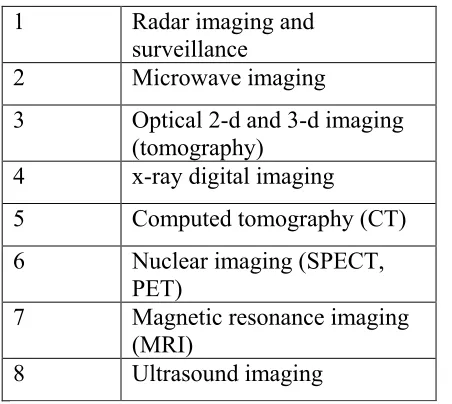
Table 2: Digital Imaging Modalities:
1 Radar imaging and
surveillance
2 Microwave imaging
3 Optical 2-d and 3-d imaging
(tomography)
4 x-ray digital imaging
5 Computed tomography (CT)
6 Nuclear imaging (SPECT,
PET)
7 Magnetic resonance imaging
(MRI)
8 Ultrasound imaging
Several electronic sensors can be utilized in the design of digital imaging systems, such as: − Radiation detectors (soft x-rays, x-rays, gamma rays)
Synthetic Aperture Radars (SAR)
(microwaves, lightwaves)
Electromagnetic sensors (RF sensors,
microwave sensors, MRI coils)
Optical sensors (PIN photodiodes,
avalanche photodiodes, fiberoptical
scintillating crystal plates coupled to
photomultipliers/photodiodes, CCD
cameras, C-MOS, operating in the UV, visible, near infrared and infrared
Ultrasound sensors (piezoelectric sensors)
Hybrid sensors: combination of more
than one detector media, such as gas/solid).
Imaging Sensors Applications:
Military:Reconnaissance Target acquisition Fire control Navigation
Civil:Law Enforcement Firefighting Borger patrol
Medical environmental:Digital radiography
(mammography, chest, dental, electronic portal imaging) Computed Tomography (CT) Nuclear Medicine (SPECT, PET) Ultrasound, MRI
Industrial:Maintenance, Manufacturing, Non-Destructive Testing.
Aero-space:Aircraft engine inspection, structural inspection, space imaging
4.0 Results and discussion
This section gives the results of exhaustive experimentation of developed methodology. A comparative study of the three feature sets used in the work is presented. A. Identification and Classification Bulk fruit samples using Color Features Each colour can be represented as a combination of three basic colors red, green and blue The array is used as input to the neural networks that are aimed at identifying images or grading.
Fig: RGB system
the input vector and the number of neurons. The transfer function for this type of problem is called sigmoid function. The rate of learning has values in the range [0.1] and the error it is recommended to have less than 0.1
Image preprocessing: an operation which shows a picture (contrast enhancement, noise reduction) with the same dimensions as the original image. the objective of images preprocessing with ANN consists in improving, restoring or rebuilding images. the resolved issues are the cartographic types, to optimize a function, an approximation function for the reconstruction of an image. data reduction or feature extraction involves extracting a number of features smaller than the number of pixels in the input window.
The operation consists in compressing the
image followed by extracting geometric characteristics facial features, etc.
Segmentation is a division of an image
into regions.
Recognition involves the determination
of objects in an image and their
classification.
The ANN’s ability to properly classify images using the Type 1 output and the two evaluation schemes is shown in Table II for various numbers of PEs in the hidden layer. As shown in Table II, the Brier scores varied from 0.153 to 0.271. The lowest Brier score was obtained by the ANN with 110 PEs in the hidden layer. The generally low Brier scores indicate the potential capability of ANNs to classify and recognize images. However, the ANN model with the lowest Brier score does not necessarily mean the best model in this case since it is not expected for a model that would give the best prediction efficiency for both corn and weed image recognitions. Rather, it is very important for our
application that weed images do not get classified as corn since it would lead to poor weed control and yield losses. Thus, it is necessary to further analyses the ANN model performance in detail and carefully consider the success recognition rates for classifying corn and weeds.
Issues resolved with ANN in field of industrial inspection:
Developed control strategies based on the liability of the plant. The network uses as input the characteristics finite element extracted from the image and the moisture content of the plant. The aim of the network was to predict the water level of a plant using a digital image with a wilted plant.a system based on ANN which identify whether plant species are dry, wet, torn or bent. Recognition system of plant leaf texture was created with a digital camera was carried out with the sameresolution photos, out of which extracting traits them representing input data network. The output of the network lied in the recognition and display of species of plants. In order to estimate the best time of the gathering of developed an ANN which recognize the fruits of the olive tree depending on the weight, color and size. Aprovided for the possibility of replacing a worker at sorting of the apples in order to gather, with an intelligent system that classifies the apples depending on the shown colors. the hypothesis that ANN is an efficient system that helps producers to identify pests from the apple orchards.
Discussions:
that need further attention. It can help radiologist to find a tumor which cannot be spotted using naked eye. As technologies keep growing, many researchers are concerned about the development of intelligent techniques which can be used in mammography to improve the classification accuracy. This artificial intelligence makes use of human skills in a more efficient manner than the conventional mathematical models do. Based on the research outcomes, ANN is proved to be a
good classifier in mammography for
classification of masses and microcalcifications. Implementation perceptron based three-layer neural network using backpropagation algorithm becomes a pioneer in ANN mammography.in order to handle the vulnerability nature of the
ultrasound images, some methods and
methodologies based on ANN have also been introduced. A majority of the research works that utilize ANN have acquired noteworthy results. Hybrid methods, which combine two ANN techniques, have recently been developed for the detection and classification of breast cancer. A two-phase hierarchical NN is also found to be promising rather than using the image analysis separately. It can also be seen that the larger the number of inputs to the ANN, the better the accuracy of the output in identification and classification of breast cancer.
Conclusions:
Processing images with artificial neuronal networks successfully resolve the problems of
classification, identification, authentication,
diagnostics, optimization and approximation. Importance of processing images with ANN in the field of medicine has emerged due to the need to lay down, in a real time, adequate
diagnosis. In the qualitative inspection, ANN plays a major role in detecting defective products for the production of steel, textiles, food stuffs, plants. In geotechnical engineering, landslides problem was resolved by training network with ASTER images and GIS and a generation after learning maps. Also, it has been determined through training network lands humidity with a set of small images for that learning to be done more quicklythe field of ANNs has to a large extent been re-incorporated in the various disciplines that inspired it: machine learning, psychology and neurophysiology. In machine learning, researchers are now turning towards other, non-neural adaptive methods, such as the support vector classifier. First, they are interesting tools when there is a real need for a fast parallel solution.
References:
[1] Mehdy,M. M.E. F. Shair,(2017) “Artificial Neural Networks in Image Processing for Early
Detection of Breast Cancer” Computational and
Mathematical Methods in Medicine,vol. 8, no. 7-8, pp. 1201–1214,
[2] Hajji TarikMohcineKodad, Jaara El Miloud (2014) “Digital Movements Images Restoring by Artificial Neural Networks”Computer Science and Engineering, volume:4(2): 36-42
[3] Juan A. Ramírez-Quintana (2005),
“Artificial Neural Image Processing
Applications” IEEE Transactions on Information Technology in Biomedicine, vol 9, no 3, PP: 459–467.