Grade Nested Array with Increased Degrees of Freedom
for Quasi-Stationary Signals
Sheng Liu, Jing Zhao*, Decheng Wu, and Hailin Cao
Abstract—In this paper a grade nested array constituted by a uniform linear array and a grade linear array with uniformly increasing inter-element is presented. The closed-form expression of the proposed array geometries and corresponding direction-of-arrival (DOA) estimation algorithm are derived. Theory analysis certifies that the proposed grade nested array can provide higher degrees of freedom (DOF) than some existing nested arrays. Some simulations are also presented to demonstrate the improved performance of the proposed nested array for DOA estimation of quasi-stationary signals.
1. INTRODUCTION
Direction-of-arrival (DOA) estimation based on array is one of the primary contents in array signal processing, and it is extensively applied in mobile communication [1] and multiple input multiple output (MIMO) radar [2, 3]. Compared with uniform arrays, sparse arrays show distinct advantage in increasing degrees of freedom (DOF) for DOA estimation of multiple signals. Many high-performance sparse arrays including minimum-redundancy array (MRA) [4], co-prime arrays [5, 6] and two-level array [7] have been proposed. In various kinds of sparse arrays, MRA can provide the largest DOF while generate the difference co-array (DCA) with consecutive virtual sensors. However, it is difficult to give the closed-form expression of the geometries of MRA as the sensor number has been given. A co-prime array consists of two uniform linear arrays, and a pair of co-prime integers is used to set the inter-element spacing of the two sub-arrays. Although co-prime array can reduce the mutual coupling between different sensors, the DOF of co-prime array is lower than MRA and two-level array.
Two-level array also consists of two uniform linear arrays, where the inter-element spacing of the second sub-array is related to the number of the elements in the first sub-array. Because of simple structure and relatively higher DOF, two-level nested array has been regarded widely, and many modified nested arrays [8–12] have been presented one after another. In [8, 9] two improved nested array configurations have been given by changing the element spacing of the second sub-array, and modified nested arrays can offer more DOF than two-level nested array [7]. A subspace extension algorithm based L-shaped nested array is presented to estimate the azimuth and elevation simultaneously in [10]. A DOA estimation algorithm with a special two-level nested array under unknown mutual coupling is proposed in [11]. It can increase DOF and improve the accuracy of DOA estimation. In addition to this, many nested arrays based fourth-order cumulants have been presented in [13–15].
The existence of periodic stationary signals [16] such as speech and audio signals is quite extensive. In [12], a new nested array for quasi-stationary signals was proposed, and it can offer more DOF than nested arrays [7–9]. However, the redundancy of this nested array is still higher because of the partial uniform structure of the second sub-array. In addition to this, the closed-form expression of corresponding DOA estimation algorithm has not been addressed.
Received 6 October 2018, Accepted 21 November 2018, Scheduled 5 December 2018 * Corresponding author: Jing Zhao ([email protected]).
In this letter, a grade nested array for quasi-stationary signals is proposed. Compared with a nested array [12], it has larger virtual array apertures and can offer more DOF. Besides, the closed-form expression of corresponding DOA estimation algorithm can also be given.
Notation: [·]T, [·]H,E[·] and [·] denote transpose conjugate transpose, statistical expectation and
integer part, respectively. and ⊗stand for Khatri-Rao product and Kronecker product, respectively.
2. DATA MODEL
Consider K narrowband uncorrelated quasi-stationary signals with DOA θk, k = 1,2,3, . . . , K
impinging a linear array. Denote dl, l = 2,3, . . . , L as the distance between the l-th sensor and
the first sensor, then the observation vector x(t) = [x1(t), x2(t), . . . , xL(t)]T ∈CL×1 can be presented
as
x(t) =As(t) +n(t) (1)
where A= [a(θ1),a(θ2), . . . ,a(θK)] ∈CL×K is the response matrix with a(θk) = [1, e−i
2π
λd2sin(θk), . . . , e−i2λπdLsin(θk)]T ∈CL×1;s(t) = [s1(t), s2(t), . . . , s
K(t)]T ∈CK×1is the signal vector;λis the wavelength
of incident signals; andn(t) represents the noise vector.
Assume that noise and signals are uncorrelated and that the length of frame is T, then we can denote the covariance matrix of theq-th frame as [12, 16]
Rq = E{x(t)xH(t)}
= ARsqAH+Rn∈CL×L, ∀t∈ [(q−1)T, qT −1] (2) forq= 1,2, . . . , Q, whereQ is the number of frames.
In formula (2),Rn=E{n(t)nH(t)}is the noise covariance matrix, andRsq=E{sq(t)sHq (t)}is the signal covariance matrix with the expression
Rsq = diagp2q1, p2q2, . . . , p2qK
(3)
3. KR-MUSIC ALGORITHM [16]
Denoting Y= [y1,y2, . . . ,yQ] and P⊥Q=IQ−(1Q1TQ)/Q, where yq=vec(Rq) and 1Q= [1, . . . ,1]T ∈ CQ×1, we can get
YP⊥Q= (A∗A)(P⊥QΨ)T (4)
where
Ψ=
⎡ ⎢ ⎢ ⎢ ⎣
p211 p212 . . . p21K
p221 p222 . . . p22K
..
. ... . .. ... p2
Q1 p2Q2 . . . p2QK
⎤ ⎥ ⎥ ⎥
⎦ (5)
Performing singular value decomposition (SVD) of YP⊥Q, we can get the signal subspace, and MUSIC algorithm [17] can be used to estimate the DOA. More details of the KR-MUSIC and the dimension reduction KR-MUSIC algorithms can be found in [16]. To save space, the detailed procedure is not presented throughout this paper.
4. GRADE NESTED ARRAY
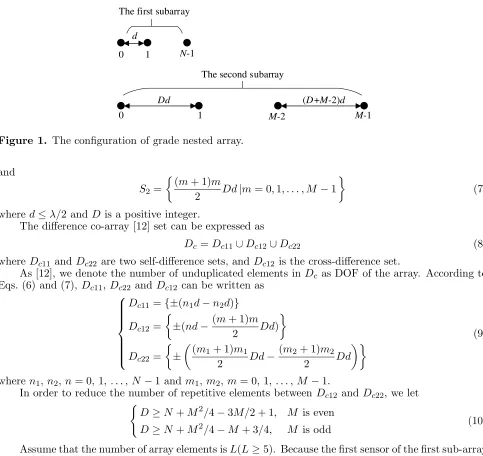
The proposed grade nested array consists of two linear arrays shown in Fig. 1. The first sub-array is a uniform linear array, and the inter-element spacing is d. The second sub-array is a grade array with continuously incremental inter-element spacing from Dd to (D+M−2)d. The set of sensor locations of the two sub-arrays can be expressed as
The first subarray
The second subarray
d 0 1 M-1 N-1 Dd 0 1
(D+M-2)d
M-2
Figure 1. The configuration of grade nested array.
and
S2 =
(m+ 1)m
2 Dd|m= 0,1, . . . , M −1
(7)
whered≤λ/2 and Dis a positive integer.
The difference co-array [12] set can be expressed as
Dc =Dc11∪Dc12∪Dc22 (8)
whereDc11 and Dc22 are two self-difference sets, and Dc12 is the cross-difference set.
As [12], we denote the number of unduplicated elements inDc as DOF of the array. According to
Eqs. (6) and (7),Dc11,Dc22 and Dc12 can be written as
⎧ ⎪ ⎪ ⎪ ⎪ ⎪ ⎨ ⎪ ⎪ ⎪ ⎪ ⎪ ⎩
Dc11={±(n1d−n2d)} Dc12=
±(nd−(m+ 1)m
2 Dd)
Dc22=
±
(m1+ 1)m1
2 Dd−
(m2+ 1)m2
2 Dd
(9)
wheren1,n2,n= 0,1, . . . , N −1 andm1,m2,m= 0,1, . . . , M−1.
In order to reduce the number of repetitive elements between Dc12 andDc22, we let
D≥N+M2/4−3M/2 + 1, M is even
D≥N+M2/4−M+ 3/4, M is odd (10)
Assume that the number of array elements isL(L≥5). Because the first sensor of the first sub-array has the same location as the first sensor of the second sub-array, we let N = [L/2] andM =L−N+ 1. When L is even, we haveN =L/2 and M =L/2 + 1. The number of nonnegative elements inDc11 is L/2. Since 0∈Dc11, we only need to know the positive elements of Dc12 and Dc22. It is easy to know that the number of positive elements being different fromDc11 inDc12 isL2/4. According to Eq. (10), removing the same elements with Dc12, the number of positive elements in Dc22 is (L2−2L)/8. When Lis odd, we have N = (L−1)/2 andM = (L+ 1)/2 + 1. The number of nonnegative elements in Dc11 is (L−1)/2, and the positive elements being different fromDc11 in Dc12 are (L2−1)/4. According to Eq. (10), except the same elements with Dc12, the number of positive elements inDc22 is (L2−1)/8.
From the analysis above, combining the symmetry of Dc11, Dc22, Dc12, we can get the DOF of
proposed array as
DOF = ⎧ ⎪ ⎪ ⎨ ⎪ ⎪ ⎩
3L2+ 2L
4 −1, L is even
3L2+ 4L−7
4 −1, Lis odd
(11)
the second array is replaced by a uniform linear array and an isolated sensor. In [9], the second sub-array is replaced by two different uniform linear sub-arrays. However, the DOF of the nested sub-arrays [8, 9, 12] is still affected by the partial uniform structure of the second sub-array.
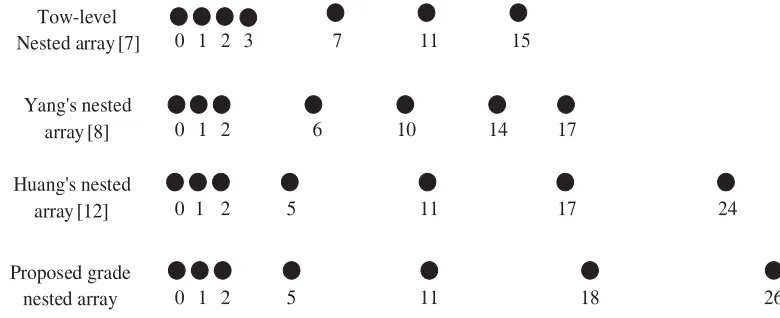
Take 7-element array as an example to compare the DOF of different nested arrays. Since the DOF of array [9] is lower than the nested array [8], and the configurations of two nested arrays are similar, we only compare the proposed array with a two-level nested array [7], Yang’s array [8] and Huang’s array [12]. For the proposed array, we let D= 5,N = 3 andM = 5. Fig. 2 shows the configurations of four nested arrays.
Tow-level
Nested array [7] 0 1 2 3 7 11 15
0 1 2 6
11
14 17
0 1 2 5 17 24
0 1 2 5 11 18 26
Yang's nested array [8]
Huang's nested array [12]
Proposed grade nested array
10
Figure 2. The configurations of four 7-element nested arrays.
The difference co-array set of sensor locations for two-level nested array [7], Yang’s array [8], Huang’s array [12] and proposed grade nested array areD1c ={−15,−14,−13,−12,−11,−10,−9,−8,−7,−6,−5,
−4,−3,−2,−1,0,1,2,3,4,5,6,7,8,9,10,11,12,13,14,15}d,D2c ={−17,−16,−15,−14,−13,−12,−11,
−10,−9,−8,−7,−6,−5,−4,−3,−2,−1,0,1,2,3,4,5,6,7,8,9,10,11,12,13,14,15,16,17}d, D3c = { −
24,−23,−22,−19,−17,−16,−15,−13,−12,−11,−10,−9,−7,−6,−5,−4,−3,−2,−1,0,1,2,3,4,5,6,7, 9,10,11,12,13,15,16,17,19,22,23,24}d, andD4c ={−26,−25,−24,−21,−18,−17,−16,−15,−13,−11,
−10,−9,−8,−7,−6,−5,−4,−3,−2,−1,0,1,2,3,4,5,6,7,8,9,10,11,13,15,16,17,18,21,24,25,26}d, re-spectively. The DOF of the four arrays are 31, 35, 39, 41, rere-spectively.
We must acknowledge that there are “holes” in the virtual array for the proposed nested array and Huang’s nested array [12]. We know that “holes” may bring about angle ambiguity. However, when the number of consecutive virtual sensors is large enough, the “holes” will not affect the performance of DOA estimation. More relevant details are described in [12]. In addition, from the above example, we can also find that the number of consecutive virtual sensors of the proposed array is larger than the nested array [12].
5. DIMENSION REDUCTION KR-MUSIC FOR PROPOSED ARRAY
In this section, we derive the closed-form expression of DOA estimation algorithm based on the characteristic of proposed grade nested array. We construct a selection matrix G ∈ CF×L2 with the expression
G= GTM−1 GTM−2 . . . GT0 G¯T0 . . . G¯TM−2 G¯TM−1 T (12) whereF is the DOF of the proposed array.
In formula (12),Gm and ¯Gm can be written as
Gm=
[0(N+m−1)×(N+m−1)L,IN+m−1,0(N+m−1)×(L2−(N+m−1)(L+1))], m= 1, . . . , M −1 [0N×(N−1)L,IN,0N×(L2−(N−1)L−N)], m= 0
(13)
and
¯
Gm= JN+m−1⊗eN+m 0(N+m−1)× [L2−(N+m−1)L]
whereeN+m = [ 0 . . . 1 . . . 0 ]∈C1×Lis a vector with one on the (N+m)th component and zero
for other components; IN+m−1 indicates an N +m−1 order identity matrix; and JN+m−1 denotes a matrix with one on back-diagonal and zero for other elements.
According to Eq. (4), we denote ¯Y∈F×Q as
¯
Y=GYP⊥Q=G(A∗A)(P⊥QΨ)T (15) As [16], SVD of ¯Y can get the noise subspace Un, where Un is a matrix consisting of the left singular vectors of the smallestF −k singular values. Minimizing cost function
f(θ) = 1
(G(a∗(θ)⊗a(θ)))HUnUH
nG(a∗(θ)⊗a(θ))
(16)
by multiple signal classification (MUSIC) algorithm [17], we can get the DOA estimation of all signals. In fact, the configuration of proposed array has something in common with the other four nested arrays [7–9, 12]. All the five arrays consist of a uniform array with small inter-element spacing and a sparse array with large inter-element spacing. Meanwhile, all the difference co-array sets of five arrays consist of two self-difference sets and a cross-difference set. So, a similar method can also be given for the other four arrays.
6. SIMULATION
In order to prove the improved performance of proposed grade nested array, we give three sets of simulation results. The nested array [8] has clear advantage over two-level nested array [7] in DOF and the performance of DOA estimation, which has been proved in [8] and [12]. Hence, we only compare the nested array [8] and nested array [12] with the proposed grade nested array.
First, we compare the DOF of the three nested arrays. DOF of three nested arrays versus the number of sensors is provided in Fig. 3. Obviously, the proposed grade nested array can offer more DOF than other two nested arrays.
Figure 3. DOF against the number of sensors.
Second, we compare the MUSIC spectra of dimension reduction KR-MUSIC for three nested arrays. 11 narrowband uncorrelated quasi-stationary signals come from the directions [−50◦,−40◦,−30◦,−20◦,
Figure 4. MUSIC spectra of three nested arrays.
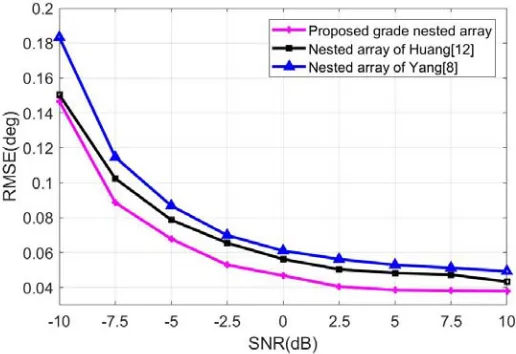
At last, we compare the RMSE of dimension reduction KR-MUSIC for three nested arrays. The root mean square error (RMSE) is expressed as
RMSE =
1
KJ
J
j=1
K
k=1
(ˆθkj−θk)2 (17)
where ˆθkj is the estimation in the jth experiment for the kth signal, and J = 200 is the number of
experiments.
The DOAs of six narrowband uncorrelated quasi-stationary signals are [−50◦,−40◦, −30◦, −20◦, 30◦, 40◦]. Let T = 500, Q = 40 and L = 7, and the RMSEs with respect to the SNR are described jointly in Fig. 5. Fig. 6 describes the RMSEs versus the number of snapshots with SNR = 10 dB,Q= 40 and L = 7. Fig. 7 shows the RMSEs versus the number of frames with SNR = 10 dB, T = 500 and L = 7. It can be indicated from the three figures that the estimation precision of proposed nested array is higher than other two nested arrays in different situations. But we must point out that the performance of three arrays degrade sharply when the number of frames is less than 25, which can be seen in Fig. 7.
Figure 6. RMSE against the number of snapshots for three nested arrays.
Figure 7. RMSE against the number of frames for three nested arrays.
7. CONCLUSION
We present a grade nested array for quasi-stationary signals. The closed-form expression of array geometries and corresponding DOA estimation algorithm are obtained. Because of the reduction of redundancy, it can offer more DOF than many pre-existing nested arrays. Simulation results testify the improved performance of proposed nested array in DOA estimation for quasi-stationary signals.
ACKNOWLEDGMENT
REFERENCES
1. Min, S., D. K. Seo, B. H. Lee, M. Kwon, and Y. H. Lee, “Direction of-arrival tracking scheme for DS/CDMA systems: Direction lock loop,” IEEE Trans. Wireless Communication, Vol. 3, No. 99, 191–202, 2004.
2. Yang, M., L. Sun, X. Yuan, and B. X. Chen, “A new nested MIMO array with increased degrees of freedom and hole-free difference coarray,”IEEE Signal Processing Letters, Vol. 25, No. 1, 40–44, 2018.
3. Yao, B., Z. Dong, W. Zhang, W. Wang, and Q. Wu, “Degree-of-freedom strengthened cascade array for DOD-DOA estimation in MIMO array systems,”Sensors, Vol. 18, No. 5, 1557, 2018.
4. Moffet, A., “Minimum-redundancy linear arrays,” IEEE Transactions on Antennas and Propagation, Vol. 16, No. 2, 172–175, 1968.
5. Vaidyanathan, P. P. and P. Pal, “Sparse sensing with co-prime samplers and arrays,” IEEE Transactions on Signal Processing, Vol. 59, No. 2, 573–586, 2011.
6. Qin, S., Y. D. Zhang, and M. G. Amin, “Generalized coprime array configurations for direction-of-arrival estimation,”IEEE Transactions on Signal Processing, Vol. 63, No. 6, 1377–1390, 2015. 7. Pal, P. and P. P. Vaidyanathan, “Nested arrays: A novel approach to array processing with
enhanced degrees of freedom,”IEEE Transactions on Signal Processing, Vol. 58, No. 8, 4167–4181, 2010.
8. Yang, M., L. Sun, X. Yuan, and B. X. Chen, “Improved nested array with hole-free DCA and more degrees of freedom,”Electronics Letters, Vol. 52, No. 9, 2068–2070, 2016.
9. Iizuka, Y. and K. Ichige, “Extension of nested array for large aperture and high degree of freedom,”
IEICE Communications Express, Vol. 6, No. 6, 381–386, 2017.
10. Liu, S., L. S. Yang, D. Li, and H. L. Cao, “Subspace extension algorithm for 2D DOA estimation with L-shaped sparse array,” Multidimensional Systems & Signal Processing, Vol. 28, 315–327, 2017.
11. Liu, S., J. Zhao, and Z. G. Xiao, “DOA estimation with sparse array under unknown mutual coupling,”Progress In Electromagnetics Research Letters, Vol. 70, 147–153, 2017.
12. Huang, H., B. Liao, X. Wang, X. S. Guo, and J. Huang, “A new nested array configuration with increased degrees of freedom,”IEEE Access, Vol. 6, 1490–1497, 2018.
13. Shen, Q., W. Liu, and W. Cui, “Extension of nested arrays with the fourth-order difference co-array enhancement,” IEEE International Conference on Acoustics, Speech and Signal Processing, 2991–2995, Shanghai, China, 2016.
14. Ahmed, A., Y. D. Zhang, and B. Himed, “Effective nested array design for fourth-order cumulant-based DOA estimation,” IEEE Radar Conference, 0998–1002, Seattle, WA, USA, 2017.
15. Zhang, L., S. Ren, and X. Li, “Generalized L-shaped nested array concept based on the fourth-order difference co-array,” Sensors, Vol. 18, 8, 2018.
16. Ma, W. K., T. H. Hsieh, and C. Y. Chi, “DOA estimation of quasi-stationary signals with less sensors than sources and unknown spatial noise covariance a Khatri-Rao subspace approach,”
IEEE Transactions on Signal Processing, Vol. 58, No. 9, 2168–2180, 2010.