Design and Analysis of IC Engine Piston with Different
Materials
Pathipati Vasu
1Dr.M.Sri Rama Murthy
2P.S.Amarnadh
3S.V.Gopal Krishna
41M-Tech, Department of Mechanical SIR C R REDDY College of Engineering 2Professor, Department of Mechanical SIR C R REDDY College of Engineering 3Assistant Professor, Department of Mechanical SIR C R REDDY College of Engineering 4Assistant Professor, Department of Mechanical SIR C R REDDY College of Engineering Abstract:
In the present work describes the stress distribution and thermal stresses of Five different materials for piston by using finite element method (FEM), testing of mechanical properties. The parameters used for the simulation are operating gas pressure, temperature and material properties of piston. The specifications used for this study of these pistons belong to four stroke single cylinder engine of Bajaj Kawasaki motorcycle. The results predict the maximum stress and critical region on the different materials piston using FEA.. Design by using catia v5 software and analysis by using Ansys software in Ansys 15 Static and thermal analysis is performed. The suitable material is selected based on results of structural and thermal analysis on these Al-sic graphite, A7075, A6082, A4032, AL-ghy 1250 materials
Key words:
FEA, Piston, Stress.etc,.Keywords
1. Introduction
The Piston is a „heart‟ of an automobile engine. It‟s one of the key components of the engine and it‟s working the hard condition. The function of the piston is bearing the gas pressure and making the crankshaft rotation through the piston pin. Piston works in high temperature, high pressure, high speed at poor lubrication conditions. Piston contact with high temperature gas directly, the instantaneous temperature can be up to 2500K. Because of the high temperature and the poor cooling condition, the temperature of the top of the piston can be reach 600~700K when the piston working in the engine and the temperature distribution is uneven. The top of the piston bears the gas pressure, in particular the work pressure.
2. Literature Review
method (FEM). FEM is performed by using computer aided engineering (CAE) software. The main objective of this project is to investigate and analyze the stress distribution of piston at the actual engine condition during combustion process.. The report describes the mesh optimization by using FEM technique to predict the higher stress and critical region on the component. The impact of crown thickness, thickness of barrel and piston top land height on stress distribution and total deformation is monitored during the study[6] of actual four stroke engine piston. The entire optimization is carried out based on statistical analysis FEA analysis is carried out using ANSYS for optimum geometry. This paper describes the stress distribution and thermal stresses of three different aluminum alloys piston by using finite element method (FEM). The parameters used for the simulation are operating gas pressure, temperature and material properties of piston. The specifications used for the study of these pistons belong to four stroke single cylinder engine. This topic shows review on design analysis of piston on the basis of improving strength according to the material properties. Vibhandik et. al . (2014), studied that Design analysis and optimization of piston and deformation of its thermal stresses using CAE tools, he had selected I.C. engine piston from TATA motors of diesel engine vehicle. He had performed thermal analysis on conventional diesel piston and secondly on optimized piston made of aluminum alloy and titanium alloy material. Conventional diesel piston made of structural steel. The main objective of this analysis is to reduce the stress concentration on the upper end of the piston so as to increase life of piston. After the analysis he conclude that titanium has better thermal property, it also help us to improve piston qualities but it is expensive for large scale applications, due to which it can be used in some special cases. Ch. Venkata Rajam et. al . (2013), focused on Design analysis and optimization of piston using CATIA and ANSYS. He had optimized with all parameters are within consideration. Target of optimization was to reach a mass reduction of piston. In this analysis a ceramic coating on crown is made. In an optimization of piston, the length is constant because heat flow is not affected the length, diameter is also made constant due to same reason. The volume varied after applying temperature and pressure loads over piston as volume is not only depending on length and diameter but also on thickness which is more affected. The material is removed to reduce the weight of the piston with reduced material. The results obtained by this analysis shows that, by reducing the volume of the piston, thickness of barrel and width of other ring lands, Von mises stress is increased by and Deflection is increased after
optimization. But all the parameters are with in design consideration.V. V. Mukkawar et. al . (2015), describes the stress distribution of two different Al alloys by using CAE tools. The piston used for this analysis belongs to four stroke single cylinder engine of Bajaj Pulsar 220 cc motorcycle. He had concluded that deformation is low in AL-GHY 1250 piston as compare to conventional piston. Mass reduction is possible with this alloy. Factor of safety increased up to 27% at same working condition. He used Al-GHY 1250 and conventional material Al-2618 and results were compared, he found that Al-GHY 1250 is better than conventional alloy piston. Manjunatha T. R. et. al. (2013), underlook specification for both high pressure and low pressure stages and analysis is carried out during suction and compression stroke and identify area those are likely to fail due to maximum stress concentration. The material used foe the cylinder is cast-iron and for piston aluminum alloy for both low and high pressure. He concluded that the stress developed during suction and compression stroke is less than the allowable stress. So the design is safe. Swati S. chougule et. al. (2013), focused on the main objective of this paper is to investigate and analyze the stress distribution of piston at actual engine condition during combustion process the parameters used for simulation is operating gas pressure and material properties of piston. She concluded that there is a scope for reduction in a scope for reduction in thickness of piston and therefore 0ptimization of piston is done with mass reduction by 24.319% than non-optimized piston. The static and dynamic analysis is carried out which are well below the permissible stress value. The study of Lokesh Singh et. al . (2015) is related to the material for the piston is aluminum silicon composites. The high temperature at piston head, due to direct contact with gas, thermal boundary conditions is applied and for maximum pressure mechanical boundary conditions are applied. After all these analysis all values obtained by the analysis is less than permissible value so the design is safe under applied loading condition. The study of R. C. Singh et. al. (2014), discussed about failure of piston in I.C. engines, after all the review, it was found that the function coefficient increases with increasing surface roughness of liner surface and thermal performance of the piston increases. The stress values obtained from FEA during analysis is compared with material properties of the piston like aluminum alloy zirconium material. If those value obtained are less than allowable stress value of material then the design is safe.
3. Project Overview
1. Have sufficient mechanical strength and stiffness.
2. Can effectively block the heat reached the piston
head.
Figure 3.1 Piston 3. High temperature corrosion resistance.
4. Dimensions as compact as possible, in order to reduce the weight of the piston.
3.2 Engine Specifications:
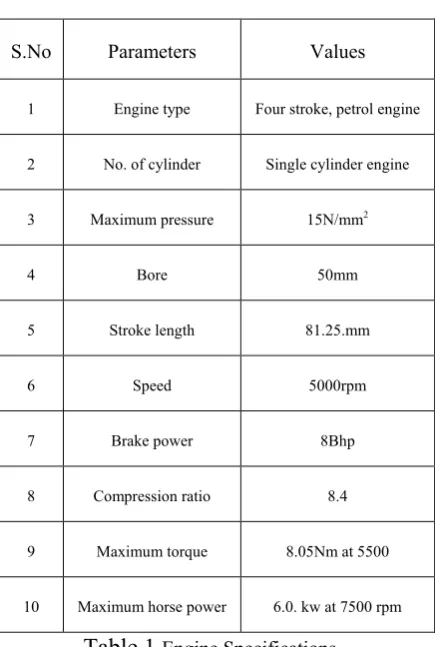
The engine used for this work is a single cylinder four stroke air cooled type Bajaj Kawasaki petrol engine. The engine specifications are given in below table
3.2 Properties of Materials:
3.2.1 AL4032:
Aluminum alloys are known for strong corrosion resistance. These alloys are sensitive to high temperatures ranging between 200 and 250°C (392 and 482°F), and tend to lose some of its strength. However, the strength of Aluminium/Aluminum alloys can be enhanced at subzero temperatures, making them ideal low-temperature alloys. Aluminium/Aluminum 4032 alloy is a wrought alloy type. The following datasheet will provide more details about Aluminium/Aluminum 4032 alloy.4032 aluminum is an alloy of aluminum, further classified within the AA 4000 series (aluminum-silicon wrought alloy). It is typically furnished in the T6 temper. 4032 is the Aluminum Association (AA) designation for this material. In European standards, it will typically be given as EN AW-4032. Additionally, the EN chemical designation is AlSi12,5MgCuNi. And the British Standard (BS) designation is DTD324B
Table 1 Engine Specifications
3.1.1.AL6082:
Aluminium alloy6082 aluminium alloy is an alloy in the wrought aluminium-magnesium-silicon family (6000 or 6xxx series). It is one of the more popular alloys in its series (alongside alloys 6005, 6061, and 6063), although it is not strongly featured in ASTM (North American) standards. It is typically formed by extrusion and rolling, but as a wrought alloy it is not used in casting. It can also be forged and clad, but that is not common practice with this alloy. It cannot be work hardened, but is commonly heat treated to produce tempers with a higher strength but lower ductility.
3.3.3 AL7075:
Aluminum alloy 7075 is an aluminum alloy, with zinc as the primary alloying element. It is strong, with a strength comparable to many steels, and has good fatigue strength and average machinability. It has lower resistance to corrosion than many other Al alloys, but has significantly better corrosion resistance than the 2000 alloys. Its relatively high cost limits its use to applications where cheaper alloys are not suitable. 7075 aluminum alloy's composition roughly includes 5.6– 6.1% zinc, 2.1–2.5% magnesium, 1.2–1.6% copper,
S.No Parameters Values
1 Engine type Four stroke, petrol engine
2 No. of cylinder Single cylinder engine
3 Maximum pressure 15N/mm2
4 Bore 50mm
5 Stroke length 81.25.mm
6 Speed 5000rpm
7 Brake power 8Bhp
8 Compression ratio 8.4
9 Maximum torque 8.05Nm at 5500
and less than a half percent of silicon, iron, manganese, titanium, chromium, and other metals. It is produced in many tempers, some of which are 7075-0, 7075-T6, 7075-T651.
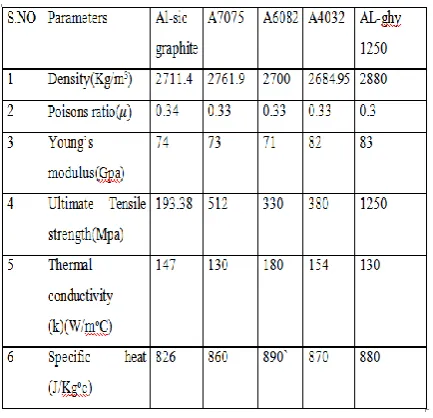
Table 2 Material Properties 3.3.4 AL-SIC graphite material:
Preparation of AL-SICGRAPHITES SPECIMEN Stir Casting technique is a method of producing composite materials, in which a scattered stage (fired particles, short filaments) is blended with a liquid metal by method for mechanical mixing with the help of stirrer. The liquid state composite material is cast by permanent die casting method. In this Stir casting technique has been used to prepare the work-piece samples of Al-Sic-Graphite hybrid metal matrix Composite material and accomplish the required properties of that composite material. The vortex stir casting is best approach to create an accurate mixing of the silicon carbide and graphite material in the matrix, the aluminium material was stacked in a crucible and it was placed into a resistance furnace at various temperature levels.
Figure 0.1 AL-SIC graphite 3.3.5 AL-GHY1250:
It is an ultra high strength Aluminum alloy processed via mechanically alloying route. The high strength
and temperature stability comes from the Yttrium and Oxides. This alloy even outperforms most of the new amorphous Aluminum alloys. Due to the very stable and small Oxides it shows outstanding strength at elevated temperatures. It is the Excellent temperature stability.
3.3 Problem Identification :
A piston is a component of reciprocating IC-engines. It is the moving component that is contained by a cylinder and is made gas-tight by piston rings. In an engine, its purpose is to transfer force from expanding gas in the cylinder to the crankshaft via a piston rod. Piston endures the cyclic gas pressure and the inertial forces at work, and this working condition may cause the fatigue damage of piston, such as piston side wear, piston head cracks and so on working condition of the piston of an internal combustion engine is so worst are high chances of failure of piston due to wear and tear. So there is necessary to analyze area of maximum stress concentration, strain, deformation and temperature distribution and heat flux on piston. The objective of the present work is to design and analysis of piston
made UP of A4032,
Al-GHY1250,AL6082,AL7075,ALSIC GRAPHITE
3.4 Designing of the Model :
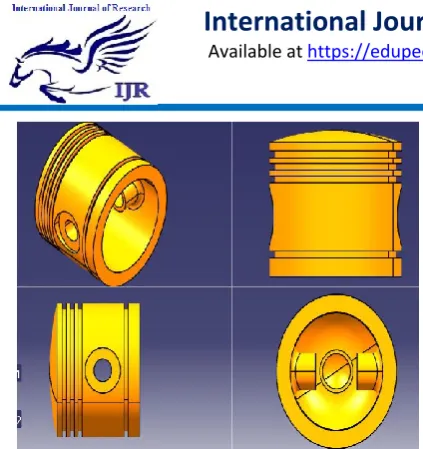
Create the half piston profile in sketcher workbench next go to exist work bench (part design) now go to the sketched based features and go to shaft option apply angle 360 after create the planes offset to xy planes create the circles and apply pocket around the up to surface now go to mirror option apply mirror finally as shown the figure below
:
Figure 3.4 different views of piston in catia work bench
4. Expermentation:
4.1 Structural Static Analysis:
A static analysis calculates the effects of study loading conditions on a structure, while ignoring inertia and damping effects, such as those caused by time varying loads. A static analysis can however include steady inertia loads and time varying loads that can be approximated as static equivalent loads. Static analysis is used to determine the displacements, stresses, strains and forces in structures or components caused by loads that do not induce significant inertia and damping effects. Steady loading and response conditions are assumed, i.e. the loads and the structure‟s responses are assumed to vary slowly with respect to time. The kinds of loading that can be applied in static analysis include:
4.2 Procedure of Static Analysis and Thermal Analysis:
Create the geometry in catia workbench and save the file in igs format and open ansys workbench apply engineering data (material properties), create or import the geometry, apply model (meshing), apply boundary conditions(setup) shown the results(stress,deformation,heat flux).
Analysis of Piston:
Frictionless support at pin bore areas and fixed all degree of freedom. Downward pressure (18.66 MPa) due to gas load acting on piston head. The piston is analyzed by giving the constraints they are Pressure or structural analysis and Thermal analysis.
Structural Analysis of Piston: Combustion of gases in the combustion chamber exerts pressure on the head of the piston during power stroke. The pressure force will be taken as boundary condition in structural analysis. Fixed
support has given at surface of pin hole. Due to the piston will move from TDC to BDC with the help of fixed support at pin hole. So whatever the load is applying on piston due to gas explosion that force causes to material.
Figure 4.1 Mesh body
4.3 Boundary conditions and in static analysis : 1. Maximum pressure load at the top surface of the piston crown 18.66 Mpa
2. Temperature at the top surface of the piston crown 1400 K
3. Piston pin holes are fixed DX = DY = DZ = 0
Figure 4.2 Boundry conditions of static analysis
5. Results and Discussion:
The constructed piston in catia is analyzed using ANSYS V15.0 and the results are depicted below. Combustion of gases in the combustion chamber exerts pressure on the head of the piston during power stroke. Fixed support has given at surface of pinhole. Because the piston will move from top dead center to bottom dead centre with the help of fixed support at pinhole.
AL-Sic Graphite Static analysis :
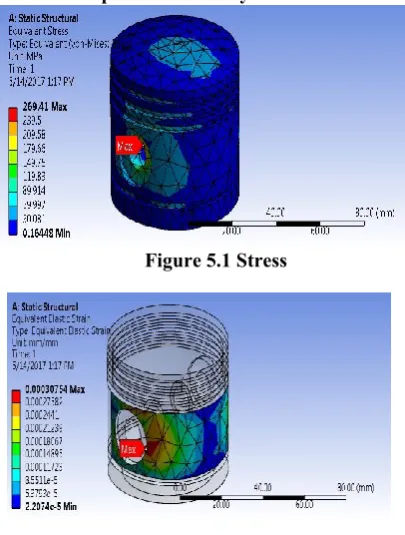
Figure 5.1 Stress
Figure 5.2 Strain
Figure 5.3 Deformation
AL-Sic Graphite Thermal analysis :
Figure 5.4 Heat flux
Figure 5.5 Temperature Distribution
5.1 Graphs:
5.2.1Static Structural Analysis:
The static structural analysis of Al-sic graphite, A7075, A6082, A4032, AL-ghy 1250are done and results are obtained for Equivalent (Von-Mises) stress, equivalent elastic strain, total deformation, heat flux, and temperature . These results are plotted graphically and a comparison is made between these results.
5.2.2 Von mises stresses (Mpa):
5.2.3 Equivalent Strain:
we can observe that in case of equivalent strain , piston made of Al-sic graphite is found to have least strain of 0.0003MPa in comparison with remaining materials including the present material. Highest strain of 0.00035MPa is observed in piston made of A6082. Maximum equivalent strain on A4032 was found to be 0.0034 Mpa, that of AL-ghy 1250 was found to be 0.00033 Mpa and A7075 was found to be0.00032 Mpa.
5.2.3 Total Deformation:
we can observe that in case of total deformation , piston made of Al-sic graphite is found to have least total deformation of 0.033MPa in comparison with remaining materials including the present material. Highest total deformation of 0.039MPa is observed in piston made of A6082. Maximum total deformation on A4032 was found to be 0.037 Mpa, that of AL-ghy 1250 was found to be 0.036 Mpa and A7075 was found to be0.035 Mpa
.
6. Conclusion :
Pistons made of different aluminium alloys like Al-sic graphite, A7075, A6082, A4032, AL-GHY 1250 were designed and analyzed successfully. In structural analysis, and in thermal analysis the pistons were analyzed to find out the equivalent (von-mises) stress, equivalent elastic strain, total deformation heat flux and temperature distribution. The results show that in case of equivalent (von-misses) stress, piston of Al-sic graphite is found to have least stress of 269.41Mpa in comparison with
remaining materials. Highest stress of 314.21MPa is observed in material of A6082, followed by A4032, AL-ghy 1250 and A7075.From the strain analysis figures, it can be observed that maximum strain is near piston pin area in all the materials. The results show that in case of equivalent (von-misses) strain, piston of Al-sic graphite is found to have least strain of 0.00030 in comparison with remaining materials. Highest strain s of 0.00035 is observed in material of A6082, followed by A4032, AL-ghy 1250 and A7075. The results show that in case of Total deformation, piston of Al-sic graphite is found to have least strain of 0.033 in comparison with remaining materials. Highest strain s of 0.039 is observed in material of A6082, followed by A4032, AL-ghy 1250 and A7075. The results show that in case of temperature distribution , piston of Al-sic graphite is found to have minimum temperature 435.95 .The results show that in case of heat flux , piston of Al-sic graphite is found to have highest heat flux of 2.0207 in comparison with remaining materials. Least heat flux of 1.5719 is observed in material of A6082, followed by A7075, A4032, and Al-ghy 1250.finally suitable material for piston is al-sic graphite material.
7. References:
[1]. Ajay Raj Singh, “Design, Analysis and Optimization of Three Aluminium Piston Alloys Using FEA” Int. Journal of Engineering Research and Applications, Vol. 4, Issue 1 Version 3, January 2014, pp.94-102.
[2]. IsamJasimJaber and Ajeet Kumar Rai, “Design and analysis of i.c. engine piston and piston-ring using catia and ansys software” International Journal of Mechanical Engineering and Technology (IJMET),Volume 5, Issue 2, February 2014.
[3]. Vinod Yadav, Dr. N. D. Mittal, “Design and Analysis of Piston Design for 4 Stroke Hero Bike Engine” International Journal of Engineering Innovation & Research Volume 2, Issue 2, 2013FERENCES.
[4]. Ch.Venkata Rajam, P.V.K. Murthy, M.V.S. Murali Krishna, G.M .PrasadaRao, “Design Analysis and Optimization of Piston using CATIA and ANSYS ”, International Journal of Innovative Research in Engineering & Science , issue 2 volume 1, January 2013.
[5]. S.Srikanth Reddy, Dr. B.Sudheer Prem Kumar, “Thermal Analysis and Optimization of I.C. Engine Piston Using Finite Element Method” International Journal of Innovative Research in Science, Engineering and Technology, Vol. 2, Issue 12, December 2013
[7].V. Esfahanian, A. Javaheri, M. Ghaffarpour- Thermal analysis of an SI engine piston using different combustion boundary condition treatments
[8]. B. Bhandari, “Design of Machine Elements”, 3rd Edition, McGraw Hill.
[9]. Ajay Raj Singh, Dr. Pushpendra Kumar SharmaDesign, Analysis and Optimization of Three Aluminum Piston Alloys Using FEA International Journal of Material and Mechanical Engineering, Jan 2014.