BIROn - Birkbeck Institutional Research Online
Drury, Lisbeth and Cameron, L. and Abrams, D. (2018) The positive
and negative impact of an intergenerational digital technology education
programme on younger people’s perceptions of older adults. In: Zhou, J. and
Salvendy, G. (eds.) Human Aspects of IT for the Aged Population. Aging,
Design and User Experience: Third International Conference, ITAP 2017.
Lecture Notes in Computer Science 10297. Springer International, pp.
419-428. ISBN 9783319585291.
Downloaded from:
Usage Guidelines:
Please refer to usage guidelines at
or alternatively
The Positive and Negative Impact of an Intergenerational Digital
Technology Education Programme on Younger People’s Perceptions
of Older Adults
Lisbeth Drury, Ania Bobrowicz (✉), Lindsey Cameron, Dominic Abrams
University of Kent, Canterbury, UK
[email protected], [email protected], [email protected], [email protected]
Abstract. In order to meet the technological needs of older adults, and ensure digital inclusion, it is important for digital technology designers to accurately assess and understand older adults’ needs and requirements, free from the influence of societal assumptions of their capabilities. This study evaluated the impact of an intergenerational digital technology education programme on younger adults’ stereotypes of older people. Using an experimental design, results show that compared to a control group, students taking part in the programme subsequently rated older adults as more friendly but less competent. Practical implications for developing intergenerational education programmes are discussed.
Keywords: Older Adults; Attitudes; Stereotypes; Digital Technology; Intergenerational Education Programmes;
1
Introduction
Although digital technologies have become all pervasive in our increasingly connected digital society, many older adults, aged 65 and above, remain digitally excluded or digitally dismissive; this is despite the general acknowledgement that the internet is important and will become a ‘way of life’ for more and
more people [1]. According to the 2015 report by Foresight, UK Government Office for Science, the rise of digital technologies has been ‘a double-edged sword for older people’ [2]. On the one hand,
There are social, economic and moral reasons for ensuring technology is appropriately designed for use by older adults [5]. Firstly, it is important that technology is usable by, and accessible to, older adults. Technology is an important tool to support older adults’ independence, allowing them to live in their
own homes for longer, therefore postponing or avoiding a need for residential social care. Secondly, increasing numbers of active older adults have more free time, therefore offering the technology industry lucrative new product development opportunities. Lastly, moral obligation and legislation (UK Disability Discrimination Act, 1995, and more recently the Equality Act 2010) require that systems are accessible to people with disabilities, who are in many cases older adults. Although technology design often adopts a ‘user-centered’ approach, it is argued that young designers may find it easier to design
technology for a user more similar to themselves and experience difficulties understanding the potential impact of technology on the day-to-day lives of older adults [6]. This gap in understanding can lead to the design of technology based on designers’, sometimes patronising, interpretation of older
adults needs [5].
The young generation of millennials, which relies on instant communication, social networking, sharing of digital information and informal and rapid connectivity, differs from the older generation in their attitudes towards, purpose for and use of digital technologies. Therefore, there is a need for young digital technology designers to be able to examine and engage with viewpoints of the users of digital technology that they will be designing in future, including older users. Educators are presented with a particular challenge: how to design intergenerational education programmes which help to convey the diverse life experiences and expectations of older users to the technologically literate young generation who are very comfortable with everyday use of digital technologies, but who may lack the understanding of digitally disengaged or digitally dismissive users [7].
1.1 Stereotypes of Older People
Across many western cultures old age is perceived as a time of illness, frailty and dependency [16], [17]. Such prevalent negative age stereotypes can have a detrimental effect on the treatment older adults receive. For example, older workers often experience discrimination in the workplace [18], [19], which can be linked to negative stereotypes such as a lower aptitude to learn, less flexibility and a resistance to change [20]. However, older adults can also be stereotyped positively and can be seen as more moral and wiser than younger adults [21], [22].
attitudes and behaviours towards older adults [23] and, in some cases, lead older adults to confirm and internalize negative age stereotypes [25], [26]. One method of reducing stereotyped views of older adults is via increased social contact between generations [27].
Older adults are negatively stereotyped about their ability to interact with new technology [28]. A study invited participants (aged 18 to 72 years old) to rate the skills and abilities perceived as typical of either adults in their 20s or their 60s. Stereotypes rated as typical of younger, but not older adults included learning new skills, using new computer technology (e.g. smartphones), and using social media (e.g. Facebook). Age stereotypes of this nature are likely to hinder the development of technology required by older adults, and may also be strengthened during intergenerational programmes that focus on technology design.
1.2. Intergenerational Education Programmes
For students whose future career may involve addressing the needs of older adults, many educational courses employ intergenerational teaching strategies to provide education and positive
intergenerational contact experiences, which also have a positive effect on attitudes towards older adults [8]. Interest in intergenerational programmes which bring together the older population and younger generation with an aim to share experiences, educate, support and engage with each other in the context of digital technologies has been growing steadily in recent years. In 2015 Kaplan et al conducted a survey of intergenerational technology-focused programmes, which considered the conceptual and practical applications of connecting younger and older generations in the technological domain [9]. Tentative conclusions from this preliminary study indicate that technology can be seen as a powerful tool for intergenerational collaboration and that an increase in digital inclusion may lead to a decrease in social isolation and exclusion.
Intergenerational programmes can bring younger and older people together resulting in positive outcomes. A review of intergenerational case studies across the United Kingdom led by the Beth Johnson Foundation documented a network of over 850 organisations and practitioners who are actively involved in delivering intergenerational programmes [10]. Specifically, studies of
intergenerational programmes in education (including technology) generally point to a positive impact such programmes have had on the participants, such as fostering more positive attitudes toward older adults [11]; improving older people’s sense of self-worth, health and well-being [12]; improving classroom atmosphere [13], and a higher overall level of social integration [14].
participants from different generations, there is a need to better understand intergenerational practice and involve research institutions in their evaluation [15]. Importantly, one potential drawback of such programmes, particularly those that focus on tasks or areas where older adults are less skilled, is that they run a risk of reinforcing negative age stereotypes by focusing on areas where adults need help, thus they could unintentionally reinforce the impression of older people as incompetent - digital technology is one such context.
1.3 Digital Technology as a Negatively Stereotyped Context
Research shows that intergenerational contact reduces negative attitudes and stereotypes about older adults [29], [30], [31], [32]; including the stereotype that older adults are incompetent [33]. However, it is possible that when the task or context of intergenerational contact highlights or confirms negative old age stereotypes, especially those around dependency or incompetence, this may increase rather than decease stereotypes in this area. Little is known about the effects of intergenerational contact in negatively stereotyped contexts, such as digital technology. Identification of effective training programmes for technology design for older users is essential, and robust evaluation of the impact of such programmes is critical, including their impact on stereotypes of older people.
2
Study Aims
The aim of this study is to evaluate an intergenerational education programme for digital technology students by assessing the degree to which it impacts students’ stereotypes of older adults. Whilst contact with older people should improve the participants’ perceptions of older adults as friendly, this type of intervention, in a domain where older adults are stereotyped as less competent, risks an increase in the young adults’ perceptions of older adults as incompetent.
2.1 Hypothesis
It is hypothesised that compared to a control group who did not take part in the intergenerational education programme, experimental participants who interact with older adults in the negatively stereotyped context will report higher warmth stereotype ratings of older adults but lower competency stereotype ratings.
2.2 Methods
Participants were eighty-four digital technology students at a University in South East England. The average age of the students was Mage 20.42 (SD=2.87). Thirty-nine were males, thirty females and
fifteen did not indicate their gender. All participants voluntarily completed paper questionnaires in class. Fifty-one participants had taken part in the intergenerational programme (intervention condition). This consisted of two intergenerational informal but loosely structured conversations, focusing on technology, and was completed as part of their coursework. Thirty-three participants that had not taken the coursework module formed the control group. The data were collected from two waves of the module that was repeated over two consecutive academic years. The final sample consisted of twenty-nine participants from the 1st wave (2014/2015) and fifty-five participants from the
2nd wave (2015/2016). The average age of older adults that took part as conversation partners was
71.52 years old, 41% were male, 45% were female and the gender of 14% of older participants was not identified.
2.3 Design and Procedure
An experimental design was used in which the independent variable was intergenerational contact. Participants were either in the experimental group that experienced contact with older adults as part of the programme or a control group that did not take part in the programme. The dependent variables were stereotypes; warmth and competence.
Participants in the experimental group were instructed to conduct two independent informal guided conversations with an older adult, either face-to-face or via SKYPE. The aim of the
conversation was to build rapport with the older adults, share each other’s experience of using technology, and identify potential barriers and frustrations. The students recorded and transcribed the conversations, then conducted analysis as instructed by the coursework brief. Both the guidelines for the conversation and the analysis featured focus on variables that had previously been identified as important moderators or facilitators of the successful effects of intergenerational contact on reduced ageism [27]. These conversations therefore focused on the following aspects:common goals, cooperation, institutional support, equal status, good quality contact, self-disclosure, story-telling, shared humour, avoiding incompetency stereotypes, challenging stereotypes, empathy, perspective taking and common in-group identities. Having conducted the conversations, the experimental group submitted their coursework via a Virtual Learning Environment (VLE), after which all participants responded to the stereotype measures.
2.4 Measures
Normative age stereotypes.
In order to measure respondents' awareness of commonly held perceptions of older peopleparticipants were asked “What does society in general think of older adults? As viewed by society……” followed by seven items “How competent/confident/ independent/competitive/warm/good natured/sincere are older adults?” on a 7-point scale (1 = not at all, 7 = very much).
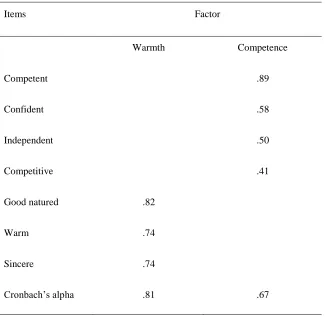
Maximum likelihood confirmatory factor analysis was conducted in SPSS to explore the warmth and competence components of the age stereotype measure. This resulted in two factors with an eigenvalue above 1. Together the factors accounted for 60.6% of the variance and a varimax
orthogonal rotation showed all items loaded onto one of the two factors, accounting to 31.2% (warmth) and 29.5% (competency) respectively. A chi-square goodness of fit test was non-significant X2 (8)
[image:7.595.92.417.432.749.2]5.82, p = .668, indicating the factors are independent of each other. A rotated matrix showing the factor loadings of the items are displayed in Table 1. Items were averaged to create two indices of warmth stereotypes and competence stereotypes.
Table 1. Varimax rotated factor matrix for stereotype warmth and competence factors.
Items Factor
Warmth Competence
Competent .89
Confident .58
Independent .50
Competitive .41
Good natured .82
Warm .74
Sincere .74
2.5 Results
Descriptive statistics.
To examine whether participants rated older adults as warm or competent one-sample t tests were conducted comparing the mean values to the midpoint (3.5) of the scale responses. The results showed that participants rated older adults as both warm (M = 4.97, SD = 0.96) t (83) 13.96, p < .001, and (M = 3.88, SD = 0.99) competent t (83) 3.47, p = .001. A paired sampled t test was computed to examine the difference in ratings of warmth and competence, revealing that the participants rated older adults as higher in warmth (M = 4.97, SD = 0.96) than competence (M = 3.88, SD = 0.99), t (83), -7.31, p <.001. Warmth and competence ratings were uncorrelated r = .02, p = .870).
Inferential statistics.
To examine attitudinal differences between the experimental and control conditions independent sample t tests were conducted. The experimental group reported higher ratings of warmth stereotypes (M = 5.18, SD = 1.01) than the control group (M = 4.64, SD = 0.80), t (82) -2.61, p = .011, d =.59 and lower ratings of competence stereotypes (M = 3.69, SD = 0.94) than the control group (M = 4.16, SD = 1.01), t (82) 2.20, p = .031, d =.48. Therefore, in line with the study hypotheses, participants who had taken part in the course reported more warmth stereotypes, and less competence stereotypes towards older adults compared to the control group.
3
Discussion
Our study found that compared with the students who did not participate, those students who took part in the intergenerational education programme, in which they conducted conversations with older adults about technology use, subsequently rated older adults higher on warmth (friendliness) stereotypes but lower on competence stereotypes1. This suggests that as a result of the programme, students perceived
older adults as more friendly but less competent.
The findings are consistent with research showing that intergenerational contact [29] and intergenerational programmes [27], [10] can have a positive impact on impressions of older people. In the case of the current research, an intergenerational education programme boosted perceptions of older people as being ‘warm’, thus confirming a commonly held positive age stereotype [24]. However,
1 Participants’ age, gender and prior contact with older adults was also measured and analysed. The results
finding that the intergenerational programme increased perceptions of older adults as incompetent, is divergent from other intergenerational contact literature. Tasipoulou and Abrams’ analysis of national survey data showed that the more friendships young adults had with older adults the less they agreed that competence declines with age [34]. Findings from the current study however, suggest that in contexts where negative age stereotypes of older adults [31] are salient, or when older adults confirm negative stereotypes about competence, this has a detrimental effect on perceptions of older adults’ competence. Therefore, intergenerational contact in these situations exacerbates the already negative societal stereotype of older adults’ capabilities [24]. It is noteworthy that students’ perceptions of
warmth and competence in the current study are not correlated. This demonstrates that the same intergenerational contact experience has independent effects of two outcomes that vary in
favourability. This finding is divergent from other intergenerational contact research, which shows an overall positive effect on positive and negative stereotypes [30], [31], [32].
In summary, the findings point to a potential pitfall of some intergenerational education programmes: when the focus is on an area of weakness for older people, such as digital technology, programmes run the risk of strengthening negative stereotypes of older people as being incompetent [24]. Future intergenerational contact research should compare programmes that vary only in the degree to which they highlight negative stereotypes in order to isolate and confirm these effects.
A psychological process that may have contributed to negative effects of the current
intergenerational education programme, and others that highlight negative age stereotypes, is that the older adults themselves may have responded to the stereotype. It is possible that discussing technology with a younger adult could have induced a stereotype threat in the older adults. Stereotype threat occurs when an individual is anxious they may confirm a negative stereotype about their social group in a situation linked to that stereotype, and subsequently underperform on the stereotype relevant task [35]. Research shows that both explicit and subtle cues about negative age stereotypes are sufficient to have a detrimental effect on older adults’ cognitive and physical performance [25]. In this case, discussing technology with younger adults may have implicitly highlighted the stereotype that older adults are viewed as poor technology users compared to younger adults, resulting in anxiety and less confidence in engaging with the subject.
4
Limitations
5
Practical Implications for Educators
In order to include older adults in a society with rapidly changing technology and increase their use of technology it is important that technology is designed with their needs in mind. However, the present research highlights that focusing on these needs presents a problem. On the one hand, the findings demonstrate how intergenerational contact in technology-learning programmes can have a positive effect on perceptions of older adults’ friendliness, yet have a negative impact on perceptions of their competence.
Future intergenerational education programmes should aim to counterbalance the detrimental effects of intergenerational contact within negatively stereotyped contexts. For example, experimental research in which young adults collaborated with older adults on tasks at which older adults are stereotypically more proficient, resulted in those young adults being more pro-social in their attitudes and behaviours compared with young adults working on other tasks, or with younger partners [38]. Further studies should examine if highlighting older adults’ abilities mitigate the detrimental effects of intergenerational contact in negatively stereotyped contexts.
The results highlight that it is important to be aware that user-centered design strategies involving intergenerational contact (e.g. conversations or interviews) have the potential to increase incompetence perceptions of older adults. In turn, this may hamper young designers’ abilities to create technology that fully meets the needs of older adults, by encouraging patronising assumptions of older adults’ interaction with, and needs for, technology [5].
These findings underscore the importance of evaluating intergenerational education programmes, as suggested by Finn & Scharf [15]. Comparing outcomes of programme groups to control groups is an important design aspect that helps identify effects attributable directly to the programme. For a review of best practice for intergenerational programmes see [28].
References
1. Age UK: Introducing another world: Older people and digital inclusion, http://www.ageuk.org.uk/professional-resources-home/research/reports/work-and-learning/archive/ (2009)
2. Foresight: How are attitudes and behaviours to the ageing process changing in light of new media and new technology? How might these continue to evolve by 2025 and 2040? https://www.gov.uk/government/uploads/system/uploads/attachment_data/file/455176/gs-15-17-future-ageing-attitudes-new-technology-er08.pdf, (2015)
3. Melenhorst, A.S., Rogers, W.A., Bouwhuis, D.G.: Older adults' motivated choice for technological innovation: evidence for benefit-driven selectivity Psychology and Aging, 21(1), pp. 190–195 (2006) DOI:10.1037/0882-7974.21.1.190
4. Coleman, G.W., Hanson, V.L., Gibson, L., Bobrowicz, A., McKay, A.: Engaging the disengaged: How do we design technology for digitally excluded older adults? In: Designing Interactive Systems 2010, pp. 175-178 (2010) DOI: 10.1145/1858171.1858202
5. Eisma, R., Dickinson, A., Goodman, J., Syme, A., Tiwari, L., Newell, A. F.: Early user involvement in the development of information technology-related products for older people. Universal Access in the Information Society, 3(2), pp. 131–140 (2004) http://doi.org/10.1007/s10209-004-0092-z
6. Keates, S., Clarkson, P. J.: Defining design exclusion. In: Keates, S., Langdon, P., Clarkson, J., Robinson, P. (eds.) Universal access and assistive technology, pp. 13-22. Springer, London (2002)
7. Batchelor, R., Bobrowicz, A.: Empathic and Ethical Design of Technology. In: Stephanidis C., Antona M. (eds) Universal Access in Human-Computer Interaction. Design and Development Methods for Universal Access. UAHCI 2014. Lecture Notes in Computer Science, (8513). Springer, Cham 3-10 (2014) DOI: 10.1007/978-3-319-07437-5_1
8. Levy, S. R.: Toward Reducing Ageism : PEACE (Positive Education about Aging and Contact Experiences) Model, Gerontologist, pii: gnw116. [Epub ahead of print], pp. 1–7. http://doi.org/10.1093/geront/gnw116 (2016) 9. Kaplan, M., Sanchez, M., Bradley, L.: Conceptual frameworks and practical applications to connect generations
in the technoscope, Anthropology & Aging, 36(2), pp. 182-205 (2015)
10. Hatton-Yeo, A. (ed.): Intergenerational Practice: An introduction and examples of practice. www.ucllouvain.be/cps/ucl/doc/aisbl.../DocPart_Terrain_UnitedKingdomPractice.pdf (2006)
11. Knapp, J.L., Stubblefield, P.: Changing students’ perceptions of aging: The impact of an intergenerational service learning course, Educational gerontology, 26(7), pp. 611-621 (2000) http://dx.doi.org/10.1080/03601270050200617
12. Park, A-La: The effects of intergenerational programmes on children and young people. International Journal of School and Cognitive Psychology, 2(1), pp. 1-5 (2015)
13. Lirio Castro J., González, D.A., Herranz Aguayo, I. & Enrique Arias Fernández: Perceptions concerning intergenerational education from the perspective of participants. Educational Gerontology, 40(2), pp. 138-151, http://dx.doi.org/10.1080/03601277.2013.802182 (2014)
14. Montoro-Rodriguez, J., Pinazo, S.: Evaluating social integration and psychological outcomes for older adults enrolled at a university intergenerational programme, Journal of Intergenerational Relationships, 3(3), pp. 65-81, DOI:10.1300/J194v03n03_05 (2005)
15. Finn, C., Sharf, T.: Intergenerational programmes in Ireland: An initial overview https://www.ageaction.ie/sites/default/files/attachments/mapping_report_november_2012_web.pdf (2012)
16. Levy, B. R., Slade, M. D., May, J., Caracciolo, E. A.: Physical recovery after acute myocardial infarction: Positive age self-stereotypes as a resource. International Journal of Aging & Human Development, 62(4), pp. 285-301. DOI: 10.2190/EJK1-1Q0DLHGE-7A35 (2006)
17. Marques, S., Lima, M.L., Abrams, D., Swift, H.J.: Will to live in older people’s medical decisions: Immediate and delayed effects of aging stereotypes. Journal of Applied Social Psychology 44, pp. 399-408, DOI:10.1111/jasp.12231 (2014)
19. McCann, R., Giles, H.: Ageism in the workplace: A communication perspective. In: T. D. Nelson (ed.), Ageism, stereotyping and prejudice against older persons, pp. 163–199, Cambridge, MA: MIT Press (2002)
20. Posthuma, R. A., Campion, M. A.: Age stereotypes in the workplace: Common stereotypes, moderators, and future research directions. Journal of management, 35(1), pp. 158-188 (2009) DOI: 10.1177/0149206308318617
21. Abrams, D., Russell, P.S, Vauclair, M., Swift, H.: Ageism in Europe: Findings from the European Social Survey. London: Age UK (2011a)
22. Levy, B. Improving memory in old age through implicit self-stereotyping. Journal of Personality and Social Psychology, 71(6), pp. 1092-1107, (1996) doi: 10.1037/0022-3514.71.6.1092
23. Fiske, S. T., Cuddy, A. J. C., Glick, P., Xu, J.: A model of (often mixed) stereotype content: Competence and warmth respectively follow from perceived status and competition. Journal of Personality and Social Psychology, 82(6), 878–902 doi.org/10.1037/0022-3514.82.6.878 (2002)
24. Cuddy, A. J. C., Norton, M. I., Fiske, S. T.: This old stereotype: The pervasiveness and persistence of the elderly stereotype. Journal of Social Issues, 61(2), pp. 267–285. http://doi.org/10.1111/j.1540-4560.2005.00405.x (2005)
25. Lamont, R. A., Swift, H. J., Abrams, D.: A review and meta-analysis of age-based stereotype threat: Negative stereotypes, not facts, do the damage. Psychol Aging. Mar 30(1), pp. 180-93 (2015) doi: 10.1037/a0038586 26. Levy, B.: Stereotype Embodiment: A Psychosocial Approach to Aging, Curr. Dir. Psychol. Sci. 18(6), pp. 2–337
(2009)
27. Drury, L., Abrams, D., Swift, H. J. (in press). Intergenerational Connections. Age UK: London
28. Abrams, D., Swift, H. J., Drury, L.: Old and Unemployable? How age-based stereotypes affect willingness to hire job candidates. Journal of Social Issues, 72(1), pp. 105–121. http://doi.org/10.1111/josi.12158 (2016) 29. Drury, L., Hutchison, P., Abrams, D.: Direct and extended intergenerational contact and young people’s attitudes
towards older adults. British Journal of Social Psychology, pp. 522–543 http://doi.org/10.1111/bjso.12146 (2016)
30. Schwartz, L.K., Simmons, J. P.: Contact quality and attitudes toward the elderly. Educational Gerontology, 27(2), pp. 127–137 (2001) doi.org/10.1080/03601270151075525
31. Hale, N. M.: Effects of age and interpersonal contact on stereotyping of the elderly. Current Psychology, 17(1), 28–38. http://doi.org/10.1007/s12144-998-1019-2 (1998)
32. Hawkins, M.: College students’ attitudes towards elderly persons. Educational Gerontology, 22(3), pp. 271-279 (1996) http://dx.doi.org/10.1080/0360127960220305
33. Abrams, D., Eller, A., & Bryant, J.: An age apart: The effects of intergenerational contact and stereotype threat on performance and intergroup bias. Psychology and aging, 21(4), pp. 691-702 (2006)
34. Tasiopoulou, K., Abrams, D.: Ageism in Britain. London: Age Concern England (2006)
35. Steele, C. M., Aronson, J.: Stereotype threat and the intellectual test performance of African Americans. Journal of Personality and Social Psychology, 69(5), pp. 797–811 (1995)
36. Swift, H. J., Lamont, R. A., Abrams, D.: Are they half as strong as they used to be? An experiment testing whether age-related social comparisons impair older people's hand grip strength and persistence. BMJ Open, 2(3), e001064 (2012)
37. Pettigrew, T. F., Tropp, L. R.: A meta-analytic test of intergroup contact theory. Journal of Personality and Social Psychology, 90(5), pp. 751–783 (2006) doi.org/10.1037/0022-3514.90.5.751