International Journal of Emerging Technology and Advanced Engineering
Website: www.ijetae.com (ISSN 2250-2459, ISO 9001:2008 Certified Journal, Volume 7, Issue 9, September 2017)
Lifting Wavelet Transform and Singular Value
Decomposition based Image Steganography
Anu Binny
1, R. N Duche
2, K. Maddulety
31Research Scholar, Dr. K. N. Modi University. Newai 2
Lokmanya Tilak College Of Engineering (LTCE) Mumbai, India 3 National Institute of Industrial Engineering
Abstract— Steganography is an art of data hiding which deals with secret communication. The singular value decomposition has been used recently in information hiding techniques especially watermarking and Steganography. In this paper, an algorithm is proposed which embeds secret image using lifting wavelet transform (LWT) and singular value decomposition (SVD). Singular values of high frequency band are used to hide the data resulting in perceptual transparency. Secret data is embedded in such a way that the visual quality of the image is not affected due to embedding of the message. After data embedding, the quality of stego image is analyzed using various metrics like PSNR (Peak Signal to Noise Ratio), RMSE (Root Mean Square Error), SNR (Signal to Noise Ratio), MSSIM (Mean Structural Similarity Index) and correlation coefficient. Simulation results shows superiority of the proposed algorithm compared to existing approach.
Keyword- Image Steganography, Singular value decomposition, Data hiding, Lifting wavelets transform
I. INTRODUCTION
Steganography is an art which is used for many centuries for maintaining secrecy of embedded data. The technology has a great impact on the way everyone communicates which is constantly evolving. The main aim of Steganography is to hide the existence of secret information. Steganography is defined as a method for hiding the secret information in a media in such only the intended user can extract that message. The term Steganography is comes from Greek word Steganos, which means, “Covered Writing”. The original files can be referred to as cover video, cover image or cover audio.
Recently, the tremendous growth of the worldwide web has increased multimedia services, such as electronic newspapers and magazines, electronic commerce, video-on-demand, and peer-to-peer media sharing. Due to rapid technological development in computer hardware technologies and sophisticated image processing software, security of information is regarded as one of the most important factors of information transmission. In digital image Steganography principle of Steganography is explained by the following diagrams. Fig. 1 shows a stego system at transmitter side which hides secret object under cover image using embedding algorithm to produce a stego object. Secret object can be a text, audio or an image. Stego image is a secret object hidden inside the cover image.
[image:1.595.330.563.297.439.2]Fig. 2 shows a stego system at the receiver side. Extracting algorithm retrieves the secret object back from stego image.
Fig. 1. Steganography embedding principle [1]
Fig. 2 Steganography extraction algorithm
Steganography and cryptography are closely related. Cryptography encrypts messages so they cannot be understood. Steganography on the other hand, will hide the message so to avoid of the existence of the message in the carrier. Both techniques can be combined to produce better protection of the message on the unreliable channel. In the case, when the Steganography does not work and the message can be detected, one cannot extract the message if is encrypted using cryptography techniques.
International Journal of Emerging Technology and Advanced Engineering
Website: www.ijetae.com (ISSN 2250-2459, ISO 9001:2008 Certified Journal, Volume 7, Issue 9, September 2017)
454 Due to the parameters like higher capacity, security, feasibility, robustness and undetectability Steganography is different from other techniques. While cryptography protects the content of messages, Steganography hides the message so that the u n i n t e n d e d u s e r cannot see the message. A thorough history of Steganography can be found in the literature [2–3].
The image used for carrying the data to be embedded is called as cover image, embedded data is known as payload and the image with embedded data is called as stego image. Information can be hidden inside a cover object using different techniques. Almost all t h e digital c a r r i e r s can be used for Steganography, but more suitable formats are those with a high degree of redundancy. The redundant bits of a c a r r i e r m e d i a are those bits that can be altered without the alteration being detected easily and deteriorating the quality. Image and audio me d i u ms a r e ha vi n g with this requirement.
Steganography can be classified into different categories. Two broad categories are spatial domain and transform domain. Spatial domain is simple but less robustness against attacks. In spatial domain pixel intensities of image is altered. For maintaining greater security and authentication of this embedded data, transform domain is used. In transform domain, digital carrier is converted into frequency domain by using different transforms like discrete wavelet transform, fractional fourier transform, discrete cosine transform, Counterlet transform. Transform domain has high computational complexity but good robustness against attacks compared to spatial domain.
In this paper, we propose a secure and robust image Steganography scheme based on SVD and Lifting DWT. The paper is organized in different sections; section II presents the prior work on Steganography. In section III, SVD is explored and lifting wavelet transform is discussed in IV. Proposed LDWT–SVD based watermarking scheme is explained in section V. Section VI provides the details of experiments performed with results and finally conclusions are drawn in section VII.
II. RELATED WORK
In spatial domain Steganography methods, various tools for data hiding based on LSB substitution are available e.g. Steg Hide, S tool, Stegnos etc. In the literature, significant LSB based data hiding schemes are proposed e.g. Adaptive LSB substitution based on brightness, edges and texture masking of the host image to estimate the number k of LSBs for data hiding [4], lossless generalised LSB data embedding [5], optimized LSB substitution using cat swarm strategy and genetic algorithm [6]-[7], data hiding based on histogram modification [8].
In the gray level modification technique, gray level values of the image pixels are modified [9]. It provides one-to one mapping between the binary data and the selected pixels in an image. In the pixel value differencing (PVD) method proposed by Wu & Tsai [10], uses two consecutive pixels for embedding the message. Several approaches based on PVD are proposed e.g. PVD method vulnerable to histogram analysis [11], combination of PVD and modulus function to achieve data hiding [12].
Another approach of data embedding is quantization index modulation. Chung et al [13] proposed a novel data hiding technique based on singular value decomposition (SVD) and vector quantization which results in good compression ratio and better image quality. A lossless data hiding algorithm that uses side match vector quantization (SMVQ) and search order coding (SOC) is presented in [14].
Frequency domain message embedding techniques uses transforms like DCT and DWT for their operation. In Behabahani et al [15], eighteen values of quantized DCT matrices are used for embedding the secret data. The technique has higher embedding and robust against Subtractive Pixel Adjacency Matrix (SPAM) steganalyzer. Mali et al. [16] used DCT coefficients and interleaving and randomization spreads the embedded information all over the cover image using Class Dependent Coding Scheme (CDCS). Huang et al [17] proposed an algorithm for image Steganography using successive zero coefficients of the medium-high frequency components in each reconstructed block for 3-level 2-D DWT of a cover image. The method employs 9/7 wavelet filter in DWT and offer high hiding capacity and preserve good quality of stego-image.
Embedding in lifting based discrete wavelet transform (DWT) coefficients instead of conventional DWT is performed in [18]. The algorithm resulted in better robustness, results in low loss in image quality due to QIM. Liu et al [19] presented an image Steganography algorithm by dividing whole JPEG 2000 bit stream into multiple layers, every 0.5 bpp and perform backward embedding in each layer. Major advantages of the method are high embedding capacity, progressive extractability and better image quality.
In the presented method, we use lifting wavelet transform and SVD for embedding secret data (image) in to the cover image.
III. SINGULAR VALUE DECOMPOSITION
International Journal of Emerging Technology and Advanced Engineering
Website: www.ijetae.com (ISSN 2250-2459, ISO 9001:2008 Certified Journal, Volume 7, Issue 9, September 2017) From the perspective of image processing, an image
can be viewed as a matrix with non-negative scalar values. A matrix can be decomposed multiplied of three different matrix with SVD method [20].
[ ]
∑
Where U and V are MXM real unitary matrices whose column vectors are and and A is an MXM diagonal matrix containing the SVs λ of W along its diagonal. The SVs are in decreasing order. In the method presented, data embedding is done in SV.
Techniques based on SVD embedding are classified as: (1) SVD based Steganography: SVD based embedding algorithm embeds secret data directly into singular values. (2) Hybrid VD Steganography. These SVD schemes uses transform domain coefficients for decomposition are called hybrid SVD schemes. DCT, DWT, FFT are among widely frequency transforms.
IV. LIFTING WAVELET TRANSFORM (LWT) LWT with standard 4-tap orthonormal filter with two vanishing moment and it is an alternative approach for DWT for transforming image into frequency domain. In LWT, translation and dilation are not fundamental to obtain lifting wavelets. In lifting wavelet transformation, up and down sampling is replaced simply by split and merge in each of the level. The polyphase components of the signal are filtered in parallel by the corresponding wavelet filter coefficients, producing the better result than up and down-sampling which is obtained in traditional DWT. This increases smoothness and reduces aliasing effects [20]. Fig. 3 shows the decomposition of image into frequency domain using LWT.
In this algorithm, various steps that are composed in the space-frequency domain transformation are (1) split, (2) lifting and (3) scaling (normalization). In addition, the lifting process involves two steps (1) primal (predict) lifting and (2) dual (update) lifting. Given image is decomposed first horizontally and then vertically to get sub bands. Horizontal decomposition of an image is carried out in three steps split, lifting and normalization as explained below:
(1) Split: In the splitting process, an image in converted into even and odd pixel coefficients called array of polyphase matrix. One level of decomposition is applied over the rows of the array are processed first. This essentially divides the array into two vertical halves. This is done as the maximum correlation between adjacent pixels can be utilized for the next predict step.
(2) Lifting process: After Splitting the image into two halves, the lifting process is carried out which consists of:
(a) Primal lifting: Primal lifting is also called as prediction step. Even pixel coefficients are predicted using primal lifting coefficients.
(b) Dual lifting (update): Dual lifting is also known as updating. In this step, detail coefficients obtained are updated using lifting coefficients.
[image:3.595.66.266.186.277.2](3) Normalization: The scaling factor is applied to normalize the frequency domain coefficients.
Fig. 3: LWT decomposition steps
V. PROPOSED ALGORITHM FOR IMAGE STEGANOGRAPHY
Fig. 4: Embedding algorithm steps
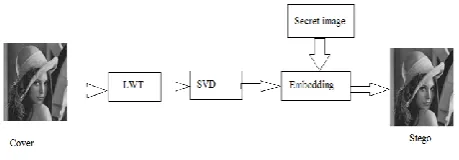
In this experiment, secret image is embedded in the cover image. Detailed steps are shown in the figure 4. First, input image is decomposed into various bands using one level LWT. Input image to be embedded is made equal to the size of HH band.
A. Image Steganography embedding algorithm:
[image:3.595.320.550.518.598.2]International Journal of Emerging Technology and Advanced Engineering
Website: www.ijetae.com (ISSN 2250-2459, ISO 9001:2008 Certified Journal, Volume 7, Issue 9, September 2017)
456 2. Decompose the input secret image W using SVD,
3. Perform SVD operation on HH band of cover image.
4. Replace the singular values of the HH band with the singular values of the secret image W.
5. Apply inverse SVD to obtain the modified HH band of cover image.
6. Perform the inverse lifting wavelet transform (ILWT) on the modified coefficients. Construct stego image.
B. Extraction Algorithm
1. Apply the lifting wavelet transform (LWT) on the stego image. Decompose the stego image into four sub-bands: LL, HL, LH, and HH.
2. Perform SVD operation on HH band to obtain
3. Extract the HH band singular values.
4. Reconstruct the secret image using singular values and orthogonal matrices Uw and Vw obtained using SVD of original watermark.
VI. EXPERIMENTAL RESULTS AND DISCUSSIONS
The proposed method is based on replacing singular values of the HH band with the singular values of the secret data. We developed a image Steganography scheme which is based on lifting wavelet transform and SVD. LWT decomposes the image into four frequency bands: LL, HL, LH, and HH band. In this experimentation, HH band is selected to embed the secret data as (1) it contains the finer details and contributes insignificantly to the image energy. Hence secret data embedding will not affect the perceptual quality of stego image. (2) LL band coefficients are sensitive to perceptual quality.
This section presents the experimental setup and results for the SVD-based image Steganography. The cover and secret images used in the experiments are of size 512X 512. Peak-signal-to-noise ratio (PSNR), root mean square error (RMSE) and signal to noise ration and mean structural similarity index are used as a metric to check image quality between original and stego image.
(i) Root Mean Square Error (RMSE):
√
∑ ∑( ̃ )
Where N×M = Image size, Iij= Cover image, =Stego image
(ii) Peak Signal to Noise Ratio (PSNR):
PSNR 20 log10( 255
RMSE) d (07)
(iii) Signal to Noise Ratio (SNR): ∑ ∑
- -
∑ - ∑ - [ - ̃ ] (08)
Where f(x, y) = Cover image and = Stego image (iv) Mean Structural Similarity Index (MSSIM):
The SSIM metric is calculated on various windows of an image [38]. The measure between two windows x and y of common size N×N is:
∑
Where X and Y are the cover and the stego images respectively; xj and yj are the image contents at the jth local window; and M is the number of windows of the image.
( )
( )
Where, is the mean intensity of x, is the mean intensity of y, is the variance of x, is the variance of y, is the covariance of x and y,
two variables to stabilize the division with weak denominator; L= dynamic range of the pixel values (255 for 8-bit grayscale image), and by default.
~
ij
I
International Journal of Emerging Technology and Advanced Engineering
Website: www.ijetae.com (ISSN 2250-2459, ISO 9001:2008 Certified Journal, Volume 7, Issue 9, September 2017) Table I shows the PSNR (in dB), RMSE, SNR,
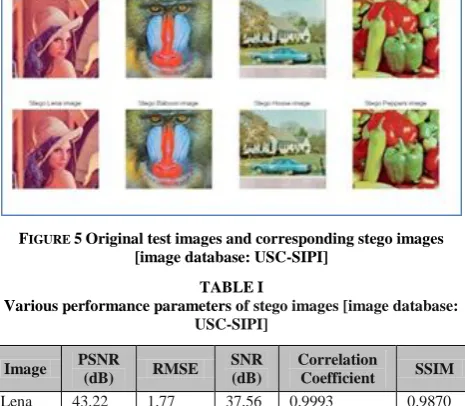
correlation coefficient and SSIM of the stego images. PSNR above 40 dB indicates a good perceptual quality [21]. From the table I, it is evident that PSNR for the different cover images is above 40 dB, resulting in the effectiveness of the proposed scheme. RMSE values are also resulting in lower values. Correlation coefficients and SSIM value which shows similarity between stego and cover image is also close to 1, showing better visual quality.
FIGURE 5Original test images and corresponding stego images [image database: USC-SIPI]
TABLEI
Various performance parameters of stego images [image database: USC-SIPI]
Image PSNR
(dB) RMSE SNR (dB)
Correlation
Coefficient SSIM
Lena 43.22 1.77 37.56 0.9993 0.9870
Girl 40.74 2.34 34.86 0.9983 0.9900
couple 42.9 1.83 35.64 0.9977 0.9851
Tank 44.21 1.59 37.69 0.9990 0.9873
boat 42.58 1.89 36.7 0.9969 0.9772
Comparison between proposed and existing
Steganography methods:
Table IIshows the comparison between the proposed and scheme presented by Chanu et. Al. [22]. They proposed a image Steganography approach by slight modification of column entries in the left singular vectors, diagonal entries in the singular values and row entries in the right singular vectors of blocks of the image in such a way that the visual quality of the image is not affected due to embedding of the message.Results from table 2 show that the proposed algorithm performs better than the method given in [22].
While comparing the proposed method using DWT and LWT, it is obsereved that in LWT there is a increase in the PSNR and substantial improvement in correlation coefficient
TABLE2
Comparison of proposed method with existing approach
VII. CONCLUSION
Image Steganography scheme that embeds the secret message in the cover image using LWT and SVD is proposed in this article. Performance of the scheme is measured using PSNR, RMSE, SNR, SSIM and correlation coefficient. Experimental results show that the stego image is indistinguishable from the stego image. The technique is compared with other existing methods and found that the proposed method is comparatively better than the other methods under consideration.
REFERENCES
[1] “Multi-Level Steganography for Smart Phones”, Vivek Amruth C and Amruta P P
[2] N. F. Johnson and S. Jajodia, “Exploring Steganography : seeing the unseen”, IEEE Computer, 31(2), 1998, pp. 26–34.
[3] N. Provos and P. Honeyman, “Hide and seek: an introduction to Steganography, IEEE Security and Privacy, 1(3), 2003, pp.32–44. [4] Anu Binny and Maddulety Koilakuntla “Hiding Secret
InformationUsing LSB Based Audio Steganography” Soft Computing and Machine Intelligence (ISCMI), 2014 International Conference.
[5] Mehmet Utku Celik, Gaurav Sharma, Ahmet Murat Tekalp and Eli Saber, “Lossless Generalized-LS Data Embedding”, IEEE transactions on image processing, Vol. 14, NO. 2, pp 253-266, February 2005.
[6] Zhi-Hui Wang, Chin-Chen Chang, Ming-Chu Li, “Optimizing least-significant-bit substitution using cat swarm optimization strategy”, Information Sciences (192), pp.98–108,2012.
[7] Shen Wang, ian Yang and Xiamu Niu, “A Secure Steganography Method based on Genetic Algorithm”, Journal of Information Hiding and Multimedia Signal Processing ,Vol.1, No.1, pp 28- 35, January 2010.
[8] Zhenfei Zhaoa, Hao Luoc, Zhe-Ming Luc, Jeng- Shyang Pand, “Reversible data hiding based on multilevel histogram modification and sequential recovery”, Int. J. Electron. Communication, pp. 814- 826, 2011.
[9] Potdar E and Chang E, “Gray level modification Steganography for secret communication”, IEEE international conference on industrial informatics, pp.355-368 Berlin, Germany 2004.
Parameter Method in
[25]
Proposed method using DWT
Proposed method using LWT
PSNR 35.24 42.83 43.22
Correlation
coefficient 0.9877
0.9882
[image:5.595.306.552.152.268.2] [image:5.595.47.282.254.370.2] [image:5.595.48.281.264.467.2]International Journal of Emerging Technology and Advanced Engineering
Website: www.ijetae.com (ISSN 2250-2459, ISO 9001:2008 Certified Journal, Volume 7, Issue 9, September 2017)
458
[10] D.C. Wu and W. H. Tsai, “A steganographic method for images by pixel value differencing”, Pattern Recognition Letters (24), pp.1613-1626, 2003.
[11] Xinpeng Zhang, Shuozhong Wang, “Vulnerability of pixel-value differencing Steganography to histogram analysis and modification for enhanced security”, Pattern Recognition Letters (25), pp. 331–339, 2004.
[12] Jeong-Chun Joo, Hae-Yeoun Lee and Heung-Kyu Lee, “Improved Steganographic Method Preserving Pixel-Value Differencing Histogram with Modulus Function”, EURASIP Journal on Advances in Signal Processing, Vol. 2010, Feb. 2010.
[13] Kuo Liang Chung, Chao Hui Shen, Lung Chun Chang, “ A novel SVD and VQ based image hiding schemes”, Pattern Recognition Letters, 22, pp. 1051- 1058,2001.
[14] Chin-Chen Chang, Thai Son Nguyen , Chia-Chen Lin, “A novel VQ-based reversible data hiding scheme by using hybrid encoding strategies”, Journal of Systems and Software, Elsevier, Sept. 2012.
[15] Yasser M. Behbahani, Parham Ghayour, Amir Hossein Farzaneh, “Steganography Based on Eigen Characteristics of Quantized DCT Matrices”, Proceedings of the 5th International conference on IT & Multimedia at UNITEN Malaysia, pp. 1-4, November 2011.
[16] Suresh N. Mali, Pradeep M. Patil, Rajesh M. Jalnekar, “ Robust and secured image-adaptive data hiding”, Digital Signal Processing, Vol. 22 Issue 2, pp.314-323, March 2012.
[17] Hui-Yu Huang, Yunlin, Taiwan, Shih-Hsu Chang, “A 9/7 wavelet-based lossless data hiding”, IEEE Symposium on Computational Intelligence for Multimedia, Signal and Vision Processing (CIMSIVP), pp.1-6, April 2011.
[18] Amit Phadikar, Santi P. Maity, “Data hiding based quality access control of digital images using adaptive QIM and lifting”, Journal of Signal Processing: Image Communication, Vol. 26, Issue 10, pp.646-661, November 2011.
[19] Wei Liu, “Data hiding in JPEG2000 code streams”, International conference on Image Processing (ICIP), pp. 1557-1560,2004. [20] Sushma G. Kejgir and Manesh Kokare, “ Lifting Wavelet
Transform with Singular Value Decomposition for Robust Digital Image Watermarking”, International Journal of Computer Applications, Volume 39– No.18, pp:10-19, February 2012. [21] Chen T S, Chang C C and Hwang M S 1998 A virtual image
cryptosystem based upon vector quantization. IEEE Trans. Image Process. 7(10): 1485–1488
![Fig. 1. Steganography embedding principle [1]](https://thumb-us.123doks.com/thumbv2/123dok_us/8683449.875279/1.595.330.563.297.439/fig-steganography-embedding-principle.webp)