
International Journal of Emerging Technology and Advanced Engineering
Website: www.ijetae.com (ISSN 2250-2459,ISO 9001:2008 Certified Journal, Volume 4, Issue 8, August 2014)
79
First Results on the Evolutionary Solution for the
Strategy-based Refactoring Set Selection Problem
Camelia Chisalita-Cretu
1 1Faculty of Mathematics and Computer Science, “Babes-Bolyai” University, Cluj-Napoca, Romania Abstract— In order to improve the internal structure of
object-oriented software, refactoring has proved to be a feasible technique. Scheduling a refactoring process for a complex software system is a difficult task to do. Refactorings may be organized and prioritized based on goals established by the project management leadership, that shapes a refactoring strategy.
The paper presents a multi-objective approach to the Strategy-based Refactoring Set Selection Problem (SRSSP) by treating the cost constraint and the refactoring impact as objectives of a weighted-sum fitness function.
The first results of the proposed weighted objective genetic algorithm on a experimental didactic case study are presented and discussed.
Keywords— genetic algorithm, multi-objective optimization, refactoring, object-oriented programming, software engineering.
I. INTRODUCTION
Software systems continually change as they evolve to reflect new requirements, but their internal structure tends to decay. Refactoring is a commonly accepted technique to improve the structure of object-oriented software. Its aim is to reverse the decaying process of software quality by applying a series of small and behaviour-preserving transformations, each improving a certain aspect of the system [11].
Refactorings may be organized and prioritized based on goals established by the project management leadership. The SRSSP definition is based on the Refactoring Set Selection Problem (RSSP) [4, 6]. Therefore, the SRSSP is the refactoring set selection problem that combines multiple strategy criteria in order to to find the most appropriate set of refactorings.
The rest of the paper is organized as follows. Section II presents some close related work on refactoring selection for the SRSSP and highlights the motivation for the problem. Useful formal notations inherited from RSSP [4, 6], together with the formal definition for the SRSSP are presented in Section III. Section IV gives the definition of the Multi-Objective Optimization Problem (MOOP). The multi-objective optimization formulation for the SRSSP is stated in Section IV-A.
A short description of the Local Area Network (LAN) Simulation source code used to study our approach is provided in Section V. The proposed approach and several details related to the genetic operators of the genetic algorithm are described in Section VI. The obtained results for the studied source code are presented and discussed in Section VII. The paper ends with conclusions and future work.
II. RELATED WORK
A closely related previous work to refactoring selection problems is the Next Release Problem (NRP) studied by several authors [21, 2, 12], where the goal was to find the most appropriate set of requirements that balance resource constraints to the customer requests, the problem being defined as a constrained optimization problem.
Other Feature Subset Selection (FSS) problems in previous work on Search-Based Software Engineering (SBSE) include the problem of determining good quality predictors in software project cost estimation, studied by Kirsopp et al. [16], choosing components to include in different releases of a system, studied by Harman et al. [13] and Vescan et al. [20].
Previous work on search-based refactoring problems [14, 15, 1, 21] in SBSE has been concerned with single objective formulations of the problem only. Much of the other existing work on SBSE has tended to consider software engineering problems as single objective optimization problems too. But recent trends show that multi-objective approach has been tackled too, which appears to be the natural extension of the initial work on SBSE.
International Journal of Emerging Technology and Advanced Engineering
Website: www.ijetae.com (ISSN 2250-2459,ISO 9001:2008 Certified Journal, Volume 4, Issue 8, August 2014)
80
More recent work on search based refactoring problems [3, 4, 5] in SBSE have defined the General Refactoring Selection Problem (GRSP), used to refine the Multi-Objective Refactoring Set Selection Problem (MORSSP) [4] and the Multi-Objective Refactoring Sequence Selection Problem (MORSqSP) [5].
Our approach is similar to those presented in [19, 15]. The research has addressed the heterogeneous objective functions approach, where multiple objectives are combined together into a single weighted fitness function. Thus, we gather up different objectives as the refactoring cost and refactoring application impact in a single fitness function.
A. Motivation
A refactoring management process for a complex software system has proved to be a difficult task to do [11]. Multiple refactoring aspects of different parts of a heavy working system need increased attention when planning the order to refactor. Moreover, within a development team, each programmer perceives the refactoring process in his own manner. A refactoring strategy allows to fit each transformation performed on the software system in a general refactoring plan, following a criteria set that unifies particular transformation requests into a homogenous single and desired development trend.
A tool [17] may be used to identify refactoring opportunities for each established bounded piece of the software system, i.e., class hierarchies, software components. Each software programmer involved in the development process may advance his set of refactorings that improves the internal structure of the software piece developed by him. Thereafter, a consistent number of refactorings is handed to the project management leadership. It has to decide the appropriate refactoring plan, based on the already known targets. The set of refactorings is used to select a subset of transformations suggested by the previously specified criteria.
The project management leadership faces several problems within the considered context. These problems emphasize different aspects of a complex refactoring process, as:
• a large number of refactorings advanced;
• different types of dependencies among the affected software entities, e.g., an inherited method from a base class is called within another method of a derived class;
• different types of dependencies among refactorings to be satisfied when combining the transformation sequences, i.e., applying a suggested refactoring may cancel the application of another refactorings that have been already selected by the developer;
• a specific refactoring priority for each software entity; • a clear request to include a transformation within the
final refactoring plan.
III. STRATEGY-BASED REFACTORING SET SELECTION
PROBLEM
The Strategy-based Refactoring Set Selection Problem (SRSSP) is mainly based on the Refactoring Set Selection Problem (RSSP) fully formalized in [3]. SRSSP is a special case of RSSP where the refactoring selection is enhanced by certain criteria, e.g., refactoring application priority, refactoring application type: optional or mandatory.
The SRSSP formal definition requires several input data notations from the RSSP. Subsequently, additional terms and notations are introduced to completely state the SRSSP.
B.Input Data
Let SE
e1,...,em
be a set of software entities as it wasdefined in [3].
The software entity set SE together with different types of dependencies among its items form a software system namedSS. The set of software entity dependency types
SED and the dependency mapping ed are similar to the ones described in [3].
A set of relevant chosen refactorings that may be applied to the software entities of SE is gathered up through
t
r r
SR 1,..., . The ra mapping sets the applicability for each refactoring from the chosen set of refactorings SRon the set of software entities SE as it was defined in [3].
The set of refactoring dependencies SRD = {Before,
After, AlwaysBefore, AlwaysAfter, Never, Whenever}, together with the mapping rd that highlights the dependencies among different refactorings when applied to the same software entity are stated in [3].
International Journal of Emerging Technology and Advanced Engineering
Website: www.ijetae.com (ISSN 2250-2459,ISO 9001:2008 Certified Journal, Volume 4, Issue 8, August 2014)
81
The overall impact of applying a refactoring
r
l,
1
l
t
,to each software entityei,i1,m, is defined as:
SR
:
res
,)
,
(
)
(
1
m i i l il
w
effect
r
e
r
res
,Where
1
l
t
andw
i is the weight of the corresponding software entitye
i fromSE
.e
SR
represents the subset of refactorings that may be applied to a software entitye
,
e
SE
[6]. Therefore,.
,
1
,
i
m
SR
SR
SE e e i i
rSE
represents the subset of software entities to whom a refactoringr
may be appliedr
SR
[6]. Therefore,.
,
1
,
l
t
SE
SE
SR r r l l
In [8], the refactoring-entity pair notion was introduced, as it was required for the refactoring sequence selection problem definition. Therefore, a refactoring-entity pair was defined as a tuple
r
le
i
(
r
le
i)
consisting of a refactoringr
l,
1
l
t
, applied to a softwareentity
e
i,
1
i
m
, wherera
(
r
l,
e
i)
T
.Let
REPSet
=
(
r
1e
1,
r
2e
2,
,
r
pe
p)
,
p
N
be the set of all refactoring-entity pairs build overSR
andSE
, wherera
(
r
s,
e
s)
T
,
1
s
p
.C.Refactoring Strategy
The refactoring strategy may be formally described by one or more functions
sf
i,
i
1
,
NC
, whereNC
is the total number of criteria integrated with the strategy. In the following, a sample strategy consisting of two criteria, i.e., mappings, is introduced.The development team may consider relevant that in a specific context some refactoring applications to be mandatory, optional or selected from a subset. Let
andatory
ptional
elected
RType
M
,
O
,
S
be the set of possible refactoring types. The mappingrtype
associates a type to each refactoring from
SR
as follows:RType
SR
rtype
:
,
.
.
.,
if
S
applied
is
if
O
applied
is
if
M
t
q
,
r
r
r
optional
r
mandatory
r
r
rtype
q0
,
,
,
,
)
(
1 .A second criterion considered by the development team may refer the level of the affected entity when refactoring. Let
RLevel
A
ttribute
,
M
ethod
,
C
lass
be the set of refactoring levels involved in the transformation process. Therefore, the functionrlevel
maps each refactoring to the entity level that it mainly changes, as:RLevel
SR
rlevel
:
,to
applied
is
if
c
to
applied
is
if
m
to
applied
is
if
a
classes
r
methods
r
attributes
r
r
rlevel
,
,
,
)
(
.D.Output Data
The strategy-based refactoring set selection means to choose the appropriate refactoring subset such that the stated criteria on refactorings are met, e.g., refactoring application level and type.
Other specific conditions to be satisfied refer to the refactoring cost and the refactoring final impact on entities. Therefore, a multi-objective strategy-based refactoring set selection problem (MOSRSSP) may be defined.
Multi-objective optimization often means optimizing conflicting goals. For the MOSRSSP formulation it is possible to blend different types of objectives, i.e., some of them to be maximized and some of them to be minimized.
IV. MOOPMODEL
MOOP is defined in [22] as the problem of finding a decision vectorx=(x1,,xn), which optimizes a vector of
M
objective functions(
)
x
f
i where1
i
M
, that aresubject to inequality constraints ( )0
x
gj ,
1
j
J
andequality constraints ( )=0
x
hk ,
1
k
K
. A MOOPmay be defined as:
)}, ( , ), ( { = )} ( { 1 x f x f maximize x F
International Journal of Emerging Technology and Advanced Engineering
Website: www.ijetae.com (ISSN 2250-2459,ISO 9001:2008 Certified Journal, Volume 4, Issue 8, August 2014)
82
Where gj x jJ
0,1 )
( and hk x kK 0,1 = ) ( where
x is vector of decision variables and
(
)
x
f
i is thei
-th objective function; ( ) x
g and ( )
x
h are constraint vectors.
There are several ways to deal with a multi-objective optimization problem. In this paper the weighted sum method [18] is used.
Let
f
1,f
2,...,f
Mbe the addressed objective functions. This method takes each objective function and multiplies it by a fraction of one, the ''weighting coefficient'' which is represented bywi,1iM. The modified functions are then added together to obtain a single fitness function, which can easily be solved using any method which can be applied for single objective optimization.Mathematically, the new mapping may be written as:
1.
=
1,
0
),
(
=
)
(
1 = 1 = i M i i i i M iw
w
x
f
w
x
F
For those cases where the conflicting objectives exist, they must be converted to meet the optimization problem requirements. Therefore, for an objective fi,
0
i
M
, withMAX
the highest value from the objective space of the corresponding objective mapping fi that needs to be converted to a minimized objective, there are two ways to switch to the optimal objective:• ( ) f x
MAX i , when
MAX
can be computed; • ( )
fi x , when
MAX
cannot be computed. E.MOSRSSP FormulationMulti-objective optimization often means compromising conflicting goals. For our MOSRSSP formulation there are two objectives taken into consideration in order minimize required cost for the applied refactorings and to maximize refactorings impact upon software entities. Current research treats cost as an objective instead of a constraint. Therefore, the first objective function minimizes the total cost for the applied refactorings, as:
, ) , ( = ) ( 1 = 1 = 1
i l m i t l e r rc minimize r f minimizewherer (r1,...,rt)
.
The second objective function maximizes the total
effect of applying refactorings upon software entities, considering the weight of the software entities in the overall system, like:
, ) ( = ) ( 1 = 2
l t l r res maximize r f maximizewherer(r1,...,rt)
.
The goal is to identify those solutions that compromise the refactorings costs and the overall impact on transformed entities. In order to convert the first objective function to a maximization problem for the MOSRSSP, the total cost is subtracted from
MAX
, the biggest possible total cost, as it is shown below:, ) , ( = ) ( 1 = 1 = 1
i l m i t l e r rc MAX maximize r f maximizeWherer(r1,...,rt)
. The final fitness function for MOSRSSP is defined by aggregating the two objectives and may be written as:
(1) ( )= 1( ) (1 ) 2( ),
f r f r r
F
Where
0
1
.Let
DS
REPSet
be the decision domain for the MOSRSSP and x=(r1e1,r2e2,,rses),
where
e
u
SE
,SR
r
u
,1
u
s
,s
N
,x
DS
a decision variable. The MOSRSSP is the problem of finding a decision vector x=(r1e1,r2 e2,,rs es), such that:
• the following objectives are optimized:
– the overall refactoring cost is minimized (
rc
) [3]; – the overall refactoring impact on software entities is maximized (res
) [3].• the following constraints are satisfied: – software entity dependencies (
ed
) [3]; – refactoring dependencies (rd
) [3]. • the addressed strategy-based criteria are met:– RMandatory
r1,...,rrm
is the set of mandatory refactorings, where r1,...,rrmSR,0
rm
t
;– ROptional
r1,...,rro
is the set of optionalInternational Journal of Emerging Technology and Advanced Engineering
Website: www.ijetae.com (ISSN 2250-2459,ISO 9001:2008 Certified Journal, Volume 4, Issue 8, August 2014)
83
– RSelect
r1,...,rrs
is the set of single selected refactorings, where r1,...,rrsSR,0
rs
t
;–
1
rm
ro
rs
t
,
ROptional RSelect
RMandatory ;
– conditions on the number of applied refactorings on attribute, method, and class levels are met.
V. CASE STUDY:LANSIMULATION
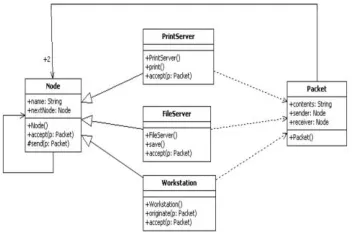
[image:5.612.86.262.324.441.2]The algorithm proposed was applied on a simplified version of the Local Area Network (LAN) Simulation source code that was presented in [10]. Figure 1 shows the class diagram of the studied source code. It contains 5 classes with 5 attributes and 13 methods, constructors included.
Figure 1. Class diagram for LAN Simulation
The current version of the source code lacks of hiding information for attributes since they are directly accessed by clients. The abstraction level and clarity may be increased by creating a new superclass for PrintServer
and FileServer classes, and populate it by moving up methods in the class hierarchy.
Thus, for the studied problem the software entity set is defined as: SE
c1,...,c5,a1,...,a5,m1,...,m13
. The chosen refactorings that may be applied are: renameMethod,extractSuperClass, pullUpMethod, moveMethod,
encapsulateField, addParameter, denoted by the set
r1,...,r6
SR in the following. The dependency relationship between refactorings is defined as follows: {(r1, r3) = B, (r1, r6 ) = AA, (r2, r3) = B, (r3, r1) = A,
(r6, r1 ) = AB, (r3, r2) = A, (r1, r1) = N, (r2, r2) = N,
(r3, r3) = N, (r4, r4 ) = N, (r5, r5) = N, (r6, r6) = N}.
The values of the final effect were computed for each refactoring, by using the weight for each existing and possible affected software entity, as it was defined in Section III.
Therefore, the values of the res function for each refactoring are: 0.4, 0.49, 0.63, 0.56, 0.8, and 0.2. The full input data table is included in [4].
Here, the cost mapping
rc
is computed as the number of the needed transformations, so related entities may have different costs for the same refactoring. Each software entity has a weight within the entire system, but
23
1
1 i
i
w .
For the effect mapping, values were considered to be numerical data, denoting the estimated impact of applying a refactoring. Due to the space limitation, intermediate data for these mappings was not included.
The refactoring strategy consists of the following refactoring criteria:
• RMandatory
r2,r5 ; • ROptional
r1,r6 ;• RSelect
r3,r4 , where if r3is applied to the entity13 , 1 ,i
mi ,
4
r will not be selected to be applied to the same entity;
• 1|RMandatory||ROptional ||RSelect |6,
ROptional RSelect
RMandatory ;
• refactorings of all levels have to be selected (attribute, method, and class).
An acceptable solution denotes lower costs and higher impact on transformed entities, both objectives being satisfied. The entities dependencies and refactoring dependencies need to be met as well, while the strategy selection criteria constraints have to be fulfilled.
VI. PROPOSED APPROACH DESCRIPTION
The MOSRSSP is approached here by exploring a possible application strategy for the addressed refactorings. As its multi-objective formulation states it (see Section IV-A), two conflicting objectives are studied, i.e., minimizing the refactoring cost and maximizing the refactoring impact, together with the constraints to be kept and the selection strategy criteria to be followed.
There are several ways to handle a multi-objective optimization problem. The weighted sum method [18] was adopted to solve the MOSRSSP. The overall objective function to be maximized
(
)
r
International Journal of Emerging Technology and Advanced Engineering
Website: www.ijetae.com (ISSN 2250-2459,ISO 9001:2008 Certified Journal, Volume 4, Issue 8, August 2014)
84
Therefore, { ( )}= { 1( ), 2( )},
r f r f maximize r
F
maximize is
mathematically rewritten to:
r f r
f r
F
maximize ( ) = 1( ) (1 ) 2( ),
Where
0
1
and
ris the decision variable, within a decision space.
An adapted genetic algorithm to the context of the investigated problem, with weighted sum fitness function, similar to the one in [5, 7], is proposed here.
In a steady-state evolutionary algorithm a single individual from the population is changed at a time. The best chromosome (or a few best chromosomes) is copied to the population in the next generation. Elitism can very rapidly increase performance of genetic algorithm, because it prevents to lose the best found solution to date.
The genetic algorithm approach uses a refactoring-based
solution representation for the strategy-based refactoring set selection problem, being denoted by SRSSGARef.
The decision vector
S
S
1,...,
S
t
, where
S
l
P
SE
,t
l
1
, determines the entities that may be transformed using the proposed refactoring setSR
. The itemS
l on thel
-th position of the solution vector represents a set of entities that may be refactored by applying thel
-th refactoring fromSR
, where anyl
u r
l
SE
e
,
SE
P
S
e
lu
l
,1
u
q
,1
q
m
,1
l
t
. Thismeans it is possible to apply more than once the same refactoring to different software entities, i.e., distinct gene values from the chromosome may contain the same software entity.
F.Genetic Operators
Crossover and mutation operators are used by this approach, being described in the following.
1) Crossover Operator. A simple one point crossover scheme is used. A crossover point is randomly chosen. All data beyond that point in either parent string is swapped between the two parents.
For instance, if the two parents are:
parent1 = [ga[1, 7], gb[3, 5, 10], gc[8], gd[2, 3, 6, 9, 12], ge[11], gf [13, 4]] and
parent2 = [g1[4, 9, 10, 12], g2[7], g3[5, 8, 11], g4[10, 11], g5[2, 3, 12], g6[5, 9]], for the cutting point 3, the two resulting off-springs are:
offspring1 = [ga[1, 7], gb[3, 5, 10], gc[8], g4[10, 11], g5[2, 3, 12], g6[5, 9]] and
offspring2 = [g1[4, 9, 10, 12], g2[7], g3[5, 8, 11], gd[2, 3, 6, 9, 12], ge[11], gf [13, 4]].
2) Mutation Operator. The mutation operator used here exchanges the value of a gene with another value from the allowed set. Namely, mutation of the
i
-th gene consists of adding or removing a software entity from the set that denotes thei
-th gene.For example, if the individual to be mutated is:
parent = [ga[1, 7], gb[3, 5, 10], gc[8], gd[2, 6, 9, 12], ge[12], gf [13, 4]] and if the
5
-th gene is to be mutated, the obtained offspring isoffspring = [ga[1, 7], gb[3, 5, 10], gc[8], gd[2, 6, 9, 12], ge[10, 12] gf [13, 4]] by adding the
10
-th software entity to the5
-th gene.In order to compare data having different domain values the normalization is applied firstly. We have used two methods to normalize the data: decimal scaling for the refactorings cost and min-max normalization for the value of the res function.
VII. FIRST PRACTICAL EXPERIMENTS FOR
THE SRSSGAREF ALGORITHM
The algorithm was run 100 times and the best, worse, and average fitness values were recorded. The parameters used by the evolutionary approach were as follows: mutation probability 0.7 and crossover probability 0.7. Different numbers of generations and of individuals were used: number of generations 10, 50, 500, and 1000 and number of individuals 20, 50, 100, and 200.
A first experiment run for the LAN Simulation Problem source code proposes equal weights (i.e.,
0.5) the refactoring cost application and the transformation impact within the aggregated fitness function.Figure 2 presents the 10 and 1000 generations runs of the fitness function (best, average, and worse) for 100 chromosomes populations, with 11 mutated genes, for
International Journal of Emerging Technology and Advanced Engineering
Website: www.ijetae.com (ISSN 2250-2459,ISO 9001:2008 Certified Journal, Volume 4, Issue 8, August 2014)
85
(a) The SRSSGARef Algorithm: Experiment with 10 generations and 100 individuals
[image:7.612.59.278.141.267.2](b) The SRSSGARef Algorithm: Experiment with 1000 generations and 100 individuals
Figure 2. The fitness function (best, average, and worse) for 100 individuals populations with 10 and 1000 generations runs, with 11
mutated genes, for the SRSSGARef Algorithm, for α = 0.5
There is a strong competition among chromosomes in order to breed the better individuals. In the 100 individuals populations the competition results in different quality of the best individuals for various runs, from very weak to very good solutions.
For the refactoring-based solution representation, the runs with 10 evolutions have few very weak solutions, better than 0.3, but they are scattered over [0.2, 0.3]. The very weak solutions for the runs with 1000 evolutions are grouped in the upper part of [0.2, 0.3], but no weak solution has the fitness value better than 0.3. The same behaviour was perceived among best and average solutions for the 100 chromosomes populations.
In the context of equal weights for the established objectives, the obtained solutions by the applied algorithm, for 100 individual populations, when α = 0.5 are:
• after 10 generations: – best fitness value = 0.4499:
∗ best chromosome = [[16, 11, 23, 22, 21], [5], [12, 16, 19, 23, 11, 14, 20], [11, 20, 18, 23, 14] , [6], [20, 16, 14, 15, 11, 23]];
• after 1000 generations: – best fitness value= 0.457:
∗ best chromosome = [[12, 23, 15, 18, 11, 20, 14], [2, 1, 3, 4], [13, 16, 18, 23, 14, 15, 11], [20, 16, 19, 23], [10], [12, 19, 20, 11, 23, 22]].
The various runs as number of generations, i.e., 10, 50, 500, and 1000 generations, show the improvement of the best chromosome.
[image:7.612.340.546.417.543.2]For the recorded experiments, the best individual obtained for the SRSSGARef Algorithm after 1000 generations of evolution with a 100 chromosomes population, has the fitness value of 0.457. This means in small populations (with fewer individuals) the reduced diversity among chromosomes may induce a harsher struggle compared to large populations (with many chromosomes) where the diversity breeds near quality individuals.
Figure 3. The fitness value for the best chromosomes within populations with 20, 50, 100, and 200 chromosomes and 10, 50, 500,
and 1000 generations evolution, for the SRSSGARef Algorithm, with α = 0.5
As the Figure 3 shows it, after several generations, greater populations produce better individuals (as number and quality) than smaller ones, due to the large population diversity itself.
G.SRSSGARef Algorithm: Impact on the LAN Simulation source code
International Journal of Emerging Technology and Advanced Engineering
Website: www.ijetae.com (ISSN 2250-2459,ISO 9001:2008 Certified Journal, Volume 4, Issue 8, August 2014)
86
The analysis of the best chromosome partially satisfies the initial strategy (see Section V).
The current version of the SRSSGARef Algorithm lessens criteria constraints of the addressed strategy. Therefore, it admits as a valid solution chromosomes where the number of applications for the mandatory refactoring
encapsulateField is at least 1. For the single selected refactorings from the setRSelect, the current version of the algorithm accepts the solutions that have at least an additional application of the addressed refactoring, i.e.,
pullUpMethod and moveMethod.
VIII. CONCLUSIONS AND FUTURE WORK
Refactoring may be used in complex software management development processes to achieve several enforced targets. Multiple refactoring aspects of different parts of a heavy working system need increased attention when planning the refactoring order. Refactorings may be organized and prioritized based on goals established by the project management leadership.
The appropriate refactoring selection for various sized software is a stimulating re-search problem. Software entity dependencies and refactoring dependencies are the basic intriguing elements that drive the research within this domain. This paper addresses the strategy-based refactoring set selection problem.
This paper has advanced the evolutionary-based solution approach for the MOSRSSP. An adapted genetic algorithm has been proposed in order to cope with a weighted-sum objective function for the required solution. Two conflicting objectives have been addressed, as to minimize the refactoring cost and to maximize the refactoring impact on the affected software entities, following a refactoring application strategy. The run experiments used a balanced weighted fitness function between the cost and the impact on the entities. Further work may be done by investigating the results where refactoring impact or the refactoring cost has a greater weight on the fitness function.
A refactoring-based solution representation was used by the algorithm implementation. The first recorded experiments have lessened the constraints criteria of the refactoring strategy.
Strengthening the refactoring strategy criteria is another task that will be approached in the future. The results achieved here will be compared to the experiments results obtained from the entity-based solution representation for the same algorithm.
The study of the weighted-sum fitness function will be further investigated, by including the strategy-based criteria in the fitness function.
REFERENCES
[1] M. Bowman, L.C. Briand, and Y. Labiche. Multi-objective genetic algorithm to support class re-sponsibility assignment. In In Proceedings of the IEEE International Conference on Software Main-tenance (ICSM1007), pages 124–133, 2007.
[2] A. Bagnall, V. Rayward-Smith, and I. Whittley. The next release problem. Information and Software Technology, 43(14):883–890, 2001.
[3] M.C. Chisalita-Cretu, A. Vescan. The Multi-objective Refactoring Selection Problem, in ”Studia Universitatis Babes-Bolyai”, Series Informatica, Special Issue KEPT-2009: Knowledge Engineering: Principles and Techniques, July 2-4, 2009, pp. 249–253.
[4] M.C. Chisalita-Cretu. A multi-objective approach for entity refactoring set selection problem, in ”Proceedings of the 2nd International Conference on the Applications of Digital Information and Web Technologies”, August 4-6, London, UK, 2009, pp. 790– 795.
[5] M.C. Chisalita-Cretu. First results of an evolutionary approach for the entity refactoring set selection problem, in ”Proceedings of the 4th International Conference Interdisciplinarity in Engineering, Nov. 12-13, Tˆargu Mure¸s, Romania, 2009, pp. 303–308.
[6] M.C. Chisalita-Cretu. The Refactoring Plan Configuration. A Formal Model, in ”Proceedings of the 5th International Conference on Virtual Learning, Oct. 29-31, Tˆargu Mure¸s, Romania, 2010, pp. 418–424.
[7] M.C. Chisalita-Cretu. An evolutionary approach for the entity refactoring set selection problem. Journal of Information Technology Review, ISSN: 0976-2922, accepted paper, 2010.
[8] M.C. Chisalita-Cretu. The refactoring plan configuration. a formal model. In The 5th International Conference on virtual Learning (ICVL 2010), October 29-31, 2010, Tˆargu Mure¸s, Romˆania, pages 418–424, 2010.
[9] M.C. Chisalita-Cretu. Refactoring in Object-Oriented Modeling, Todesco, Cluj-Napoca, Romania, 2011.
[10] S. Demeyer, F. Van Rysselberghe, T. Grba, J. Ratzinger, Marinescu R., T. Mens, B. Du Bois, D. Janssens, S. Ducasse, M. Lanza, M. Rieger, H. Gall, and M. El-ramly. The lan simulation: A refactoring teaching example. In 8th Int. Workshop on Principles of Software Evolution (IWPSE’05), pages 123–134, 2005.
[11] M. Fowler. Refactoring Improving the Design of Existing Code, Addison-Wesley, 1999.
[12] D. Greer and G. Ruhe. Software release planning: an evolutionary and iterative approach. Infor-mation and Software Technology, 46(4):243–253, 2004.
[13] M. Harman, S. Swift, and K. Mahdavi. An empirical study of the robustness of two module clustering fitness functions. In Proceedings of the Genetic and Evolutionary Computation Conference (GECCO 2005), Washington DC, USA, pages 1029– 1036, 2005.
[14] M. Harman and L. Tratt. Pareto optimal search based refactoring at the design level. In In Proceed-ings of the Genetic and Evolutionary Computation Conference (GECCO2007), pages 1106–1113. ACM Press, 2007.
International Journal of Emerging Technology and Advanced Engineering
Website: www.ijetae.com (ISSN 2250-2459,ISO 9001:2008 Certified Journal, Volume 4, Issue 8, August 2014)
87
[16] C. Kirsopp, M. Shepperd, and J. Hart. Search heuristics, case-based reasoning and software project effort prediction. In Proceedings of the Genetic and Evolutionary Computation Conference (GECCO 2002, W. B. Langdon, E. Cant-Paz, eds., Morgan Kaufmann Publishers, San Francisco, CA, USA, pages 1367–1374, 2002. [17] T. Mens, G. Taentzer, O., Runge. Analysing refactoring
dependencies using graph transformation, in Software and System Modeling, vol. 6 (2007), no. 3, pp. 269–285.
[18] Y. Kim and O.L. deWeck. Adaptive weighted-sum method for bi-objective optimization: Pareto front generation. Structural and Multidisciplinary Optimization, 29(2):149–158, 2005.
[19] O. Seng, J. Stammel, and D. Burkhart. Search-based determination of refactorings for improving the class structure of object-oriented systems. In Proceedings of the 8th Annual Conference on Genetic and Evolutionary Computation, pages 1909–1916. ACM Press, Seattle, Washington, USA, 2006.
[20] A. Vescan and H.F. Pop. The component selection problem as a constraint optimization problem. In Proceedings of the Work In Progress Session of the 3rd IFIP TC2 Central and East European Conference on Software Engineering Techniques (Software Engineering Techniques in Progress), Wroclaw University of Technology, Wroclaw, Poland,, pages 203–211, 2008.
[21] Y. Zhang, M. Harman, and S.A. Mansouri. The multi-objective next release problem. In Proceedings of the Genetic and Evolutionary Computation Conference (GECCO2007), ACM Press, pages 1129– 1136, 2007.

![12 Ethoxy 2,3,8,9 tetramethoxybenzo[c]phenanthridine dichloromethane solvate](data:image/gif;base64,R0lGODlhAQABAIAAAP///wAAACH5BAEAAAAALAAAAAABAAEAAAICRAEAOw==)