RHEOLOGICAL EVALUATION OF BITUMINOUS BINDER MODIFIED WITH
WASTE PLASTIC MATERIAL
Abdelaziz MAHREZ
1and Mohamed Rehan KARIM
21Assistant Professor and 2Professor, Department of Civil Engineering - University Malaya, Kuala
Lumpur, Malaysia
ABSTRACT: This research investigates the viscelastic properties of asphalt bitumen modified with waste plastic bottles compared to the ordinary 80/100 bitumen. The contents of modifier will be varied to investigate its effects on the rheological properties of the modified binders. The binders were characterized using standard laboratory tests such as penetration test, softening point test, viscosity test and dynamic shear rheometer test. Using the waste plastic materials showed prominent results in improving the viscoelstic properties of ordinary bitumen. The effects waste modifiers influenced significantly the rheological behavior of bitumen by increasing its complex modulus and decreasing phase angle.
Key words: Rheological properties, modified bitumen, waste materials, PET.
1. INTRODUCTION
The rheological behaviour of bitumen is very complex phenomenon, varying from purely viscous to elastic, depending on loading time and temperature. As a visco-elastic material, bitumen plays a prominent role in determining many aspects of road performance. For example, a bituminous mixture (asphalt) needs to be flexible enough at low service temperatures to prevent pavement cracking and to be stiff enough at high service temperatures to prevent rutting. These functional properties are required to enable pavements to accommodate increasing traffic loadings in varying climatic environments [1]. Unfortunately, due to the increased performance related requirements on asphalt pavements, the asphalt containing conventional bitumen does not always perform as expected. Therefore, in order to improve the asphalt properties modified bitumen has been adopted and widely used in the industry as commercial product.
Polymer modification of asphalt binders has increasingly become the norm in designing optimally performing pavements. Mixing polymers into bitumen has important consequences on the engineering and rheological properties of bituminous binders by improving the performance of asphalt pavements, [2, 3, 4]. The high cost of the polymers compared to bitumen means that the amount of polymer needed to improved pavement performance should be as small as possible.
The uses of virgin polymers in bitumen to improve the characteristics of resulting polymer modified bitumen have been accomplished for many years. Recently there is interest in the substitution of commercial virgin material by recycled polymers. When recycled polymers are used as bitumen modifying agents, the resulting mixture may show similar performance to those containing virgin polymers [5]. Casey et al. [6] stated that in general, recycled plastics have poorer mechanical properties than the virgin ones; they concluded that although the recycled polymer modified binder did not perform to the same high levels as the available proprietary commercial binder, it did however demonstrate enhanced performance when compared with unmodified binders. These results suggest that the recycled polymer modified binder has great promise. From an environmental and economic standpoint, the use of recycled instead of virgin materials help easing landfill pressures and reducing demands of extraction.
There are four groups of waste martial that are used in pavement, namely, industrial wastes, domestic wastes, mineral wastes and agricultural wastes [7]. The waste plastic bottles falls under domestic group, furthermore plastic material can be classified into 6 major types:
• LDPE- Low Density Polyethylene (film and trash bags)
• HDPE- High Density Polyethylene (milk jugs)
• PVC- Polyvinyl chloride (pipes, siding and flooring)
• PP- Polypropylene (battery casings and luggage)
• PET- Polyethylene Terepthalate (mineral water and soda bottles) [7]
Polyethylene has been found to be one of the most effective polymer additives [8]. Polyethylene is the most popular plastic in the world. Polyethylene is semi-crystalline materials with excellent chemical resistance, good fatigue and wear resistance and a wide range of properties. It has a very simple structure. A molecule of polyethylene is a long chain of carbon atoms, with two hydrogen atoms attached to each carbon atom They are light in weight; provide good resistance to organic solvents with low moisture absorption rates [9].
The purpose of this research paper is to investigate the possibility of using the waste plastic material containing PET as a bitumen modifier and its effects on the physical and rheological properties of the modified bituminous residue.
2. MATERIALS AND TESTING METHODS
2.1. Bituminous material
[image:2.595.184.412.319.397.2]In this study asphalt binder 80/100 penetration grade bitumen was used. The properties of asphalt binder are presented in Table 1. These properties are within the specification of penetrated bitumen grade 80/100.
Table 1 Tests results performed on original bitumen
Test Test result
Ductility (cm)
Penetration (0.1 mm) Softening point (°C)
Specific Gravity (g/cm3)
< 100 84 - 100
46 1.03
2.2 Polyethylene
In this research work waste PET in powder form was prepared by grinding the waste plastic bottles using the crusher machine and sieved according to sieve size given in table 2. The density and
melting point of the used waste PET are 1370 kg/m3 and 260°C, respectively.
Table 2 Gradation of PET
Sieve size Percent passing
701 µm 450 µm
100 0
2.3 Sample preparation:
Modified binders were prepared by mixing 80/100 penetration grade bitumen with various percentages of waste PET, namely 2%, 4%, 6% and 8% by mass of bitumen. Blending the bitumen and waste PET was done using high speed shear mixer at temperature of 130ºC for a period of time of 3 min.
2.4 Binder Testing
Binders were characterised by using a number of standard physical tests such as penetration test (temperature, load and time are 25ºC, 100g and 5sec respectively), softening point test, viscosity test using Brookfield viscometer (temperature range from 90 to 170ºC, spindle No.27, and a rotating speed of 20rpm), and including rheological measurements by using a Dynamic Shear Rheometer (tests conducted by using a temperature sweep starting from 30ºC to 80ºC, and the frequency is 1.159Hz).
3. RESULTS AND DISCUSSION
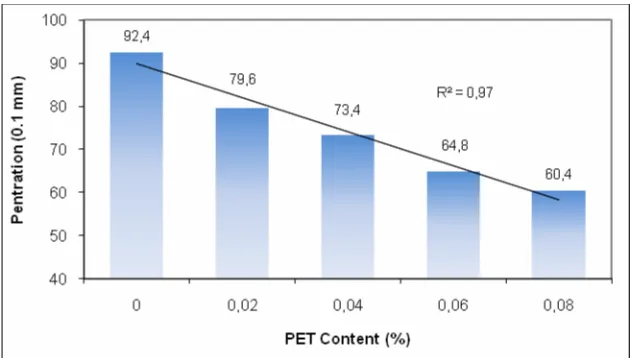
Penetration measures the bitumen consistency. The depth of penetration is measured in units of 0.1 mm and reported in penetration units (e.g., if the needle penetrates 8 mm, the asphalt penetration number is 80). Penetration Grading is based on the penetration test.
Figure 1 shows the variation of penetration value with the various percentages of bitumen modified PET decreases with the addition of PET. The figure indicates that the consistency of the PET modified bitumen decrease as the PET content increases in the mix. Reduction of 14%, 21%, 30% and 35% in penetration values with the addition of 2%, 4 %, 6% and 8% of PET, respectively, as compared to the original bitumen. This means that the addition of PET makes the modified bitumen harder and more consistent. This is good in one sense since it might improve the rutting resistance of the mix, but on the other hand this may affect flexibility of the bitumen by making the asphalt much stiffer, thus the resistance to fatigue cracking can be affected.
Figure 1 Penetration grade vs. different percentage of PET
3.2 Softening point
The softening point is defined as the temperature at which a bitumen sample can no longer support the weight of a 3.5-g steel ball. Basically, two horizontal disks of bitumen, cast in shouldered brass rings are heated at a controlled rate in a liquid bath while each supports a steel ball. The softening point is reported as the mean of the temperatures at which the two disks soften enough to allow each ball, enveloped in bitumen, to fall a distance of 25 mm (1.0 inch).
Figure 2 show that softening point increases with increasing PET content. It appears clearly from the results that the addition of PET to bitumen increases the softening point value, and as the PET content increase the softening point also increases. This increase ranges from 5% to 13% with the addition of 2% to 8% PET contents. This phenomenon indicates that the resistance of the binder to the effect of heat is increased and it will reduce its tendency to soften in hot weather. Thus, with the addition of PET the modified binder will be less susceptible to temperature changes.
Figure 2 Softening point vs. different percentage of PET
3.3 Brookfield viscosity test on PET modified bitumen
Viscosity is synonymous with internal friction and is a measure of the resistance to flow. The basic rotational viscosity test measures the torque required to maintain a constant rotational speed (20 RPM) of a cylindrical spindle while submerged in an asphalt binder at a constant temperature. This torque is then converted to a viscosity and displayed automatically by the RV.
The viscosity of asphalt binder at high manufacturing and construction temperatures generally above 135°C is important because it can control the following:
• Pumpability. The ability of the asphalt binder to be pumped between storage facilities and into
the HMA manufacturing plant.
• Mixability. The ability of the asphalt binder to be properly mixed with and to coat aggregate
and other HMA constituents in the HMA manufacturing plant.
• Workability. The ability of the resultant HMA to be placed and compacted with reasonable
effort.
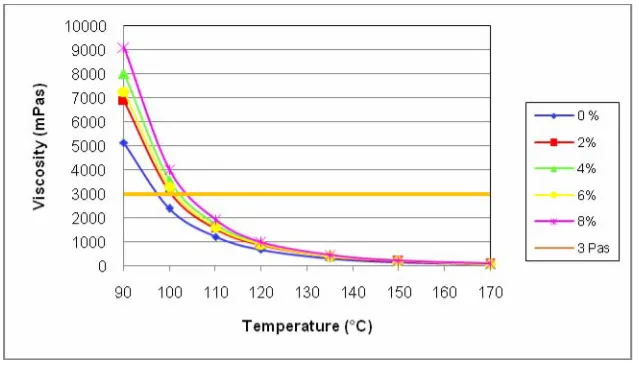
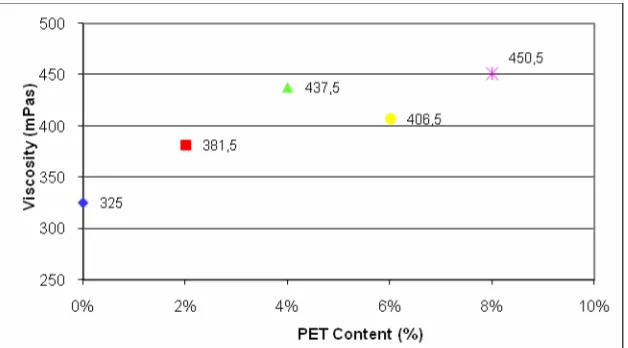
Figures 3.1 and 3.2 indicated that the modified bitumen viscosity have increased compared to original binder. Modified asphalt binders are usually more viscous than unmodified ones [2]. The increment
was obvious at lower temperature, 90°C compared to higher temperature.
Figure 3.1 Viscosity vs. different percentage of PET
Strategic Highway Research Program (SHRP) has fixed the maximum steady state viscosity of 3 Pas
[image:4.595.139.458.512.698.2]laydown and compaction. Results obtained showed that the viscosity of PET modified bitumen fulfilled the SHRP requirement.
Figure 3.2 Viscosity vs. different percentage of PET at Temperature 135°C
3.4 Dynamic Shear Rheometer (DSR) Test Results
Asphalt binder is viscoelastic material which behaves partly like an elastic solid (deformation due to loading is recoverable – it is able to return to its original shape after a load is removed) and partly like a viscous liquid (deformation due to loading is non-recoverable – it cannot return to its original shape after a load is removed).
The dynamic shear rheometer (DSR) test is used to characterize the visc-elastic behavior of asphalt binders at medium to high temperatures. In this test a thin asphalt binder sample sandwiched between two circular plates. The lower plate is fixed while the upper plate oscillates back and forth across the sample at 10 rad/sec (1.59 Hz) to create a shearing action. The specified oscillation rate of 10 rad/sec is meant to simulate the shearing action corresponding to a traffic speed of about 55 mph (90 km/hr). The test is largely software controlled.
The DSR measures a specimen's complex shear modulus (G*) and phase angle (δ) over a
temperature range from 30°C to 80°C. The complex shear modulus (G*) is defined as the ratio of the
peak stress to the peak strain which measure the overall resistance to deformation of a material when
repeatedly sheared, while the phase angle (δ) is the phase difference between the applied stress and
the resulting strain. It represents the relative distribution between the elastic response and the viscous
response to loading of the asphalt binder [11].The binder considered as purely viscous if the δ equal to
90°C and as an ideal elastic solid if the δ equal to 0°C.
A lower value of complex shear modulus G* means that the asphalt is softer, and it can deform without developing large stresses [12]. In addition binders with high complex shear modulus G* may reduce rutting problems in the asphalt. In order to resist rutting, an asphalt binder should be stiff enough and sufficiently elastic (able to return to its original shape after load deformation) [13]. Therefore, higher
complex shear modulus elastic portion, G*/sin δ, would be an advantage.
3.4.1 Complex modulus and Phase angle
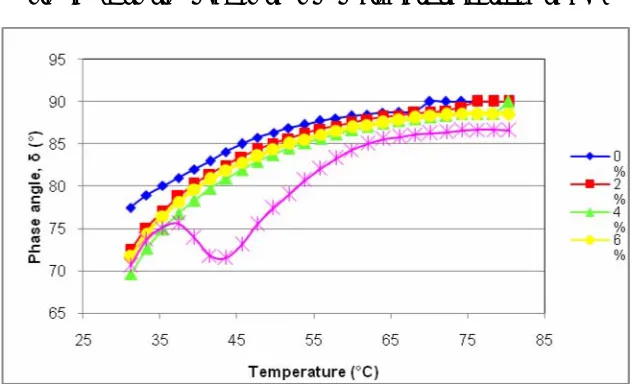
Figures 4 and 5 illustrate the complex modulus and Phase angle, respectively, versus different PET contents in the mix. All specimens showed a decrease in complex modulus values, respectively an increase in phase angle, as the temperature increases. In General the PET modified bitumen exhibited slightly higher complex modulus throughout the temperature range compared to original binder. The higher complex modulus indicated that binder strength have increased which can be correlated to higher rutting resistance.
Figure 5 showed that phase angle for modified bitumen was lower compared to original bitumen. As
However, improvement was noticed in modified binder where the binder can retain its elastic respond or delay lost of its elasticity respond at high temperature.
From temperature 37°C to 43°C, the phase angle of 8% PET content passes through a maximum and
[image:6.595.141.457.167.347.2]minimum value and slower phase angle increment compared to other binder. This transition and plateau region may an indication of polymer network developed in the mixture. Although 4 wt% show the highest complex modulus value but no plateau region was observed in the phase angle curve.
Figure 4 Complex shear modulus vs. different percentage of PET
Figure 5 Phase angles vs. different percentage of PET
3.4.2 Rutting Characteristics G* / sin δ
According to a SHRP specification, the temperature at which kPa marks the maximum
temperature for a good viscoelastic performance of the binder once in the pavement [14]. The high value was found to correlate to high rutting resistance [1]. The temperature which corresponding
to the G*/sin δ value less than 1 kPa for 0%, 2%, 4%, 6% and 8% PET was about 60°C, 65°C, 67°C,
67°C and 62°C respectively.
[image:6.595.140.456.368.561.2]4. CONCLUSIONS
Results showed an improvement in PET modified bitumen properties as the PET content increase in the binder. The recycled PET modified bitumen have higher softening point and viscosity, lower penetration value and better viscoelastic properties such as higher complex modulus and lower phase
angle compared to original binder. The viscosity value at 135 °C of recycled PET modified bitumen
were lower than 3kPas which fulfills SHRP binder requirement. The rutting performance of modified
bitumen evaluated through G* / sin δ value indicated improvements in its rutting resistance compared
to unmodified bitumen.
REFERENCES
1. X. Lu and U. lsacsson. (1999) Rheological characterization of styrene-butadiene-styrene copolymer modified bitumens.
2. Aflaki, S. & Tabatabaee, N. (2008) Proposals for modification of Iranian bitumen to meet the climatic requirements of Iran. Journal of Construction and Building Materials, vol. 10, No. 1. 1-10.
3. González Uranga, O. (2008) Rheological property of bitumen modified with polyethylene and polyethylene based blends.
4. Pe´rez-Lepe,A., Martý´nez-Boza, F.J., Gallegos, C., Gonza´lez, O., Mun˜o, M.E., Santamarý, A. (2003) Influence of the processing conditions on the rheological behavior of polymer-modified bitumen. Fuel, Vol.82, No.11. 1339-1348.
5. Cristina Fuentes-Aude′ n, Juan Andre′ s Sandoval, Abel Jerez, Francisco J. Navarro. (2008).
Evaluation of thermal and mechanical properties of recycled polyethylene modified bitumen.
6. Casey D,c, Ciaran McNallya,d, Amanda Gibneya, Michael D. Gilchristv (2008). Development of a recycled polymer modified binder for use in stone mastic asphalt.
7. U.S. Army Corps of Engineers, Use of waste material in pavement construction, 1999.
8. Hinisliglu, S. & Agar, E. (2004). Use of waste high density polyethylene as bitumen modifier in asphalt concrete mix. Journal of Materials letters. vol. 58, 267-271.
9. Awwad, M. T. & SHbeeb, L. (2007) The Use of Polyethylene in Hot Asphalt Mixtures. American Journal of Applied Sciences,vol. 4, No.6, 390-396.
10. Bing Sh, Hong L, Thomas B. k. and Lawrence K. D. (2006) Surface Properties of Cell-treated Polyethylene Terephthalate. American Journal of Biochemistry and Biotechnology,vol 4,No.2, 170-174.
11. Basu, A., Marasteanu, M. O. and Hesp, S. M., (2003). Time-Temperature Superposition and Physical Hardening Effects in Low-Temperature Asphalt Binder Grading. Transportation Research Board, 82nd Annual Meeting, Washington, D.C.
12. Samsuri, A. and Karim, M. R. (1997). Effects of temperature of mixing and heat aging on the physical properties of rubberised bitumen, Conference on the use of rubberised bitumen in.road construction.
13. Kose, S., Guler, M., Bahia, H. U. and Masad, E. (2000). Distribution of Strains Within Hot-Mix Asphalt Binders. Transportation Research Record 1728, Paper No. 1391, National Research Council, Washington, D.C., pp.21-28.