International Journal of Emerging Technology and Advanced Engineering
Website: www.ijetae.com (ISSN 2250-2459, ISO 9001:2008 Certified Journal, Volume 4, Issue 1, January 2014)586
Content Based Filtering With Multiparty Access Control for
OSNs
Sangavai
1. J, Gopi. R
21,2
Department of computer science and engineering, Dhanalakshmi srinivasan engineering college, perambalur
Abstract—Online social networks (OSNs) have experienced tremendous growth in recent years and become a de facto portal for hundreds of millions of Internet users. Users of these sites form a social network, which provides a powerful means of sharing, organizing, and finding content and contacts. But, it raises number of security and privacy issues. Today’s OSNs allow users have little control on the unwanted messages displayed on their walls and restrict access to shared data but, OSNs does not provide any mechanism to enforce privacy concerns over data associated with multiple users. To fill the gap, the proposed system uses rule based system which allows user can directly specify what contents should be displayed on his/her walls to state constraints on message creators.And MachineLearning-based softclassifier,categorize the messages based on its content in support of content based filtering. Content-based filtering selects information items based on the correlation between the content of the items and the user preferences. Also formulates an access control model
to capture the essence of multiparty authorization
requirements, along with a multiparty policy specification scheme and a policy enforcement mechanism for protection of shared data associated with multiple users.
Keywords— Content Filtering, Filtering rules, Machine
Learning ,Multiparty Access Control, Online Social Networks.
I. INTRODUCTION
Social Network is a social structure made up of a set of social actors such as Individuals or organizations. Social networking service is a platform to build social networks or social relations among the people. For example share interests, activities, backgrounds, or real-life connections.A social network service consists of a representation of each user (often a profile), his/her social links, and a variety of additional services. Most social network services are web-based and provide means for users to interact over the Internet, such as e-mail and instant messaging. Online community services are sometimes considered as a social network service, though in a broader sense, social network service usually means an individual-centered service where as online community services are group-centered. Social networking sites allow users to share ideas, pictures, posts, activities, events, and interests with people in their network.
Online Social networks(OSNs) such as Facebook, Google+ and Twitter used to share personal and public Information to make social connection with friends, coworkers, colleagues and family.A typical OSN provides each user with a virtual space containing profile information, a list of the user’s friends, and webpage’s, such as wall in Facebook, where users and friends can post content and leave messages. A user profile usually includes information with respect to the user’s birthday, gender, interests, education, and work history, and contact information. In addition, users can not only upload content into their own or others’ spaces but also tag other users who appear in the content. Each tag is an explicit reference that links to a user’s space. For the protection of user data, current OSNs indirectly require users to be system and policy administrators for regulating their data, where users can restrict data sharing to a specific set of trusted users. OSNs often use user relationship and group membership to distinguish between trusted and untrusted users. For example, in Facebook, users can allow friends, friends of friends (FOF), groups, or public to access their data, depending on their personal authorization and privacy requirements. Although OSNs currently provide simple access control mechanisms allowing users to govern access to information contained in their own spaces, users, unfortunately, have no control over data residing outside their spaces[1],[7]. For instance, if a user posts a comment in a friend’s space, she/he cannot specify which users can view the comment. In another case, when a user uploads a photo and tags friends who appear in the photo, the tagged friends cannot restrict who can see this photo, even though the tagged friends may have different privacy concerns about the photo[13].
International Journal of Emerging Technology and Advanced Engineering
Website: www.ijetae.com (ISSN 2250-2459, ISO 9001:2008 Certified Journal, Volume 4, Issue 1, January 2014)587
On one hand, removing a tag from a photo can only prevent other members from seeing a user’s profile by means of the association link, but the user’s image is still contained in the photo. Since original access control policies cannot be changed, the user’s image continues to be revealed to all authorized users. On the other hand, reporting to OSNs only allows us to either keep or delete the content. Such a binary decision from OSN managers is either too loose or too restrictive, relying on the OSN’s administration and requiring several people to report their request on the same content. Hence, it is essential to develop an effective and flexible access control mechanism for OSNs, accommodating special authorization requirements coming from multiple associated users for managing the shared data collaboratively.
II. RELATED WORKS
2.1 Rule Based System
Rule based system based on the decision making process [2],[8]. As per Fuzzy Systems, the representation takes the form of antecedent-consequent pairs or IF-THEN statements. Aside from support for fuzzy logic, the method differs in terms of 1. Only one rule gets to provide the consequent action; 2. Arbitration necessary to determine which rule wins. In our project Filtering rule(FL) used for users state what contents should not be display on their walls. Also allows users to customize the filtering criteria to be applied to their walls. This is used for users state constraints on message creators.
2.2 Machine Learning
Machine learning (ML),that is a branch of artificial intelligence, concerns the construction and study of systems that can learn from data. For example, a machine learning system could be trained on email messages to learn to distinguish between spam and non-spam messages. After learning, it can then be used to classify new email messages into spam and non-spam folders. Machine learning focuses on prediction based on known properties learned from the training data. Machine learning algorithms can be organized into a taxonomy based on the desired outcome of the algorithm or the type of input available during training the machine.
supervised learning
Unsupervised learning
Supervised Learning
Algorithms are trained on labeled examples.That means input where the desired output is known. So algorithms attempts to generalize a function or mapping from inputs to outputs which can be used to speculatively generate an output for previously unseen inputs.
Unsupervised Learning
The unsupervised learning approaches are unlabelled that means input where the desired output is unknown.
2.3 Information Filtering
Information filtering system are designed to classify stream of dynamically generated information dispatched asynchronously by an information producer and present to the user those information that are likely to satisfy his/her requirements. It is used to give users the ability to automatically control the messages written on their own walls by filtering out unwanted messages.
2.4 Content-Based Filtering
Select Information items based on the correlation between the content of the items and the user preferences as opposed to a collaborative Filtering system[4],[6],[11]. Content based filtering is mainly based on the use of ML paradigm according to which a classifier is automatically induced by learning from a set of preclassified examples.
2.5 Access Control
In the fields of information security, access control is the selective restriction of access to a place or other resource. The act of accessing may mean consuming, entering, or using permission to access a resource is called authorization. Locks and login credentials are two analogous mechanisms of access control. Physical access control can be achieved by a human (a guard, bouncer, or receptionist), through mechanical means such as locks and keys, or through technological means such as access control systems like the mantrap.
International Journal of Emerging Technology and Advanced Engineering
Website: www.ijetae.com (ISSN 2250-2459, ISO 9001:2008 Certified Journal, Volume 4, Issue 1, January 2014)588
Access control systems provide the essential services of authorization, identification and and accountability where, Authorization is to specify what a subject can do. Identification and authentication enforces that only legitimate subjects can log on to a system. Approval is to grant access during operations, by association of users with the resources that they are allowed to access, based on the authorization policy.
III. THE PROPOSED APPROACH
OSNs provide very little support to prevent unwanted messages on user walls. For example,Facebook allows user to state who is allowed to insert messages in their walls(i.e., friends,friends of friends, or defined groups of friends).However, no content based preferences are supported and therefore it is not possible to prevent undesired messages,such as political or vulgar ones,no matter of the user who posts them.Short text do not provide sufficient word occurrences[6],[10],[11].When a user uploads a photo allow tagged users to remove the tags links to their profile or report violations asking facebook managers to remove the contents that they do not want to share with the public. Removing a tag from a photo can only prevent other members from seeing a user’s profile by means of the association link,but the users image is still contained in the photo.Since original access control policies cannot be changed, so the users image is still continues to be revealed to all authorized users. Hence ,it is essential to develop an effective and flexible access control mechanism for OSNs,accommodating the special authorization requirements coming from multiple associated users for managing shared data.
3.1 Challenges faced
User’s data will share to un authorized person and can’t specify which users can view or comment their data.
Photo tagging restriction will remove the user’s name from the tag but not the photo content.
The proposed system use multiparty authorization requirements along with a multiparty policy specification schema and policy enforcements mechanism for protection of shared data associated with multiple users.
IV. ARCHITECTURE
Photo Tagging
Verifying Tagging
Users Online social Networks
Server
Rule Based System credential
Posted messages
Content Based Filtering
Classified Messages
M
User walls content
MPAC Model
Multiparty Access control
Privacy policy
Exit
Access allowed Deny
Permit
netural Admin Decision
Allow the user
u
u Nonnetural
[image:3.612.308.571.139.625.2]Filter unwanted content
International Journal of Emerging Technology and Advanced Engineering
Website: www.ijetae.com (ISSN 2250-2459, ISO 9001:2008 Certified Journal, Volume 4, Issue 1, January 2014)589
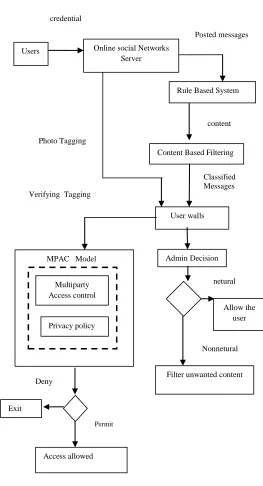
Figure 2.1 explains the overall functionality of the system. In our proposed system input is the posted messages and output is filtering unwanted messages. Filtering depends on rule based system and machine learning based classifier in support of content filtering. Also access control provided to multiful users in OSNs.Initially users register the details and authentication done by verifying username and password. Here user profile information such as the name, age ,gender, likes and dislikes, interested topics, hobbies , graduation information as well as theemail id and personal information can be stored. Thus users all information can be maintained separately. After the updation of all the profile information the user need to add the relationship of other users such as sending friends request to know user and getting the user profile and adding the users to his relationship status.
After verifying username and password verified user posted messages on walls. This is achieved through a flexible rule based system, that allows users to customize the filtering criteria to be applied to their walls,and machine Learning based soft classifier automatically labeling messages in support of content based filtering. Also admin make the decision based on the netural and nonnetrual classes .so nonnetrual messages are filtered in filtering walls.
In multiparty access control used for protection of shared data associated with multiple users’ .Here multiparty access control based on owner’s, contributor’s, stakeholder’s and disseminators. Thus it creates some policy specification through which only limited or well trusted and authorized user can has the access the permission for adding tags on the photo of the user. The multiparty access control first checks the access request against the policy specified by each controller and yields a decision for the controller. In the second step,decisions from all controllers responding to the access request are aggregated to make a final decision for the access request. Since data controllers may generate different decisions (permit and deny)for an access request. The unknown user will view some profile and he/she can able to tag the name of unknown user to the photo. since photo tagging will also a sensitive issue for misbehaving the information of the user. To avoid unknown users of tagging the known or unknown user in the photo will be done in this module. Thus it creates some policy specification through which only limited or well trusted and authorized user can has the access the permission for adding tags on the photo of the user. Thus the unauthorized tagging will be prevented effectively. Thus in this module the unauthorized and block list user list will be maintained periodically to avoid adding un wanted messages.
Thus the unauthorized tagging will be prevented effectively. Thus in this module the unauthorized and block list user list will be maintained periodically to avoid adding un wanted messages.
V. PERFORMANCE EVALUTION
To evaluate the performance of control of shared photo, we take controllers of shared photo from 1 to 20,and assigned each controller with the average number of friends 130.The cases can be used. In the first case, each controller allows”friends” to access the shared photo.In the second case ,controllers specify “FOF” as the accessors instead of “friends”.For both cases, the experimental results showed that the policy evalution time increases linearly with the increase of the number of controllers.so that the protection of shared data associated with multipule users.
VI. CONCLUSION
In OSNs management prevent unwanted messages and access control is quite difficult. To rectify this problem in our proposed system use content based filtering with multiparty access control. Filtering based on rule based system and machine learning based soft classifier in support of content based filtering. In rule based system allows users to customize the filtering criteria to be applied to their walls. Machine learning based text Classification method used to categorize text content in support of content based filtering.Also multiparty authorization requirements ,along with a multiparty policy specification scheme used for access control. This way unwanted messages are filtered and access control provided.
REFERENCES
[1] Ahn.G,and Hu.H,(2011),“Multiparty Authorization Framework for Data sharing in Onlinesocial Networks,”proc.25th ann.IFIP WG 11.3 conf.data and application security and privacy,pp.29-43.
[2] Apte.C,Dameru.F,Sholom.D,Weiss and
Weiss.S.M(2001),”Automated of Decision Rules for Text Categorization,”Trans.Information Systems,vol.12,no.3,pp.233-251. [3] Barbara Carmininati,Elena Ferrari,Elisabetta Binaghi,Marco Vanetti
and Moreno Carullo(2013), “A System to Filter unwanted messages from OSN user walls”,IEEE Transcation on knowledge and data Engineering,vol.25,No.2..
[4] Bilge.L,Balzarotti.D,Kirda.E and Strufe.T(2009),”All Your Contacts Are Belong to us:Automated Identity theft Attacks on Social Networks,”proc.18th Int’l Conf.World wide web,pp.551-560. [5] Carminati.B and Ferrari.E(2011),”collaborative Access Control in
On-line Social Networks,”Proc.Seventh Int’l Conf.Collaborative Computing:Networking,Applications and Worksharing,pp.231-240. [6] Carminati.C,Ferrari.E,andperego.A(2006),“Rule-Based Access
International Journal of Emerging Technology and Advanced Engineering
Website: www.ijetae.com (ISSN 2250-2459, ISO 9001:2008 Certified Journal, Volume 4, Issue 1, January 2014)590 [7] Foster.I, Golbeck.J and Moreau.L(2006), “Combining Provenance
with Trust social Networks for semantic web Content Filtering,”proc.Int’l Conf.Provenance and Annotation of Data,L.Moreau and I.Foster eds.,pp.101-108.
[8] Mooney.R.J and Roy.L(2000), “Content-Based Book Recommnding Using Learning for Text Categorization,”proc.Fifth ACM conf.Digital Libraries,pp.195-204.
[9] Paci.,F,Squicciarini.A,and Shehab.M,(2009) “collective privacy Management in social Networks,”proc.18th Int.lConf.wold wide web,pp521-530.
[10] Besmer.A and Lipfored.H.R(2010),”Moving beyond
untagging:Photo Privacy in a Tagged World,”proc.28th Int’l Conf.Human Factors in Computing System,pp.1563-1572.