Open Access
Vol 12 No 4
Research
Circuit life span in critically ill children on continuous renal
replacement treatment: a prospective observational evaluation
study
Jimena del Castillo
1, Jesús López-Herce
1, Elena Cidoncha
1, Javier Urbano
1, Santiago Mencía
1,
Maria J Santiago
1and Jose M Bellón
21Pediatric Intensive Care Unit. Hospital General Universitario Gregorio Marañón, Universidad Complutense de Madrid, Madrid, Spain
2Preventive and Quality Control Service, Hospital General Universitario Gregorio Marañón, Universidad Complutense de Madrid, Madrid, Spain
Corresponding author: Jesús López-Herce, [email protected]
Received: 30 May 2008 Revisions requested: 15 Jul 2008 Revisions received: 22 Jul 2008 Accepted: 25 Jul 2008 Published: 25 Jul 2008
Critical Care 2008, 12:R93 (doi:10.1186/cc6965)
This article is online at: http://ccforum.com/content/12/4/R93 © 2008 del Castillo et al.; licensee BioMed Central Ltd.
This is an open access article distributed under the terms of the Creative Commons Attribution License (http://creativecommons.org/licenses/by/2.0), which permits unrestricted use, distribution, and reproduction in any medium, provided the original work is properly cited.
Abstract
Introduction One of the greatest problems with continuous renal replacement therapy (CRRT) is early coagulation of the filters. Few studies have monitored circuit function prospectively. The purpose of this study was to determine the variables associated with circuit life in critically ill children with CRRT.
Methods A prospective observational study was performed in 122 children treated with CRRT in a pediatric intensive care unit from 1996 to 2006. Patient and filter characteristics were analyzed to determine their influence on circuit life. Data were collected on 540 filters in 122 patients and an analysis was performed of the 365 filters (67.6%) that were changed due to circuit coagulation.
Results The median circuit life was 31 hours (range 1 to 293 hours). A univariate and multivariate logistic regression study was performed to assess the influence of each one of the factors on circuit life span. No significant differences in filter life
were found according to age, weight, diagnoses, pump, site of venous access, blood flow rate, ultrafiltration rate, inotropic drug support, or patient outcome. The mean circuit life span was longer when the heparin dose was greater than 20 U/kg per
hour (39 versus 29.1 hours; P = 0.008), with hemodiafiltration
compared with hemofiltration (34 versus 22.7 hours; P =
0.001), with filters with surface areas of 0.4 to 0.9 m2 (38.2
versus 26.1 hours; P = 0.01), and with a catheter size of 6.5
French or greater (33.0 versus 25.0 hours; P = 0.04). In the
multivariate analysis, hemodiafiltration, heparin dose of greater
than 20 U/kg per hour, filter surface area of 0.4 m2 or greater,
and initial creatinine of less than 2 mg/dL were associated with a filter life of more than 24 and 48 hours. Total effluent rate of greater than 35 mL/kg per hour was associated only with a filter life of more than 24 hours.
Conclusion Circuit life span in CRRT in children is short but may be increased by the use of hemodiafiltration, higher heparin doses, and filters with a high surface area.
Introduction
Continuous renal replacement therapy (CRRT) is currently the treatment of choice in critically ill adults and children with acute renal failure, fluid overload, or multiorgan dysfunction as it allows a steady removal of fluid, creatinine, urea, and other substances and produces with less hemodynamic instability than occurs with hemodialysis [1-5]. One of the greatest prob-lems with CRRT is early coagulation of the filters, leading to blood loss, decreased efficacy of the technique, increased costs, and a greater risk of hemodynamic instability in the
con-nection [6,7]. Contact between the blood and an artificial sur-face is the factor underlying the initiation of coagulation, although other factors such as the number of blood flow reductions [8], hemoconcentration, a high platelet count, tur-bulent blood flow, and blood-air contact in the air-detection chambers are also involved [9,10]. Few studies have moni-tored circuit function prospectively in patients on CRRT [9,10]. We conducted a prospective observational study to determine those variables associated with circuit life in criti-cally ill children treated by CRRT.
Materials and methods
A prospective observational study was performed in a pediat-ric intensive care unit from 1996 through 2006. The study was approved by the local institutional review board. Due to the characteristics of the study, informed consent of patients was not considered to be necessary. Patients requiring CRRT were included prospectively. Data from those filters that had to be changed because of circuit coagulation were analyzed. The machines used for continuous venovenous renal replacement therapy were the BSM32 (Hospal, Lyon, France) during the first 5 years of the study and then the PRISMA (Hospal). Venous access was secured by inserting a double-lumen cath-eter into one of the central veins. The size of the cathcath-eters depended on the size of the patient. Either polyacrylonitrile AN69 (Hospal) or polysulfone (L.IN.C Medical Systems Ltd, Leicester, UK) hollow-fiber hemofilters were used, depending on the body surface area of the patient and on the pump employed. Commercially prepared, bicarbonate-buffered
hemofiltration replacement fluid (Clearflex®; Bieffe Medital,
Senegue, Spain) was infused prefilter to compensate for fluid losses, which were assessed clinically. Decisions on the use of hemodiafiltration were the responsibility of the treating phy-sician and were based on the patient's need for solute clear-ance. Age, gender, weight, and diagnoses were recorded on admission to the pediatric intensive care unit and pediatric risk of mortality (PRISM), pediatric index of mortality (PIM), and pediatric logistic organ dysfunction (PELOD) scores, lactic acid, and need for inotropic drug support were recorded at the beginning of the CRRT. The variables analyzed in order to determine their influence on circuit life were catheter and venous access used, blood flow rates, heparin dose, filter sur-face area, filtration fraction, ultrafiltration rate, and total effluent flow rate (ultrafiltration plus dialysis). The reasons why the fil-ters stopped functioning were collected prospectively; filfil-ters removed electively were excluded from the analysis. Anticoag-ulation was performed according to our protocol. Circuits were primed with 1 L of 0.9% NaCl to which 5,000 IU of heparin was added. Because of active bleeding or severe coagulopathy, anticoagulation was not performed in 15 filters. The rest of the patients were anticoagulated. At the time CRRT was initiated, a heparin bolus of 20 to 50 IU/kg was adminis-tered, depending on the baseline activated clotting time (ACT). Patients with a normal baseline ACT received a bolus of 50 IU/kg and this was reduced to 20 IU/kg for a baseline ACT of greater than 200 seconds. This was followed by a con-tinuous heparin infusion via the pre-blood pump port, aiming to maintain an ACT of between 150 and 200 seconds. No other anticoagulation drug was administered.
Statistical analysis
The statistical analysis was performed using the SPSS (ver-sion 15) statistical program (SPSS Inc., Chicago, IL, USA). Analysis of normality was performed with the Kolmogorov-Smirnov test. The chi-square test, Fisher exact test, Mann-Whitney test, Kruskal-Wallis test, and analysis of variance
were used to compare the qualitative and quantitative varia-bles and to assess the influence of each factor on circuit life span. A multivariate logistic regression model was performed. Results are expressed as the odds ratio and corresponding
95% confidence intervals. Significance was taken as a P value
of less than 0.05.
Results
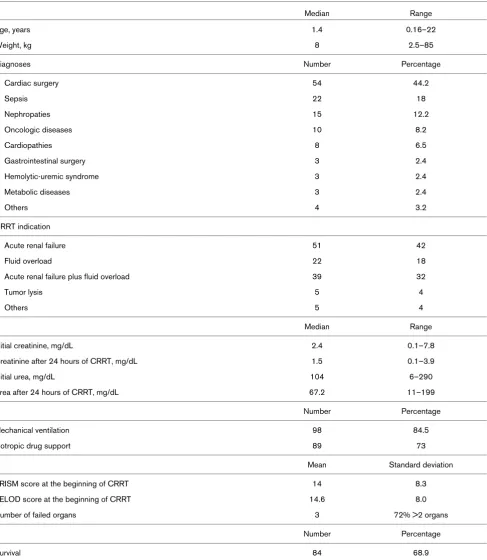
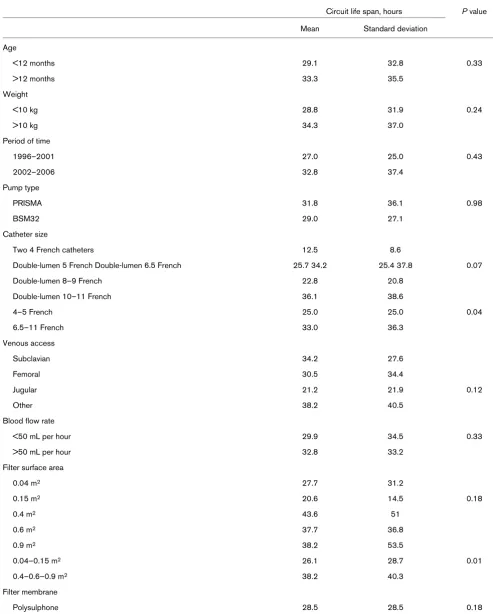
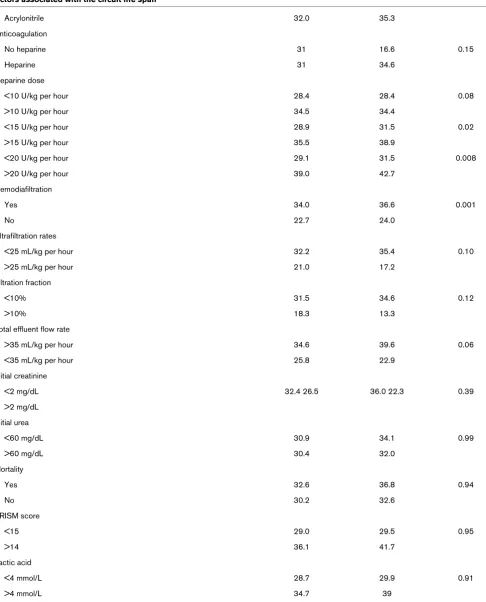
During the study period, 122 patients were treated with CRRT. The clinical and demographic data of these patients are shown in Table 1. Data were collected on 540 filters, and the analysis was performed using the 365 (67.6%) filters that were changed because of signs of circuit coagulation (the ters were clotted, or there was an important increase in the fil-ter pressure in the CRRT monitor, which suggest coagulation of the filter). The median circuit life was 31 hours (range 1 to 293 hours). The analysis of the influence of each factor stud-ied is presented in Table 2. Filter life was slightly longer in chil-dren older than 12 months and with a weight of greater than 10 kg, although this difference did not reach statistical signifi-cance. Hemofilter life did not correlate significantly with patient diagnoses, initial creatinine and urea, site of venous access, type of pump, blood flow rates, severity of illness score, need for inotropic drug support, or final outcome, nor were significant differences observed on comparing the sur-face area of the filters or the size of catheter used. However, significant differences in filter life were found on comparing the use of catheters larger or smaller than 6.5 French and the use
of filters with surface areas larger or smaller than 0.4 m2 (Table
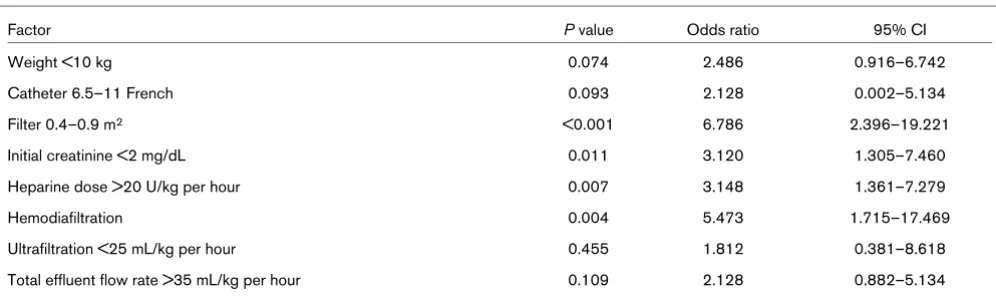
2). Mean circuit life proved to be significantly longer with hemodiafiltration than with hemofiltration. Filter life was also longer with a total effluent flow rate of greater than 35 mL/kg per hour, ultrafiltration flow rates of less than 25 mL/kg per hour, and filtration fractions of less than 10%, although these differences did not reach statistical significance. The adminis-tration of heparin doses of less than 10 U/kg per hour did not lead to any difference in circuit life span but there was a signif-icant increase in life span with doses of greater than 15 U/kg per hour. There were no bleeding events related to heparin dose. In the multivariate logistic regression analysis, hemodia-filtration, heparin dose of greater than 20 U/kg per hour, filter
surface area of 0.4 m2 or greater, and an initial creatinine of
less than 2 mg/dL were associated with a filter life of more than 24 and 48 hours. Total effluent rate of greater than 35 mL/kg per hour was associated only with a filter life of more than 24 hours (Tables 3 and 4).
Discussion
filter life in children [16]. When life span is evaluated, the main problem appears to be filter coagulation [6,10,11,17-19]. Dur-ing CRRT, blood passes through an extracorporeal circuit and
[image:3.612.66.553.113.673.2]coagulation is activated. Anticoagulation is therefore neces-sary. There are a number of agents that can be used to achieve circuit anticoagulation [6,15,17-21] and, of these, heparin
Table 1
Data of patients and clinical characteristics (n = 122)
Median Range
Age, years 1.4 0.16–22
Weight, kg 8 2.5–85
Diagnoses Number Percentage
Cardiac surgery 54 44.2
Sepsis 22 18
Nephropaties 15 12.2
Oncologic diseases 10 8.2
Cardiopathies 8 6.5
Gastrointestinal surgery 3 2.4
Hemolytic-uremic syndrome 3 2.4
Metabolic diseases 3 2.4
Others 4 3.2
CRRT indication
Acute renal failure 51 42
Fluid overload 22 18
Acute renal failure plus fluid overload 39 32
Tumor lysis 5 4
Others 5 4
Median Range
Initial creatinine, mg/dL 2.4 0.1–7.8
Creatinine after 24 hours of CRRT, mg/dL 1.5 0.1–3.9
Initial urea, mg/dL 104 6–290
Urea after 24 hours of CRRT, mg/dL 67.2 11–199
Number Percentage
Mechanical ventilation 98 84.5
Inotropic drug support 89 73
Mean Standard deviation
PRISM score at the beginning of CRRT 14 8.3
PELOD score at the beginning of CRRT 14.6 8.0
Number of failed organs 3 72% >2 organs
Number Percentage
Survival 84 68.9
Factors associated with the circuit life span
Circuit life span, hours P value
Mean Standard deviation
Age
<12 months 29.1 32.8 0.33
>12 months 33.3 35.5
Weight
<10 kg 28.8 31.9 0.24
>10 kg 34.3 37.0
Period of time
1996–2001 27.0 25.0 0.43
2002–2006 32.8 37.4
Pump type
PRISMA 31.8 36.1 0.98
BSM32 29.0 27.1
Catheter size
Two 4 French catheters 12.5 8.6
Double-lumen 5 French Double-lumen 6.5 French 25.7 34.2 25.4 37.8 0.07
Double-lumen 8–9 French 22.8 20.8
Double-lumen 10–11 French 36.1 38.6
4–5 French 25.0 25.0 0.04
6.5–11 French 33.0 36.3
Venous access
Subclavian 34.2 27.6
Femoral 30.5 34.4
Jugular 21.2 21.9 0.12
Other 38.2 40.5
Blood flow rate
<50 mL per hour 29.9 34.5 0.33
>50 mL per hour 32.8 33.2
Filter surface area
0.04 m2 27.7 31.2
0.15 m2 20.6 14.5 0.18
0.4 m2 43.6 51
0.6 m2 37.7 36.8
0.9 m2 38.2 53.5
0.04–0.15 m2 26.1 28.7 0.01
0.4–0.6–0.9 m2 38.2 40.3
Filter membrane
[image:4.612.57.550.115.729.2]Acrylonitrile 32.0 35.3
Anticoagulation
No heparine 31 16.6 0.15
Heparine 31 34.6
Heparine dose
<10 U/kg per hour 28.4 28.4 0.08
>10 U/kg per hour 34.5 34.4
<15 U/kg per hour 28.9 31.5 0.02
>15 U/kg per hour 35.5 38.9
<20 U/kg per hour 29.1 31.5 0.008
>20 U/kg per hour 39.0 42.7
Hemodiafiltration
Yes 34.0 36.6 0.001
No 22.7 24.0
Ultrafiltration rates
<25 mL/kg per hour 32.2 35.4 0.10
>25 mL/kg per hour 21.0 17.2
Filtration fraction
<10% 31.5 34.6 0.12
>10% 18.3 13.3
Total effluent flow rate
>35 mL/kg per hour 34.6 39.6 0.06
<35 mL/kg per hour 25.8 22.9
Initial creatinine
<2 mg/dL 32.4 26.5 36.0 22.3 0.39
>2 mg/dL
Initial urea
<60 mg/dL 30.9 34.1 0.99
>60 mg/dL 30.4 32.0
Mortality
Yes 32.6 36.8 0.94
No 30.2 32.6
PRISM score
<15 29.0 29.5 0.95
>14 36.1 41.7
Lactic acid
<4 mmol/L 28.7 29.9 0.91
>4 mmol/L 34.7 39
[image:5.612.66.552.108.710.2]PRISM, pediatric risk of mortality. Table 2 (Continued)
continues to be the most widely employed [1,18]. The aim of anticoagulation in our study was to maintain an ACT of between 150 and 200 seconds. We found that the use of higher doses increased circuit life span and we did not observe an increase of bleeding. Other studies have also found that the heparin dose is a significant independent pre-dictor of filter life [10,19]. Although we did not observe any major complications due to heparin use, patients with a risk of bleeding can be managed without anticoagulation [1,22,23]. Some but not all studies have found that the use of sodium cit-rate increases filter life compared with heparin [6,13,15,17,19,24,25]. In a recent evidence-based review, Oudemans-van Straaten and colleagues [19] recommended that, if bleeding risk is not increased, unfractionated heparin (with an activated partial thromboplastin time of 1 to 1.4 times normal) or low-molecular-weight heparin (anti-Xa 0.25 to 0.35 IU/L) should be used (evidence grade E). CRRT without anti-coagulation can be considered when coagulopathy is present (grade D). To our knowledge, no randomized studies in criti-cally ill patients on CRRT have evaluated the effect of catheter site or size. Hackbarth and colleagues [16], in a pediatric
reg-istry, found that larger catheter diameter and jugular access are associated with longer circuit life. A short large-caliber catheter is preferable. Smaller-caliber catheters do not permit high flows and are more likely to kink, leading to a greater risk of system malfunction and coagulation. However, a more cen-tral position of the tip of the catheter improves flow [6]. In our study, increased filter life was found with larger-caliber cathe-ters, although this factor did not reach statistical significance in the multivariate analysis, nor were differences in filter life found on comparing the different sites of catheter placement, although the simultaneous influence of a number of factors makes it difficult to analyze these results adequately.
Filter life was slightly longer in children over 1 year of age and in those with a body weight of greater than 10 kg, probably due to the larger caliber of the catheters used and the greater surface area of filters; however, the differences were not sig-nificant. We found a significant correlation between circuit life span and filter surface area. Although the filter must be chosen according to the patient's age and weight, a larger surface
Multivariate analysis of circuit life span more than 24 hours
Factor P value Odds ratio 95% CI
Weight <10 kg 0.147 1.914 0.796–4.606
Catheter 6.5–11 French 0.051 1.933 0.996–3.749
Filter 0.4–0.9 m2 0.006 3.311 1.407–7.795
Initial creatinine <2 mg/dL 0.009 2.534 1.263–5.088
Heparine dose >20 U/kg per hour 0.031 2.026 1.065–3.852
Hemodiafiltration 0.001 4.162 1.781–9.726
Ultrafiltration <25 mL/kg per hour 0.224 1.811 0.696–4.710
Total effluent flow rate >35 mL/kg per hour 0.029 2.143 1.082–4.245
[image:6.612.57.555.114.260.2]CI, confidence interval.
Table 4
Multivariate analysis of circuit life span more than 48 hours
Factor P value Odds ratio 95% CI
Weight <10 kg 0.074 2.486 0.916–6.742
Catheter 6.5–11 French 0.093 2.128 0.002–5.134
Filter 0.4–0.9 m2 <0.001 6.786 2.396–19.221
Initial creatinine <2 mg/dL 0.011 3.120 1.305–7.460
Heparine dose >20 U/kg per hour 0.007 3.148 1.361–7.279
Hemodiafiltration 0.004 5.473 1.715–17.469
Ultrafiltration <25 mL/kg per hour 0.455 1.812 0.381–8.618
Total effluent flow rate >35 mL/kg per hour 0.109 2.128 0.882–5.134
[image:6.612.56.554.569.717.2]area is associated with a longer life span. This might be explained by the fact that membrane saturation could be delayed by the presence of a larger filter surface area. These filters permit higher blood flows, thus increasing capillary shear forces and reducing protein layering, with the conse-quent decrease in membrane clotting and the prolongation of filter life [6]. In a prospective study, filters with longer hollow fibers had a longer life and a lower transmembrane pressure than filters with a larger cross-section. This may have been due to a lower blood flow leading to an increase in blood viscosity in a filter with a larger cross-section [26]. Although the type of membrane can also affect filter coagulation, no studies, to our knowledge, have analyzed the effect of this variable during CRRT in critically ill patients. In our study, there were no differ-ences between polysulfone and acrylonitrile membranes, but the surface areas of the filters were different. We found no dif-ference in filter life over the study period or on comparing the two types of machine used. Although more modern machines permit greater control of the process, more accurate adjust-ment, and have more sensitive alarms, in our experience this has not led to longer filter life. This lack of a difference between the machines could be due in part to the fact that a higher per-centage of filters with a smaller surface area were used with the more modern machines. In adults, circuit life has been found to be longer with continuous venovenous hemodialysis than with continuous venovenous hemofiltration [27]. In one study in children, hemodiafiltration showed longer circuit life than hemofiltration [16]. In comparison with hemofiltration, hemodiafiltration permits lower blood flow rates to be used and causes less hemoconcentration to achieve the same sol-ute clearance; this could explain the longer circuit life [6]. In our patients, a total effluent flow rate of greater than 35 mL/kg per hour was associated with a longer filter life, probably due to the use of dialysis. This suggests that continuous veno-venous hemodiafiltration can achieve sufficient fluid and sub-stance interchange efficacy with a lower risk of coagulation. However, a prospective survey in children did not find a corre-lation between circuit survival and CRRT mode [13]. Using lower ultrafiltration rates and lower filtration fractions could prolong circuit life, minimizing the procoagulant effects of hemoconcentration [6]. Although filtration fractions of up to 25% have been used by some groups, we currently use low filtration fractions, though still achieving adequate clearances and azotemic controls. In our study, there were no statistically significant differences in relation to filtration fraction. Another option for reducing the filtration fraction is to administer the replacement fluid before the filter to reduce the hemoconcen-tration. In two studies, predilution replacement was associated with longer circuit survival [10,28]. In our study, we consist-ently used predilution replacement and therefore are unable to analyze the effect of this factor. Apart from the dose of heparin, the multivariate study also revealed that a low creatinine at the time of starting CRRT was associated with a longer filter life. This could be due to the fact that patients with a higher creat-inine required higher rates of ultrafiltration, which could have
led to increased filter coagulation. However, as the compari-son was performed using the creatinine at the time of starting CRRT and not with the creatinine level at the time of each change of filter, these results must be viewed with caution.
Our study has certain limitations. It is an 11-year, descriptive, epidemiological study that does not test any intervention and it is possible that some differences could be due to the changes in treatment over time. However, it is prospective in design and aims to increase our understanding of the nature and magnitude of a phenomenon that has been poorly explained up to now. Second, when comparing heparin doses, we did not study the patients' anticoagulation parameters. Although it seems reasonable to consider that correct antico-agulation rather than the dose of heparin could prolong the cir-cuit life span, this conclusion cannot be drawn from our data. In addition, it has not been possible to control the effect of problems with the vascular access on filter life in this study; this is one of the main causes of CRRT system malfunction [8], particularly in infants. Another factor that could not be studied is staff training. This is a determinant factor in the early recog-nition of and response to pump alarms, having a significant effect on filter life [6].
Conclusion
We conclude that, in children on CRRT, filter life can be increased by the use of hemodiafiltration, high heparin doses, and filters with a large surface area.
Competing interests
The authors declare that they have no competing interests.
Authors' contributions
JdC and JL-H conceived the study and participated in the study design, data collection and analysis, and drafting of the manuscript. EC, JU, SM, and MJS participated in the data col-lection and analysis and drafting of the manuscript. JMB par-ticipated in the design of the study and performed the statistical analysis. All authors read and approved the final manuscript.
References
1. Uchino S, Bellomo R, Morimatsu H, Morgera S, Schetz M, Tan I, Bouman C, Macedo E, Gibney N, Tolwani A, Oudemans-van Straaten H, Ronco C, Kellum JA: Continuous renal replacement therapy: a worldwide practice survey. The beginning and end-ing supportive therapy for the kidney (B.E.S.T. kidney) investi-gators. Intensive Care Med 2007, 33:1563-1570.
Key messages
• Circuit life span in continuous renal replacement
ther-apy in children is short.
• Filter life can be increased by the use of
medicine. Curr Opin Pediatr 2005, 17:368-371.
3. Goldstein SL, Somers MJ, Baum MA, Symons JM, Brophy PD, Blowey D, Bunchman TE, Baker C, Mottes T, McAfee N, Barnett J, Morrison G, Rogers K, Fortenberry JD: Pediatric patients with multi-organ dysfunction syndrome receiving continuous renal replacement therapy. Kidney Int 2005, 67:653-658.
4. Fernández C, López-Herce J, Flores JC, Galaviz D, Rupérez M, Brandstrup KB, Bustinza A: Prognosis in critically ill children requiring continuous renal replacement therapy. Pediatr Neph-rol 2005, 20:1473-1477.
5. Goldstein SL, Currier H, Graf C, Cosio CC, Brewer ED, Sachdeva R: Outcome in children receiving continuous venovenous hemofiltration. Pediatrics 2001, 107:1309-1312.
6. Joannidis M, Oudemans-van Straaten HM: Clinical review: pat-ency of the circuit in continuous renal replacement therapy. Crit Care 2007, 11:218.
7. Cutts MW, Thomas AN, Kishen R: Transfusion requirements during continuous veno-venous haemofiltration: the impor-tance of filter life. Intensive Care Med 2000, 26:1694-1697. 8. Baldwin I, Bellomo R, Koch B: Blood flow reductions during
con-tinuous renal replacement therapy and circuit life. Intensive Care Med 2004, 30:2074-2079.
9. Holt AW, Bierer P, Bersten AD, Bury LK, Vedig AE: Continuous renal replacement therapy in critically ill patients: monitoring circuit function. Anaesth Intensive Care 1996, 24:423-429. 10. Uchino S, Fealy N, Baldwin I, Morimatsu H, Bellomo R:
Pre-dilu-tion vs. post-diluPre-dilu-tion during continuous veno-venous hemofil-tration: impact on filter life and azotemic control. Nephron Clin Pract 2003, 94:c94-c98.
11. Uchino S, Fealy N, Baldwin I, Morimatsu H, Bellomo R: Continu-ous is not continuContinu-ous: the incidence and impact of circuit "down-time" on uraemic control during continuous veno-veous haemofiltration. Intensive Care Med 2003, 29:575-578. 12. Jander A, Tkaczyk M, Pagowska-Klimek I, Pietrzykowski W, Moll J,
Krajewski W, Nowicki M: Continuous veno-venous hemodiafil-tration in children after cardiac surgery. Eur J Cardiothorac Surg 2007, 31:1022-1028.
13. Brophy PD, Somers MJ, Baum MA, Symons JM, McAfee N, Forten-berry JD, Rogers K, Barnett J, Blowey D, Baker C, Bunchman TE, Goldstein SL: Multi-centre evaluation of anticoagulation in patients receiving continuous renal replacement therapy (CRRT). Nephrol Dial Transplant 2005, 20:1416-1421. 14. de Pont AC, Bouman CS, Bakhtiari K, Schaap MC, Nieuwland R,
Sturk A, Hutten BA, de Jonge E, Vroom MB, Meijers JC, Büller HR: Predilution versus postdilution during continuous venovenous hemofiltration: a comparison of circuit thrombogenesis. ASAIO J 2006, 52:416-422.
15. Kutsogiannis DJ, Gibney RT, Stollery D, Gao J: Regional citrate versus systemic heparin anticoagulation for continuous renal replacement in critically ill patients. Kidney Int 2005, 67:2361-2367.
16. Hackbarth R, Bunchman TE, Chua AN, Somers MJ, Baum M, Symons JM, Brophy PD, Blowey D, Fortenberry JD, Chand D, Flores FX, Alexander SR, Mahan JD, McBryde KD, Benfield MR, Goldstein SL: The effect of vascular access location and size on circuit survival in pediatric continuous renal replacement therapy: a report from the PPCRRT registry. Int J Artif Organs 2007, 30:1116-1121.
17. Monchi M, Berghmans D, Ledoux D, Canivet JL, Dubois B, Damas P: Citrate vs. heparin for anticoagulation in continuous veno-venous hemofiltration: a prospective randomized study. Inten-sive Care Med 2004, 30:260-265.
18. Garcés EO, Victorino JA, Veronese FV: Anticoagulation in con-tinuous renal replacement therapies (CRRT). Rev Assoc Med Bras 2007, 53:451-455.
19. Oudemans-van Straaten HM, Wester JP, de Pont AC, Schetz MR: Anticoagulation strategies in continuous renal replacement therapy: can the choice be evidence based? Intensive Care Med 2006, 32:188-202.
20. Holt AW, Bierer P, Glover P, Plummer JL, Bersten AD: Conven-tional coagulation and thromboelastograph parameters and longevity of continuous renal replacement circuits. Intensive Care Med 2002, 28:1649-1655.
21. Vargas Hein O, von Heymann C, Lipps M, Ziemer S, Ronco C, Neumayer HH, Morgera S, Welte M, Kox WJ, Spies C: Hirudin
replacement therapy. Intensive Care Med 2001, 27:673-679. 22. Tan HK, Baldwin I, Bellomo R: Continuous veno-venous
hemo-filtration without anticoagulation in high-risk patients. Inten-sive Care Med 2000, 26:1652-1657.
23. Uchino S, Fealy N, Baldwin I, Morimatsu H, Bellomo R: Continu-ous venovenContinu-ous hemofiltration without anticoagulation. ASAIO J 2004, 50:76-80.
24. Elhanan N, Skippen P, Nuthall G, Krahn G, Seear M: Citrate anti-coagulation in pediatric continuous venovenous hemofiltra-tion. Pediatr Nephrol 2004, 19:208-212.
25. Symons JM, Chua AN, Somers MJ, Baum MA, Bunchman TE, Ben-field MR, Brophy PD, Blowey D, Fortenberry JD, Chand D, Flores FX, Hackbarth R, Alexander SR, Mahan J, McBryde KD, Goldstein SL: Demographic characteristics of pediatric continuous renal replacement therapy: a report of the prospective pediatric continuous renal replacement therapy registry. Clin J Am Soc Nephrol 2007, 2:732-738.
26. Dungen HD, von Heymann C, Ronco C, Kox WJ, Spies CD: Renal replacement therapy: physical properties of hollow fibers influence efficiency. Int J Artif Organs 2001, 24:357-366. 27. Ricci Z, Ronco C, Bachetoni A, D'amico G, Rossi S, Alessandri E,
Rocco M, Pietropaoli P: Solute removal during continuous renal replacement therapy in critically ill patients: convection versus diffusion. Crit Care 2006, 10:R67.