International Journal of Emerging Technology and Advanced Engineering
Website: www.ijetae.com (ISSN 2250-2459,ISO 9001:2008 Certified Journal, Volume 4, Issue 3, March 2014)
418
Flame and Fire Boundary Tracking Using Self Adaptive
Technique
Kasyap MPS
1, Lalitha Vaishnavi P
2, Asha Bhanu P
3 1PG Student, 2Assistant Professor, Sri Krishna College Of Engineering and Technology
3Assistant Professor, EASA College of Engineering and Technology
Abstract— Determination of flame or fire edges is increasing importance now-a-days due to the immense applications in fire and safety, laboratory research and in the power generation plants. A wide variety of flame or fire detectors are currently available in the market, but image based flame detection is getting of increased importance because of its easier and faster implementation and increased processing and analytical abilities. Research shows that the existing edge detection methods do not emphasize the continuity and clarity of the flame and fire images. In this proposed method, it identifies continuous and clear edges from the flame image, which can be used for various industrial and research purposes. This work uses Sobel edge detection method along with Gaussian window for the detection of flame and fire edges.
Keywords— Flame characterization, Flame edge detection, Cumulative Distribution Function (CDF), Gaussian Mask (GM), Sobel Operator, Preliminary Edge Image (PEI).
I. INTRODUCTION
To meet the stringent standards on combustion efficiency and emission of pollutants, quantitative flame monitoring is becoming increasingly important in the fossil-fuel-fired combustion systems, mainly in power generation plants[1],[2]. This led to a wave of research on advanced flame imaging technologies [3], [4] both in the power generation industry and in laboratory research. In fire and safety engineering, technique of flame image processing is also emphasized as image-based flame detectors are increasingly applied in fire detection systems [5]–[10]. Compared to conventional flame detectors such as those techniques based on optical sensing, detection of ionization current, and thermocouple, image based flame detectors are deemed more appropriate in fire detection because of their capability for remote detection of a small-sized fire, as well as having other advantages[11].
As one of the important steps in flame and fire image processing, flame edge detection is often the precursor and it lays a foundation for other processing techniques. There are several reasons why it is essential to identify flame edges. First, the flame edges form a basis for the quantitative determination of a range of flame characteristic parameters such as shape, size, location, and stability.
Second, the definition of flame edges can reduce the amount of data processing and filter out unwanted information such as background noise within the image.
A number of methods have been reported for identifying flame edges for the geometric characterization of a flame [12], [13] or fire [14], [15]. Adkins [16] developed a software tool used to analyze fire images, with which one can use a mouse to manually trace the edges of flame. This edge-detection method is manual, but it shows the importance and usefulness of the flame/fire edge detection. Bheemul et al. [13] introduced an effective method to extract the flame contours by detecting the changes of brightness in the horizontal direction by using line over a flame image, but the method was only suitable for simple and steady flames. Zhang et al. [6] developed a new method using FFT and wavelet transform for the contour analysis of images of forest fire on a video. Lu et al. [7] proposed an algorithm for early detection of fire and tested it on video clips. Toreyin et al. [8], [9] succeeded in detecting fire in a real-time video by using different methods such as hidden Markov models and wavelet transform. Chacon- Murguia and Perez-Vargas [10] managed to detect and analyze the fire information on a video by analyzing shape regularity and intensity saturation feature. Razmi et al. [11] used background subtraction and Prewitt edge-detection approach for detecting flames for fire protection systems. Then, She and Huang [17] proposed a Chan–Vese active contour model for the edge detection of flames in a power plant. Jiang and Wang [15] demonstrated an improved Canny edge detector which was used to detect moving fire regions in the large space fire images.
International Journal of Emerging Technology and Advanced Engineering
Website: www.ijetae.com (ISSN 2250-2459,ISO 9001:2008 Certified Journal, Volume 4, Issue 3, March 2014)
419
II. EXISTING SYSTEM
A typical edge in an image under study might, for instance, be the border between blocks of different colors or of different gray levels. Mathematically, edges are represented by first - and second-order derivatives. The edge-detection methods that have been published maybe grouped into two categories according to the computation of image gradients, i.e., the first order or the second-order derivatives. In the first order derivative, edges are detected through computing a measure of edge strength with a first-order derivative expression. Examples of the gradient-based edge-detection operators include Roberts, Prewitt, and Sobel operators [18]. The Canny edge-detection algorithm [19], an improved method using the Sobel operator, is known to be a powerful edge-detection method. In the second category, edges are detected by searching a second-order derivative expression over the image under consideration, usually the zero crossings of the Laplacian or a nonlinear differential expression.
III. PROPOSED METHOD
In general, a flame region has a stronger luminance in comparison to its ambient background and the boundary between the flame region and its background is mostly continuous in nature. Furthermore, in most of the cases, there is only a main flame in the image under consideration; otherwise, the image can be segmented so that each of the segmented area contains only one main flame. Accordingly, an auto-adaptive computing algorithm is proposed where these features are used to identify the flame edges. The basic strategy is to detect the coarse and superfluous edges in the flame image then identify the flames principal edges and remove irrelevant ones. The algorithm can be divided into following logical steps.
A. Adjusting the gray level of the flame image.
The first step is to adjust the gray level of a flame image according to its statistical distribution. Considering a discrete gray scale image x and letting ni be the number of
occurrences of gray level of i, The probability of the occurrence of a pixel of gray level i in the image is [20]
= p(x = i) = ni/n, 0 < i < L (1)
Where L is the total number of gray levels in the image, n the total number of pixels in the flame image, and the histogram for pixels with i, normalized to [0,1]. Also, the Cumulative Distribution Function (CDF) corresponding to can be defined as,
= ∑ (2) Which is also the accumulated normalized histogram of the image. Next, create a transformation of form y = T(x)to produce a new image {y}, such that its CDF will be liberalized across the value range with a constant number K, i.e.
= iK. (3)
To map the values back to its original range, the following transformation is applied to the result.
y’ = y (max{x} − min{x}) + min{x} (4)
B. Smoothing the image for noise elimination.
The second step is to filter out any noise in the image before locating and detecting any edges. A Gaussian filter can be achieved using a simple mask. The Gaussian smoothing [21] is performed using standard convolution methods after a suitable mask is selected. The larger the width of the Gaussian mask, the lower the detector’s sensitivity to the background noise in the flame/fire image, but a large mask may also make the detected flame/fire edge so precise that the localization error in the detected flame/fire edges also increases slightly with the Gaussian width. After certain tests and comparison, the Gaussian mask, as shown in Fig. i, is used in the implementation.
C. Using the sobel operator for finding basic edges.
Finding basic edges is achieved by finding the gradients of all the pixels in the image so as to highlight the regions with high gray level contrast at their edges.
International Journal of Emerging Technology and Advanced Engineering
Website: www.ijetae.com (ISSN 2250-2459,ISO 9001:2008 Certified Journal, Volume 4, Issue 3, March 2014)
[image:3.612.299.559.118.594.2]420
Fig.i. Discrete approximation to Gaussian function
It uses a pair of 3 × 3convolution masks, one estimating the gradient in the x-direction (columns) and another estimating the gradient in the y-direction (rows). The Sobel operator is expressed as follows
Mx=[
]
My=[
]
(5)
D. Adjusting TH and TL for better results.
Better results are achieved by giving the first pair of TH and TL initial values according to the a priori results of similar flame images and then adjusting the values for a better result. The ―better‖ result is assessed by how many edges there are: The more edge pixels detected in the edge image, the better the parameters are. Another threshold TE is also set to restrict the total number of edges, i.e., if the number of edge pixels exceeds the TE, the automatic adjustment will be terminated. At this point, a preliminary image with edges identified is obtained from the original flame image. It is designated as a Preliminary Edge Image (PEI).
E. Removing unrelated edges in the PEI.
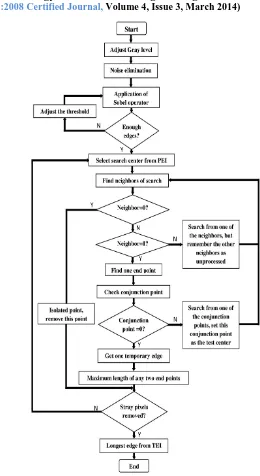
The steps for removing the unrelated edges from PEI are as given below:
a) Select any edge point from the PEI, remove that particular point from the PEI, form a new temporary edge image, and plot the point onto the temporary edge image.
b) Use the selected point as the center, and search in a 3 × 3 area. Store the location of all the neighboring pixels if they are edge pixels. In eight neighboring pixels, operations are taken for the following three different cases.
Fig. ii. Flowchart of the flame edge-detection algorithm.
[image:3.612.87.253.131.247.2]International Journal of Emerging Technology and Advanced Engineering
Website: www.ijetae.com (ISSN 2250-2459,ISO 9001:2008 Certified Journal, Volume 4, Issue 3, March 2014)
421
ii) If there is one neighboring pixel, the selected point is an endpoint. It should then be removed from the PEI, plotted onto the temporary edge image, and added into the endpoint list. Start the search from the newly found neighbor, and go to Step c.
iii) If there are two or more than two neighboring pixels, the selected point is a normal transition point in an edge line or an intersection with more than three bifurcations. Set one of the neighboring points as the new search center, and then start a new search. Store the other positions as unchecked conjunction points, and then, go back to Step b.
c) Check the conjunction points. If all the conjunction points have been searched as a center, one temporary edge image is completed. Compute the lengths of any two endpoints in the temporary edge image, and pick the longest one. Then, go to Step d.
d) If all the pixels in the PEI are moved to the temporary edge image, then go to the next step.
F. Achieving a clearly defined edge.
Select the pixels of the longest edge in the final edge image which should have the same size as the original image. The flowchart of the whole process is shown in Fig. ii.
IV. RESULTS AND DISCUSSIONS
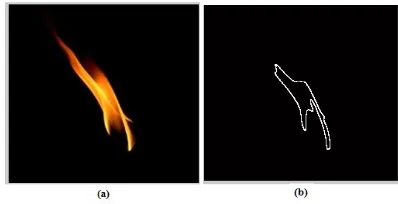
After implementation of the algorithm as described in Section III, numerous flame images were processed using the algorithm so as to evaluate its effectiveness. The flame images were taken for propane Bunsen flame burning in open air. Some of the images used were attained from the Internet with courtesy of permission of use. The desktop computer used has a 2.20-GHz Intel Core 2 Duo CPU. Fig. 3 shows typical processed flame images with edges identified.
[image:4.612.346.545.134.236.2]The proposed method makes it very easy to distinguish the flame region from the background of the image. This algorithm can also be used to extract the edges of more complex flame types such as turbulent diffusion flames or flames of pool fires [14]. Thus the clearly defined flame edges will form the basis for subsequent processing of the flame images, for example, computation of flame size, removal of flame background, and determination of other flame parameters [4]. With a clearly defined flame/fire edge, various flame/fire parameters can be easily computed for the shape description. For instance, the flame area can be counted by the number of pixels inside the flame edge, the flame perimeters can be achieved by determination of total number of pixels of the detected flame edge boundary.
Fig. iii. Edge detection result for flame image. (a) Input image. (b) Detected flame edge from input image using the proposed method.
V. CONCLUSION
After the flame characteristics are analyzed, a new flame edge-detection method has been developed and the algorithm developed is effective in identifying the edges of irregular flame images. The advantage of this method is that the flame and fire edges detected are clear and continuous. Furthermore, with the change of scenarios, the parameters in the algorithm can be adjusted to achieve better results. The clearly defined combustion region lays a good foundation for subsequent quantification of flame parameters, such as flame volume, surface area, flame spread speed, and so on. It is envisaged that this effective flame edge-detection algorithm can contribute to the in-depth understanding and advanced monitoring of combustion flames. Meanwhile, the algorithm provides a useful addition to fire image processing and analysis in fire and safety engineering.
REFERENCES
[1] TianQiu, Yong Yan, Fellow, IEEE, and Gang Lu,―An Autoadaptive Edge-Detection Algorithm for Flame and Fire Image Processing‖, in IEEE transactions on instrumentation and measurement, vol. 61, no. 5, may 2012.
[2] D. Roddy, Advanced Power Plant Materials, Design and Technology, Cambridge, U.K.: Woodhead Publ., 2010.
[3] G. Lu, Y. Yan, and M. Colechin, ―A digital imaging based multi-functional flame monitoring system,‖ IEEE Trans. Instrum. Meas., vol. 53, no. 4, pp. 1152– 1158, Aug. 2004.
[4] Y. Yan, T. Qiu, G. Lu, M. M. Hossain, and G. Gilabertet, ―Recent advances in 3D flame tomography,‖ in Proc. 6th World Congr. Ind. Process Tomogr., Beijing, China, Sep. 2010, pp. 1530–1539. [5] D. S. Huang, L. Heutte, and M. Loog, ―Real-time fire detection
using camera sequence image in tunnel environment,‖ in Proc. ICIC, vol. 4681, LNCS, 2007, pp. 1209–1220.
[6] Z. Zhang, J. Zhao, D. Zhang, C. Qu, Y. Ke, and B. Cai, ―Contour based forest fire detection using FFT and wavelet,‖ in Proc. Int. Conf. CSSE, Wuhan, China, Dec. 12–14, 2008, pp. 760–763. [7] X. Zhou, F. Yu, Y. Wen, Z. Lu, and G. Song, ―Early fire detection
International Journal of Emerging Technology and Advanced Engineering
Website: www.ijetae.com (ISSN 2250-2459,ISO 9001:2008 Certified Journal, Volume 4, Issue 3, March 2014)
422
[8] B. U. Toreyin, Y. Dedeoglu, and A. E. Cetin, ―Flame detection invideo using hidden Markov models,‖ in Proc. IEEE ICIP, Sep. 11– 14, 2005, p. II-1230-3.
[9] B. U. Toreyin, Y. Dedeoglu, U. Gudukbay, and A. E. Cetin, ―Computer vision based method for real-time fire and flame detection,‖ Pattern Recognit. Lett., vol. 27, no. 1, pp. 49–58, Jan. 1, 2006.
[10] M. I. Chacon-Murguia and F. J. Perez-Vargas, ―Thermal video analysis for fire detection using shape regularity and intensity saturation features,‖ in Proc. MCPR, vol. 6718, Lecture Notes in Computer Science, 2011, pp. 118–126.
[11] S. M. Razmi, N. Saad, and V. S. Asirvadam, ―Visionbased flame analysis using motion and edge detection,‖ in Proc. ICIAS, no. Jun. 15–17, 2010, pp. 1–4.
[12] G. Lu, G. Gilabert, and Y. Yan, ―Vision based monitoring and characterization of combustion flames,‖ J. Phys. Conf. Ser., vol. 15, no. 15, pp. 194– 200, 2005.
[13] H. C. Bheemul, G. Lu, and Y. Yan, ―Three-dimensional visualization and quantitative characterization of gaseous flames,‖ Meas. Sci. Technol., vol. 13, no. 10, pp. 1643–1650, Oct. 2002. [14] B. C. Ko, K. H. Cheong, and J. Y. Nam, ―Fire detection based on
vision sensor and support vector machines,‖ Fire Safety J., vol. 44, no. 3, pp. 322–329, Apr. 2009.
[15] Q. Jiang and Q. Wang, ―Large space fire image processing of improving canny edge detector based on adaptive smoothing,‖ in Proc. Int. CICCITOE, 2010, pp. 264–267.
[16] C. W. Adkins, ―Users guide for fire image analysis system-Version 5.0: A Tool for measuring fire behavior characteristics,‖ U.S. Dept. Agric., Forest Service, Southern Res. Station, Asheville, NC, Gen. Tech. Rep. SE93, 1995.
[17] X. She and F. Huang, ―Flame edge detection based on C–V active contour model,‖ in Proc. Int. Conf. Artif. Intell. Comput. Intell., 2009, vol. 2, pp. 413–417.
[18] D. Ziou and S. Tabbone, ―Edge detection techniques: An overview,‖ Int. J. Pattern Recognit. Image Anal., vol. 8, no. 4, pp. 537–559, 1998.
[19] J. Canny, ―A computational approach to edge detection,‖ IEEE Trans. Pattern Anal. Mach. Intell., vol. PAMI-8, no. 6, pp. 679–698, Nov. 1986.
[20] K. R. Castleman, Digital Image Processing. Englewood Cliffs, NJ: Prentice-Hall, 1995.