Loan loss provisioning in the commercial
banking system of Barbados: practices
and determinants
Craigwell, Roland C and Elliott, Wayne A
University of the West Indies, Cave Hill Campus, Barbados
2011
of Barbados: Practices and Determinants
By
Roland Craigwell
1Professor of Economics University of the West Indies
Cave Hill Campus And Research Associate Central Bank of Barbados
And
Wayne Elliott
Undergraduate Student University of the West Indies
Cave Hill Campus And
Summer Intern Central Bank of Barbados
November 2010
1
Loan Loss Provisioning in the Commercial Banking System
of Barbados: Practices and Determinants
Roland Craigwell and Wayne Elliott
Abstract
The purpose of this paper is to investigate the process of loan loss provisioning within the commercial banking system of Barbados. It uses questionnaires and interviews to ascertain how banks set their provisional standards and levels. In addition, the results from this approach
reveal, for the first time in Barbados, the individual banks‟ procedures for loan loss provisioning. An evaluation of the impact of macroeconomic and bank specific factors on commercial banks‟
provisions utilising panel dynamic ordinary least squares is also undertaken. Both sets of factors are found to influence the level of provisions. In particular, loan loss provisions are heavily dependent upon the performance of the real economy and competition in international markets is shown to have serious implications for the banking sector in both the short and long run. Moreover, this study asserts that larger banks in Barbados are better able to screen loans and avoid defaults.
Keywords
:
Loan Loss Provisioning; Banking System; Loan Classification;Introduction
A loan loss provision is a charge to commercial banks‟ profit and loss statements that creates a
reserve on their balance sheets. It can be viewed as a cushioning mechanism which may ensure
that banks do not unexpectedly lose their entire outstanding loan balances. Without this
adjustment, the amount of loans and advances on the balance sheets of banks would include
possible future losses. Furthermore, regulators, creditors and investors could be misled by
overstated capital figures.
One of the major consequences pertaining to the financial crisis of 2007 is to raise concerns
about the need for closer control and supervision on lending institutions. In Barbados, the Central
Bank has started to review the regulatory framework of these activities with the goal of
minimising the adverse effects of future crises. International regulators (International Monetary
Fund, World Bank, and the Bank for International Settlements) have suggested several reforms,
and programs aimed at strengthening the international banking and financial system. One key
element of these reforms highlighted by the regulators is to assess the process of loan loss
provisioning.
Given the above, this study evaluates the loan loss provisioning process of the banking system of
the small open economy of Barbados. It is the first of its kind to be undertaken on this country
and possibly, on the wider Caribbean. Two methodologies are used: interviews with the main
objective of ascertaining how banks provide for loan losses, and an econometric model which
The structure of the paper is as follows: Section 2 gives some background information on loan
loss provisions. Section 3 presents the methodologies while section 4 describes the results
derived from employing the various methods. Section 5 concludes with a summary of the
findings, including limitations and policy implications.
2.
Background
On account of many different factors, the principle and interest that banks agree upon with their
creditors are not always collected. As a result, they have to apply a technique to soften the
impact of such losses: loan loss provisioning. To make the provisioning process consistent across
different jurisdictions, banks use many different means, of which a major one is utilising loan
loss provisioning standards.
2.1
Loan Loss Provisioning Standards
The Basel 1 Capital Accord was released in 1988 seeking to create a competitive international
banking system by strengthening its stability and setting up fair and consistent standards. It
consists of three mutually reinforcing pillars - minimum capital requirements, the supervisory
review process and market discipline - which together contribute to the safety and soundness of
the financial system.
The Basel Committee (1999) emphasizes that there are no uniformed loan classifications, nor is
there a standard procedure to assess loan risk across all jurisdictions. It further posits that several
concepts of loan loss provisioning are susceptible to different interpretations. To deal with these
there was a move to introduce more suitable standards, for example, The International
Accounting Standards (IAS), to resolve some of these issues. According to Laurin and Majnoni
(2003) these standards are yet to give detailed guidance for loan loss provisioning. Due to the
shortcomings of these accounting standards, countries that implement the IAS still have different
loan loss provisioning regulatory frameworks. For instance, sometimes banks need to apply more
complex internal classification systems, while more standardised systems are required by bank
regulators for reporting purposes.
In concurrence, the Central Bank of Barbados, as a regulator, uses the Financial Institutions Act
1998 which is an adaptation of Basel Accord 1. Prior to the current Act, financial institutions
were governed by the Financial Intermediaries Regulatory Act (1992) which was predated by the
Banking Act (1978). The Financial Institutions Act (1998) governs all financial institutions in
Barbados. It is the benchmark for loan loss provisioning regardless of the standards the
individual commercial banks choose to employ. When reporting to the Central Bank of
Barbados, banks must ensure that all information concerning loan loss provisioning is in
accordance with the Financial Institutions Act 1998. However, the flexibility given to
commercial banks through their classification processes, limits the use of penalties and sanctions
that could be utilized to regulate inappropriate classification and provisioning (Laurin and
Majnoni, 2003). Regulators therefore rely mainly on moral suasion and the threat of sanctions
2.2
Classification Criteria
The provisioning criteria employed to estimate losses in the loan portfolio are one of the key
ways to assess the adequacy of loan loss provisioning levels and reserves. An inaccurate
classification of individual loans destabilizes the process of provisioning, which, in turn, distorts
the figures on the balance sheet and overstate capital and capital ratios (Angklomkliew et al,
2009). In support of this view, Song (2002) adds that there ought to be one set of well-known
rules governing the provisioning process. He states that the classification of outstanding loans
should be based on a comprehensive assessment of whether or not the borrower is able to service
the debt, rather than on the outstanding loan value or the collateral provided. The Basel
Committee (1999) supports this viewpoint but also believes that the current value of collateral
and the ability to realize this value should be included with other criteria that banks deem
necessary.
The main method of classifying loans is by the time that has elapsed since the last payment was
due. The longer the time past the last due date, the less likely it is for commercial banks to
recover the entire balance and the greater the banks‟ provision for the outstanding balance. This
procedure is used mainly as a trigger, after which further evaluation is undertaken. Relying only
on the „time past the due date‟ approach would cause losses to be recognized later in the loan
analysis rather than earlier.
Many countries have become aware of the inefficiencies of the „time past due‟ methodology and
agree that more forward-looking criteria - borrower‟s cash flow and repayment capacity - should
behavior as a proxy for their willingness to repay a loan. An example of this is a case where a
borrower misses a few payments, the commercial bank contacts him but he gives no suitable
reason for his delinquency. This indicates that a default may be in the near future and that a
provision should be made.
Another major difference in loan loss provisioning practices across jurisdictions, as pointed out
by Cortavarria et al (2000), is the classification of restructured loans. Restructured loans are
loans that have been modified to better ensure the loan balance is recovered. In the Czech
Republic, for instance, bankers may characterize restructured loans as substandard while in
Thailand they may be placed in the „special mention‟ or pass category. However, the
reclassifications of the restructured loans may not be implemented immediately but may be
undertaken over a period of time when bankers are satisfied that borrowers are meeting the terms
of the new contracts. Bearing this in mind, credit analysts should ensure that restructuring is
based on sound underwriting standards because the cost to recover collateral is time sensitive. In
other words, if the collateral was collected early, and the option of restructuring not issued, then
the bank may have recovered more of the outstanding loan balance (Cortavarria et al, 2000).
Just as there are different ways to characterize loans and various categories for loans to be
classified into, there are several types of loan loss provisions. The type of provisioning in one
economic community may not be suitable in another.
2.3
Types of Loan Loss Provisioning
Balla and Mckenna (2009) highlight two broad categories of loan loss provisioning: the dynamic
loan loss provisioning procedure and the traditional incurred loss method. Dynamic provisioning
is a statistical method that utilizes the historical data of various asset classes. It determines the
event driven provisioning periodically. It is a deliberate way to construct the loan loss reserve in
good economic times. The built up reserve then eases pressures on earnings and capital by
absorbing loan losses during an economic downturn. Conversely, the incurred loss method
delays provisioning until the economy fails to grow; it may magnify the bust because most bad
loans will only reveal themselves during recessions. In essence, the key difference between the
two categories of loan loss provisioning is not the level of provisioning but its timing (Balla and
Mckenna, 2009).
Bouvatier and Lepetit (2006) also distinguished between non-discretionary and discretionary
loan loss provisioning. The non-discretionary component is designed to cover expected loan
losses in the banks‟ loan portfolio. The authors state that this component drives the cyclicality of
loan loss provisioning and it leads to a misevaluation of expected credit losses. The discretionary
component is caused by management‟s use of loan loss provisioning for its own objectives.
Bouvatier and Lepetit (2006) give at least three functions for which banks‟ management utilises
loan loss provisioning (see also Bikker and Metzemakers, 2002). The first function is the practice
of earnings management where banks reserve more in good years to cover for bad years. This
effectively raises and lowers income, and by extension, profits and dividends, as desired. The
second is the management of the capital ratio which is possible on account of loan loss
The third function is tax evasion and this is common because provisions are tax deductible in
most countries.
In addition, Bikker and Metzemakers (2002) argue that the propensity to use discretionary loan
loss provisioning to smooth income is greater for banks with good performance relative to banks
with moderate performance. The authors concluded that, during upswing phases, weak specific
provisions encourage the expansion of credit. With sudden downturns, the identification of
problem loans constrains the banks to make provisions, thereby reducing their ability to provide
new credit. Poorly capitalized banks appear more restricted by provisioning. Dziobek et al
(2000) also suggest that, if loan loss provisions count as regulatory capital and are tax deductible,
management has a greater incentive to use loan loss provisions which should lower the tax
burden. Loan loss provisions could also inadvertently signal financial strength. A bank‟s level of
loan loss provisions and reserves may indicate that it is strong enough to withstand a financial
blow to the loan portfolio.
Using the theoretical model by Cavallo and Majnono (2002), Bikker and Metzemakers (2002)
examined balance sheet data of 29 Organization for Economic Co-operation and Development
(OECD) countries and found that banks that hold a greater amount of risky loans act somewhat
prudently and provision more. There was also evidence in support of the capital management
hypothesis that banks lend more when their capital ratios are low. In addition, it emerged that
provisions depend strongly on credit risk. In harmony with most previous authors (for example,
see Laeven and Majnoni, 2003; Floro, 2010; Jiménez and Saurina, 2006; Wezel, 2010), the
and Metzemakers (2002) could not support the hypothesis that an expansion in provisioning
during successive years of economic boom resulted in higher reserves after the year of recession.
There was also no evidence in favour of the hypothesis that the erosion of reserves after years of
consecutive recession was due to increased provisioning in years of economic boom.
2.4
How much to Provide for Loan Losses?
Another key question that needs to be answered in order to complete the provisioning process is
how much to provide for each category of loans. As described by the Financial Institutions Act
1998, following the annual review of the loan portfolio, each loan classification category should
be assigned minimum levels of provisions. As a result, the substandard, doubtful and loss
categories are considered as classified debt and are provided for whilst pass, special Mention and
mortgages (up to six months) are not. Therefore, reserves are comprised of the provisions on
total categorical classified debt; 10% for the total substandard loans value, 50% for total doubtful
and 100% for loss loan amounts. There is also a 1% provision that is made for the balance of the
loan portfolio which was not reviewed in the past 12 months. One of the criteria, which is critical
during the analysis and categorisation of loans, is the security that backs the loan.
2.5
Collateral
Collateral in its simplest definition is a form of security to a lender in case the borrower fails to
repay a loan. It plays an important role in the financial sector, as it is a means of covering
potential losses. The Basel Committee (1999) recognizes the importance of collateral and advises
There are many different approaches concerning whether and how collateral should be viewed
when classifying loans and determining their appropriate provisions (Laurin and Majnoni, 2003).
All regulatory frameworks do not guarantee the acceptance of some forms of collateral. This
contributes to the problems in comparing the loan loss provisioning processes across different
jurisdictions. Once there is acceptance of some form of security, Song (2002) posits that when
classifying a troubled loan, it is reasonable that a conservative value of the collateral be taken
into account, instead of just the value of the collateral. This conservative value represents a truer
picture of the amount that can be recovered, after taking the cost of collection into consideration.
Jokivuolle and Peura (2003), in an attempt to provide insight into the estimation of the credit risk
quantity, highlight the sensitivity of using collateral as a source of recovery. For example, if a
company is unable to meet its debts and goes into default, its assets, which are not high enough
to cover its liabilities, are usually the same ones that would have been pledged as collateral.
Collateral also plays a major role when making decisions about the amount of provision to be
made on an impaired loan. The question that arises is whether or not to „net off‟ the collateral
value against the impaired loan amount before a provision is made. Arguments against „netting
off‟ refer mainly to deriving the collectible value for collateral. There are difficulties with
valuing, limited marketability and legal impediments of liquidating collateral. Legal procedures
are usually prolonged, expensive and may include extra costs for court and sales fees. For these
reasons, it is believed that collateral values should not be deducted from impaired loan values.
The case for the inclusion of collateral in the calculation is simpler. If the collateral is liquid, of
appraised. Consequently, only collateral that can be reliably measured are likely to be
incorporated in the loan provisioning process.
The monitoring of the value of collateral is another issue that banks are expected to grapple with.
Banks may establish a mechanism periodically to have collateral appraised. Assets that cannot be
seized, possessed or foreclosed should not be considered capital. Continuously monitoring
capital could steer a bank clear of tremendous losses in the loan portfolio. As witnessed in the
early 1990s, neglecting to monitor collateral values may be perilous to financial institutions
(Song, 2002).
3.
Methodology
3.1
Questionnaires and Interviews
One of the primary interests of this paper is to ascertain the loan loss provisioning practices of
commercial banks in Barbados. The key participants interviewed are therefore the employees of
the banks who are directly involved with or managed the processes of loan loss provisioning.
Regulatory staff and relationship officers from the Central Bank of Barbados who deal
specifically with the commercial banks were also interviewed to gain their perspectives of the
processes.
The questionnaire- available on request- was designed to acquire information from all six
commercial banks in Barbados during the interview. It is structured similar to the literature
followed, loan loss provisioning practices including the treatment of collateral and how the
banks‟ management feel about their levels of provisions and reserves.
3.2 Econometric Models and Data
Econometric Models
Finding out how the commercial banks provide for loan losses is important but this does not give
sufficient information to describe the major determinants of loan loss provisioning in Barbados,
which is required because provisions and reserves lessen the impact of non-performing loans that
are sometimes major leading indicators of banking crises. As a result, this paper applied the
panel dynamic ordinary least squares (PDOLS) methodology proposed by Kao and Chiang
(2000) and adopted by Mark and Sul (2003) to estimate regression models aimed at assessing
the factors that influence loan loss provisioning in Barbados in the short and long run. PDOLS is
based on the single equation DOLS procedure pioneered by Saikkonen (1991) and generalized
by Stock and Watson (1993) and has the following similar features: it allows for the direct
estimation of a mixture of I(I) and I(0) variables, performs well in small samples and avoids the
issue of endogeneity. Further, statistical inference on the parameters of the co-integrating vector
is facilitated by the fact that the t-statistics of the estimated coefficients have an asymptotic
normal distribution, even with endogenous regressors (Stock and Watson, 1993).
The application of PDOLS involves three steps. First, panel unit root tests are employed to
check the stochastic nature of the variables. The procedures used are due to Levin, Lin and Chu
(LLC) (2002), and Breitung (2002) [which have a common unit root process as their null
Chi-square (ADF) [whose null assumes individual unit root processes] and the Hadri z-statistic which
has a null hypothesis of no unit root.
If the variables are non-stationary, the next step is to test for co-integration. The methods
employed are the residual based panel and group statistics tests of Kao (1999). The more
popular Pedroni (1999) co-integration tests were attempted but the data set lacked enough
observations for estimation. Finally the short run and long run factors influencing loan loss
provisioning is determined.
The following long run model is estimated:
1
0 1
k
t t t
i k
LLP X X e
(1)where X is a vector of all explanatory variables, X1 is a subset of I(1) variables of X, is a
vector of long –run coefficients and e is a well behaved error term. The leads and lags of the first
differenced I (1) regressors are included to deal with the problems of endogeneity and
autocorrelation. In this paper, the models begins with five leads and lags and as is customary
the general to specific methodology is executed in order to obtain a parsimonious representation
of the regression equations. Therefore, only statistically significant variables are retained in the
model.
In addition, a general Error Correcting Model was done so that the short run coefficients could
1
1 1 2 1 3 1 1 1
1 1 1 0 1 0 1
( )
t
m m m m
t o t t t t t
i
LLP Y X Z Y X
(2)Changes in the loan loss provisions on total loans ratio are a function of its past, lagged first
difference non-stationary variables (X1
), lagged stationary variables (Z) and the lagged error
correcting term. The short run effects are captured by 1, 2and3 while the rate at which loan
loss provisions readjusts to steady state, after disequilibrium have occurred, is given by.
The independent variables used in this study to explain the natural logarithm of loan loss
provisions (Lllp) combines variables from Khemraj and Pasha (2009) and Anglomkliew et al
(2009) and can be broadly categorized into two types: macroeconomic and bank specific. The
macroeconomic variables include: the natural logarithm of real gross domestic product (lGdplev)
whichis expected to have a negative association with Lllp. It is anticipated that as the economy
expands, loan payment defaults are less likely to occur because of increased income, thus, a
reduced provisioning level based on a person‟s ability to service their debt.lPrices represents the
logarithm of the Retail Price Index and a positive relationship is expected between this variable
and Lllp since inflation makes it more expensive to service debts, which may cause the provision
for defaults to rise. The association between the logarithm of the real effective exchange rate
(Reer) and Lllp is likely to be positive following the argument that for countries with fixed
exchange rates and major export industries, it is anticipated that if the currency appreciates those
local exports would become relatively more expensive when compared to foreign products. This
implies that since a substantial number of loans go into exporting enterprises that an expected
With respect to the bank specific variables lEarn represents the logarithm of profits before tax
and provisions divided by total assets for the individual bank. An ambiguous sign between Lllp
and earnings is anticipated. If banks are using provisions to smooth earnings a positive
relationship is likely. A direct link between the logarithm of total loans divided by total assets of
the banks (lLoAs) and Lllp is expected. Total loans to total assets describe the amount of credit
risk. Therefore, if a bank has a high loan to asset ratio it may provide more provisions for the
credit risk it is undertaking. lSiz is a proxy for the size of the bank and represents the logarithm
of the bank‟s assets divided by the total assets of all the banks. The a priori sign for this variable
is ambiguous. It is believed that the sign will be negative if banks are better able to manage
credit risk efficiently during the credit rationing stage because they have better screening
processes - due to their size. A positive association is likely between the logarithm of the total
loans for the banks (ltloans) and Lllp. Rapid credit growth implies higher defaults and by
extension, the larger the loan portfolio the greater the risk of default. During the interviews,
commercial bankers said that they use historical default information when making decisions on
current loan loss provisions. For this reason, a positive relationship is expected between the
logarithms of non-performing loans to total loans ratio (lNpl1). Higher interest rates imply that
borrowers should find it harder to service their debt, thus, leading to more defaults and higher
provisions. In essence, a direct link between (Rir) and Lllp is anticipated.
Data Issues
The data utilised in this paper cover the quarterly period from 1996 to 2009 and were obtained
from the Central Bank of Barbados.The dependent variable is loan loss provisions on total loans
the Retail Price Index (lPrices), the real effective exchange rate (Reer), profits before tax and
provisions divided by total assets (lEarn), total loans as a ratio of total assets (lLoAs), the bank‟s
assets divided by the total assets (lSiz), total loans (ltloans), nonperforming loans divided by total
loans (lNpl1) and the real interest rate (Rir) given by the total weighted average loan rate minus
inflation. The descriptive statistics of the series are shown in Table 1.
Over the period of interest there was one amalgamation and a number of acquisitions. The
amalgamation occurred in 2002Q4. There was further restructuring of this new venture in
2006Q1 when one bank increased its share capital by buying a part of the other bank‟s share. As
a result of this amalgamation and the fact that one bank now prevails the data prior to 2002Q4
was summed as if this bank existed as it appears today, over the entire study period. Although
this summation does not truly represent the structure of the banking sector from 1996 to 2002Q3
[image:18.612.68.578.468.679.2]it was necessary to maintain a consistent dataset.
Table 1: Descriptive Statistics
Lllp lEarn lGdplev lLoAs lPrices lSiz lTloan Reer Rir LNpl1
Mean 0.485 -4.880 5.526 3.894 4.732 1.330 12.926 96.561 10.945 1.542
Median 0.648 -4.824 5.516 3.993 4.729 2.240 12.966 96.371 10.714 1.511
Maximum 3.065 -3.239 5.694 4.323 4.932 3.682 14.299 104.540 12.192 3.830
Minimum -1.664 -7.346 5.362 3.112 4.589 -6.397 11.421 88.974 9.642 -16.118
Std. Dev. 1.047 0.824 0.085 0.293 0.092 2.756 0.798 4.078 0.783 1.295
Skewness -0.070 -0.354 0.130 -0.726 0.318 -1.574 -0.204 0.123 0.040 -7.480
Kurtosis 2.253 2.815 2.055 2.321 2.483 3.924 1.867 2.035 1.612 103.932
Jarque-Bera 8.077 7.491 13.449 35.942 9.409 150.638 20.290 13.886 27.063 145753
Probability 0.018 0.024 0.001 0.000 0.009 0.000 0.000 0.001 0.000 0.000
Sum 163.106
-1639.680 1856.654 1308.216 1589.946 446.910 4343.155 32444.64 3677.594 518.179
Sum Sq. Dev. 367.479 227.468 2.425 28.689 2.807 2544.865 213.372 5570.053 205.357 562.087
The first acquisition during the period occurred in 2003Q4 and the second, in 2004. The last one
came in 2008Q2 but this did not disrupt the data series as separate reporting continued up to the
end of the review period. All in all this presents a full data set of six banks spanning the entire
[image:19.612.73.533.206.473.2]period for the banking system that prevails today.
Figure 1: Loan Loss Provisions to Total Loans
0 4 8 12 16 20 24
96 97 98 99 00 01 02 03 04 05 06 07 08 09
BANK 1 BANK 2 BANK 3
BANK 4 BANK 5 BANK 6
Percentage (%)
Time (Years)
In Barbados, the behaviour of loan loss provisions to total loans ratio is different for each bank
(Figure 1). For instance, one bank showed a steady decline in this ratio from 1.62% in 1996Q2 to
its lowest level (0.21%) in 2006Q1 followed by a steady increase to 0.49% at the end of 2009.
On the other hand, the provisions ratio for another bank was 0.19% at the beginning of 1996 and
expanded over the next seven years to it maximum of 2.03% in 2003Q2. Subsequent to this, the
ratio recorded a steady decline during the following four years before it began to rise with the
onset of the financial crisis in 2007 when it reached 0.70% in 2009Q2. The main reason for this
issued by each bank. Certain loans within particular industries and sectors have been historically
proven to be unlikely to default and would carry a lower actual provision. For example, a bank
with mainly mortgages in its portfolio would have a lower actual provision because people
seldom default on mortgage payments since they place a high priority on keeping their
properties.
4.
Results
4.1
Findings of the Questionnaire and Interviews
The structure of the loan provisioning process in Barbados is such that the Central Bank
regulates loan loss provisions by setting minimum levels on a categorical system. The Bank
provides the commercial banks with the criteria for loan classification and minimal provisioning
levels. It then conducts credit reviews of the individual bank‟s loan portfolios to ensure
compliance with the criteria and categories of the Financial Institutions Act (1998). The purpose
of this Act is to level the playing field across banks and other financial institutions, making
regulations more enforceable.
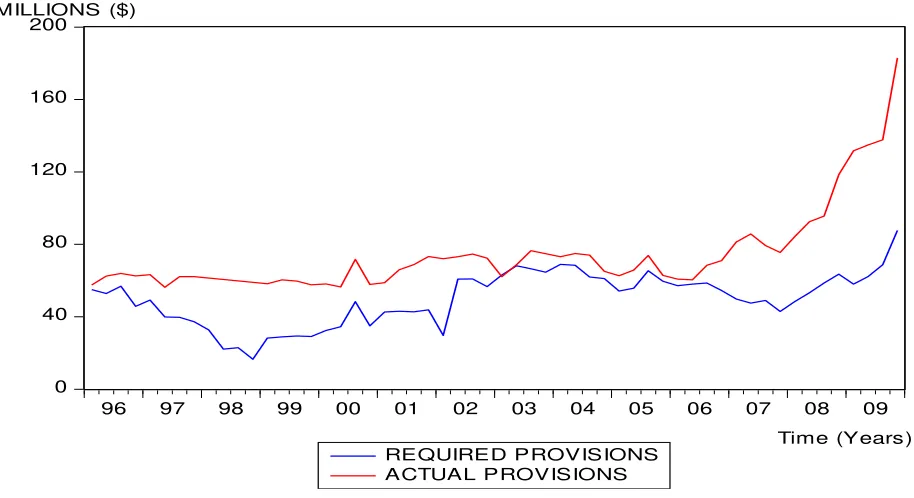
An issue that is highlighted by regulators is the discrepancy between required and actual
provisions. Required provisions are the provisions calculated by the Central Bank of Barbados
based on their classifications as determined by The Financial Institutions Act 1998 while actual
provisions reflect the amount that banks set aside to cover losses within their loan portfolios.
The study asked commercial bankers whether or not they believed that their provision and
From Figure 2 it is observed that there are many small fluctuations in the data as commercial
banks are constantly adjusting their provisions based on the economic climate and previous loan
default behaviours. It can also be seen that regulatory provision and actual provision levels move
very closely together but commercial banks provided more than required by their regulator, the
Central Bank of Barbados. As of the 2006Q2 there was an upward trend in actual provisions with
an opposite movement in the level of regulatory provisions for the subsequent four periods. With
the onset of the financial crisis of 2007, one can recognise that the actual and regulatory
provisions begin to go in the same direction. What is of greater significance is that these two
trends vary significantly in the recent period between 2007Q2 and 2009Q4. The regulatory
provisions are noticeably lower than the actual provisions because the former are based solely on
a set percentage of the loans within the different non-performing categories and allows for no
discretionary influences. Also, the financial expectations in Barbados were dismal thus, banks
would have been trying to raise their reserves as the economic climate was and continues to be
Figure 2: Actual verses Required Loan Loss
Provisions
0 40 80 120 160 200
96 97 98 99 00 01 02 03 04 05 06 07 08 09
REQUIRED PROVISIONS ACTUAL PROVISIONS MILLIONS ($)
Time (Years)
The underlying cause of the discrepancy between regulatory and actual provisions is because
commercial banks have different internal rating systems for classifying their loans. The
interviews highlight that commercial banks use the same primary indicator as the Central Bank
-the time past -the due date - and incorporate o-ther indicators such as internal credit scores, -the
borrower‟s significant assets, the value and type of collateral as well as other borrower specific
characteristics. The reason for the difference in classification is that the commercial banks utilize
The International Financial Reporting Standards (IFRS) or the Generally Accepted Accounting
Principles (GAAP) which do not align perfectly with the Central Bank‟s Regulations on
provisioning. However, the hierarchy is such that no matter what standards the commercial
banks decide are best for their personal use, their provisions and reserves must comply with the
flexible. This flexibility is desired because it allows the banks to take the current valuation of
assets and collateral into consideration. On the other hand, under the Central Bank‟s regulation,
the historical value of the loan is used to estimate the provision.
Due to the differences in the classification ratings for loans, regulators usually face the problem
of synchronization. They must seek to decide, based on the criteria of the commercial banks‟
loan categories, which one(s) match the criteria set out in the regulations. This process is
necessary in determining which provisioning level is being employed in the calculations and is
usually well documented by the banks.
In was revealed during the interviews that the provisioning levels in some commercial banks are
computed using hindsight while in the others only current information is taken into
consideration. Also, some local banks have no authority in determining their own provision
levels and take the level passed on by their international head offices. Sometimes, the
provisioning levels decided by the commercial banks are less than those of the Central Bank and
have to be corrected by the creation of an additional account.
The primary trigger that commercial banks in Barbados use to determine if a loan is to be
classified as non-performing is the „time past the due date‟. In addition to timing, there are other
criteria that can be employed such as the borrower‟s cash flow, the type of collateral and the
probability of collection of the debt. The amount and purpose of the loan do not impact on the
level of provision applied to the loan but may become relevant when the decision to issue credit
Other important information derived from the interviews are (1) commercial banks in Barbados
partition their loan loss provisioning into a general provision and a loan specific provision related
to the individual loan amounts; (2) Central Bank‟s regulations do not consider collateral while
some banks do; (3) the most common type of securities in Barbados is property - land and houses
– which are usually valued by third party appraisals but this value is sometimes adjusted by the
bank‟s management to reflect other characteristics about these securities; and (4) regulatory
monitoring of commercial banks is of a continuous nature, with reporting to the Central Bank of
Barbados done on a weekly, monthly, quarterly and annual basis. To supplement these reports,
officials also conduct on-site inspections to test different key areas of concern which may range
from grievances with a particular process to the traditional high-risk areas such as capital
management and credit risks.
4.2
Econometric Results
The results of the panel unit root tests mentioned above revealed that all the variables, except the
logarithm of loans to assets ratio (lLoAs), logarithm of operating profit on total assets ratio
(lEarn) and the logarithm of non-performing loans divided by total loans ratio (lNpl1), are
integrated of order 1 [I(1)], that is, they need to be differenced once to become stationary (see
Table 2:Panel Stationary Tests
Variable Levin, Lin Breitung Im, Pesaran and ADF - Fisher PP - Fisher
Chi-Lllp
Level -1.78997** 2.25073 -1.38674* 16.4544 15.5911 1st Difference -17.8331*** -6.04304*** -17.4028*** 213.590*** 215.380***
lEarn
Level -3.59849*** -2.43416*** -4.37206*** 51.3037*** 103.556*** 1st Difference 1.00358 -3.14124*** -10.4063*** 121.558*** 135.691***
lprices
Level 2.84057 0.40571 2.86434 1.51318 2.07558 1st Difference -15.0916*** -13.8678*** -13.5521*** 162.483*** 161.502***
lLoAs
Level -.91547*** 0.87629 -3.02976*** 31.4518*** 30.4265*** 1st Difference -17.4912*** -11.4741*** -16.5494*** 199.925*** 204.049***
lTloan
Level -0.06293 0.52110 3.04777 4.68405 6.32559 1st Difference -15.5133*** -10.6867*** -13.5692*** 163.121*** 168.525***
lgdplev
Level -2.38532*** -0.44658 -0.72176 10.6070 16.9463 1st Difference 15.3195 -2.69677** -3.25119*** 29.8734*** 304.050***
RIR
Level 1.43881 -1.49582* 2.34140 2.09488 2.38555 1st Difference -22.1595*** -17.2348*** -18.3591*** 228.123*** 227.148***
lSiz
Level -1.78875** -3.34322*** -1.73913** 21.5210** 49.6274*** 1st Difference -14.9972*** -13.1326*** -16.0338*** 195.809*** 247.959***
REER
Level -0.73426 -2.85402*** -2.34624*** 22.2960** 12.0016 1st Difference -15.4053*** -12.0439*** -12.3879*** 145.579*** 141.504***
Level -3.27370*** -0.08771 -4.70317*** 57.9441*** 58.1823*** lNpl1 1st Difference -20.8006*** -8.39757*** -20.9672*** 245.288*** 223.927*** Note: *** ** and * are the critical values for the rejection of the null hypothesis of a (common or individual) unit root at the 1%, 5% and 10% level respectively. All tests were done using an intercept with an automatic selection of lags except for the Breitung Common Root Test which utilises an intercept with a trend. Lags were selected automatically using Schwarz information criterion.
The long run determinants of the PDOLS model are presented in Equation (3). It is derived from
a general model and reduced to a parsimonious form using the general to specific methodology a
la Hendry. The leads and lags are omitted to save space.
*** *** * *** ***
*** *** ***
(9.8285) (-2.8962) (1.7218) (-7.3808) (-5.2328)
(4.6764) (-7.3859)
Lllp=12.88967 - 0.10641 LEarn + 0.10574 1- 0.71419 - 0.46973
+ 0.023564 Re - 0.2151 - 0.65675 P
LNpl LTloan LSiz
er Rir L
(-2.2739) rices
(3)
2
R 0.918408
Note: t- statistics of regressors are shown in parentheses. ***, ** and * indicates significance at the 1, 5 and 10% level of testing, respectively. R2is the coefficient of determination. The standard errors in brackets are
Seven significant variables can be found in this long run model and they explained 91.8% of the
variation in loan loss provisions (Lllp). The operating profit on total loans ratio (lEarn) has an
adverse relationship with provisions. This result is consistent with Angklomkliew et al (2009)
and it suggests that the commercial banks in Barbados are not using Lllp to smooth income in the
long run. The real effective exchange rate (Reer) has a weak positive significant relationship
with the Lllp, implying that the impact that the real economy has on provision levels is
minuscule. This was also found to be the case in Pasha and Khemraj (2009). The level of
classified debt on total loans (LNpl1) is only significant at the 10% level and has the a priori
sign, indicating that as the level of classified debt or non-performing loans increases Lllp also
advance.
The relative market share (lSiz) of commercial banks has an adverse sign with Lllp. This suggests
that, unlike Guyana (Pasha and Khemraj, 2009), the larger banks in Barbados are more able to
screen loans through better risk management strategies thus providing a stronger loan portfolio.
Contrary to the results seen in Jimenez and Saurina (2005) a negative link between provisions
and the real interest rate (Rir) is observed. The retail price index (LPrices) gives evidence that
the price level affects Lllp in the long run. However, it should be noted that the a priori sign was
positive. The parameter on the total number of loans (LTloan) has an adverse sign. This indicates
that as total loans increases Lllp will decrease. This anomaly between a priori and actual signs
can be explained if one considers that bigger banks in Barbados are the ones with the largest loan
portfolios and are better able to screen possible defaults. Hence it is expected that as total loans
expand then Lllp should contract.
The results of the PDOLS error correcting model (ECM) are reported in Equation (4).
*** *** ***
( 3) ( 4 )
*** **
( 3)
(4.1007) (2.3817) (1.5618) (-4.8949)
(5.6323) (-2.4593)
Lllp=1.683799 + 0.101463 ( 1 ) + 0.074894 ( 1 ) - 1.20615 d(LTloan)
+ 0.660077 ( Pr ) - 0.445547 d(LGdplev) +
d LDep d LDep
d L ices
**
( 5)
** *** ** ***
(-3) ( 4 ) (-1)
(1.6451)
(-1.9606) (2.9136) (-1.7649) (-4.0764)
0.026876 ( )
- 0.065133 d(Rir ) + 0.013059 (Re ) - 0.03217 d(lSiz) - 0.129188 ECM
d LEarn d er (4) 2
R 0.247186
Note: t- statistics of regressors are shown in parentheses.. ***, ** and * indicates significance at the 1, 5 and 10% level of testing, respectively. R2is the coefficient of determination. The standard errors in brackets are heteroskedasticity consistent a la White (1980). „d‟ represents the first difference operator.
The error correcting term in this model is negatively signed, has the a priori magnitude (less than
one) and is very significant; its coefficient suggests that given an exogenous shock to Lllp it
returns to equilibrium with 12.9% of the initial shock dissipating in the ensuing quarter. This
finding for the error correcting term supports the earlier result that the variables cointegrate.
Except for LGdplev and LNpl1 all the other variables are significant in both the long run and
ECM formulations. In addition, the signs of the parameters in both specifications are similar
excluding LPrices and LEarn. With respect to the ECM all the variables have the a priori sign
except for the real interest rate (Rir(-3)) and total loans (LTloan). The variable for total loans has
a very significant negative relationship with Lllp and suggests that as the loan portfolio grows
Lllp should decrease. In support of this is the relative market share variable (LSiz) which is
significant at the 10% level and carries a negative sign, implying that larger banks are better at
risk management. The gross domestic product (LGdplev) has the expected relationship with Lllp,
with the results obtained in the interviews where bankers state that as incomes increase creditors
appear better able to service their debt and avoid default.
To shore up the effect of the real economy on loan loss provisions the real effective exchange
rate from four periods prior (Reer(-4)) is significant and has the expected sign; if it advances by
one unit a 1.3% change in Lllp in the same direction results. The retail price index from three
periods before (Lprices(-3)) also proved to have a influential effect on Lllp. As prices expand by
one unit Lllp are expected to rise by 66% as it would now be harder to service debt. Finally, the
model suggests that the short run expectation is quite small with a value of 17.36%. The signs
obtained on these lagged parameters (Lllpt-3andLllpt-4) are positive and imply that the higher the
value of these parameters, the more banks must provide for current Lllp. This persistence in Lllp
implies that a period of hardship is most likely to be followed by another one until the cycle
breaks. Information gathered from the interviews found a similar result, namely, that commercial
banks usually use historical default data along with current and previous business cycle
information when determining their current levels of provisioning.
5.
Conclusion
This paper examined the components of the loan loss provisions within the banking system of
Barbados. It combines information acquired through the use of interviews along with data from
the regulator- The Central Bank of Barbados. The study also used an econometric model to
explore the main factors which drive loan loss provisions. The results revealed, for the first time
in Barbados, and possibly regionally, a greater appreciation for the individual procedures of the
commercial banks as it pertains to loan loss provisioning. Additionally, the paper discovered that
run; non-performing loans ratio and real gross domestic product were only significant in the long
run and the short run, respectively.
This article showcased the persistence of loan loss provisions and revealed how current and
forecasted economic trends could influence the levels of reserves that provide safety for
depositors. A heavy dependence of loan loss provisions on the real economy emerged and is
evidenced in the significant relationships between loan loss provisions and the real effective
exchange rate, the retail price index and real gross domestic product. This implies that regulators
and policy makers‟ need to keep abreast of leading economic indicators both locally and
internationally as competition could influence the level of defaults and, by extension, loan loss
provisions.
In particular, this research proposes that commercial banks are using loan loss provisions to
smooth income in the short run. This means that as income falls, profits will decline, and tax
revenue, which is calculated based on profits, will follow suit. Consequently, it is very important
for policy makers in Barbados to take the relationship of loan loss provisions and tax revenue
into consideration.
In addition, evidence from the model suggested that the larger commercial banks were better
able to screen borrowers to avoid future defaults in both the long and short run, probably,
One implication of the study is that banks must hold enough reserves to lessen the impact of
adverse shocks to the economy. It would appear that the shortcomings of the current regulatory
framework could curtail this development, therefore, considerable groundwork should continue
to be done to propel the Barbadian Banking System to a better regulatory framework: Basel
Accord 2.
In Barbados, the current regulatory methods are proving to be successful possibly because there
are few commercial banks. Their adherence to the reporting regulations and their willingness to
incorporate the suggestions made by the regulator improves the long standing relationships and
communication channels between banks and the Central Bank. Therefore, there is normally no
need to apply any sanctions or penalties. However, there is not sufficient flexibility of regulative
authority to prevent the major disparity between regulatory and actual provisions during
undesirable economic times, as evidenced in the recent financial crisis.
In light of this belief, this paper argues that an additional x-factor that could be controlled by the
Central Bank be included. This would give regulatory staff the much needed flexibility to
influence the regulated provision and to compensate for the deficiencies in the current historical
category value method until a better alternative can be fully adapted.
There are also limitations of this study that provide scope for future research. Variables such as
the loss given default and the probability of default were contemplated but were not included
because of the large amount of information required to construct appropriate proxies. Also, given
towards these institutions. Such a study could be aimed at making a comparison of their loan loss
References
Angklomkliew, S., George, J., and Packer, F. (Dec 2009) “Issues and Developments in Loan
Loss Provisioning: The Case of Asia.” BIS Quarterly Review.
Balla, E. and McKenna, A., (2009). “Dynamic provisioning: a countercyclical tool for loan loss reserves.” Economic Quarterly, Federal Reserve Bank of Richmond, issue fall, pages
383-418.
Basel Committee on Banking Supervision (1999) “A New Capital Adequacy Framework.” Bank
for International Settlements
Bikker, J.A. and Metzemakers, P.A.J., (2002). “Bank provisioning behaviour and procyclicality.”
Research Series Supervision 50, Netherlands Central Bank, Directorate Supervision.
Bouvatier, V. and Lepetit, L., (2008). “Banks' procyclical behavior: Does provisioning matter?”
Journal of International Financial Markets, Institutions and Money, Elsevier, vol. 18(5),
pages 513-526, December.
Breitung, J. (2002), “Nonparametric Tests for Unit Roots and Cointegration.” Journal of
Econometrics 108, 343-364.
Cortavarria, L. Kanaya, A., Song, I. and Dziobek, C.H, (2000) “Loan Review, Provisioning, and Macroeconomic Linkages.” IMF Working Papers 00/195, International Monetary Fund.
Floro, D, (2010) “Loan Loss Provisioning and the Business Cycle: Does Capital Matter?
Evidence from Philippine Banks.” Bank for International Settlements.
Greenidge, K. and Grosvenor, T.,(2010), “Forecasting Non-Performing Loans in Barbados.” Business. Finance and Economics in Emerging Economies Vol 5 No.1 2010.
Im, K.S, Pesaran, M.H. and Shin, Y. (2003) “Testing for Unit Roots in Heterogeneous Panels.” Journal of Econometrics 115(1): 53-74.
Jiménez, G. and Saurina, J., (2006), “Credit cycles, credit risk, and prudential regulation”
International Journal of Central Banking (2), 65-98.
Jokivuolle, E., and Peura, S. (2003). “Incorporating Collateral Value Uncertainty in Loss Given
Default Estimates and Loan-to-value Ratios. European Financial Management.” 9(3),
299-314. Retrieved from E-Journals database.
Khemraj, T., and Pasha S. (2009) “The determinants of non-performing loans: an econometric
Kao, C., (1999). “Spurious Regression and Residual-Based Tests for Cointegration in Panel
Data.” Journal of Econometrics, 90, 1-44.
Kao, C., and Chiang, M. (2000) “On the estimation and inference of a cointegrated regression in
panel data.” Advances in Econometrics 15, 179-222.
Laeven, L. and Majnoni, G., (2003). “Loan loss provisioning and economic slowdowns: too much, too late?” Journal of Financial Intermediation, Elsevier, vol. 12(2), April.
Laurin, A. and Majnoni, G. (2003) “Bank loan classification and provisioning practices in
selected developed and emerging countries.” World Bank working paper series; no. 1, Report Number 26056
Levin, A., Lin, C. and Chu, S,. (2002) “Unit root tests in panel data:Asymptotic and finite
-sample properties.” Journal of Economics 108: 1-24.
Mark, N., and Sul, D., (2003). “Cointegration Vector Estimation by Panel DOLS and Long-run
money Demand.” Oxford Bulletin of Economics and Statistics 65(5), 655-80.
Pedroni, P., (1999). “Critical Values for Cointegration Tests in Heterogeneous Panels with
Multiple Regressors.” Oxford Bulletin of Economics and Statistics 61, 653-678.
Saikkonen, P. (1991), “Asymptotically Efficient Estimation of Cointegration Regressions.”
Econometric Theory, 7, 1-21.
Song, I. (2002). “Collateral in Loan Classification and provisioning.” IMF- Monetary and Exchange Affairs Department. EconLit with Full Text, EBSCOhost(accessed June
10,2010).
Stock, J., and Watson, M., (1993). “A Simple Estimator of Cointegrating Vectors in High Order Integrated Systems.” Econometrica,61, 783-820.
Wezel, T., (2010) “Dynamic Loan Loss Provisions in Uraguay: properties, Shock Absorption
Capacity and Simulations Using Alternative Formulas.” IMF Working Papers, Vol., pp.
1-22, 2010.
White, H. (1980). “A Heteroskedasticity- Consistent Covariance Matrix Estimator and a Direct