>*»iÆ3i;
U R 4 5 6 1 e
m
THE HEAT TRANSFER COEFFICIENT
AS A FUNCTION OF STEAM QUALITY
FOR HIGH-PRESSURE ONCE THROUGH FLOW BOILING,
WITH DETERMINATION OF THE TRANSITION POINTS
BETWEEN THE REGIONS OF PARTICULAR HEAT TRANSFER
. .ii*W I.J
if
mi
m
L. NOBEL
MKKPBÍ
LEGAL NOTICE
Γ'»^J^M»",4^··'*'t",
mi'
'm
wwMåmmm
mNmmêimmt
This document was prepared under the sponsorship of the Commission of the European Communities.
Neither the Commission of the European Communities, its contractor;
l ' í . V t . t í
nor any person acting on their behalf :
make any warranty or representation, express or implied, with respect to the accuracy, completeness, or usefulness of the information con tained in this document, or that the use of any information, apparatus, method, or process disclosed in this document may not infringe VW™
I
PH*'δίΑΜίτΤ' origins«'afta MlTrøEff JicStf? J1 Ώ 8 ^ -'h'*'Ψ&ν
This report is on sale at the addresses listed on cover page 4
at the price of F F 11.— Β. Fr. 100.— DM 7.30 It. Lire 1,250 Fl. 7.25
When ordering, please quote the EUR number and the title, which are indicated on the cover of each report.
1*ΐ$»
illiillÉi
Printed by Guyot, s.a., Brussels»ftp
mm
Luxembourg, November 1970
m
EUR 4561 e
THE HEAT TRANSFER COEFFICIENT AS A FUNCTION OF STEAM QUALITY FOR HIGH-PRESSURE ONCE THROUGH FLOW BOILING WITH DETERMINATION OF THE TRANSITION POINTS BETWEEN THE REGIONS OF PARTICULAR HEAT TRANSFER, by L. NOBEL Commission of the European Communities
Joint' Nuclear Research Center - Ispra Establishment (Italy) Engineering Department - Heat Transfer Division
Luxembourg, November 1970 - 70 Pages - 28 Figures - B. Fr. 100.—
In a "once through" process in which water at a temperature far below the saturation temperature enters the tube, and leaves it as superheated steam, the heat transfer takes place according to different mechanisms each of which is active over a limited length of the tube.
As far as the present state of knowledge permits, the heat transfer coefficient for a particular heat transfer region is determined analytically as a function of the mathematical steam quality X, for different heat and mass fluxes and pressures between 170 and 210 bar.
ι
I
EUR 4561 e
THE HEAT TRANSFER COEFFICIENT AS A FUNCTION OF STEAM QUALITY FOR HIGH-PRESSURE ONCE THROUGH FLOW BOILING WITH DETERMINATION OF THE TRANSITION POINTS BETWEEN THE REGIONS OF PARTICULAR HEAT TRANSFER, by L. NOBEL Commission of the European Communities
Joint Nuclear Research Center - Ispra Establishment (Italy) Engineering Department - Heat Transfer Division
Luxembourg, November 1970 - 70 Pages - 28 Figures - B. Fr. 100.—
In a "once through" process in which water at a temperature far below the saturation temperature enters the tube, and leaves it as superheated steam, the heat transfer takes place according to different mechanisms each of which is active over a limited length of the tube.
As far as the present state of knowledge permits, the heat transfer coefficient for a particular heat transfer region is determined analytically as a function of the mathematical steam quality X, for different heat and mass fluxes and pressures between 170 and 210 bar.
EUR 4561 e
THE HEAT TRANSFER COEFFICIENT AS A FUNCTION OF STEAM QUALITY FOR HIGH-PRESSURE ONCE THROUGH FLOW BOILING WITH DETERMINATION OF THE TRANSITION POINTS BETWEEN THE REGIONS OF PARTICULAR HEAT TRANSFER, by L. NOBEL Commission of the European Communities
Joint Nuclear Research Center - Ispra Establishment (Italy) Engineering Department - Heat Transfer Division
Luxembourg, November 1970 - 70 Pages - 28 Figures - B. Fr. 100.—
In a "once through" process in which water at a temperature far below the saturation temperature enters the tube, and leaves it as superheated steam, the heat transfer takes place according to different mechan;sms each of which
is active over a limited length of the tube.
As far as the present state of knowledge permits, the heat transfer coefficient for a particular heat transfer region is determined analytically as a function of the mathematical steam quality X, for different heat and mass fluxes and pressures between 170 and 210 bar.
Also, for X values indicating the transition between the different regions of heat transfer, equations have been set up as functions of the same parameters. The theoretical background of these equations differs in some cases from the actual theories.
Maybe one of the most unconventional approaches to the problem is the assumption that the pipe length over which film boiling takes place can be determined by using an analogy with a water-jet-gas-pump aggregate.
This method indeed seems to give a useful correlation equation.
Also, for X values indicating the transition between the different regions of heat transfer, equations have been set up as functions of the same parameters. The theoretical background of these equations differs in some cases from the actual theories.
Maybe one of the most unconventional approaches to the problem is the assumption that the pipe length over which film boiling takes place can be determined by using an analogy with a water-jet-gas-pump aggregate.
This method indeed seems to give a useful correlation equation.
Also, for X values indicating the transition between the different regions of heat transfer, equations have been set up as functions of the same parameters. The theoretical background of these equations differs in some cases from the actual theories.
Maybe one of the most unconventional approaches to the problem is the assumption that the pipe length over which film boiling takes place can be determined by using an analogy with a water-jet-gas-pump aggregate.
E U R 4 5 6 1 e
COMMISSION OF THE EUROPEAN COMMUNITIES
THE HEAT TRANSFER COEFFICIENT
AS A FUNCTION OF STEAM QUALITY
FOR HIGH-PRESSURE ONCE THROUGH FLOW BOILING,
WITH DETERMINATION OF THE TRANSITION POINTS
BETWEEN THE REGIONS OF PARTICULAR HEAT TRANSFER
by
L. NOBEL
1970
Joint Nuclear Research Center Ispra Establishment - Italy
A B S T R A C T
In a "once through" process in which water at a temperature far below the saturation temperature enters the tube, and leaves it as superheated steam, the heat transfer takes place according to different mechanisms each of which is active over a limited length of the tube.
As far as the present state of knowledge permits, the heat transfer coefficient for a particular heat transfer region is determined analytically as a function of the mathematical steam quality X, for different heat and mass fluxes and pressures between 170 and 210 bar.
Also, for X values indicating the transition between the different regions of heat transfer, equations have been set up as functions of the same parameters. The theoretical background of these equations differs in some cases from the actual theories.
Maybe one of the most unconventional approaches to the problem is the assumption that the pipe length over which film boiling takes place can be determined by using an analogy with a water-jet-gas-pump aggregate.
This method indeed seems to give a useful correlation equation.
KEYWORDS
HEAT TRANSFER TUBES MATHEMATICS BOILING STEAM FILMS FLUID FLOW PUMPS
C O N T E N T S
1. INTRODUCTION 5 2. THE HEAT TRANSFER-COEFFICIENT-STEAM-QUALITY CURVE 9
2.1. The liquid phase forced convection heat transfer
coefficient as a function of thermodynamic quality 1C 2.2. Calculation of the X- value at which
subcooled boiling begins '5 2.3. Calculation of the subcooled boiling heat transfer
coefficient 15 2.4· Calculation of the saturation boiling heat transfer
coefficient 1 8 2.5· Determination of the X- value at which the heat
transfer-crisis occurs 20 2.6. Determination of the X— value at which the ultra
crisis region starts 25 2.7· The relation between heat flux, wall temperature
and mass-flux 29 2.8. Determination of the heat transfer coefficient in
the transition and ultra crisis regions 30 2.9. Approximata construction of the X- value at which
the ultra crisis region ends 32 2.10 The maximum heat transfer coefficient in the ultra
crisis region 33 2.11 The heat transfer coefficient in the region of vapor
phase forced convection heat transfer 3h.
3. CONCLUSION 35
TABLES 38 - '+6
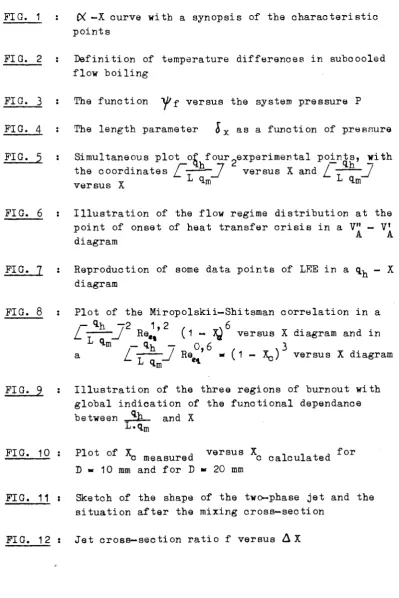
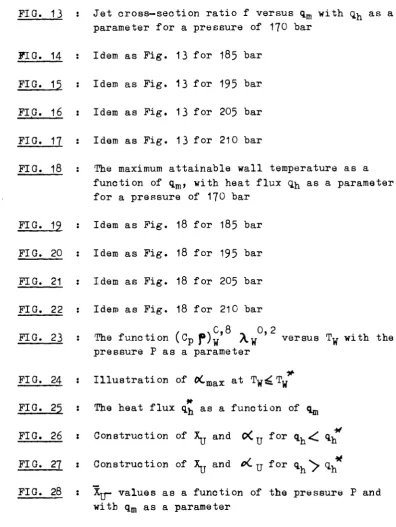
KEY TO THE FIGURES ^7
FIGURES ^9 - 63
NOMENCLATURE Sk
1. INTRODUCTION *)
If the oooling of a heated channel is performed by flow boiling of water at a pressure lying in the near subcriticai range (17O - 210 bar), relatively high heat fluxes may be applied
without causing excursions of wall temperature severe enough to damage the material of the wall.
Normally a certain amount of heat transfer deterioration will
ooour, but the maximum temperature to be attained by the wall can be predicted knowing such parameters as mass flux of the coolant, pressure, diameter of the ohannel and heat flux to be
supplied. If the operating limits, determined by the material of the wall, are taken into account the whole scale of heat transfer modes can infact be subsequently realised in a heated ohannel,
beginning at the entrance of the ohannel with forced oonvection heat transfer in the sub-saturation temperature range and terminat-ing with heat transfer in the superheated vapour region leavterminat-ing
the channel.
As soon as the wall temperature slightly exceeds the saturation temperature of the liquid, nucleation starts and the subcooled boiling becomes the main type of heat transfer. After the hulk temperature of the liquid has reached saturation temperature, fully developed boiling takes place, hut thie merely depends on the magnitude of the difference between wall temperature and satu-ration temperature. Given the fact that onoe boiling has begun, the wall temperature soon raaohes a level that remains constant over the whole nuoleate boiling region, one may say that fully developed boiling normally starts already far in the suboooled boiling region.
As we know from the current literature, the breakdown of
nucleate flow boiling follows the onset of boundary layer
separation.
It can be imagined that the onset of boundary layer separation
should be a function of the channel length over which fully
developed nucleate flow boiling occurs} the mass flux, the heat flux, the channel diameter and the pressure of the system.
The breakdown of nucleate boiling causes the formation of a vapour layer stratified over the wall, giving a steep increase
in wall temperature. The core flow surrounded by the vapour layer now acts as a kind of jet, and the system jet vapour layer simulates to a certain extent a water jet gas pump aggre-gate.
A very-well-known phenomenon of liquid jets is the discontinuous enlargement of the jet which refills the entire oross seotion
of the duct. This behaviour can also be expected at a oertain distance down-stream from the breakdown point, resulting in restabilisation and re-configuration of the flow-pattern, due
to the intensive mixing of the phases. This «stabilisation point coincides with the point of maximum wall temperature, although this latter point oan have a certain extension of length.
This is due to the faot that although the wall cooling is
improv-ed, it continues to be governed by a process of quenching of the hot wall. The high wall temperature impedes rewetting and re-nucleation and the system behaves as a peripherically flashing
7
-The heat transfer in this ultra orisis region depends mainly upon the gas phase characteristics, although the influence of
droplet deposition strengthens dependency on the mass flow
rate.
Up to a certain steam quality, the heat transfer improves steadily due to an increase in the two phase velocity and the
spray effect of droplets on the wall.
Beyond this steam quality a thermal disequilibrium is established between the vapour phase near the wall, and the liquid phase
moving in the oentre part of the tube. The vapour annulus at the
wall becomes more and more superheated, whereas the oore, consist-ing of a mixture of vapour and water droplets, remains at
satura-tion temperature.
The heat transfer from the wall to the superheated vapour annulus occurs aooording to the laws for superheated steam so that the wall temperature will gradually increase again, and the heat
transfer coefficient will decrease. Up to now we have given a brief description of the heat transfer phenomena occurring in a once through flow boiling system at high working pressures.
At moderate heat fluxes the crisis starts in the annular dispersed flow regime and heat transfer deterioration oocurs through the
drying-out of the fine water film on the wall. Initially this introduces a steep increase in wall temperature due to contact between the vapour and the wall. Further wall temperature increase
depends on the steam quality. For the lower qualities the tempe-rature will decrease once more, but for the higher qualities the temperature will continue to increase because the fluid behaves .
like superheated steam.
It will be clear that in this case no particular jet aotion can
exist and the heat transfer minimum depends only on the heat exchange between the superheated vapour flowing in the vicinity of the wall and the liquid droplets moving in the oore. (For
further information see the work of BENNETT et al. J_ 1_/) .
Although, as we have mentioned already, no oomplete simularity oan exist between the types of heat transfer to be expected when
the critical heat transfer conditions are fulfilled under differ-ing circumstances in different parts of the system, there are nevertheless certain common features to remark. In the region
upstream from the crisis the wall is wetted and the flow regimes are in accordance with the model given by COLLIER ¡_ 2_/.
In the region downstream from the crisis the wall is not wetted
and the flow regimes differ from the model given by COLLIER and
As we have discussed in the foregoing paragraphs,the heat transfer in
a once through flow boiling system whirJh inoludas preheating of
the water and superheating of the steam, is a polyform phenome
non with a number of caraotheristic transition points and
distinct heat transfer regions between them.
Although f rom a strictly heat transfer point of view, the
maximum allowable wall temperature is the only restricting
parameter and all other wall temperatures beneath this one
are of seoondary importance, in this work a oomplete summing
up of the equations governing the heat transfer in the differ
ent regions will be given as well as the equations or diagrams
predicting the transition points between these regions.
All equations are written as far as possible as functions of
the steam quality x, being the ratio between the increment of
enthalpie over the saturated liquid state and the latent heat
of evaporation. In the case of subcooled heat transfer χ is
negative. The data used are taken from the work of HERKENRATH
and MORKMÖRKENSTEIN ¿ l j .
2. THE HEAT TRANSFER COEFFICIENT STEAM QUALITY CURVE
General outline of the curve.
Fig. 1 reproduoe« a curve oC versus χ taken from J_ 3_/·
This figure shows the typical heat transfer regions as well
as the transition points labeled with the figures 1 up to and
-
101) Region in which heat transfer to the liquid phase is performed by forced convection
2) The X—value at which subcooled boiling starts
3) Region of suboooled boiling heat transfer 4) Region of saturation boiling heat transfer
5) The X—value at which the heat transfer orisi s occurs
6) The X-value at which the ultra crisis region starts 7) The minimum value of heat transfer coefficient
8) The region of transition and ultra crisis heat transfer 9) The X-value at which the ultra ori si s region ends
10) The maximum heat transfer coefficient i$ the ultra ori si s region
11) The region of vapour phase forced convection heat transfer.
The area between 2 and 5 is approximately the area in which
fully developed boiling exists. The region of vapour phase forced convection heat transfer can belonglpstrtiàlly to the wet vapour region and partially to the superheated steam region.
The reproduction of ct in the transition between region 1 and
3 has to be approximated beoause systematio measurements to calculate this transition are not available. In the following pages the mentioned points from 1 to 11 will be discussed more
profoundly and equations to calculate the magnitudes pertinent to the matter in question will be derived.
2.1. The liquid phase forced oonvection heat transfer coefficient
as a function of thermodynamic quality
11
In such cases it would be wrong to use bulk temperature only
as the reference temperature for the calculation of the charac
teristic physical constants, as is frequently done e.g. as in
the PETHUKOV equation
J_ ¿±_]
reproduced here below:
* P
q.
σ„
H
m pB
8(1,82 lg Re 1,64)
2Í 1,07+1 2,7\/
~
B L
V
8(l,82 1g
lg Re
B1,64)
(Pr|
/3l)j
(11)
For the supercritical region HERKENRATH /
$_/
modified the
PETHUKOV equation introducing the wall PRANDTL number and the
influence of the heat capacity taken at the wall temperature.
His formula:
0Í
Η
q
C
*m
pW
8(1,82 lg Re 1 , 64)
2i 1,07+1 2,7\/
1B
l
V 80,82 1g
Re
B1,64)
(12)
gives good results in the case Pr„^Pr^.
W B
For c i r c u m s t a n c e s u n d e r which Pr S Pr , the o r i g i n a l PETHUKOV
ft SJ
12
range (170210 bar), the PRA.NDTL number goes through a minimum
at an average value of about 260 degrees C. This means that
for Τ > 260 deg. C the PETHUKOV equation can be used and for B
T < 260 degrees C the HERKENRATH equation. B
This temperature is only a rough indication however.
By using a "mixed equation", we found that:
q λ / Ο C
\ V pff pB
\ 1,07+12,7^
1
'80,1
8 ( 1 , 8 2 l g Re 1 , 6 4 )2
■D » —r/ ι ■ ι " > · ■ —ï ' y ρ
' 82 l g Re 1 , 6 4 )
B
^
* ;
/ 3-
D}
(1-3)
The transition point between the PETHUKHOV equation and the
HERKENRATH equation can be found more easily if the following
condition is fulfilled:
A y (equation 1—2) » 0\^.(equation 13)
Moreover it seems that the "mixed equation" especially for the
higher heat fluxes gives better agreement in the region above 260
degrees C .than the other two methods. Unfortunately the experi
mental information at our disposal is toofragmentary for
a definite conclusion to be drawn.
Remark:
The method of o a l o u l a t i n g 0( i s the following:
F i r s t s t e p :
T
J51 ff Now i s T » T q / / V
B2 ff V OCf C a l c u l a t e 0( a s s u m i n g T
13
Second s t e p :
C a l c u l a t e ot using Τ
2 B¿
Now is Τ » Τ q. /oc B3 ff V ^ 2
The number of steps is determined and limited by the condition
that T Τ , ^ 0,001 Τ
Bn Bn+1 Bn
A temperature interval for Τ of 10 deg. C is normally sufficient.
w
The c a l c u l a t i o n of 0C follows from T
Bn+1
The bulk temperature gives also the enthalpie decrement A h sat
to be taken from the steamtable in order to calculate x, accord
ing to the formula
x T ^ ( 14)
From the foregoing it will be clear that functions of OC explicit
in χ are not to be expected for the moment due to the lack of
sufficient information. However the method desoribed so far gives
the indirect relation between the two functions.
In Table 1 we have given some examples of the calculation of T B using equations (1i) (12) and (1—3)· In a fourth column the measured values of T so far determined are also indioated.
B
2.2. Calculation of the Xvalue at which subcooled
boiling begins
As we have disoussed already, the wall temperature increases
until a constant temperature level has been reached lying
slightly above the saturation temperature. In 3 we will develop
14
oase of boiling.
In the context of the actual problem
which is to calculate the Xvalue
at whioh subcooled boiling starts, we may assume with a good
approximation that boiling starts as soon as the wall tempera
ture has reached the saturation value. In the subcooled region
'the general expression for X may be constituted also as:
X « (T Τ ) C
κ Β
S
;ρ
(21)
From whioh:
τ τ /
S Β JUsing t h e PETHUKHOV e q u a t i o n we o b t a i n f o r Τ Τ t h e e x p r e s W o
s i o n :
4,
1,07+ 12,7 V ? / 8
( P r
2 / 3 i ;
- ')^-\'7^Z
=
(2
-
3)
Hm pB
w i t h
5/8
2
( &"
3 a )8 ( 1 , 8 2 l g ReB 1,64)
S u b s t i t u t i n g Τ — Τ i n ( 2 1 ) by t h e e x p r e s s i o n a c c o r d i n g t o B S
(2—3), we o b t a i n f o r t h e X—value a t which n u c l e a t i o n s t a r t s :
i.
.
c
11,07+12,7 V V e Í P r !
/ 3 OJ
15
This equation may be substituted by a simpler one, assuming
that the numerioal value of the expression
pB
| l , 0 7 + 12,7
V V M P X B
2 / 3-
D ]
will lie between narrow, limits.
Assuming that this is the case, and remembering that ΗΘ Si Re0,
B S the formula (2-4) becomes then,
\ 2
\ ' - C v η τ (1,82 lg Re - 1,64) (2-5)
Ν Ν q · L S m
Here Cjj is a coefficient to be determinedby the experimental da ta. From our data we have deduced the following values for C Ν
Ρ - 170 bar C - 10,963
Ν
Ρ =· 185 bar C
>T- 11,343
Ν
Ρ - 195 bar C - 11,669
Ν
Ρ - 205 bar C - 13,103
Ν
Ρ - 210 bar C « 13,914
Ν
These values of C give calculated X - values lying between the
+_ 10 % error l i m i t s of the experimental X - v a l u e s .
2.3· Calculation of the subcooled b o i l i n g heat t r a n s f e r c o e f f i c i e n t
From the method described in 1, we have oaloulated up to the
" q u a l i t y " X the forced oonveotion heat t r a n s f e r c o e f f i c i e n t s .
This means that the value Ci
wcorresponding to X„ i s a l s o
known. From that point we enter a t r a n s i t i o n region in which
surfaoe b o i l i n g w i l l be e s t a b l i s h e d .
16
at which nucleate boiling will be fully developed and the wall
temperature remains constant for the smaller q, values far up
h
into the positive X range untili the heat transfer crisis starts.
The temperature difference in the subcooled boiling region may
now be found from:
Δ Τ Δ Τ
+ Δ Τ
(see Fig. 2)
sub
f
Δ Τ , may be found from equation ( 2 l ) , g i v i n g
sub
Δτ ,
4 ^
Í
3"
1)
sub
C
Ρ
When looking for an expression for Δ Τ , we may conclude that
the passion of "boiling" experimentalists for describing the
relation between boiling magnitudes in the form Nu =
φ
(Re, Pr),
is nearly ineradicable. So we will also try to find a useful
equation in the same way. The general equation for flow boiling
would then be:
Nu C . Re
y. Pr
Z(32)
This equation implies t h a t OCis anindependent function of q, .
h
S p e c i f i c a t i o n and rearrangement of t h i s equation g i v e s :
„*, 1y ..
., ï»
A m L qh
Δ τ
\
Η hfl <»)
f
C' C^ L q
p f
*m
In the REYNOLDS number of this equation, a length parameter
ψindicated by D has been assumed, whose magnitude depends normally
on pressure and tube diameter. For pool boiling (q 0, q > 0),
m
h
similar formulae are ohoosen, to be expressed in the most general
17
Δ τ
t/L
·
i V
C' C
Ρ o
1^1 l=£
/ * '
m
O M )
Also,in this equation 1
may depend on system dimensions and
physical constants, often 1 is a function of bubble diameter.
A mean value for η would be η ■ l/3, and according to ROSENOff
¡_
6__/ is for water at high pressures m « 1 . Applying these
values and combining the two equations we obtain the result:
o
, 1 y
« 1 / 3
Δ τ Δ τ
— D
1
f
o 0
fC ' 1Λ'
L λ '
- z
2/3 f
L *m m ra
2/3-y
(3-5)
From their subcooled boiling experiments ZENKEVICH and SUBBOTIN
2
m
Assuming that this dependency will be sustained to some extent
¡_ 1_]
obtained the relation q © c q
m·
into the positive quality region, we obtain as a universal value
for y; y «
ΐ/3· As long as ζ remains an unknown exponent,
the expression
* -·
■"
Ί¥Γ
will be substituted by the new parameter 5
. By doing this
τ
we arrive at the temperature equation for saturated flow boiling
i .Θ?
A?. - Δ τ
f o
,-
qh
2
αΓ
Ì1/3
V
¿T
/——/
/ ——
-ι
m
'
For p o o l b o i l i n g v e f e u n d Τ « Κ / » q
So we o b t a i n f o r e q u a t i o n ( 3 6 )
1/3
18
2
1/3
Í lv,
q*
6Φ
1
(37)
Writing for
equation (37) may be written as
m
The function'M/ f(p) has been plotted in Fig. 3· It is a
unique function of the pressure. Combination of the equations
(31) and (39) gives the temperature difference in subcooled
boiling
Δ Τ
' Ρ
+
^ T V 3
<^°>
ρ
m
The heat transfer coefficient is now to be found from
** subcooled
77E
V f · *h
(311)
C ~
+1/3
P \
2.4· Calculation of the saturation boiling heat transfer
coefficient
The difference between wall temperature and saturation temperature
may be calculated by equation (39)· This formula leads to a
very simple expression for the heat transfer coefficient in the
19
0,33
<?C - -A- = - f -
(4-1)
2
Keeping i n mind t h a t under s i m i l a r c o n d i t i o n s q, oC q , we
h
m
may state that also for inoipience of boiling α
» k . q ,
ni
i
m
inserting this relation in equation (41)> we obtain for the
heat transfer ooeffioient at boiling incipiency :
q
°>
6 6oí
-
-ΤΤΓΤ
(4-2)
κ
Ο,33 γ
i
' f
DAVIS and ANDERSON
[_ 8_/
proposed the following relation for
the wall temperature difference at boiling incipiency :
_ 8 G τ
_ 0,5
n_
Δ Τ /
S /
q
0'
5(4_3)
giving for the heat transfer coefficient
*■ λ * L p " "
7The difference in exponent between the equations (42) and
(44) may be explained by the difference in type of boiling.
The formuîmof DAVIS and ANDERSON has to be applied mainly for
annular flow conditions»w.hich seems to be confirmed by the work
of K0PCHIK0V et al.
¿
9_/ who found roughly the same relation as
(43) for liquid film pool boiling i.e.
G T
_0,5
0ς
20
However in 5 it will be seen that the work of MORKMORKENSTEIN
and HERKENRATH / l j is restricted mainly to the bubbly
flow regime.
2.5· Determination of the X value at which the heat transfer
crisis occurs
On the threshold of the heat transfer crisis, equation (36)
may be used to calculate the dimensionless temperature dif
ference:
Z>
Tf3
q^
2
q
m· S
To m '
The right hand side of equation (5—1) may also be used as a
correlating group for the determination of the steam quality
at which the wall temperature almost stepwise starts to
rise. Such correlating groups are already described in the
literature. The correlation of TONG / 10_/should be transferred
intothe equation:
L^J
L-^T-J
. * ♦ « £
(52)
m '
Our group correlates in the following manner:
¿rrW
L-^J
-\«-\
(5-3)
m '
The function υ can be taken from Fig. 4ι and is a unique
21
The c o n s t a n t χ i s a weak f u n c t i o n of t h e p r e s s u r e i n t h e r e f
p r e s s u r e r a n g e : 170 ^ Ρ ¿ 210 b a r .
The v a l u e s a r e g i v e n i n T a b l e 2 .
P ( b a r ) 170 185 195 205 210
X
ref
° '
4 1° '
4 2° '
4 2 5° '
4 3 5°
> 4 4The i n t r o d u c t i o n of a r e f e r e n c e v a l u e χ _ i s a l s o known i n
ref
the heat transfer literature. The correlation of C.I.S.E.
J_ 11_/ takes the form:
η A P °»4
- \ - \'
^°
, 4
(-f-D
I-.P/P„
ZrfV
E^ x
(54)
L q
m
0,794
(W
CMOOO'
I t i s c l e a r from t h i s e q u a t i o n t h a t :
1 P / P
Xr e f » q 1/3 ( 5 5 )
M000y
I n our r e s u l t s we c o u l d a l s o o b s e r v e a weak dependence of χ
ref on q . ffe have nevertheless ignored this influence in our correla
lo
tion. The question now arises as to whether the correlation so
far developed is a so called overall correlation or is it oonneoted
to a specifio flow pattern? In order to answer this question, we would first like to demonstrate the subtlety of the problem. For
Ρ 170 bar ι
data groups:
2
\
\
m
SS
9 2 , 5
102,44 123,94 146,32 X X X X 10* 104 104 104
, 2 ff/m
, 2 ff/m
, 2 ff/m
, 2 ff/m
22
-X 0,354 c
X - 0,338
o
X 0 , 3 0 2 c
X - 0,273
c
P l o t t i n g t h e s e f o u r g r o u p s r e s p e c t i v e l y i n a / / X
- <lv - L Q-m °
Ζ
η "τ m—_/— X d i a g r a m , we o b t a i n t h e c u r v e s
m
printed in Fig. 5· Three data points correlate proportionally Ih
better with ~ , and two points presumably correlate with
,*h 72 L , tm
/ I . The transition between the two regimes is situated L.q
at a A— value of 0,3» corresponding to a volumetric quality
A of 0,68. Note
X V" + ( ix)~^r
X V
ß '
τ
V" +
(
ixì ir*
Due to the very low slip between the gas and liquid phases
at the high working pressures, we can state that the void
fraction is nearly equal to the volumetric quality, certainly
in the bubbly flow and mist flow regimes. A void fraction of
0,68 may correspond to the transition region from bubbly flow
to annular flow. In Fig. 6 we have plotted all the data points
of X in a V" — V' diagram,
o A A
V" « q . Χ . v" (the "superiioial" steam velocity)
A m
V* « q . (1X) r* (the "superficial" water velocity)
A m
In thi β diagram ƒ?> «- lines are linear functions going through
the origin. Assuming that OC and β are identioal, it follows from the diagram, that for 78^ of the data point· the
23
In Fig. 7 we have reproduced a group of 19 data points from
LEE /~12_7, with
q « 4134 + 3 , 3 $ a t + 71 isg/om
m — —
The points for X <. 0,09 correlate proportionally with
2
°
/ q^/L q 7 and the points for X > 0,09 with / q^/L q _/.
h m c ' h m
For Χ ■ 0,09 i s ft « 0 , 6 6 . From the foregoing i t can be
concluded t h a t f o r the bubbly flow regime the b u r n o u t or heat
t r a n s f e r d e t e r i o r a t i o n q u a l i t i e s c o r r e l a t e with a high p r o b a b i l i
t y according to a formula of the form:
X * - X
- Ζ ~ Ά -
J
2 Re l (5-6)
r e f c *- L.q -J eq w /
m
for high pressures Ρ ^ 170 bar is m « 1. It further follows that
a small part of our data will presumably correlate better propor tionally with q / L q . This means that to a certain extent our
h m . -correlation is really an overall -correlation. However, this mainly bears upon the choice of the value for X .. From Fig. 5
ref
it can be seen that our X _ - values are between X „ „ ■ 0,38
ref ref B
and Χ „ 0,505. Note: ref A
χ _ _ i s X „ value for the bubblyflow regime ref B ref
Χ is Χ _ value for the annularflow regime, ref A ref
It will be clear that overall correlations are blurring out
the typical characteristics of a burnout curve. However with
some imagination an overall correlation can be redivided into
two branches, one of which corresponds to the form of equation
24
As an example we have written the correlation of MIROPOLSKII
SHITSMAN [_ 13_/ in our notation. It becomes:
_ <L _ 2 _ q . £ m
(l-zf-ÍT^J
L-J^J
(57)
m / ,
\ Λ
Γ Ρ
1-f>,2^ ,
-2
In t h i s formula m 1,2 and f o r
—
Lp^J
/> 6.10
i s η ■ 6. In the e q u i v a l e n t Reynolds group
ζ
i s the following
A.
f u n c t i o n :
2
h
—τ-
^)
2
(cV)
1 , 3 3
(r/f)
0 , 1 3 3
(ïï)
1
'
6 6
Ρ »
(58)
f o r l/D /MOO i s
C » 0,174.
Plotting / q, /L q / . Re versus (1X ) , we obtain a curve
* ^h ^m—' v o
as has been shown in Fig. 8. For X ^ 0,10 the ourve may be c
approximated by a straight line indicating the relation
m
For X the value 0,20 will give the best resul*.The part between ref
X « 0 , 1 0 and X « 0,40 may be approximated very well by a
c c
function of the form
X
X
L-T^—J
· Re°'
6(510)
ref o * L. q —' v '
Here Χ Λ « 0,52. ref
Except for the rudimentarilyexisting annular flow branoh of the
burnout curve, a third branoh may be blurred out by the form
25
already by DOROSHCHUK / M^_J to be covered by the steep
decreasing part of our correlation approaching X „. Burnout
r e t
a t t h i s branch i s c h a r a c t e r i s e d by dryingout of the water
film on the w a l l . The X value a t which t h i s phenomenon occurs
can be c a l c u l a t e d by means of a r e l a t i o n given by HEffITT and
PULLING / ~ 1 5 _ / . Writing the l i m i t i n g X value in f u l l we o b t a i n :
xti
χ
1L I ( i î = 5 ) dx
q m E a(1 X )
(511)
L l
'
d Z\
SnEa
7 T . D q
hIn this equation q _ is the entrained mass flux at the point
mEa
f o r X » X where annular flow s t a r t s . According t o DOROSHCHUK
a
X,. i s a constant value f o r a whole range of q v a l u e s . HEWITT
l i
h
and PULLING however have given several arguments to explain that
for smaller q values (and thus increasing boilinglengths)
dq _/dz, q _ and X take different magnitudes from those at mEr mEa a
higher q values. Acoording to this fact,therefore,X may be
h li
expected to increase slightly with decreasing q, . The discussion h
so far will have made clear that the correlation given by equation
(53)> theoretically holds only for the suboooled boiling and
bubblyflow regime. However by the o o r r e c t choice of X _, the
ref
oritical parameters in the liquidfilm boiling regime and in
the liquid deficiency regime oan also be predicted. An illustra
tion of this principle is given in Fig. 9·
In Table 3 a synopsis has been given of the experimental r e s u l t s
- 26
between experimental results of X and the calculated X - values,
c c for D - 10 mm and for D » 20 mm. The maximum deviation between
X measured and X calculated amounts to about X - + 0,05· The
c c — influence of D is in the range of investigation very weak and
thus may be ignored. The range of validity of the correlation
lies between X - - 0,1 and X _ *= 0,44· c ref max
2.6. Determination of the X- value at which the ultra crisis
region starts
General considerations
At the point of heat transfer crisis, the liquid separates
from the wall and a steam layer is formed, under which influence the wall temperature increases as a function of length. In the case of bubbly flow the volumetric content of the liquid in the bulk stream amounts to more than 32%. This enables the bulk
27
onset of an amelioration of heat transfer coincides with a
reorientation of the fluid flow.
Calculation of X ^ . .
Ifweconsider the momentum exchange in the mixing cross section,
(see Fig. 11) the summant of core mass flux and film mass flux
is equal to the mass flux q thus: m
K + «U 9 . (61)
k f m
Further is q „ * q (Χ, Χ ) (62)
*f *mv *min c' '
From equations (6I) and (62; follows, that
IT,
» q. Ζ 1 -
(
xøC
· -
x)_7
(63)
k m * "Snm cIntroducing the mass flux ratio
qf
m » —
\
it follows from equations (62 to 64) that
xv . χ
** m m c m «
(64)
1 (Χ, . χ )
ν * m m c
(65)
The momentum exchange can be calculated from the momentum
balance, Momentum loss ■* Momentum core flow + Momentum film
flow Momentum after mixing cross section.
Momentum core flow *
L
1
(ΧΛ/ . X ) _ /
L
0
xoC · ) V' +
X V"_y q
2/f (oc>)
* »min c —' ·* Λϋΐιη c —' m ' x '28
Momentum f i l m flow »
(
χ*
·
-
χ) r - 7
α!
ί
6-
8)
^•min c 1 - f mMomentum a f t e r mixing c r o s s - s e c t i o n «*
H
1_X ) ΛΓ' +
x
ÄV " V q.
(6-9)
^ iliDin' * m i n ' m v '
Because the momentum loss is partially transferred into a
pressure recovery, the maximal attainable pressure recovery
ratio is:
_. momentum loss
ι Ι ! m a x m o m e n t u m b e f o r e m i x i n g c r o s s s e c t i o n
or
( XA , X )2 V " / l f / ( 1 X , )V» + x . V"_y
n
^ m i n c/ ' ^ * m m ' *min -1 , , ,„» m 1 + _ _ _ _ _ ( 6 1 0 )h
- ( χ * · -χ V
L
χ ν- + ( ι +
Xoc. )vvi/f
*" Λυ ι η c^ ^ c Λπ ι ι η —'Assuming t h a t we may s u b s t i t u t e :
X V" + (1 X . )V« by ¿(t X . . )V' + X ^ . V"J ξ c "mm * v am i n et mi η
w i t h S * c o n s t a n t o v e r a s m a l l m r a n g e , b y i n t r o d u c i n g
m.we o b t a i n :
ry
m 1 +f :
m
2· V"
_ (m+l).f
SOf)'(m+l) /"X^ V»
+0X . )T'J
I
otmin ^rnin —'The p r e s s u r e r e c o v e r y a s a f u n c t i o n of m w i l l b e a m a x i m u m f o r
max dm
T h i s i s
0 .
29
"I
Xe«. v" + O X w )v'
c " # min ' 1/ ν · ■/ 'V"
/ / v —'min Äm i n / , , N
χ χ _ 1 + 1 / 1 _ ( i _ f ) — ( 6 1 1 ) c # m m 1/ v ' f
T h i s f o r m u l a w i l l be u s e d a s a p o t e n t i a l c o r r e l a t i o n e q u a t i o n
between X and X J . I n F i g . 12 we have p l o t t e d t h e f u n c t i o n c c*· min
f v e r s u s ¿ X * X » X .
Λ mm c
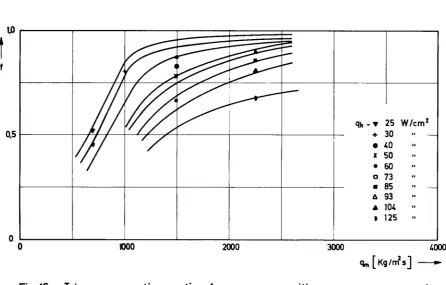
For pressures in the range 170^ Ρ ¿210 bar, a single curve
may be used. Fig. 12, 14> 15> 16 and 17 give the relations between f, q and q, for pressures of 170, I85, 195» 205 and
m h
210 bar. The curves plotted in these figures have the character
ri p
of growth—curves, for q*. 0 and for q Ss 3500 ^ 0 . For q,» 0,
m m " dqm h
the f versus q curve tends to a step function, m
2.7· The relation between heat flux, wall temperature and mass
flux
One of the most important design informations needed by the
thermal hydraulics engineer is the maximum wall temperature
at which the material of the wall will be exposed at a given
heat flux and mass flux. Material properties and security require
ments will here set the finallimits upon the amount of heat flux
which can be tolerated.This consideration has led to a decision not to
give the information containing the maximum wall temperature
in an implicit form using the t)C q relation with q as a
min m h
parameter, but in the explicit form. In Fig. 18, 19, 20, 21 and U S
22 diagrams are given that enable*to find immediately the rela
tion between the maximum wall temperature to be expected, heat
flux and mass flux, this respectively for pressures of I70, I85,
195> 205 and 210 bars. By use of these diagrams the minimum
30
Remark
A practically identical diagram has been given by SMOLIN,
P0LYAK0V and ESIKOV / 16 J for a pressure of 147 bar and a
tube diameter of 10,4 mm.
2.8. Determination of the heat transfer coefficient in the
transition and in the ultra crisis region
In the transition region between the onset of the heat transfer
crisis and the point where the wall temperature reaches a
maximum value, the heat transfer is characterised by an increas
ing heat transfer resistance of which the physical background
is still unknown. This forces us to approximate the
heat transfer by a linear interpolation between the points men
tioned. We obtain:
X — X
*r -
<*. X„ . Λ
C * o
-
« „ J
(8
l)valid for X ^ X ¿ X /
c £* m m
The heat transfer in the ultracrisis region can be calculated
by the equation developed by HERKENRATH and MORKMORKENSTEIN
J_ 17_/· This equation in which all physical constants are
related to the gas phase assumed to be at wall temperature,
h a s t h e form:
O U V (O D ° *8 y,r ° ·8 „ 0 . 4 2.7
f .
o,o
6
Γ-ψ-J
¿ % J
ZJ.J
(f) (M)
' w qm0 c
c Λ ^
31
In this equation V » q / X V" + ( 1 Χ) V'_/
q =* 1000 kg/m sec. Equation (82) may be written in a more mO
p r a c t i c a l form as f o l l o w s :
0,0664 q,. D '2 0,8 ■ 0,2
h
—
-
2
-y¡-
C V V ^ . S
¿%J
L^-J
Z"xv» + (ix)v.7
(83)
The right hand side of equation (8—3) has been plotted in Fig. 23 with Ρ as a parameter and Τ Τ as the abcis. The left hand
W Β
side can be calculated for any situation and the temperature dif
ference Τ Τ be found by means of the diagram. In this way it is
possible to determine the tX X relationship for eaoh combination
of q and q at a given pressure. In Fig. 24, it has been shown
n
m
s maximum
t h a t for Τ Τ**", the f a c t o r (C
· f ) ° '
λ
τ τ° '
2has i t
W W
ρ
'
ff
ff
v a l u e . This means t h a t f o r a given X value i . e . X ■ X , and for
Ξ q , D and Ρ » constant the expression
m
gi
_Λ
(V < V V
(1000
) (PJ
J,
W t, t
E Tff TB 0,0664 D0'2 L E E J
(84)
is the maximum attainable value for cC at this point.
Up to a pressure of 210 bar the value for Τ Τ may be approx
ff Β
imately estimated to be 10,7 deg. C. For each pressure the
numerical value of the expression (Cpi> fif) ' λ I is then
6 x 1 6 . Now equation (8—4) is a known function and represents part of the envelope of the 0C X curves in the ultra orisiβ region. The envelope ends for a q value indioated with
- 32
q causing a minimum wall temperature j u s t equal to T deg.C.
b. W
These q, - values are given in Fig. 25 as a function of q .
h m
if Th.* pressure has practically no influence. Introducing the q
-h vaJ.ue in equation '8-4) gives the maximum X - value up to whioh
ecuation (8-4) is valid. For q - values smaller than q , X^ may b<« calculated, and for X^X^» the PC-X curve coincides with the envelope.
2.9« Approximate construction of the X- value at whioh the
ultra crisis region ends
For an;,r q - value a minimum wall temperature will be reaohed
and according to CUMO, FARELLO and FERRARI ¡_ 18_/ the ultra
crisis region ends at this point. The X- value corresponding to the end of the ultra orisis region will be indicated by
X-. ffith increasing q also X increases. For q, - q , X_
*
coincides with X_ a value to be indioated further by X^.This
value X is the only X- value that oan be found analytioally. For other q - values the X_- values have to be constructed, ffe meet a big difficulty when trying to do this however. It is true that the heat transfer w.ersens directly after the ultra
crisis, but it is still better than it would be with dry steam. Unfortunately the equation given by HERKENRATH and
MORK-MORKEN-STEIN, does not hold for this region. Using an adequate
equa-tion for the determinaequa-tion of the cK -X relation in the super-heated steam region affords us an "asymptotio" eurve, whioh meets together with the OC -X curve after it has exceeded X_.
33
constructed (see 6 11) and from the point 0( X determined EU EU
by equation (84), an approximative curve may be drawn by hand between this point and the asymptotic curve. This q curve serves
h
now as a kind of templet for the construction of other q curves. h
For q values smaller than q, , the intersection of the envelope
•h h
with the q curve drawn parallel on the q, curve gives a rough
h h
approximation of the value for X (see Fig. 26). For q bigger
than q , we construct first the q curve in the superheated
h h
region, then we draw a parallel line to the q curve just to the h
intersection point with the curve constructed with the HERKENRATH
MORKMORKENSTEIN equation (see Fig. 27). Also in this case an
estimation of the X value may be obtained. The foregoing conside
rations are all based on the fact that for lOOO<iq ^.3500 the value ** m
of Xm T, is smaller than 1. Additionally we give mean values for
EU
X_, as a function of the pressure Ρ with q as a parameter (see
υ m
Fig. 28). A minimum at about Ρ ■ 205 bar oan be observed. The X
values lie between 0,7 and 1,5·
2.10. The maximum heat ^ansfer coefficient in the ultra crisis
region
ffith the construction method given for 7L·, the maximum heat trans
fer coefficient in the ultra crisis region is also known. Such
trial and error method is of course very unsatisfactory and it is
very necessary, especially in the design of nuclear super heaters,
34
2.11. The heat transfer coefficient in the region of vapour
phase forced convection heat transfer
For the heat transfer coefficient in the region for X ^ 1 , there
i s an extensive l i t e r a t u r e available. For high pressure the
formula of HAUSEN J_ 19_/ can be applied. This formula has the
form:
Nu. « 0 , 0 2 4 / 1 + ( D / D2 / 37 Re. ? '7 8 6 P r0'4 5 (111)
i t ·*- ' —' i t i t
The physical constants are related to the intermediate tempe rature Τ * 0,5 (Τ + Τ ) . In the formula we substitute the
i t ' Β η
expression:
0,024
L
1 + ( D / 1 )
2 / 3V
by the fixed factor 0,025. So the formula of HAUSEN becomes:
Nu. » 0,025 R e ° '7 8 6 P r ° '4 5 (112)
i t ' i t i t v
The calculation scheme i s again very easy. We take as a f i r s t
step Τ <* Τ . This gives for T. the value Τ , and we are W1 Β i t Β
able to calculate 0( · Then Τ » Τ + q / Q( , and T. = Τ +
+ <1,/2 OC · Now we calculate (X . Then Τ , * Τ + q,/n£ _ e t c . h 1 2 W3 B h ¿
In the case Τ . . Τ <C 0,001 Τ , the iteration prooedure W(, n+1 ; W η Wn
may be s t o p p e d . I n t h e c a s e where X ■ 1, by s u b s t i t u t i n g t h e
f o r m u l a of HAUSEN f o r t h e f o r m u l a of HERKENRATHMORKMORKENSTEIN,
we o b t a i n f o r t h e NUSSELT Number:
Cp <? 0 , 8 α 0 , 4 2»X Λ
*
l t
«
2>4
»ir »¡f
(¿L&-, (-^-) <-*--> {
™^\
i t » i t
°
(113)
The multiplication factor falls between the limits given in
- 35
coefficients by faotors of between 2—20, when adding small mass amounts of liquid in a turbulent gas stream seems to be
believable. As has been mentioned already in § 9> the HAUSEN formula must be seen as a kind of asymptotic line in the
0C -X plane, which can be approaohed more closely with an increasing X»value.
3. CONCLUSION
In general it is possible to describe the heat transfer prooesses in a. once through flow boiling system in an analyti-cal form in whioh the heat transfer coefficient Pi oan be expressed as a function of the mathematical quality X. For the liquid phase forced oonveotion flow equation (l-3) may be used, however with the reservation that thi« equation need« further
confirmation in the lower temperature range.
Equation (2-5) gives the X - value at whioh suboooled boiling start«. For X - 0, surfaoe boiling changes into saturated flow boiling. The heat transfer coefficient in the suboooled region, thus for X ^ X ^ O ^ m a y be desoribed by equation (3-11)» while the heat transfer ooeffioient in the saturated flow boiling region may be desoribed by equation (4-1). The looation of X the steam quality at whioh the heat transfer orisi· occurs may be formed using equation (5-3)· This equation is valid for -0,1
^ X ¿ 0,44. The beginning of the ultra orisi« region may he e
36
The heat transfer coefficient at this point has to be deduced from Fig. 18, 19, 20, 21 and 22. The heat transfer coefficient in the transition region between the onset of the crisis and the point of minimum heat transfer may be interpolated using a linear relation between the two points. Equation (83) in accordanoe with Fig. 23 makes it possible to caloulate the
ûivalue in the ultra crisis region. The end of the ultra crisis region indicated by X can be constructed making use of the heat flux α to be taken from Fig. 25. This heat flux gives the value X~T» using equation (84), as well as the value
0C . Furthermore by using equation (11—2) the q curve may be
EU h
plotted in the region for which X > 1 . This latter ourve has to be seen as a kind of asymptote and the curve between the coordin ates Λ X and this "asymptote" has to be estimated by
EU EU
drawing the ourve, on a trial and error basis. For q values h
differing from α , parallel lines have to be drawn until the ourve according to equation (83) will be intersected. In this very approximative way X^ and cC can be found. As has been mentioned already the heat transfer coefficient in the super heated steam region can be formed using equation (112). The heat transfer coefficient in the transition region between the end of the ultra crisis region and the region of superheated steam oan only be "found" by artistic curve fitting as has been disoussed before. For future work in this field it would be
interesting and important to study the following items in greater details
37
-b) Experimental verification of the theoretical background for the calculation of the point where the ultra orisis region starts.
c) Determination of the point when the ultra crisis region ends
and study of the influencing magnitudes.
- 38
T A B L E S
TABLE 1 : Calculation of Τ using equations (1-1), (l-2) and (1-3)
Experimental values of T- at I70 bar and 195 bar for D » 10 mm
TABLE 2 : Survey of experimental values concerning Χ,,, Χρς,„,ιηι
qh and qm for pressures of 170, I85, 195, 205 and
210 bar at D - 10 mm
39
-T A B L E 1.1
Τ
w
350 340 330 320 310 300 290 280 270 260 250 240 230 220 210 200 190 I80 170 160 150 HO 130 120 110 100Τ ( 1 - 1 ) Β ν '
330,3 318,7 308,0 297,4 287,0 276,5 266,2 255,9 245,6 235,3 225,0 214,8 204,5 194,3 184,0 173,6 163,3 152,9 142,4 131,9 121,3 110,6 9 9 , 8 8 8 , 8 77,4 65,4
Ρ - 170 b a r 2
qm - 225Ο kg/m seo
a « 50OOOO W/m2
h
D - 10 mm
\
0-2)
331,5 319,6 308,8 297,9 287,5 277,0 266,7 256,9 246,2 236,0 225,8 215,6 205,3 195,2 185,0 174,9 164,8 154,5 144,3 134,0 123,7 113,4 103,0 9 2 , 6 8 2 , 2 71,7
Τ
Β0 - 3 )
332,4 320,4 309,4 298,3 287,8 277,2 266,9 256,5 246,2 235,9 225,7 215,4 205,1 194,9 187,7 174,4 164,2 153,8 143,5 133,1 122,7 112,2 101,6 9 1 , 0 8 0 , 2 6 9 , 2
Τ measured
40
T A B L E 1.2
Τ w
3 6 3 , 6 ■ 360
350 340 330 320 310 300 290 280 270 260 250 240 230 220 210 200 190 180 H O 160 150 140 130 120
τΒ ( 1 - 1 )
3 2 3 , 2 318,7 3 0 7 , 7 2 9 6 , 6 285,9 2 7 5 , 2 2 6 4 , 6 2 5 4 , 1 2 4 3 , 6 233,1 2 2 2 , 6 2 1 2 , 1 2 0 1 , 6 1 9 1 , 2 180,5 169,8 1 5 9 , 0 1 4 8 , 2 137,1 1 2 6 , 0 114,6 102,9 9 0 , 7 7 7 , 5 6 2 , 6 4 3 , 4
TB 0 - 2 )
3 2 9 , 6 3 2 4 , 1 310,9 298,9 2 8 8 , 0 2 7 7 , 0 2 6 6 , 6 2 5 6 , 1 245,7 235,5 2 2 5 , 2 2 1 5 , 0 204,7 194,4 1 8 4 , 2 1 7 4 , 2 164,1 1 5 4 , 0 143,9 133,5 123,1 112,8 102,4 9 1 , 9 8 1 , 5 7 1 , 0
TBO - 3 )
333,9 3 2 7 , 6 3 1 3 , 1 3 0 0 , 5 2 8 9 , 3 277,9 2 6 7 , 2 256,4 245,8 2 3 5 , 3 224,8 214,4 203,9 193,5 1 8 3 , 0 1 7 2 , 6 1 6 2 , 2 151,7 1 4 1 , 3 130,5 1 1 9 , 0 108,9 9 8 , 0 8 6 , 8 7 5 , 5 6 3 , 7
Τ measured
329,5 3 2 6 , 0 3 1 5 , 0
Ρ 195 bar 2
q m 1000 kg/m sec
M 2
q^ 5OOOOO W/m h
41
T A B L E 1.3
Τ
w
363,62
360 350 340 330 320 310 300 290 280 270 260 250 240 230 220 210 200 190 I8O 170 I6O 150 140 130 120 110 100«Β (1-1)
340,4
336,2
324,9
313,8
303,0
292,4
281,9
271,5
261,1
250,8
240,5
230,1
219,8
209,5
199,2
188,9
178,5
168,1
157,6
147,1
136,5
125,9
115,1
104,2
93,0
81,5
69,4
56,4
T
B0 - 2 )
343,6
338,5
326,3
314,7
303,8
293,1
284,6
272,3
261,9
251,6
241,3
231,0
220,9
210,7
200,4
190,2
180,1
170,1
159,9
149,6
139,3
129,0
118,7
108,3
97,9
87,4
77,0
66,6
T
B0 - 3 )
346,0
340,4
327,4
315,6
304,6
293,6
283,0
272,5
262,0
251,7
241,3
231,0
220,7
210,4
200,1
189,8
179,6
169,3
159,0
148,6
138,2
127,7
117,2
106,6
95,9
85,0
74,0
62,8
Τ measured
Β
341,5
337,0
327,5
Ρ
-m195 bar
2
2250 kg/m seo
600.000 W/m
- 42
T A B L E 1.4
Τ
w
363,62
360 350 340 330 320 310 300 290 280 270 260 25O 240 230 220 210 200 HO 180 170 160 150 140 130τ
Β0 - ι )
314,8
310,7
299,1
288,1
277,1
266,4
255,6
244,9
234,3
223,7
213,1
202,6
192,0
181,2
170,4
159,6
148,7
137,5
126,3
114,7
103,0
90,6
77,0
61,4
38,6
T
B0 - 2 )
321,9
316,4
302,9
290,9
279,7
268,8
258,0
247,6
237,2
226,9
216,4
206,3
196,0
185,7
175,5
165,5
155,3
145,3
135,2
124,8
114,5
104,1
93,8
83,5
73,2
T
B(1-3)
329,5
322,3
306,8
293,6
282,0
270,3
259,2
248,3
237,5
226,8
216,2
205,6
195,0
184,6
174,0
163,5
153,0
142,5
131,9
121,1
110,2
99,3
88,2
76,8
65,1
Τ measured
Β
325
- 195 Bar
m
* h
-35OO kg/m seo
43 q. m 1000 1500 2250 3500 T A \ 319400 4 2 1 4 0 0
4 1 2 3 0 0 5 2 1 4 0 0 638500 675600
619300 725900 8 3 1 9 0 0 9 4 6 7 0 0 1057000
9 25000 1024400 1463200 1239400
B L E 2 .
Χ„
C m e a s u r e d
0 , 4 1 1
0 , 3 4 7
0 , 3 7 8 0 , 3 4 7 0 , 3 1 7 0 , 2 7 9
0 , 3 5 1 0 , 3 2 2 0 , 2 7 9 0 , 3 1 0 0 , 2 7 2
0 , 3 5 4 0 , 3 3 8 0 , 2 7 3 0 , 3 0 2
χ ^
CX mm m e a s .
0 , 4 9 5 0 , 5 4 6
0 , 4 1 3 0 , 4 9 5 0 , 4 9 6 0 , 5 2 9
0 , 3 8 9 0 , 3 6 6 0 , 3 4 7 0 , 3 3 9 0 , 3 3 6
0 , 3 7 2 0 , 3 5 8 0 , 3 0 1
0 , 3 2 7 P m 170 b a r D « 10 mm
T A B L E 2 .
<1 m 7OO 15OO 225O 35OO
K
318800 375200 514900 625200 7 3 7 8 0 0 8 5 3 5 0 0602900 8 3 0 2 0 0 1048400 1176300
9 4 4 1 0 0 1018100 122670 1436200 1674400
X„ C m e a s u r e d
0 , 4 1 2 0 , 3 6 2
0 , 3 6 6 0, 353 0 , 3 3 5 0 , 3 0 5
0 , 3 4 1 0 , 2 8 7 0 , 2 5 8 0 , 2 3 3
0 , 3 5 1 0 , 3 0 9 0 , 2 7 3 0 , 2 2 5 0 , 1 8 2
PCmin m e a s .
0 , 6 6 5 0 , 6 1 7
0 , 4 2 0 0 , 3 8 5 0 , 3 7 3 0 , 3 4 9
0 , 3 6 3 0 , 3 4 6 0 , 2 9 5 0 , 2 7 4
0 , 3 7 2 0 , 3 3 4 0 , 3 0 2 0 , 2 5 0 0 , 2 2 1
44
-T A B L E 2 .
Sn
700 1500 2250 3500 I h 316300 405300 498600 610800 728700 844700 911100 715700 817000 924400 1042100 1146900 1254400 1019600 1237200 1389500 1639300x„
C measured 0,342 0,303 0,357 0,339 0,294 0,248 0,187 0,344 0,318 0,303 0,275 0,253 0,199 0,306 0,261 0,177 0,119 P^rnin meas. 0,551 0,462 0,389 0,377 0,338 0,299 0,298 0,374 0,351 0,341 0,318 0,300 0,250 0,333 0,293 0,214 0,161Ρ - 195 b a r
45
T A B L E 2 .
m 700 1000 1500 2250 3500 253300 315400 367600 3O68OO 4044OO 516600 5583OO 403OOO 493600 617900 7181OO 831800 628100 818500 1020000 1268800 12159OO 1435OOO 1645100 C measured 0,379 0,309 0,197 0,392 0,345 0,262 0,253 0,391 0,323 0,286 0,198 0,117 0,321 0,238 0,141 0,107 0,108 0,044 0,228
Lc* mm meas.
0,624 0,610 0,428 0,462 0,378 0,319 0,315 0,452 0,398 0,325 0,306 0,204 0,352 0,279 0,192 0,044 0,187 0,057
0,122 Ρ
D
205 b a r
10 mm
T A B L E 2,
q m 700 1000 1500 225O 35OO q^ h 209 200 2537OO 3059OO 357OOO 426100 4O2OOO 5154OO 3085OO 5O97OO 6O95OO 8381OO 622800 80750O IOI83OO 1219300 Xn C measured 0,398 0,374 0,301 0,226 0,141 0,276 0,156 0,332 0,247 0,169 - 0 , 2 0 2 0,299 0,101 0,079 - 0 , 0 6 7 5
χ mm meas. 0,437 0,420 0,415 0,425 0,451 0,329 0,222 0,372 0,290 0,221 - 0 , 0 5 7 0,335 0,147 0,153