Munich Personal RePEc Archive
Endowment Effects in Contests
Price, Curtis and Sheremeta, Roman
2011
Online at
https://mpra.ub.uni-muenchen.de/52103/
Endowment Effects in Contests
Curtis R. Price
*and Roman M. Sheremeta
*** Department of Economics & Finance, College of Business, University of Southern Indiana,
8600 University Blvd., Evansville, IN 47712
** Argyros School of Business and Economics, Chapman University,
One University Drive, Orange, CA 92866, USA
January 31, 2011
Abstract
We experimentally study overbidding in contests and find that overbidding is significantly higher when subjects are given a large per-experiment endowment rather than when the endowment is given per-period. Risk-aversion and non-monetary utility of winning can partially explain our findings.
JEL Classifications: C72, C91, D72
Keywords: rent-seeking, contest, experiments, overbidding, endowment
Corresponding author: Roman M. Sheremeta; E-mail: [email protected]
1. Introduction
Contests are games in which players compete in order to win a prize. It is well
documented in experimental contest literature that subjects overbid relative to Nash equilibrium
predictions and thus they incur substantial losses (Morgan et al., forthcoming; Sheremeta,
forthcoming). A number of studies have tried to identify means by which overbidding can be
reduced. To date, researchers have found that overbidding decreases with the repetition of the
contest (Davis and Reilly, 1998), groups make lower bids than individuals (Sheremeta and
Zhang, 2010), and constraining individual endowments reduces overbidding (Sheremeta,
forthcoming). This last study suggests that a portion of overbidding can be attributed to the size
of the endowment i.e., endowment effects.
The purpose of this paper is to study the amount of overbidding in contests when the
endowment is given at the beginning of each contest (per-period) versus a single equivalent
endowment given at the beginning of the sequence of contests (per-experiment). We find that
overbidding is significantly higher when subjects are given the large per-experiment endowment
than when the endowment is given per-period. Risk-aversion and non-monetary utility of
winning play important roles in explaining our findings.
2. Theoretical Model
We consider a lottery contest with 𝑁 identical risk-neutral players with initial endowment
levels 𝑊. Player 𝑖 chooses his bid, 𝑏𝑖, to win the prize of value 𝑉. The probability that a player
𝑖 wins the prize, 𝑝𝑖(𝑏𝑖, 𝑏−𝑖), is given by the lottery contest success function:
That is, the probability of winning depends on player 𝑖’s own bid relative to the sum of
all player’s bids. Given (1), the expected payoff for player 𝑖, 𝐸(𝜋𝑖), can be written as
𝐸(𝜋𝑖) = 𝑝𝑖(𝑊 + 𝑉 − 𝑏𝑖) + (1 − 𝑝𝑖)(𝑊 − 𝑏𝑖) = 𝑝𝑖𝑉 − 𝑏𝑖 + 𝑊. (2)
Differentiating (2) with respect to 𝑏𝑖 and accounting for the symmetric Nash equilibrium
leads to the classic solution (Tullock, 1980),
𝑏∗ = 𝑉(𝑁 − 1)/𝑁2. (3)
3. Experimental Design and Procedures
Two commonly used protocols in experimental studies of contests are per-experiment
and per-period endowments. We refer to the “per-experiment” protocol as “E” and the “per
-period” as “P”. The E protocol has been used by Davis and Reilly (1998), Barut et al. (2002),
Gneezy and Smorodinsky (2006), and Noussair and Jonathon (2006). In these studies, each
subject receives a large participation fee, announced at the beginning of the experiment. This
participation fee can be used to pay off any losses incurred during the series of contests. The P
protocol has been used by Potters et al. (1998), Anderson and Stafford (2003), Morgan et al.
(forthcoming), and Sheremeta and Zhang (2010). Under the P protocol, each subject receives a
small per-period endowment which can be used to make bids in that period of the experiment.
At the beginning of the next period, subjects receive a new endowment and bidding again occurs.
No endowment from the previous period is allowed to be carried over.
In each treatment of our experiment, there are 4 players (N = 4) competing with each
other for the prize which is valued at 120 experimental francs (V = 120). From (2) and (3), we
see that the equilibrium bid is 22.5 and the expected payoff is 7.5. In the E treatment, subjects
which are randomly selected for payment at the end of the experiment. In the P treatment,
instead of a show up fee, subjects receive a per-period endowment of 120 francs to play a contest
for 30 periods. Again, 5 out of the thirty periods are randomly selected for payment at the end of
the experiment. An important aspect of the design is the equivalence of the two endowment
types. Although we cannot rule out any perceived differences the subjects may have about the E
and P endowments, we can argue that the two endowments are quantitatively similar. For
example, a subject who chooses to make no bids earns the same under the two endowments.
Additionally, there are no theoretical differences between the two treatments since the
endowment does not enter the equilibrium bid (3). Consequentially, there is no reason a-priori
that the subject’s bidding behavior would vary across the two treatments.
The experiment involved 96 undergraduate subjects from Purdue University. The
computerized experimental sessions were run using z-Tree (Fischbacher, 2007). We ran 4
sessions of the E treatment and 4 sessions of the P treatment. In each session, there were a total
of 12 subjects and the session proceeded in three parts. Instructions were given to subjects at the
beginning of each part and the experimenter read the instructions aloud.1
In the first part, subjects made 15 choices in simple lotteries, similar to Holt and Laury
(2002).2 This method was used to elicit subjects’ risk preferences. In the second part, subjects
participated in a total of 30 periods of the bidding contest. At the beginning of each period,
subjects were randomly re-grouped to form a 4-player group. Subjects were then allowed to
make bids between 0 and 120 for a prize of 120 francs. After all subjects submitted their bids,
the computer chose the winner by implementing a simple lottery rule: the chance of receiving the
1 Instructions are available upon request.
2 Subjects were asked to state whether they preferred safe option A or risky option B. Option A yielded $1 payoff
prize is calculated by the number of francs a subject bids divided by the total number of francs
all 4 subjects in the group bid. In the third part of the experiment, subjects were asked to bid for
a prize with a value of zero francs. Subjects were told that they would be informed whether they
won the contest or not and that all subjects would have to pay their bids. This procedure was
used to measure how important it is for subjects to win when winning is costly and there is no
monetary reward for winning.
At the conclusion of the experiment, 1 of the 15 lottery choices subjects made in part one
was randomly selected for payment. Subjects were also paid for 5 of the 30 periods in part two
and for the 1 decision they made in part three. The earnings were converted into US dollars at
the rate of 60 francs to $1. Average earnings were $12 per subject and the experiment lasted for
about 40 minutes.
4. Results
Table 1 summarizes average bids and payoffs. Overall, subjects in both treatments
significantly overbid relative to the risk-neutral Nash equilibrium prediction (for both treatments
p-value < 0.01).3 The difference is also significant when we run Wilcoxon signed-rank tests for
the bids made in the first period (p-value < 0.01). As a result of significant overbidding, average
payoffs are negative. In the E treatment subjects receive the average payoff of -12.8 and in the P
treatment they receive -22.2.
It is often argued that subjects need to get some experience in order to learn how to play
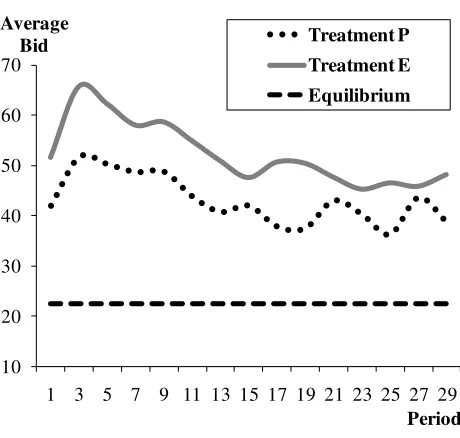
the equilibrium. For that reason, Figure 1 displays the average bid over all 30 periods of the
3 We ran a random effects model on a constant and session dummy-variables separately for each treatment. Then
experiment. As players become more experienced, the average bids in both treatments decrease.
The declining trend over the periods in each treatment is significant based on the estimation of a
random effects model (p-value < 0.01), where the dependent variable is a bid and the
independent variable is an inverse of a period trend. Nevertheless, even in the last period of the
experiment subjects overbid relative to the Nash equilibrium.
Table 1: Average Bid and Payoff
[image:7.612.194.424.340.559.2]Treatment Treatment P Treatment E Equilibrium Average Bid 42.8 (0.87) 52.2 (0.97) 22.5 Average Payoff -12.8 (1.37) -22.2 (1.38) 7.5 Standard error of the mean in parentheses
Figure 1: Average Bid over Periods
The presence of overbidding in numerous experimental studies, including our own,
suggests that winning may be a component in a subject’s utility (Sheremeta, 2010). In our
experiment, at the end of each session we presented subjects with a trivial task similar to the
thirty periods of bidding that they have completed in E and P treatments. The only difference is
that now the prize was valued at zero francs. Again, subjects were explicitly told that they would
10 20 30 40 50 60 70
1 3 5 7 9 11 13 15 17 19 21 23 25 27 29
Average Bid
have to pay their bids. Almost 50% of all subjects made positive bids, with 20% of subjects
making bids higher than 30 francs (30 francs is equivalent to $0.5). This finding suggests that a
non-monetary value of winning may significantly contribute to overbidding in our experiment.
The focus of this study is to determine if individual behavior is similar under the two
theoretically-equivalent protocols commonly used in the literature. Table 1 indicates that
subjects bid 22% more in the E treatment than in the P treatment (52.2 versus 42.8). This
difference is significant based on the estimation of a random effects model, where the dependent
variable is the bid and the independent variables are a period trend, session and treatment
dummy-variables (p-value = 0.03). Moreover, the average bids in the E treatment are higher
than the average bids in the P treatment over all periods of the experiment. The difference is
marginally significant in the first 15 periods (p-value = 0.08) and it is significant in the last 15
periods (p-value = 0.02) of the experiment.
One possible explanation of the treatment differences is due to loss aversion theory
(Kahneman and Tversky, 1979). Nevertheless, it is unlikely that loss aversion can explain
treatment differences because, relative to the initial endowment, subjects’ decisions have
identical consequences for gains and losses in both treatments. Additionally, the quantal
response equilibrium model, designed to capture individual mistakes, is also unlikely to explain
our results because in both treatments the strategy space is between 0 and 120 and therefore
predictions for both treatments are exactly the same (Sheremeta, forthcoming).
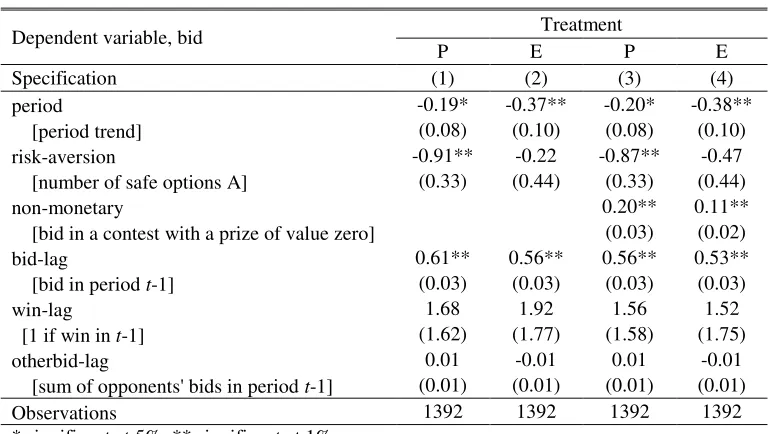
Another possible explanation may be risk preferences. Table 2 reports the estimation
results of four random effects models, where the dependent variable is the subject’s bid and the
also include dummy-variables to capture session effects (not shown in the table) and lagged
[image:9.612.114.498.151.368.2]variables to capture the dynamic nature of the experiment.
Table 2: Determinants of Bid
Dependent variable, bid Treatment
P E P E Specification (1) (2) (3) (4) period -0.19* -0.37** -0.20* -0.38** [period trend] (0.08) (0.10) (0.08) (0.10) risk-aversion -0.91** -0.22 -0.87** -0.47 [number of safe options A] (0.33) (0.44) (0.33) (0.44) non-monetary 0.20** 0.11** [bid in a contest with a prize of value zero] (0.03) (0.02) bid-lag 0.61** 0.56** 0.56** 0.53** [bid in period t-1] (0.03) (0.03) (0.03) (0.03) win-lag 1.68 1.92 1.56 1.52 [1 if win in t-1] (1.62) (1.77) (1.58) (1.75) otherbid-lag 0.01 -0.01 0.01 -0.01 [sum of opponents' bids in period t-1] (0.01) (0.01) (0.01) (0.01) Observations 1392 1392 1392 1392 * significant at 5%, ** significant at 1%.
Random effect models account for individual characteristics of subjects. In each regression we include dummy-variables to control for session effects.
The risk-aversion variable is defined as the number of safe options chosen by a subject in
part one of the experiment (for the details see footnote 2). A higher number corresponds to more
risk-aversion. Specifications (1) and (3) indicate that risk-aversion elicited from lotteries has
significant negative influence on bidding behavior of subjects in the P treatment. On the other
hand, risk-aversion does not have a significant effect on bidding behavior in the E treatment
(specifications 2 and 4). One possible explanation of why risk-aversion seems to be important
only in the P treatment is that subjects may perceive the endowment of 600 francs in the E
treatment as a level of initial wealth. If this is the case, subjects with a high level of initial
wealth may feel more inclined to disregard risks in the P treatment, and thus such subjects may
consistent with Thaler and Johnson (1990), who document that after a prior gain, such as a large
endowment, people behave as less risk-averse which leads to more aggressive bidding behavior.
The non-monetary variable is defined as the amount of bidding in a contest with the prize
valued at zero. The results indicate a significant and positive correlation between a subject’s bid
and the non-monetary variable, suggesting that winning is a component in a subject’s utility and
that non-monetary utility of winning is an important factor which may explain overbidding in
contests.
5. Conclusions
Beyond the obvious benefit of understanding human behavior this study contributes to
our understanding of several economic phenomena. A common topic in the finance literature is
the concept of the Free Cash Flow Hypothesis (FCFH). Although the root problem in the FCFH
is the misalignment of incentives in the principle-agent relationship, our research also shows that
having a large reserve of “free cash” within a corporation may precipitate the wasteful use of
resources (Jensen, 1986). Our study also yields important results for experimental methodology.
Merlo and Schotter (1999) find that the manner in which subjects are paid may have an impact
on what they choose to learn from the experiment. Similarly, our results have potential
consequences for experimental methodology since they indicate that the manner in which
References
Anderson, L.R., & Stafford, S.L. (2003). An experimental analysis of rent seeking under varying competitive conditions. Public Choice, 115, 199-216.
Barut, Y., Kovenock, D., & Noussair, C.N. (2002). A Comparison of Multiple-Unit All-Pay and Winner-Pay Auctions Under Incomplete Information. International Economic Review, 43, 675-708.
Davis, D., & Reilly, R. (1998). Do many cooks always spoil the stew? An experimental analysis of rent seeking and the role of a strategic buyer. Public Choice, 95, 89-115.
Fischbacher, U. (2007). z-Tree: Zurich Toolbox for Ready-made Economic experiments. Experimental Economics, 10, 171-178.
Gneezy, U., & Smorodinsky, R. (2006). All-Pay Auctions – An Experimental Study. Journal of Economic Behavior and Organization, 61, 255-275.
Hillman, A.L., & Katz, E. (1984). Risk-averse rent seekers and the social cost of monopoly power. Economic Journal, 94, 104-110.
Holt, C.A., & Laury, S.K. (2002). Risk Aversion and Incentive Effects. American Economic Review, 92, 1644-1655.
Jensen, M. (1986). Agency Costs of Free Cash Flow, Corporate Finance, and Takeovers. American Economic Review, 76, 323-329.
Kahneman, D., & Tversky, A. (1979). Prospect Theory: An Analysis of Decision under Risk. Econometrica, 47, 263-291.
Merlo, A., & Schotter, A., (1999). A Surprise-Quiz View of Learning in Economic Experiments, Games and Economic Behavior, 28, 25-54.
Morgan, J., Orzen, H., & Sefton, M. (2011). Endogenous Entry in Contests. Economic Theory, forthcoming.
Noussair, C., & Jonathon, S. (2006). Behavior in all-pay auctions with incomplete information. Games and Economic Behavior, 55, 189-206.
Potters, J.C., De Vries, C.G., & Van Linden, F. (1998). An experimental examination of rational rent seeking. European Journal of Political Economy, 14, 783-800.
Sheremeta, R.M. (2010). Experimental Comparison of Multi-Stage and One-Stage Contests. Games and Economic Behavior, 68, 731-747.
Sheremeta, R.M. (2011). Contest Design: An Experimental Investigation. Economic Inquiry, forthcoming.
Sheremeta, R. M. and Zhang. J. (2010). Can Groups Solve the Problem of Over-Bidding in Contests? Social Choice and Welfare, 35, 175-197.
Thaler, R. H., & Johnson, E. J. (1990). Gambling with the house money and trying to break even: The effects of prior outcomes on risky choices. Management Science, 36, 643-660. Tullock, G. (1980). Efficient Rent Seeking. In James M. Buchanan, Robert D. Tollison, Gordon